In making the most specific declaration on Danzig yet offered by a member of the British Government, Earl De La Warr, President of the Board of Education, said today that “Britain is able and prepared to fight any and every aggressor, however indirect may be the method of aggression.” He upheld the present status of Danzig as being justified by history and by Chancellor Adolf Hitler himself until a few months ago.
“If, therefore, war breaks out over the apparent cause of Danzig,” Earl De La Warr declared, “it will be because the German Government realizes that Danzig is the key to Polish independence and that a free Poland is a bastion against their domination of Europe.” Although Earl De La Warr is a comparatively minor figure in the government, his speech was regarded as a forerunner to a statement by Prime Minister Neville Chamberlain defining the exact circumstances in which the British guarantee to Poland would come into operation.
Mr. Chamberlain is now expected to make his declaration in the House of Commons on Monday. Count Edward Raczynski, the Polish Ambassador, who went to Warsaw on Thursday, postponed his return until tomorrow to have a further talk with Foreign Minister Josef Beck. It is believed that when the Ambassador returns, he will bring with him the Polish Government’s approval of the Chamberlain declaration.
The Poles, however, it is understood here, are still reluctant for the statement to be made at this time. Count Raczynski is expected to have an interview on the subject with Viscount Halifax, the Foreign Secretary, as soon as he arrives, but official quarters predicted today that the statement nevertheless would be made Monday.
The occasion of Mr. Chamberlain’s speech will be a question by Harold MacMillan, Conservative, who will ask whether the British guarantee to Poland covers all possible contingencies. As drafted, the question reads: “Whether the government will issue a declaration to the effect that any change in the present status of Danzig other than by an agreement to which the Polish Government is a party, whether brought about externally by military action on the part of Germany or internally by a movement initiated or supported by the German Government, will be regarded as an act of aggression on the part of Germany and therefore covered by the terms of our pledge to Poland.”
In contrast to the grave fears they felt last weekend, British official quarters do not now expect any coup in Danzig during the next few days. Pessimism over the possibility of an uprising later, however, is by no means diminished.
Pope Pius is planning a new peace move, Vatican circles reported today. This would indicate that previous suggestions, made through diplomatic channels, had yielded disappointing results. The fact that Mgr. Filipo Corteal, the Papal Nuncio to Warsaw, has just gone back to Poland from the Vatican has given rise to reports that he has taken new peace proposals with him. If one can judge from the attitude of Osservatore Romano, Vatican City newspaper, the Pope feels the Danzig conflict should be settled by compromise on both sides.
The Italian press asserts the Vatican has clearly indicated its opposition to the proposed British-French alliance with Russia. Today the Vatican City correspondent of Bologna’s Resto del Carlino, one of the most important Fascist newspapers, writes an article in praise. of the Pope’s peace effort which is partly based on that supposition. However, it should be stated that the belief in the Pope’s opposition to any Russian alliance is founded on the general principle of his condemnation of communism and not on anything that is definitely known about the Pope’s activities of recent weeks.
Eight thousand Germans go from Italy to the Reich. Italians of German descent may choose whether to leave Tyrol.
The southern third of England (excepting London) was darkened for an air raid test.
Alice Marble of the United States defeated Kay Stammers of the United Kingdom in the Ladies’ Singles final at Wimbledon. That made a clean U.S. sweep of all five events. Miss Marble of San Francisco added the Wimbledon championship to her American title by defeating Miss Stammers of England, 6–2, 6–0, in a 25-minute match. Miss Marble shared in two other titles at Wimbledon as the United States representatives won the five all-England championships for the second straight year. With Mrs. Sarah Palfrey Fabyan, Miss Marble successfully defended the women’s doubles laurels. She and Bobby Riggs of Chicago, who won the men’s singles honors on Friday, took the mixed doubles final. Riggs and Elwood Cooke of Portland, Oregon, won the men’s doubles.
The death penalty was asked by the prosecution in the trial today by a Spanish military court of 69-year-old Professor Julian Besteiro, Socialist President of the Republican Cortes in 1931 and the only member of Madrid’s Defense Council to remain for the city’s actual surrender, last March 28.
The eighth Congress of the International Federation of Trade Unions, at its final meeting today, rejected, by 46 votes to 37, the British resolution calling for renewal of the membership invitation to the Soviet trade unions. Although the resolution’s sponsors sought to win support on the ground that international trade union unity was a vital necessity at the present time and that the invitation would be in line with the spirit of the proposed Anglo-French-Soviet pact, only the British, French, Norwegian, and Mexican delegates voted for it. The Norwegians, who had submitted a similar resolution, withdrew theirs in favor of the British proposals. The opposition was led by the American, Belgian, and Dutch delegates, and the American Federation of Labor’s twelve votes finally proved the deciding factor.
Gabriel Puaux, French High Commissioner for Syria, today suspended the Constitution of the Republic of Syria and appointed a council of directors to rule the mandated State under his direction. M. Puaux’s action followed the resignation yesterday of President Hashim el-Atassi, which left Syria without any native central government, since the Cabinet had resigned several days earlier. The President and Cabinet quit in protest against France’s failure to grant Syria independence.
Administration officials, including Secretary of State Hull and other members of the Cabinet, are bringing their personal influence to bear on Senators who, they hope, may be won over to support repeal of the arms embargo contained in the present Neutrality Act: The lines are so closely drawn in the Senate, following the rebellion in the House, that a few votes one way or the other might decide the result.
The immediate problem lies in the Foreign Relations Committee of the Senate, which has been summoned by its chairman, Senator Pittman, to start executive consideration of the neutrality legislation on Tuesday. This committee, with twenty-three members, has eleven who are opposed to repealing the embargo or altering it in any way. Thus, the Administration must obtain a favorable vote from the remaining twelve members to report a measure to the Senate.
Ten of these twelve are considered fairly certain by Administration nose-counters. The two in doubt are Senators George and Gillette. Mr. Gillette said today that Mr. Hull and two other Cabinet members, whom he declined to name, had discussed the issue with him. and had asked his support for the Administration proposals. Mr. George has declined to tell even close personal friends how he stands.
Even if the Administration should succeed in obtaining a favorable report by the margin of one vote from the Foreign Relations Committee, the proposal recommended would face an apparently interminable battle of words on the Senate floor. Opponents assert that the bloc of “die-hards” which assembled yesterday at the invitation of Senator Johnson of California had swelled from twenty-odd to more than forty overnight.
The combined oratorical efforts of forty or more Senators, even without resort to dilatory tactics or filibuster, could extend the debate beyond a month before any vote could be had even on the various amendments which will be offered. Then, if outright filibustering tactics were considered necessary to defeat the proposal, the opponents say they have plenty of man-power, their ranks including young and vigorous Senators capable of holding the floor for hours at a time, until relieved by a colleague.
The Foreign Relations Committee’s discussions and its possible 12-to-11 report will revolve around two proposals. The first will be the Bloom resolution, as amended and passed by the House of Representatives last week. This measure would limit the embargo to “arms and ammunition” but not to “implements of war,” which are included in the present law; direct that the President, or Congress, should proclaim that a state of war exists abroad only when such proclamation is necessary to protect the lives of Americans or to preserve the security of the nation and warn Americans, they could travel on belligerent vessels only at their own risk.
It also would prohibit loans and credits to belligerents and require transfer of title before the export of any shipments to belligerents; regulate the solicitation of funds and the use of American ports by belligerent submarines or armed merchant vessels or as bases of supply, exempt American republics and continue the Munitions Control Board. Should this measure be reported, it would meet the disfavor of most of the opposition group because the proposed arms embargo is not as strict as that contained in the present law and because each of the operative clauses vests a large amount of discretion in the President.
The second plan, which will attract most of the committee’s attention, is embodied in the Pittman Resolution which the Nevada Senator has called the “Peace Act of 1939.” It follows the same broad. outline as the Bloom resolution and would abolish the arms embargo by the expedient of placing all commerce with belligerents, in whatever commodities, on the “cash-and-carry” basis. In a general way, it would leave considerably less discretion to the President in the carrying out of its provisions.
While there is a wide difference of opinion in the committee and the Senate as a whole on the merits. of many details of these plans, both of which approximate the Administration’s recommendations as outlined by Secretary Hull, the chief battle will revolve about the arms embargo. On grounds of expediency, the Administration hopes to rally, about one or the other of these measures, the support of those Senators who agree that the arms embargo must go.
Equally, the last-ditch opponents are bound by their opposition to repealing the arms embargo. They might, as did many of the opponents in the House, favor certain other provisions of the Administration plans, but they would prefer to see the present law stay in force rather than risk losing the arms embargo in the pursuit of improvements they might like to see in the law.
A warning that WPA projects throughout New York City would be “shut down better than 90 per cent” tomorrow morning was issued through its local offices yesterday by the American Federation of Labor, which is backing a strike of more than 100,000 WPA workers here and elsewhere throughout the country against longer hours and reduced hourly wages fixed by Congress. Coincidentally with the threat of the AFL, Lieut. Col. Brehon B. Somervell, local WPA Administrator, and United States Attorney John T. Cahill conferred during the afternoon on plans to prosecute persons who may be charged with interfering with the operations of the WPA. In a brief statement, which he declined to supplement, Mr. Cahill said that the law applicable to interference with operations of the WPA is clear, and that if and when a complaint is made, and evidence obtained of a violation, the matter would be presented to the grand jury and speedily prosecuted in case of indictment.
U.S. banks safeguard European funds. Individuals and concerns seek haven in case of war.
President Franklin Roosevelt orders speed on an American Antarctic expedition. Germany’s move there spurs action to claim territory.
Much of the nation and several Eastern Canadian Provinces sweltered again, yesterday in a midsummer heat wave that took at least fifty lives in the United States and eight in Canada and sent the mercury soaring to record-high levels in numerous places.
Shining One won the 2nd annual Hollywood Derby.
Prior to the first game of a doubleheader with the Boston Red Sox at Yankee Stadium, a wall of Japanese beetles forms in front of the home dugout. Although over 5,000 insects will be captured, the problem will return later in the month. The Yankees also lost a double-header for the first time this season, the Red Sox winning, 3–1 and 3–2.
Before 34,543 sweltering fans, the New York Giants and Brooklyn Dodgers broke even in a doubleheader at Ebbets Field. Five runs in the eighth inning helped the Giants win the first game, 8–3, but another rally in the eighth frame of the second fell short and Brooklyn triumphed, 3–2, behind Fred Fitzsimmons’s skillful relief pitching. The Giants, however, gained a half game on the Reds, who lost to the Cubs. The Reds now hold a lead of five and a half games in the National League.
Tokyo claims a new Mongol rout. Land forces are said to be driven back.
Japanese naval authorities in Shanghai apologized to British naval officers today for endangering the British gunboat HMS Falcon in yesterday’s raid by Japanese planes at Chungking. Doors of the vessels were blown in and waves washed over her low decks when bombs fell near her anchorage.
A Japanese naval spokesman at the same time warned the French that if there were future cases in which Chinese used the French flag, the Japanese would not “respect the French flag as a neutral banner.” He referred to the alleged raising of a French flag over a building on Chusan Island, off Ningpo.
Agents of the British steamer Changsha received reports from Hankow today that the Changsha’s first officer, Clifford Winterbottom, had been released after having been held by Japanese since Thursday for “insulting behavior.”
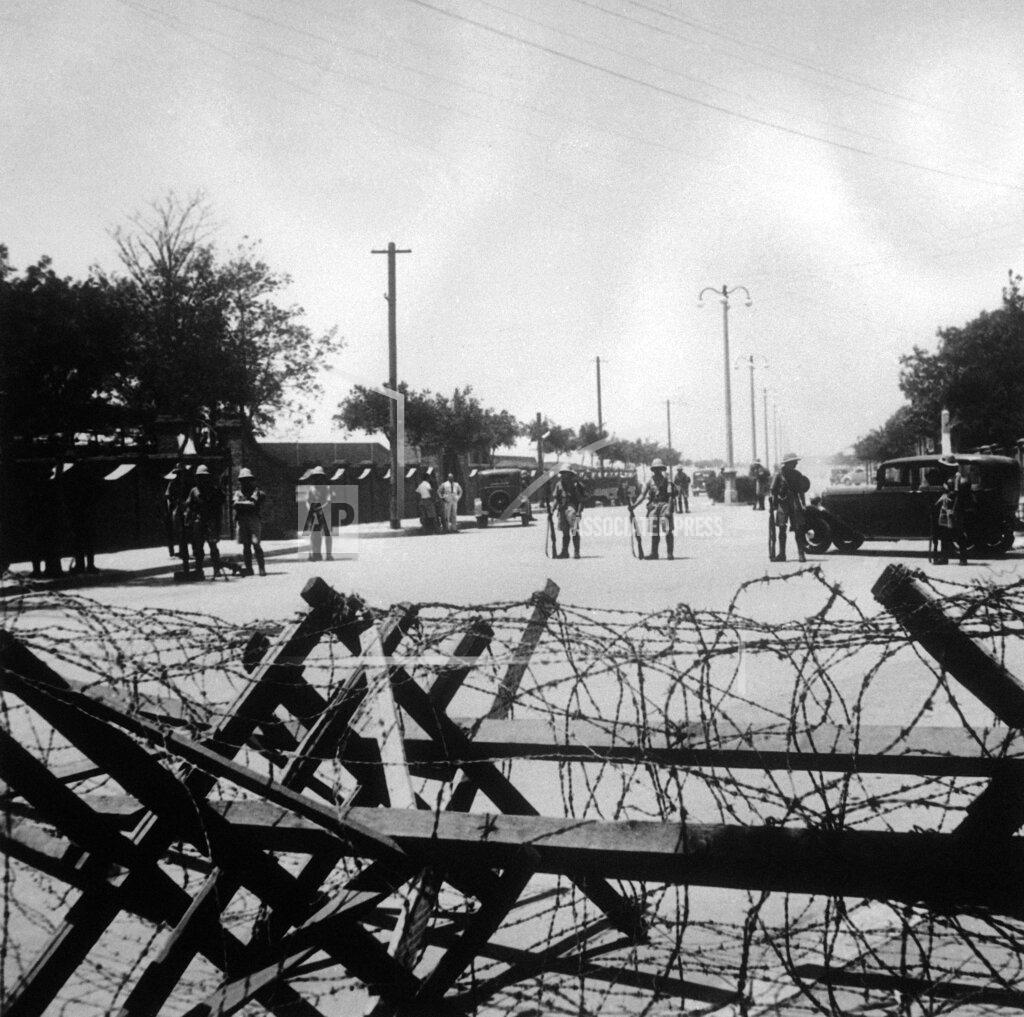
It is disclosed that American women and girls as young as 12 have been searched at the Tientsin blockade around the foreign concessions. It is unclear whether any American women have been subjected to strip searches, as have been performed on British women.
Several British missionaries have arrived in Peiping from mission stations in Shansi Province, charging that conditions which they ascribed to a Japanese-directed anti-British campaign compelled them to leave. They alleged that as a result of this instigation some mission properties had been pillaged. Tientsin’s foreign community was startled today by the noise of machine-gunning and airplane bombing near the city, but Japanese Army officers explained that local maneuvers of the Japanese garrison were in progress. Conditions in the British and French Concessions, which the Japanese Army have blockaded for three and a half weeks, remained unchanged.
Dow Jones Industrial Average: 133.24 (+0.02).
Born:
Tommy Mason, NFL running back (Pro Bowl, 1962-1964; Minnesota Vikings, Los Angeles Rams, Washington Redskins), in Lake Charles (d. 2015).
Ed Keegan, MLB pitcher (Philadelphia Phillies, Kansas City A’s), in Camden, New Jersey (d. 2014).
Died:
Havelock Ellis, 80, English physician, writer and sexologist.
Naval Construction:
The U.S. Navy Cimarron-class oiler USS Platte (AO-24) is launched by the Bethlehem Steel Corp. (Sparrows Point, Maryland, U.S.A.).





 History Diaries