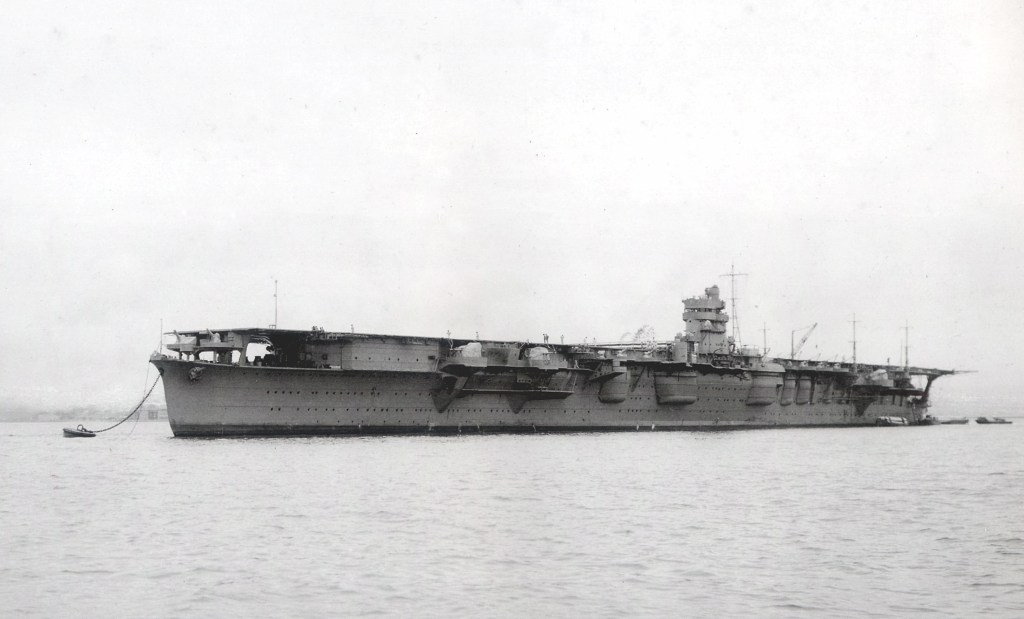
https://en.wikipedia.org/wiki/Japanese_aircraft_carrier_Hiryū#Construction_and_service
Scuttled after the Battle of Midway, 5 June 1942
Stricken 25 September 1942.
The British Cabinet decided today to reject the demand of Vyacheslav M. Molotov, Soviet Premier and Foreign Commissar, for a guarantee against “indirect aggression” on the Baltic States — aggression that takes the shape of political changes in those States. Prime Minister Chamberlain and his colleagues are unwilling to tamper with the principle of independence of small nations and to admit that eventually the strategic interests of Russia must be allowed to take precedence over this independence. They are obviously of the opinion that the independence of small nations must be unrestricted, and that it ought not to be interfered with even if the actions of the rulers in the Baltic States should be such as to entail subjugation by Germany.
The British Cabinet today approved the draft of a strong and specific declaration making it clear that Britain would fight in defense of Poland in the event of any “unilateral change” in the status of Danzig such as self-annexation of the Free City to Germany. The statement was promptly sent to Warsaw for the Polish Government’s approval and it was being studied there this evening. Unless the Poles prefer to wait with it until the militarization of Danzig has gone further, Prime Minister Neville Chamberlain is expected to read it to the House of Commons tomorrow, or Friday at the latest.
It is understood the statement will make perfectly plain what Cabinet Ministers have said only by implication or in imprecise language until now — namely, that even a “peaceful” annexation of Danzig without Poland’s consent would be a threat to Poland’s independence and would be treated by Britain accordingly.
This is what Mr. Chamberlain has never said in so many words and what the British guarantee to Poland did not say in such specific terms. There is reason to believe. that the British declaration will recall the invasion of Bohemia-Moravia and the annexation of Memel as among the reasons why no further seizures of territory can be tolerated either by Poland or by the countries that have guaranteed her independence.
Of course, Mr. Chamberlain’s government will never oppose free and equal negotiations between Poland and Germany and may say so once more in its declaration — a prospect that may revive the fear of “appeasement” in suspicious quarters. Suspicions of this sort were aroused today when Mr. Chamberlain made what sounded to some like an evasive statement on Danzig in answer to questions in the Commons. He had been asked whether, in view of the “illegal proceedings” in Danzig, he would take steps “to impress upon the German Government the determination of the British people by some physical action such as mobilization of the fleet.”
“His Majesty’s Government will not fail to take any steps which may seem to them necessary or desirable to make their attitude clear,” Mr. Chamberlain said without mentioning Danzig, “but this already has been stated with precision in recent speeches by the Ministers.” Another questioner asked whether the military preparations in Danzig did not constitute a breach of the Danzig Statute and whether the British Government proposed to take any action on the matter. This time Richard Austen Butler, Undersecretary for Foreign Affairs, answered that “certain of the military preparations which have been reported would appear to constitute a breach of Article V of the Danzig Statute,” and he added that the British, Polish, and French Governments were keeping in touch “regarding all aspects of the Danzig situation.”
Investigation of the situation in Danzig discloses that in the late night and early morning hours there is an amount of heavy trucking unusual in a European provincial city at such times and quite unusual in Danzig until a few weeks ago. There are, moreover, certain areas from which strangers are excluded as far as possible during those hours. Any one approaching the docks at this time is certain to be stopped and asked what he is doing there. Unless he can prove urgent business, he is advised to go home. The docks are frequently busy at night.
Along the main highway from Pomorze [the Polish Corridor] to the city late travelers now see after midnight a steel-helmeted, rifle-bearing sentry in the shadow of the trees about every twenty yards for a mile and a half; that is from where the main road enters Danzig territory to where a short street leading to the airport branches off from it. In the light of passing motor lamps, which is the only light there is, these sentries bear every resemblance to German soldiers. Closer investigation shows them to be merely Danzig policemen with the additional equipment of helmet and rifle.
There is no explanation of such an unusually heavy guard. Nobody really expects the Polish Army to march in some night, but the proximity of the airport — which is closed during the night hours — may have something to do with it. Well-informed Poles have taken the mysterious maneuvers in recent weeks with a certain degree of equanimity on the theory that they are more provocative than dangerous. At least 100,000 well-equipped troops would be necessary to hold the 750 square miles of Danzig territory against the forces Poland could instantly send there.
On the other hand, a Nazi leader has been cited as saying that no such force would be necessary; three hours’ undisturbed possession of the airport was all that was required to make the Free City German for all time. A great deal of the energy of war scare investigators has been taken up trying to trace the elusive light tanks and “several batteries of artillery” believed to have been brought in, but thus far without result. The latest report is that they were in the Langfuhr Barracks, to which outsiders are not admitted, or in wooded heights along the frontier that comprise a forbidden area. How they got into the barracks without being seen or traversed the frontier district without leaving tracks is not explained.
President Roosevelt’s assertion at his Hyde Park press conference yesterday that the failure of the House of Representatives to remove the arms embargo clause from the Neutrality Law would lend encouragement to Berlin and Rome and increase the danger of a war is caustically derided in apparently authorized comment made in Berlin tonight as follows: “What the American Congress does about its neutrality legislation is purely an American affair which interests us at best only when it is employed by Roosevelt and his Jewish accomplices for war agitation against the German people.”
Bulgarian Premier Georgi Kiosseivanov arrived at Anhalter Station in Berlin at 2:30 this afternoon for a four-day state visit. He was greeted by Foreign Minister von Ribbentrop. All of Berlin was bedecked with Bulgarian flags and the Nazi swastika. An honor company of Chancellor Hitler’s S.S. Elite Guards was drawn up outside the station, where it was reviewed by the Bulgarian Premier while an Elite Guard band played the Bulgarian national anthem. The guests were driven to Bellevue Castle, their Berlin home for the duration of their visit, along streets lined with cheering crowds.
Following the usual exchange of courtesy visits with Herr von Ribbentrop, the Bulgarian Premier called at the new Chancellery and had an audience with Herr Hitler for slightly more than an hour. Tonight, Herr Hitler gave a dinner at the Chancellery to honor his guest. The press devotes long editorials to reviewing Bulgaria’s collaboration with Germany in the World War and expresses sympathy for the present Bulgarian Government’s revisionist designs. It emphasizes the friendship between Germany, Bulgaria and Yugoslavia. It is believed in usually well-informed quarters here that the question of giving Bulgaria access to the Aegean Sea will form a basic point of the current discussions.
Hitler shortens his title to Der Fuhrer. He deletes Reichskanzler because it implies a politician, rather than a beloved leader.
The Nazis in Berlin announce a scrap metal drive, to be carried out throughout Germany as well as Austria and the Sudetenland. It is to run through September 1st…
The Italian Foreign Minister Count Ciano will visit Franco. He is expected to bring up economic and military questions, provided they contribute to check Communism, the professed aim of the Axis.
The Tyrolese in Italy go to the Reich. An agreement with Germany is made to control movement from the ex-Austrian area.
Prominent space was given today on the front page of the Osservatore Romano, Vatican City newspaper, to the recent speech of Representative John G. Alexander of Minnesota in the United States House of Representatives suggesting that Pope Pius be urged to call an international peace conference. More than a column of extracts from his talk are printed, with particular emphasis on passages referring to the suggested parley.
Although the article is dated Washington, nothing is printed in Osservatore without being carefully weighed and edited here in Vatican City. Publication of Mr. Alexander’s proposal, therefore, can be safely considered as tacit approval of what he said, particularly in view of the Pope’s desire that an international conference be called. A similar suggestion from Admiral Nicholas Horthy, Hungarian Regent, a few weeks ago, also received generous space in the Vatican newspaper.
The British deny pleas for aid for Jewish refugees and refuse to ease entry rules or provide public funds for Jewish settlements.
President Roosevelt returned from a week-end at Hyde Park, called in the party’s congressional leaders and urged action at this session on revision of the Neutrality Act and his new self-liquidating lending program.
The Senate by a four-vote margin approved the conference report on the Monetary Bill which revives the President’s powers, temporarily ended by a Senate filibuster last Friday night. The Foreign Relations Committee delayed consideration of the Neutrality Bill until Saturday to permit several members who are on the Finance Committee to act on Social Security Amendments. The Senate received the renomination of Aubrey Williams as National Youth Administrator and recessed at 5:30 PM until noon tomorrow.
The House considered Foreign Affairs Committee bills, passed a joint resolution establishing a commission to adjudicate claims against the Soviet Government, received a Presidential request for $104,000 more for the Securities and Exchange Commission, and adjourned at 5:04 PM until noon tomorrow.
The House Labor Committee resumed hearings on amendments to the National Labor Relations Act and the Ways and Means Committee heard Mayor La Guardia and others attack Treasury proposals to remove tax exemptions on the income from future issues on government securities.
The Senate, by the vote of 43 to 39, approved today the conference report on the monetary bill continuing the President’s control over the dollar until June 30, 1941. The Administration victory returned to President Roosevelt his authority to reduce further the gold content of the dollar and his power to control exchange rates by operation of the $2,000,000,000 stabilization fund.
The victory was clouded by a division of legal opinion, however, as to whether the bill as finally approved is not illegal in itself, because it seeks to extend powers already dead, instead of reviving them by an original act of Congress. But there was little indication that the question actually would go to a court test, and in practical effect the vote was satisfactory to the Senate democratic leadership.
According to Administration interpretation, as expressed early on Saturday morning after a filibuster had made impossible a vote on the conference report prior to midnight, the expiration hour for the former Gold Reserve Act, the lapse of time has made no difference. The Administration leadership contended, and reiterated today, that adoption of the report would pick up the authority where it had lapsed on Saturday night. Senator Austin, acting minority leader, opposed this view.
As its only concession, the Administration permitted the writing into law of a price of 71.11 cents an ounce as the legal rate for newly mined domestic silver, thus replacing former authority under which the Treasury, acting under Presidential power to fix a price, has bought silver at the price thus established, the last rate being 64.64 cents. The silver group and a Republican-Democratic conservative coalition had voted to set a price of 77.56 cents by law, but Senate and House conferees split the difference.
The Republican minority, which voted with the silverites in order to win support for an amendment to stop further purchases of foreign silver as well as repudiation of the President’s power to devalue the dollar further, lost on both counts, but only after making its strongest demonstration of force since the New Deal obtained control of Congress in 1933. The Senate had voted by substantial majorities last week to stop devaluation and stop imports of foreign silver as well as to increase the price of domestic silver. The Senate conferees in two brief sessions gave way on the first two amendments, however, and compromised on the domestic price of silver.
President Roosevelt intends not only to force the fight in Congress to obtain a repeal of the arms embargo and enactment of the type of neutrality legislation he regards as essential but also to carry this struggle and other current issues to the country on his projected trip west, a high-ranking New Deal official indicated today.
Whereas the President originally intended to make his trip west merely a springboard for a journey to Alaska this Summer, with a political speech included, the revolt of some conservative Democrats in Congress is said to have led the President to change his mind and to determine to carry to the country the battle for issues he regards as vital. Not only does the President intend to wage an immediate campaign designed to assure him control of the Democratic convention next year, but already he has conferred privately with numerous State and local officials of the Democratic party and has obtained pledges from some of them to hold their delegates’ votes for the candidate he may decide on, the same official said.
While Mr. Roosevelt is said to be determined to withhold until the last minute the decision whether to run for a third term, he has told his closest aides and advisers that the important issue at present is to assure the nomination of some New Dealers. Only such persons, he maintains, can be certain of obtaining for the Democratic Party the vote of the labor unions and the underprivileged — the share-croppers, tenant farmers and those on relief. A purge like that of 1938 is not among the Chief Executive’s present plans, but he is represented as set on not letting the party fall into the hands of its conservatives and on making the New Deal the main campaign issue, starting at once.
Regaining a tenuous hold on a Congress which last week broke into a collection of rebellious groups, the Administration leaders faced anew today the demand of President Roosevelt for action this session on revision of the neutrality laws. and on the new $3,860,000,000 domestic and foreign lending program.
The Administration’s hold over Congress was reasserted when the Senate approved by a four-vote margin the conference report on the President’s emergency Monetary Bill, the same measure which a coalition of Republicans and Conservative Democrats blocked Friday night by filibustering until past the time when the executive’s authority to devalue the dollar and operate the $2,000,000,000 stabilization fund was to expire.
The President’s insistence upon the Neutrality Act amendments and the lending program were renewed at an hour’s conference which Mr. Roosevelt had with his Congressional spokesmen, Senator Barkley and Representative Rayburn of Texas, upon his return this morning from Hyde Park. The President was understood to have told them substantially what he had told them before, that he would ask that Congress stay in session all Summer if necessary to enact these measures.
Notwithstanding these demands of the President, the feeling was growing at the Capitol that the current session may end even earlier than the leaders now expect-possibly some time before August 1. This impression was based on the belief that both the neutrality and lending legislation may be disposed of soon, even though they may not be turned out in the form or exact substance desired by the President. The leaders exhibited a rather grim mood when they left the White House this morning. Each confirmed the report, already abroad, that the President had called them. to insist upon fulfillment of his program before adjournment. Mr. Rayburn said that so far as the House was concerned, Congress could still adjourn July 15, the date set as a goal several weeks ago. But Senator Barkley interposed to say: “Nobody can predict within a week when we will be able to quit.”
Thousands of Works Progress Administration workers across the nation went on strike in protest against longer work hours. Congress has passed legislation ordering that WPA workers no longer be paid union scale wages and must work about 150 hours per month, rather than the 50 they previously had put in.
There are disastrous flash floods in Kentucky. The Red Cross reported that flooding affected 21 counties in eastern Kentucky, with 79 people losing their lives (52 in Breathitt County, 25 in Rowan County and 2 in Lewis County). The most disastrous flash flooding occurred in Breathitt and Rowan counties.
The New York Times reports the next day:
Thirty-three persons are known to have been drowned today when swiftly rising Eastern Kentucky mountain streams, following cloudbursts late last night, rushed down creeks and rivers to inundate communities along their banks. Government and relief officials said they feared the death toll might reach 100, since eighty-one persons are still missing. Aid was sent to the stricken areas. Postmaster W. E. Crutcher of Morehead, Kentucky said thirty-eight persons had drowned in that part of Rowan County. The known dead at Morehead numbered twenty-six, with twelve missing. The known dead at Keck was seven, with sixty-nine missing. In Washington, the Red Cross gave out the following report from Roger W. Jones, chairman of the Breathitt County Red Cross: “Seventy-five to 100 drowned or missing on Frozen Creek. Ten to twenty homes swept away. Hunting Creek flooded but no reports of loss of life.”
U.S. Life expectancy rises to a record 61.94 years.
The Senate Naval Committee recommended today that legislation be passed authorizing partial modernization of five battleships at a total cost of about $8,850,000. House approval has already been given to the legislation, which adds $6,600,000 to the navy’s standing authority to spend $450,000 a vessel on such improvements. The battleships are the USS Tennessee, USS California, USS Colorado, USS Maryland and USS West Virginia.
Naval officials said that if the bill became law the work would be done at the Puget Sound (Washington) Navy Yard, as all the ships were on the West Coast. Admiral William G. Dubose, chief of the Bureau of Construction and Repair, told the committee that complete modernization of the ships would cost around $15,000,000 each. The navy did not want to undertake such a program, he said, both because of the expense and the time that would be required.
New York Yankees rookie pitcher Atley Donald wins his 10th game without a loss, beating Washington, 6–4. Joe DiMaggio and Joe Gordon hit home runs for the Yankees.
Eddie Smith, who for three years had been trying to southpaw his way to victory over the Cleveland Indians, did it today in his tenth attempt — a two-hit performance which gave the Chicago White Sox a 2–1 triumph in the series opener.
The Pittsburgh Pirates went on a hitting spree today behind the pitching of Joe Bowman and vanquished the Chicago Cubs by a score of 10–1. The Pirates scored seven runs in the third inning and cruised to an easy win.
The New York Giants hammer out sixteen hits and defeat the Boston Bees, 11–7. The Giants still needed a four-run ninth-inning rally to break a 7–7 tie and win.
Bucky Walters of the Cincinnati Reds held the third-place St. Louis Cardinals to four hits today as the Reds punched out a 6–2 victory that maintained their five-game advantage at the top of the National League.
The Japanese were beaten back across the Khalkhin Gol. General Georgy Zhukov’s counterattack forced the northern prong of the Japanese offensive to retreat across the river Khalkhin Gol in the Mongolian area of China. The Japanese northern task force had succeeded in crossing the Khalkhin Gol, driving the Soviets from Baintsagan Hill, and advancing south along the west bank. However, Zhukov, perceiving the threat, launched a counterattack with 450 tanks and armored cars. The tanks consisted of primarily BTs with a handful of T-26s, while the armored cars were BA-10s and BA-3/6s, which were similar in armor (6–15 mm (0.24–0.59 in)) and armament (main: 45 mm (2 in) gun 20K mod, secondary: two 7.62 mm (0.30 in) machine guns) to the Soviet light tanks. The Soviet armored force, despite being unsupported by infantry, attacked the Japanese on three sides and nearly encircled them. The Japanese force, further handicapped by having only one pontoon bridge across the river for supplies, was forced to withdraw, recrossing the river on 5 July.
Foreigners arriving in Shanghai from Manchukuo said today that hospitals in Harbin were “filled to overflowing” with Japanese soldiers wounded in fighting Soviet Russian and Mongolian forces along the border between Manchukuo and Outer Mongolia. The reports were the first independent confirmation of heavy fighting previously reported in Japanese and Russian announcements of large-scale air and land battles under way sporadically since May 11.
[Ed: The Japanese continue to make claims of victory even as their forces are being ground down. Soviet losses are actually higher; but this does not matter. Zhukov, as he will be in 1945, is content to suffer even horrific losses if he wins the battle. The Soviets have about a 2-to-1 advantage in manpower and much more in tanks. The Soviet strategy is simply to keep pouring in men and equipment until the Japanese are overwhelmed. Since Zhukov has a large logistic force with motorized transport, and the Japanese do not, he finds it easy to keep the pressure up, re-supplying much faster than the Japanese army can. It is a simple and brutal equation which can have only one outcome.]
The Japanese renewed today their threats of more drastic action against the international settlement of Kulangsu at Amoy and against Tientsin, where they have blockaded the British and French foreign concessions in a quarrel with the British. Japanese dispatches from Kulangsu said the Japanese authorities there had announced they would tighten the isolation of the island and take “other appropriate measures” unless the foreign consuls reply soon to the Japanese note of June 29 suggesting the resumption of negotiations on Japanese demands for more representation on the Municipal Council, governing body of the settlement.
The situation at Tientsin remained acute. Domei, the Japanese news agency, quoted General Gen Sugiyama, supreme commander of North China headquarters at Peiping, as stating: “The traffic restrictions now enforced at Tientsin should never be relaxed, regardless of the British-Japanese talks in Tokyo. These conversations will be meaningless unless they provide a starting point for a new British policy which will abandon assistance to General Chiang Kai-shek and interference with the establishment of the new order in East Asia.” He said that as long as Britain continued her present policy, the Japanese would continue the Tientsin blockade. A ban on delivery of milk to the foreign concession continued, and a tightening of restrictions accentuated a shortage of other foods, especially fresh vegetables.
Sir Robert Craigie, the British Ambassador, indicated today that the forthcoming British-Japanese talks would be limited to the Tientsin controversy, Japanese wishes notwithstanding. At a press conference he said: “It is definitely understood that the conferences will be confined to local issues connected with present conditions in Tientsin.” The Japanese imposed a blockade of the British and French concessions there on June 14.
Foochow’s fifty-three Americans and 205 other foreigners are remaining at their posts despite the Japanese threat to bombard the city tomorrow. Japanese have agreed that Ningtai Island, in the middle of the Min River opposite the city, will be an international safety zone. It would be impossible to evacuate the foreigners because only one British steamer, the Sinkiang, is there. Another is due soon. The Japanese Consul General today again presented his demand to the Kulangsu Council for increased Japanese representation. When this was rejected, the Japanese said they would tighten their blockade.
The former Chinese premier Wang Ching-wei seeks to form a new political party. The foe of Chiang Kai-shek is said to be planning to head a puppet regime in Nanking.
Dow Jones Industrial Average: 133.68 (+1.75).
Born:
Booker Edgerson, AFL and NFL cornerback and safety (AFL All-Star, 1965; Buffalo Bills, Denver Broncos), in Baxter, Arkansas.
Bob Coolbaugh, AFL flanker (Oakland Raiders), in Kingston, Pennsylvania (d. 1985)
Naval Construction:
The Nihon Kaigun (Imperial Japanese Navy) minelayer Tsugaru (津軽) is laid down by the Yokosuka Naval Arsenal, Yokosuka, Kanagawa Prefecture, Japan.
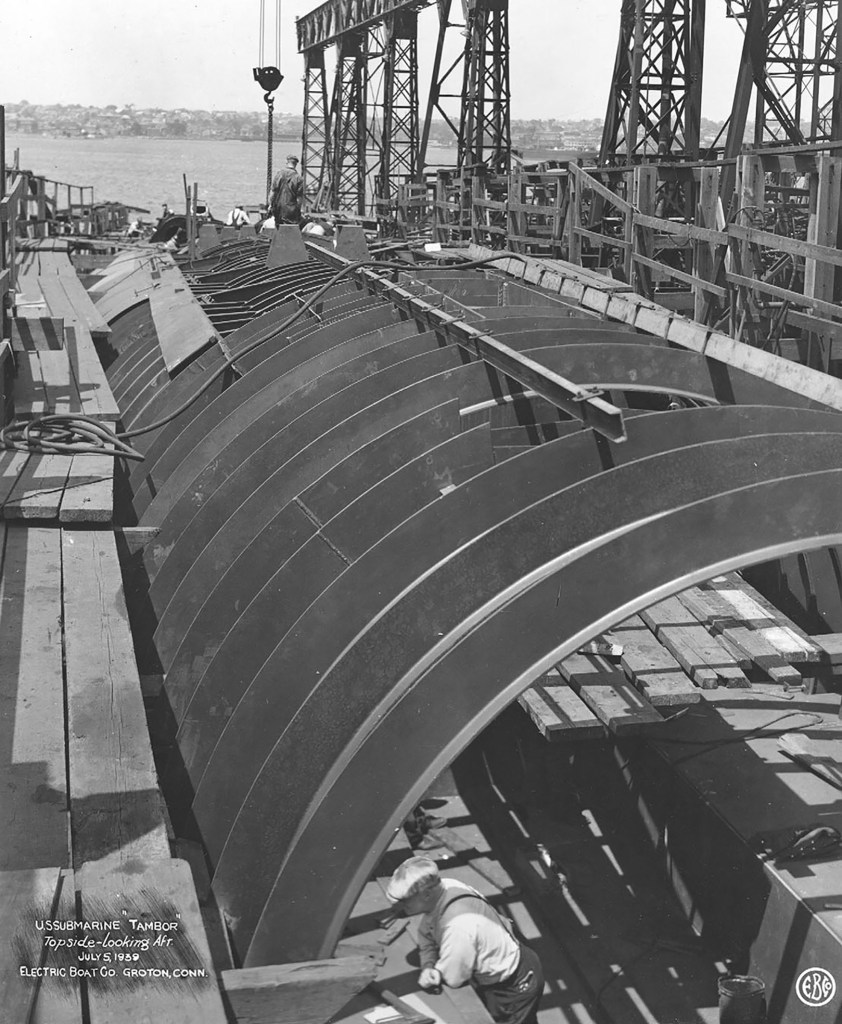
The U.S. Navy Tambor-class submarine USS Triton (SS-201) is laid down by the Portsmouth Navy Yard (Kittery, Maine, U.S.A.).
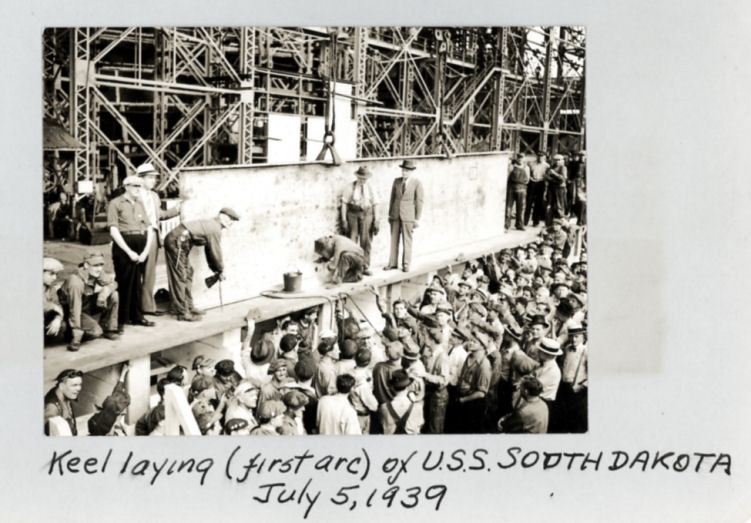
The U.S. Navy battleship USS South Dakota (BB-57), lead ship of her class of 4, is laid down by the New York Shipbuilding Corporation shipyard (Camden, New Jersey, U.S.A.).
The Royal Navy Lake-class ASW whaler HMS Thirlmere (FY 206) is launched by the Smith’s Dock Co., Ltd. (South Bank-on-Tees, U.K.).
The Royal Navy Net-class boom defense vessel HMS Burgonet (Z 33) is commissioned.
The U.S. Navy Benham-class destroyer USS Wilson (DD-408) is commissioned. Her first commander is Lieutenant Commander Russell G. Sturges.
The Japanese Imperial Navy aircraft carrier HIJMS Hiryū (飛龍, “Flying Dragon”), sole ship of her class (modified Sōryū design), is commissioned.
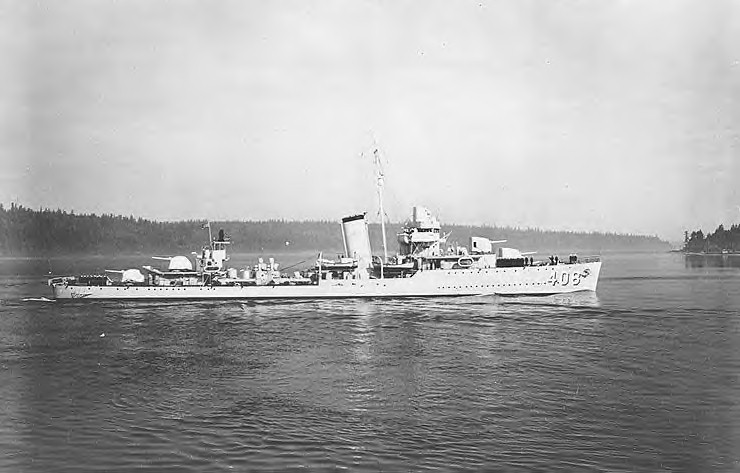
Wilson operated along the west coasts of the United States, Central and South America into April 1940, when she went to the Territory of Hawaii to participate in Fleet Problem XXI. In June 1941, after a year mainly spent in the Hawaiian area, Wilson was transferred to the Atlantic. In the last half of that year, and first months of 1942, she served an escort for major fleet units off the U.S. east coast and, in March–May 1942, steamed across the ocean to Iceland and the British Isles.
Wilson returned to the Pacific as part of a task group centered on the aircraft carrier Wasp, and accompanied it to the south Pacific in July 1942. Early in the next month, she provided bombardment and anti-aircraft services to the invasion force during landings at Guadalcanal and Tulagi. While in that area on 9 August, Wilson engaged Japanese cruisers during the Battle of Savo Island, and later rescued survivors of the sunken cruisers Quincy, Astoria and Vincennes.
Following a west coast overhaul, Wilson was back off Guadalcanal in January 1943, in time for the last weeks of the fighting there. She subsequently participated in landings on the Russell Islands, bombarded enemy positions on New Georgia and escorted shipping in and around the Solomon Islands. In November 1943, the destroyer screened U.S. aircraft carriers during strikes on Rabaul and Nauru and was similarly employed during attacks on the Marshall and Caroline Islands in January and February 1944.
In June and July 1944, Wilson served with the carrier task forces during the Marianas Campaign and the Battle of the Philippine Sea, and also fired her guns at small craft and shore targets at Guam. After overhaul work in August–October 1944, she battled enemy suicide planes in late December while escorting a convoy to Mindoro, in the central Philippines. The next month, Wilson again engaged hostile aircraft and shore positions during the Lingayen Gulf invasion. On 16 April 1945, during the campaign for Okinawa, she was hit by a kamikaze, which cost the lives of five of her crewmen and left an unexploded bomb in her after hull. Soon repaired, she served in the Okinawa area until June and operated out of Saipan until the war ended in August.
Wilson was employed on occupation duty until December 1945, when she returned to the U.S. west coast. In May of the next year, she was assigned to Operation Crossroads target duty. Made radioactive by the July atomic bomb tests at Bikini, Wilson was decommissioned in August 1946 and sunk in deep water off Kwajalein on 8 March 1948.
Wilson received 11 battle stars for her service during World War II.
 History Diaries