The State Department said that William Macomber, the United States Ambassador to Turkey, had been called back for consultation because of the strained Turkish-American relations resulting from Turkey’s decision to resume the cultivation of opium poppies. Turkey was once the main source of illegal heroin in the United States. On Monday, Turkey lifted her ban — imposed in 1971 as part of an agreement with the United States — on cultivation of the poppy. The 1971 arrangement included an American pledge to give Turkey $35.7 million over a four-year period as compensation.
Authoritative sources said today that Greece’s Foreign Minister and two high‐ranking diplomatic officials had resigned as a result of the country’s deteriorating relations with the Turkish and Cypriot Governments. They said that another major cause of the resignations was the direct handling of affairs by military members of the Government here and the bypassing of civilian officials. There has been no official announcement of the resignations of Foreign Minister Spyridon Tetenes; Anghelos Vlachos, the ministry’s general secretary, and Ioannis Tzounis, director general of the department handling Turkish and Cypriot affairs. Mr. Tetenes told newsmen last night that he had “long wanted to resign” for health reasons. The sources said that Mr. Vlachos and Mr. Tzounis became disgruntled when the Cyprus Government provided evidence that Greek military leaders controlled the guerrilla group in Cyprus that seeks the overthrow of President Makarios and union with Greece by force.
President Makarios today accused Greece’s military government of trying to introduce a dictatorship in Cyprus and said that he would take over control of the Cypriot National Guard from its Greek officers. Archbishop Makarios said that the guard’s command was disregarding cabinet decisions. The President said that under its Greek officers the guard had turned into “the mainstay and supplier of the criminal EOKA‐B organization,” the guerrilla group that seeks union of Cyprus with Greece.
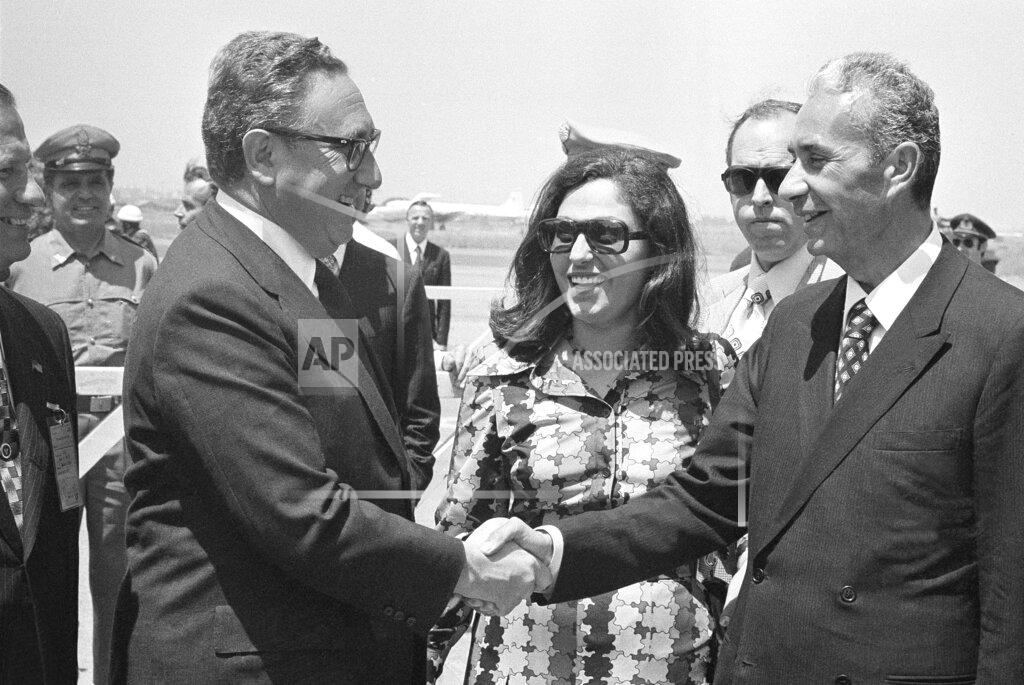
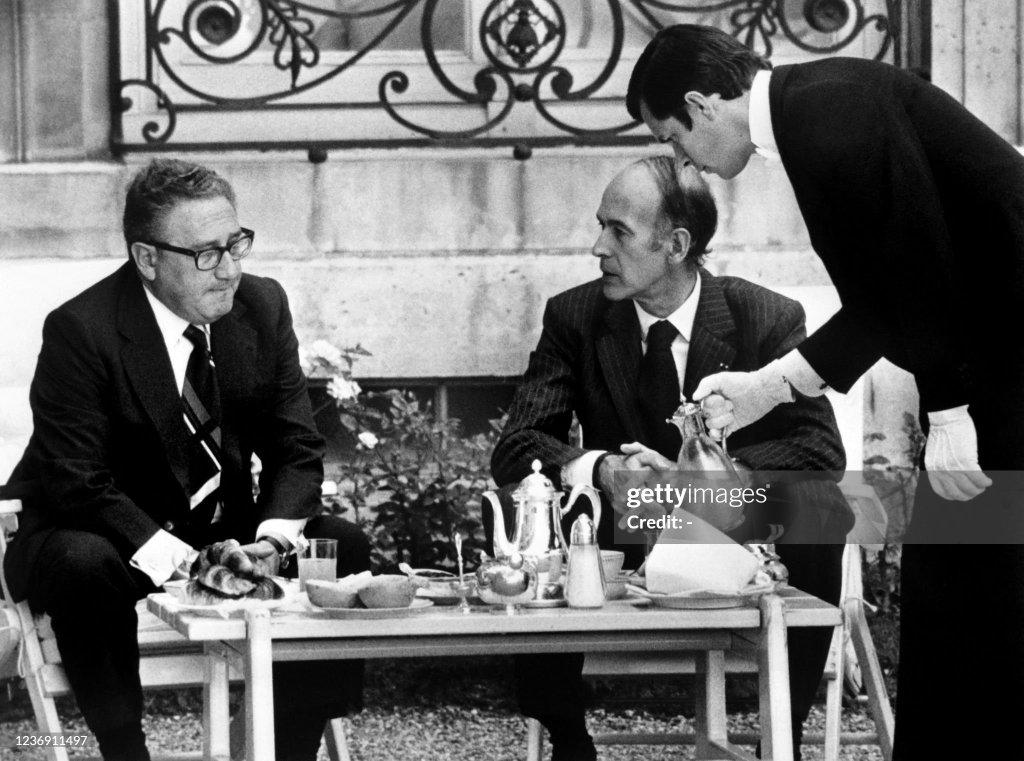
Secretary of State Kissinger met with allied leaders, in Paris and Rome today, and the Italian Foreign Minister said: “This is the way we think the alliance should work.” The minister, Aldo Moro, was also quoted as having told the Secretary that his current tour of West European capitals, to brief allied leaders on the results of President Nixon’s summit conference with Leonid I. Brezhnev, was “just the kind of consultation we consider necessary” in the North Atlantic Treaty Organization. In Paris this morning, Mr. Kissinger had a breakfast meeting with French President Valéry Giscard d’Estaing, and later a senior American officer said on the Kissinger plane that the French now wanted relations with the United States put on an “even keel” and that the United States was prepared to go along.
Other sources reported that when Mr. Kissinger met last night with the French Foreign Minister, Jean Sauvagnargues, the two sides drew up a list of mistakes each had made in the last year of bickering: They agreed that the mistakes should not be repeated. Here in Rome, Middle Eastern issues received particular attention in the talks that Mr. Kissinger had with Mr. Moro. The problem of Jerusalem was expected to come up tomorrow morning when the Secretary has an audience with Pope Paul VI. Some high Roman Catholic officials in Jerusalem have taken the stand that the Old City, which the Israelis took over in 1967, should remain under Israeli administration and that an international group should be responsible for the holy places.
Dutch Premier Joop den Uyl said today that his government was “not jubilant” about the results of President Nixon’s visit to Moscow as outlined by Secretary of State Kissinger. The Premier, at a news conference, criticized the attention that apparently was paid to proposals for an early conclusion of the European security conference, to be followed by a ceremonial signing of a declaration on Europe’s postwar boundaries. “Naturally we are in favor of safe frontiers in Europe, but we would have welcomed more progress in respect to the free movement of peoples, ideas and information,” Mr. Den Uyl said.
Construction began in Austria of the 13.976-kilometer (8.684 mi) long Arlberg Road Tunnel (Arlberg Strassentunnel) through the Alps and would last for more than four years. At the time of the tunnel’s opening on December 1, 1978, between St Anton am Arlberg in Tyrol and Langen am Arlberg in Voralberg, it would be the longest road tunnel in the world.
The Lebanese Government has reportedly refused to allow the Palestinian guerrillas to station ground‐to‐air missiles and other heavy weapons at their refugee camps in Lebanon. According to reports from Cairo in a number of newspapers here today, the Lebanese, position was made clear at the meeting in Cairo yesterday of the Arab League defense council. A delegation representing the Palestine Liberation Organization, the umbrella guerrilla group, had submitted a plan asking for joint Arab help to fortify the camps in Lebanon against Israeli attacks. The plan reportedly provided for setting up missiles and antiaircraft guns at 15 refugee camps spread out in various parts of Lebanon. According to press quarters here, the liberation organization proposed entrusting the defense of the camps to the Palestine Liberation Army, the military arm of the organization.
Gunfire between Bangkok policemen and rioters continued for the third night tonight while Thai Premier Sanya Dharmasakti and his cabinet met in urgent session to decide on measures to end the violence that has plagued Bangkok’s Chinese district. Three persons were killed in tonight’s riots, according to an official statement released by the Ministry of Public Health. The total number of deaths in the three days of strife are now put at 25. The ministry’s statement said that 133 persons had been wounded in the first two days of riots. A survey of hospitals indicated that another 45 persons were wounded tonight. The violence appeared, however, to be tapering off and the government decided against imposing a curfew. Mr. Sanya said that though the Government was empowered to impose a curfew, the Cabinet had decided against it for now.
The riots started Wednesday night, over a seemingly meaningless incident in which policemen tried to arrest a taxi driver who was parked illegally. The violence then built up as the result, observers believed, of long pent‐up frustrations over record inflation, labor conditions, and other social grievances. Policemen and paramilitary troops called in by Mr. Sanya were guarding a series of roadblocks set up to cordon off the Chinese district, and sporadic gunfire in the area tapered off by tonight.
Chou En‐lai, China’s 76‐year‐old Premier, is being treated in a hospital in Peking, Hsinhua, the official press agency, reported early today. The disclosure came in an otherwise routine dispatch on Mr. Chou’s half‐hour meeting yesterday morning with Senator Henry M. Jackson, Democrat of Washington. There was no indication of the nature of the Premier’s illness or the treatment. Mr. Jackson, who was winding up a five‐day visit to Peking, had declined to tell correspondents there where the meeting took place. But he said Mr. Chou was “sharp as tack” and said: “He has obviously been ill, as he explained to me, but the Premier was extremely alert and in good humor.” Mr. Chou himself said, “I am not very well because I am old.”
For the last eight weeks, political candidates have been telling the Canadian people that the election for a new Parliament next Monday provides an occasion for pulling their huge, diverse land together. “In an election, we have to talk to all Canadians, not just any one group, whether it’s East or West, French or English, or what,” Prime Minister Pierre Elliott Trudeau said at Liberal party luncheon in Calgary, Alberta, a few weeks ago. “Indeed, it is because of its diversification that this country is rich, because people respect the differences.” But that same sunny afternoon in Calgary, the Prime Minister was reminded of those differences when, during a 10‐minute campaign walk downtown, he could find only half a dozen people willing to shake his hand.
Mr. Trudeau, whose minority Government fell May 8 when it lost a vote of confidence over budget policies, is relatively unpopular among the people of Calgary because he is a French Canadian. He is unpopular also because he thinks the soaring revenues of the oil industry in their area should be shared by all Canadians through the federal treasury.
Similarly, Robert L. Stanfield, leader of the Progressive Conservative party and Mr. Trudeau’s principal challenger, is unpopular among most of the people of Quebec, even when he is struggling to speak the French that he learned a few years ago, because, as a French-Canadian woman said at a campaign rally in Montreal, “he is so obviously Them, and not Us.”
Two Soviet astronauts were orbiting the earth tonight in the Salyut 3 space station after their Soyuz 14 spacecraft, in which they rose from the earth on Wednesday, made a smooth link‐up with the station before dawn this morning. “It was a soft link‐up,” Colonel Pavel Popovich, the command pilot, reported to ground control about midnight. “We are preparing to pass to the station.” At 4:30 AM, the flight engineer, Lieutenant Colonel Yuri Artyukhin, moved into the 25-ton Salyut 3, switched on the light, checked the life sustaining systems and signaled Colonel Popovich to join him. “The atmosphere inside here is fine,” mission control heard from Colonel Popovich, a veteran of one of the earliest Soviet orbital missions, Vostok 4, in August, 1962.
Today’s successful docking was an especially important one for the Russians. It was the first space rendezvous since the mission of Soyuz 11 in June, 1971, when three astronauts perished on their return to earth. It demonstrated the techniques the Soviets will use in a space link‐up with United States astronauts a year from now. After an “orbital chase” of about 2,200 miles, the manned Soyuz, which was lofted into orbit from the Soviet space center at Baikonur on the steppes of Kazakhstan, caught up with the Salyut 3 station on its 17th orbit in about 26 hours.
This falls within the 30‐hour docking time frame scheduled for the planned link‐up in space with an American Apollo craft next year. The Soviet and U.S. crews are now undergoing joint training on Soyuz mock‐ups at the Soviet astronauts’ training center, Star City, about 30 miles from Moscow. According to Tass, the Soyuz 14 was automatically guided to within about 100 yards of the Salyut 3 station, and Colonel Popovich handled the final distance manually. “The closer to the finish, the calmer and slower the Soyuz moved,” the Soviet press service reported.
President Nixon ordered that the seriousness of his leg ailment be kept secret during his recent trips abroad because he feared public disclosure would interfere with his negotiations with foreign leaders, Gerard L. Warren, the deputy White House press secretary, said today. The President did not want his health problems discussed because he felt it would get in the way of the goals he hoped to achieve on what he considered to be two important trips, Mr. Warren replied to reporter’s question on why the gravity of Mr. Nixon’s condition had been kept hidden from the American public.
Mr. Warren did not elaborate on how disclosure of the seriousness of Mr. Nixon’s ailment would have interfered with his negotiations. Dr. Walter Tkach, the President’s personal physician, disclosed yesterday that a blood clot in the President’s leg could have been fatal during Mr. Nixon’s recent trip to the Middle East. The clot, caused by an ailment called thrombophlebitis, could have broken off and traveled to Mr. Nixon’s heart or lungs and possibly caused his death, Dr. Tkach said. The physician added that he had warned the President of the gravity of his condition but that Mr. Nixon had decided to go on the trips anyway, thus taking what Dr. Tkach called a “calculated risk.”
The Labor Department reported that the unemployment rate remained unchanged at 5.2 percent in June, holding at a level that has been essentially stable for five consecutive months. Herbert Stein, chairman of the President’s Council of Economic Advisers, said that the unemployment rate “is one of the more gratifying economic developments of 1974 so far.” However, there was at least one puzzling conflict in the agency figures.
As the prosecution rested its case in the conspiracy trial of John Ehrlichman and three other defendants, Judge Gerhard Gesell of the Federal District Court in Washington ordered Secretary of State Kissinger to “hold himself in readiness” for a possible appearance as defense witness. Mr. Kissinger had been subpoenaed to appear today, but his lawyers presented a motion to quash the subpoena on the ground that he had no information relating to the break-in at the office of Dr. Lewis Fielding, who was Dr. Daniel Ellsberg’s psychiatrist, the central incident on which the conspiracy charged is based.
Former Attorney General John N. Mitchell has been questioned for nearly three hours by counsel for the House Judiciary Committee and has restated his position that he will not testify in the impeachment inquiry unless compelled by subpoena, his lawyer said today. “Basically, our position is that his appearance would jeopardize his chances for a fair trial” in the Watergate coverup trial, William G. Hundley, Mr. Mitchell’s attorney, said. The trial of Mr. Mitchell, who faces charges of conspiracy and obstruction of justice, and five codefendants is scheduled to begin in the United States District Court here on September 9.
The leadership of the National Association for the Advancement of Colored People today, for the second year in a row, quashed a move from the convention floor calling for the impeachment of President Nixon. At the same time, the body of 3,000 delegates adopted 26 resolutions, several of which will be in the forefront of the organization’s attention in the next year, according to Roy Wilkins, the organization’s executive director. In those resolutions, the membership is urged to push for affirmative action programs in all educational institutions; to seek legislative to revoke licenses of real estate agents and lenders whose practices support a dual market in housing, and to work for the elimination of discriminatory practices against women in employment, promotion and compensation.
Offering an incentive to lenders, the Department of Housing and Urban Development and the Veterans Administration announced that they would increase interest rates on F.H.A. and V.A.-insured home mortgages to 9 percent from 8¾ per cent, effective Monday. In announcing the increase, James Lynn, Secretary of Housing and Urban Development, said that the increase was necessary because mortgage lenders were reluctant to take on government-guaranteed loans when they could get a return of up to 12 percent on loans.
Senator Henry M. Jackson, Democrat of Washington, a leading contender for the 1976 Presidential election, today dismissed the results of the Moscow summit meeting between President Nixon and Mr. Brezhnev as “very limited.”
A drug‐smuggling ring that allegedly brought $32.7‐million worth of cocaine into this country by using Chilean diplomatic pouches and military flights has been disrupted with the arrest of 22 persons this week, according to the Justice Department. Arrests were made here and in New York City, Madison, Wisconsin, and Santiago, Chile. Sixteen of the 22 were Chilean military personnel arrested in that country and six were arrested in the United States. John R. Bartels Jr., drug enforcement administrator, said the ring smuggled at least 162 pounds of cocaine from Chile to New York by way of Washington in the last year. Among those arrested were Mr. and Mrs. Eduardo Diaz of Chevy Chase, Maryland. Mr. Diaz is a chief petty officer in the Chilean Navy assigned to the Chilean Embassy here. A kilogram weighs about 2.2 pounds.
A five‐count Federal indictment in the Southern District of New York said that on at least three occasions, one of the suspects “stoved four kilograms of cocaine in diplomatic pouches, which were then transported to Washington, D.C., and passed through U.S Customs.” Diplomatic pouches are used by diplomats to carry communications and are not subject to customs inspections. The authorities said the smuggling occurred between May, 1973, and June, 1974.
The Pittston Company, the owner of a coal mine dam that breached in February, 1972, causing the deaths of 125 West Virginians in the valley below, announced here yesterday that it had settled a $65‐million damage—suit by the survivors out of court for $13.5‐million. The negotiated settlement ended nearly two years of pretrial sparring by lawyers for both sides and canceled the Federal court trial that had been scheduled to open July 15 in Charleston, West Virginia. Altogether, 654 survivors of the so‐called Buffalo Creek dam disaster were pressing damage claims against the company. The settlement sum of $13.5‐million — before legal costs — would average about $20,640 for each plaintiff.
The U.S. state of Louisiana authorized a flag for, and recognition of, the “Cajun Country” (officially “Acadiana”) in the southern portion of the state, inhabited by Louisiana residents of French descent.
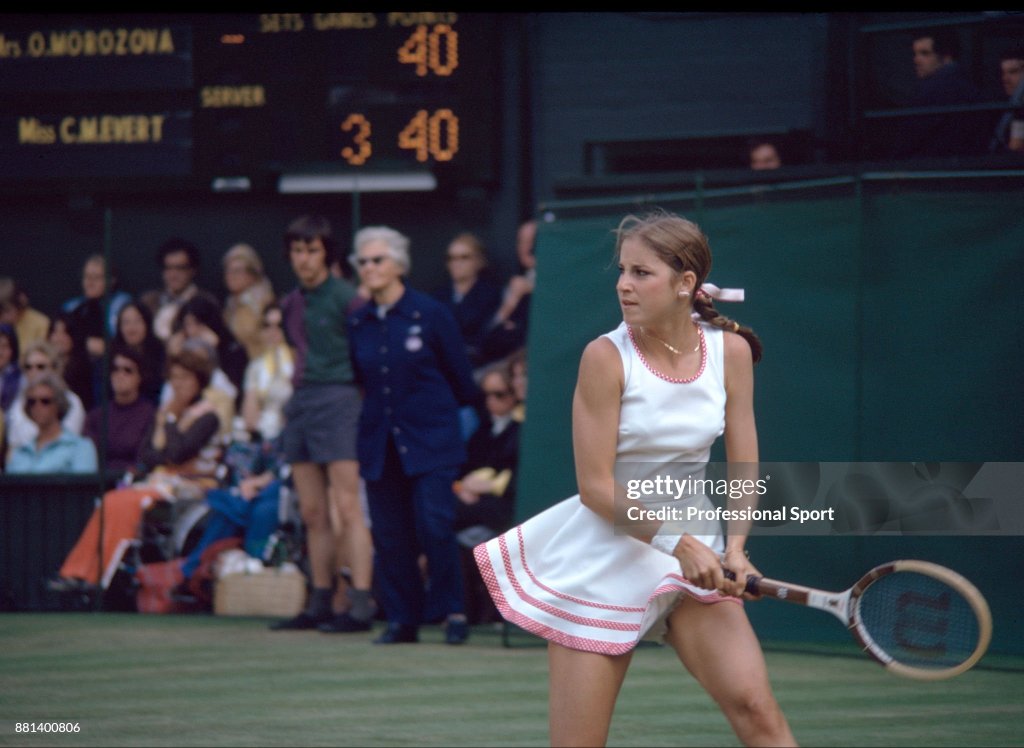
Wimbledon Women’s Tennis: Chris Evert wins her first Wimbledon title beating Russian Olga Morzova, 6–0, 6–4. At the women’s final at the Wimbledon tennis championships, Chris Evert of the United States, in just under an hour, defeated Olga Morozova of the Soviet Union, and added the Wimbledon tennis title to the Italian and French titles that she won a few weeks ago. She was the runner-up a year ago in all three of the tournaments. At the age of 19, Miss Evert, of Fort Lauderdale, Florida, was the youngest winner of the Wimbledon women’s singles since Maureen Connolly, also an American, took the title in 1952 at the age of 17.
The New York Yankees bang out 20 hits and crush the Texas Rangers, 14–2. Thurman Munson and Graig Nettles hit back-to-back home runs, and Munson and Eliott Maddox each had four hits. Rudy May picks up the complete game win.
The Detroit Tigers defeated the Chicago White Sox, 9–6 and 7–4. Jim Northrup hit his sixth home run in the last six games to lead Detroit to the victory in the first game at Tiger Stadium. In game two, Norm Cash and Gates Brown each slugged two‐run homers, and Ed Brinkman drove in a pair of runs with a homer and a single.
Reggie Jackson and Bill North each hit two‐run homers and Jim Catfish Hunter pitched a seven‐hitter as the Oakland A’s shut out the Baltimore Orioles, 6–0, and won their fifth straight and went five games ahead of the Kansas City Royals in the West. It was Hunter’s 28th major league shutout.
Del Unser tripled home two runs, and Bob Boone hit a three-run homer in a five‐run first inning for Philadelphia as the Phillies cruised to an 8–1 win over the San Diego Padres. Steve Carlton snapped a personal three‐game losing streak, pitching a six‐hitter to run his record to 10–7. Carlton struck out four and walked three.
Dow Jones Industrial Average: 791.77 (-1.10, -0.14%).
Born:
Márcio Amoroso, Brazilian footballer, with 19 caps for the national team; in Brasilia.


 History Diaries