Prime Minister Neville Chamberlain tonight delivered still another in the series of resonant warnings that have gone out toward Germany from the British and French Governments in the last few days. “We are living in critical and dangerous times,” the Prime Minister said in a radio speech on preparedness to a nation-wide audience. “We are ourselves a peaceful nation and we desire no quarrels with anyone.
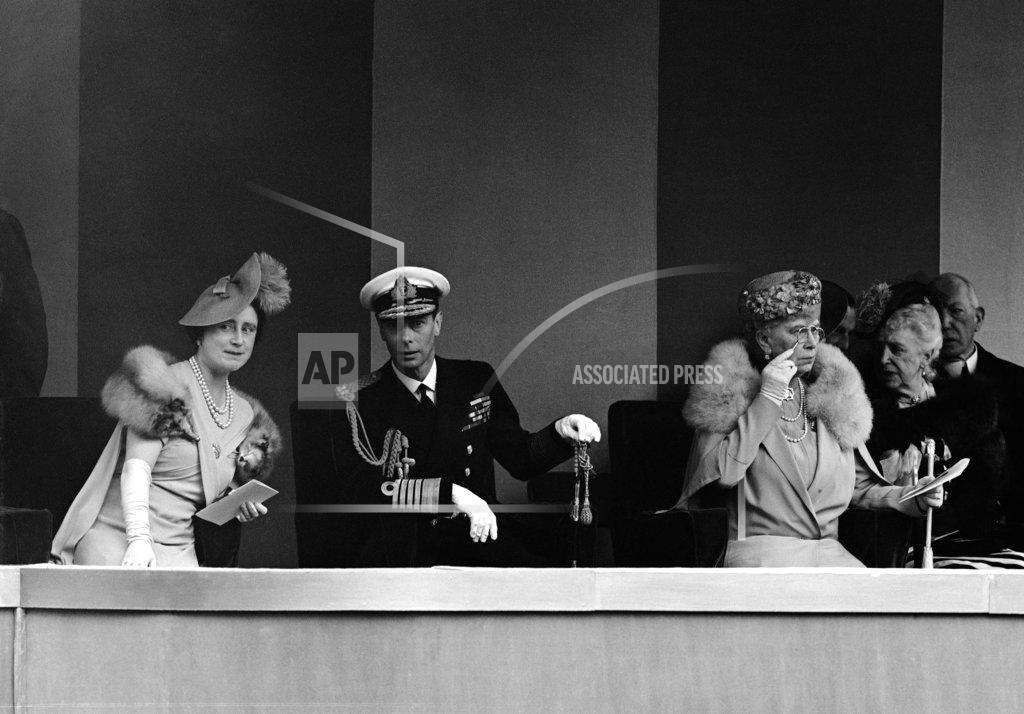
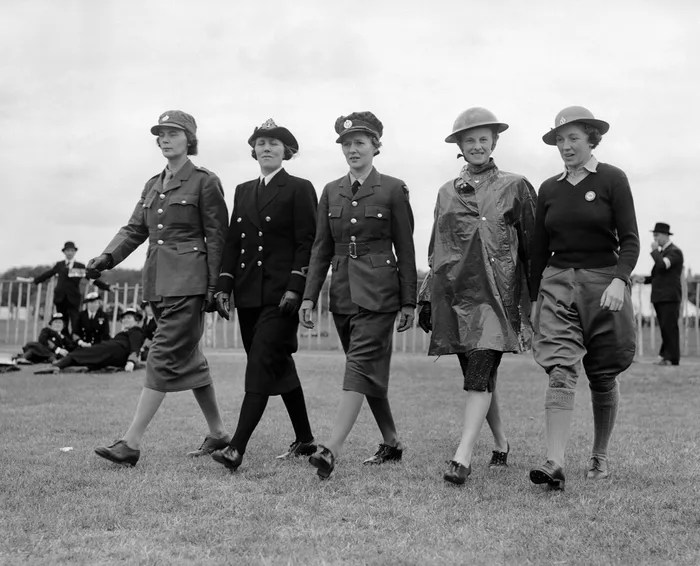
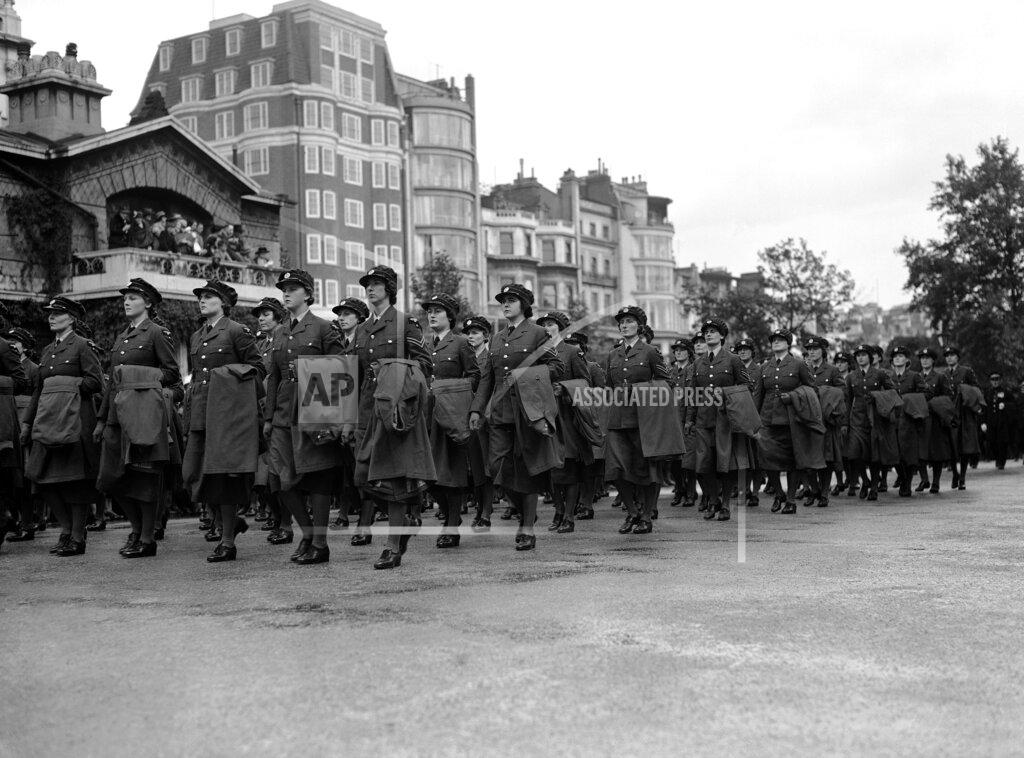
“But let no one make the mistake of supposing that we are not ready to throw our whole strength into the scale, if need be, to resist aggression, whether against ourselves or against those whose independence we have undertaken to defend.” Mr. Chamberlain spoke a few hours after 20,000 National Service volunteers, representing 1,500,000 men and women in all branches of civilian defense, had marched past King George and Queen Elizabeth in Hyde Park in a demonstration of Britain’s readiness on the home front.
The Prime Minister’s warning was echoed by the King in a message that Mr. Chamberlain read over the radio. “You know that all our preparations are designed not to provoke war but to preserve peace,” the King wrote. “We still preserve the hope that nations may learn to live together in fellowship and harmony. But in the meantime, we are resolved to leave nothing undone to maintain our country’s security, and to that task the National Service volunteers are making a contribution which deserves all our gratitude.”
Meanwhile, there has been another revival of optimism here over the prospects of an Anglo-Russian alliance. The foreign affairs subcommittee of the Cabinet will meet tomorrow to consider a report received over the week-end from Sir William Seeds, British Ambassador in Moscow, following his latest talk with Vyacheslav M. Molotov, Soviet Premier and Foreign Commissar. According to well-informed sources, only one point of difference remains, The British are said to have agreed to name the Baltic States in the proposed guarantee if the Kremlin insists; they have agreed that the alliance shall not become operative until military staff consultations have taken place; they have agreed to a Russian request for a pledge that Britain would not make a separate peace in time of war and thus leave Russia to bear the brunt of the fighting.
The only obstacle now is said to be a Russian demand that the guarantee of the Baltic States should operate against internal changes of regime in those countries as well as against aggression, In other words, the Russians want Britain and France to go to war to prevent or defeat any internal fascist rising in Finland, Latvia or Estonia. This, of course, is a tall order, and if the Russians press it there may be further difficulties in these negotiations, which have already dragged on for almost three months.
The British are hopeful, however, that the tension over Danzig may bring the negotiators in Moscow to an agreement more quickly than. otherwise, especially since the British and the French have already yielded to every important Russian demand. For reasons best known to himself Mr. Chamberlain made no mention of Danzig in his speech tonight, although his government has been alert over the weekend for a possible coup in the Free City. Mr. Chamberlain’s Ministers have been equally shy of specific warnings in the last few days.
Albert Förster, leader of the Danzig Nazis, told a rally at Tiegenhof today that Danzigers were ready to sacrifice “blood and life” to return to Germany. “We in Danzig declare we want to return to Germany and we declare further that we will return,” he asserted at the close of a district Nazi meeting.
“One word of the Führer (Chancellor Hitler) has a thousand times more weight with us in Danzig than all the war cries and lying agitation in the world,” Herr Förster said, adding: “No threat from Poland can frighten Danzig. When the Führer brings Danzig liberty, then this German population will stand together as one man in brazen faith. to the Führer and Germany and it will be ready for every sacrifice which the Führer demands, not only of possessions but also of blood and life.” He charged that the “encirclement powers” were ready to wage war against the theory of self-determination of peoples in order to perpetuate “an injustice.”
“They are preparing to deliver Danzig to Poland rather than to agree to fulfillment of the wish of the determined Danzig population for return home to the Reich,” he said. “As a result, Danzigers and all Germans in Greater Germany now conclude that nothing else is left but to adapt themselves to the position of force held by England and her allies.”
Considerable interest is centered on the action of the British and French Governments in calling home their ambassadors to Warsaw to report on German-Polish relations and the whole question of Danzig and Pomorze, the Polish Corridor. The Nazi newspaper Vorposten declared that such discussions could not change the “inevitable trend of events.”
“The return of Danzig to the Reich has been decided,” the newspaper said. “The time of such return is to be decided by Führer Adolf Hitler.” It added that forces advocating “encirclement” of Germany seem to be gaining the upper hand in the French and British press and political circles. “We note these tendencies in the capitals of the Western States but hold they can have no influence on the resolution of Germany in the Danzig question. The German intentions are clear and have been repeated so often there can be no misunderstanding.” Danzig continued calm with its police and black-shirted Danzig Elite Guards in complete control. The watch along the Free City’s borders was strengthened and several barracks were full of Nazi guards ready for any emergency.
Today for the first time Italians learned that a truly grave crisis had arisen over Danzig, which might lead to war. All the newspapers print adequate accounts of the speeches of British leaders, the French Ministerial Council’s decisions, the appeal by the British Laborites and frank stories from Berlin and from Danzig itself. As yet, Premier Benito Mussolini remains “cloaked in silence” and Government officials have not made any pronouncement; there are few editorials on Danzig and they do not give a new lead, so Italy remains somewhat an enigma.
All that one can say is that the Italo-German alliance commits this country irrevocably to join Germany in a war over Danzig, and there is no reason to suppose that Italy would hold back. Posters appeared in Rome’s streets today urging the Italians to buy gas masks. This is the first time that such an appeal has been made, although a campaign has been going on for months to make the Italians realize the danger of an air bombardment. Today’s posters show a man wearing a gas mask and underneath is a caption, “Buy it now, while you are in time.”
Official notification having been given yesterday to the German Government through its Ambassador to Paris, Count Johannes von Welczeck, by Foreign Minister Georges Bonnet that France will not tolerate any unilateral change in the status of Danzig, it is believed some reply must be made by Berlin through diplomatic channels. Recently Berlin and Rome have tended to neglect this form of international interchange. Mr. Bonnet’s interview with the Ambassador following yesterday morning’s Cabinet meeting was formal, and in normal circumstances should receive a reply from Berlin: Germany’s reaction is awaited with great interest.
M. Bonnet’s action opened the way once more in an orthodox manner for a peaceful settlement, if such is desired by Germany, of Polish-German differences at Danzig on the basis laid down by Foreign Minister Josef Beck of Poland. Whether reason or hysteria is dominating Berlin is expected to be revealed by the manner and the matter of the reply, if one is made. M. Bonnet and Count von Welczek were guests at a large evening party and circus given at the Versailles home of Lady Mendl, the former Elsie De Wolf, wife of Sir Charles Mendl, special press attaché of the British Embassy here. Premier Édouard Daladier had a long interview this morning with General Marie Gustave Gamelin, Commander-in-Chief of all French fighting forces, who had shortened his inspection of defenses in Savoy and Corsica to keep in close touch with the situation.
The Czechs try to see Hitler and persist in their efforts to submit grievances despite his rebuff.
The Nazis bid France to be neighborly and call Britain an inciter.
Europe is headed for a grave new crisis in which Czecho-Slovaks at home and abroad are ready to play a part similar to the one they played in the World War leading to the creation of their nation, Dr. Eduard Benes, former President of Czecho-Slovakia, declared yesterday in an address at a Czecho-Slovak Day celebration in the Triborough Stadium on Randalls Island in New York.
Eighteen-thousand people, all of them immigrants from Czecho-Slovakia or children of immigrants, cheered Dr. Benes’s call to action, which was broadcast by short wave to Czecho-Slovakia. To his people at home Dr. Benes appealed to “be prepared just as we are and do not permit yourselves to be provoked into irresponsible and premature action.” His address was preceded by a message to the people of Czecho-Slovakia by Colonel Vladimir Hurban, Czecho-Slovak Minister in Washington, to remain united in their fight to regain independence.
The attempt of the Nazi-controlled Evangelical Church Ministry to oust Pastor Martin Niemöller’s wife and seven children from the now familiar Dahlem parsonage of the former fighting U-boat commander has elicited a scathing rebuke from Pastor Friedrich Mueller. Pastor Mueller, who has already spent some time in a Nazi prison for his outspokenness, has been substituting for Pastor Niemöller since. the latter’s incarceration in the Sachsenhausen concentration camp for alleged pulpit misuse. The sharpness of the phraseology in Pastor Mueller’s letter might well. expose him to further imprisonment.
Freed by the legal authorities after many months in prison, Pastor Niemöller was immediately taken again into custody by the Gestapo and is still interned although no formal charges have been made against him. He won fame as a militant champion of the Confessional Church against what it considers to be State interference with freedom of worship.
Early last month the German Evangelical Consistory of Brandenburg initiated proceedings against Pastor Niemöller that could only result in his relegation to the status of an itinerant preacher. Through the Gestapo, Pastor Niemöller was advised that a recent decree of Dr. Friedrich Werner, president of the Evangelical Church Council and virtual dictator over the Protestant Church, made it possible to place pastors on the “retired list.” This. although allowing them to continue to preach, would practically deprive them of a livelihood and of the use of parsonages.
Pastor Mueller, who since November had been deprived of any salary by the controlling church, has written a letter of protest to Dr. Werner, severely criticizing the latter for his action and for the “battle that you are waging against Our Lord Jesus Christ.”
An army of civilian volunteers parades in Britain. Twenty thousand march past the King and Queen in a display of auxiliary defense forces.
Barriers to congressional adjournment which a week ago seemed almost insurmountable were hurdled or knocked down with such rapidity during last week that predictions of an end to the first session of the Seventy-sixth Congress by July 15 or soon thereafter were revived today.
The feeling prevailed, after the hot battles that produced night sessions on Wednesday, Thursday and Friday, that most of the fight had gone out of the legislators. Accordingly, it was expected that the rest of the session would be somewhat anticlimax, and that adjournment would come in about a fortnight in comparative peace, in contrast to the tumultuous closing sessions which have marked other Congresses.
One reason for the expectation of early adjournment was the belief in some quarters that opposition forces had gained their objective to a degree even they themselves had hardly expected, and accordingly would be content to rest on their laurels unless the Administration forced new contests. In the light of the approaching Presidential campaign, it was reported that the Republicans had manufactured enough ammunition for their cause last week to satisfy them for the present and that the same was true of the anti-Administration Democrats.
Unless President Roosevelt whips up the leadership to press for reversal of actions displeasing to the Administration, or injects new issues that would stir up controversy, the probabilities are that the remaining weeks of the session will see little recurrence of the hot debate and desperate maneuvering that featured the past week.
An indication that the leadership did not expect crises within the next few days at least was seen in the departure for a vacation in Canada of Speaker Bankhead, with the remark that he was “just a little bit tired.” Undoubtedly others on Capitol Hill share his weariness. The legislators will have time to do some resting over the July Fourth holiday, since neither house will be in session until Wednesday. On Wednesday the Senate, by agreement, will vote on the monetary bill, involving continuation of the $2,000,000,000 stabilization fund, the power of the President further to devalue the dollar, and the pegging of the price of newly mined domestic silver at 70.95 cents per ounce.
There is still a wide difference of opinion as to whether the filibuster which kept the Senate in session until early Saturday morning and prevented enactment of the Monetary Bill before the expiration of the devaluation powers and the authority for the stabilization fund, had accomplished the legal death of these measures, which the administration considers vital cogs in the gears of the fiscal program, or whether passage of the bill by the Senate next Wednesday would restore their legal status.
U.S. President Roosevelt signs the final Army bill. Over $223 million will be spent for planes and other defense needs. As President Roosevelt settled down for a holiday, it was announced today that he had signed the $223,398,047 supplemental military appropriation bill carrying funds for increases in the Army Air Corps. The measure also provides for “educational orders” for the manufacture of war materials, and enlargement of the garrison in the Panama Canal Zone. It was signed by Mr. Roosevelt before he left Washington yesterday, as was a resolution appropriating $20,000 for financing the administration of the Connally “Hot” Oil” Act during July. A two-year continuance of the regulatory statute was approved by Congress and approved by the President last week.
Mr. Roosevelt came back to Hyde Park, his boyhood home overlooking the Hudson River for three days of relaxation before resuming the legislative battle centering around continuance of his dollar devaluation powers and revision of the Neutrality Law. He arrived in the morning aboard his special train after a leisurely overnight run from Washington. He planned a long weekend visit with his mother, Mrs. Sara Delano Roosevelt, who is sailing for Europe on Thursday. There were no official callers and Mr. Roosevelt remained away from church, passing the day quietly with his wife and mother. He is scheduled to leave Hyde Park Tuesday night and arrive back in the capital early Wednesday morning.
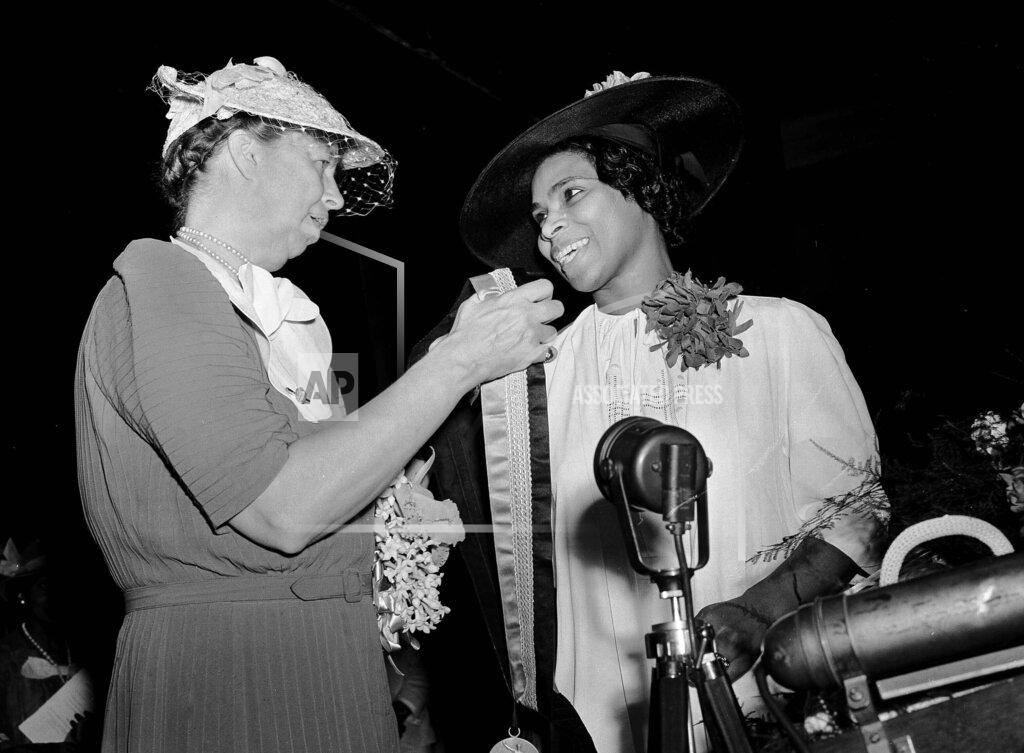
First Lady Eleanor Roosevelt praises contralto Marian Anderson, saying her gift transcends race, and presents her with the Spingarn Medal in Richmond, Virginia, today. Mrs. Roosevelt told a crowd of 5,000 persons in presenting the medal at the annual conference of the N.A.A.C.P. that Miss Anderson “had the courage to meet many difficulties” and that “her modesty and her great gift are well known.” The Black singer appeared on a musical program for King George and Queen Elizabeth at the White House during their recent visit. In accepting the award, Miss Anderson said she appreciated the “significance it carries” and declared that she felt it a signal honor to have received it “from the hands of our First Lady, who is not only a first lady in name, but in every deed.”
The ceremony recalled the incident of last Spring when the Daughters of the American Revolution denied Miss Anderson the use of their Constitution Hall in Washington for a concert on April 9, and Mrs. Roosevelt’s subsequent resignation from the D.A.R. Soon after the incident the President’s wife, although refusing to name the group, said she was resigning from “an organization” because she could not actively fight an action by it, which she disapproved.
A spectacular fireball or meteor passed over Portland just before 8:00 AM. Somewhat to the east of Portland the meteor exploded, causing many people to awaken from their Sunday morning slumbers as buildings shook, and dishes and windows rattled. A small friable stone was recovered a day later near the town of Washougal. It turned out to be a new member of the rare Howardite class of achondritic meteorites.
Farm distress continues, and the conditions of the South’s sharecroppers and plain states-families are cited.
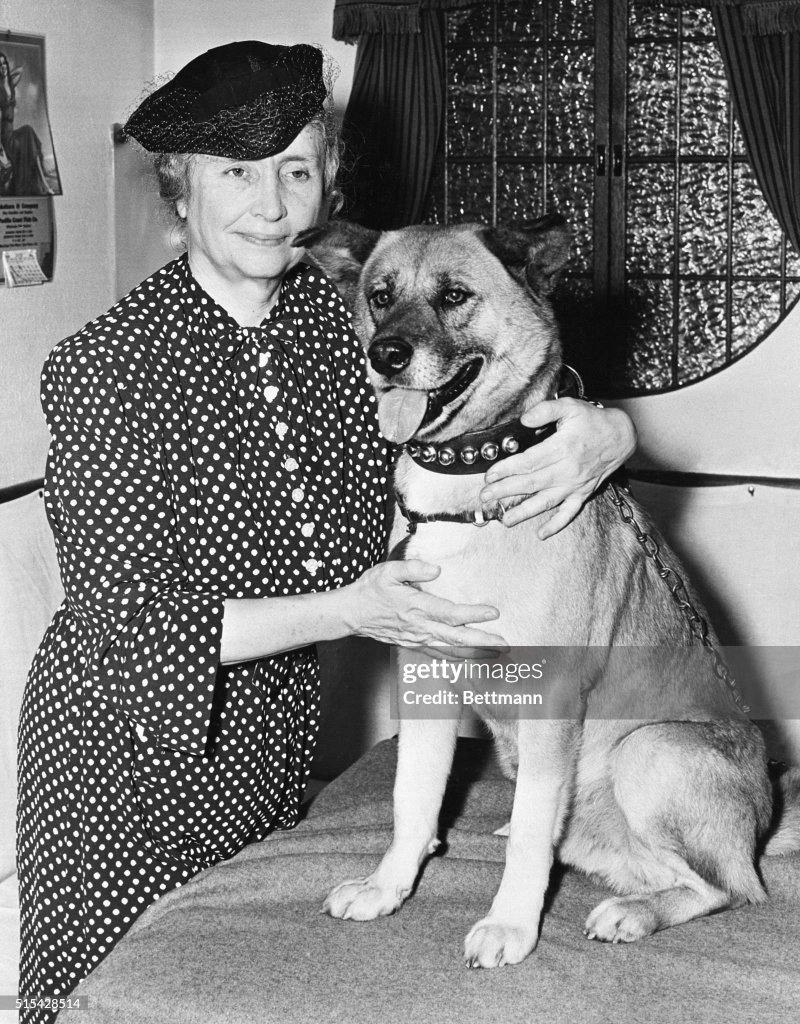
Helen Keller gets a new dog, a brown “barkless” Akita from Japan named Kazan Go.
The first World Science Fiction Convention opened in New York in conjunction with the World’s Fair.
Syndicated columnist Ann Landers (21) weds business executive Julius Lederer.
In a Giants’ doubleheader with the Brooklyn Dodgers before 51,435 at the Polo Grounds, the fireworks start 2 days early. The Dodgers take an uneventful opener 3–2, but in the 4th inning of the nitecap, Dodger player-manager Leo Durocher ends the inning by grounding into a double play and spikes first baseman Zeke Bonura as he crosses the bag. Bonura takes off after Durocher, chases him down the right field line, and throws his mitt at him. He finally wrestles him to the ground. Both players are ejected, and the Giants go on to win 6–4. To Bonura’s charge of intentional spiking, the Lip retorts, “If that big clown hadn’t got his foot in my way, I wouldn’t have been close to him.”
In St. Louis, the Pittsburgh Pirates take a pair from the Cards, winning 8–5 and 6–3. Elbie Fletcher, with his first homer of the year, contributes a grand slam in the Buc attack. The homer strikes the pavilion roof and bounds back on the field, causing a brief argument about whether it is a homer or double. Ray Mueller of the Pirates and Don Gutteridge of the Pirates, natives of Pittsburg, Kansas, along with umpire George Barr, a former resident there, were presented with gifts by a delegation from that city.
Four-hit pitching by Tommy Bridges enables the Detroit Tigers to beat the Chicago White Sox, 5–1. Sox manager Jimmy Dykes is fined $50 for his part in yesterday’s dustup when Hank Greenberg took a swing at Joe Kuhel, accusing the Sox player of deliberately trying to spike him at first base. Reacting to the fine, Dykes pulls all his non-starting players out of the dugout and has them sit in the centerfield bullpen. Eric McNair of the Sox is ejected from the game for tossing his bat after a third strike call, and when Dykes and Ted Lyons add their two cents, they get tossed as well. Dykes joins his players in the bullpen from where he directs the game. As the Sox skipper passes the Tiger bench, all the Detroit players doff their caps.
In Philadelphia, Al Lopez hits a 2nd inning grand slam and the Boston Bees sting the Phillies, 9–7. Lopez will hit a career-high 8 homers this year.
The Washington Senators move into 6th place in the American League by sweeping a pair from the Philadelphia A’s, winning 4–3 and 13–2. Johnny Welaj has 4 hits in the nitecap to drive in 6 runs.
The Soviets retook the Baintsagan Heights and threatened the one pontoon bridge the Japanese had across the Khalkin Gol, forcing the Japanese to withdraw across the river. The Khalkhyn Gol or Khalkha River is a river in eastern Mongolia and Inner Mongolia in northern China.
The Japanese launched a new offensive in the Battles of Khalkhin Gol, invading Mongolia with a force of 38,000 men. The southern prong of the Japanese offensive in the Mongolian Area of China commenced.
Korean Crown Prince Yi Un, a Major General in the Japanese Imperial Army, inspected troops in Qingdao, Shandong Province, China.
A Tientsin-born British newspaper man, John Anderson, was reported in dispatches today from Tientsin to have been forced to strip and to have been slapped with his passport by a Japanese policeman. The report followed a general tightening of the Japanese blockade of the British and French Concessions, with Japanese military authorities characterizing it as retaliation. They charged British authorities with “deliberately insulting” the Japanese Army by disseminating false news of the Tientsin situation, Mr. Anderson said he was en route to visit his mother in the former German Concession, when he was halted at the barrier. He quoted the policeman as saying, “You think because you’re British you needn’t be afraid.” His case was the first disrobing of a Briton reported since the Japanese commander ordered less exacting personal searches last week.
Chinese guerrillas were reported increasingly active in and near the Tientsin and Peiping areas. Peiping dispatches said guerrillas wrecked two trains on Japanese-operated railways last week and engaged Japanese forces in a battle east of Tinghsien on the Peiping-Hankow line. In three simultaneous raids at Tientsin last night guerrillas struck inside the Chinese city, one group attacking a Belgian-owned power plant. One Chinese employee was killed and two were wounded.
Born:
John H. Sununu, U.S. Secretary of State (R, 1989-91), Governor of New Hampshire (1983-89), in Havana, Cuba.
Alexandros Panagoulis, Greek politician and poet who fought the military junta in Greece, in Athens, Greece (d. 1976).
Michael N. Castle, (Rep-R-Delaware 1993-2011, Governor of Delaware 1985-92), in Wilmington, Delaware.
Paul Williams, American baritone singer and choreographer (The Temptations – “Cloud Nine”), in Birmingham, Alabama (d. 1973).
M. A. Foster, American sci-fi author, (“Gameplayers of Zan”), in North Carolina (d. 2020).

 History Diaries