The Việt Cộng ambush an ARVN 36-truck convoy in the Pleiku-Quy Nhơn area, but its load of shells is saved when two U.S. helicopters arrive; 29 ARVN troops are killed, 24 injured and five missing. Communist guerrillas ambushed a big South Vietnamese Army convoy in the central highlands, but the convoy was saved from annihilation by the guns of two United States helicopters, officials reported today.
The ambush was sprung yesterday. Before the fighting ended, 29 government troops were killed and 24 were wounded, United States and Vietnamese officers reported. Five were said to be missing. At least three guerrillas were killed. While the dazed Vietnamese of the 36‐truck convoy fell back and the guerrillas seized the convoy’s arms, an unarmed United States helicopter appeared. Two United States soldiers in the aircraft opened fire with their carbines. Then an armed United States helicopter roared up from a valley and let go with machine guns and rockets, scattering the black‐clad guerrillas into the jungles. By that time the Việt Cộng had seized a Vietnamese machine gun and 30 small weapons.
The arrival of the helicopters kept the 200 or so guerrillas from getting away with what they wanted most — the high explosive shells carried in some of the trucks. The convoy had set out from the coastal town of Quy Nhon, 250 miles north of Saigon. Its destination was II Corps headquarters at Pleiku, 80 air miles inland along a tortuous route where guerrillas are active. The Vietnamese sent along 90 soldiers to guard the convoy. It was in the area around Pleiku that an earlier government announcement said a mop-up of guerrillas had just been completed, with 104 of the Việt Cộng slain.
The guerrillas sprang their ambush at 11:15 AM. It came near the high Mang Yang Pass. Nearby is a weathered stone marker at the spot where a French mobile brigade was wiped out in 1954 in the closing days of the French war in Indochina. Land mines blew up the leading trucks, destroying at least four and damaging 12 others, United States sources said. The informants added that they were almost certain that the Việt Cộng knew the convoy was loaded with heavy artillery shells, which the guerrillas could use for mines.
After the mines went off, the guerrillas closed in on the security forces, firing from the edge of the highway with mortars and heavy weapons. Even though they took immediate heavy losses, the security force was reported to have held out for some time before yielding the trucks, which were strewn across the road. As the guerrillas swarmed over the trucks, the unarmed helicopter flew over. This startled the Việt Cộng, who ran back from the road into the jungle for some time. Then they came out again. Then the armed helicopter hove into view and made repeated runs, a United States spokesman said. The guerrillas fled. By that time, it was midafternoon and a relief column had been alerted at An Khê, eight miles away. The column arrived around 4 P.M.
Terrorists throw a bomb at a U.S. officers’ billet in Saigon and two Americans are injured.
At a joint news conference, Senate Republican leader Everett Dirksen (Illinois) and House Republican leader Charles Halleck (Indiana) say that the war will be a campaign issue because “President Johnson’s indecision has made it one.” This statement at a joint news conference held by the leaders, Senator Everett McKinley Dirksen of Illinois and Representative Charles A. Halleck of Indiana, was taken as a criticism of Henry Cabot Lodge, former Ambassador to South Vietnam. Mr. Lodge, who returned Monday to work for the candidacy of Governor William W. Scranton of Pennsylvania, has said he has no essential difference with the Johnson Administration’s Asian policy.
Mr. Lodge’s drive to block Senator Barry Goldwater of Arizona pits him against Senator Dirksen, who has agreed to nominate Mr. Goldwater at the convention, opening July 13 in San Francisco. Both Mr. Dirksen and Mr. Halleck read statements saying that Administration policy in South Vietnam, or what they termed the lack of it, would be a campaign issue this year. “Contradictions, confusion and vacillation abound” in the Administration’s policy toward the Southeast Asian nation, Mr. Halleck said. Mr. Dirksen said that “much as we would prefer to avoid the subject, we must declare that not only the Vietnam question but the Johnson Administration’s broader policy of ‘coexistence’ must be fully exposed in the 1964 Presidential campaign.”
After the two Republican leaders read their statements, Senator Dirksen was asked about Mr. Lodge’s remark yesterday on the announcement that he would nominate Senator Goldwater. Mr. Lodge said he recalled that at the 1952 convention, Senator Dirksen had nominated Senator Robert A. Taft of Ohio. In that convention, General Dwight D. Eisenhower, with Mr. Lodge’s help, wrested the nomination from Senator Taft. “I raised money for that ticket and I campaigned all over the country,” Mr. Dirksen replied. Then he added: “If he hadn’t kept banker’s hours, we might have fared a little better.” He indicated that he was talking about Mr. Lodge’s activities as Richard M. Nixon’s running mate in 1960. Some Republicans have previously complained that Mr. Lodge did not campaign as hard as he might have in 1960, when Mr. Nixon was narrowly defeated by John F. Kennedy.
Mr. Halleck said in his statement that “for a year now the military situation in Vietnam has deteriorated steadily despite the presence of more than 15,000 American military personnel on the scene in ‘advisory’ or ‘training’ roles. In the responsible American and Vietnamese press, there has been open speculation that the Johnson Administration is avoiding a decision until after the Presidential election here in November while we go on dribbling away both American lives and American prestige in a ‘no‐win’ war in Southeast Asia,” he said.
The Chinese Communists reported that the Pathet Lao shot down two T‐28’s and captured their pilots Tuesday in central Laos, according to The Associated Press. The Chinese said the downed planes were among five that strafed and bombed Pathet Lao territory in Xiengkhouang Province, about 80 miles northeast of Vientiane, the administrative capital. Hsinhua, the Chinese press agency, quoted a Laotian broadcast. It said: “In order to safeguard the security of the liberated areas and property and life of the people, the Laotian patriotic forces were forced to counterattack in self‐defense and brought down two of the five aircraft and damaged two others.”
At the same time the Peking radio said the Pathet Lao had rejected as “a trick played by the United States” a five‐nation appeal for an immediate cease‐fire in Laos. The broadcast on the rejection of the cease‐fire appeal said the Pathet Lao had also refused to give up positions won last month in the Plaine des Jarres of north central Laos, another part of the proposal. The appeal was issued in Vientiane Monday by diplomatic representatives of the United States, Britain, Canada, Thailand and South Vietnam. The five nations urged the two measures as the first steps toward ending the civil conflict in Laos.
The Soviet Union told the Western powers today that they must choose between their projected nuclear mixed‐manned fleet and an accord to. halt the spread of weapons. Valerian A. Zorin, a Soviet Deputy Foreign Minister, warned the disarmament conference here that all future developments in the field of nuclear arms could hinge on the West’s choice. The Soviet diplomat delivered the warning at the close of a 13‐page speech in which he repeatedly denounced the plan for a nuclear fleet manned by members of several allied fleets and including West German participation. He said plans for such a fleet under the North Atlantic Treaty Organization were aimed at “quenching the nuclear thirst of West German revenge seekers.” William C. Foster of the United States replied that Moscow was using “groundless political arguments against the multilateral force in the pursuit of its long‐standing aim to disrupt NATO defensive arrangements.”
Fazil Kutchuk, leader of the Turkish Cypriot community, today accused “senior” United Nations officials in Cyprus of bias in favor of the Greek Cypriots. Mr. Kutchuk, who is Vice President of Cyprus, asserted that the recent report to the Security Council by the Secretary General, U Thant, also was biased in favor of the Greek Cypriots. The report asked the Council to authorize a second three‐month tour of duty for the United Nations Cyprus force. A United Nations spokesman said he had no comment on Mr. Kutchuk’s charges. They were made in a letter to Mr. Thant forwarded by the Turkish delegation. The two senior United Nations officials in Cyprus are General Kodendera S. Thimayya of the Indian army, commander of the United Nations Force in Cyprus, and Galo Plaza Lasso of Ecuador, Mr. Thant special representative in Cyprus.
Juana Castro, the 31‐year‐old sister of Cuba’s Premier Fidel Castro, was described here tonight as a provider of “useful tidbits” of information to United States operatives in Cuba for the last four years. The information aided the Central Intelligence Agency. According to qualified informants, Miss Castro had turned against her brother and his regime as early as the beginning in 1960. Since 1960, she had devoted much time and energy to hiding and helping anti‐Castro Cubans as well as supplying United States intelligence with occasional information on general affairs.
In Havana, Premier Castro accused United States officials of having put in his sister’s mouth the censure she delivered against him in Mexico Monday. The Embassy in Mexico City denied the charge.
Architect Le Corbusier is made Grand Officiers of the Légion d’honneur.
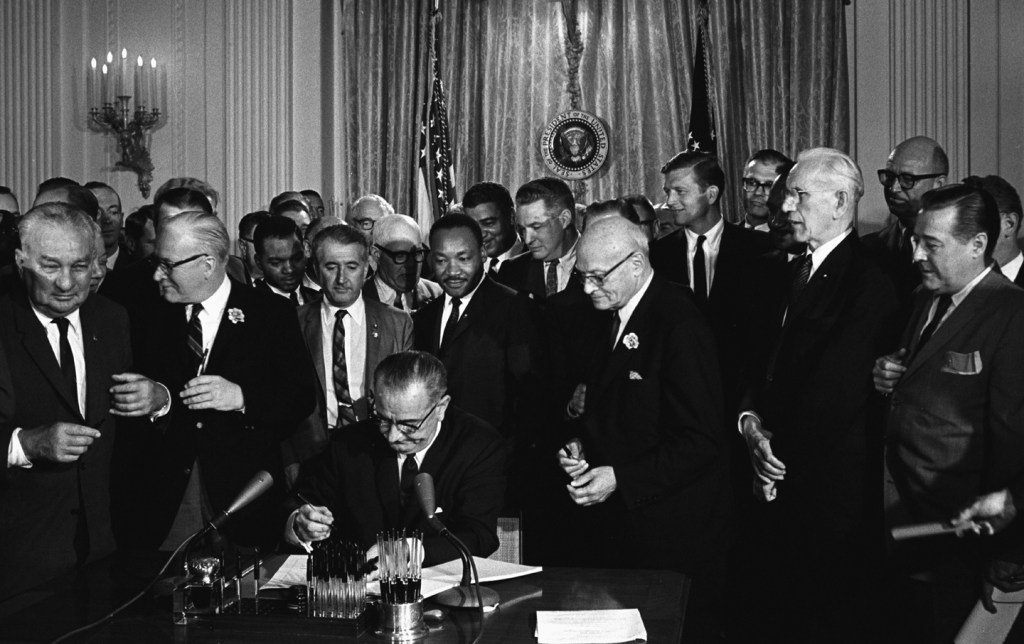
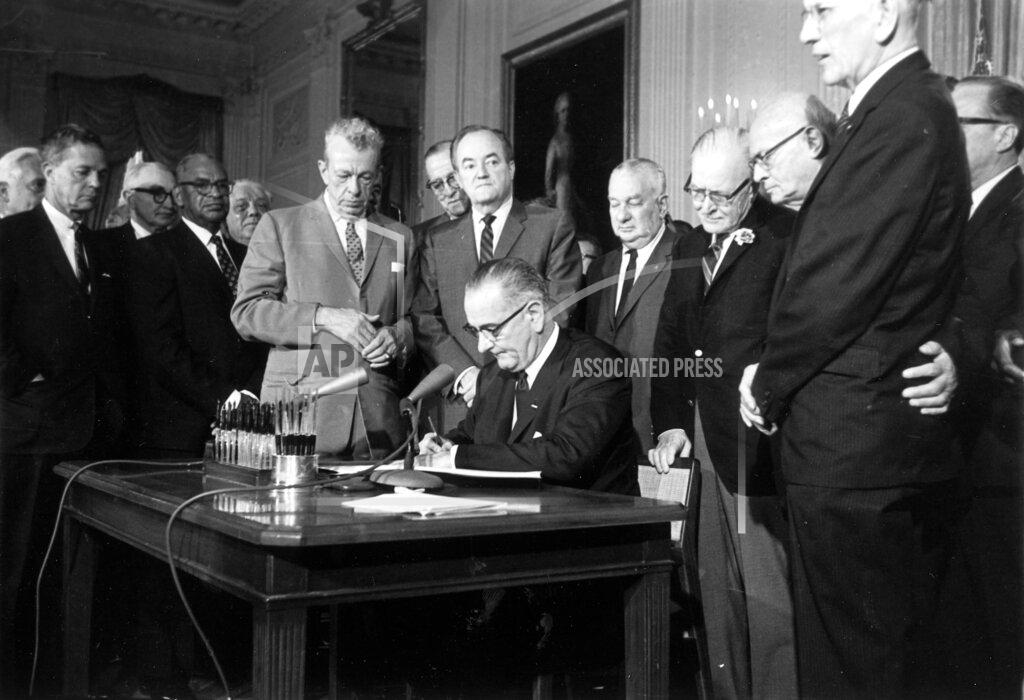
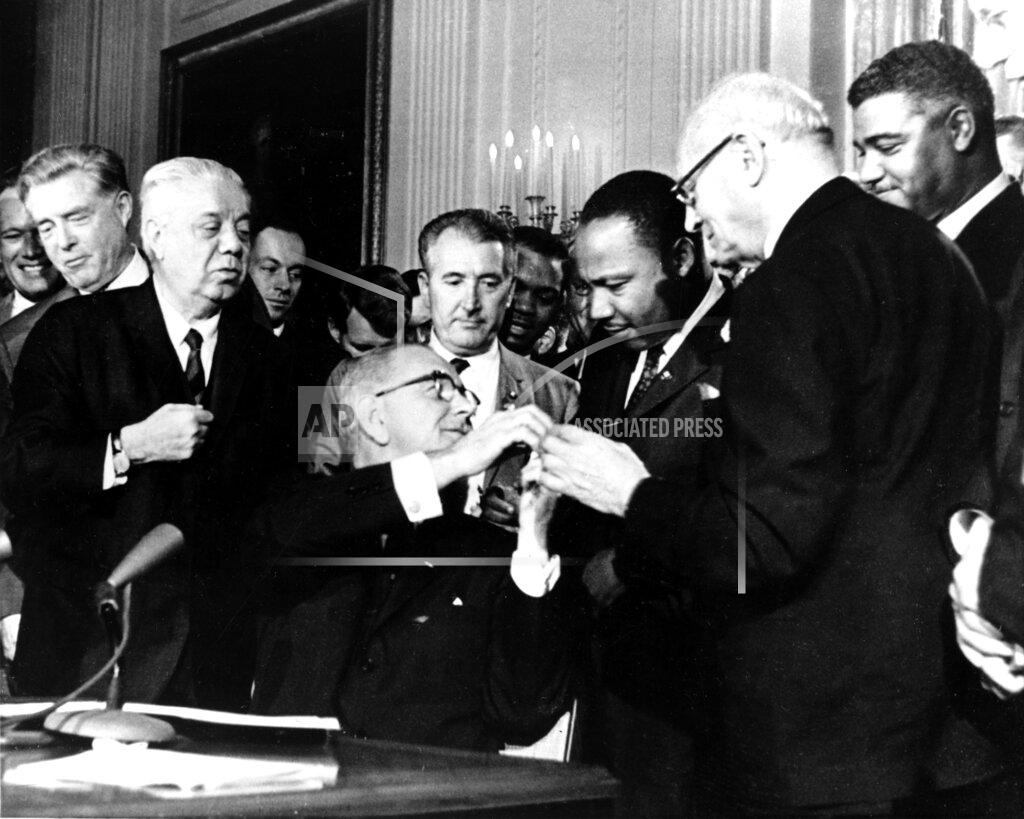
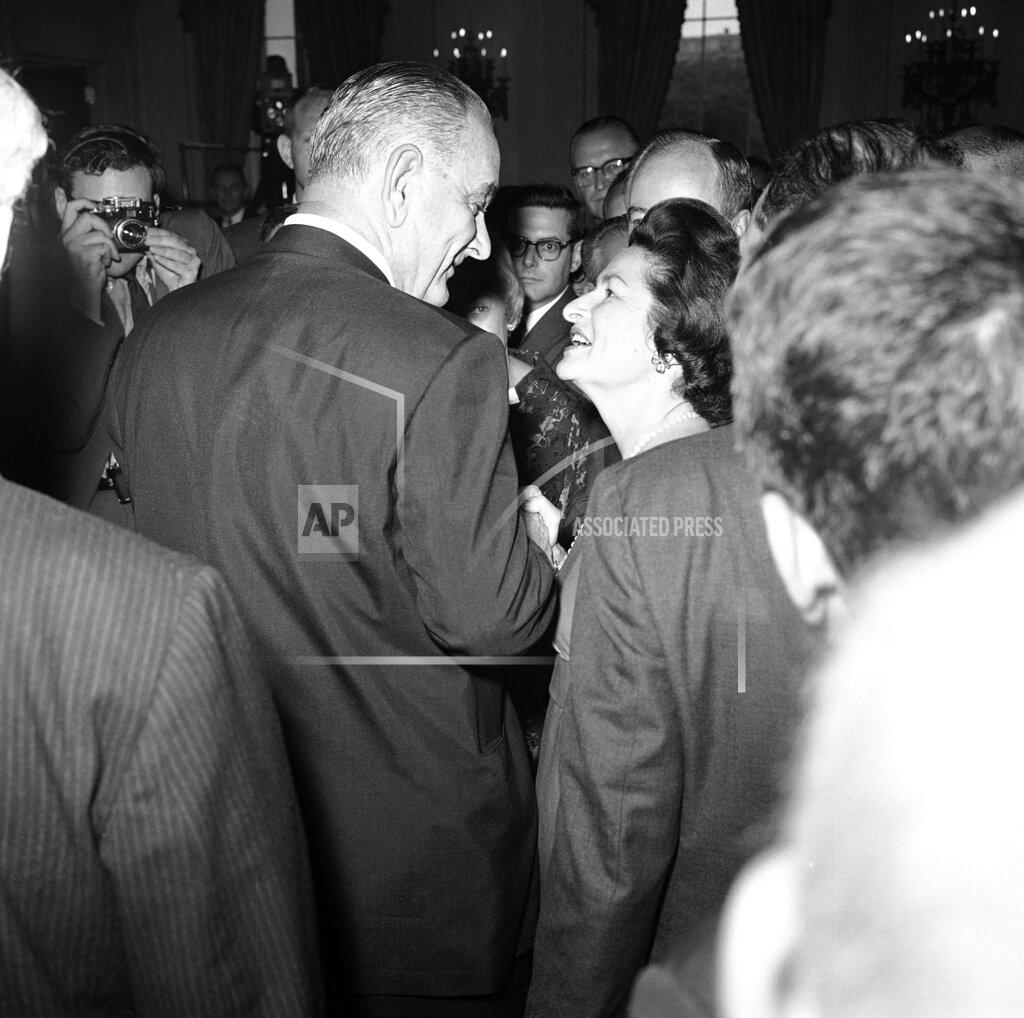
U.S. President Lyndon Johnson signed the Civil Rights Act of 1964 into law, abolishing racial segregation in the United States in public schools, public accommodations and travel, and in voting registration. The move came hours after the U.S. House of Representatives voted 289 to 126 to approve the bill as amended by the U.S. Senate. Of the 126 against, 91 were Democrats (88 from the Deep South) and 35 were Republicans. Charles L. Weltner of Georgia was the only southern Democrat to vote for the bill, saying, “We must not remain forever bound to another lost cause.” The law took effect at 6:45 in the evening Eastern time when President Johnson signed the bill at a White House ceremony in the East Room, commenting that “Years ago I realized a sad truth. To the extent that black people were imprisoned by racial segregation, so was I.”
It is the most far‐reaching civil rights law since Reconstruction days. The President announced steps to implement it and called on all Americans to help “eliminate the last vestiges of injustice in America… Let us close the springs of racial poison,” he said in a short television address. The President signed the bill in the East Room of the White House before television cameras shortly before 7 o’clock. That was about five hours after the House of Representatives had completed Congressional action on the sweeping bill. Among other things, it prohibits discrimination in places of public accommodation, publicly owned facilities, employment and union membership and federally-aided programs.
The House approved, by a vote of 289 to 126, the changes that the Senate had made. All provisions of the measure became effective with President Johnson’s signature except the one prohibiting discrimination in employment and union membership. This one goes into effect a year from now. In announcing his implementation program, the President said he was, as had been previously indicated by White House sources, appointing former Governor LeRoy Collins of Florida as director of the new Community Relations Service. Mr. Collins is now president of the National Association of Broadcasters. Among other implementation steps, the President said he would name an advisory commission to help Mr. Collins resolve disputes arising under the bill. He will also ask Congress, Mr. Johnson said, for a supplemental appropriation to finance initial operations under the new law.
President Johnson asked the American people tonight to make the civil rights law work, but he promised that the full resources of the Federal Government would be applied if needed. In a ceremony at the White House for the formal signing of the bill, which was completed by the House of Representatives this afternoon, the President itemized five steps he has taken or will take to implement the purposes of the bill. These were:
He will send to the Senate the nomination of former Governor LeRoy Collins of Florida to be chairman of the Community Relations Service, created under the bill to assist communities to resolve disputes arising under the bill.
He will appoint an advisory committee to assist Governor Collins’s group.
He will ask Congress for a supplemental appropriation to finance initial operating procedures under the act.
He has directed all agencies of the government to give their full support in the implementation of the act.
He has asked appropriate officials of the government to meet with representative groups to promote a spirit of compliance.
“We must not approach the enforcement of this law in a vengeful spirit,” the President said. “Its purpose is to provide a more abiding commitment to freedom, a more constant pursuit of justice, and a deeper respect for human dignity. “This is why the Civil Rights Act relies first on voluntary compliance, then on the efforts of state and local communities to secure the rights of citizens. It provides for the national authority to step in only when others cannot or will not do the job.”
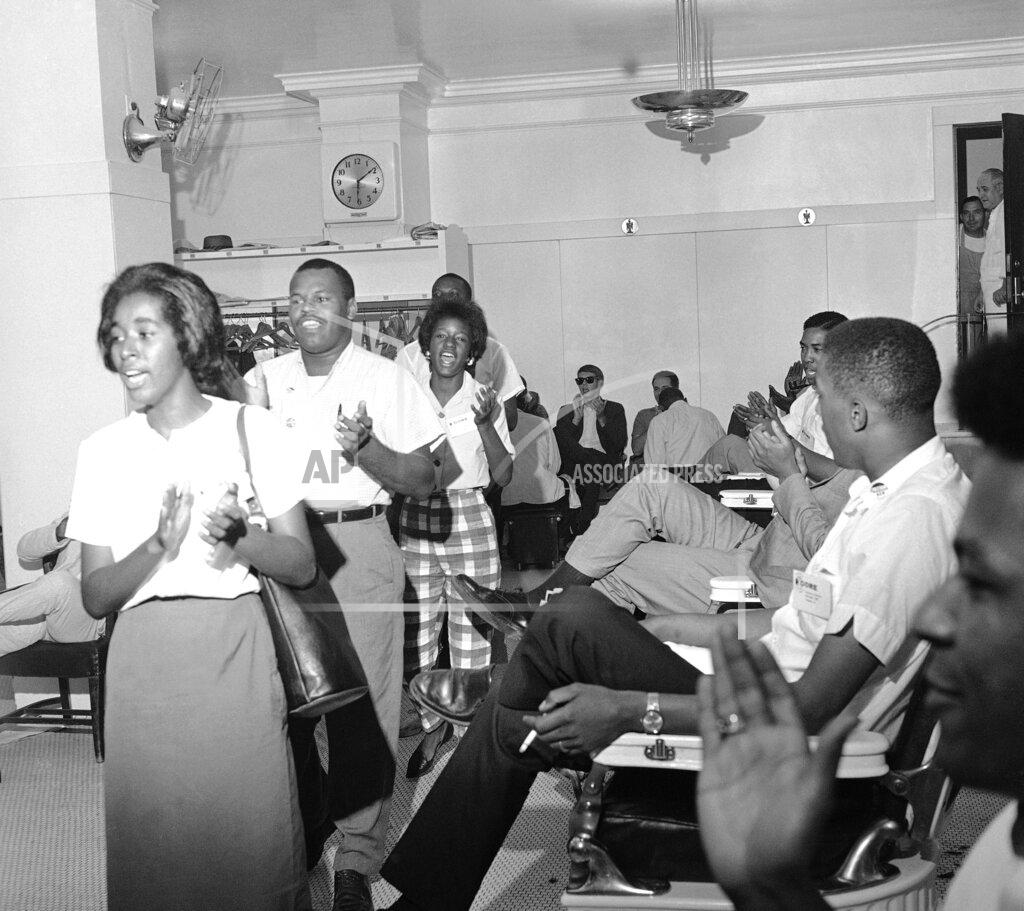
After watching the signing of the bill on national television, two African-American men in Jacksonville, Florida, became the first to put the desegregation law to a test. Robert Ingraham and Prince McIntosh “went to a cafeteria where they previously had been arrested when they previously had been arrested when they sought service” and were asked “May I help you?” by a white employee behind the counter. The manager of the Morrison’s Cafeteria told a reporter, “We decided to go along and obey the law of the land. There were no incidents.”
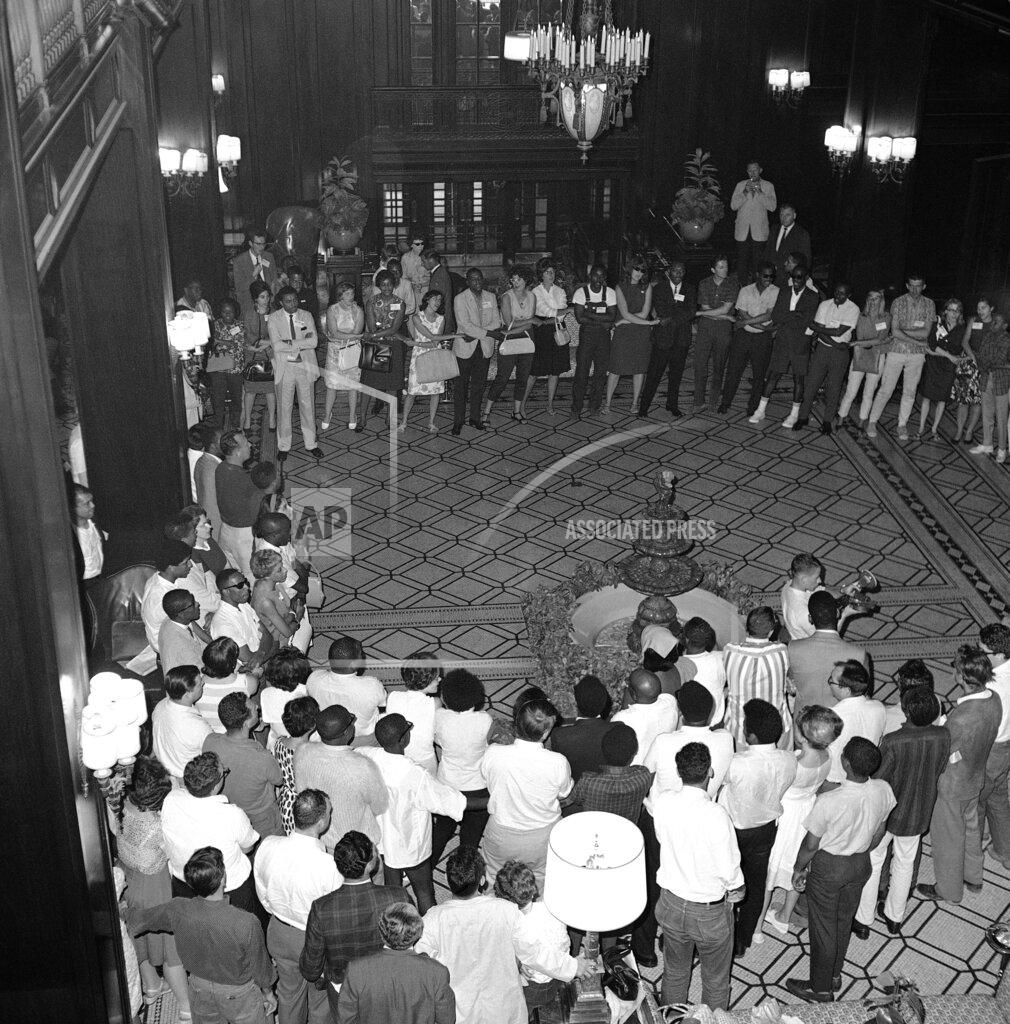
John Paul of Ossining, New York, walked down the streets of a community that does not want him today. Mr. Paul is white, well mannered, a college senior, the kind of young man that most small towns delight in, but as he walked in Itta Bena, Mississippi, white people looked away. When he and a friend asked at a drugstore for a universal digestive remedy, they were told none was in stock. This is Hospitality Month in Mississippi, but the only time local residents stopped to talk with him and his white colleague, Roy Torkington, 24 years old, of Santa Monica, California, they told them to leave town. Today Mr. Paul walked back to the Black section of town. Some Blacks watched speculatively from their houses. Some seemed glad he was there. Some were frightened.
Mr. Paul wants to rent a house in the Black section to serve as a library, community hall and voter registration center. The house‐finding mission is not the kind of job most Hamilton College seniors seek. Last summer Mr. Paul earned $100 a week as a ditch digger. He will earn no money in Itta Bena. He and Mr. Torkington and the third member of their team, William McGee, 23, a Black from Itta Bena, are members of the Mississippi project of the Council of Federated Organizations. The three youths have $30 a month to spend on rent, but they haven’t found a house yet. Whether by chance or not, several times they have called at houses only to find the prospective landlords missing. Once they found an excellent house, vacant and available. The owner worked on a plantation in the country. He said that $30 a month sounded good and that he needed the money badly. But his wife was afraid that renting the house might cause them trouble.
Senator Barry Goldwater is seriously disturbed that racial tensions may become an explosive issue in the Presidential campaign and that one of his own campaign appearances may be the fuse to set off violence. Last night Mr. Goldwater gave long, and apparently agonizing, thought to the ugly possibilities of the civil rights issue. If he wins the Republican Presidential nomination, the Arizona Senator is thinking of calling a meeting of some religious and academic figures, plus his own political advisers, to suggest to him how he could keep race from being a campaign issue. These views, and Mr. Goldwater’s thoughts on other subjects, became known today from reliable sources.
Mr. Goldwater voted against the civil rights bill this year, and in campaign speeches he has deplored civil disobedience campaigns by civil rights groups. But he has also consistently deplored prejudice, citing his own record of steps to end discrimination in various Arizona institutions. As reported by reliable sources, Mr. Goldwater’s feelings are these: He would not blame the Democrats for making his civil rights record an issue. If he were a Democrat, he would do so himself. What worries him is that political and journalistic attacks picturing him as a sort of bigot will lead both some Blacks and some bigots to believe just that, and that this could lead to clashes, very possibly violent. He regards the racial situation as very dangerous and something that could blow up. In fact, he thinks it probably will.
The Senate approved today a bill to give $564.2 million in annual pay increases to 1.7 million Government employes, executives, legislators and judges. It rejected proposed amendments in almost wholesale lots and held firmly to the recommendations of its Civil Service Committee, except on raises for Supreme Court Justices. Senator Gordon Allott, Republican of Colorado, called for a cut of $5,000 in the recommended increase for members of the Court, including the Chief Justice. He won, 46 to 40.
The Senate passed tonight a bill authorizing appropriations of $1 billion for the Federal highway program in the fiscal years 1966 and 1967. The funds, to be matched by the states, are for the construction of primary, secondary and urban highways. President Johnson had asked for an authorization of $975 million, the present level, for each of the two years.
The National Labor Relations Board decertified the Independent Metal Workers Union as a collective bargaining agent for the Hughes Tool Company (and effectively for any other companies whose employees were members of the IMWU) because of the union’s policy of racial segregation and because the union “had failed to fairly represent all workers at the company and systematically discriminated against African Americans” on matters of wages and benefits.
Grand jury indicts Byron De La Beckwith in murder of Medger Evers.
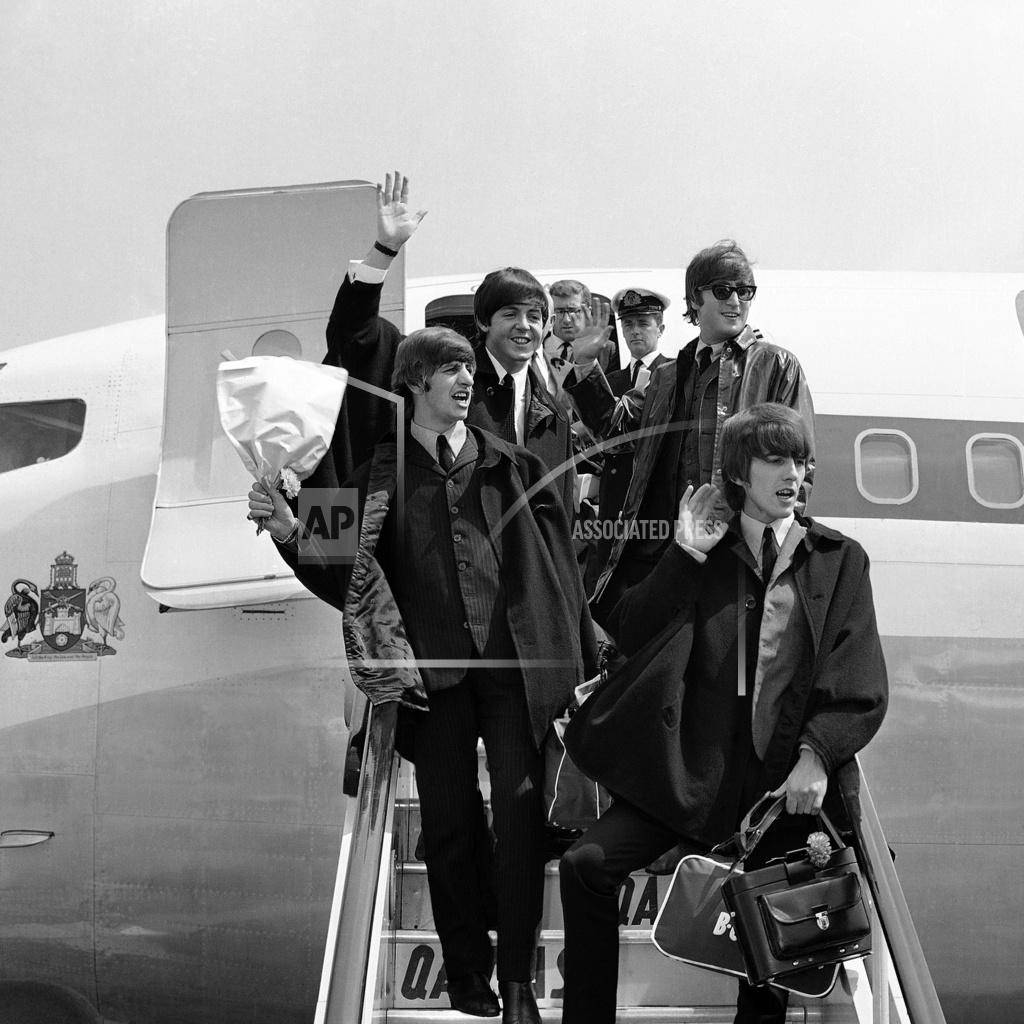
Cilla Black records Lennon/McCartney song “It’s For You”, Paul McCartney plays piano.
Mickey Mantle, who appears at times as if he can hardly walk, ran full tilt to get a triple in the 15th inning last night and a minute later trotted home easily on Hector Lopez’s single to give the New York Yankees a 4–3 victory over the Kansas City Athletics. The Bombers’ second Suburban Night at Yankee Stadium started at 6 PM before 14,308. It didn’t end until 10:41. Trailing by 3–0 midway through the game, the Yanks came back to beat one of their most surprising tormentors of the season. It was only the fifth time New York has beaten the A’s in nine games this year. Bobby Richardson of the Yanks hit his second homer of the year into the right‐field seats in the eighth inning to tie the game, but it was Mantle and Lopez who did the big job seven innings and a couple of hours later.
At Memorial Stadium, the California Angels beat the Baltimore Orioles, 10–6. Willie Smith had 4 hits, including a 9th inning tie-breaking grand slam, as he drove in 6 runs. Jackie Brandt had a pair of homers good for 4 RBIs for the Orioles. The loss trimmed the Orioles’ first‐place margin over New York Yankees to three games.
John Callison hit a two‐run homer and Clay Dalrymple singled in the deciding run tonight as the Philadelphia Phillies scored a 3–2 victory over the Los Angeles Dodgers. The Phillies, who remained one and a half games behind the league-leading San Francisco Giants, scored all their runs in the third inning. The run that won the game was unearned because of a throwing error by the third baseman, Derrell Griffith. Frank Howard of the Dodgers belted a 470‐foot homer — the longest ever hit in a National League game at Dodger Stadium — but the bases were empty when he connected.
Orlando Cepeda’s two-run homer today paced the San Francisco Giants to a five‐run sixth inning, a 6–5 victory over Pittsburgh and the National League leaders’ 12th triumph in their last 14 games. Cepeda’s smash over the right‐field fence scored Willie McCovey, who had singled. Before the inning was over, the Giants were aided by singles from Jim Hart, José Pagan, Jesus Alou and Hal Lanier, a walk and a wild pitch. The uprising came primarily at the expense of the Pirates’ starter, Steve Blass, who suffered his fifth defeat against three victories.
Dow Jones Industrial Average: 841.47 (+3.41).
Born:
José Canseco, Cuban-born American MLB outfielder and designated hitter (World Series Champions, 1989-A’s, 2000-Yankees; Home run leader, 1988, 1991; All-Star, 1986, 1988-1990, 1992, 1999; Oakland A’s, Texas Rangers, Boston Red Sox, Toronto Blue Jays, Tampa Bay Devil Rays, New York Yankees, Chicago White Sox), in Havana, Cuba.
Ozzie Canseco, Cuban-born MLB outfielder and pinch hitter (Oakland A’s, St. Louis Cardinals), twin brother of José, in Havana, Cuba.
Joe Magrane, MLB pitcher (St. Louis Cardinals, California Angels, Chicago White Sox), nicknamed “Maddog”, in Des Moines, Iowa.
Hassan Jones, NFL wide receiver (Minnesota Vikings, Kansas City Chiefs), in Clearwater, Florida.
Anthony Bell, NFL linebacker (St. Louis-Phoenix Cardinals, Detroit Lions, Los Angeles Raiders), in Miami, Florida.
Bill Leach, NFL tackle (New Orleans Saints), in Baltimore, Maryland.
Paul Lawless, Canadian NHL left wing (Hartford Whalers, Philadelphia Flyers, Vancouver Canucks, Toronto Maple Leafs), in Scarborough, Ontario, Canada.
Maurice Martin, NBA small forward (Denver Nuggets), in Liberty, New York.
Andre Moore, NBA small forward and power forward (Denver Nuggets, Milwaukee Bucks), in Chicago, Illinois.
Dave Parsons, British rock bassist (Bush, 1992-2002 – “Swallowed”; Transvision Vamp), in Hillingdon, England, United Kingdom.
Doug Benson, American comedian (The LEGO Batman Movie), in San Diego, California.
Died:
Glen “Fireball” Roberts, 35, American stock car driver, following injuries and burns sustained in a crash during the World 600, nearly six weeks earlier on May 24.

 History Diaries