*
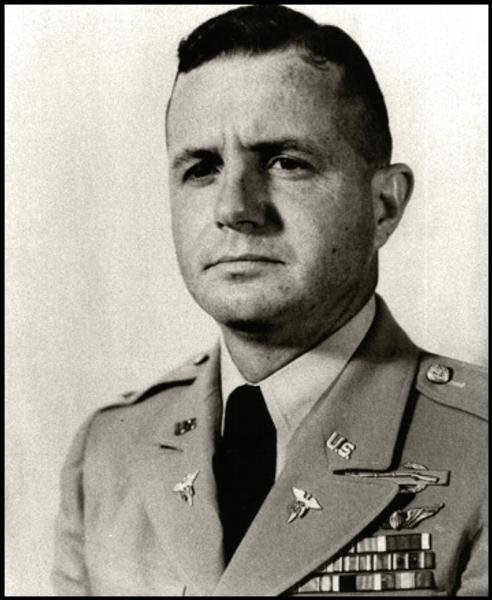
Distinguished Service Cross
Awarded for actions during the Vietnam War
The President of the United States of America, authorized by Act of Congress, July 9, 1918 (amended by act of July 25, 1963), takes pride in presenting the Distinguished Service Cross (Posthumously) to Major (Medical Corps) Charles L. Kelly (ASN: 0-70399), United States Army, for extraordinary heroism in connection with military operations involving conflict with an armed hostile force in the Republic of Vietnam, while serving as an Aircraft Commander of the 57th Medical Detachment, on 1 July 1964. Major Kelly demonstrated exceptional courage, strong determination, and complete disregard for his own personal safety while participating in an aerial medical mission to evacuate wounded soldiers from an area under heavy attack by hostile forces. With unique professional skill and full knowledge of the intense ground fire and the immediate proximity of the enemy, he landed the unarmed helicopter ambulance close to the wounded men in the exposed area. Although the ground advisor warned him of the grave danger and recommended departure, Major Kelly refused to leave without the wounded soldiers and succeeded in loading them aboard the helicopter moments before he was mortally wounded by hostile gun fire. Major Kelly’s extraordinary heroic actions, valiant efforts, and deep concern for his fellow man are in the highest traditions of the United States Army and reflect great credit upon himself and the United States Army Medical Service, and the armed forces of his country.
General Orders: Department of the Army, General Orders No. 40 (December 11, 1964)
Action Date: July 1, 1964
*
His “DUSTOFF” became the callsign for all aeromedical missions in Vietnam, and “When I have your wounded” became the personal and collective credo of the many gallant medevac pilots who followed him.
Charles is buried at Screven County Memorial Cemetery, Sylvania, Screven County, Georgia. He is remembered on the Wall at Panel 1E, line 57.
Both sides in Vietnam are now engaged in a barely-secret war in violation of the Geneva Accords. The Hồ Chí Minh Trail is being turned into a modern route to carry the tons of weapons, ammunition, food and other necessities for the Việt Cộng and the increasing numbers of North Vietnamese regular troops infiltrating into South Vietnam. Engineer battalions using modern Soviet and Chinese machinery are building roads and bridges capable of handling heavy trucks and a whole network of support facilities are also being built — antiaircraft defenses, underground barracks, workshops, warehouses, fuel depots and hospitals.
Meanwhile, the various clandestine activities called for by Oplan 34A are well underway. The Royal Laotian Air Force, strengthened by more T-28s, and U.S. planes from Yankee Team are now conducting regular missions in Laos. The DeSoto Mission is operating off North Vietnam’s coast, and Admiral Ulysses Grant Sharp, Jr, American commander in the Pacific, orders the Seventh Fleet to deploy the aircraft carrier USS Ticonderoga and its ancillary force, at the entrance of the Tonkin Gulf; the destroyer USS Maddox is ordered over from Japan to engage in DeSoto electronic ‘eavesdropping.’
And in Laos this month, U.S. military advisers assist the Laotian army in a ground operation to clear the junction of the road from the Plain of Jars with the road between Vientiane and Luang Prabang; this Operation Triangle (or Three Arrows) involves U.S. Army advisers with Laotian regiments also U.S. ground controllers for strikes by U.S. airplanes.
A Việt Cộng sniper kills a U.S. helicopter pilot and injures three other Americans who were picking up a wounded serviceman. At a news conference in Saigon, a U.S. military spokesman reports that U.S. helicopters are now flying 1300-1400 hours a week, and this explains the rising losses of U.S. aircraft and personnel.
Secretary of State Dean Rusk softened today the tone of recent warnings from the Administration on the risks of war in resisting Communism in Southeast Asia. He said at a news conference that peace with the independence of non‐Communist nations was Washington’s ultimate objective and that peace “ought to be possible in Southeast Asia without any extension of the fighting.” But he added that peace could not be obtained by “acquiescence to aggression” by Communists in South Vietnam and Laos. The Secretary’s comments were carefully qualified at every turn. He refrained from disclosing any moves planned by the Administration in Southeast Asia.
On the one hand, the Secretary said, peace in the region “is not obtained by going and looking for a war.” On the other hand, he added, “there is always the risk of further development in dangerous confrontations of this sort.” One questioner asked Mr. Rusk if the Administration had not confused the country recently by blowing “hot and cold” on its Southeast Asia policy, by alternately emphasizing “our willingness to go to war to protect our interest” last week and “our passion for peace” this week. The Secretary replied that such “changing fads may be changing trends in the way in which speeches are reported.” He noted, for instance, that in a speech in Minneapolis Sunday President Johnson had emphasized his dedication to peace. The President’s speech was widely reported as having contained the warning that the United States, “when necessary,” would not hesitate to “risk war” to preserve the peace.
The U.S. Senate confirmed without dissent today President Johnson’s appointment of General Maxwell D. Taylor as Ambassador to South Vietnam and U. Alexis Johnson as Deputy Ambassador. The appointments were approved by voice vote. The Senate Democratic leader, Mike Mansfield of Montana, praised General Taylor as a man of “extraordinary ability and integrity.” General Taylor, former Chairman of the Joint Chiefs of Staff, replaces Henry Cabot Lodge.
President Makarios of Cyprus rejected today the appointment of “any advisers or assistants” to the United Nations mediator on the Cypriote crisis. The United States had suggested the appointment of a leading American to assist Sakari S. Tuomioja, the United Nations mediator. Archbishop Makarios said such a move “would raise the danger of the Cyprus question becoming involved in circles outside the United Nations.”
The archbishop also announced that he would not attend the forthcoming conference of Commonwealth Prime Ministers in London because of the situation in Cyprus. The Cypriot leader was said to have decided not to attend the conference, which begins next week, because of the attitude of the British Government as reflected in the communiqué issued after the talks on Monday between the British Prime Minister, Sir Alec Douglas-Home, and Premier İsmet İnönü of Turkey. Informed sources said that Sir William Bishop, the British High Commissioner, had spent an hour with the archbishop today trying unsuccessfully to dissuade him from his decision to stay home.
The British‐Turkish communiqué reaffirmed the validity of the Cyprus treaties and Constitution denounced by President Makarios, thus worsening the already bad relations between Britain and Cyprus. In view of this the President also was said not to wish to expose himself to possible hostile demonstrations in London. The 1959 treaties give Britain, Turkey and Greece the right to intervene to maintain the status quo in the island republic. In some quarters there was speculation that Archbishop Makarios may have decided not to absent himself from Cyprus because of the apparent ascendancy of General George Grivas on the political‐military scene here. President Makarios named Foreign Minister Spyros Kyprianon to represent Cyprus at the London meeting, United Press International reported.
Meanwhile, the United Nations command and General Grivas unofficially praised each other’s presence on the island. Until today the former leader of the Cypriot fight for independence from Britain had avoided any mention of the United Nations peacekeeping efforts here. The United Nations, for its part, had gone no further than a cautious expression of hope that the general’s presence would help to ease tensions. This reluctance to make a public assessment of each other’s role on Cyprus apparently was put aside at an unofficial, fifty‐minute meeting today between General Grivas and Galo Plaza Lasso, United Nations special representative on Cyprus. A Turkish Cypriot spokesman said that his people viewed the meeting “with regret and surprise.” The least they expected of United Nation officials, the spokesman said, was to “keep away from such a person” whose activities he called illegal and contrary to the Security Council’s resolution asking restraint in the Cyprus crisis.
President Joseph Kasavubu asked Moise Tshombe today to explore means of forming a government of transition. In a brief communique broadcast over the Congo radio, Mr. Kasavubu said he had requested the deposed President of Katanga Province to undertake a “mission of information.” He said Mr. Tshombe had accepted the assignment and had promised to report back as soon as possible. Mr. Tshombe returned to the Congo last week after a year’s exile in Europe. The secessionist movement that he headed in Katanga, the Congo’s richest province, was suppressed by United Nations troops in January, 1963. Mr. Tshombe, opening consultations with political leaders, met for two hours this afternoon with Premier Cyrille Adoula. President Kasavubu accepted Mr. Adoula’s resignation yesterday but asked him to stay on as head of a caretaker government until a government of transition could be formed. It will prepare national elections within nine months.
The Algerian Government disclosed today that a rebellion was under way in the desolate Aureès Mountains, 200 miles southeast of Algiers. The disclosure came in an emotional broadcast by President Ahmed Ben Bella when he called on dissident officers to desert the “criminal enterprise.” The revolt is led by Colonel Mohamed Chabani, who was abruptly expelled in absentia last night from his posts in the ruling National Liberation Front party. Colonel Chabani was accused of “insubordination” and “Subversive activities in the south.” A communiqué of the 17‐member Political Bureau, the party’s high command, said his actions “in recent days have taken an antinational turn.”
The colonel was ousted from both the Political Bureau and the party’s 106‐member Central Committee. The strength and scope of the colonel’s revolt remained uncertain tonight. However, the Ben Bella regime announced that advancing loyalist troops had entered “without incident” several major towns on the fringes of the Sahara — Bou Saada Djelfa, El Kantara and Biskra. Biskra, an oasis city believed to be rebel headquarters, had been reported in Colonel Chabani’s hands since yesterday. No reports reached Algiers of shooting between loyal National People’s Army units and the Aurès rebels. The colonel’s troops come from his old command, the Fourth Military Region, embracing part of the Aurès Mountains and the eastern Sahara. An Algerian spokesman said the basic conflict stemmed from Colonel Chabani’s persistent refusal to give up his Aurès “fiefdom” in the face of President Ben Bella’s orders.
Field Marshal Mohammad Ayub Khan, president of Pakistan, visited Kabul briefly, where he met King Mohammad Zahir. For the first time in several years, relations between Afghanistan and Pakistan were relatively amicable following the decision of the government of Afghanistan to deal with the Pakhtunistan dispute only through diplomatic negotiations, and to carry on normal relations with Pakistan in other respects.
Prime Minister Lal Bahadur Shastri announced tonight “with a great deal of sadness” that, on his doctors’ advice, he had canceled his trip to London for the conference of Commonwealth Prime Ministers. Mr. Shastri was stricken last Friday with what was reported to have been a heart attack. The “strain of the journey and the heavy program in London” were given as reasons for the cancellation. It was announced that Mrs. Indira Gandhi, Minister of Information, and T. T. Krishnamachari, Minister of Finance, would represent India at the London conference. Mrs. Gandhi is the daughter of the late Prime Minister Nehru. Her designation as one of Mr. Shastri’s substitutes appeared to support predictions here that she would soon take over the Foreign Affairs portfolio, now held by Mr. Shastri.
President Heinrich Lübke of West Germany was elected today to a second five‐year term at a meeting in West Berlin of the Federal Assembly. The meeting was held in West Berlin despite the objection of the Soviet Union. In a protest to the United States, Britain and France last week, Moscow termed the proposed meeting a “provocation.” It said such a meeting would violate the four‐power World War II agreement on the status of the city.
The British and French Governments have decided to conduct a preparatory geological survey this summer for the construction of an English Channel tunnel, Ernest Marples, Britain’s Minister of Transport, told the House of Commons today. The announcement was received with satisfaction by the House except for a few shouts of derision from the Opposition Labor benches. Last February, 162 years after a link under the channel between Britain and France was first proposed to Napoleon by a French engineer, the two governments agreed in principle to construct a rail tunnel to connect the countries. Mr. Marples replied that the government was still a long way from placing contracts, but added that it was hoped to start this summer after the bids had been assessed.
Senator Everett McKinley Dirksen said today that Senator Barry Goldwater’s drive for the Republican Presidential, nomination could not be stopped, even by former President Dwight D. Eisenhower. “This thing has gone too far,” the Illinois Senator said. Mr. Dirksen, the Senate Republican leader, made the assertion at a news conference at which he said he would place the Arizona Senator’s name in nomination at the Republican National Convention.
The move was viewed as a heavy blow to the late‐starting campaign of Governor William W. Scranton to win the nomination. Mr. Dirksen said that Mr. Goldwater would win the contest even if General Eisenhower threw his support to the Pennsylvania Governor. John Eisenhower denied tonight a report that his father had agreed to nominate Governor Scranton at the convention. Meanwhile, Henry Cabot Lodge, former Ambassador to South Vietnam, conceded that he still lacked a battle plan to stop Mr. Goldwater. However, he said he was confident that something could be done by the opening of the convention and insisted that Mr. Goldwater’s present delegate strength could be chimerical.
The view that Mr. Goldwater could not be stopped was shared by many observers. Recent political developments have seemed to help the Arizonian and to frustrate Mr. Scranton. Since Monday these developments have taken place:
The 40‐member New Jersey delegation, in a holding action that favored Mr. Goldwater, declined to commit itself even though a majority was inclined toward Mr. Scranton.
The 58‐member Illinois delegation, in contrast, was polled and Senator Goldwater received the first‐ballot support of 48 delegates and the probable support of five more.
Governor George Romney of Michigan virtually released the state’s 48 delegates from their obligation to vote for him as a favorite son.
At the convention, opening July 13 in San Francisco, 655 votes are needed to win the nomination. Mr. Goldwater claims about 690 votes. Many close observers believe that Senator Dirksen bowed to political realities and threw his full and open support to Mr. Goldwater when he concluded that Mr. Goldwater’s nomination was inevitable. At his news conference today, however, the Illinois Senator said that his decision “represents my person‐ al preference—this represents a conviction.” The allegiance of Mr. Dirksen was, perhaps. more important to Mr. Goldwater’s cause than the arithmetic of delegate polls. As a backer of Senator Robert A. Taft, Mr. Dirksen was the man who wagged his finger at Governor Thomas E. Dewey of New York at the 1952 convention and said that liberal Republicans had led the party down the path to defeat. But in the intervening years Mr. Dirksen has shed much of his old conservatism and has become the model of bipartisan responsibility in senatorial and national affairs.
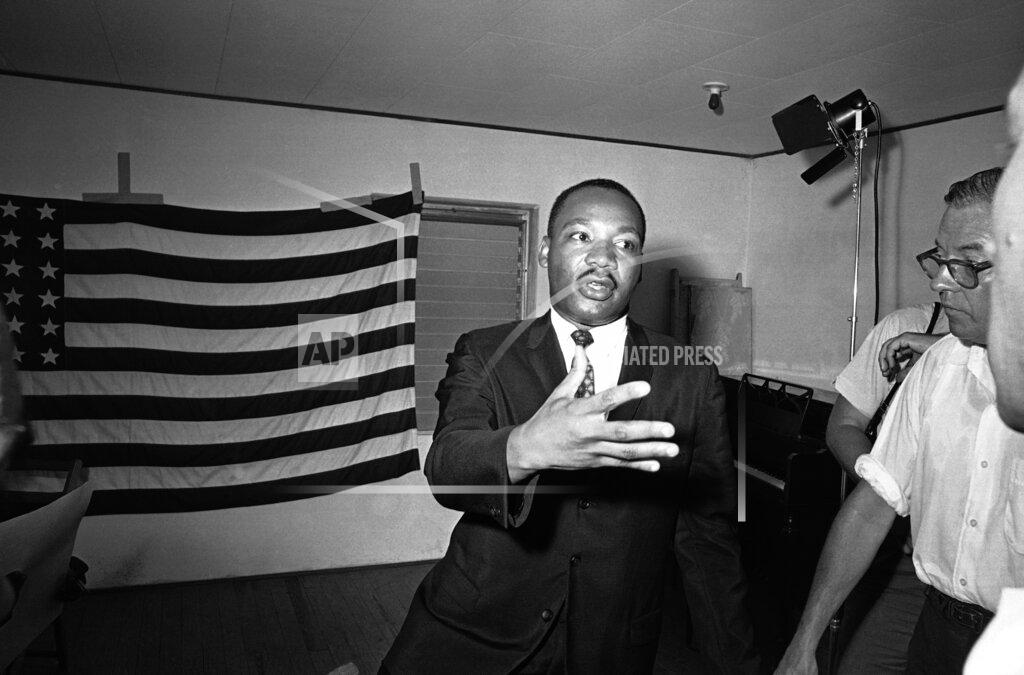
Plans for a massive testing by Blacks of the South’s compliance with the pending civil rights law were announced today by the Rev. Dr. Martin Luther King Jr. At the same time, more than 80 hotel, motel and restaurant owners in this city that has been plagued by racial turmoil in recent weeks decided almost unanimously that they would comply with the law. In Washington it was reported that the civil rights bill, following final passage by the House on Thursday, would be signed by President Johnson tomorrow night in a televised ceremony.
Dr. King told a press conference that a two‐phase program would be opened by his Southern Christian Leadership Conference soon after President Johnson had signed the bill. The first phase will be called Operation Dialogue, Dr. King said. Local affiliates of the conference will sound out business and community leaders all over the South and seek to persuade them to announce their compliance with the law. Then, after about a week, the second phase, Operation Implementation, will be started. This, Dr. King said, will consist of actual testing of restaurants, hotels, motels and other businesses to determine whether they will serve Blacks. Those who turn Blacks away will face lawsuits in Federal courts, Dr. King said.
Six Deep South cities have already indicated they will flout the law, Dr. King said, and these cities will face “massive direct-action programs” similar to that staged in St. Augustine. He listed the cities as Birmingham, Tuscaloosa, Montgomery, Selma and Gadsden, all in Alabama, and Albany, Georgia. He said he would meet on Monday in Birmingham with Alabama civil rights leaders to plan for the drive in the Alabama cities. Dr. King said he would appear before the Republican National Convention platform committee in San Francisco on Tuesday. He praised Savannah, Georgia, for its initial steps in desegregating its public accommodations and said his conference would seek to hold up Savannah as a “model city.”
Dr. King spoke in the hot, bare upstairs hall of the Elks Rest, a Black social center. This city, which had seemed last week on the verge of racial war after a series of violent attacks on Black demonstrators by segregationists, was quiet under a truce. Last night both Dr. King and Holsted (Hoss) Manucy, recognized leader of the extremist white segregationists, said they would call off demonstrations and counterdemonstrations for a few weeks while a biracial committee tries to settle the conflict resulting from the Blacks’ integration demands.
The House of Representatives voted 208 to 198 today to approve all but $200 million of President Johnson’s request for $3.5 billion in foreign aid appropriations. The bill now goes to the Senate. The vote, on a second Republican attempt to cut $447.8 million instead of $200 million, put an end, at least temporarily, to the iron rule by Representative Otto E. Passman, Democrat of Louisiana, over foreign assistance money bills. Mr. Passman is chairman of the appropriations subcommittee on foreign aid. Today’s approval of $3.3 billion in appropriations came after two days of bitter partisan debate. During the debate Mr. Passman was accused by a Republican, Silvio O. Conte of Massachusetts, of asking the House “to submit to a diabolical lie” and Republican leaders accused Democrats of acting as a “rubber stamp” for the Administration.
President Johnson, in a statement issued by the White House, hailed the House action as an “important victory for American foreign policy,” and added: “The House approved a course which is in line with the best interests of America and the best interests of the free world. I congratulate the members who backed a measure which was realistically and honestly conceived. This is an important victory for American foreign policy, and that means for every American citizen.”
In approving $3.3 billion, the House accepted the bill reported by its Appropriations Committee. Today’s crucial and unexpectedly close vote came on a motion by Mr. Passman to send the bill back to the committee with instructions to cut it $247.8 million. The perennial foe of foreign aid had lost earlier by a vote of 171 to 151 when he made the same proposal as an amendment to the appropriation measure.
President Johnson signed yesterday a $2.6 million authorization bill for programs of the Atomic Energy Commission in the fiscal year starting today. The authorization was cut $28.4 million by Congress at Mr. Johnson’s request.
Clemson Agricultural College of South Carolina adopted its current name, Clemson University.
In an event at the Bislett stadion in Oslo, Norwegian athlete Terje Pedersen broke the Men’s javelin world record. Pedersen’s throw of 285 feet, 10 inches broke the record of 284′ 7″ set by Carlo Lievore of Italy on June 1, 1961.
Jack Brandt’s two‐run single in the eighth inning tonight gave the Baltimore Orioles a 4–2 victory over the Los Angeles Angels. With the Angels ahead, 2–1, Willie Kirkland and Jerry Adair opened the eighth with singles. Bob Johnson sacrificed and Brandt hit a single to put the Orioles in the lead, 3–2, Luis Aparicio singled to deep short, and Brandt scored on Bobby Knoop’s error on Boog Powell’s grounder. The Baltimore victory, coupled with the Yankee loss to Kansas City in the afternoon, put the Orioles four games in front in the American League race.
It’s “Taxi Day” at Yankee Stadium and nearly 5,000 cabbies and their families are on hand as Kansas City runs up the meter to win, 5–4. Billy Bryan’s 11th inning solo home run is the decisive blow.
At Crosley Field, the Reds score 4 runs in the bottom of the 9th to tie the Cubs, 5–5. Pete Rose ends the game with a 10th inning homer.
While the Giants’ Juan Marichal is reducing his ERA from 2.54 to 2.44 in the course of a 2–1 win over Bob Veale and the Pirates, Willie Mays and Roberto Clemente resume their personal war for National League hitting honors. Clemente singles twice, drives in the Pirates’ only run, and finishes at .349. Mays doesn’t have much of a chance to close ground; after his first-inning home run, the Bucs’ moundsmen walk him the next three times up. However, the one hit jumps him from .344 to .347. Ironically, the Pirates’ only run is driven in by Clemente when Marichal resorts to a quick pitch with the bases loaded in the fifth.
Clemente speaks with Giants beat writer Bob Stevens: “‘I was trying to smooth out the dirt around the plate,’ Clemente said, ‘not looking, when I hear someone on the bench yell at me. I look up and see the ball, and I try to just punch at it with one hand.’ He got just enough of it to drive it into the ground in front of the plate and bounce it so high that Orlando Cepeda had to wait helplessly for it to come down as the run scored and Clemente fled across the base. Clemente laughed in reminiscence. ‘I don’t remember anybody try to quick-pitch me since Don Bessent do it with Brooklyn. ‘I punch it for double.’”
Dow Jones Industrial Average: 838.06 (+6.56).
Born:
Marlon Jones, NFL defensive end and defensive tackle (Cleveland Browns), in Baltimore, Maryland.
Frank Harris, NFL running back (Chicago Bears), in Waukesha, Wisconsin.
Yu Long, chief conductor of the China Philharmonic Orchestra, in Shanghai, China.
Bernard Laporte, French rugby union player and head coach of the French national team from 1999 to 2007; in Rodez, département of Aveyron, France.
Died:
Roscoe Pound, 93, American legal scholar.
Pierre Monteux, 85, French-born conductor of the Boston Symphony Orchestra, the Amsterdam Concertgebouw Orchestra, the Orchestre Symphonique de Paris, the San Francisco Symphony and the London Symphony Orchestra.
 History Diaries