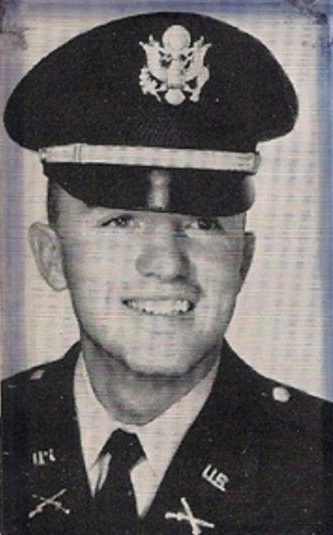
Silver Star
Awarded for actions during the Vietnam War
The President of the United States of America, authorized by Act of Congress July 9, 1918 (amended by an act of July 25, 1963), takes pride in presenting the Silver Star (Posthumously) to Second Lieutenant (Infantry) William Bayles Cawthorne (ASN: 0-5315457), United States Army, for gallantry in action while engaged in military operations on 30 June 1964, in the Republic of Vietnam. Acting as an Aircraft Commander of a UH-1st Battalion aircraft of the 52d Aviation Battalion, Lieutenant Cawthorne displayed fortitude, perseverance, and professional skill while providing armed escort for helicopters participating in a re-supply mission in support of the ground forces of the Republic of Vietnam. When the helicopters became the target of sporadic small arms fire, he skillfully maneuvered his aircraft close to the terrain to cover the departure of the cargo helicopters from the landing zone. Although he sustained a critical bullet wound as his aircraft crashed into rugged terrain, he succeeded in freeing himself from the demolished aircraft. Despite his own mortal wounds, he continued his courageous efforts by successfully evacuating the injured pilot moments before the aircraft was engulfed in flames. His bravery, determination, and unselfish actions assisted the Vietnamese forces in accomplishing their objectives and saved the life of a fellow soldier at the sacrifice of his own. Lieutenant Cawthorne’s conspicuous gallantry is in the highest traditions of the United States Army and reflects credit upon himself and the military service.
General Orders: Department of the Army, General Orders No. 40 (December 11, 1964)
Action Date: June 30, 1964
William is buried at Forest Lawn Memorial Park, Glendale, Los Angeles County, California. He and his crew chief Freddy Dean Dodson of Marshall, Texas are remembered on the Wall at Panel 1E, line 56.
Communist guerrillas shot down a United States Army helicopter in South Vietnam’s northern mountains today, killing the pilot and his gunner. Both were Americans. A U.S. Army helicopter UH-1B (tail number 62-01879) from the 52nd Aviation Battalion was one of two gunships providing protection for unarmed Marine H-34 helicopters which were resupplying ground troops near a little grass-hut village called Phoun San, about thirty-five miles south and west of Da Nang, Vietnam, an area they referred to as “Indian country.” As they entered the LZ aircraft 879 was flying low recon over the area when it came under enemy fire. The pilot, 2LT William B. Cawthorne, sitting right seat, was hit through the right shoulder and chest and unable to recover the helicopter, which crashed. The left seat pilot, CAPT Rodney Turner, suffered severe leg injuries. The crew chief, PFC Freddy D. Dodson, was pinned under the left side skid. The gunner, PFC Peino Salinas, although injured, tried to lift the burning helicopter off PFC Dodson’s legs but was unable and suffered burns on his hands as a result of his efforts.
A swift moving fire consumed the aircraft and PFC Salinas was forced to retreat. He and CAPT Turner would survive their injuries, but both 2LT Cawthorne and PFC Dodson were killed. CAPT Cawthorne was able to exit the helicopter and assisted the other crewmen in getting out, but once outside, he sat down, collapsed, and was pronounced dead upon arrival at the United States Marine Corps, Medical Dispensary at Da Nang. The evacuation of CAPT Cawthorne and the two surviving crew members was accomplished within minutes after the crash, by a Marine Corps helicopter. Operations on CAPT Turner’s left leg shortened it by two inches. PFC Salinas was returned to full duty three days after the crash. PFC Dodson’s remain were recovered and brought back to Da Nang. Soon afterward, the Marines held a memorial service in their chapel for their fallen Army comrades.
It was the third United States helicopter crash in the last five days with a total loss of eight Americans. The crash brought the toll of United States dead in Vietnam to 244, including 148 killed in action. Two American fliers were killed Friday when they were shot down in the Mekong Delta. Four Americans were killed yesterday when a helicopter crashed in Kiến Phong Province.
Both the incoming and outgoing United States Ambassadors to South Vietnam rejected today a proposal by a group of Republicans that the United States take over operational command of the war in that country. “If we do that, we become a colonial power,” Henry Cabot Lodge, the retiring Ambassador, said today. “I think it is pretty well established that colonialism is over,” he added. “It would bring unfortunate results in the form of anti‐American feeling, a tendency to let the Americans do it.” General Maxwell D. Taylor, Chairman of the Joint Chiefs of Staff, who is leaving Saturday night to take over the embassy in Saigon, took the same stand. For one country to take command of the troops of another “is always difficult” and the prospects for success are “always doubtful,” General Taylor said.
Talking to reporters after a closed session with the Senate Foreign Relations and Armed Services Committees, Mr. Lodge said he felt that South Vietnam already had a “competent” commander in General Nguyễn Khánh, the Premier. “This is a little country, but it has brave soldiers and a competent command,” Mr. Lodge asserted. The proposal that the United States take over operational control in Vietnam instead of continuing its present advisory effort was made at a news conference yesterday by Representative Gerald R. Ford. The Michigan Republican released a report signed by 13 Republican members of Congress criticizing the Administration’s defense and foreign policies, including those in South Vietnam. Members of the Republican task force include Representative Melvin R. Laird of Wisconsin, chairman of the Republican convention platform committee. Mr. Lodge is scheduled to go before that committee July 8.
The Polish representative on the International Control Commission said today that the chief of the Laotian pro‐Communists had agreed to a meeting with the rival rightist and neutralist leaders to seek a solution to the crisis dividing the nation. According to the Pole, the head of the pro‐Communist Pathet Lao, Prince Souphanouvong, assented to a proposal that the leaders of the three Laotian factions meet outside the country. Under the proposal, Britain and the Soviet Union, co‐chairmen of the 1962 Geneva conference on Laos; India, Canada and Poland would attend the meeting as observers. India and Canada are also members of the International Control Commission, set up by the Geneva conference to supervise the agreement on the neutrality and independence of the Southeast Asian kingdom. The efforts for a reconciliation meeting of the three rival Laotian groups have been intensified following a renewal of fighting last month on the strategic Plaine des Jarres.
The Pathet Lao forces drove troops of the neutralist faction, which is opposed both to the Communist orientation of the Pathet Lao and the pro-Western stand of the rightists, from the plain. The Premier of Laos, Prince Souvanna Phouma, has expressed concern that the Pathet Lao is preparing another major assault soon. The Polish representative on the Control Commission, Jerzy Dudzinski, flew this morning to Khang Khay, the Pathet Lao headquarters, for talks with Prince Souphanouvong. The prince is Deputy Premier of the coalition regime organized in Laos in 1962. Mr. Dudzinski said that the place for a meeting of the leaders of the three Laotian factions still had to be decided. Premier Souvanna Phouma made the proposal for a meeting in a foreign country.
The Premier had agreed earlier to a Pathet Lao proposal for a meeting on the Plaine des Jarres, but only on the condition that the Pathet Lao troops yielded positions captured from the neutralists. If the Pathet Lao refused to agree to this condition, he said, the only solution was to meet abroad. Mr. Dudzinski said that Prince Souphanouvong had proposed that the meeting be held in Phnom Penh, Cambodia, or Jakarta, Indonesia. The prince was said to have suggested this in a note to Premier Souvanna Phouma yesterday. The Pole said that the pro-Communist leader had no objection to members of the International Control Commission and Britain and the Soviet Union participating in the meeting as observers.
The Navy disclosed today that Charles Klusmann, a jet pilot, apparently chose to allow himself to be captured by Communist forces in Laos early this month rather than risk the lives of a rescue crew. The Navy lieutenant from San Diego was captured by the Pathet Lao after his plane was shot down June 6 while on reconnaissance. Lieutenant Klusmann parachuted from his plane and landed in Communist territory. A rescue helicopter was rushed to pick him up. “As the helicopter approached the area,” the Navy said in a citation accompanying the presentation of the Distinguished Flying Cross to his wife, Lieutenant Klusmann exhibited heroism of the highest order, waving the helicopter off.” Admiral Claude V. Ricketts, Vice Chief of Naval Operations, expressed the hope at the Pentagon presentation ceremony that the lieutenant and his wife, Sara, would be reunited soon.
UNOC, the United Nations Operation in the Congo, came to an end with the withdrawal of the last UN peacekeeping troops from the former Belgian Congo after four years. Major General Johnson Aguiyi-Ironsi, commander of the first Nigerian Battalion and the future President of Nigeria, was the last of the 143 UN men on the force to board the chartered plane. His 85-member contingent, and the 58 men of the 57th division of the Canadian Army were the only remaining UN forces, whose departure coincided with the resignation of Congolese premier Cyrille Adoula.
Cyrille Adoula resigned as Premier of the Congo. President Joseph Kasavubu named him head of a caretaker regime pending the appointment of a government of transition and a national election.
The Secretary General, U Thant, warned the Security Council today that “the immediate outlook” for the, Congo after the withdrawal of the United Nations force was “none too promising.” Mr. Thant said that the situation in the Congo had greatly improved from the “collapse and chaos” that followed Belgium’s grant of independence to the Congo four years ago. But he emphasized that the Congo still needed “wise, imaginative, strong and courageous leadership, effective government and some measure of understanding from the people.” He added that “failure to overcome present dangers would no doubt bring disintegration and ruin.”
U.S. Attorney General Robert F. Kennedy conferred with Stefan Cardinal Wyszynski in Częstochowa today despite a government warning that the meeting could damage relations between Poland and the United States. Mr. Kennedy met with the Roman Catholic Primate of Poland for an hour at the historic Jasna Gora monastery. He said they had “a good and interesting talk on many matters.” Polish authorities are becoming increasingly restive over the American visitor’s emotional reception by the people. For three days Mr. Kennedy has not been able to walk 10 paces along a street before being enveloped by cheering, clapping crowds. In his trip to Częstochowa, the site of Poland’s national shrine, the Attorney General deliberately limited the opportunities for such demonstrations. He did not act, however, on official hints that he should reduce his public appearances and avoid meeting the Cardinal, whom the Government regards as its principal political adversary.
Premier Khrushchev delivered an emphatic warning today against any further United States reconnaissance flights over Cuba. He sought to give the impression that he had already informed the Cubans they had his blessing to shoot down any United States plane in Cuban airspace. The Premier said that the Soviet Union would come to the aid of the Cubans if the United States were to retaliate against them for downing an aircraft. The Soviet leader, who arrived yesterday on an official visit, made these points during a three‐hour talk this morning with a Norwegian Government delegation headed by Premier Einar Gerhardsen. The vehemence of his remarks appeared to startle the Norwegians.
President Humberto Castelo Branco believes that the Brazilian “democratic revolution” has been vindicated by the speed with which legal and institutional order has been restored. In recent conversations, President Castelo Branco has compared the Brazilian revolution with other similar movements in Latin America, Asia, and Africa and has come to the conclusion that no other has restored public affairs to constitutional order so quickly. His explanation for this is that “the former Government was devoted to subversion and the revolution came to restore legality.” In the 90 days since a military and civilian movement overthrew President João Goulart, Brazil has undergone a stern political test. The victorious leaders arrested thousands of persons, conducted military investigations that brought suspension of individual guarantees and instituted a political purge. Now, the atmosphere of repression has receded. Congress and the political parties engage in lively debate with the Government. The press maintains a free-swinging style of criticism of official actions. The Supreme Court is intact and the judicial system is unaltered, although the courts have shown a reluctance to review the actions of revolutionary investigators.
The Senate Rules Committee sought unparalleled powers today to investigate infractions of Senate rules and to recommend punishment up to expulsion for violators. This is the first time in the memory of Capitol Hill veterans that any committee has sought continuing authority to regulate the conduct of Senators. The authority would apply also to Senate employes. Today’s action came as the committee voted, 6 to 2, in favor of amending a resolution voted out yesterday requiring Senators and Senate employes to disclose facts about their outside financial holdings. The amendment was proposed by Senator Joseph S. Clark, Democrat of Pennsylvania. Yesterday he had proposed an amendment with similar enforcement provisions but with stricter disclosure requirements than those the committee finally approved.
This was rejected by a reported 5‐to‐3 vote. It would have required disclosure of all outside holdings and all outside earnings, including capital gains, in excess of $100. It would also have required disclosure of assets held by spouses. The amendment accepted today is designed primarily to enforce compliance with the disclosure provision, but by its wording it is applicable to all other Senate rules, as well. And in the opinion of the committee counsel, Lennox P. McLendon, serious breaches of Senatorial conduct and decorum also fall within the scope of the resolution. No such authority exists at present except that held by the Senate as a whole under the Constitution, which empowers it to regulate the conduct of its members.
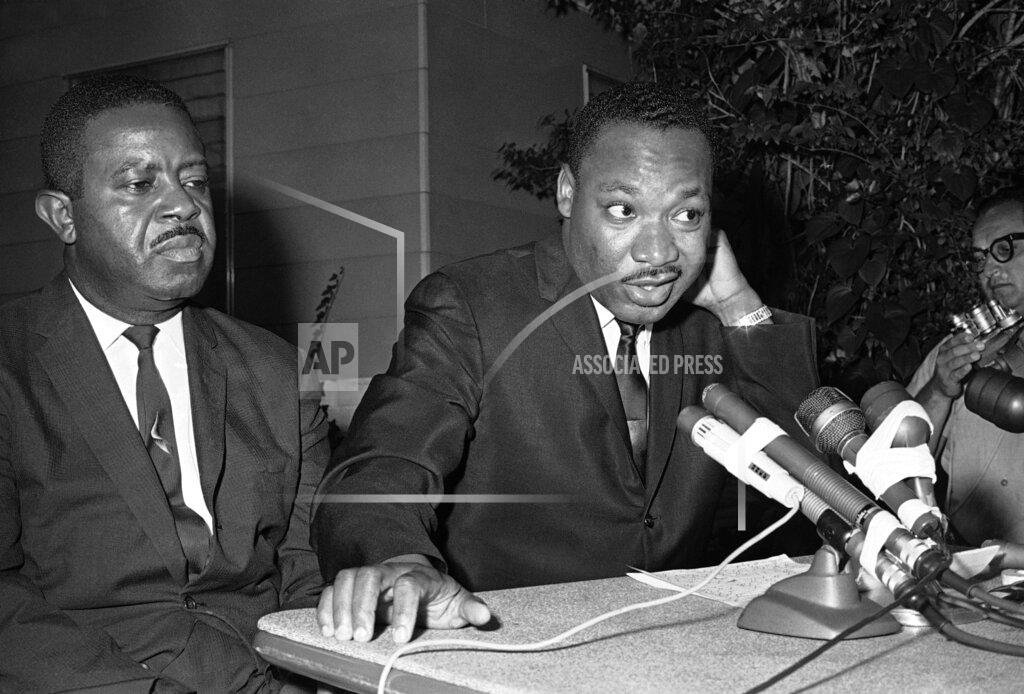
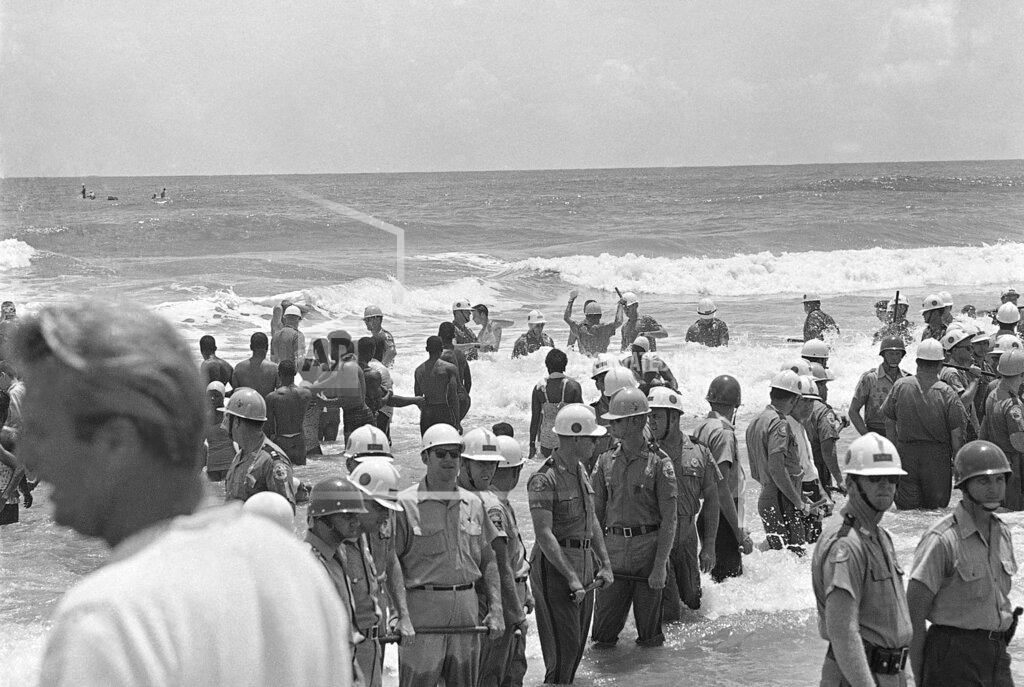
Hopes for racial peace in the old city of St. Augustine, Florida revived tonight with the announcement that Governor Farris Bryant had named an emergency committee to “restore communications” between whites and Blacks. The Rev. Dr, Martin Luther King Jr., leader of the desegregation campaign here, termed the action “a demonstration of good faith” and called off civil rights demonstrations. However, he said he was not leaving St. Augustine until “a meaningful resolution” of the conflict had been worked out. The Governor refused to disclose the membership of the committee, but it reportedly consists of two whites and two Blacks.
The committee will serve until a permanent biracial group to mediate the bitter civil rights dispute is named by a special grand jury investigating the troubles here. Dr. King, too, refused to divulge the names of the emergency committee members. But he said it was made up of “four distinguished citizens” of this city. “We have agreed to withhold the names so that there will be no external harassment of these people,” he said.
Dr. King called the formation of the committee the first step toward a settlement of the problem. “Every 1,000‐mile journey begins with the first step,” he said. “This is merely the first step in a long journey toward freedom and justice in St. Augustine, but it is a creative and important first step, for it at least opens the channels of communications.” However, Dr. King said that after the civil rights bill became law there would be tests of the law through small sit‐ins. Dr. King disclosed that he had gone to court voluntarily to answer a warrant charging him with contributing to the delinquency of minors. The accusation alleged that youths who were wards of the juvenile court were taking part in racial demonstrations. Dr. King was released without bond.
The Rev. Charles M. Seymour Jr., the rector who admitted Blacks to Trinity Episcopal Church on Sunday, June 21, is fighting for his pulpit against a segregationist vestry. At yesterday’s services, Father Seymour announced that on Wednesday he found on his desk a letter from the vestry saying that his resignation would be accepted immediately because of “disagreement over certain policy decisions.” Father Seymour said he had no intention of resigning.
At the end of the 11 AM service, many in the congregation lined up to greet Father Seymour. “God bless you,” many of them whispered. One of the few moderate voices in a town dominated by extremist sentiment on the race issue, Father Seymour has been rector of Trinity Church for 15 years. A year ago, when the Ku Klux Klan beat up several Blacks here, Father Seymour denounced the secret terrorist organization from his pulpit.
The director of the Mississippi Summer Project announced today that civil rights workers would be sent into the southwest part of the state despite reports that white terrorists are armed with automatic weapons and hand grenades. Bob Moses, who arrived here today from Ohio, said adult staff workers would go first into Natchez, McComb, and Amite County and it would be decided later whether to permit students in the area. The southwest corner of the state is considered potentially more dangerous than Neshoba County, in the central section, where three civil rights workers have been missing for nine days and are feared dead.
Five Blacks have been reported killed in the southwest counties in the last six months. Others have been flogged and threatened. There have been bombings and cross‐burnings. Mr. Moses, a slight, pensive Black who has been working in Mississippi for three years, made the announcement at a news conference in the headquarters of the Council of Federated Organizations, sponsor of the civil rights project. He said the decision to go into southwest Mississippi had been made after careful deliberation and with full knowledge that some of the workers might be killed. He said Negroes who lived there faced that possibility every day but nothing had been done to protect them. “If we go and work there,” he said, “we can share the danger with the local Blacks. As it is now, they are completely isolated.” He said there was a need to “open up” areas where Blacks were intimidated daily and to help them organize — “to form some bloc against the white community.”
Mr. Moses said he had information that automatic weapons and hand grenades had been brought into the area through Natchez and distributed to terrorist organizations. He would not disclose the source of his information. “We understand there is a place in Natchez where they say the weapons are funneled out for the Klan,” he said. The Ku Klux Klan is one of the organizations that has been operating in the area recently
Senator Barry Goldwater, his tan face cracked by the biggest smile he has shown in a month, picked up psychologically important new strength in the Middle West today. A poll of the Illinois delegation to the Republican National Convention, after it heard addresses by Mr. Goldwater, Governor William W. Scranton of Pennsylvania and Harold E. Stassen, former Governor of Minnesota, gave Mr. Goldwater 48 of the 58 votes. Five more delegates at the meeting in Chicago said they were leaning strongly toward Mr. Goldwater. The rest were uncommitted.
Henry Cabot Lodge met with former President Dwight D. Eisenhower today in an effort to win the general’s active support for Governor William W. Scranton’s campaign for the Republican Presidential nomination. He declined to say whether he had succeeded, and General Eisenhower had no comment on the conference. But Mr. Lodge said he was happy, “on the whole,” over the outcome of the 45‐minute talk. The meeting took place in the Presidential suite of the Army’s Walter Reed Medical Center, where General Eisenhower had gone for a checkup.
Twenty-two employees of the Reading and Bates Drilling Company were killed, and 26 injured, in the explosion of an offshore oil platform in the Gulf of Mexico, about 72 miles (116 km) off of the coast of Morgan City, Louisiana. Only nine bodies were recovered, and the remaining 13 were presumed to have sunk with the rig in 185 feet (56 m) of water.
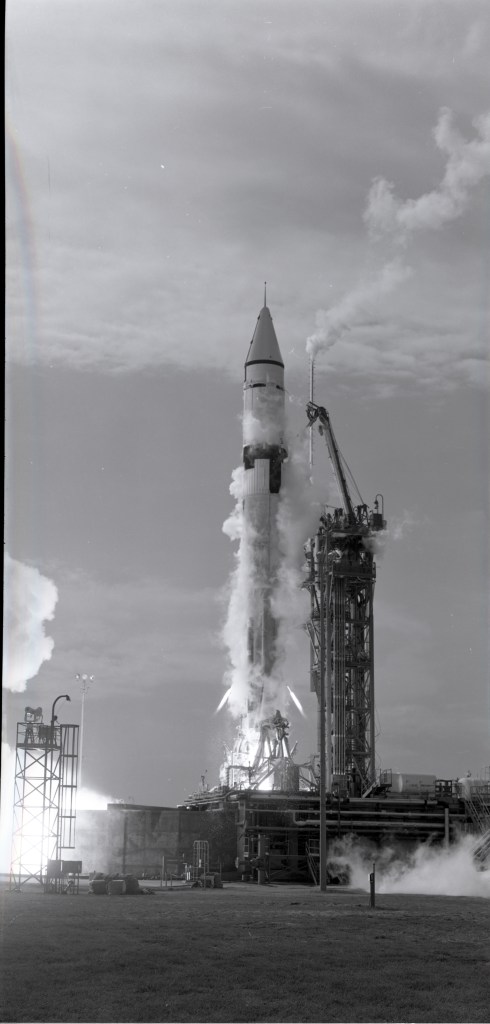
The Atlas-Centaur 3 launch vehicle fails to make Earth orbit. Atlas-Centaur 3 was launched on at 14:04:22 GMT with a payload of 4815 kg. Atlas performance was close to nominal with the sustainer running slightly LOX-rich for the first 70 seconds of flight and the trajectory being more lofted than expected. Insulation panel and payload shroud jettisons were tested for the first time. Following Centaur staging and engine start, the number two (C-2) engine began to lose roll control. The C-1 engine was able to compensate for a time, but the Centaur eventually lost control and began tumbling. Premature engine shutdown due to propellant starvation occurred at T+496 seconds, and the Centaur impacted in the South Atlantic. Postflight investigation traced the malfunction to a failure of the Centaur-2 engine hydraulic gimbal actuator.
The New York Yankees whittled 1½ games from the Baltimore Orioles’ league lead last night by sweeping a double‐header from the Los Angeles Angels, 4–0 and 3–2. The chief whittlers were Jim Bouton and Al Downing. They got an assist from the Minnesota Twins, who knocked off the Orioles, 3–1, just before the Yankees took on the Angels at Yankee Stadium. In the twilight opener, before 20,644 fans, Bouton threw a four‐hit shutout against the Angels and ran his string of scoreless innings against Los Angeles to 28. Then Downing became the first left‐hander in 15 games to survive against the Angels by pitching an eight‐hitter that ended when Cletis Boyer made a leaping catch of Jim Piersall’s line drive with two men on base.
In Cleveland, the White Sox spot the Indians a run, then score 12 runs before the Tribe answers. Juan Pizzaro (10–4) scatters 11 hits while his batterymate Jerry McNertney has a grand slam in the 7-run 5th inning. The rookie catcher also hit a double as the White Sox mounted a 13‐hit attack against four Cleveland pitchers, scoring all their runs with two out. Pete Ward drove in two runs with doubles in the fifth and sixth and added a single in the seventh. The White Sox win, 12–3.
John Kennedy’s threerun homer with one out in the last of the ninth inning gave the Washington Senators a 6–5 victory over the Detroit Tigers tonight. Dave Wickersham went into the ninth with a 5‐3 lead, but was relieved by Mickey Lolich after Ed Brinkman had singled and Moose Skowron had grounded out.
At Wrigley Field, the Cincinnati Reds’ Joey Jay allows just 2 hits but loses to the Chicago Cubs, 1–0. Larry Jackson does him one better, allowing just one hit and driving in the lone run with a single. Jackson’s no-hit bid is stopped in the 7th when Pete Rose singles for the Reds only baserunner.
Ty Cline, a pinch‐hitter, slammed his first home run of the season today with a man on in the eighth inning to give the Milwaukee Braves a 5–4 victory over the St. Louis Cardinals. Cline’s two‐out blast to the right‐field pavilion roof came off Roger Craig, the starting pitcher, and followed a pinch-hit double by Ed Bailey. Bob Sadowski went one and a third scoreless innings in relief of Wade Blasingame for the victory. Bobby Tiefenauer pitched the last two innings.
Jim Bunning kept the Philadelphia Phillies hot on the heels of the league‐leading San Francisco Giants tonight by defeating the Houston Colts, 8–1. Ken Johnson was the victim of three errors by Colt outfielders in the first inning. The errors, coupled with three hits and two walks, accounted for five runs. Bunning took advantage of the first‐inning cushion to coast to his eighth victory of the season. He allowed five hits.
Dow Jones Industrial Average: 831.50 (+0.56).
Born:
Doug Dascenzo, MLB outfielder (Chicago Cubs, Texas Rangers, San Diego Padres), in Cleveland, Ohio.
Mike January, NFL linebacker (Chicago Bears), in Lake Charles, Louisiana.
Kevin Fitzgerald, NFL tight end (Green Bay Packers), in La Crosse, Wisconsin.


 History Diaries