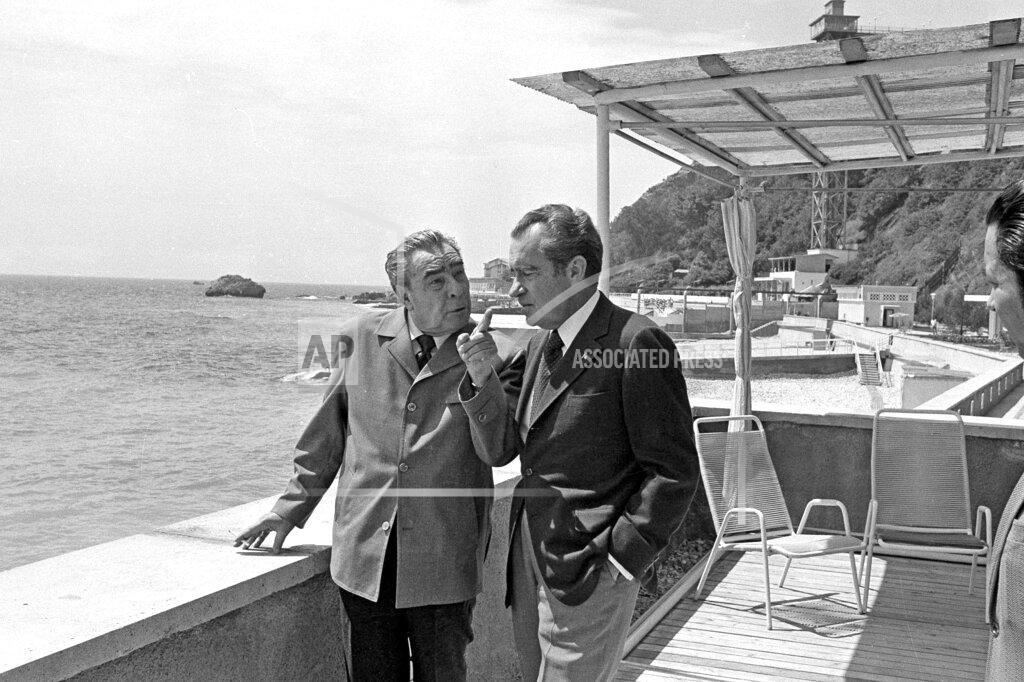
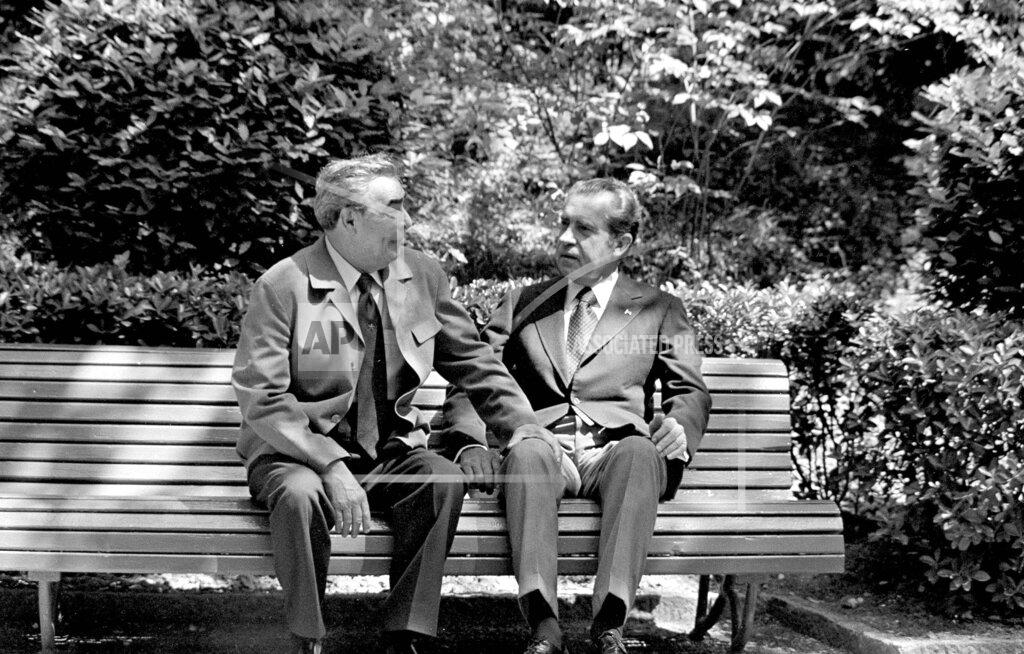
President Nixon and Leonid Brezhnev conferred for more than four hours in Yalta, but both sides indicated afterward that little progress had been made on the critical issue of the limitation of offensive nuclear weapons. They will take a respite from their bargaining sessions tomorrow and will resume their meetings Tuesday and Wednesday in Moscow. American officials were hopeful that significant progress could still be made in the remaining two days.
Since 1972, in a period of detente to many in the United States and Western Europe, there has been a methodical improvement and expansion of nuclear and conventional military power in the Soviet Union and Eastern Europe. At the same time a barrage of official speeches and writings have warned the Soviet people that despite the agreements on limiting strategic arms and despite Soviet-American exchanges such as President Nixon’s visit to Moscow, the struggle against capitalism continues.
Foy D. Kohler, former Ambassador to Moscow, told the House subcommittee on foreign affairs that the Soviet version of peaceful coexistence “sounds more like the Western definition of cold war.” He cited an editorial from Krasnaya Zvezda, the newspaper of the armed forces, on August 14, 1973, that said: “We have been and still are the opponents of imperialism and bourgeois ideology and morality. Class peace between Socialism and capitalism and peaceful coexistence between the Communist and bourgeois ideologies have not existed and do not and cannot exist.” There has been no evidence since 1972 of any reductions in Soviet military strength. The consensus among Western experts is that high force levels will continue to be a basic feature of Moscow’s planning and that Soviet leaders agree that military force, active or potential, is an effective instrument of policy.
Mikhail Baryshnikov, a leading Soviet ballet dancer, fled from the touring Bolshoi company in Toronto as members of the troupe were walking toward a chartered bus to return to their hotel after a reception following their last performance in Toronto. His friends said that he wished “to proceed with his career in the West.”
The Chinese government has canceled without notice all student exchange visits with Britain planned for this summer, British sources said in London. Diplomatic observers said the action was caused by internal problems and “administrative difficulties” in China rather than any disagreement with Britain. The 120 Chinese already studying in Britain will be allowed to continue their courses, Peking sources said.
Voting for parliament was held in Iceland for all 40 seats of the Lower House (Neðri deild) of the Althing, and 20 seats of the Upper House (Efri deild). The Sjálfstæðisflokkurinn (Independence Party) of Prime Minister Geir Hallgrímsson remained the largest, winning 17 seats, but no party obtained a majority.
For the first time in seven years, prayers were offered at the war-shattered Church of the Virgin Mary at Quneitra, the “capital” of the Golan Heights. Damascus Radio, in its report of the services, charged that the Israelis had “pillaged and disfigured” the church before their withdrawal last week. Quneitra, conquered by Israel in the 1967 war, was restored to Syrian civil administration as part of the military disengagement between the two countries.
Israel planned to adopt tough measures this week to halt runaway inflation and to correct a severe balance of payments deficit caused by the October war. A government spokesman said there were no plans to devalue the Israeli pound, but a $400 million decrease in public spending was being considered to combat a 31% rise in the cost of living from January to May. To correct a projected $3.3 billion trade deficit, Israel may put higher tariffs on imports, the spokesman said.
President Nixon today wrote off $500‐million in debts owed by Israel for United States assistance replenishing her military establishment after the Israeli-Arab war last October. A White House spokesman said that the President, who is visiting Moscow, signed the authorization there, converting the loan into an outright grant. The $500‐million was part of a $2.2‐billion emergency package of American equipment — and some cash — approved by Congress last December. Most of it has already been delivered. Congress gave Mr. Nixon the discretion of making as much as $1.5‐billion of that total grants, rather than loans. In April, the President chose to declare only $1‐billion as grants. His action in Moscow today extended his waiver to the full amount allowed.
The Ethiopian armed forces said today that they had been arresting officials of the previous Government for conspiring to obstruct the four‐month‐old administration of Premier Endalkachew Makonnen. It was the first official explanation for the unrest since Friday among troops in Addis Ababa. The capital was declared under curfew last night and the army continued it today in an atmosphere described as uneasy calm. No military action was reported in other parts of the country, but a traveler who arrived here from Asmara today said Ethiopians were glued to their radios to hear the latest order or statement from the troops. The armed forces’ statement, which pledged unswerving loyalty to Emperor Haile Selassie and to Mr. Endalkachew, said the armed forces decided to act last week when some members of Parliament and others attempted to obtain “by dubious means the release of detained former ministers and officials.”
Cambodian rebels armed with captured American artillery launched fresh attacks against a government task force on Highway 5 north of Phnom Penh. Government bombers attempted to push back the insurgents, who were mounting a counterattack to block a government drive toward the provincial capital of Oudong, in rebel hands for more than three months. The rebels, reinforced by an estimated 700 troops, were firing barrages with American-made 105-mm. Guns.
South Vietnamese troops and Communist forces entered the 12th day of an “at all costs” struggle for control of a military base 24 miles north of Saigon. A Viet Cong officer in Saigon told newsmen that Communist forces had been ordered to “hold the base at all costs.” Base 82 was overrun by North Vietnamese troops six weeks ago. But 12 days ago, the South Vietnamese commander in the area also told his troops they “must retake Base 82 at all costs.”
Voters in the Matanzas Province of the Communist nation of Cuba were given a choice of candidates in the first election held in the Caribbean island nation since 1958. The political experiment was limited to the Matanzas province and was for municipal government administrators described as delegates to the popular power assemblies. The Communist Party newspaper Granma announced that single-candidate “yes/no” lists were barred, with each neighborhood precinct to have at least two candidates nominated, and that voting would be by secret ballot, strictly voluntary, and for all citizens aged 16 or older.
Special U.S. Ambassador Ellsworth Bunker reported that negotiations with Panamanian Foreign Minister Juan Antonio Tack for a new canal treaty were making excellent progress. Asked in Panama City about the possibility of a new treaty by the end of the year, Bunker said, “That’s our hope,” but denied any definite time limit for reaching agreement. Tack merely said, “We are hoping.” More talks are scheduled for mid-July.
Physicians attending Juan Perón said in Buenos Aires that the condition of the Argentine President, who is said to be suffering from infectious bronchitis with heart complications, had undergone a “favorable change,” but that he remained under “constant medical treatment.”
Falling rocks and new mudslides frustrated rescuers in the search for between 250 and 300 victims of an Andean landslide Friday that buried motorists and construction crews trying to clear a blocked road. Chilean President Augusto Pinochet Ugarte, meanwhile, declared 13 provinces in central and south Chile to be disaster areas where rains, wind, snow and floods caused at least 25 other deaths and left more than 5,000 homeless.
Zaire’s governing political party announced last week that President Mobutu Sese Seko would no longer be referred to as “His Excellency.” It said the people of Zaire would henceforth celebrate Christmas on June 24; the day the country’s Constitution was proclaimed. In addition, the party said, committee has been formed to revise the Constitution, and an institute is soon to be formed to instruct party members in programs and ideology. All these moves are intended to “radicalize our revolution,” the political bureau of the governing Popular Movement of the Revolution declared. The announcement, made last Wednesday, was seen here as part of a continuing attempt to build a national spirit among Zaire’s 22 million people, who are divided into more than 200 ethnic groups.
Mrs. Martin Luther King Sr., the 69‐year‐old mother of the slain civil rights leader, was fatally wounded this morning when a young black man went on a shooting spree while she was playing the organ in Atlanta’s famed Ebenezer Baptist Church. A young black man, shouting “I’m tired of all this. I’m taking over,” went on a shooting spree in an Atlanta church and shot to death Mrs. King. He also killed a church deacon and wounded a member of the congregation. Mrs. King was playing the organ in Ebenezer Baptist Church, where her husband is pastor, when the gunman sprang from the “amen corner” next to the organ.
The police later identified the man as Marcus Wayne Chenault Jr., 21, of Dayton, Ohio. He was charged with two counts of murder and one count of aggravated assault. Investigators said there was no evidence that any conspiracy was involved in today’s shootings, which came a little more than six years after the assassination in Memphis of Dr. King. “Chenault told police he received orders from his god to come to Atlanta and kill the Rev. Martin Luther King Sr. Chenault told investigators the reason he shot Mrs. King was because she was nearest to him. He said he shot the other two persons because they were worshiping a false idol.”
The four Justices whom President Nixon appointed to the U.S. Supreme Court have formed a bloc that is increasing in both unity and capacity to produce a working majority for their views of the law and the Constitution. This was indicated in a study by the New York Times of 144 decisions in the October-to-June term.
The National Women’s Political Caucus closed its meeting in Wichita with a warning that it might not survive another year unless dues from its 30,000 members were boosted from $1 a year to $20. Treasurer Betsy Deardourff reported that the 3-year-old organization was $12,000 in debt for operating expenses, Frances (Sissy) Farenthold, co-chairperson of the three-day meeting and a two-time candidate for Texas governor, told the 601 delegates from 39 states that dues provided only 11% of operating revenue. Higher dues will be considered at a September meeting in Denver.
Rep. Wright Patman (D-Texas), chairman of the House Banking and Currency Committee, has asked President Nixon to use existing credit control powers to reduce the pressure for high interest rates. “It is time for the Credit Control Act of 1969 to be implemented,” Patman said in a message to the President. He said the credit controls would enable the Federal Reserve System to “gracefully” give up its policy of higher and higher interest rates as a cure for inflation. The law, Patman explained, gives the Federal Reserve broad powers to control all aspects of any credit transaction.
As Congress neared agreement on a program to set national pension standards for millions of workers, critics contended that a business-labor lobbying coalition had diluted many meaningful changes from what had been hailed as a major social reform. Ralph Nader said the agreement was “a terrible disappointment.”
Interviews with workers, employers, bankers and economists across the country reflect the crosscurrents sweeping the American economy at mid-1974. A spurt in the gross national product was not expected anyway, but now economic forecasters have generally lowered their sights from a slow-growth year to a no-growth year.
Forty-four congressmen proposed the creation of a temporary commission of leading economists to investigate the nation’s economic troubles. The legislation would set up a 14-member commission whose members would be named by the President, the House Speaker and the Senate majority leader, according to Rep. Benjamin S. Rosenthal (D-New York), the panel would operate for two years.
Petty thief Peter Leonard sets a fire to hide his burglary at a bowling alley in Port Chester, New York; the fire spreads next door to “Gulliver’s” nightclub.
Twenty-four panic-stricken young patrons and employees of a singles bar in Port Chester, New York, were killed when they were trapped in suffocating smoke from a flash fire. More than 100 young men and women in their late teens or early 20’s were dancing to soul-rock music in Gulliver’s on the New York-Connecticut border when the fire broke out. In addition to the dead, 19 other patrons and 13 firemen were injured.
The possibility that the fire in Gulliver’s started in an adjoining part of the building was being investigated by Port Chester officials. The Westchester County District Attorney, Carl Vergari, said every piece of debris would be examined to find evidence relating to the origin of the fire. About 200 persons reportedly were in Gulliver’s when the fire started. Port Chester’s Mayor, Joseph Dzaluk, said the village lost a court fight four years ago to have occupancy limits posted in public places.
The head of the National Indian Tribal Land Rights Association, A. A. Hopkins-Dukes, called a $35 million settlement made for Indian land in five states a farce perpetuated by government attorneys who met in secret with tribal committees. He said he intended to appeal the settlement before the Indian Claims Commission. He said constitutions of the Iowa, Comanche and Apache tribes had been violated by the government in calling last Saturday’s meeting at Anadarko, Oklahoma, and not notifying persons whose rights would be adversely affected by the settlement. The lands cover a vast area of southwest Oklahoma, the Texan and Oklahoma panhandles, eastern New Mexico, southwestern Kansas and southeastern Colorado.
Firefighters pulled back and watched as more than 30 derailed cars of a Southern Pacific train loaded with toxic chemicals and synthetics burned in a wooded area just south of Nacogdoches, Texas. “Right now, we are not allowing anyone to go within half a mile of the fire, a railroad spokesman said. He explained that “there is still danger of explosions.” The cars were part of an 85-car train that derailed Saturday while on a run from Beaumont to St. Louis. At least one of the cars blew up and the blast shattered windows six miles away.
Police and the FBI sought an ex-convict from Missouri for questioning in the death of a Roman Catholic priest who might have died of a heart attack after being left gagged and tied to bedposts in the church rectory in North Wilkesboro, North Carolina. Police Chief Kyle M. Gentry said the medical examiner would make further tests to settle the manner of death of Father Francis T. Donahue, 64. The priest’s empty wallet was found by his body and his car was taken. Police said they were seeking William R. Roberts, 37, of Kansas City.
The U.S. Government says that more evidence is being compiled to show that cigarette smoking is the major cause of lung cancer, which killed 72,000 Americans last year. The Department of Health, Education and Welfare, in a report to Congress, also said that cigarette smoking was the primary cause of such other lung diseases as chronic bronchitis and emphysema and a contributing factor leading to coronary heart disease. It said that studies “reveal an increased risk of development of lung cancer in pipe and cigar smokers compared to nonsmokers.” Some studies, the report said, show a slightly higher risk of coronary heart disease for pipe and cigar smokers than nonsmokers, but significantly lower than cigarette smokers. It said that other studies showed no such relationship.
Canadian Open Golf (Peter Jackson Classic), Candiac GC: Carole Jo Skala wins by 3 from JoAnn Carner.
National Football League players went on strike at midnight tonight with the slogan. “No freedom, no football.” The walkout, spurred by stalemate in contract bargaining, threatened to prevent preseason training camps from opening and to eliminate the exhibition‐game schedule. It was the fourth major league sports strike in four years. The first Players Association pickets will be posted in San Diego Wednesday when Charger rookies are to report to the league’s first preseason camp. Ed Garvey, executive director of the players’ union, predicted a long strike, saying, “I’m confident we can hold out until a new collective bargaining agreement is signed.”
With a little help from his friends and teammates in the field, Mike Cuellar prolonged the New York Yankees frustrations against lefthanded pitchers today by beating them, 3–0, before a crowd of 21,176. The Baltimore infield accounted for 17 of the 27 putouts by turning in three double plays, throwing out eight runners and grabbing three assorted popups or liners. A couple of the sparklers were Mark Belanger’s rush into left to spear an Otto Velez blooper in the fourth, and Brooks Robinson’s quick move in front of short to take a Roy White grounder and force Thurman Munson at second in the eighth.
The Chicago White Sox and Minnesota Twins split a pair with Chicago taking the opener, 8–3, and losing the second game, 6–3. Jorge Orta is 5-for-5 in the opener, which gives him 8 straight hits. He was 3-for-3 in his last 3 at bats in yesterday’s game. He strikes out in his first at bat in game 2. The Twins took the second game as Vic Albury held the White Sox scoreless until the ninth. He received his main support from Eric Soderholm, who drove in three runs with a homer and a single.
The rebuilding job that has been going on in Cleveland for the last three American League seasons under Manager Ken Aspromonte is starting to get results. The Indians, who finished last in the Eastern Division by 26 games last season, are currently only 2½ games behind the leaders, the Boston Red Sox. The new‐look Indians thrust themselves into pennant contention this weekend by winning three of four games at home from the Red Sox. Steve Arlin pitched his first complete game since coming to the American League from San Diego on June 14. The righthander allowed only six hits as the Indians romped to a 9–2 triumph.
The Atlanta Braves beat the Cincinnati Reds, 7–3. Carl Morton gave the Reds three runs on three hits in the opening inning, then settled down to blank Cincinnati the rest of the way. He earned his 10th triumph against 6 losses when the Braves erupted for a pair of runs in the fourth and four in the fifth. Paul Casanova’s single in the fifth scored Mike Lum with the tie‐breaking run.
Scoring their fifth straight victory, the Los Angeles Dodgers widened their Western Division lead to 7½ games over Cincinnati, as they defeated the San Francisco Giants, 5–3. Bill Buckner’s third homer of the season, with Dave Lopes on base in the eighth inning, broke a 3–3 tie and gave Andy Messersmith his eighth triumph in 10 decisions. He needed help, though from Mike Marshall, who appeared in his 11th straight game, extending his major‐league record.
Born:
Bert Robertsson, Swedish NHL defenseman (Vancouver Canucks, Edmonton Oilers, New York Rangers), in Sodertalje, Sweden.
Hezekiel Sepeng, South African athlete, born in Potchefstroom, South Africa
Died:
Alberta Williams King, 69, African-American musician and church leader and the mother of the late Martin Luther King Jr., was shot to death by Marcus Wayne Chenault while she was playing the organ at services in the Ebenezer Baptist Church in Atlanta. Chennault, an African-American religious zealot who was apparently planning to kill Dr. King’s father, also killed a 69-year-old deacon, Edward Boykin.
Gregory Ruth, 34, American collegiate wrestler and NCAA champion 1965 and 1966, was killed in a powerboat racing accident.


 History Diaries