In the strongest statement yet made by a British statesman in office in the present world crisis, Viscount Halifax, the Foreign Secretary, warned Germany tonight that “In the event of further aggression we are resolved to use at once the whole of our strength in fulfillment of our pledges to resist it.” This statement was the keynote of a speech that Lord Halifax delivered at the annual dinner of the Royal Institute of International Affairs at Chatham House.
Spurning earlier circumlocutions, the Foreign Secretary spoke directly of Germany and Italy and prefaced his statement of British readiness to fight with a summary of the present strength of the British Army, Navy and Air Force. “We have an unchallengeable navy,” he declared. “Our air force, still undergoing expansion which has outstripped all the expectations of a few months ago, has now nothing to fear from any other. I have little doubt that its personnel, in spirit and in skill, is superior to all others. Our army, once derided, but which survived to prove its worth so that it made a boast of that derision, is undoubtedly small in comparison to that of some other countries. But, as happened once before, we are creating here also a powerful weapon for the defense of our own liberty and that of other peoples.”
At the same time, he said that once “the threat of military force” holding the world for ransom were removed Britain would be ready and willing to negotiate with Germany and Italy over all their grievances, including colonies. In this connection he held out the possibility that Britain might be willing to abandon her traditional attitude toward her colonies and adopt the principle of the “open door” for them-a statement that is held here to have great significance.
Lord Halifax qualified both this statement and the offer to negotiate with the two dictator countries by saying that they could not be considered for the moment. “If we could once be satisfied that the intentions of others were the same as our own and that we all really wanted peaceful solutions, then, I say here definitely, we could discuss the problems that are today causing world anxiety,” the Foreign Secretary said. “But that is not the position which we face today.”
The strength and scope of Lord Halifax’s speech was the best example of British firmness in the face of continued rumors of an impending German coup in Danzig and the general impression that there is a groundswell that may presage a storm there. It is known that the speech at first had been milder and less specific and that it was strengthened this morning. And it was allowed to become known this afternoon that it would constitute at once an answer to the German charges of encirclement and a warning of Britain’s position in case of further German aggression.
Poland served notice to Germany that it was willing to fight for Danzig when millions nationwide swore an oath to “never allow themselves to be cut off from the Baltic Sea.”
“The Baltic seacoast, Pomorze [the] Polish Corridor] and our two ports, Gdynia and Danzig, are the air and sun of our national life and the basis of our political and economic independence,” President Ignaz Moscicki declared today speaking over the radio to millions of Poles participating in mass celebrations of Naval Day all over the country. The President intimated that the Polish Navy would be substantially increased. “We are a great force on land and in the air,” he said. “We must also be strong on the sea to consolidate Poland’s position as a maritime nation.”
Speaking of the vital importance of access to the sea for Poland, the President referred all the time to Gdynia and Danzig as one indivisible unit. “Through this narrow gate, through a small strip of seacoast,” he said, “is done three-quarters of our business with foreign nations. This is our free unhindered way to all the other countries in the world and the more they are menaced the stronger is our determination to defend Pomorze and the seacoast and the stronger is the will to be united with these provinces forever.”
The biggest demonstration was held in Gdynia, to which several hundred special trains brought large crowds from all parts of Poland. Danzig’s Polish minority was represented by many delegations numbering almost 5,000 persons. Altogether some 100,000 took part in the meetings and processions in Gdynia. A representative of the Polish Americans, Mr. Oscrogodzky of Chicago, was among the speakers. M. Budsynski, Polish Deputy in the Danzig Diet, was received with thunderous applause. “We wait for you to come to us!” he exclaimed at the conclusion of a violent anti-Nazi speech.
A review of the entire Polish fleet was the chief feature of Naval Day at Gdynia. The ships passed in review all around the Gulf of Danzig, at the westernmost corner of which Gdynia is situated. The ships were clearly seen from Danzig. The display was as much a tonic for the Poles as a warning for Danzig’s Nazis, who, contrary to rumors and predictions, did not attempt to stage any hostile demonstration.
The British and French diplomats negotiating in Moscow for a three-power anti-aggression pact received a heavy jolt this morning when they read on the first page of Pravda a lengthy accusation that their governments were deliberately protracting the negotiations because they did not really want a pact acceptable to Soviet Russia but instead were trying to clear the way for a deal with the aggressor nations. The article was by Andrey A. Zhdanov, who is generally considered the most important political figure in the Soviet Union after Joseph Stalin. He is a member of the Politburo and chairman of the recently formed Committee on Propaganda and Agitation of the Central Committee of the Communist party.
Mr. Zhdanov specifically stated in the article that he was expressing only his own personal opinion, and that friends disagreed with him. Nevertheless, his position in the Kremlin hierarchy and the publication of his article by Pravda make it virtually an official utterance. His description of it as a purely personal opinion leaves the door open to further negotiations, despite his uncompromising charges of bad faith, which in an official document might wreck the negotiations.
Tonight, the British and French diplomats appeared not seriously disturbed by Mr. Zhdanoff’s blast. Evidently, they expected the negotiations would soon be resumed. New instructions were received yesterday by Ambassador Sir William Seeds and William Strang, the British negotiators. But there is little likelihood that they and Paul-1 Emile Naggiar, the French Ambassador, will see Premier and Foreign Commissar Vyacheslav Molotov for another day or two. Britain, according to The Associated Press, was believed ready now to include Estonia, Finland, and Latvia among the States to be guaranteed specifically.
The feeling among foreign diplomats generally is that the Zhdanov article is another effort to prod the British into speedy acceptance of the Soviet terms. It is generally understood here that there is a basis for Soviet impatience with the British and that, while the French have been willing to subscribe to the Soviet terms, the British have shown little inclination to modify their position and that, as the Soviet has charged, the “new” British proposals have been largely rephrasing of older ones rejected by the Kremlin.
French diplomatic quarters heard reports tonight that 600,000 reservists had been called to duty in Germany.
The Fascist Grand Council approved more Italian Racial Laws, prohibiting Jews from practicing their professions among Christians, owning radios, using popular vacation resorts or placing notices in newspapers, among other restrictions.
The first group of Gypsy women from Austria is sent to Ravensbrück concentration camp. They number some 440.
Following a referendum, the legislature of the Republic of Hatay voted to disestablish the Republic and join Turkey. The French encouraged the annexation, hoping it would act as an incentive to Turkey to reject an alliance with Nazi Germany.
The Irish agrarian political party Clann na Talmhan was founded.
The 4th Dutch government of Prime Minister Hendrikus Colijn falls.
Thirteen Arabs were killed and four wounded in shooting outrages in the early hours of this morning in Southern Palestine. Two of the victims were shot dead on the outskirts of Tel Aviv. Near the Jewish colony of Rehovoth, Arab laborers passing in carts were fired at from an open car that overtook them on the road. Eight of the laborers were killed, and two wounded severely, including a young boy.
On the road between the Jewish town of Petach Tikvah and Ras el Ain three Arabs were shot dead and two were wounded. All these shootings presumably were by Jews. The military commander of the southern district immediately ordered suspension of all Jewish traffic on roads to and from Tel Aviv, Rehovoth, and Petach Tikvah from this noon until 4 PM tomorrow. Actually traffic to and from Jewish colonies in that district had already been suspended at 8 o’clock this morning. All shops on the busy thoroughfare connecting Jaffa and Tel Aviv were ordered closed for the same period.
In Washington today, President Roosevelt signed the War Department Civil Functions Appropriation Bill, conferred with Senator Barkley and Representative Rayburn on the legislative situation, and entertained at tea for the Crown Prince and Princess of Norway.
The Senate confirmed the nominations of Paul A. Walker to the Federal Communications Commission, of John Carmody as head of the Federal Works Agency, of Archibald MacLeish as librarian of Congress and Louis G. Dreyfus Jr. as Minister to Iran. It rejected the nomination of William S. Boyle as United States Attorney for Nevada. It ratified the treaty authorizing a barter agreement with Great Britain, approved the $223,398,045 supplemental War Department Appropriation Bill carrying funds for increasing the air force, approved the $3,189,377 Emergency Deficiency Appropriation Bill and adjourned at 5:58 PM, until noon tomorrow.
Conferees on the Monetary Bill agreed to a compromise restoring the President’s power to devalue the dollar, reinstating the foreign silver purchase program and pegging the price of domestically produced silver at 70. cents an ounce.
Conferees on the 1940 Relief Bill announced agreement, but withheld the terms.
The House sent the Relief Appropriation Bill to conference, approved an additional appropriation of $75,000 for the Works Progress Administration investigating committee, continued consideration of the Neutrality Bill and adjourned at 11:50 PM until 11 AM tomorrow.
The Roosevelt Administration lost, by a margin of two votes tonight, the first important House battle on the issue of revising the Neutrality Act when the well-disciplined Republican organization temporarily forced reinstatement of a modified arms embargo in the Bloom resolution. The vote was 159 to 157, which Democratic leaders felt certain they could reverse later when the question came up on third reading. Despite efforts of the leadership to force the whole question of neutrality revision to a decision tonight, there was such a flood of amendments, practically all of them rejected, that adjournment was permitted a short time before midnight after nearly thirteen hours of continuous session. Every effort will be made to force a final vote tomorrow.
It has been apparent for the past several weeks that the arms embargo issue would be the crux of any final decision on revising the existing law to meet the views of President Roosevelt and Secretary Hull, both of whom have declared the present automatic arms embargo to be impracticable. The Bloom resolution, on which a final vote had been expected tonight, would permit exports of all commodities, arms included, on a “cash and carry” basis to all belligerents. The embargo amendment, which was provisionally adopted by the House, was offered by Representative Vorys of Ohio, a Republican member of the Foreign Affairs Committee. The committee had rejected it, in executive session, by a party vote.
It would prohibit the export to all belligerents of “arms and ammunition,” omitting reference to the “implements of war” which are covered by the existing law, as well as reference to transshipment for the use of belligerents, as Mr. Vorys believed this phase is cared for by other laws. This would provide the sort of arms embargo the American people think they now have,” he said, adding: “We are not required under international law to ship arms to anybody.”
The U.S. Senate voted early this morning a relief bill for the coming fiscal year totaling $1,808,300,000, following adoption of a series of amendments which both enlarged the total voted by the House and went far toward nullifying drastic changes in administration of the WPA voted previously by the House.
Passage of the bill came at 1:10 AM (2:10 New York time), with 54 votes in support and 9 in opposition. The vote ended a session which began at 11 AM yesterday morning with a warning by Senator Barkley, the majority leader, that the Senate would remain in continuous session until it acted upon the bill.
The Senate version of the bill will be sent today to the House, where disagreement with the Senate amendments is certain, and then to a conference where representatives of each chamber will attempt to work out a compromise that will permit final enactment of the bill into law before the expiration of the current fiscal year at midnight tomorrow.
All but the most optimistic members of Congress consider such quick work impossible, and accordingly the leaders of the House and Senate have written a resolution designed to continue the status quo in supplying occupations for about 2,500,000 men until a compromise is effected.
Within twenty-four hours after he returned to Washington to take up the leadership in a fight with Congress over control of vital Federal policies President Roosevelt tonight won a preliminary skirmish for continuation of his power to devalue the dollar and continue the foreign silver purchase policy of his Administration. This was when a Senate-House conference committee reached a “compromise” by which the dollar devaluing power would be restored to the Monetary Bill and the Senate amendment ending foreign silver purchases would be deleted. The “price” offered for these concessions on the part of Administration leaders was the pegging of the domestic silver price at 70 cents an ounce. By its amendment of Monday the Senate had fixed this figure at 77.5 cents.
Whether this action of the conference committee would bring a perceptible break in the legislative jam in Congress was problematical. It is certain to provoke a fight tomorrow on the Senate floor which, from appearances, had every possibility of turning into a “filibuster” against the time when the President’s monetary powers expire at midnight tomorrow. Prior to this agreement the Administration leadership had been driving against increasing obstacles to clear the way for the emergency Monetary and Relief Bills and to shove them through to enactment before laws on each subject expired tomorrow night.
While the House worked away on the Neutrality Act amendments, which constitute the greatest threat of delay to final adjournment of the session, the leaders were concentrating most of all on the Relief and Monetary Bills. They were giving more attention to the latter, because, unless it is enacted, the President’s authority to revalue the dollar and the $2,000,000,000 Stabilization Fund expire together at midnight tomorrow. Although indications pointed sharply to a probable temporary defeat for the Administration on the Money Bill, there was every prospect that the stabilization account would be renewed before the session ends. The President’s remaining power to devalue the dollar may be less certain of reinstatement, however, should it be allowed to lapse.
The Administration’s spokesmen in Congress refused to concede more than the possibility of the monetary authority’s expiration, even temporarily. Moving under the strongest of urgings from the President, who returned last night from Hyde Park, these leaders worked feverishly all day to break the jam that was holding up not only this measure but the new appropriation for relief. The conference committee to which the Monetary Bill was sent met for an hour this afternoon but came to no conclusions. It broke up when three Senate members — Byrnes, Adams and Townsend — were called away to a similar conference on the relief measure. It met again tonight and reached the “compromise” agreement.
In an annual report of unusual scope and emphasis, to be made public tomorrow. General Malin Craig, outgoing Chief of Staff of the army, urgently recommends the addition of about 1,800 officers and 23,000 enlisted men to the regular army.
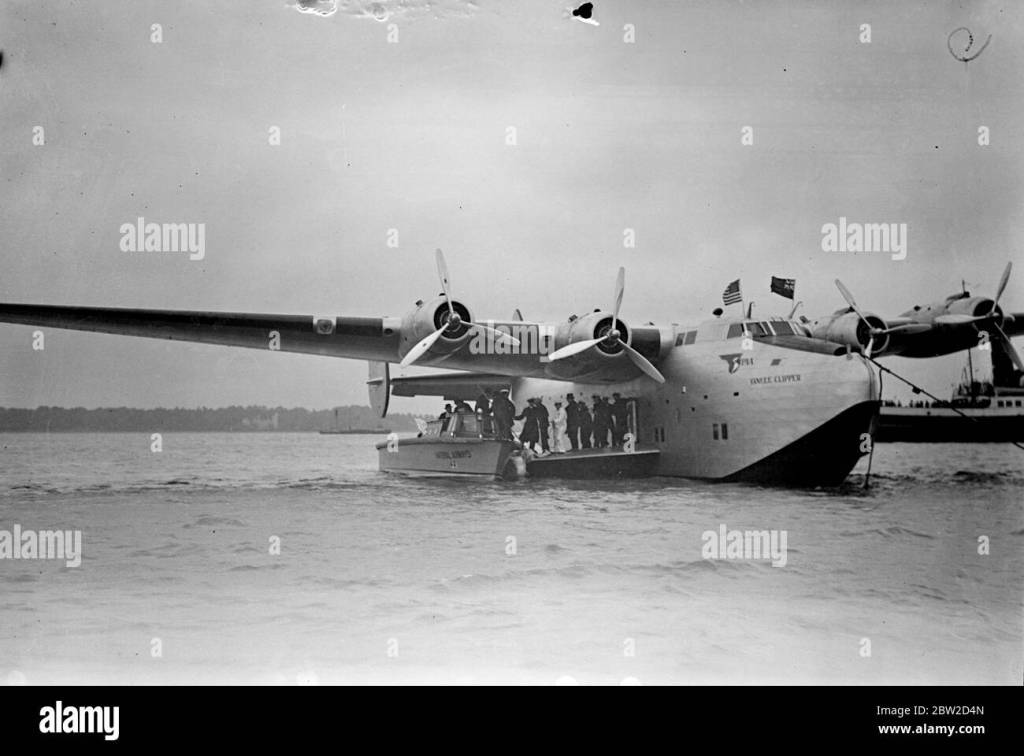
The Pan Am Dixie Clipper completes the first commercial passenger airplane flight to Europe, landing in Lisbon, Portugal, at 7:10 PM local time tonight.
Ford introduces the revolutionary Ford-Ferguson 9N tractor incorporating Harry Ferguson’s three-point hitch system.
The Yankees hoist the 1927 championship flag in honor of Lou Gehrig.
Nicaraguan President Anastasio Somoza says his country will build the long-discussed canal in Nicaragua between the Atlantic and Pacific Oceans.
Brazil is negotiating with Italy to obtain a small force of three submarines.
The Japanese blockaded Foochow and Wenchow today and thereby took control of the last major Chinese ports along more than 2,000 miles of coastline between the Great Wall and Canton. A Japanese warning to all foreign vessels to leave the ports because they would be closed by “dangerous objects” (mines) and “other obstacles” went into effect at noon. The warning had been rejected by the United States through Clarence E. Gauss, Consul General, who notified Japanese officials that Japan would be held responsible for any damage to American interests in the closing operations. The British and French took similar stands. All foreign merchant vessels were said to have left the two ports.
A Japanese Army spokesman told a gathering of his compatriots here today that “nothing could be more foolhardy than to expect much” from the Tokyo negotiations in which Britain and Japan have agreed to seek a solution of their Tientsin crisis. The spokesman said that any relaxation of Japan’s attitude in Tientsin — where the army has blockaded the British and French Concessions since June 14 — “would only play into British hands.” “There may be occasion for us to tighten the isolation of the local British Concession and in such an event our determination remains strong,” he said. The spokesman reflected the attitude of the army in North China, which the Tokyo Government in some degree overruled in agreeing to the Tokyo conference, removed from the bitterness of the Tientsin atmosphere.
Despite the strong tone of the Japanese Army spokesman, restrictions on the blockaded concessions remained relaxed, considerable food supplies were received, market prices dropped and even Britons were subjected to only cursory examinations at the Japanese barriers. The Hai River, Tientsin’s outlet to the sea, was enlivened today, when twenty Chinese coolies, enlisted for work in Manchukuo, plunged into the river from a Japanese ship and swam for the British Concession waterfront, apparently trying to escape. Japanese guards fired into the air, scaring the coolies into returning to the ship.
Dow Jones Industrial Average: 130.05 (-2.78).
Born:
Sante Gaiardoni, Italian cyclist (Olympics, gold medals, 1000m time trial, 1000m sprint, 1960; UCI Track World Championship gold, 1960, 1963), in Villafranca di Verona, Italy (d. 2023).
Fate Echols, NFL tackle and defensive tackle (St. Louis Cardinals), in Union Springs, Alabama.
Naval Construction:
The Вое́нно-морско́й флот СССР (ВМФ) (Soviet Navy) “ShCh” (ShChuka)-class (6th group, Type X-modified) submarines ShCh-411, ShCh-412, ShCh-413, and ShCh-414 are laid down by A. Marti (Leningrad, U.S.S.R.) / Yard 194.
The Royal Navy Hunt-class (Type I) escort destroyer HMS Holderness (L 48) is laid down by Swan Hunter and Wigham Richardson Ltd. (Wallsend-on-Tyne, U.K.).
The Royal Navy aircraft repair ship and light aircraft carrier HMS Unicorn (D 72), sole ship of her class, is laid down by Harland & Wolff Ltd. (Belfast, Northern Ireland).
The Royal Australian Navy modified Leander-class light cruiser HMAS Perth (D 29), formerly the Royal Navy HMS Amphion (I 29, later D 29), is commissioned. Her first commander in Australian service is Captain Harold B. Farncomb, RAN.

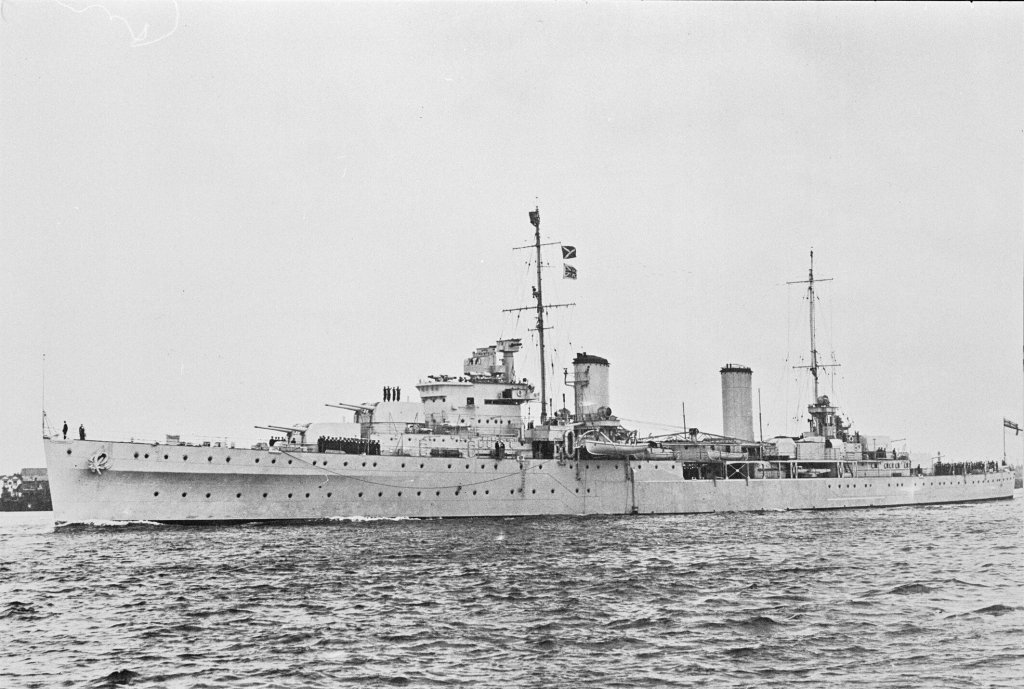
Amphion had been commissioned in 1936 and spent the next several years as flagship of the Commander-in-Chief, Africa before she was transferred to the RAN in 1939 and renamed as HMAS Perth.
At the start of World War II in September, the ship patrolled the Western Atlantic and the Caribbean in search of German shipping and escorting convoys for six months before she was ordered home in early 1940. The ship continued the same types of duties in Australian waters before she was transferred to the Mediterranean Fleet at the end of 1940. Perth then helped to escort numerous convoys to Malta in early 1941 and played a minor role in the Battle of Cape Matapan in March. She escorted convoys to Greece and Crete and helped to evacuate Allied troops from both places in the face of the victorious Axis forces. The ship was badly damaged by Axis aircraft in May during the evacuation of Crete.
After repairs were completed in June, Perth provided naval gunfire support to Allied forces ashore during the Syria-Lebanon Campaign and bombarded Vichy French targets. She returned to Australia in mid-1941 and was tasked with the same sorts of missions as she had been performing at the beginning of the war. The ship continued to perform these tasks after the start of the Pacific War in December until she was transferred to the American-British-Dutch-Australian Command in February 1942 to help defend the Dutch East Indies against the Japanese. Perth was not damaged during the Battle of the Java Sea, but was torpedoed and sunk by the Imperial Japanese Navy at the Battle of Sunda Strait immediately afterwards.
Lost 1 March 1942.
Perth capsized to port and sank at 00:25 on 1 March 1942, with 353 killed: 342 RAN (including Captain Waller), 5 Royal Navy, 3 Royal Australian Air Force, and 3 civilian canteen workers. USS Houston was torpedoed and sank about 20 minutes later. Of the 328 survivors of Perth, 5 died after reaching shore, while the rest became prisoners of war; 106 died during their internment: 105 naval and 1 RAAF, including 38 killed by Allied attacks on Japanese “hell ships”. The surviving 218 were repatriated after the war.
Battle Honours: ATLANTIC 1939 – MATAPAN 1941 – GREECE 1941 – CRETE 1941 – MALTA CONVOYS 1941 – SUNDA STRAIT 1942
 History Diaries