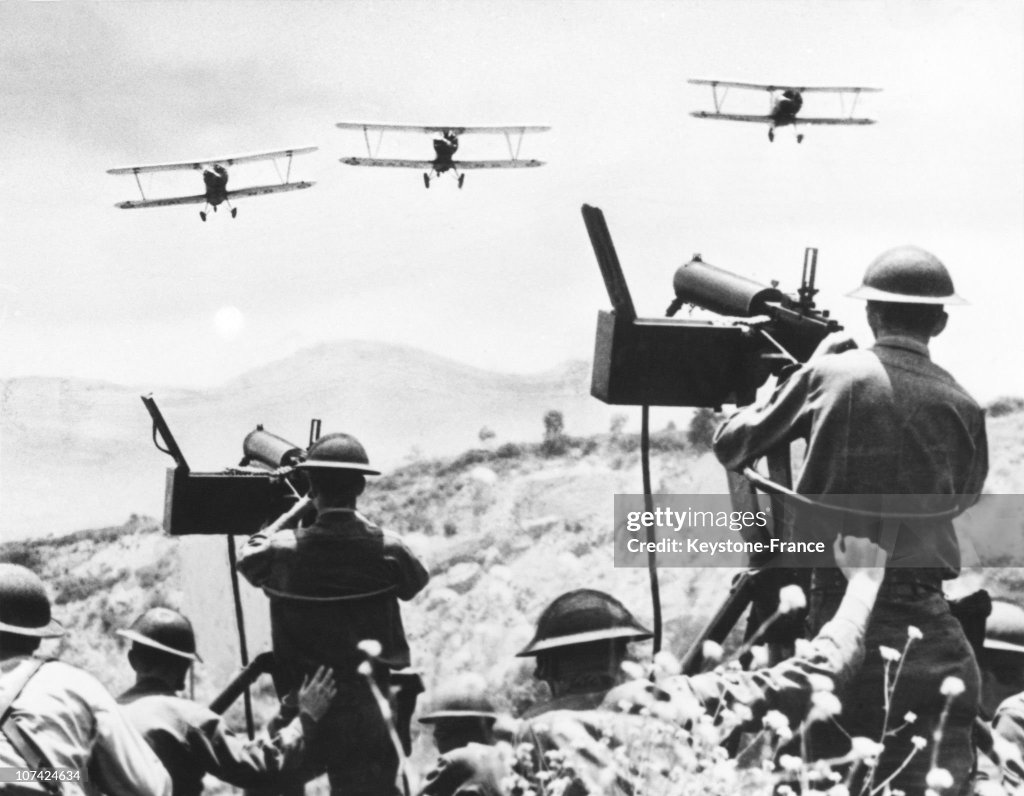
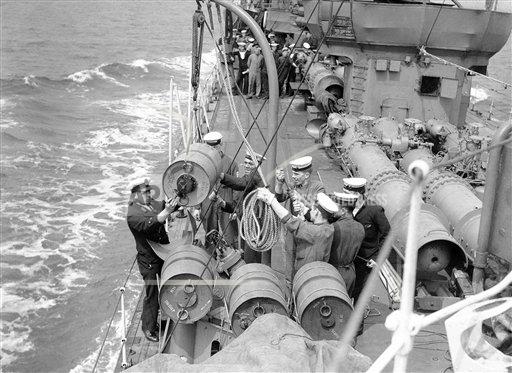
The date of Great Britain’s annual naval maneuvers in the North Sea was advanced today from September to August as a part of the effort to guard against a “danger period” in Europe later in the summer. This announcement had no direct bearing on anything but the European situation, but it threw additional light upon British patience in the Far East and British anxiety over the slow progress of negotiations with Russia. It served as a reminder that the German danger outweighs all others in British minds and that the probability of a challenge by Chancellor Adolf Hitler this Summer is seen clearly in London, although nobody can be quite sure where, when or how it will come.
Already thousands of reservists are undergoing training in all branches of the fighting forces; the first 35,000 of Britain’s conscript “militiamen” will receive their summonses for compulsory training at the end of this week, while thousands more reservists will report for duty with the colors. War Minister Leslie Hore-Belisha has stated that at least 750,000 men will be under arms in Great Britain before the end of this summer — that is to say, by the time the expected crisis in Europe becomes acute. The object of all this is to man front-line trenches before any attack comes and perhaps to avert an attack by letting Germany know Britain is ready.
The early naval maneuvers are part of the same process. It will be no surprise if the naval reservists who were called up by public proclamation at the height of the crisis last year are summoned for duty again, but this time before a new crisis breaks and without any preliminary publicity. Today’s Admiralty announcement explained that the normal summer leave period of ships of the Home Fleet had been advanced to July “to enable dockings and refits to be completed during that month preparatory to carrying out exercises in August.” This decision will mean cancellation of the fleet’s usual July visits to seashore resorts; it will also mean cancellation of “Navy Week,” usually the first week in August.
If this is just a coincidence — and the Admiralty likes to pretend that these things are just accidental — it will be the most striking coincidence since Winston Churchill, then First Lord of the Admiralty, sent the whole British fleet to its battle stations in the north of Scotland the week before war broke out in 1914. There is no thought now, any more than in the Summer of 1914, of detaching powerful units of the fleet for service far away or of letting the attention of the armed forces be diverted in any way from the essential job near home.
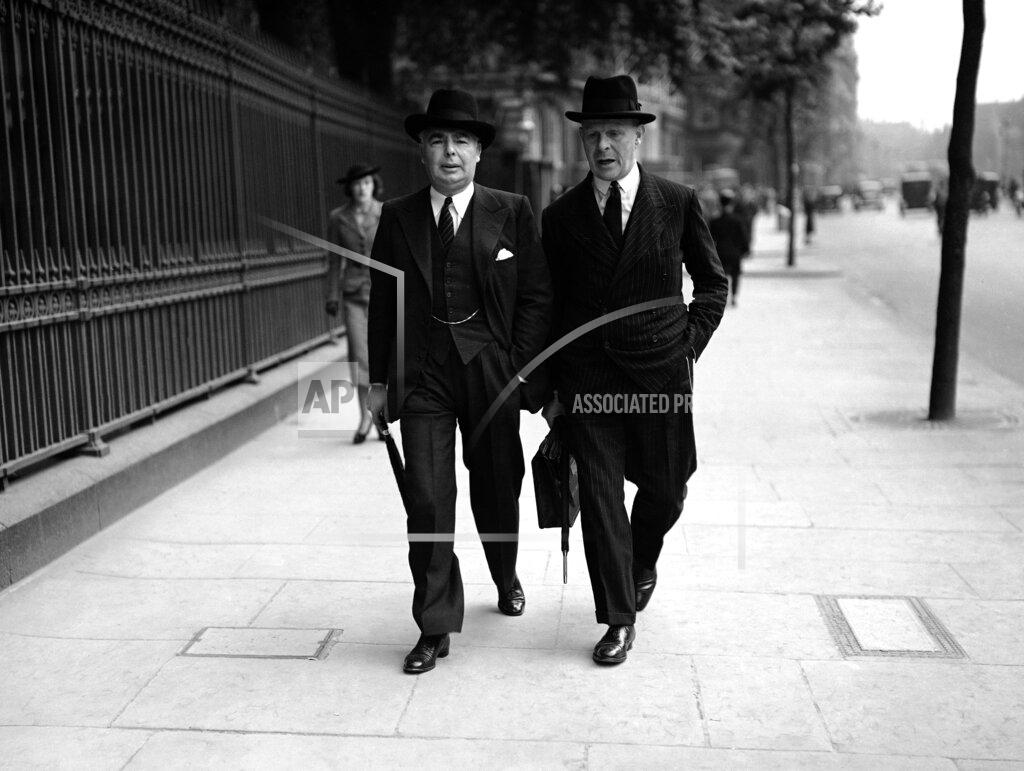
The Cabinet’s subcommittee on foreign policy met today to discuss the Far Eastern situation and the state of the Russian negotiations. The impression tonight was that the Ministers had needed to devote comparatively little of their time to the Far East. Prime Minister Neville Chamberlain told the House of Commons today of British protests “in the strongest terms” already delivered in Tokyo and of discussions now going on between Foreign Minister Hachiro Arita and Sir Robert Leslie Craigie, the British Ambassador.
The suggestion that the United States join a peace front with Great Britain and France, advanced by Georges Bonnet, French Foreign Minister, in a speech yesterday at Arcachon, met with an exceedingly frigid reception in Washington today. In Congress, M. Bonnet’s statement was said by Administration supporters to be “very unfortunate” in view of the pending debate on neutrality legislation. At the U.S. State Department, where no official comment was made on M. Bonnet’s suggestion, it was pointed out privately that the United States does not enter into alliances. Isolationists in Congress, led by Senator William E. Borah, assailed the speech and used it as a springboard for insisting that rigidly defined neutrality legislation was necessary.
Germany discounts British war steps, saying conscripts require long training.
The Secretary of State for Air, Sir Kingsley Wood, announced that the Royal Air Force would impress civil aircraft in the event of war.
Italians hasten a road in Albania. They are ordered to finish a highway to the Balkans by August 31. The big Italian road-building concerns that received the contract for the new Albanian strategic highway to the Greek and Yugoslav frontiers have been ordered to complete their work by the end of August, it was learned today when Marshal Pietro Badoglio returned from a trip to Albania. Those who have been predicting another grave international crisis, if not war, this summer are adding this little item of news to the body of evidence available.
Crops will be harvested by that time and it seems fairly certain now that Italy has once again been saved at the eleventh hour from a disastrous wheat crop. Last year the long drought ended just in time and this year a few days more of rain would have brought a catastrophe such as that which forced Italy in 1937 to import $70,000,000 worth of wheat. That would have made a big difference in the international situation, but a dry warm spell has now set in and all signs point to a normal crop of wheat.
France hears the Reich army will attack Poland to stem unrest at home. Nazi acts are seen as a prelude to war.
The Ministry of Education in Hungary has decreed that henceforth Jewish pupils will be admitted to secondary schools only in the proportion of 6 percent, which is the percentage of Hungarian Jews to the total population. In several Budapest schools, special classes will be established for Jews. On the other hand, the Calvinist Gymnasium and Benedictine College, among denominational establishments, announced that they will admit all pupils without discrimination. For purposes of the franchise, the government has decreed, all Jews must register and prove uninterrupted residence of their families in Hungary since 1887. All Jews permitted to vote in the recent parliamentary elections will be called on to establish their status anew.
There were moving scenes at the port of Constanta today when a small Rumanian steamer left for Palestine. There were 450 Jewish refugees from Austria and Czecho-Slovakia who were allowed aboard, but 120 more were left behind because of lack of accommodation. As the ship left her moorings a number of the latter sought to swim out to her despite the efforts of the authorities and bystanders to prevent them. Twenty jumped into the water. Fourteen were picked up by boats; the others drowned.
While the Soviet, British, and French Governments are engaged in Moscow in finding a formula to protect Finland’s integrity in the event of war, Finnish youths have taken steps designed to keep an aggressor away. Thousands of young men; mostly university students and young militiamen from all parts of Finland, are these days gathering in the districts bordering on Russia to dig trenches and prepare fortifications to “make Finland’s frontier secure” against an attack, while other detachments have been sent elsewhere to fortify strategic points.
This voluntary mobilization of Finnish youth is in response to an urgent appeal recently made for aid to the government by free labor during summer vacations. Voluntary women’s organizations provide food for the students and the government has provided the lodgings. The young trench diggers, though more used to intellectual than manual work, are reported making remarkable progress. They have even attracted the admiration of General Sir Walter Kirke, inspector general of British Home Forces. During his recent visit to Finland, he said he was convinced they were erecting a lasting “stone wall.”
A third term movement for President Roosevelt is growing. President Roosevelt leads in Presidential polls made by anti-New Deal Senators and is so far ahead, they say, as to convince the opposition group that he can be nominated for a third term if he wishes. Democratic State chairmen and workers are reporting that sentiment for Mr. Roosevelt has recently increased. Such reports, many from political workers canvassed by Postmaster General Farley on his Western trip, assert the general public to be still strong for the New Deal. It is also said that in many sections the President is personally stronger than his theories of government. Aspirants for State and county jobs declare that, with a Roosevelt-headed ticket, the chances for continued Democratic control in States and counties would be enhanced, while a party division, under the leadership of conservatives, would lose many voters won in 1932 and 1936.
Some of the twenty-three Democratic Senators up for reelection in 1940 are impressed with the Presidential strength. Some, who early gave encouragement to the movement for the nomination of Vice President Garner, have now left. that camp, and are telling Administration advisers they will stick with Mr. Roosevelt. They assert that, while the anti-third-term tradition remains strong among old liners, it is not a real factor in the situation. They insist that the President can be re-elected and that if he is the nominee there will be a natural coalition with the Labor party in New York, Progressives in Wisconsin and the Farm-Laborites in Minnesota.
New York and Pennsylvania and several of the Farm Belt States are counted by this group as sure to be carried if Mr. Roosevelt is renominated. Anti-Administration Senators no longer doubt that the President is thinking of running next year. They declare that everything he has done lately in appointments and legislatively points that way. The $3,860,000,000 spending-lending program is accepted by many as indicative of the President’s plan to prepare for a third term.
Today in Washington, the Senate passed the monetary bill, with amendments discontinuing President Roosevelt’s power to devalue the dollar, repealing purchases of foreign silver, and setting the price of domestically mined silver at 77½ cents, and recessed at 6:30 PM until noon tomorrow. The Appropriations Committee eliminated a three-man board provision from the 1940 relief bill, and approved the $1,735,000,000 total of the measure. The Judiciary Committee approved resolution for a proposed Constitutional Amendment to levy taxes for old-age pensions, but rejected a proposed Constitutional amendment requiring selection of Supreme Court justices on a geographical basis. The Education and Labor Subcommittee heard witnesses for the Chamber of Commerce on the National Labor Relations Act.
The House received President Roosevelt’s request for $500,000 appropriation for an Alaska Coast Guard station, and a $1,533,568 supplemental appropriation for the Interior Department, considered District of Columbia bills, and adjourned at 5:35 PM until noon tomorrow.
President Roosevelt’s control of the dollar is voided. The Senate votes to remove the President’s authority to further devalue the gold content of the dollar. An extraordinary coalition of high-silver advocates and conservatives which cut through all party lines in the Senate voted today to strip away President Roosevelt’s authority to devalue further the gold content of the dollar, while at the same time. ordering the Treasury to pay 13 cents an ounce more for domestic silver than the current Treasury rate. In late afternoon it passed the amended Monetary Bill without a record vote.
This double defeat of the Administration leadership in the Senate not only created a shocking and unexpected situation for the leadership but set up complications which threatened the whole monetary powers of the Administration. While the Senate voted to preserve the Stabilization Fund for exercise of control over exchange rates, it removed what Secretary Morgenthau has repeatedly called a “necessary reserve power” to offset possible devaluation by other countries.
In addition, it created a parliamentary situation of the most delicate character because, in voting by substantial majorities to stop the devaluation power and to make the price of domestic silver a matter of law instead of Treasury discretion, it went directly counter to the House in a manner which made a solution of differences in conference absolutely unpredictable, even by the leadership.
As a final stroke in upsetting Administration policy, the Senate voted by an overwhelming chorus of “ayes,” to stop on July 1 the Treasury’s purchases of foreign silver. The Administration leadership won one victory early in the day’s hectic session, when the Senate voted down, 52 to 26, an amendment to the Monetary Bill which would have made the legal price of newly mined domestic silver $1.16 as proposed by Senator Pittman, instead of the current price of 64.64 cents an ounce.
However, the Senate soon thereafter cast 48 votes in favor of establishing the price of silver at 77.57 cents an ounce, with only 30 opposed. On the question of continuing the President’s devaluation authority, the Senate voted 47 to 31 in favor of an amendment to stop that when the current Monetary Act expires, at midnight on June 30.
President Roosevelt heard today of the Senate’s refusal to continue his power further to devalue the dollar and then went fishing, traditionally the favorite sport of the contemplative mind. If he was considering anything other than the size of the trout, the subject could only be guessed at as he did his fishing within the guarded acres of Judge John E. Mack, who twice nominated him for the Presidency. On the Senate’s refusal to continue the President’s dollar devaluation authority and its action in increasing the Treasury’s price for domestically mined silver, Mr. Roosevelt had no comment to make. Whatever he has to say will be said at his regular press conference tomorrow, it was announced at the temporary White House offices.
Confronted by rebellious and self-willed groups in both houses, and a growing jam of legislation which already had frustrated early adjournment plans, Congressional and Administrative leaders tonight were contemplating “emergency” measures to be employed in case bills continuing certain important New Deal laws were not passed before the deadline of midnight June 30.
Chief among the bills imperiled by a complicated situation on Capitol Hill were the one to extend the Gold Reserve Act, through the $2,000,000,000 Stabilization Fund and the President’s power further to devalue the gold dollar, and the relief bill, extending and financing the Federal unemployment relief setup for another year. The likelihood of either of these major measures being enacted before Friday midnight lessened with every passing hour.
Notified last week by Secretary Morgenthau that the Administration was studying ways of meeting any possible “emergency” that might arise from emasculation or delay of the monetary bill, Washington speculated tonight on what steps might be taken in view of the coup in the Senate today whereby the dollar devaluation power was stricken out.
Rumors sprang from one quarter that the President had made known to intimates his intention to use his authority immediately and devalue the gold dollar by the remaining margin of about nine cents between now and Friday midnight, should Congress fail to continue his authority. Official circles were quiet, however, regarding any plans that might be in the making and definite confirmation was impossible in the face of this reticence.
The House leadership was said by a reliable source today to have decided to scrap much of the Administration’s Neutrality Bill, leaving, however, its most important provision — repeal of the embargo on arms shipments to nations at war. Speaker Bankhead, Leader Rayburn and Democratic members of the House Foreign Affairs Committee met with the Democratic Steering Committee for nearly three hours this afternoon.
America has entered a long period in which the “processes of social entropy — the dissipation and destruction of human resources and the expansion and proliferation of the authoritarian state — are being immensely accelerated by external and internal forces generated by the World War,” Dr. Virgil Jordan, president of the National Industrial Conference Board, said in Johnsonburg, New Jersey tonight at the ninth annual economics conference for engineers at the summer camp of the Stevens Institute of Technology.
“The dogmas of modern statism have already been developed, even in America, into a mass religion, and the impulses of liberal humanism are being rapidly submerged and their expression eradicated,” Dr. Jordan said. Although the tempo of modern history seems more rapid than that of the ancient world, it is unlikely that the phases of this new cycle of statism will work themselves out within the rest of this century and for the next generation or two it is possible to forecast with confidence the course of certain essential elements in the process, he declared.
Among Dr. Jordan’s predictions were these: Tenure of political power by personalities, parties and state agencies will be increasingly prolonged and will tend to become permanent; the population of political dependents will multiply rapidly; private business will become increasingly bureaucratized and will finally be operated in large part by political persons or agencies; private employment and investment will progressively disappear; the value of private ownership of real property will diminish, and its acquisition will cease; all forms of economic enterprise and technological invention will decline; private consumption will be increasingly rationed, and the standard of living will slowly fall; investigation, education and communication will be increasingly controlled and finally will be completely conducted by political agencies.
Earl K. Long was sworn in as Governor of Louisiana at 7:15 o’clock tonight, after Governor Richard W. Leche stepped down as a climax to a day of swiftly moving developments obscured by mystery, scandal and embezzlement charges against President James Monroe Smith of Louisiana State University, who is now missing.
The U.S. Army begins building a base on the island of Puerto Rico.
The American Bar Association criticizes prisons and judges; sentences are too often based on hunches, they say.
The National Woman’s Party holds that bars to married women’s employment are a step toward fascism.
In Philadelphia, the Yankees play the first night game in franchise history losing to Connie Mack’s A’s, 3–2 at Philadelphia’s Shibe Park, where the first-ever American evening tilt took place last month. The Yankees will not play their first home game under the lights for another seven years. Cotton Pippen (1–5) gets the win and Bump Hadley (6–2) takes the loss, the Yankees drop to 46–13 on the season and the A’s improve to 25–35.
The Imperial Japanese Air Force’s 2nd Air Brigade (2nd AB) struck the Soviet air base at Tamsak-Bulak in Mongolia. The Japanese won this engagement, but the strike had been ordered by the Kwangtung Army without getting permission from Imperial Japanese Army headquarters in Tokyo. In an effort to prevent the incident from escalating, Tokyo promptly ordered the Japanese Army Air Force to not conduct any more air strikes against Soviet airbases.
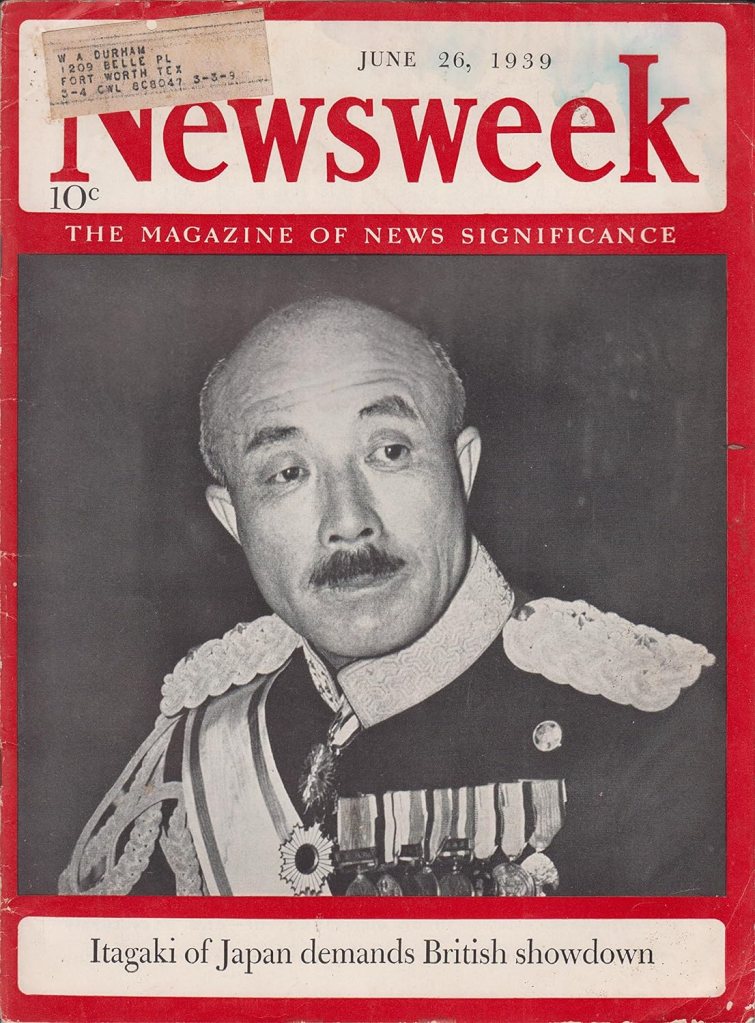
Preliminary talks are under way for a settlement of the fourteen-day British-Japanese deadlock at Tientsin, it was said authoritatively today, with actual negotiations expected to develop speedily with agreement upon a “few remaining points.” The British Ambassador, Sir Robert Leslie Craigie, conferred half an hour yesterday with Foreign Minister Hachiro Arita, on a basis for a settlement.
It was understood that one of the points to be ironed out before actual negotiations start centered on the place of the conferences. Japan was understood to be desirous of holding the conferences in Tientsin where she presumably would be represented by her Consul General, Shigenori Tashiro, and a high-ranking Japanese diplomat sent to assist him. Britain preferred holding the conversations directly with the Foreign Office in Tokyo.
It was assumed that Sotomatsu Kato, former Minister to Canada and now embassy counselor at Hsinking, Manchukuo, would be sent to Tientsin to assist Mr. Tashiro if the negotiations took place in China. The newspaper Asahi reported that Mr. Kato was slated to be appointed Ambassador to China soon.
It was said authoritatively that Japan had not yet outlined concrete demands for a settlement. So far Japanese demands have been confined to press reports of Japanese Army spokesmen in China declaring that Britain must promise to cease support of Generalissimo Chiang Kai-shek and to aid Japan in establishing her “new order in Asia.” A Foreign Office spokesman said “no time limit” had been set for the start of the final negotiations.
The Japanese blockade of the British and French Concessions here went into its fourteenth day amid a sudden rush of rumors that negotiations were under way to settle the British-Japanese impasse. According to the reports, which could not be confirmed, Wang Kehmin, head of the Japanese-fostered government at Peiping, has arrived here to attempt to negotiate a settlement through Wen Shih-tseng, the Chinese Mayor of the Japanese-controlled portion of Tientsin. They asserted that the Japanese, growing tired of the two-week-old deadlock, were seeking a way out of the crisis and turned to their Peiping puppet regime to save face for the local Japanese Army authorities.
In contrast to the rumors of attempts at a settlement, there was currently a report that local Japanese military authorities were preparing for an even more strict blockade. This report, also unconfirmable, said that stricter measures would be enforced next Friday if the British had not by then complied with a demand presented by Mayor Wen last Saturday for “closer cooperation,” of foreigners with the Chinese section of Tientsin, over which the Japanese military rules.
British military authorities have taken sharp exception to action of the Japanese soldiery late yesterday afternoon in holding up a British military truck seeking to enter the concession with foodstuffs from Chinese areas for the British garrison in the concession. The Japanese held the British vehicle for one hour while officers of the two forces argued. The Japanese insisted the British were “not sufficiently identified,” while the British recalled the Japanese military declaration when the blockade began that the personnel of the various foreign garrisons and their maintenance would not be interfered with.
Chinese members of the British and French Concession Municipal Police whose families live in Japanese-controlled areas received another threat against their own lives and those of their families.
Japanese naval authorities announced today that they had forbidden third-power vessels to discharge either passengers or cargo at Swatow and even to approach the wharves there during the period of military operations. Swatow, a leading port of South China, was captured by the Japanese last Wednesday. The British are the only third-power nationals regularly operating and controlling wharves there.
The new Japanese order, according to Japanese reports, followed the entry into Swatow harbor today of two British vessels. Japanese naval authorities ordered them not to approach the wharves and soon afterward the vessels, which were not named in reports received here, left Swatow.
Previously, after the Japanese had announced that all third-power vessels entering Swatow would be searched, British naval authorities here replied that their warships. would continue escorting British vessels into Swatow harbor. However, the first British vessels entering Swatow after last week’s capture failed to accomplish anything beyond establishing an entry precedent, and as a result Hong Kong shippers were discouraged from making either passenger or cargo bookings to the port.
All British lines operating regular Swatow services are dispatching vessels there, but they carry only ballast. The Taksang, which entered Swatow Saturday, returned to Hong Kong today without attempting to unload cargo. Today’s Japanese ban on third power vessels at Swatow exempted steamers carrying mails and supplies specifically for the port’s third power nationals. Japanese said the commander of the Japanese South China Fleet had issued a statement saying: “Swatow having become a center of fresh military operations, Japanese forces are not in a position to permit vessels to embark and disembark passengers or load or unload freight, with the exception of mail and provisions for foreign residents.”
British naval officers in Hong Kong said that the Japanese had strung wire barricades around the British wharves at Swatow. While these were regarded as a possible source of further friction between the British and Japanese, it was said that a lack of coolies had prevented the British from attempting to unload and that the barricades therefore had not yet been tested.
The remains of Genghis Khan arrive at Sian for safety. A colorful cavalcade brings in the remains of the great conqueror.
Dow Jones Industrial Average: 135.09 (-2.27).
Born:
Chuck [Charles] Robb, American politician, 64th Governor of Virginia, in Phoenix, Arizona.
Smangaliso Mkhatshwa, South African Secretary-General (Bishops’ Conference 1983-88), in Barberton, Mpumalanga, South Africa.
Ansar Ilgamovich, Russian Soviet cosmonaut (retired for medical reasons; never flew in space), in Satka, Russian SFSR, Soviet Union.
Died:
Ford Madox Ford, 65, English writer (“The Good Soldier”) and editor.



 History Diaries