Prime Minister Neville Chamberlain today issued the sharpest warning that he has yet given to Germany when he attacked the “propagation of false and unfounded suspicions” and asserted that British hope of cooperation with Germany “must remain. a dream until Germany is ready to drop her unjust suspicions of others and show that she is sincerely ready to talk reason with reasonable people.”
“I repeat once more, and this is my last word; our opposition is not to change, for in a changing world there must be adjustments from time to time,” the Prime Minister told an audience estimated at 10,000 gathered at a Conservative open air meeting here. “But what we are resolved to oppose is the use of force to bring about changes which should be determined by discussion and cooperation,” he continued, “and I trust that in spite of all the dangerous possibilities, which are only too apparent to the people who in all countries cry for peace, we may yet find the patience and will to achieve it.”
After stressing the increase in British military strength during the past year, Mr. Chamberlain took notice of the Tientsin dispute with Japan. He expressed the hope that it could be settled by negotiation, but warned that “no British Government could submit to dictation from another power as to its foreign policy.” The Prime Minister for the first time publicly mentioned the general election for which the Conservatives are preparing this year, although he told his audience that he could not say when it would be held. The date, he said, must depend on foreign affairs, among other things, but he devoted most of his speech to a summary of the increased employment and increased welfare that have come to England during his regime.
It was only at the end that he turned to foreign affairs, warning of the economic dangers to the world of the rearmament race. Apparently countering the official German thesis that Britain is preparing a peace front to encircle Germany with aggressive intent, Mr. Chamberlain made an attempt to appeal to the German people. The Germans are being “drenched day and night” with assertions that Great Britain is trying to encircle them to destroy their trade and drive down their standards of living, Mr. Chamberlain said.
“What a grotesque travesty of the attitude of this country!” the Prime Minister exclaimed. “The aim of our foreign policy is now, as always, to establish a peaceful world where each nation can pursue its occupations in security and confidence. In such a world we can see great prospects for the expansion of German industry and the employment of German workers, for every country today needs goods and equipment such as German and British industries are particularly well able to supply. In a world in which confidence was restored our two countries could well cooperate in developing the resources which still lie latent and which would bring in returns of solid value to us both.”
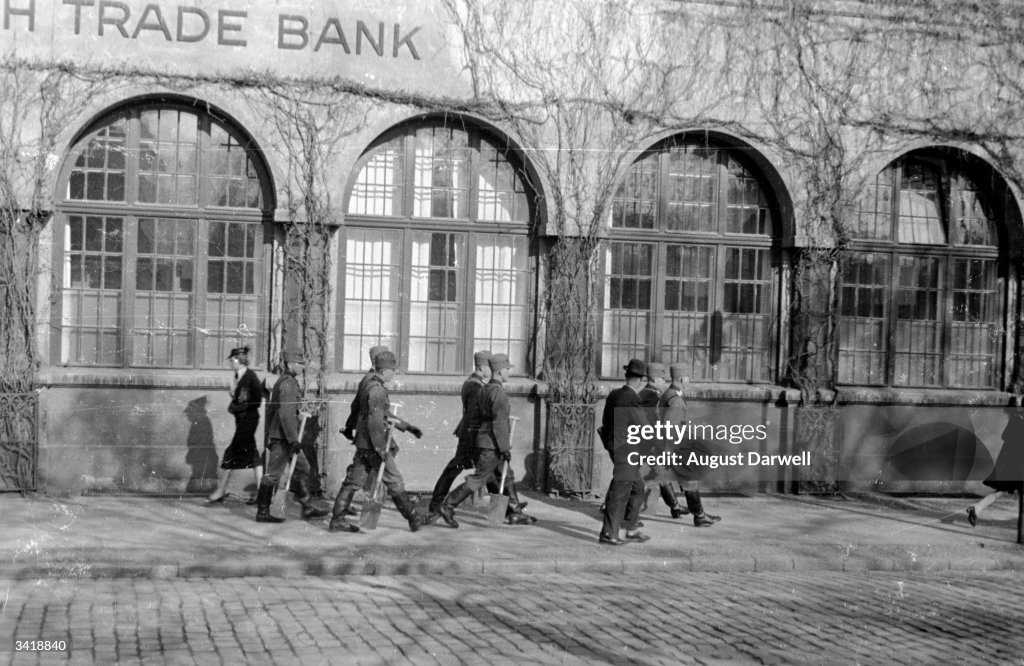
Four bombs exploded in London’s theater district, causing at least twenty injuries and causing panic among Saturday night crowds. The explosions were caused by bombs similar to those attributed to the Irish Republican Army in other recent bombings throughout Britain. Hundreds of policemen and members of the British Territorial Army were. rushed into London’s busy theatre section last night as four separate explosions threw Saturday night crowds into confusion and tangled the city’s traffic. All the explosions took place outside banks. About twenty persons were taken to hospitals but most of them were treated for minor cuts and shock. Four men were taken to the Vine Street Police station for questioning about the blasts. After the second explosion in Piccadilly, the crowd manhandled a man shouting “Lynch him! String him from a lamp post!” Police rescued him and took him away in an ambulance.
The first explosion occurred just off Piccadilly Circus about 10 PM. Onlookers said a bomb was thrown from a passing taxi. It shattered windows for blocks off the Circus and brought thousands of persons rushing out of theaters, hotels and restaurants of the district. Almost an hour later another explosion shattered glass and stopped traffic farther down Piccadilly and within fifteen minutes two other explosions rocked the Strand. All the explosions apparently were caused by bombs similar to those police have accused the illegal Irish Republican Army of using in other recent bombings throughout the British Isles. The anti-British I. R. A. is agitating for severance of all Ireland’s connections with England.
There were conflicting stories about the first explosion in Piccadilly Circus, but most people in the large crowd of passers-by said two men jumped from a taxi, dropped a bomb and ran through the crowd when it exploded. The first blast brought terrified crowds into Piccadilly. People poured out of theatres. Those who were in subways tried to get out into the streets, and those in the streets tried to crowd into the subways. The crowds broke through police lines and hundreds of extra police. were rushed to the district. They were supplemented by auxiliary firemen and Territorial soldiers, equivalent to the United States National Guard. When they got there everything was under control in Piccadilly and they found there was not as much damage as had been feared. The three other explosions went off a few blocks apart.
The “French Army” is going to invade Piedmont and move down the Po valley late in August, but the Italian Army of the Po is moving swiftly from its encampments in Veneto and will descend on it and presumably drive it back to France. This will bring to a climax the great series of military maneuvers that began today and will continue through July, August and part of September. As in previous maneuvers in recent years no doubt is being left as to the identity of the supposed invaders.
This year’s exercises will be the greatest ever held if only because there are more men under arms than ever before, and the units employed will be of full war strength. Unusual attention will be given to the specialized units stationed around the French-Italian border such as frontier guards, motorized battalions and mountain artillery. However, there will be other exercises all over Italy, and even Libya and Albania, which means that virtually the whole mass of armed forces will be in fictitious action.
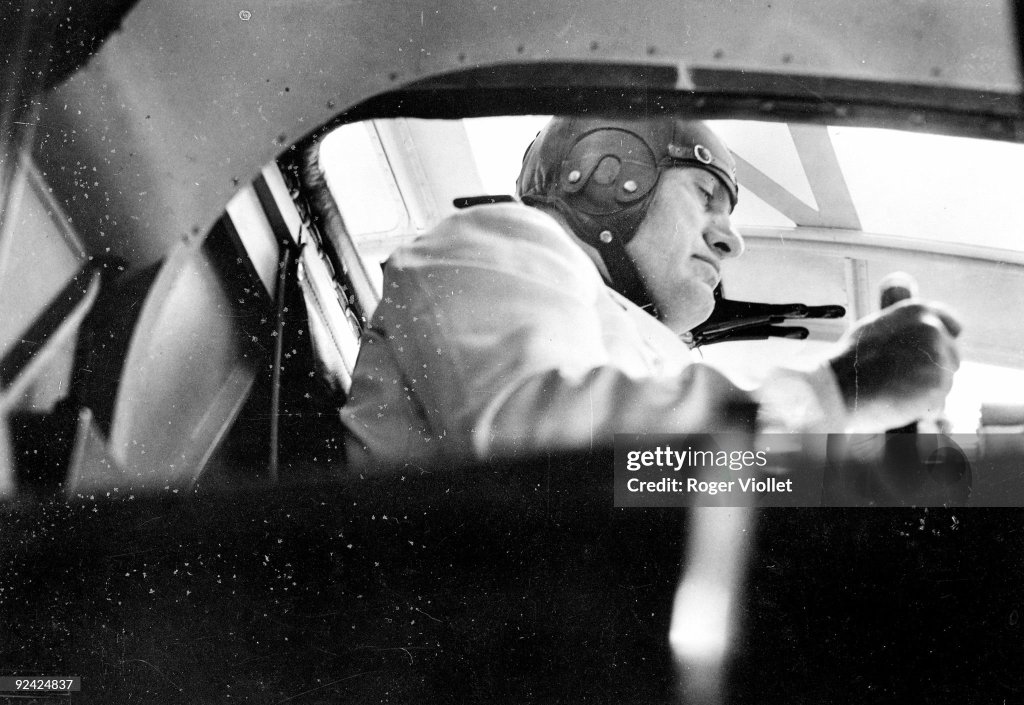
Premier Mussolini flew to Fiume from Riccione today at the controls of a tri-motored seaplane, continuing a series of unannounced visits to Northeastern Italy. At a torpedo factory he watched a test launching of three torpedoes.
General Giuseppe Valle, Italian Under-Secretary of Air, arrived today at Staaken Airport near here to confer with Field Marshal Hermann Goering, German Minister of Aviation. It was said the two air chiefs would discuss plans for common action of the German and Italian air forces in the event of war.
Reich farmers receive electrical equipment. Power plants are assessed 35 million marks annually.
Slovaks end co-education and ask girls to marry rather than pursue careers.
German Gestapo ordered all Czechs who were deemed unwilling to work, politically active, or deemed to have anti-German beliefs were to be placed in concentration camps.
France strengthened her army general staff tonight by an official decree that added sixty-five commissioned officers to the special group charged with planning national defense measures.
France announces it is abolishing public executions. The guillotine will still be used, but not in public.
The bells of the uncoordinated churches still left in the Third Reich will toll next Saturday, the beginning of the third year of the imprisonment of Pastor Martin Niemöller, one of the most fearless, most outspoken and ablest leaders of the German Evangelical Church, which has refused to accept Nazi leadership in internal church affairs and has refused to allow itself to be “gleichgeschaltet” [coordinated] for political purposes. On that day ministers all over the United States, as in other democratic countries, will unite in spirit with the German martyrs in a demonstration of solidarity in the struggle against Nazi efforts to curb the freedom of the human spirit and their attempts to establish a neopaganism.
The trial of twenty-five young Hungarian Nazis for subversive activities — enrollment in a terrorist group to operate if the coup of Major Ferenc Szalasi, Hungarian Nazi leader, had materialized — ended in Budapest today with the conviction of all but six, five of whom were acquitted. The other, having been elected a Member of Parliament since his arrest, at present enjoys immunity.
The Soviet secret police arrest a stage director at his home at night.
Steps are being taken to acquaint President Roosevelt with the many “inequities” which would result, according to high Administration officials, if the proposed amendments to the Social Security Act are adopted. Government officials who have just completed a new and searching analysis of the proposed amendments assert that in many respects they would completely change the basis of the social security program and work hardship to many thousands of persons who would benefit under the present act. Here is what would result, according to the analysts, if the changes are adopted:
- Although by the end of 1940 about 1,200,000 persons 65 years of age and over will have made payments into the old-age benefit fund, not more than 200,000 will have retired by that time. The proposed changes would prevent some 1,000,000 from obtaining their old-age benefits, although it has been stated in connection with the proposed changes that that many would retire.
- Because of what are alleged to be “arbitrary” employment and other requirements in the proposed amendments, differences of only a few days in birth might result in great differences in benefits. An individual who might, at present, receive as much as $6,000 in benefits would receive nothing under the proposals because he was born a few days late, while another individual with scanty payments into the fund might receive comparatively high benefits because he attained the age of 65 a day or two before those in the former group.
- Under the changes proposed in employment requirements, some men now eligible for fairly good pensions would receive nothing, while others with but a penny additional employment would obtain benefits worth $4,000 to $6,000.
- The proposed amendments would result in the anomalous situation in some cases of lowering survivors’ benefits the longer a man lived after ceasing work, with the survivors receiving nothing if the insured man lived long enough.
- Those totally disabled would have rights in the pension funds for only a short time. If these persons died in the first year after being disabled, their families would receive the maximum benefit payments. If they died the following year, the benefits would decrease, and if they died a few years later, there would be no benefits for survivors. This would arise from the proposed requirements concerning eligibility, which would be connected with employment. These requirements, it appeared obvious to governmental authorities who studied the problem, would put a premium on the suicide of disabled persons.
- Probably $20,000,000 is being paid each year by employees who would receive no benefits if the changes went into effect. Possibly 50,000 persons would be disqualified annually from death benefits because of lapse of their rights and an equal number would be penalized by reduced benefits because of the changed methods of computation.
Charges that President Roosevelt’s plan to lend $500,000,000 to foreign governments in the next two years would merely provide United States taxpayers’ money “for South American politicians to play with” were made by Senator Borah today. In demanding that Latin-American nations pay their debts to the United States before any more money is advanced to them, he led an attack on the Administration’s foreign spending program at a moment when the proposal threatened to cause serious discord within the Administration itself, although Senators Barkley and Wagner defended it on the Senate floor today.
Coincidentally, it was learned that the proposed lending of $200,000,000 abroad in 1939-40 and $300,000,000 more in the next year marks only the first step of the inner circle of New Dealers led by Adolf A. Berle Jr., Assistant Secretary of State, to employ the money power of the United States to combat the subsidized export systems of totalitarian governments. The eventual mobilization of idle bank credits for the campaign is envisaged.
The President’s espousal of the plan drafted by Mr. Berle, who was a member of the original “Brain Trust,” is interpreted as indicating that the program will be extended if the first undertaking is successful. It marks a decisive defeat for Jesse Jones, RFC chairman, and Warren Lee Pierson, president of the Export-Import Bank, who have fought within the Administration to keep loans to Latin-American and other countries, as far as possible on an orthodox banking basis.
Senators Taft of Ohio and Lucas of Illinois joined Senator Borah in his attack on the Administration plan as the Republican National Committee issued a statement by Representative Ditter of Pennsylvania, member of the House Appropriations Committee, asserting that President Roosevelt had reversed. his own stand on Latin-American loans and that the present proposal appeared part of a “sucker policy.”
“We are now proposing to loan some $500,000,000 to South American countries,” Senator Borah declared. “These South American countries owe the people of the United States in different ways very large sums of money. They are not paying them and in many instances no effort is being made to pay. They are long since overdue, both in principal and interest, and every indication of repudiation rests upon some of them.
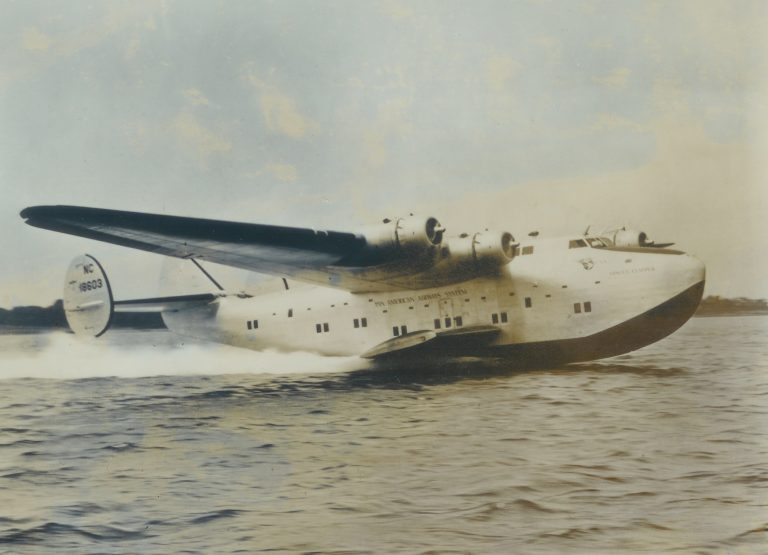
The Pan American Airways System began scheduled air service from the United States to Britain. The Boeing 314 Yankee Clipper, NC18603, made the first flight from Port Washington, New York, departing at 8:21 am. It made intermediate stops at Shediac, New Brunswick, and Botwood, Newfoundland, where fog delayed the flying boat until 12:49 pm, 28 June. Continuing across the Atlantic, Yankee Clipper made another stop at Foynes, Ireland, and finally arrived at Southampton at 7:25 pm that evening. The largest airplane of the time, the Pan American Clipper flying boat could carry 77 passengers in “one class” luxury, with a ticket priced at $675—that’s in 1939 dollars. ($12,389.82 in 2020) Uniformed waiters served five and six course meals on silver service. Seats could be folded down into beds.
The new Cunard White Star liner Mauretania ended her maiden voyage from Liverpool early yesterday morning, moving in from her Atlantic track not long after a copper sun rose above the Brooklyn skyline to turn the last few miles of the journey into a brilliant pathway. Thus, she brought back to the sea and to the port of New York a name long cherished here and a name unmentioned in regular shipping annals for nearly five years. For it was on September 28, 1934, that the former bearer of the name, known also as “The Old Lady of the Atlantic,” passed out to sea on her final voyage and was recorded on the marine ticker “Mauretania clear, Sandy Hook Bar.”
A Dies Committee member asks for curbs on Communists and fascists, saying all “-isms” need to be exposed.
The Army changes the number of cadence steps from 128 to 120.
The U.S. birthrate rises for the second time in 20 years. The census bureau thinks the decline is now checked.
Four hundred New York school children have been sickened since Friday by food poisoning from tainted egg salad sandwiches in free school lunches. Some 55 are still in hospitals tonight as a precaution.
First-inning home runs by Harry Danning and Zeke Bonura helped the New York Giants defeat the league-leading Cincinnati Reds yesterday, 7–2, this being the New Yorkers’ twelfth triumph in their last fourteen games.
Red Ruffing accounted for his eleventh victory of the season as he pitched the New York Yankees to a 2–1 decision over the St. Louis Browns.
The Pittsburgh Pirates beat the Brooklyn Dodgers, 6–2.
Brazil agrees to take in 3,000 German Catholics of Jewish ancestry as refugees. The refugees are now in German concentration camps. It is said that President Vargas acted after a plea from Pope Pius.
Dispatches from Swatow reported the Japanese are making no objection to American and British ships entering or leaving Swatow with passengers and mail if they do not carry cargoes. A Shanghai spokesman denied the Japanese had proclaimed a blockade of Swatow, which they occupied Wednesday. Two British and two American destroyers are there now, and a British and Norwegian ship docked there without trouble yesterday. British officials in Hong Kong said the Japanese on Wednesday had warned ships and citizens of other nations they entered or remained at Swatow at their own risk.
Intense fighting has flared anew in Southeast Shansi during the last few days, according to Chinese reports. The Japanese are said to be stabbing into the Chungtiao Mountains area in four different directions in another attempt to smash Chinese guerrillas in the rugged Shansi country. The Chinese are said to be stubbornly resisting with characteristic mobile flanking attacks. Japanese plane squadrons are reported to be assisting the land drive with daylong bombings of Chinese positions.
In the Yangtze Valley the Japanese administered one of the most merciless bombings of the war to Changteh in West Hunan yesterday. Thirty-nine planes took part in nine raids on the city during the day, dropping 500 bombs and wrecking and firing the major portion of what remained of the frequently bombed center of the city.
The Japanese virtually closed the important port of Ningpo today in their drive to wrest from China the few remaining coastal cities that have been gateways for armaments. Quickly following their occupation Wednesday of Swatow, on the South China coast, Japanese naval officers announced an operation shutting off the maritime approach to Ningpo, 120 miles south of Shanghai. Japanese sailors, the naval announcement said, landed on Chusan Island, which dominates the entrance to Ningpo. Tinghai, Chusan’s port, was said to have been taken last night.
Japanese military supplies are being unloaded at Swatow in great qualities. Hong Kong reports said Chinese admitted the Japanese column south of Swatow had progressed inland, but said the detachment north of the city had been halted after advancing ten miles.
The Chinese Army spokesman at Chungking declared the loss of Swatow had little military significance because the harbor had not been used as a receiving point for munitions for some time. Shipping and trade figures, however, failed to support the assertion. Neutral sources agreed that since the fall of Canton, last October 21, shipments landed at Swatow, including trucks and other military supplies, had more than doubled.
Dow Jones Industrial Average: 137.36 (-0.06).
Born:
Michael Gothard, English actor (“For Your Eyes Only”), in Hendon, London, England, United Kingdom (d. 1992).
Henry Lawrence Garett III, American Secretary of the Navy (1989-1992), in Miami, Florida.
William Taylor, American banking regulator (Chairman of FDIC, 1991-1992), in Chicago, Illinois (d. 1992).
Mike Bundra, NFL defensive tackle (Detroit Lions, Cleveland Browns, Minnesota Vikings, New York Giants), in Coplay, Pennsylvania (d. 2009).
Naval Construction:
The Kriegsmarine (German Navy) Type VIIB U-boat U-49 is launched by F. Krupp Germaniawerft AG, Kiel (werk 584).
The Kriegsmarine (German Navy) Type VIIB U-boat U-53 is commissioned. Her first commanding officer is Oberleutnant zur See Dietrich Knorr.





 History Diaries