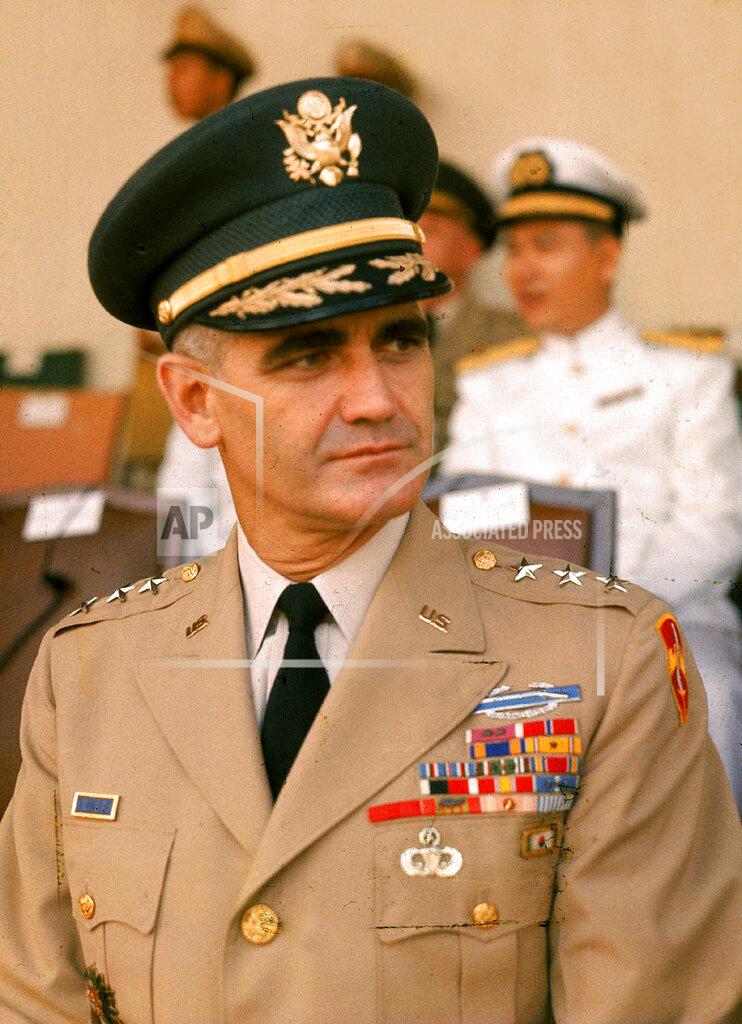
U.S. Army Lieutenant General William C. Westmoreland took command of Military Assistance Command, Vietnam (MACV), succeeding retiring General Paul D. Harkins. During his four-year command, the number of American troops that he requested for the Vietnam War would increase twenty-fold, from less than 25,000 to more than 500,000 and he would continue to guide the conduct of the war as Chief of Staff of the United States Army from 1968 to 1972. The new commander called in all senior American officers to outline his program for future, military and civic action to counter the Việt Cộng by advances from hamlet to hamlet. General Westmoreland made no innovations in the pacification concept approved by the United States Secretary of Defense, Robert S. McNamara, but promised an energetic response from Saigon and assistance to the needs of the countryside. Americans who are field advisers to Vietnamese troops report that General Westmoreland’s approach has already made itself felt. The Westmoreland appointment was announced last April.
Harkins left Vietnam today after two and a half crucial and stormy years as head of the United States effort in the war against the Communist insurgents. General Harkins’s influence and authority diminished progressively during his tour here — partly because of policy changes in Washington, which put increasing emphasis on civilian direction of the Vietnamese war effort, and partly because of what many American officials considered his inflexibility in dealing with a worsening situation. The general frequently told associates he considered it his duty to remain optimistic and positive even when faced with what is now acknowledged as a sharp deterioration in military strength relative to the Việt Cộng during the last two years. He is said to have rejected out of hand warnings by field advisers that the Government of President Ngô Đình Diệm was not proving effective in meeting the Việt Cộng threat. Mr. Diệm was overthrown November 1.
Some thoughtful associates said General Harkins had fallen victim to the United States policy that had supported Mr. Diệm until last summer when, about the time Mr. Lodge arrived, Washington apparently became convinced that the authoritarian President was no longer effective in leading the war effort. Officers less friendly to General Harkins said that before the coup d’état in which Mr. Diệm and his brother Ngô Đình Nhu were overthrown, the general did not acknowledge the seriousness of the situation. After the fall of the Ngô regime, General Harkins took a less and less active role in American policy. General Westmoreland was appointed as his deputy in January.
The United States is shipping tanks and other military equipment to reinforce stockpiles in Thailand, the Defense Department said today. A spokesman said the shipments were routine. He added that they were intended to “resupply and replace” military stocks sent to Thailand during the Laotian crisis two years ago. At that time, 5,000 American troops, including Air Force units and marines, were deployed in Thailand to meet any threat arising from a Communist takeover in Laos.
It was decided then, after the crisis eased, to maintain stockpiles at a forward base to be ready in the event of a new threat of aggression. The first shipload of new materiel is expected to arrive in Bangkok early next week. There was no evidence today that any American troops, other than supply handlers, were being sent with the equipment, although the situation in Laos was termed grave by officials in Washington. The troops sent to handle the supplies in Thailand were reported to be from the 25th Infantry Division in Hawaii.
In informal talks with news‐men and diplomats and pointed references to United States military power, the Administration has undertaken to publicize warnings that a major war in Asia will surely result if the Communists do not desist in their aggressive actions in Laos and South Vietnam. President Johnson called attention to the United States military strength in a speech in California yesterday. Newsmen in Washington were informally advised to convey the word that the United States commitment against Communist aggression in Asia was unlimited, comparable to the stand in the defense of West Berlin.
High‐ranking United States diplomatic and military officials stationed in Vientiane, Bangkok and Saigon conferred today at Udon, Thailand, former United States Marine Corps helicopter base 50 miles from the Laotian border. Among those attending the meeting was the Ambassador to Laos, Leonard Unger, the Ambassador to Thailand, Graham Martin, General H. Moore, commander of the United States Air Force Second Air Division, based at Saigon, and top‐ranking Navy officers. Amid stringent security arrangements they met for about three hours in a building belonging to Air America, a private concern flying on contract with the United States Government. The airline has a large aircraft maintenance unit on the base.
A short distance from the building where the officials were meeting, 10 T-28 fighter‐bombers were parked on a runway. Five of the United States‐made T-28’s had Laotian Air Force markings; the five others were unmarked. Ten Laotian pilots were sitting on the grass in front of the operations building, situated near the runway. The pilots were wearing flying gear bearing Laotian Air Force insignia and were described by one United States Air Force official as being in Udon for “training.” Three T-28’s later took off and had not returned five hours later. Two American pilots took off in T-28’s, one of which had Laotian markings, but they returned a short while later. The two planes were adapted to carry bombs and rockets but were not armed when they took off. It was not known whether the T-28’s were normally based at Udon.
The political charade of the Princes of Laos has suddenly lost significance. Now the real antagonists in the Southeast Asian kingdom — the United States and Communist China — confront each other, and a miscalculation could result in general war in Asia. For more than a year the world has observed in no little bewilderment the obscure palavering between Prince Souvanna Phouma, the neutralist who is the Laotian Premier, and his half‐brother, Prince Souphanouvong, leader of the Pro‐Communist faction. Western aspirations for stability in Laos resided uncertainly with Prince Souvanna Phouma and Communist hopes for taking over the kingdom rested with his half‐brother. Today the facade of princely dialogue no longer conceals the naked power struggle. United States reconnaissance planes and their jet fighter escorts are patrolling over Laos, inhibiting the Pathet Lao military advance. Peking is warning that the war may spread unless the 1962 Geneva conference on Laos is reconvened and United States air power compelled to withdraw. The prestige of the two outside countries has become so deeply involved that a backdown by either would affect the course of the struggle for influence throughout Southeast Asia.
The Soviet Union supports the appeal made by Prince Souphanouvong, leader of the Pro‐Communist Pathet Lao, for a resumption of negotiations among Laotian leaders, the Tass press agency reported today. Tass said the Soviet position was given in a draft for a proposed message from Britain and the Soviet Union, as co‐chairmen of the Geneva Conference on Laos. If agreed upon it would go to the United States Government, to leaders of the three political forces in Laos and to the chairman of the International Control Commission there. “The draft expresses the hope that the Governments of the United States and other countries parties to the Geneva agreements ‘will scrupulously abide by these agreements and prevent interference in the internal affairs of Laos,’ ” Tass said.
The Security Council voted unanimously today to extend the United Nations peacekeeping operation in Cyprus for three months, through September 26. The Secretary General, U Thant, issued an appeal to all member states for financial contributions, declaring that without them the operation could not be carried out. He also asked the nine countries that have troops or police forces in Cyprus for the United Nations to continue their participation “at the same strength and on the same terms as at present” for three more months. They have been paying their own way.
The force consists of 6,238 military members from Austria, Britain, Canada, Denmark, Finland, Ireland and Sweden and 173 civilian policemen from Australia, Austria, Denmark, New Zealand and Sweden. Their task is to prevent violence between Greek and Turkish Cypriotes that has broken out sporadically since December 23 while a United Nations mediator, Sakari S. Tuomioja of Finland, tries to find some political basis for a permanent peace settlement. Nikolai T. Fedorenko of the Soviet Union voted for today’s text. His insistence on postponing the vote from yesterday had led to speculation that he might be expecting orders to abstain. In debate Mr. Fedorenko accused the North Atlantic Treaty Organization of trying to get control of the island republic under the guise of settling the crisis.
Not quite four years old, the Mediterranean Republic of Cyprus seems to be swiftly and perilously heading for its demise as an independent nation, mortally wounded by the unbridgeable antagonisms among its inhabitants. That Cyprus has ceased to be viable as a sovereign state is a fact of political life that by now has become tacitly accepted in Washington and in virtually every major foreign office in the world. But the inevitable process of phasing Cyprus out of an independent existence is wrought with dangers as vast as those involved in disarming a live bomb, and the United States is finding itself in the role of one of the chief handlers. At this stage, however, neither the United States nor the United Nations nor any of the principals appear to have much of a notion how to go about this handling, except for the general agreement that it would be “unthinkable” if the bomb did go off.
Aside from the immediate explosiveness of the situation in the island — where the fighting between the Cypriot majority and the Turkish Cypriot minority has resumed this week at the highest pitch since the arrival of the United Nations peace‐keeping force nearly three months ago — the Cyprus problem carries with it the continuous threat of a Turkish invasion, of a Greek counter‐punch, and of the possible escalation of such a war into a Big Power conflict. In this capital, long accustomed to a daily diet of international crises, the Cyprus issue is regarded with extraordinary and ominous concern. It is this concern that has led President Johnson to assume personally the initiative to attempt to bring the Turkish and Greek Governments into direct negotiations before the Cyprus bomb explodes.
A Greek‐Turkish war over Cyprus — and Athens has made it clear that it would be a war if Turkey should invade the island — would not only deal a powerful blow to the North Atlantic Treaty Organization, to which both countries belong, but it would obviously shatter the entire stability of Southeast Europe and the Near East. And just as inevitably, in the judgment of policy‐makers in Washington, it would lead immediately to the Internationalization of the conflict in some form, inasmuch as the Soviet Union — historically concerned with affairs of that area — cannot be expected to remain totally neutral in such a situation.
Civil Air Transport Flight 106, a Curtiss C-46-CU operated by the Taiwanese airline Civil Air Transport, crashed near the Fengyuan in western Taiwan, killing all 57 people aboard. Among the dead were 20 Americans, one Briton, and members of the Malaysian delegation to the 11th Film Festival in Asia, including businessman Loke Wan Tho and his wife Mavis. The plane had taken off from Taichung 10 minutes earlier and then exploded.
The long‐awaited meeting between President Sukarno of Indonesia, President Diosdado Macapagal of the Philippines and Prime Minister Abdul Rahman of Malaysia began today. The last obstacle to the meeting was removed early yesterday when 32 Indonesian guerrillas withdrew from the Malaysian state of Sarawak through a checkpoint manned by Thai military observers. Indonesia has refused to accept Malaysia, which consists of the former British territories of Malaya, Singapore, Sarawak, and Sabah, formerly North Borneo. President Sukarno has insisted that Malaysia was conceived by the British as a means of encircling Indonesia and retaining economic advantages in Southeast Asia. The Philippines has refused to recognize Malaysia until a claim by Manila to part of Sabah has been referred to a judicial body.
Soviet Premier Khruschev’s visit to Denmark has turned contentious, as some of his remarks have offended his Danish hosts. A parting reception turned into a tense debate about Capitalism and Communism, and left Danes fuming.
The first phase of one of the most ambitious civil rights projects yet conceived has ended here in an atmosphere of mixed hope and doubt, fear and determination. Some 200 college students, the vanguard of a volunteer force of 1,000, are drifting out of this quiet little college town to engage in a Black voter registration drive in Mississippi. There they will face white hostility in the smallest cities, dusty county seats, farms and plantations of the countryside. They will attempt in two months to bring a lasting change in the pattern of segregation and discrimination under which Blacks have lived for a century.
No one can predict the outcome. But there is abundant evidence that the Mississippi project has already sharpened the controversy over the state’s racial codes and customs. The consensus among observers is that, whether it leads to a serious crisis or not, the relationship between whites and Blacks there will be markedly different by the summer’s end.
The national implications are symbolized by the red‐lettered bulletin in the lobby of the Edith Clawson Hall at the Western College for Women, site of the first of two weeklong orientation courses for the volunteers. It says: “Before you leave Oxford, write your congressmen asking them to act to ensure your safety. Contact should be established with them before you reach Mississippi. The memo on Federal authority may help give background for your letters.” Many of the volunteers, most of whom are white, come from prominent and influential families in New York, California, Illinois and New Jersey. Civil rights leaders have complained that the Federal authorities have in the past shown little concern for the plight of Mississippi Blacks. They believe the presence of the students will involve the entire nation.
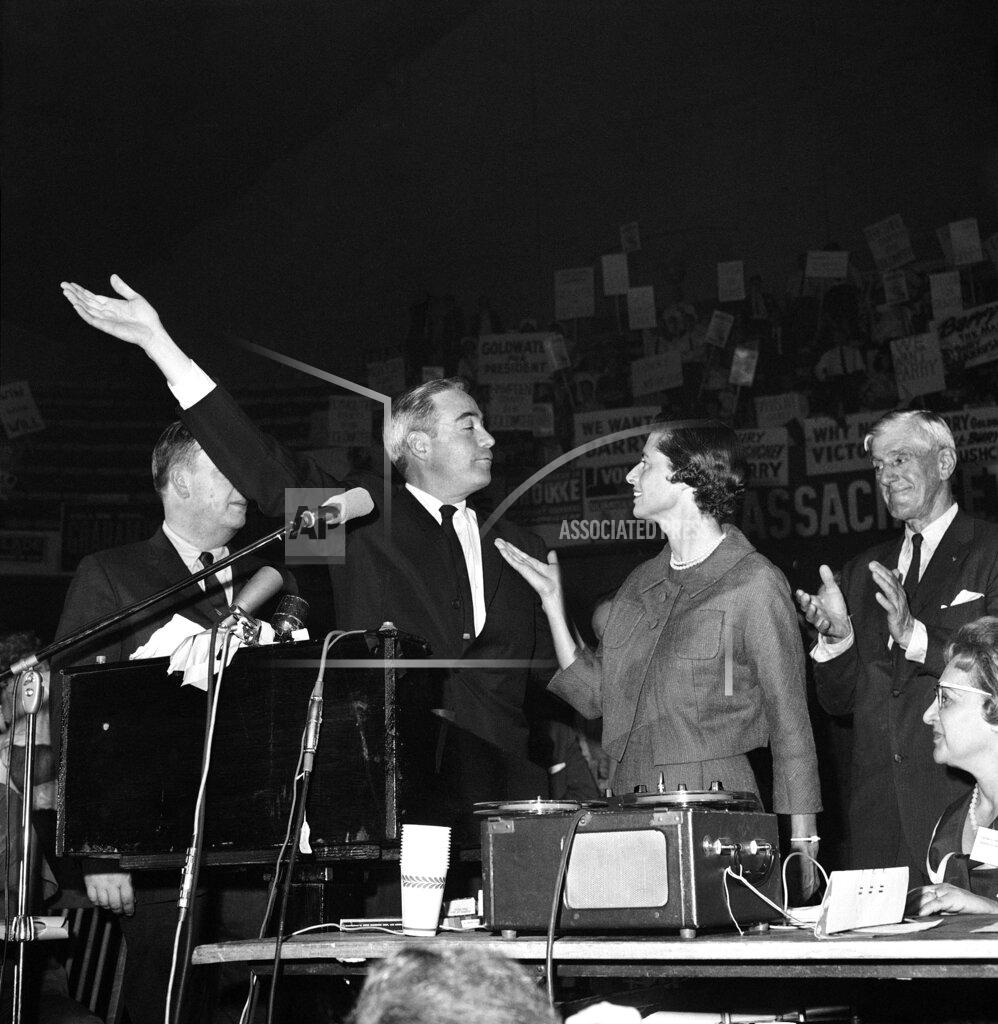
Officials who will have the job of enforcing the new civil rights act after final passage are concerned about the effect of Senator Barry Goldwater’s opposition. They fear that his strong criticism of the bill as “unconstitutional” and a step toward a “police state” will serve to encourage intransigence. They worry especially about the effect in the areas of hardcore resistance to equal rights for Blacks, such as Mississippi. The general feeling at both the White House and the Justice Department is that the main reliance for carrying out this legislation — as any legislation — must be on voluntary compliance. Law, it is pointed out, is simply not effective if it has to be enforced in numberless, unending lawsuits.
Burke Marshall, the Justice Department’s civil rights chief, gave as an example last spring the chaos that would result if the Government had to sue every citizen to collect his taxes. The significance of what, Senator Goldwater said against the bill this week lies, of course, in the fact that he is the likely Republican nominee for President. One close observer of the racial situation remarked today: “If one of our two great parties nominates for President of the United States a man who says this law is unconstitutional and dangerous, why should a Mississippian comply with it? I cannot imagine anything more calculated to encourage bitter resistance.”
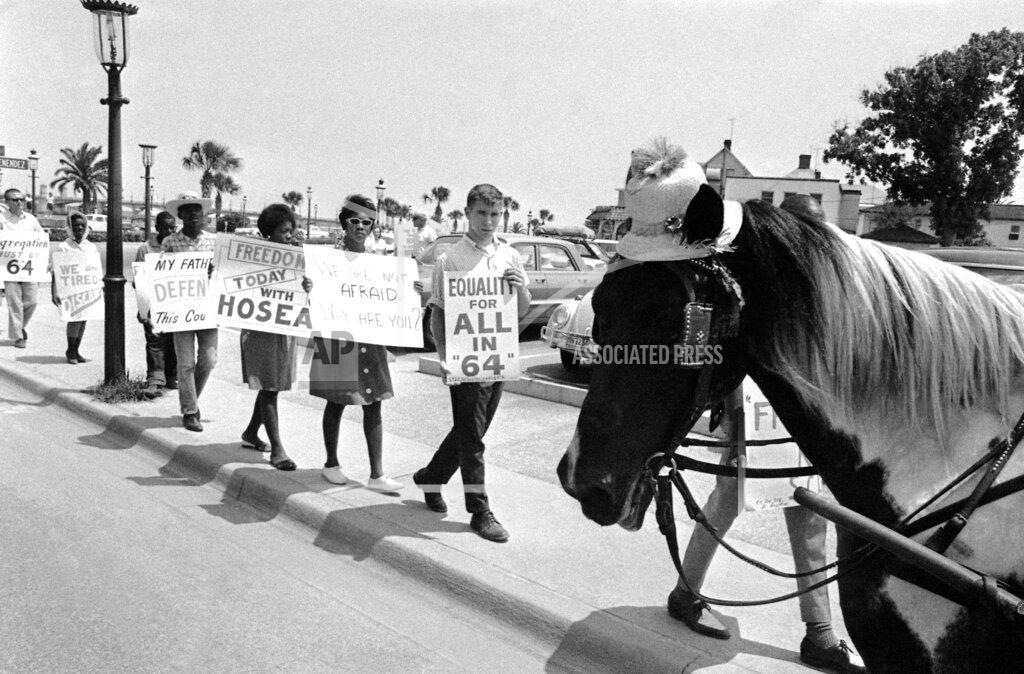
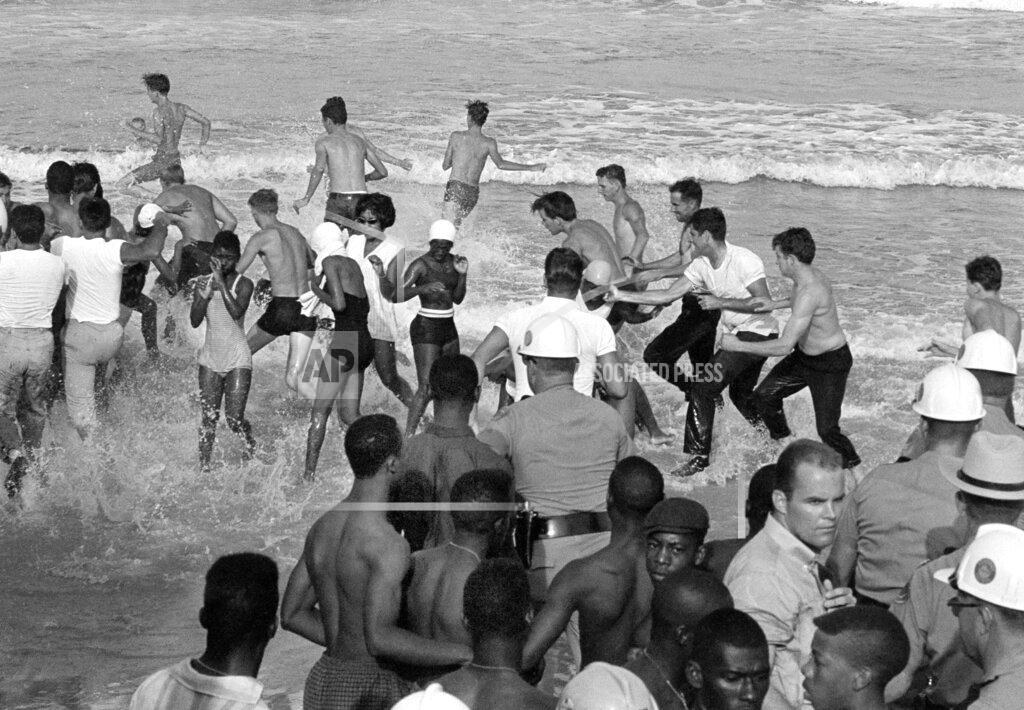
Florida Governor Farris Bryant tonight banned night demonstrations on all public property in St. Augustine. The action came as segregationist attacked an integrated group swimming at a public beach. The brief melee at the beach today came when a group of whites waded into the surf and attacked the swimmers. Three Blacks were injured before state troopers moved in and broke up the fighting. Blacks previously had used the public beach without incident. Four hours later 90 Blacks began a march downtown. After they had walked for eight blocks, they were met by about 50 highway patrolmen, who read them the Governor’s order. The group then turned around and returned to the church where they had assembled.
The Governor acted under his emergency police powers at the request of State Senator Verle A. Pope, who said that the public safety was endangered by riotous outbreaks such as occurred last night when Blacks and whites held simultaneous street demonstrations. The Southern Christian Leadership Conference, which has been leading a civil rights movement here, was expected to go into Federal Court to ask that the ban be lifted. United States District Judge Bryan Simpson of Jacksonville earlier had voided a similar ban made by local authorities. Judge Simpson’s order is still in effect. Senator Pope, a power in Florida politics, advised the Governor to act despite the Federal Court order. “That was an order and not an adjudicated decision,” the white‐haired legislator said in a news conference. Senator Pope said he made the request on behalf of “sorely pressed business interests and citizens who fear for the safety of their children.”
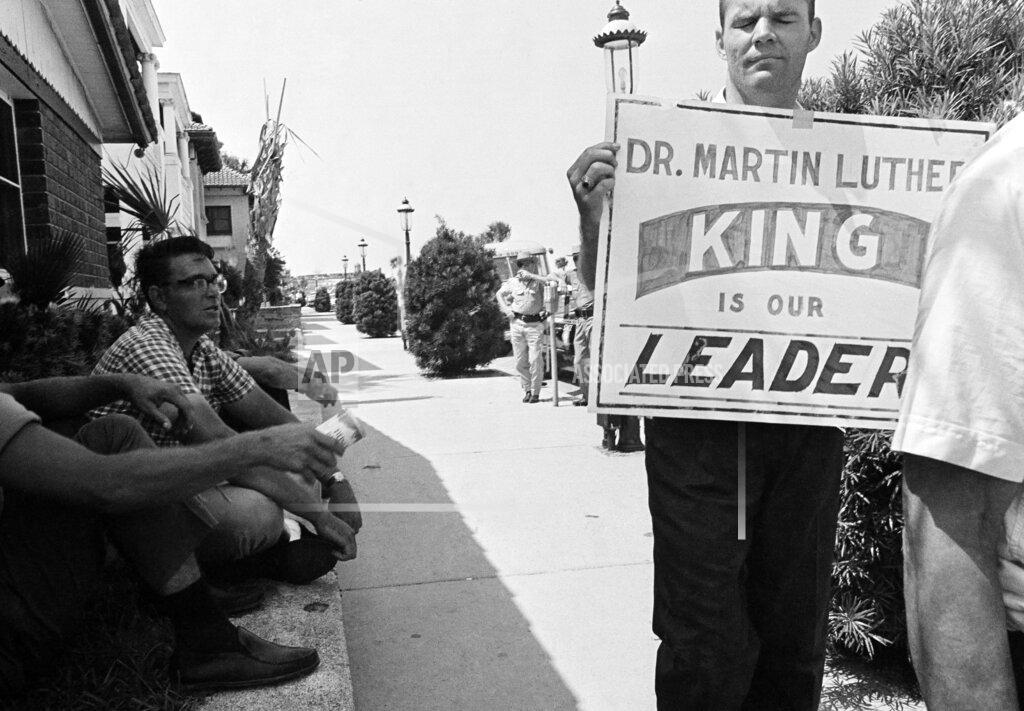
The Southern Christian Leadership Conference headed by the Rev. Dr. Martin Luther King Jr. has been holding orderly marches late at night for four weeks as part of a campaign to break down segregation in public accommodations. The marchers have been harassed by gangs of whites.
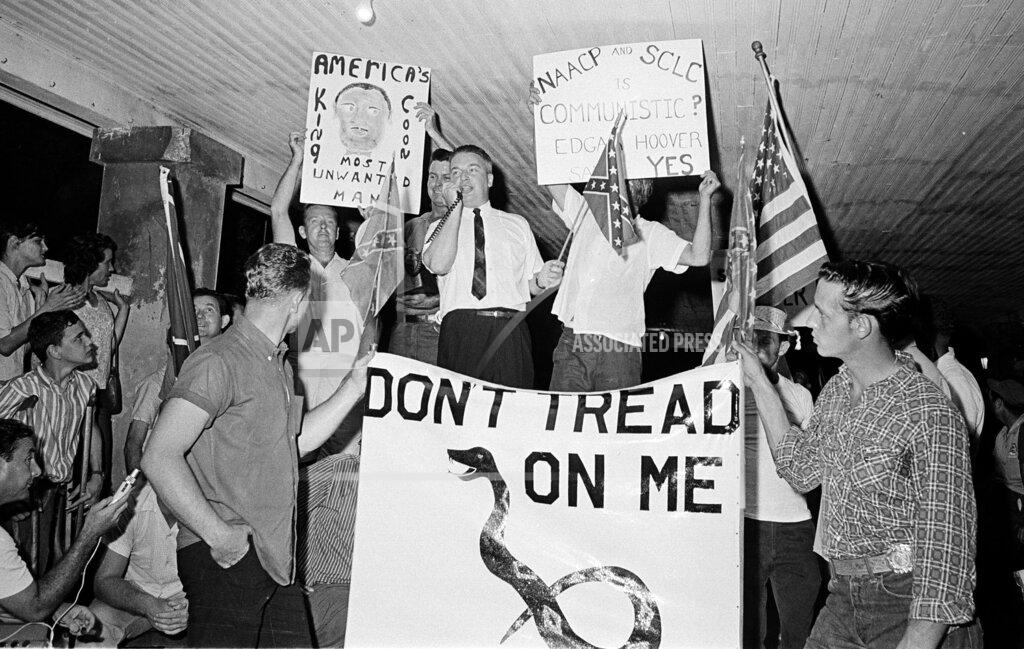
St. Augustine townspeople call them Manucy’s Raiders. Blacks refer to them as nightriding Klansmen. A Federal judge says they are hoodlums. Some of them are easy to spot because they patrol the streets in cars that carry guns, two‐way radios and whiplash antennas. They take down license numbers of outsiders’ cars and they can be seen around the sheriff’s office. The leader of this force, as every law‐enforcement officer in St. Johns County knows, is Holsted Richard (Hoss) Manucy, a 45-year‐old former bootlegger who was recently laid off his job for allegedly beating a Black.
Hoss Manucy is 220 pounds of brawn and belly. He wears a T‐shirt, jeans and a battered black cowboy hat that hides his bald spot. Black hair curls around his ears and he usually is in need of a shave. A pack of dirty youths follow him about town. The good people of St. Augustine have never considered his raiders much to worry about. They think he exaggerates the number of men under his command. But as a principal in the city’s racial strife he has turned out to be a source of embarrassment. United States District Judge Bryan Simpson of Jacksonville focused attention on Manucy several days ago when he required Sheriff L. O. Davis to bring in a list of his special deputies. Manucy’s name was on the list. Judge Simpson recognized it immediately. “That man’s a convicted felon in this court,” he said.
It was Manucy’s thugs who carried out the beach attack today. He was waiting in his car when the demonstrators arrived at the beach. By 2-way radio, he notified his men, called “Manucy’s Raiders” by the townspeople, that the group had arrived. Within a few minutes several carloads of whites waving confederate flags arrived and poured out on the beach. They waded into the water and began beating some of the group, which numbered about 25. Four state troopers who were stationed nearby waded into the water and broke up the slugfest with their clubs.
Those injured were Al Lingo, leader of the demonstrators; Dorothy Cotten, one of Dr. King’s staff members, and an unidentified 15-year‐old girl. All suffered head injuries and were given emergency treatment. Mr. Lingo was one of those arrested. He was charged with disturbing the peace.
Manucy was not arrested.
Exhilarated by a political triumph in San Francisco, President Johnson moved today into the Goldwater country of southern California, preaching national unity and Democratic virtue. Nonpolitical this afternoon in a dedication speech at a new campus of the University of California, its ninth, Mr. John‐son was openly in search of votes and campaign funds at a party dinner in Los Angeles to night. About 2,500 Democrats who paid $100 a plate heard the President sound what has become the trademark theme of his Administration — a plea for “national unity, for an end to difference and division, to rancor and reproach.” Having said that, however, Mr. Johnson did not hesitate to assert that the Democratic party “has always been the special agent of the American aim toward compassion.”
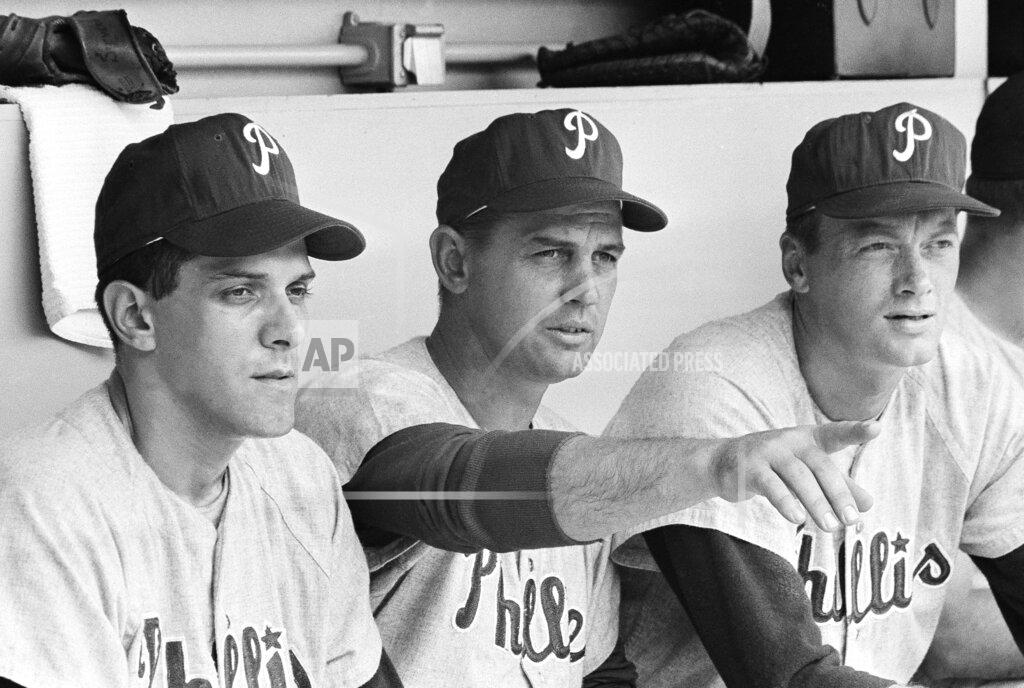
The Kansas City A’s use a 6-run first inning to down the Senators, 8–2. Nelson Mathews grand slam is the big blow in the inning. Washington scores on Bill Skowron’s 2-run homer in the 4th off Diego Segui.
George Thomas raced home with the winning run when Garland Shifflett, a relief pitcher, threw wildly on an attempted pickoff, giving Detroit an 8–7 victory over the Minnesota Twins today.
Vada Pinson smashed two home runs tonight and John Edwards one, but it took a squeeze bunt by a pinch hitter, Pete Rose, to drive in the deciding run as the Cincinnati Reds downed the Los Angeles Dodgers, 6–4. Don Drysdale took the loss for the Dodgers.
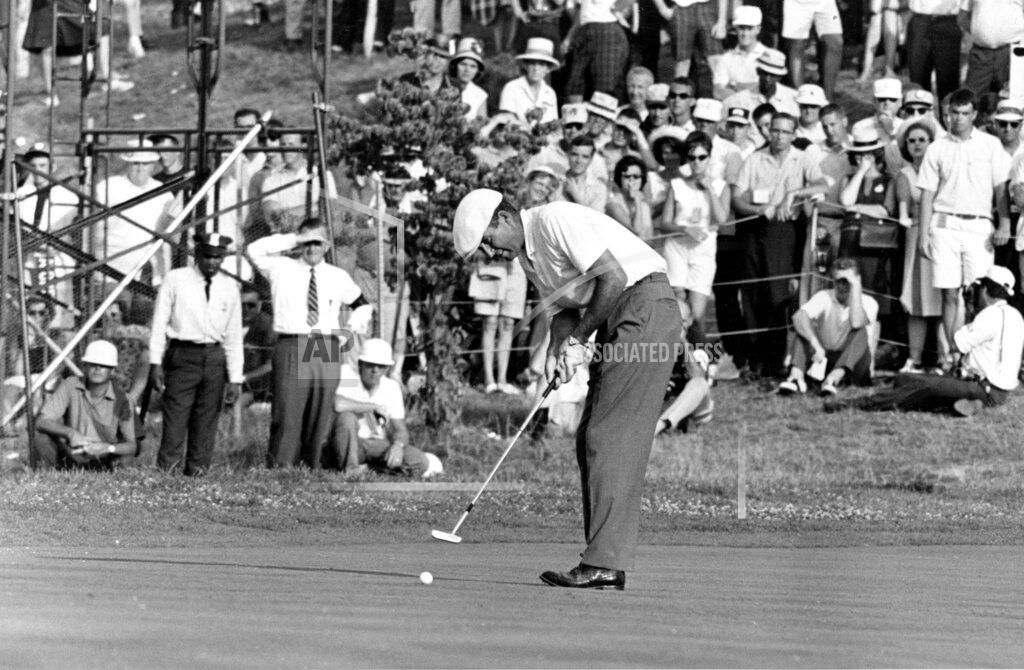
US Open Men’s Golf, Congressional CC: Ken Venturi wins his only major title, 4 strokes ahead of runner-up Tommy Jacobs.
Born:
Michael Landon Jr., American actor and director (“Little House on the Prairie”, “Bonanza” {TV movies}), in Encino, California.
Najee Mustafaa [as Reggie Rutland], NFL cornerback and safety (Minnesota Vikings, Cleveland Browns, Oakland Raiders), in East Point, Georgia.
Keith Cupp, NFL tackle (Cincinnati Bengals), in Lima, Ohio.
Died:
Edgar Barrier, 57, American actor (“Phantom of the Opera”, “Macbeth”, “Rocky”, “Cornered”), from a heart attack.
 History Diaries