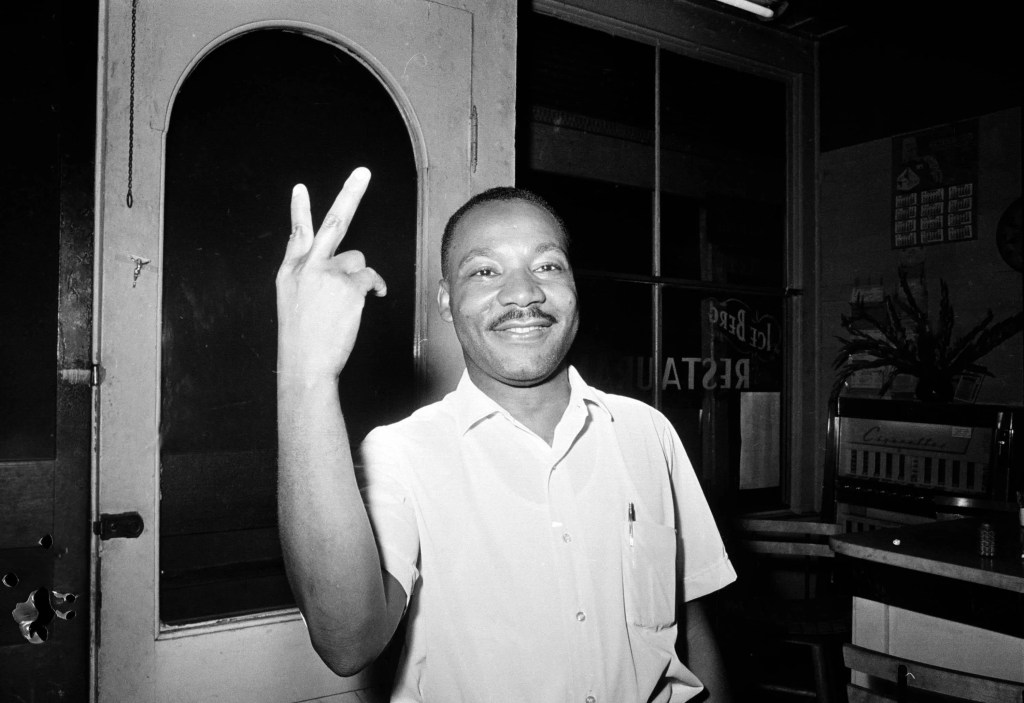
The 1964 Civil Rights Act was approved by the United States Senate by a vote of 73 to 27. All of the votes against the bill came from the same U.S. Senators who had voted no in the 71-29 approval against ending the filibuster against the bill, including Republican presidential candidate Barry Goldwater of Arizona, who had opposed the measure as an unconstitutional usurpation of state powers by the federal government, rather than on opposition to the rights of African-Americans. U.S. Senators Alan Bible of Nevada and Carl Hayden of Arizona, who had voted against cloture, both voted in favor of the Civil Rights Act. The final roll‐call came at 7:40 PM on the 83rd day of debate, nine days after closure was invoked. Voting for the bill were 46 Democrats and 27 Republicans. Voting against it were 21 Democrats and six Republicans. Except for Senator Robert C. Byrd of West Virginia, all the Democratic votes against the bill came from Southerners.
The bill will now go back to the House for concurrence in the changes that the Senate made in the measure the House passed last February 10 by a vote of 290 to 130. Tonight, Representatives Emanuel Celler, Democrat of New York, and William M. McCulloch, Republican of Ohio, who are the chairman and ranking minority member of the House Judiciary Committee, said that they would accept the Senate version of the bill. We believe that the House membership will take the same position,” they said. With the support of these two men, who were responsible for the House bill, acceptance of the Senate bill in the House is assured. President Johnson hopes to have the bill on his desk by July 3 at the latest so that he can sign it on the Fourth of July.
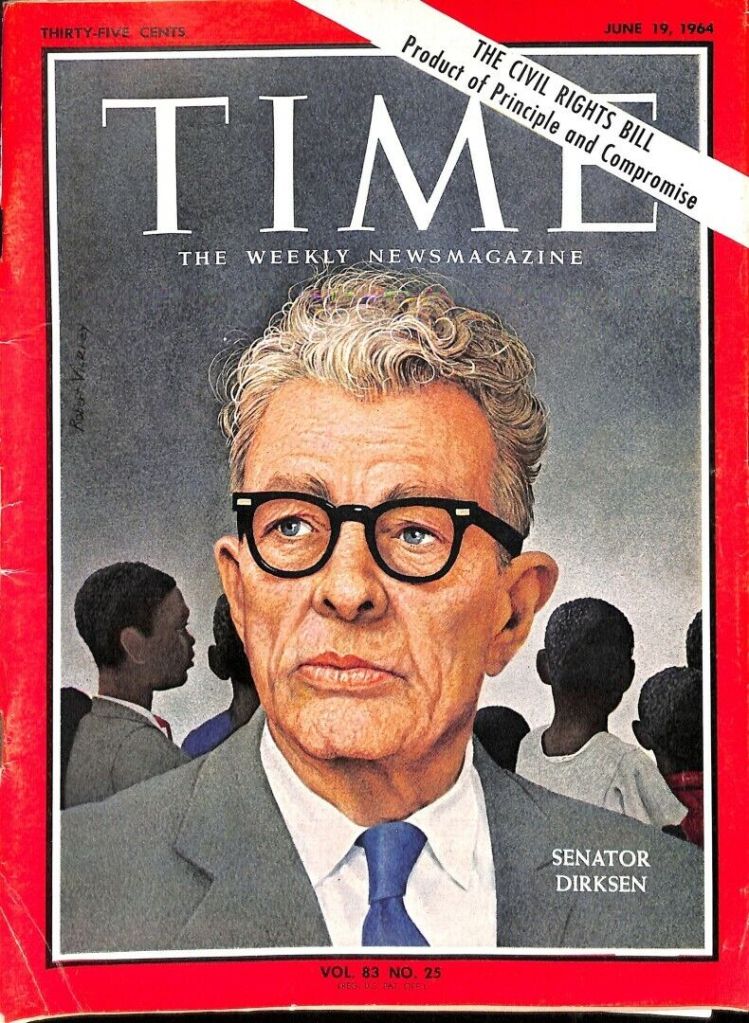
The bill passed by the Senate outlaws discrimination in places of public accommodation, publicly owned facilities, employment and union membership and Federally aided programs. It gives the Attorney General new powers to speed school desegregation and enforce the Black’s right to vote. The Senate bill differs from the House measure chiefly in giving states and local communities more scope and time to deal with complaints of discrimination in hiring and public accommodations. It allows the Attorney General to initiate suits in these areas where he finds a “pattern” of discrimination, but does not permit him, as did the House bill, to file suits on behalf of individuals. After the roll‐call, several thousand people gathered in the plaza before the floodlit Capitol to applaud the Senate Democratic leader, Mike Mansfield of Montana, and the Republican leader, Everett McKinley Dirksen of Illinois. Mr. Dirksen was instrumental in shaping the compromise that the Senate passed.
President Johnson called the Senate passage of his civil rights bill today a “challenge to men of good will in every part of the country to transform the commands of our law into the customs of our land.” Mr. Johnson said it was now the nation’s task “to reach beyond the content of the bill to conquer the barriers of poor education, poverty, and squalid housing which are an inheritance of past injustice and an impediment to future advance.” He said that he did not “underestimate the depth of the passions involved in the struggle for racial equality.” But he also spoke of “a large reservoir of goodwill and compassion, of decency and fair play which seeks a vision of justice without violence in the streets.” If these forces, the President said, “do not desert the field, if they can be brought to the battle, then the years of trial will be a prelude to the final triumph of a land ‘with liberty and justice for all.’ ”
Deep South politicians and businessmen lashed out angrily at passage of the civil rights bill today and an elderly Black said, “I’ll believe it when I see it.” Governor George C. Wallace of Alabama declared that “this is a sad day for individual freedom and liberty,” but a Chattanooga housewife said, “I firmly believe in it.” Reaction differed sharply between stanchly segregationist areas and areas where there has been desegregation. Many Blacks approached on the streets in the South had little, if any comment. “I just don’t know much about it. I’m afraid to say,” said a Black in Nashville. “It is good. I am glad,” said George Thomson, a 40-year‐old Black cab driver in Montgomery, Alabama. Jefferson Johnson, an elderly Black selling ice cream on a street in Birmingham, Alabama, said: “I’ll believe it when I see it. I hope it’ll do good, but — well, I’ll just have to wait and see.”
In Jackson, Mississippi, Mrs. Myrlie Evers, widow of the slain integrationist leader Medgar Evers, said, “The passage of this bill has special meaning to me because it was one year ago today that my husband was buried.” And the slain man’s brother, Charles Evers, said: The passage of the bill is not the important thing. The most important thing is the implementation of it, that it is accepted by both races without too much hatred or bigotry.”
U.S. Secretary of State Rusk, in a news conference, states that the U.S. commitment to the security of Southeast Asia, is ‘unlimited’ and comparable to the commitment to West Berlin, and that the United States demands full compliance with the Geneva Accords both in South Vietnam and Laos.
The Administration is saying more emphatically each day that North Vietnam and its closest ally, Communist China, must leave their neighbors alone or face a war with the United States. In the minds of officials here the United States commitment to the security of Southeast Asia is now unlimited and comparable with the commitment to West Berlin. In diplomatic terms this means the officials find themselves unable to negotiate with anything except the threat of force to persuade the Asian Communists to stop the efforts to “liberate” South Vietnam and Laos. Thus far, the Administration is not sure that the Asian Communists have accurately interpreted the warning signals from Washington. It is not sure that its allies in Europe appreciate the gravity of the United States commitment. And it is not sure that the American people understand the reasons for it.
Britain has acceded to a request by the Soviet Union that their joint efforts to bring about a six-nation conference in Laos be postponed. Official sources in London were at a loss today to explain the Soviet move. It was noted that the Russians had merely asked for more time. It was suspected, however, that the Soviet Union was feeling pressure from the Chinese Communists to bring them into the proposed conference and to widen its agenda from Laos to the whole of Southeast Asia. The Foreign Ministers of Britain and the Soviet Union are co‐chairmen of the 1962 Geneva agreements that guaranteed Laotian neutrality and independence.
In public statements Britain has been condemning the Pathet Lao, the military arm of the pro‐Communist political faction in Laos, since it began its attack against neutralist forces on the Plaines des Jarres in central Laos on May 16. The Soviet Union has publicly condemned the United States, saying it has made air strikes against Pathet Lao positions. Privately, however, Sir Humphrey Trevelyan, the British Ambassador in Moscow, and Sergei G. Lapin, a Soviet Deputy Foreign Minister, have been trying to win quiet agreement to a conference on Laos on the lines proposed by Poland. Such a conference would be attended by Britain and the Soviet Union, as co‐chairmen; Poland, India and Canada, which make up the International Control Commission in Laos, and the three political groups that formed the Laotian coalition Government in 1962 — the neutralists, rightists and pro‐Communists.
Premier Souvanna Phouma declared in a letter made public today that foreign backers of the Pathet Lao, in continuing violation of Laotian neutrality, “are taking the surest road toward a generalized war.” The prince specifically mentioned Communist North Vietnam, and by implication Communist China, among those “who show sympathy for the Pathet Lao and aid them militarily — actions contrary to the principle of peaceful coexistence and noninterference, which they constantly talk about.” “These countries place world peace in a very great danger,” he said in the letter, addressed Monday to Britain and the Soviet Union.
President de Gaulle and the Chinese Communist Ambassador, General Huang Chen, conferred for more than an hour today on the situation in Southeast Asia and on other world issues. After his first substantive discussion with the French President, Ambassador Huang said their meeting had been “very friendly.” He presented his credentials to General de Gaulle June 6. The crisis in Laos and the guerrilla war in South Vietnam were reported by East European diplomats to have been the most urgent topics discussed by the President and the Ambassador.
General de Gaulle, they believe, pointed to United States determination to sustain the Government of South Vietnam in its efforts to put down the Communist Vietcong insurrection. Two weeks ago, Under Secretary of State George W. Ball of the United States made this clear to the General. President de Gaulle does not believe that a protracted guerrilla war is the proper way to bring peace to Southeast Asia. But he has been impressed by American resolution, French sources said. Consequently, they deduced, it would be in the interests of peace for the French President to indicate to the Chinese Ambassador that the United States was fully committed in the area and would increase the stakes if necessary. Both France and China favor calling the 14 nations that participated in the 1962 Geneva conference on Laos into session again to reaffirm Laotian unity, independence and neutrality. The 1962 settlement guaranteed the independence and unity of Laos as well as her neutralization.
Although both Paris and Peking are now concentrating on the situation in Laos, it is conceded here that any conference would ultimately be forced to consider the situation in neighboring North Vietnam, South Vietnam and Cambodia. Prospects that a new Geneva conference would be held seemed to be receding as President de Gaulle and General Huang talked. The French Government has been informed that Prince Souvanna Phouma, the Laotian Premier, believes that a conference would be useless as long as the Communist‐led Pathet Lao continues to violate the 1962 Geneva agreements. Foreign Ministry sources also said that the Soviet Union had now asked for a postponement of six‐power talks proposed by Poland as a preliminary to any 14-nation Geneva conference.
Firing broke out today between Greek and Turkish Cypriot forces in two villages in the Kyreaia Mountain area. Reports reaching the capital of Nicosia put the shooting at the Turkish Cypriot villages of Krini and Gaziveran. No casualties were reported.
The U.N. Security Council failed to reach a vote tonight on a resolution to extend the United Nations peacekeeping force in Cyprus for another three months. It will vote tomorrow. The brief resolution, formally presented by five countries, noted that the Secretary General, U Thant, had recommended a three‐month extension of the peacekeeping operation. It also reaffirmed past resolutions setting up the force and extended its life to September 26 instead of June 27. Without giving any reason, this month’s President of the Council, Arsene Assouan Usher of the Ivory Coast, announced that the vote would be taken tomorrow. It was understood that Nikolai T. Fedorenko of the Soviet Union had objected to voting today although he had said he would not oppose the resolution. There has been no discussion about the need for the peacekeeping force, but three days of acrimonious exchanges preceded the decision to vote on extending its life.
Prime Minister İsmet İnönü narrowly survived a motion of no confidence in the Grand National Assembly of Turkey, but by only six votes, 200 to 206. The Premier declared later that he would leave Sunday for the United States for consultations with President Johnson. The narrow vote was interpreted in political circles here as an indication that about half of the National Assembly was dissatisfied with the İnönü Government’s policy of “moderation” on Cyprus. This, it is believed, will enable the Premier to contend in Washington that he is under powerful pressure from a political opposition that would like to see Turkish military intervention in Cyprus. The vote is expected to reinforce Turkish contentions that if a solution of the Cyprus problem acceptable to Turkey is not found soon, there is serious danger that Mr. İnönü will be replaced by a more bellicose leadership.
Chancellor Ludwig Erhard turned down to‐day an unofficial but urgent Soviet invitation to go to Moscow for an attempt at improving Soviet‐West German relations. He suggested instead that the Soviet Premier ask for an official invitation to Bonn if he thought the trip would be worthwhile. At his first news conference here in six months, Dr. Erhard carefully held open the door for an eventual encounter with Premier Khrushchev while dashing cold water on the prospects of settling soon any of the fundamental questions that divide Bonn and Moscow. As he spoke, Bonn’s Western allies were putting the final touches on the text of identical notes scheduled to be delivered shortly in Moscow, reminding the Soviet Union of its ultimate responsibility for the reunification of Germany.
Albertville, the capital of Congo’s North Katanga Province, was reported today to have fallen to anti‐government rebels. According to messages reaching here, rebels striking south along the shore of Lake Tanganyika entered the city about midday. It is not known here whether there was any resistance from Congolese soldiers there. Many of the city’s Europeans have fled in steamers across the lake. At least 150 women and children left on two steamers last night for Bujumbura, the capital of Burundi. Another steamer, with 350 persons aboard, was scheduled to leave early this afternoon, but it was not whether it got away.
Meanwhile, the United States Embassy here said that two American civilian pilots who had been flying combat missions for the Congolese Army had voluntarily decided to cease the flights. An embassy official said the pilots made their decision after they learned that they might be subject to penalties under United States law. The embassy spokesman adhered to the official United States position that the two men were “individual Americans on contract to the Congolese Government.” He said the United States Government had neither authorized their contract nor directed their activities here. The Americans, Ed Dearborn and Don Coney, also insisted in an interview here, as they had previously, that they were civilians under contract to the Congolese Government.
Leaders of national civil rights groups last night hailed the Senate passage of the civil rights bill, and vowed that the measure would be quickly tested. There was little indication that the Senate’s action would reduce the number of demonstrations in the immediate future. James L. Farmer, national director of the Congress of Racial Equality, said that CORE would press for implementation and enforcement of the bill’s provisions. “There will be no breathing spell on demonstrations,” Mr. Farmer said. “We breathe easiest when the pressure is on.”
“The passage of the civil rights bill may well be the single most important act of our Congress in several decades,” Mr. Farmer said. “It gives hope to Blacks that the American people and Government mean to redeem the promise of the Declaration of Independence and the Emancipation Proclamation.” Mr. Farmer also saw the bill as an “act of goodwill and reconciliation” between Blacks and the white community. He said: “We in CORE pledge that We will accept it as such.” He declared, however, that Blacks wanted “the reality of equality.” He added, “We will continue to demonstrate and to use our body and, our spirit to secure that reality.”
Roy C. Wilkins, executive secretary of the National Association for the Advancement of Colored People, hailed the bill as “a giant step forward, not only for the Black citizens but for our country.” Mr. Wilkins, in answer to a question, said he believed the bill “may reduce the number of demonstrations, but I cannot predict that it will eliminate them.” He said that civil rights demonstrations “grow out of local irritations and problems, and if local officials refuse to discuss and plan and negotiate for change, then demonstrations will be the only recourse.”
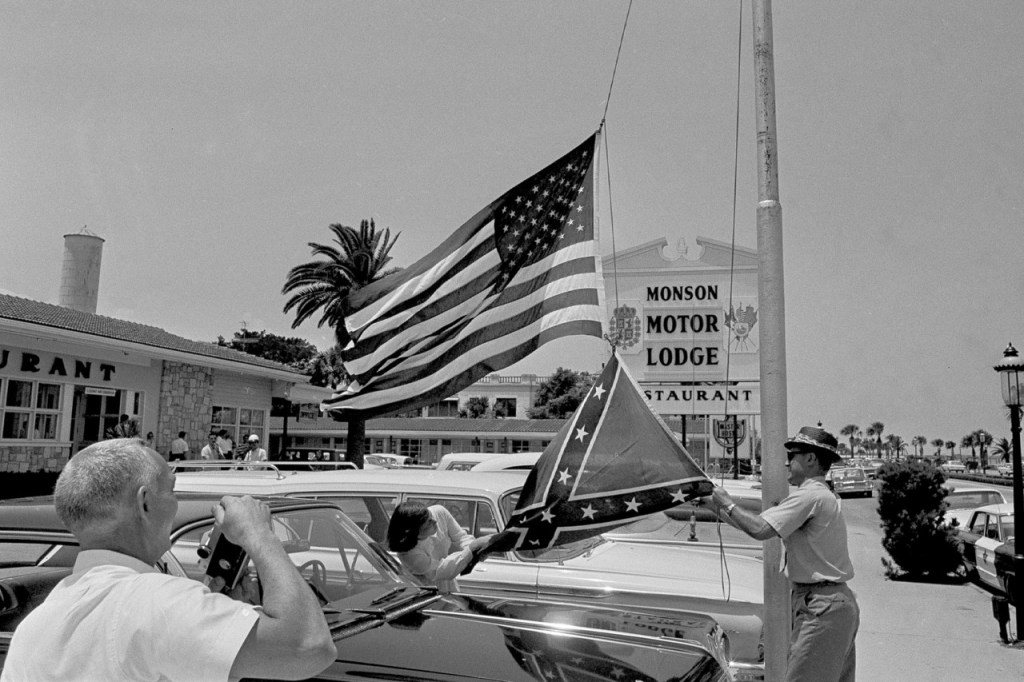
A mob of whites in St. Augustine, Florida, shouting threats and obscenities, tried to penetrate a shoulder-to-shoulder police line tonight in an attempt to get at a procession of Blacks celebrating passage of the civil rights bill. The whites, fired up by Ku Klux Klan speakers, followed the 180 marchers through dark, narrow streets but were repulsed at every turn by state troopers and other officers. Bricks and bottles were thrown, but there were apparently no injuries.
About 200 Blacks had met in a Baptist church and cheered the Rev. Dr. Martin Luther King Jr. when he called passage of the civil rights bill a “dawning of new hope” for the Black. At the same time about 500 whites were meeting several blocks away in the old Slave Market, which occupies one end of a plaza in the heart of town. They heard a speaker say that the civil rights bill would “bring on a race war.” Meanwhile the Blacks formed their marchers and headed for the Slave Market as they have done on previous evenings. Sheriff L. O. Davis and a posse of officers headed them off and arrested two leaders, the Rev. Andrew Young and the Rev. C. T. Vivian, both members of Dr. King’s staff, who were intent on marching into the plaza.
The Rev. Fred L. Shuttlesworth, a Birmingham, Alabama, integration leader, who is an associate of Dr. King, then led the procession past the Slave Market down Menendez Avenue toward the old Spanish Fort. At this point about 200 whites broke out of the plaza and rushed at the marchers. “Get the black apes,” some of them yelled, but the police held them back as the procession was turning into a narrow street toward a white neighborhood. The whites tried to break through the police line on several occasions but were unsuccessful. After that the whites, chanting and cursing, ran through lawns and hedgerows trying to find a weak spot in the line of officers. Repulsed, they finally gave up and returned to the rally.
A Justice Department official today told volunteers for the coming civil rights campaign in Mississippi that there was no federal police force there to protect them. John Doar, deputy chief of the department’s civil rights division, suggested that the volunteers accept this fact “and guide your conduct accordingly.” His remarks brought angry reaction among the 200 student volunteers and 75 representatives of various civil rights organizations attending a one‐week orientation course in Oxford, Ohio at the Western College for Women. The volunteers will leave tomorrow for Mississippi. They will be followed by another group, which will undergo orientation here next week. Some 800 persons, many of them white college students from outside the South, are expected to take part in the program of political action, education, and cultural activities among Blacks.
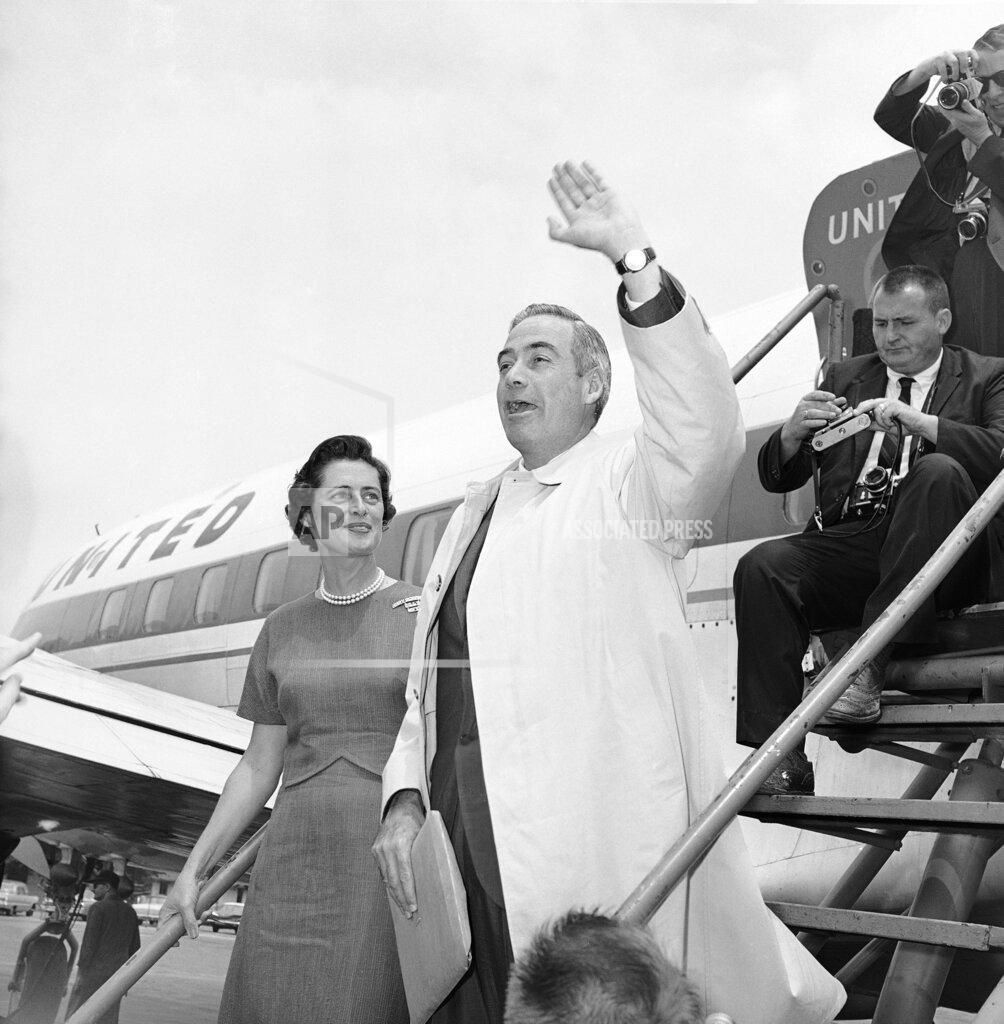
Senator Edward Kennedy, 32, and Senator Birch Bayh, 36, were seriously injured in a private plane crash at Southampton, Massachusetts. The pilot, Edward J. Zimny, was killed. Accompanied by a Kennedy aide and by Mrs. Bayh, the two U.S. Senators were flying from Washington, D.C., to attend the Massachusetts Democratic state convention in West Springfield when the twin-engine Aero Commander plunged into an apple orchard. Kennedy broke his back and would be hospitalized for nearly six months, until December 16.
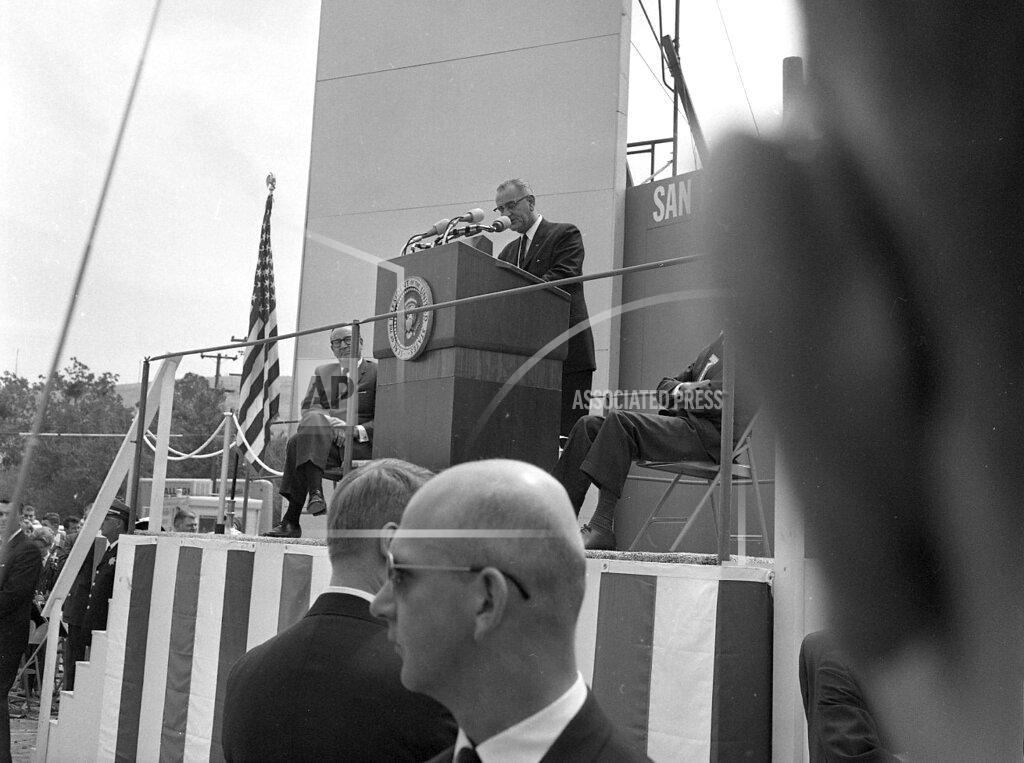
President Johnson brought to the West Coast today his prophesies of the good life for every American, promising Californians the lion’s share. From Edwards Air force base in the Mojave Desert to Concord in the Oakland Bay area and later to a downtown corner in San Francisco, Mr. Johnson delivered the message that “California has led all the rest” — in federal defense spending and the economic benefits that flow from it. The President’s mission today was ostensibly nonpolitical. He inspected the air base and dedicated a new rapid transit facility and a new federal building. Its net impact, however, in a state that will cast 40 electoral votes next fall, was hardly nonpolitical.
Tonight, at the Hilton Hotel in San Francisco, Mr. Johnson turned openly political as the main speaker at a $100-a‐plate Democratic party fund‐raising dinner. It was a natural climax to a day in which he had claimed that “a government which can get things done and know where it is going” was what the nation had had for four years and was what “you are going to get for the next four years.”
U.S. President Johnson presided over the groundbreaking ceremonies for the Bay Area Rapid Transit (BART) system in Concord, California. Criticizing Barry Goldwater’s views on states’ rights, Johnson talked about the federally-aided transit system serving San Francisco and Oakland and said “The idea that we are 50 separate countries, that the federal government — representing the destiny of 190 million people — does not have duty to meet the needs of these people — this idea is as out of date as the dinosaur.” The President arrived by helicopter, “raising huge clouds of dust and whirling papers hundreds of feet into the air” as the pilot flew only 100 feet above the crowd of 25,000 at the dedication, and a 70-year-old Concord resident was injured when a metal chair was blown into the crowd.
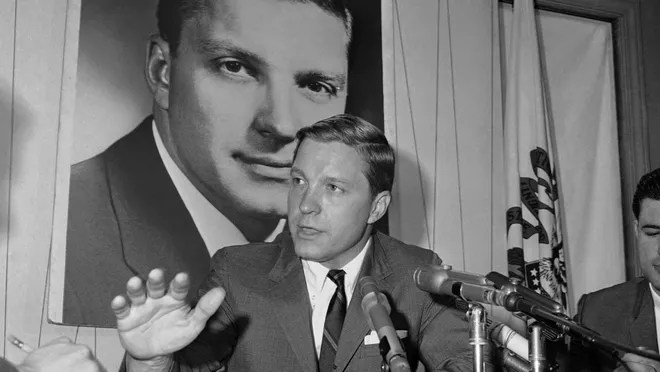
The Republican leader in the Senate, Everett McKinley Dirksen of Illinois, closed the civil rights debate tonight with a biting attack on his party’s leading Presidential prospect, Senator Barry Goldwater. Senator Goldwater’s announced opposition to the bill brought on the attack. He said yesterday that he could not “in good conscience” vote for the bill because he thought it was “unconstitutional” and would lead to a “police state.” Earlier, it was reported that former President Dwight D. Eisenhower had indicated to Mr. Goldwater that the general would not hold a negative vote on the bill against the Arizonan. On the floor of the Senate, Mr. Dirksen ridiculed the Goldwater, constitutional argument and moral position. Looking often at Senator Goldwater, though never mentioning him by name, Mr. Dirksen in effect challenged the likely nominee of his party on what may be the chief issue at the Republican National Convention next month.
Luther Burbank Home and Gardens, home of the famous horticulturist, is designated a National Historical Landmark in Santa Rosa, California
The last original episode of “The Twilight Zone,” the CBS science fiction anthology series, was telecast with the showing of “The Bewitchin’ Pool”.
Bob Dylan completes a UK tour.
Harmon Killebrew, the major league’s leading home run hitter, paced a four‐homer attack, with his 21st as the Minnesota Twins overpowered the Detroit Tigers, 7–6, tonight. Two‐run blasts by Bob Allison and Zoilo Versalles and shots by Killebrew and Tony Oliva with the bases empty enabled the Twins to snap a three‐ game losing streak.
Julian Javier hit a two‐run homer in the seventh inning tonight to give the St. Louis Cardinals a 3–1 victory over the San Francisco Giants. Javier’s clout which came after Bob Skinner had singled, broke a 1–1 tie. Javier drove in five runs with a homer and double in sparking the Cardinals to 7–6 victory yesterday.
Dow Jones Industrial Average: 825.25 (+1.27).
Born:
Boris Johnson [as Alexander Boris de Pfeffel Johnson], (Prime Minister of the United Kingdom, 2019-22, Mayor of London, 2008-2016), in New York, New York.
Died:
Hans Moser, 83, Austrian actor (“Hello Service Man”, “Once Upon a Time”).
 History Diaries