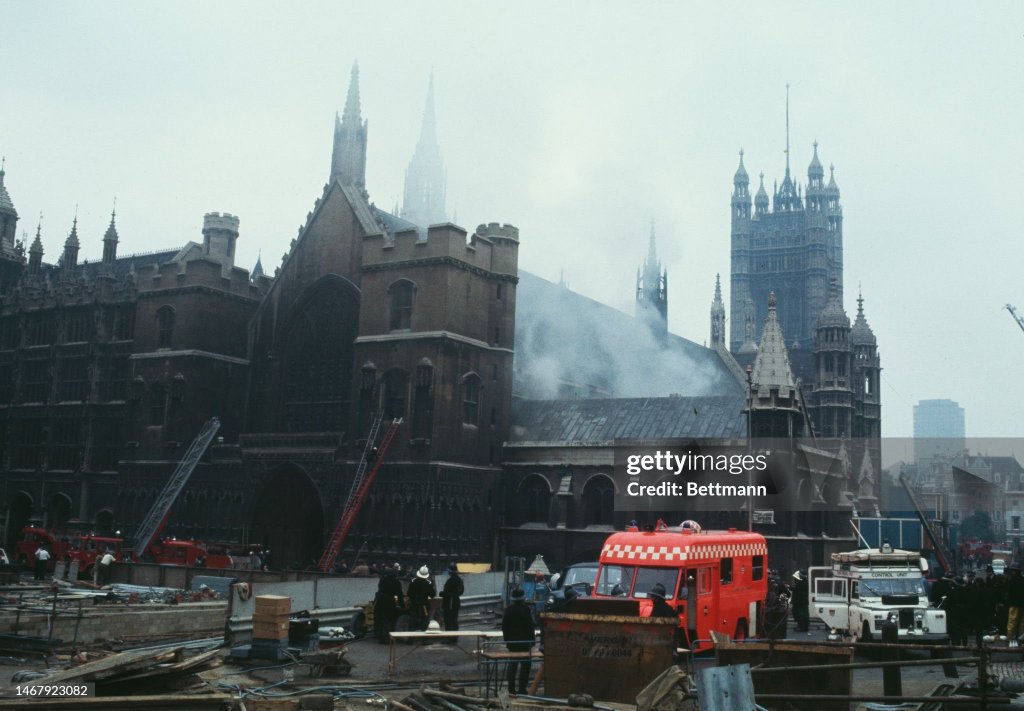
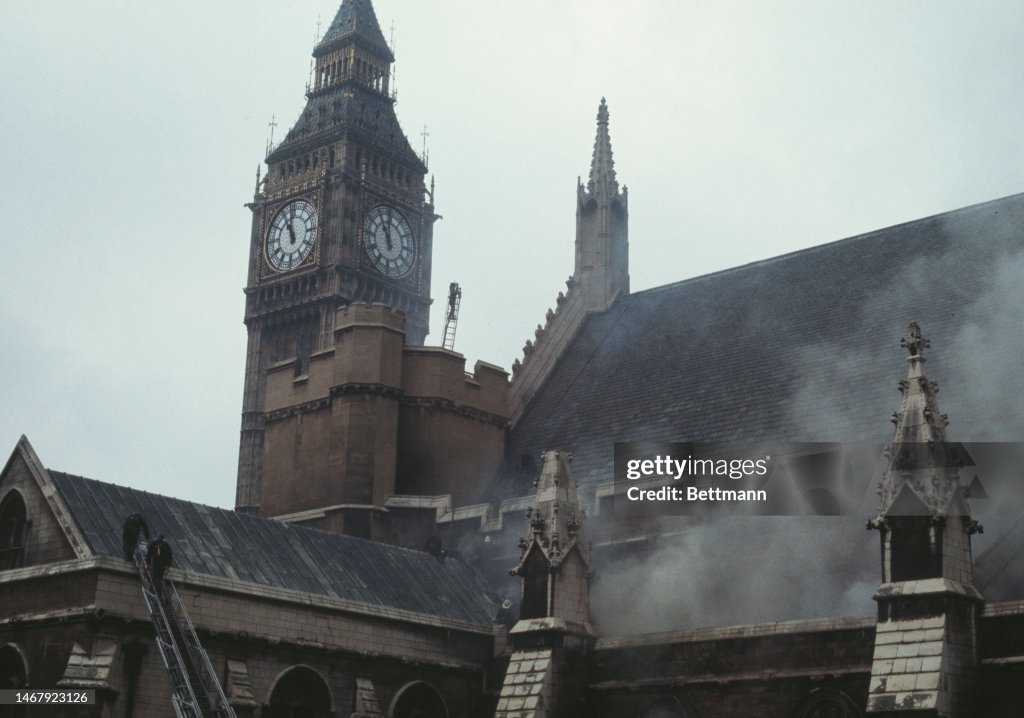
At 8:28 in the morning, a bomb exploded at the Houses of Parliament at Westminster Palace in London, setting off natural gas fires, causing extensive damage and injuring 11 people. An anonymous caller alerted the British Press Association six minutes before the blast, and security officials at Westminster evacuated persons inside the building. A man with an Irish accent telephoned the Press Association, the local news agency, giving six minutes warning of the explosion and using a code word of the I.R.A. to identify a genuine alert. The Irish Republican Army claimed responsibility.
For several hours after the blast, smoke shrouded Big Ben as firemen fought the fire fed by an ignited gas main. The hall’s annex, which housed a canteen and some offices, was wrecked. The great hall itself, the oldest remaining part of the original Royal Palace of Westminster, appeared only slightly damaged. The famous ceiling curved arches of oak and carved hammer beams remained intact. Windows along both sides of the hall were blown out, along with panels of glass over the northern entrance. The stained-glass window at the southern end — the area tourists pass when they enter Parliament for tickets to the galleries — was undamaged. There was also no damage the House of Commons or House of Lords, both of which are some distance from hall. But the smell of smoke lingered in the corridors of Parliament all day as Members deplored the attack and called for more stringent security measures.
Unknown assassins shot and killed two members of the neo-Fascist Italian Socialist Movement in its local headquarters in Padua, and the party’s secretary said the incident escalated the “spiral of civil war” engulfing Italy. Giorgio Almirante blamed the slayings on leftists and said the shaky coalition government of Premier Mariano Rumor was incapable of controlling the situation. Almirante said the government, opposition parties and press had started a campaign of civil hatred against the right wing since the bombing of a leftist rally at Brescia two weeks ago in which eight have died.
Alexander Galich, 54, actor, poet and singer widely known and admired by Soviet intellectuals, said he has received permission to leave the Soviet Union for Israel and must be out by June 25. He had been turned down in requests to visit Europe and the United States, where he has relatives, but was told the road to Israel was open. His application was granted within two months. Galich, whose songs lampooned Soviet life, was expelled two years ago by the Writers’ Union.
More than 99% of Soviet voters, an estimated 150 million citizens, went to the polls to elect an unopposed slate of 1,517 candidates to the Supreme Soviet, Pravda reported. The Communist Party newspaper said that four hours before the polls closed, 99.34% of those eligible had cast their ballots. The winners of the four-year terms, traditionally elected by a 99% margin, will be announced later.
The White House-to-Kremlin communications “hotline” has had its troubles over the years: a Danish bulldozer once cut the closed-circuit wire line near Copenhagen, a Finnish farmer once plowed through it, and an underground tunnel fire in Baltimore took its toll. So, according to Electronics Magazine, a satellite hookup using European Intelsat and Russian Molniya circuits will be set up later this year to ensure that the crisis line is always open.
Secretary of Defense James R. Schlesinger said today that there was a possibility that an agreement in principle to limit the deployment of new Soviet missiles with multiple warheads might be reached during President Nixon’s visit to Moscow next week. At a Pentagon news conference, Mr. Schlesinger also took a generally hopeful view that some overall progress could be made at Moscow on limiting strategic weapons. Reflecting a foregone Administration conclusion, he saw no likelihood that a permanent, comprehensive agreement could be reached on limiting offensive strategic missiles. But, he suggested, there were other “areas in which constructive steps can be taken and progress made.” He cited the possibility of an agreement in principle in which the Soviet Union would place numerical restraints on deployment of its big new missiles that can carry multiple warheads, known as MIRV’s. Also possible, he said, were a partial ban on underground nuclear tests and some limitations on further development of ballistic missile defense systems.
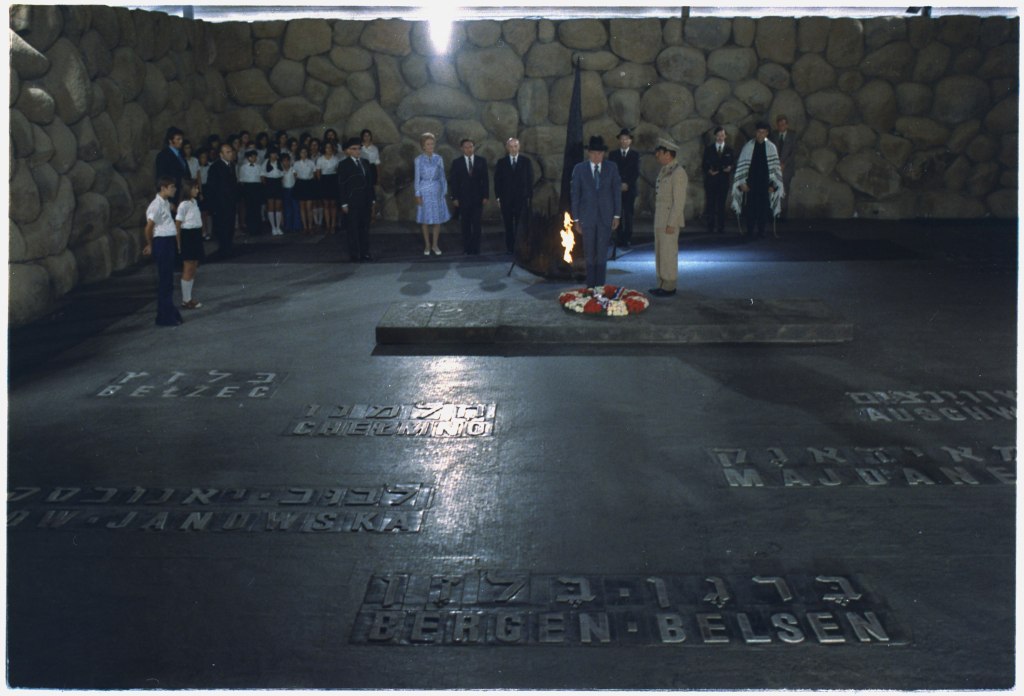
President Nixon assured Israel of long-term military and economic assistance and urged her new government to demonstrate its statesmanship by taking risks for peace. This dual theme dominated Mr. Nixon’s tightly scheduled 26-hour visit to Israel, which included two meetings with Israeli leaders, a state banquet and a somber ceremony at Yad Vashem, the memorial to the six million Jews killed during World War II. The President then went on to Amman, Jordan, for the last stop of his Middle Eastern tour.
A majority of the world’s large oil-exporting countries announced a 2 percent increase in royalties paid by Western oil companies. But Saudi Arabia, the biggest exporter, dissociated herself from the increase. The Organization of Petroleum Exporting Countries also decided at a ministerial meeting in Quito, Ecuador, to continue the posted price of oil at present levels for another three months beginning July 1.
Egypt has the scientific capability of manufacturing atomic weapons and would do so if Israel develops and tests such weapons, Egyptian Foreign Minister Ismail Fahmi said in Cairo. Fahmi said that the Israeli signing of the nuclear non-proliferation treaty is essential to a Mideast peace settlement.
Cambodian government troops, launching one of their biggest operations, killed more than 100 rebels in fighting 11 miles north of Phnom Penh, according to field reports. The drive by six battalions of infantry, each with more than 500 men supported by 60 armored personnel carriers, is aimed at relieving two besieged government positions at Long Vek, 10 miles farther north.
The Atomic Energy Commission said that China conducted a relatively large nuclear test early today at her test range in the northwestern part of the country. Defense Secretary James Schlesinger expressed no particular concern over the test, He said it “simply reflects the slow-paced Chinese program,” which, he said, has been deliberate but “moderately successful.” The commission said the explosion took place in the atmosphere at about 2 AM Eastern Daylight Time, at the test range in: northwestern China. The blast was in the “intermediate range” between 200 kilotons and one megaton, according to the announcement. A kiloton is the equivalent of 100 tons of TNT and a megaton is equal to one million tons of TNT.
The worst hurricane to strike the resort city of Acapulco, Mexico, since 1938 caused landslides that killed nine persons, including four children, the authorities announced today. Thirteen others are missing. The dead all came from impoverished areas on the mountain outskirts of the city.
General Augusto Pinochet, chairman of the four-man military junta that had taken control of Chile in 1973, was proclaimed “Supreme Chief of the Nation” (“Jefe Supremo de la Nación”) by Decree Law No. 527, “Aprueba Estatuto de la Junta de Gobierno. He would formally be designated as President of the Republic on December 17.
Benjamin Mendoza, 39, a Bolivian painter who last week completed a four-year jail sentence for an attempt to kill Pope Paul VI during a 1970 visit to the Philippines, pleaded innocent to charges of being an undesirable alien. Mendoza said he wants to stay in the country to pursue a claim that he was swindled of $3,428 by a Filipino acquaintance.
A German‐born executive in Argentina of the Mercedes‐Benz automobile company was kidnapped in Buenos Aires on Friday apparently by left‐wing urban guerrillas, police sources said today. The sources said that Herbert Pilz, 48‐year‐old Mercedes Benz production manager here, was kidnapped near his home in the northern suburb of Munro as he was driving to the company’s plant 28 miles south of here. They said that the kidnappers later contacted Mercedes‐Benz and identified themselves as a left‐wing guerrilla group, but did not say which one. It was not immediately known if the kidnappers demanded a ransom or set any conditions for the release of Mr. Pilz. Both Mercedes‐Benz and members of Mr. Pilz’s family refused to comment.
President Juan Domingo Perón today threatened a crackdown on terrorists to quell a new wave of murder, bombing and kidnapping. “This evil must be wiped but, one way or another, “General Perón said at a meeting with labor leaders. “If not, we must answer violence with a repression that is also a little more violent and stronger.” In the last week, in addition to the kidnapping of the Mercedes‐Benz executive, two union leaders were shot to death, a powerful bomb blasted the home of a provincial governor, and a policeman was killed.
The Union for Total Independence of Angola and the Portuguese military command there have reached an agreement on the suspension of hostilities, an official communique announced. UNITA, the smallest of three nationalist guerrilla groups, is estimated to have 300 fighting men in the sparsely populated grasslands of east central Angola.
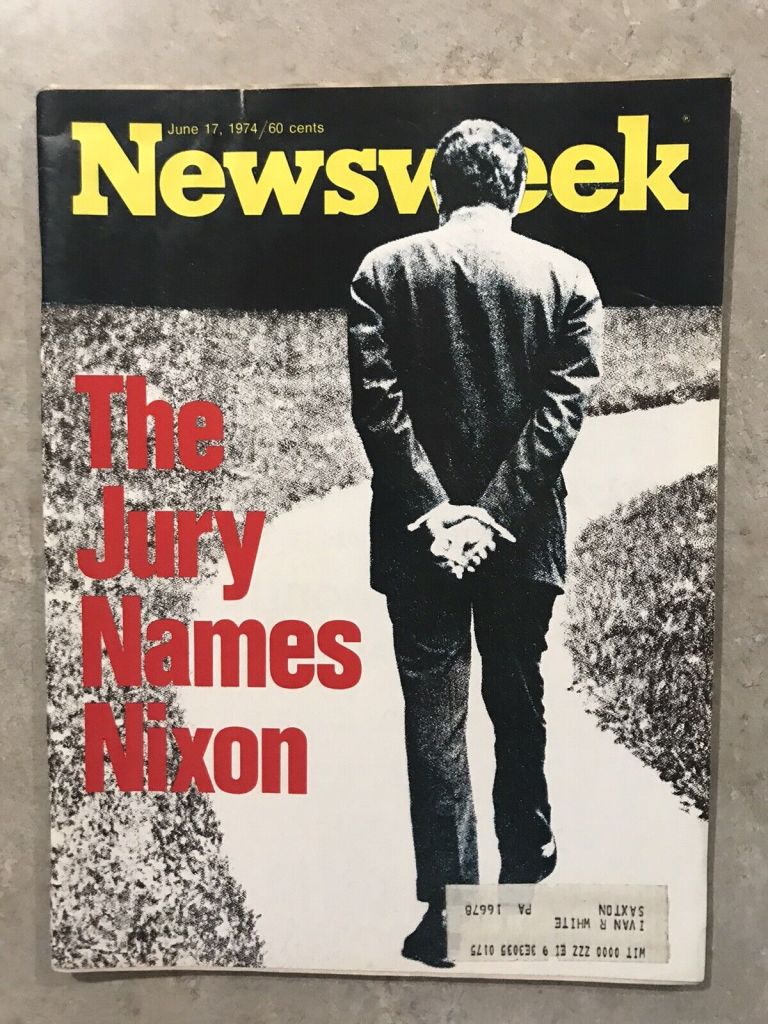
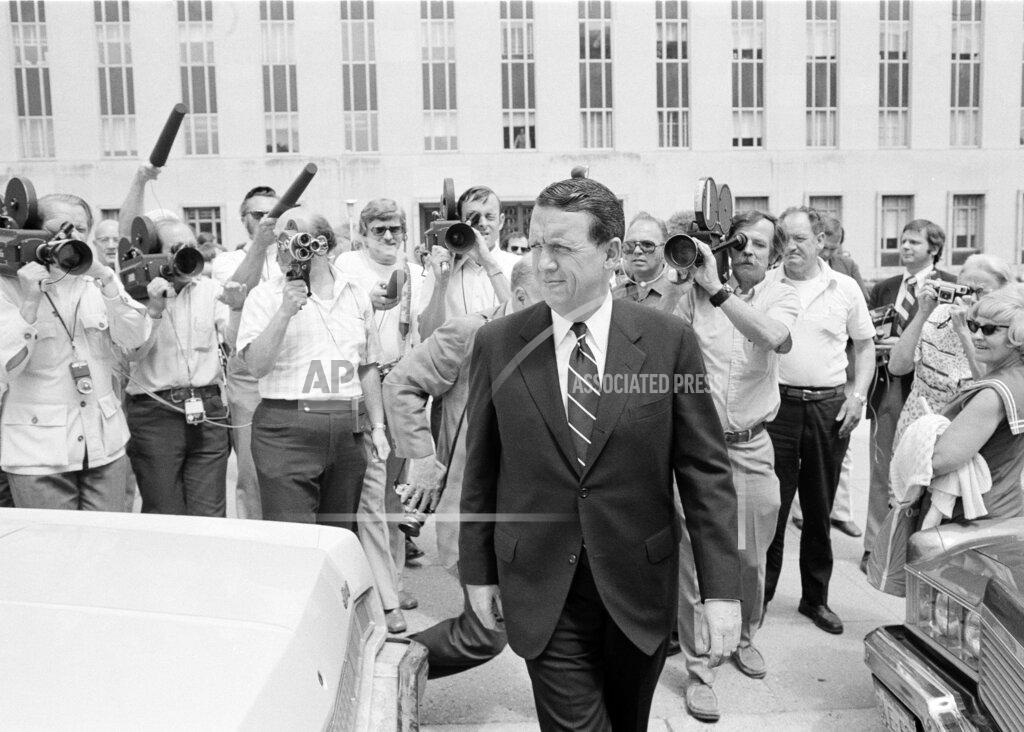
“Your honor, I’d like to let you know how deeply embarrassed I am and how much I regret standing here before you this afternoon,” said Herbert Kalmbach, President Nixon’s former personal lawyer, as he was sentenced to six to 18 months in prison and fined $10,000 for illegal fundraising activities on behalf of the White House. He was sentenced by Judge John Sirica in Federal District Court in Washington.
Vice President Ford expressed “a restrained note of optimism” in White Sulphur Springs, West Virginia today that food prices would start leveling off soon and perhaps even drop. Speaking to the annual meeting of the Grocery Manufacturers of America, the Vice President conceded that there was a “deep and pervasive anxiety” about rising food prices throughout the nation. But Mr. Ford said his own assessment of the situation led him to believe that if wholesalers, retailers, farmers and the weather continued to cooperate, “it is even possible that prices at the check‐out counter may begin to come down.” Mr. Ford also told the grocery manufacturers that the Nixon Administration was determined to bring down the rate of inflation. “We. cannot stop it immediately without plunging the nation into a depression,” he said. “But we aim to slow inflation down over a period of time in such a way as to avoid either a depression or a recession.”
The Vice President also spoke out against Government‐imposed controls, saying that they interfered with economic freedom. Yet, he added, the Administration does see a need for close monitoring of prices and wage developments. “The basic solution,” he said, “is fiscal and monetary restraint.” Mr. Ford also challenged they grocery manufacturers to provide better, cheaper and more healthful food products through creative cooperation and productivity.
Supermarket spokesmen promised to try to reduce meat prices and promote sales at a White House meeting of government and food-industry officials on the financial troubles of the nation’s cattle producers.
In a decision regarded as a serious setback for women’s rights advocates, the Supreme Court ruled 6 to 3 that states can deny disability benefits to women incapacitated by normal pregnancy without committing unconstitutional discrimination. In the majority opinion, Justice Potter Stewart said, “there is nothing in the Constitution that requires the state to subordinate or compromise its legitimate interests solely to create a more comprehensive social insurance program than it already has.”
The effort of liberal Democrats to attach a $6‐billion tax reduction and a package of tax reforms to the pending debt‐ceiling bill appeared likely today to be blocked by a filibuster. Senator James B. Allen, Democrat of Alabama, moved faster than the liberal group and called up his own amendment to the debt‐ceiling bill. He then announced that he would agree to no limitation of debate on his amendment, except under terms that would prohibit introduction of the tax‐reduction and tax‐reform amendments. The Allen amendment would increase the debt ceiling to $490‐billion, instead of the $495‐billion that has been approved by the Senate Finance Committee.
The Nixon Administration had asked for a ceiling of $505‐billion, which would permit the Government to continue borrowing at the rate that is expected to be necessary through June 30, 1975. The $495‐billion ceiling would make necessary another increase in the ceiling before next March 31, according to present estimates. However much or little the debt ceiling is increased, the legislation will have to be passed no more than a day or two after June 30, the expiration date of the present $475.7‐billion ceiling. Otherwise, the Government could not continue the necessary borrowing to pay its bills.
Because of the deadline for enactment of the debt‐ceiling measure, it had been assumed that it would be difficult for tax‐cut and tax‐reform advocates to see their amendments through to enactment. President Nixon has said he would veto any bill containing a tax cut. The liberal Democrats had nonetheless hoped to secure lopsided Senate votes for tax reduction and for such reforms as immediate termination of the oil depletion allowance. That way, they thought, they would achieve a psychological advantage for enactment of their ideas later in the year. Senator Allen’s move appeared likely to thwart even this limited prospect.
The Federal Trade Commission said it intended to accept a negotiated settlement of a complaint that Ford Motor Co. had misled the public by depicting Ford cars as quieter than a glider and stronger than a steel guardrail. A glider isn’t quiet, the FTC claimed, and the steel beams in the sides of Fords can’t withstand the same lateral impact as highway guardrails. The commercials which were challenged involved the 1971 Ford LTD and Galaxie and the 1973 Ford LTD. A Ford executive noted that the consent order did not constitute an admission of any wrongdoing.
Four members of a family, bearing head wounds and wrapped in blankets, were found dead in the basement of their home in Park Ridge, a Chicago suburb, by firemen who arrived to put out a smoldering fire. They were identified as Raymond A. Fuchs, his wife, Ruth, 48, a daughter, Lynda, 14, and a son, Scott, 15. A fifth body unidentified but believed by police to be that of the eldest son, Jeffrey, 17, was found in the kitchen. Although burned, it bore no other marks of injury, police said. Firemen said the minor blaze, which might have been purposely set, had been discovered by a relative who came to the house.
An explosion and fire leveled a bowling alley and ballroom in Hamel, a Minneapolis suburb, killing at least one person. Authorities had said earlier that two young girls were missing and feared dead. The body found was not immediately identified and it was not known if it was that of one of the missing girls. Four other persons were injured of 20 who were in the building at the time. Authorities said the two girls were Kathy Raskob, daughter of one of the building’s owners, and an unidentified friend. They said the two were varnishing the floor of the second-story ballroom when the explosion occurred.
A Eugene, Oregon, couple — who lived just two blocks from where a massive search centered last week for escaped murderer Carl Bowles — are missing. Bowles was shot and arrested Sunday near Coeur d’Alene, Idaho. Eugene Police Chief Dale Allen said his department was operating under the assumption that the disappearance of Mr. and Mrs. Earl C. Hunter might be related to Bowles’ flight. Allen said Hunter had received a telephone call at his office and told a coworker merely that he was going home to comfort his wife. The couple’s two children, John Hunter of Toronto, Canada, and Linda Kirschbaum of Seattle, said they had phoned home Sunday but got no answer.
Campers using many of the facilities in national forests will begin paying fees ranging from $1 to $4 a day this Saturday, the U.S. Forest Service announced. Officials said the fees, suspended by Congress in 1973 and later reinstated, will be charged on about 2,000 of the 5,000 camping grounds operated by the agency. These grounds include about 53,000 individual family sites. Fees will be charged for areas with tent or trailer spaces, drinking water, access roads, toilets, refuse containers and devices for containing campfires. Campers will not have to pay at the other “less-developed” 3,000 areas. The money, about $5 million a year, will go toward improvements and maintenance.
The New Jersey state Senate, voting 23 to 13, passed a controversial bill that would prohibit the use of Medicaid funds for elective abortions. The bill’s opponents contended that it discriminated against the poor and was unconstitutional. It will go to the Assembly.
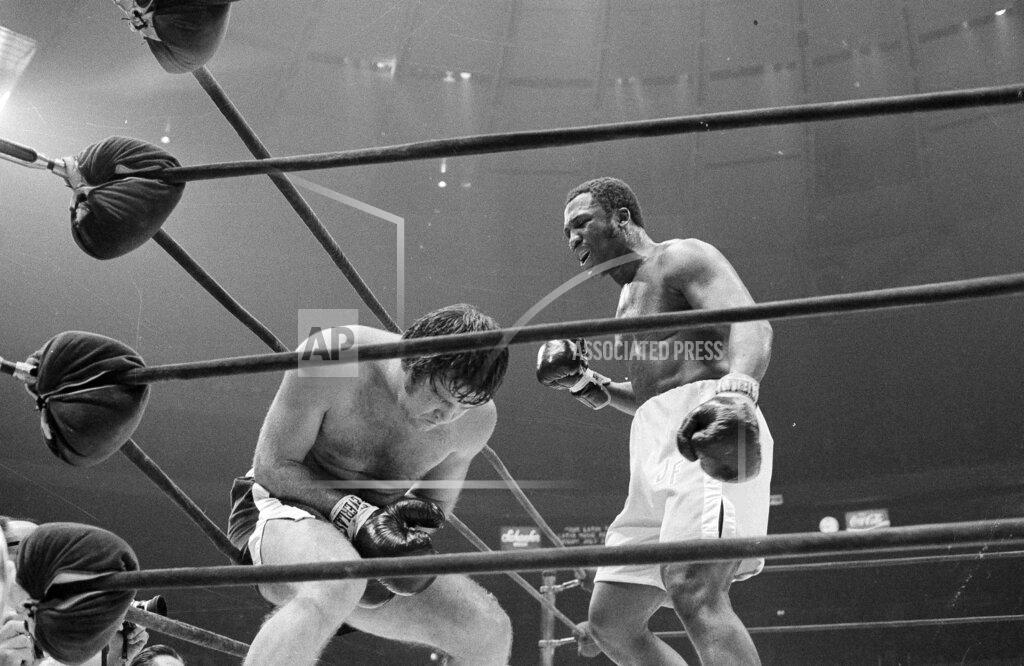
Joe Frazier came out smoking last night and Jerry Quarry had nothing to put out the fire. With a savage burst of fury fueled by pride and the desire to prove his championship fiber, Frazier pummeled the Californian into submission at 1 minute 37 seconds of the fifth round. It was an act of mercy that Joe Louis performed in ending the scheduled 12‐round bout at Madison Square Garden. The fans were screaming “Stop the Fight!” and even Frazier shouted to Louis, in his first major bout as a referee: “He’s cut. What’re you gonna do?” Frazier said afterward he had not wanted to hit Quarry again. “I don’t like to hit a man when I see he’s in bad trouble,” he said. “I don’t want to do a man damage. I don’t get any pleasure taking a man apart when I see he’s in big trouble.”
Gaylord Perry of the Cleveland Indians won his 12th straight game, beating the Chicago White Sox, 4–3, tonight. Jack Brohamer’s run-scoring single in the ninth inning provided the victory margin.
The San Francisco Giants beat the St. Louis Cardinals, 3–0, as Jim Barr threw a shutout for his 4th win of the year.
After completing the first 1,000 games in franchise history with a winning percentage of .332, the Mets compile a 517-482-1 record in their next thousand contests. During the span, that includes Tom Seaver winning 12% of the team’s victories, New York wins two National League pennants and a World championship.
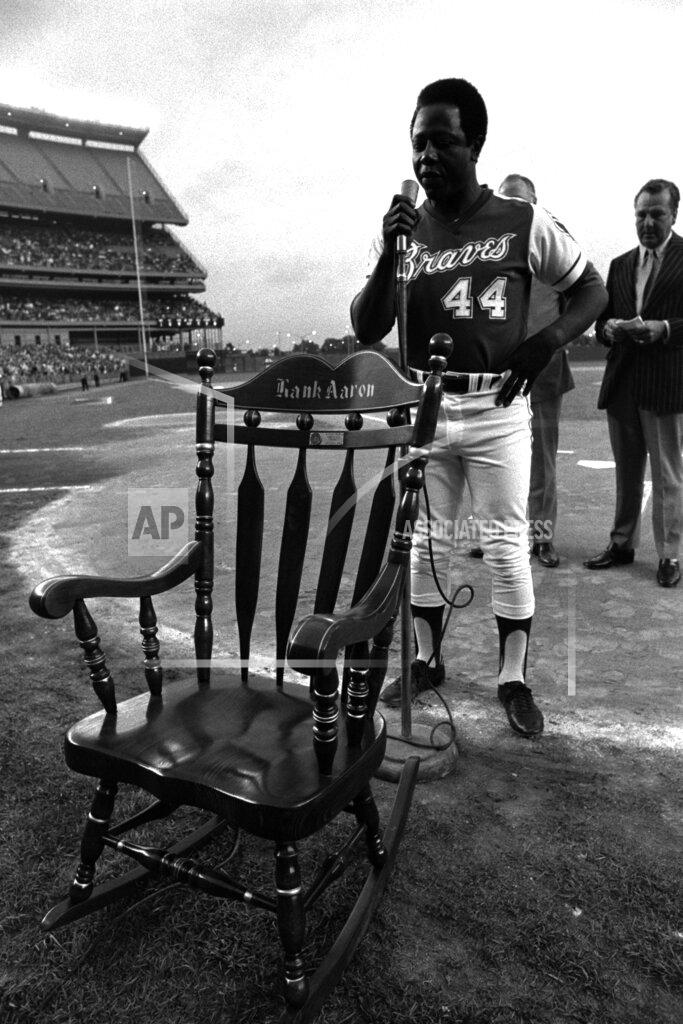
Hank Aaron addresses the crowd as the Mets honor him at Shea Stadium. Playing in his fourth straight game, and in his 48th of the season, Aaron did not add to his career total of 724 home runs — nor to the 11 he has hit this year while overtaking Babe Ruth’s record. But he did contribute a single and double while his Atlanta Braves were manhandling the Mets, 8–1.
Dow Jones Industrial Average: 833.23 (-9.86, -1.17%).
Born:
Ricardo “Rikrok” Ducet, Jamaican-British singer (with Shaggy – “It Wasn’t Me”), in Manchester, Jamaica.
Died:
Leon H. Washington Jr., 67, African-American newspaper publisher and founder, in 1933, of the Los Angeles Sentinel.
Sir Yadavindra Singh, 61, Indian Army Lieutenant-General, former maharaja of the princely state of Patiala from 1938 to 1971, and India’s Ambassador to the Netherlands since 1971, died of heart failure at The Hague.
Sir Charles Keightley, 72, British Army general.
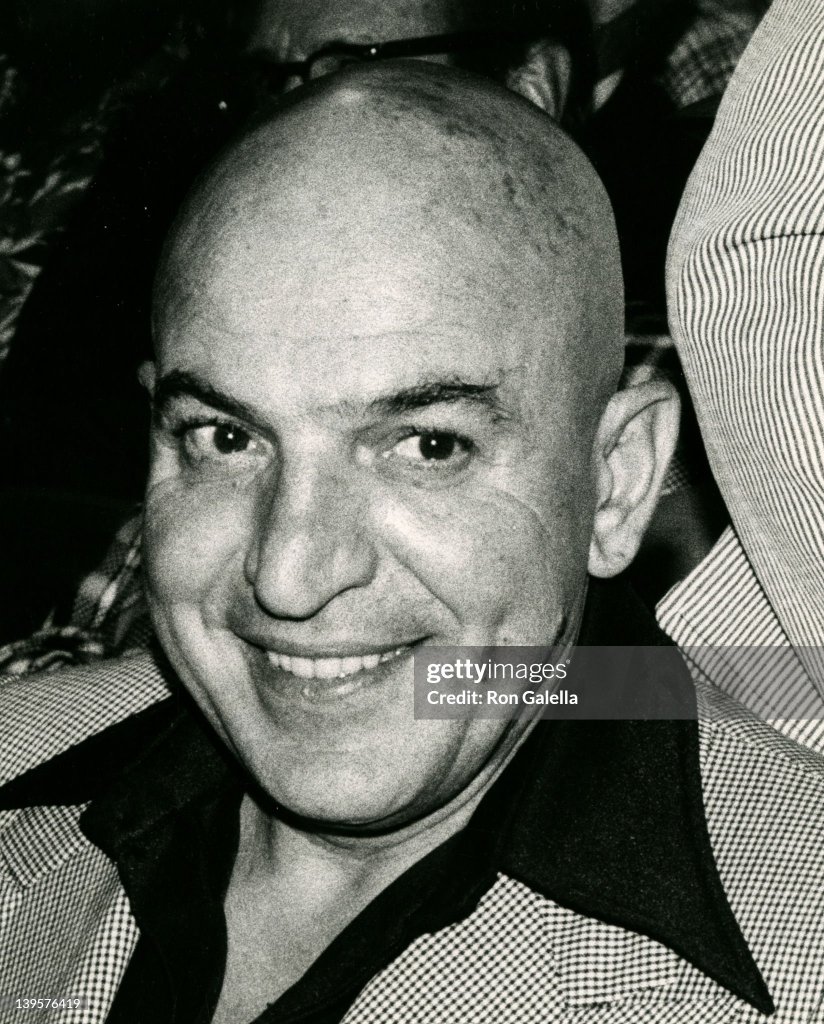
Pamela Britton (stage name for Armilda Owens), 51, American stage and screen actress (“D.O.A.”; “Blondie”; Mrs. Brown-“My Favorite Martian”), died of brain cancer.
Refik Koraltan, 85, Turkish politician who served as Speaker of the Grand National Assembly of Turkey from 1950 to 1960 before being arrested following a coup d’état, died of kidney failure.


 History Diaries