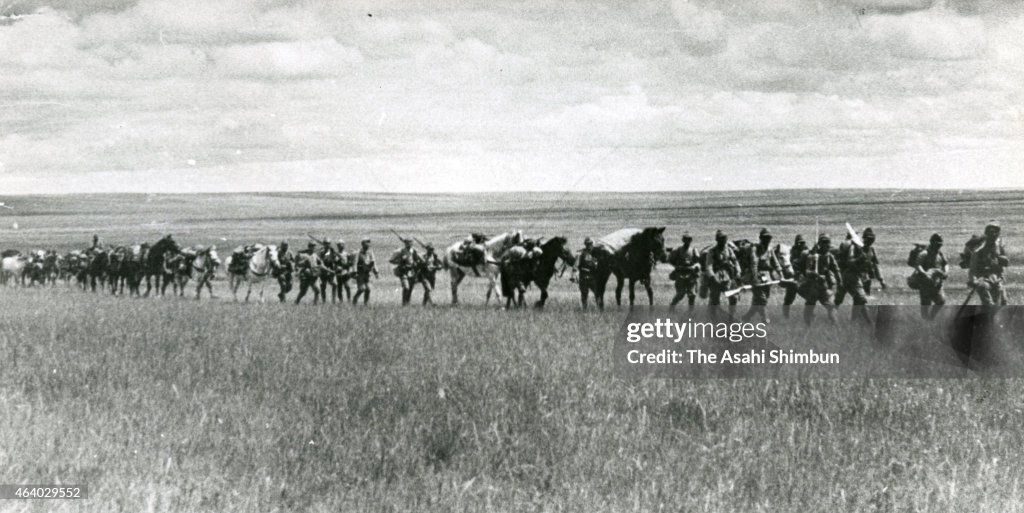
The British Foreign Office issued a statement warning that if the Japanese maintained their blockade in China, “an extremely serious situation will arise” and the British government would “have to consider what immediate and active steps they can take for the protection of British interests in China.”
A special Nazi tribunal in Prague tonight worked toward the swift conclusion of the trial of two German policemen, George Bulla and Paul Stehr, charged with killing a Czech policeman at Nachod a week ago. A verdict was expected tomorrow at the latest after only one day of hearings. No appeal from the tribunal’s verdict is possible. Three barmaids testified that the German policemen drank 47 marks’ worth of beer, wine and cognac in a Nachod bar the night of the killing and later went through the streets shooting into the air.
Two Czech fellow officers of Jaroslav Miller testified he was shot through the head as he pressed against the wall of the Nachod police station in an attempt to avoid the Germans’ gunfire through a window six feet away. The witnesses said Bulla and Stehr shot through the guardroom window and then climbed in. The two Germans, however, asserted they fired in self-defense.
The Czech officers declared they heard seven shots fired before the Germans reached the station. German police finally arrived and disarmed Bulla and Stehr, the witnesses said. Then, they stated, none of the Czech weapons in the station was found to have been fired. The trial was held in a Prague court apparently to avoid the possibility of Czech demonstrations in Nachod. German officials there ordered private burial services for Miller after 20,000 persons gathered to attend his funeral.
The prompt trial was regarded by Czechs as an effort by Germans to impress the world with the justice and impartiality of the Nazi protectorate over Bohemia-Moravia. Miller’s killing followed the slaying of a German policeman, Wilhelm Kniest, at Kladno and stern retributive measures upon that town. Czech indignation mounted after the Czech policeman’s death and German police were withdrawn from Nachod following a quick Nazi investigation.
German comment on yesterday’s decision of the Mixed Claims Commission is unanimous in denouncing it as “devoid of all legality” and “the opening gun of a new anti-German campaign in America.” The official news agency writes that “this ‘decision’ was rendered under circumstances which violate the regulations of the Mixed Claims Commission and is therefore naturally not binding for Germany. The Reich Government reserves for itself the right to take suitable steps.”
Adolf Halfeld, Berlin editor of the Hamburger Fremdenblatt, denounces the decision as a “gross legal violation,” accuses Justice Roberts of being “openly prejudiced against Germany and determined in all circumstances to force a decision against the Reich” and winds up by asserting that “the whole affair is a dirty bit of financial trickery — $20,000,000 which the American Government kept from the loot of German property is to be given to private concerns interested in the case.”
He characterizes the decision as “monstrous” and says “the purpose was only — for the sake of anti-German propaganda — to force a decision contrary to all earlier evidence which cannot be regarded as legal at all but only a political maneuver. “America needs such shabby pronouncements,” he continued, “for its propaganda in order to reawaken the nursery scare of the so-called German agents which was used so effectively during the war.”
The Voelkischer Beobachter asserts “the decision rendered yesterday is an absolute violation of regulations governing the work of the commission.” It joins with the Hamburger Fremdenblatt in denouncing the pronouncement as “an arbitrary political maneuver devoid of all legal basis.” “There can no longer be any doubt about the highhandedness of this anti-German action,” the paper states. “The rump commission not only ordered the reopening of the case in violation of the Berlin treaty [which regulated damages incurred through the work of German agents in the United States during the war] but also decided that Germany was guilty without giving German representatives any chance to state the Reich’s case.
German Nazis set a goal of four children per family, minimum, saying some mothers may be too lazy, but they owe this responsibility to the nation.
Hitler takes over the Reichsbank. Under a new reorganization, foreigners are barred from holding shares.
Speaking before officers of the German Army in Berlin today, Spanish General Miguel Aranda, leader of the Galician Corps of the Nationalist forces, stated that the Spanish Civil War proved that the “classic infantry, mobile and always ready for attack, still formed the basis of military combat.” Artillery, tanks and the air force, General Aranda asserted, were important for their role as preparatory forces for infantry advances, but “they are able only in the fewest of instances, and then only for a short time, to take the place of foot soldiers. Artillery alone was not enough to penetrate a deep defensive zone and infantry was necessary to carry the fight on toward victory.”
General Aranda stated that the heaviest and most effective artillery barrages of Generalissimo Francisco Franco’s troops were “laid down on a two-kilometer front by 150 batteries — about three guns to every ten meters.” He revealed that during the 100-day battle on the Ebro River the Nationalist forces fired more than one and a half million rounds of artillery ammunition.
The Rumanian foreign minister, Grigore Gafencu, arrives in Athens for talks with Greek Premier John Metaxas.
The Swedish newspaper Aftonblatdet prints reports from Helsingfors, Finland, that during negotiations with Finland over re-fortification of the Aland Islands Russia suggested an arrangement by which Finland would cede four islands in the eastern part of the Finnish Bay in return for Soviet willingness to readjust the Soviet-Finnish frontier and consent to the fortification plan.
As definite word reached the Capitol today that President Roosevelt would insist on revision of the Neutrality Act before adjournment of Congress, opposition began to take form in the Senate and House. Although it will be some time before the Administration’s proposals reach the floor of either chamber, strategy and numbers are already being calculated by opponents and proponents.
The central point of the controversy will be the Administration’s proposal to do away with the existing automatic embargo on exports of arms, ammunition and implements of war to all belligerents, as soon as the President shall have found that a state of war exists between or among foreign countries. The Senate was not in session today, but thirteen of its members gathered in the office of Senator Nye and decided they would offer “an uncompromising fight” against any repeal of the arms embargo. They were Senators Nye, Borah, Clark of Missouri, Clark of Idaho, Johnson of California, Vandenberg, McCarran, La Follette, Walsh, Capper, Frazier, McNary and Bulow — eight Republicans, four Democrats and one Progressive.
The Administration will try to hold Congress in session until the Senate acts, in the belief that no more than twenty-five ballots will be cast against its neutrality proposals if a vote can be forced. Mr. McNary, the minority leader, has tried, in vain thus far, to engineer a compromise under which the House would pass the Bloom resolution containing the Administration’s recommendations, and the matter would then repose in the Senate Foreign Relations Committee’s files until the next session convenes in January.
Although it is taken for granted, even by the Republicans, that the Bloom resolution will be passed in the House, minority members, led by Representative Fish of New York, intend to make as strong a fight against it as the rules of the House, stricter than the Senate’s, will permit. They believe that, by their discussions on the floor, they can arouse public opinion to a pitch which will encourage their Senate colleagues who will have to carry the ball at the later, and decisive, stage.
With that end in view, the minority members of the Foreign Affairs Committee, of whom Mr. Fish is senior, drafted today a report opposing passage of the Bloom resolution. The majority report, which is being prepared by Representative Bloom of New York, acting chairman of the committee and author of the proposal, will be ready tomorrow.
Twenty-one U.S. Senators sign a declaration opposing President Roosevelt’s stand on neutrality.
The U.S. House votes on the 1940 relief bill with drastic WPA control, 373–21. The bill cuts a federally funded theater. The House passed early today the 1940 Relief Bill containing provisions for remodeling of the Works Progress Administration along lines strongly opposed by President Roosevelt and containing drastic restrictions designed to curb the influence of alleged subversive organizations on the relief administration. The measure called for an outlay of $1,735,000,000. The vote was 373 to 21. The appropriation included $1,477,000,000 for the WPA and $258,000,000 for related activities.
In the longest session of the year, the House backed its Appropriations Committee — which had written the bill in the light of testimony adduced by a subcommittee which investigated the WPA — in all except a few particulars and, in the words of members, served notice on the WPA that the House would insist that the relief program be “dressed up and cleaned up.”
The House would not listen to the plea of the New Dealers to delete from the bill a provision that a three-man bipartisan board be substituted for the present one-man administrator of relief, and it retained all of a score of provisions. which would force the WPA to abandon its large construction enterprises, abolish the Federal Theatre Project and force local sponsorship for the other four phases of Federal Project No. 1.
The membership also would not follow the leadership of the liberal spenders except in one instance, and this was the result of a compromise which the Administration leader, Representative Rayburn of Texas, effected with Representative Woodrum of Virginia, who, as subcommittee chairman, was in charge of the bill. This compromise gave the National Youth Administration $100,000,000 for its next year’s program, against $81,000,000 proposed by the committee and $123,000,000 recommended by President Roosevelt. The NYA this year had $76,000,000, and in voting the $81,000,000, the Appropriations Committee considered that it had accorded to the agency even greater consideration than that given the WPA, which received the amount requested by the President. This was one-third less than the current appropriation.
With scores of agents of downtown departments in the corridors outside the House chamber, Mr. Woodrum said privately that he feared for the lesser NYA amount and reluctantly agreed to the compromise in the hope that the Treasury would be saved an additional expenditure of $23,000,000. In voting the NYA compromise the House increased the bill total from $1,716,000,000, but the $1,735,000,000 was still $26,890,000 below budget estimates and $804,205,000 below the amounts appropriated for the current year for all purposes in the bill.
President Roosevelt favors a broader tax base. He says a levy on smaller incomes would not balance the budget, but would help citizenship.
The FDA seizes 40,000 lipsticks said to contain poisonous or deleterious substances.
Cubs manager Gabby Hartnett sends Dizzy Dean home to Chicago after he is called to Dean’s hotel room and discovers the pitcher with a gash in his left arm. The Chicago order is part disciplinary.
At Wrigley Field in Los Angeles, Jigger Statz hits two home runs in the Pacific Coast League Angels’ 10-run first inning. They beat San Diego 14–5, then lose 8–5.
The liner Empress of Britain, bearing King George and Queen Elizabeth to Newfoundland, anchored tonight in Conception Bay on the east coast. The vessel passed the narrows at the entrance to St. Johns Harbor ahead of schedule on her way to Conception Bay, twenty-six miles from there. She dropped anchor at 6:30 PM in calm water after a day of cool sailing from Halifax. As the royal flotilla entered the wide bay a large iceberg was sighted. The royal party will land early in the morning at Holyrood and motor to St. Johns, twenty-five miles distant, for a welcome such as Newfoundland, Great Britain’s oldest colony, has never presented in its long history. It will be the first time a British King has set foot on the colony, founded by Sir Humphrey Gilbert in 1583.
The British government, responding to the demands of local Japanese Tories at Tientsin, China, said that Britain was prepared to take “immediate and act of steps” to protect her interests in China. It was believed that Britain was considering the possibility of renouncing the British-Japanese trade agreement of 1911, which gives the Japanese most favored nation treatment. The British Government, stung by the Japanese blockade of its concession in Tientsin, issued a statement yesterday warning Tokyo of “immediate active steps” if the Japanese should persist in their indicated new demands. Leading members of the Cabinet, however, virtually rejected proposals that Britain retaliate economically at this juncture.
The Japanese Army, in a “see it through” mood, obtained a free hand to deal with the Tientsin affair when the Cabinet decided that the problem must be settled locally, thus compelling the Foreign Office to stand aside. The public appeared confident that the other powers would leave Britain standing alone, but there were indications of uneasiness at their silence.
Tension at Tientsin lessened as the blockade entered its fourth day with the Japanese urging the Chinese people to press Britain to yield and the British protesting as obstacles to the delivery of foodstuffs caused a shortage in the British area. Japanese reports stated that two British warships had been ordered to run the blockade. Japanese sentries were reported to have killed two Chinese handing a basket of vegetables into the British Concession.
Although the U.S. State Department is sympathetically inclined toward London and Paris in their dispute with Tokyo, it has not yet considered what action the United States should take if the Japanese insist upon jeopardizing the position of the foreigners in Tientsin.
Far from the scene of the controversy, the Italian press exulted over what it termed a blow to British prestige, declaring that Rome’s sympathies were with Japan and that any settlement of the Tientsin problem must take Italy into account.
The Chinese have definitely smashed the eighth Japanese attack that attempted to wipe out Chinese guerrillas in the Chungtiao mountains of Southwest Shansi, the military spokesman stated in a review of the war situation today. Recalling the recapture of Pinglu, Maotsingtu and Tachen over the week-end after the Chinese had first withdrawn from these points in the face of the initial Japanese rush, the spokesman declared that the Chinese are now cutting up the Japanese columns in a general counter-offensive. The spokesman asserted that a portion of several new Japanese divisions, recently arrived in China, had been used in the Chungtiao operations and that these raw units suffered heavy casualties. These were estimated at 10,000.
The Japanese “mopping-up” efforts in West Shansi are also said to be a failure. The Japanese are said to have been repulsed after occupying Chungtu and Chikow, strategic Yellow River crossings. Similarly in Shantung the Japanese are reported to have failed to wipe out the guerrilla bases at Mengyin, Chuhsien and Yishui, while in Anhwei Province Japanese columns that are pushing out from Anking in an endeavor to occupy and pacify the surrounding counties have been checked.
General Chow Chi-ju has replaced not only General Chien Ta-chun, former secretary general of the air force, but also General Mao Pangtsu, chief of operations, as the result of a decision in recent air corps conferences here. General Chow has now become the commander and also is directly in charge of operations. Although for a long time connected with the air force, General Chow is not an aviator and at one time was the commander of an infantry division. The vice chief of aviation, under him, will be General Hung Kwang-jui
It was reported that the French submarine Phenix with a crew of 63 on board was missing after undersea exercises in Cam Ranh Bay off the coast of French Indochina. This was the fourth accidental submarine sinking of 1939.
Dow Jones Industrial Average: 134.67 (+0.26).
Born:
Billy “Crash” Craddock, country and rockabilly singer (“Rub It In”), in Greensboro, North Carolina.
Jim Perkins, AFL tackle (Denver Broncos), in Loyalton, California (d. 1992).
Died:
Chick Webb, 34?, American jazz and swing drummer and bandleader (spinal tuberculosis).
Naval Construction:
The Svenska Marinen (Royal Swedish Navy) Göteborg-class destroyer HSwMS Karlskrona is launched by Karlskronavarvet, Karlskrona, Sweden.


 History Diaries