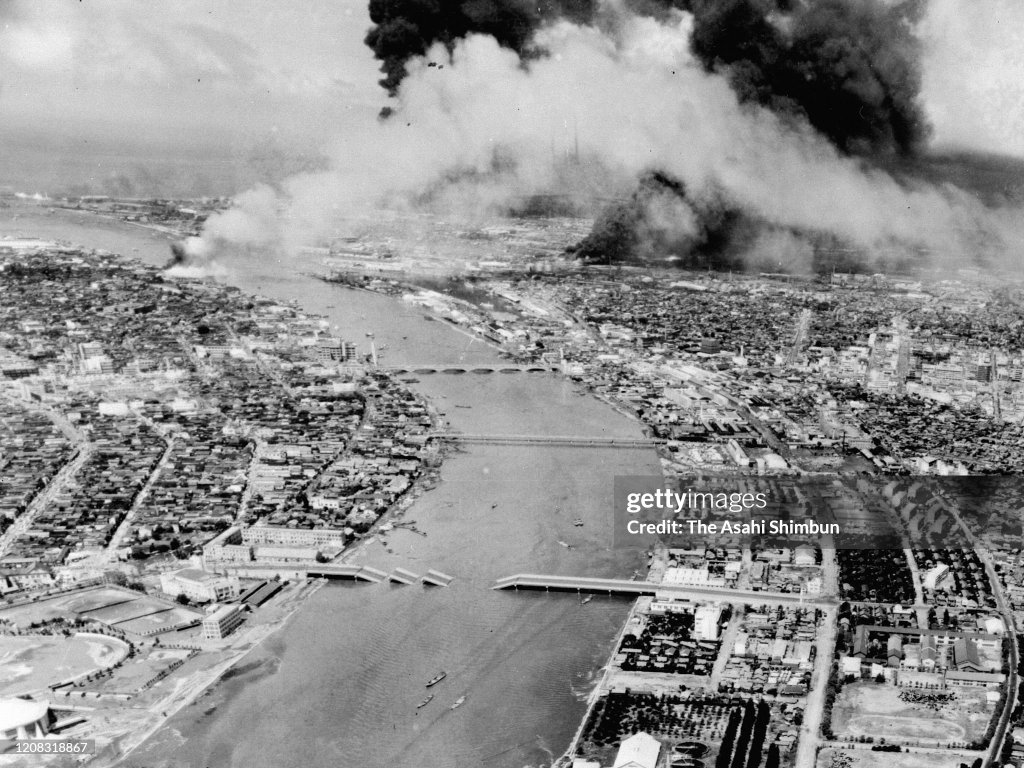
An earthquake rocked northern Japan yesterday, causing widespread casualties and destruction in three prefectures. A 7.5 magnitude earthquake struck 60 kilometers (37 mi) offshore from the city of Niigata, Japan at 1:01 in the afternoon local time (0401:44 UTC) and killed 28 people. More than 2,000 houses were destroyed and 12,000 flooded in Niigata, Yamagata and Akita prefectures. Niigata city, Japan’s largest petroleum and natural‐gas producing center, which has a population of 290,000, is reported to have suffered the most serious damage. The tremor ignited oil tanks at three refineries near piers in Niigata, which were also badly damaged. Train service and telephone communications with the stricken areas were cut off.
The Japanese Government set up a headquarters last night to direct aid and relief operations. The United States Embassy said that American forces in Japan would provide whatever assistance they could. The meteorological agency issued tidal‐wave warnings to areas along the Sea of Japan. Tidal waves were reported to have lashed the coastal city of Sakata in Yamagata. The tremor was felt in Tokyo, where big ferro‐concrete buildings swayed. The Central Meteorological Agency placed the epicenter of the earthquake in the sea off Niigata city.
Premier Souvanna Phouma has called on Prince Souphanouvong, leader of the Communist-led Pathet Lao, to meet him in a neutral country to try to settle the Laotian crisis. The Premier, in a message dated yesterday and announced today, suggested New Delhi, Rangoon or Zurich as possible sites. He asked Prince Souphanouvong to reply promptly “because the situation is becoming very dangerous.” “International tension is mounting, as you know, and it is absolutely necessary for us to meet without delay,” he said.
Prince Souvanna Phouma said he was making the proposal because Prince Souphanouvong had not agreed to an earlier suggestion that they meet in Vientiane, the administrative capital, or Luang Prabang, the royal capital of Laos. The Pathet Lao leader rejected a meeting in either capital, contending it was dangerous for him to go to those rightist‐controlled cities. Prince Souphanouvong, the Premier’s half‐brother, has not been in Vientiane since last year when the Pathet Lao faction in the Laotian coalition government withdrew and set up headquarters at Khang Khay. The Pathet Lao contended then that it was not safe to remain in Vientiane, and left behind only two ministers to represent it in Prince Souvanna Phouma’s neutralist Government. Prince Souphanouvong later asked that the two ministers be escorted safely to Khang Khay.
Several Saigon newspapers published unconfirmed reports today that Premier Nguyễn Khánh, an ARVN major general, was preparing to hand over the South Vietnamese Government to a civilian Premier.
Cambodia filed a protest today with the Security Council on a raid she charged had been made by South Vietnamese aircraft on Cambodian territory last Thursday. The complaint came as the Council was organizing a three-member investigating commission to visit the border area under a resolution adopted here June 4. A spokesman said the commission was awaiting designation of Morocco’s representative. The two other members were announced today. They are Pio Correa, Brazil’s Ambassador in Mexico, and Moise Aka, deputy chief of the Ivory Coast mission at the U.N. in New York. Sonn Voeunsai of Cambodia asked that today’s protest be circulated to all Council members.
The statement said that “some 30 aircraft and helicopters” of the South Vietnamese forces had bombed and machine‐gunned the village of Tralokbek in Soairieng Province, about 1,200 feet inside Cambodian territory. Two buildings were reported set afire and crops destroyed. “Splinters from a rocket of American make were recovered at the scene of the incident,” the protest said.
President Johnson announced today the selection of Randolph Appleton Kidder, a career diplomat, as Ambassador to Cambodia. Mr. Kidder, 50 years old, will succeed Philip D. Sprouse, who is leaving because of illness. Mr. Kidder is now senior Foreign Service inspector in the State Department.
A resurgence of Soviet activity in Asia was reported here today. Diplomatic observers said that Moscow was reacting vigorously to Chinese Communist efforts to exclude Soviet influence from the region. The Soviet response has included a bid to re‐establish Moscow’s eroded influence in the Indochinese states and new economic overtures to countries such as Japan and India. Moscow was reported to have taken a more militant propaganda line on the Communist guerrilla struggle in South Vietnam to counter Chinese Communist charges that the Soviet Communist party had failed to give adequate backing to left‐wing revolutionary movements.
In mid‐May, when new Soviet diplomatic initiatives in several Asian countries began to take shape, the Soviet Ambassador to Communist North Vietnam, Suren A. Tovmassyan, issued a statement endorsing the policies of the South Vietnamese Liberation Front, the political arm of the Việt Cộng. “The Soviet Union supports the heroic struggle of the patriots in South Vietnam against the aggressive policy of the United States imperialists and their henchmen,” the statement said. It added: “We fully and wholeheartedly support the stand of the North Vietnamese Government toward the South Vietnamese question and the line of the South Vietnamese National Liberation Front”
Diplomatic sources said the Soviet Union was also going ahead with a five‐year program of economic and technical assistance to the Hanoi regime although the North Vietnamese Communist party has tended to support Peking in the Chinese ideological quarrel with the Russians. The Soviet Communist party has been a long‐standing patron of revolutionary movements in Southeast Asia. However, the Soviet party’s influence over them has waned in the last two years because its relatively cautious program for gaining power has been viewed less favorably than the strategy of violence advocated by Peking.
One Greek Cypriot was reported killed this afternoon in an hour‐long exchange of fire between Greek and Turkish Cypriot villagers in the Tylliria area on the northwest coast of Cyprus. It was the second day in a row that shooting had broken out in the area, where tension has been building up in recent days. The Tylliria coast is understood to be one of the main entry points for guns smuggled from Turkey. Swedish troops of the United Nations peace force have been alerted there for several days to evidences of a Greek Cypriot military build‐up. Earlier today a Finnish patrol of the peace force was fired on by the Greek Cypriots in the Nicosia area and it returned fire. This was announced by a United Nations spokesman who said there had been no known casualties in the exchange, which occurred five miles northeast of Nicosia.
The U.N. Secretary General, U Thant, asked the Security Council today to keep the United Nations force in Cyprus three months more, until September 27. He warned that “an early resumption of fighting, which might well develop into heavy conflict,” would probably result if the force were withdrawn on June 27, at the end of its first three months. The only optimistic note in the Secretary General’s report was that “no military clashes of any significance” between Greek and Turkish Cypriotes had occurred between March 26, the day before the United Nations force began operating in Cyprus, and June 8. He said, however, that the lull in the fighting was due in part to the fact that both sides were trying to get in their crops. Mr. Thant said that both sides had strengthened their military positions in Nicosia, the capital, and the suburbs and had improved their ability “to undertake operations in the future.”
The United States is attempting to bring Greece and Turkey into direct negotiations to find a solution to the Cyprus crisis. This is being done amid growing recognition in most Western capitals that the status of Cyprus as an independent nation can no longer be maintained. Officials are known to have discussed a wide variety of possible formulas, ranging from “enosis,” or the union of Cyprus with Greece, to “double enosis,” a phrase used to describe the partitioning of Cyprus between, Greece and Turkey. The United States insists it has not endorsed either of these formulas. Authorities here say only that a solution is urgent, adding that their main concern now is to bring Greece and Turkey together. This was evidently the goal President Johnson had in mind when he invited the Premiers of the two Governments to meet with him in separate conferences next week. Turkey’s Premier, İsmet İnönü, will confer with President Johnson on Tuesday and Greece’s Premier, George Papandreou, will be at the White House two days later.
The U.S. Government reversed itself today and acknowledged that American citizens were flying United States aircraft against rebel Bafulero tribesmen in the eastern Congo. The State Department abandoned a series of explicit denials of American participation by saying that it was “now informed” differently. It said, “Some American civilian pilots under contract with the Congolese Government have flown T‐28 sorties in the last few days in the eastern part of the Congo.” The department said the new information had come, in response to inquiries, from the United States Embassy in Leopoldville.
The Soviet Union still leads the United States in the space race and is speeding up its program, Dr. Edward C. Welsh, acting chairman of the National Aeronautics and Space Council, said today. There is no evidence that crop failures and demands for consumer goods have caused any cutback in the Soviet program he said. “We know they are working on” manned lunar landings and believe they are developing larger rocket boosters — although there is “no solid evidence” about the boosters, he said. The Space Council advises the President on aeronautical and space matters. Its members are the Secretaries of State and Defense, the chairman of the Atomic Energy Commission and the administrator of the National Aeronautics and Space Administration.
Keith Bennett, a 12-year-old boy, was abducted by Myra Hindley and Ian Brady. Bennett vanished on his way to his grandmother’s house in Longsight. Hindley lured him into her Mini pick-up, in which Brady was sitting, by asking for help in loading some boxes, after which she said she would drive the boy home. She drove to a lay-by on Saddleworth Moor, and Brady went off with Bennett, supposedly looking for a lost glove. Hindley kept watch, and after about 30 minutes Brady reappeared, alone and carrying a spade that he had hidden there earlier. When Hindley asked how he had killed Bennett, Brady said that he had sexually assaulted the boy and strangled him with a piece of string.
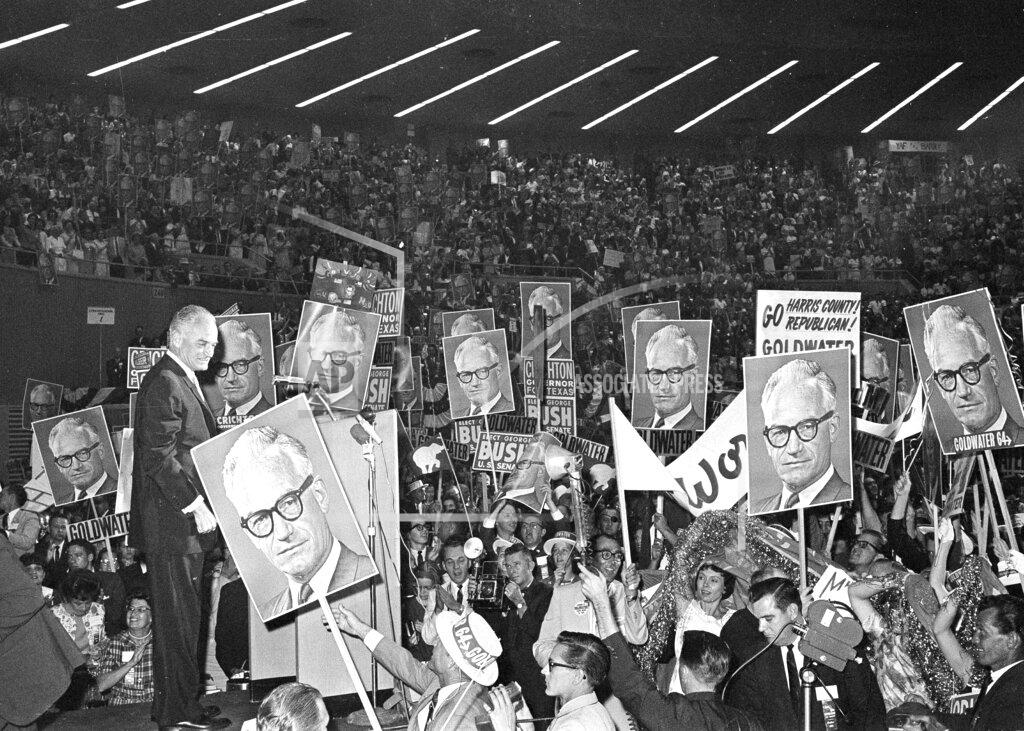
Meeting in Dallas, Texas, the 11,000 participants at the Republican state convention in Texas pledged the state’s 56 delegates to U.S. Senator Barry Goldwater, while Arkansas pledged 9 of its 12 delegates to the Arizona senator, bringing his total to 660, five more than the 655 needed to clinch the Republican Party nomination in the 1964 presidential race.
Senator Barry Goldwater collected 56 more votes toward the Republican Presidential nomination today at the Texas Republican state convention. Theoretically, this is enough to win. But Mr. Goldwater remained cautious. According to an Associated Press poll of delegates to the Republican National Convention next month, the Texas votes, in addition to eight new votes in Arkansas, gave the Senator a total of 682, or 27 more than the 655 needed to nominate. A United Press International poll yielded a total of 659 votes.
It is not that simple, however. There is, as Mr. Goldwater volunteered to newsmen later, no guarantee that all the faithful will stay that way. Mr. Goldwater said his own computation of delegate strength, after the Texas convention today, was “about 670.” However, he said this was not enough unless “you have signatures in blood” from “committed” delegates. He explained that with the “resources” of the liberal and moderate Republicans opposing him, it should not be difficult to change the minds of more than 20 delegates.
According to figures previously released by Mr. Goldwater’s campaign headquarters the Texas delegates would give him only 628 delegates. Even when the 14 votes he is expected to win in the Montana state convention next weekend are added, he would, by this tally, be short of nomination. It has been understood, however, that Mr. Goldwater’s managers have been deliberately keeping their own figures conservatively behind press association tallies, for psychological reasons. This was confirmed today when Mr. Goldwater mentioned his figure of 670.
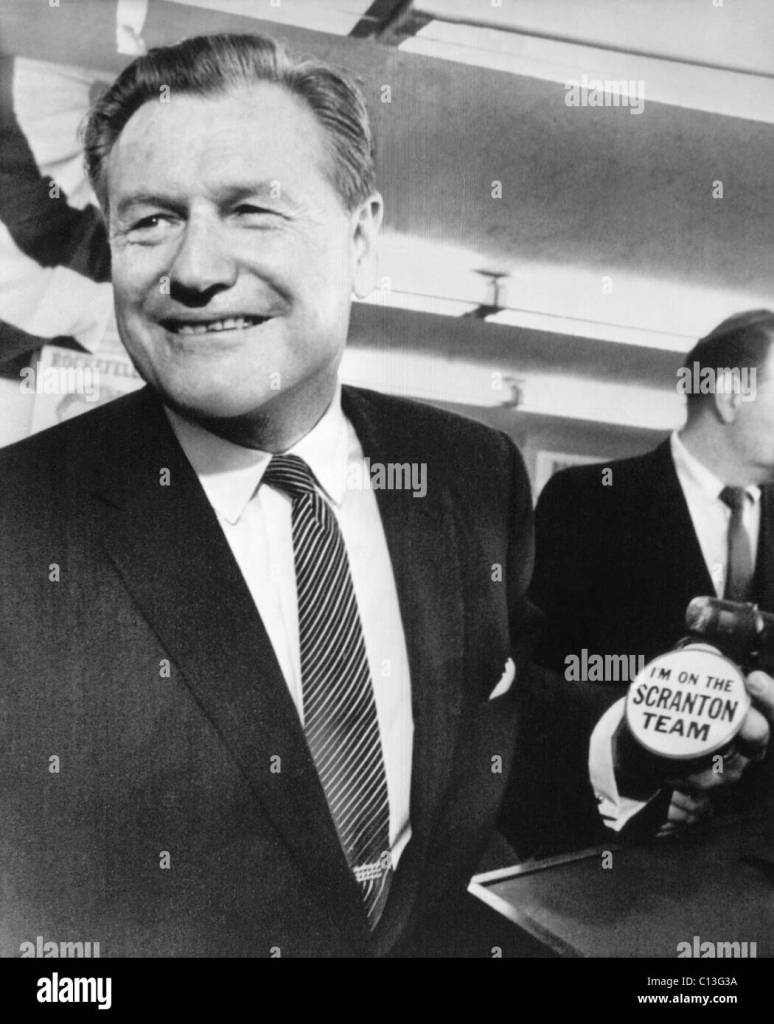
Governor William W. Scranton rode a wave of goodwill into the north central United States tonight, disputing the mathematics that give Senator Barry Goldwater all he needs for the Republican nomination for President. The Pennsylvanian assailed Senator Goldwater for making “devastating” comments on sensitive issues and accused the Johnson Administration of stalling policy decisions on the Vietnam war until after the election. In Iowa and Kansas, where his receptions pleased him, Governor Scranton said he found big holes in the published delegate totals credited to his Arizona rival. He would not identify the delegates by name or specify the number he was counting on in those states to vote for him.
Governor Rockefeller called yesterday on former President Dwight D. Eisenhower and all “forward-looking” Republican leaders throughout the country to support William W. Scranton for the Republican nomination for President. Mr. Rockefeller said he had telephoned General Eisenhower in an effort to enlist support for the Pennsylvania Governor. While he refused to disclose details of their conversation, Mr. Rockefeller indicated he had not obtained a commitment. He also confirmed indirectly that former Vice President Richard M. Nixon had refused to come out for Mr. Scranton when he telephoned and asked him to do so.
The bipartisan leadership of the Senate decided yesterday not only to let the Southern opponents of the civil rights bill call up amendments but also to keep them at it. The vote on passage therefore could possibly come tomorrow or Friday. Amendment after amendment came before the chamber throughout the day, and when a recess was finally called, a few minutes after midnight, the Senate had taken 34 roll‐calls in 13 hours. Thirty‐three were on amendments — all were defeated—and one was on a Southern motion to adjourn at 7:15 PM, which also was defeated. The number of roll‐calls set a record for a single day. The previous record, set in 1951, was 16. Of the 33 amendments offered yesterday, all but one were proposed by Southerners. And of the 32 Southern amendments, 14 were called up by Strom Thurmond of South Carolina, eight by Sam J. Ervin Jr. of North Carolina and seven by Russell Long of Louisiana.
As a result of the long day’s session, the bipartisan leaders — Mike Mansfield, Democrat of Montana, and Everett McKinley Dirksen, Republican of Illinois — were confident the remaining Southern amendments to be offered, probably not more than a baker’s dozen, could be disposed of today. In the remaining time before a vote on final passage the Southerners are expected to make speeches in defense of their three-month filibuster against the bill, and the civil rights leaders are expected to make speeches calling for reconciliation and a united effort to seek racial equality. For the first five days after closure was invoked last Wednesday, ending the Southern filibuster, Mr. Mansfield, has recessed the Senate at a relatively early hour — usually between 5 and 6 P.M. after 10 to 13 Southern amendments had been voted on.
However, when a handful of the Southerners made it evident yesterday that they had not been surfeited by defeat and intended to keep on calling up amendments, Mr. Mansfield and Mr. Dirksen changed their tactics and decided to keep the Senate in night session. At 7:15 the Southerners attempted a fast run around end. Senator James O. Eastland of Mississippi moved to adjourn. If this had passed, it would have meant the end of the legislative day that has been going on since March 9, since Mr. Mansfield has been recessing rather than adjourning. With a new legislative day beginning today, the Southerners could have demanded the reading of the journal for the 80 calendar days of “the legislative day of March 9.” The leaders quickly assembled their forces, and the motion was defeated, 73 to 18, with only Southerners voting for it.
Employment, industrial production and personal income in the United States all continued to rise strongly in May. President Johnson, in a statement issued at the White House, hailed the gains and said the outlook for the economy “is one of continued growth.” The gain in the number of jobs outside of agriculture, while smaller than that of other recent months, indicated that the sharp drop in the unemployment rate in May represented a genuine improvement in the job situation, Labor Department experts said. The unemployment rate for May, reported earlier this month, showed a decline from 5.4 to 5.1 percent. This was the lowest rate in more than four years. The number of employed workers outside of agriculture rose by 40,000 in May after allowance for normal seasonal fluctuations, to a total of 58.5 million.
While the month‐to‐month increases in employment since December have averaged more than 100,000, Labor Department officials noted that 50,000 to 60,000 workers were kept off factory payrolls in May because of strikes, largely in the construction industry. Thus, without the strikes, the May gain might have been more in line with that of other recent months, they said. Industrial production and personal income likewise showed smaller gains in May than in April. The increase in industrial production — seven‐tenths of a point — brought the Federal Reserve’s industrial production index to 130.3 percent of the 1957‐59 average.
The collision of two barges with the 26-mile-long Lake Pontchartrain Causeway bridge in Louisiana created a 240-foot-wide hole that was large enough for a Continental Trailways bus to fall through. The bus was traveling north on the world’s longest bridge, and had traveled nine miles along the Causeway when it encountered the hole at shortly after 1:45 in the morning. Only 8 people were on board the early morning bus, on their way to Jackson, Mississippi from New Orleans, and six of them drowned. The barges were being pushed by the towboat Rebel Jr.; the helmsman of the tugboat said later that he had “fainted and apparently fell against a steering lever which drove the tug and its barges” into the bridge.
The National Aeronautics and Space Administration said today it is negotiating with the Grumman Aircraft Engineering company to build a third orbiting space laboratory. The Bethpage, Long Island, New York, concern also will have an option to build two more of the astronomical observatories, NASA said today. NASA officials said the value of the contract was in excess of $20 million for the single space lab. If all three were purchased, the contract would exceed $50 million.
Don Drysdale, backed up by the extra‐base hitting of Willie Davis and John Roseboro, tonight gained his ninth victory of the season by pitching the Los Angeles Dodgers to a 5–1 victory over the Milwaukee Braves. Warren Spahn suffered his first loss to the Dodgers since June 13, 1962, after having beaten them six straight times. And it was his first defeat by Drysdale in the four times they have opposed each other.
For the second time in his career, Ken Boyer hits for the cycle to pace the St. Louis Cardinals to a 7–1 win over Houston. The Cardinals tagged Colts pitching for a total of 15 hits. Curt Simmons is the winning pitcher with a four-hit complete game.
Ed Kirkpatrick slammed his second home run of the season in the 10th inning tonight and gave the Los Angeles Angels a 7–5 victory over the Washington Senators. Kirkpatrick’s two‐run blast against the right‐field scoreboard was his third hit in four trips to the plate.
Steve Barber’s four‐hit pitching sparked the Baltimore Orioles to a 3–1 victory that kept them only 8 percentage points out of first place tonight after the league ‐ leading Chicago White Sox won the first game of a doubleheader, 5–0, behind Juan Pizarro’s three‐hitter.
Dow Jones Industrial Average: 818.16 (+4.60).
Born:
Danny Burstein, American stage actor (“Moulin Rouge!”), in Mt Kisco, New York



 History Diaries