The German Army presented a plan to Adolf Hitler for the invasion of Poland (“Fall Weiss” – “Case White”), with much of the strategy focusing on concentrated surprise attacks to quickly eliminate Polish opposition. The origins of the plan went back to 1928, when Werner von Fritsch started working on it. Fall Weiss was developed primarily by Günther Blumentritt and Erich von Manstein while the two were serving as staff officers under General Gerd von Rundstedt with Army Group South in Silesia. The plan called for a start of hostilities before the declaration of war. German units were to invade Poland from three directions:
- A primary attack from the German mainland across the western border of Poland.
- A secondary attack from the north, from the exclave of East Prussia.
- A tertiary attack by German and allied Slovak units across the border of Slovakia.
All three assaults were to converge on Warsaw while the main Polish army was to be encircled and destroyed west of the Vistula River.
Mass arrests of German officers in East Prussia are reported tonight to the conservative newspaper Czas in a dispatch from Danzig. The paper says that fifty officers of various regiments have been detained by the Gestapo — the German secret police — which unearthed a conspiracy against the National Socialist regime. Seventeen arrested in Danzig were transported to Prussia, it is said.
Germany’s new airship, the Graf Zeppelin, left today for her first flight in 1939. Under the direction of Captain Albert Sammt, the airship will stage tests of new equipment installed during the Winter and will return to Frankfort late tomorrow. The Zeppelin company has announced a series of propaganda flights beginning July 1 covering Il parts of Germany. Passengers will not be taken on these flights, since the airship will still be filled with inflammable hydrogen. Following the Hindenburg disaster two years ago the Zeppelin company resolved not to take passengers until it could equip its ships with non-flammable helium.
Although conditions in Prague were outwardly calmer today than at any time in the last two weeks, the knowledge that extraordinary measures are being taken by the Germans, which thus far has reached only the better-informed sections of the public, is causing much nervousness. In government offices there is the conviction that something is brewing. There is that same atmosphere of uncertainty and the same thirst for information among people who in the past have been accustomed to precise knowledge that preceded the occupation.
It is generally felt, however, that the fate of the protectorate of Bohemia-Moravia is too insignificant a matter to occupy Germany seriously and interest is focused outside these lands, on Poland and Slovakia. From the first moment of the occupation the Czech people have felt themselves to be only wayside onlookers at Germany’s march further eastward, and whenever troops are known to be moving in that direction the immediate Czech reaction is to say that they are on their way to Hungary or Slovakia. From Slovakia it is learned today that the desperate economic conditions prevailing in that country have tended to heighten the feeling that a change must take place soon.
A symptom of this feeling is the amount of native Pan-Slavism, which is being encouraged by pamphlets secretly distributed. A large number of arrests were made last night in Bratislava on account of the distribution of such pamphlets. and some fifty persons were reported sent to a concentration camp. A sign of Germany’s present indifference to the economic situation in Slovakia is the reception recently given to a delegation representing the tourist industry that approached the Germans with a request that the ban on crossing the frontier should be removed to allow the Czechs, Slovakia’s best tourist customers, to spend their holidays in the Tatra Mountains or spas. Many Slovak districts subsist for a whole year on the fruits of the short tourist season.
The German reply was unfavorable. Czechs are not allowed to travel, and only a few Germans. When the Slovaks suggested that this would encourage civil unrest, the Germans replied that they would look after that by using local Germans. The director of the Slovak State spas, it is learned, has not received his salary for the last three months. Germany’s delay in giving any real aid in Slovakia’s economic plight naturally makes the Czechs think that Germany is merely temporizing; thus troop movements that can be accounted for by Germany’s privileged military position in Slovakia are immediately interpreted in the worst possible light in Prague.
Britain’s Conservative Government struck today at the swollen earnings of armament companies by announcing that it would impose an entirely new tax on the excess profits of those firms that get the biggest orders. This move was the latest in a long series of ineffectual attempts — beginning with the ill-starred proposal of the “National Defense Contribution” of 1937 — to limit the huge profits being made from the rearmament program. It was made all the more necessary because this is a general election year when there would be political danger in letting these profits go on unchecked.
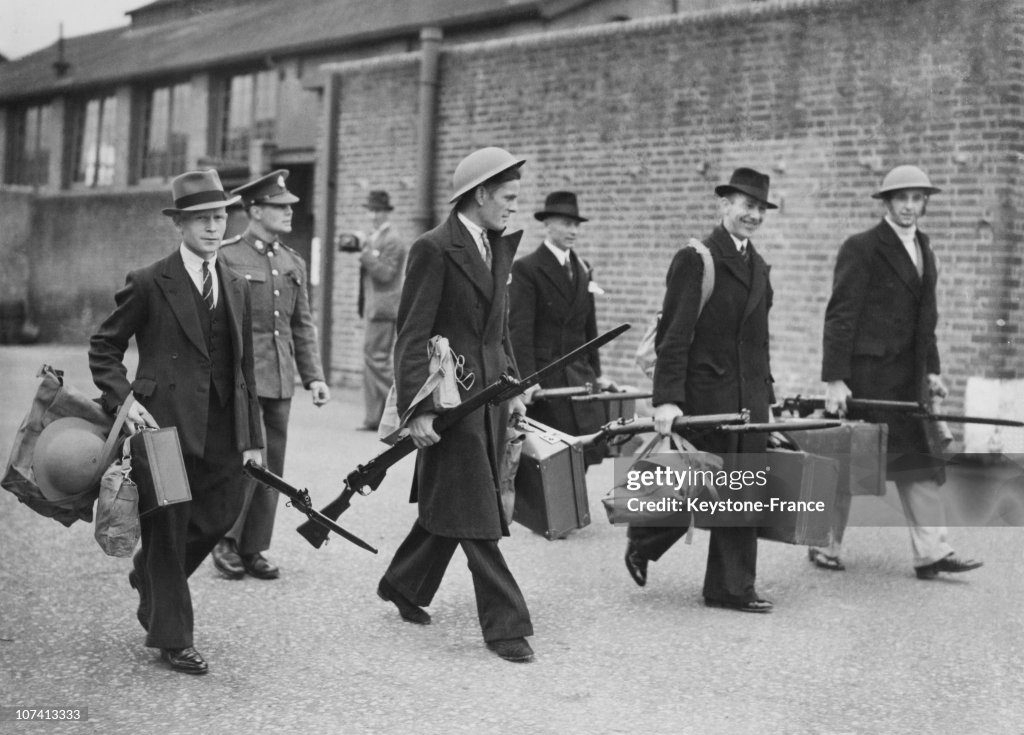
In spite of all the government’s efforts to control armament prices, masses of voters are convinced that the big armament companies are being allowed to pile up fabulous profits while the youth of the country is being conscripted and while millions of others are “doing their bit” uncomplainingly for the national service. The new tax on armament makers is intended to remove any sense of injustice among the British working people; so was a series of sweeping concessions announced today for the families of “militiamen” and reservists who would be called up for military service. Thousands of army reservists left their civilian duties and reported at army depots today to serve their time with the colors under a quiet mobilization that will gather momentum here during the Summer.
Irish Prime Minister Eamon de Valera declared the IRA (of which he and many of his cabinet had been members in former times) to be an unlawful organization.
The Spanish Nationalist Government press chief today ordered “purification” of newspapermen. All employees of newspapers and foreign news agencies were directed to report what they wrote for the Republican cause and against Generalissimo Francisco Franco during the civil war.
Spanish Nationalist secret service agents today seized Edmundo Rodriguez, a 48-year-old constructor of mosaics, and his wife on charges of participating in the killing of thousands of Nationalist sympathizers during the civil war. Arresting authorities said Señor Rodriguez acknowledged that he was the custodian of the notorious torture chambers in Calle San Bernardo and that he personally put to death 225 persons. They said his wife, Resurreccion Garcia Ruiz, 47 years old, participated in firing squad executions of “thousands” of sympathizers confined in the Calle San Bernardo quarters.
There was more violence in the Mandate of Palestine today. One Arab was shot dead and two were severely wounded early today while riding on donkeys between Tel Aviv and Jaffa. A Jewish supernumerary policeman was fatally shot on the Tiberias-Haifa Road.
A bomb was thrown by three Jews into an Arab family’s tin shack near the Jaffa-Tel Aviv boundary. Another bomb exploded without injuring anyone in a quarter near the Jaffa-Tel Aviv boundary where Jews usually gather to buy vegetables from Jaffa Arabs.
As punishment for the Jews of Tel Aviv, the military commander of the southern district has ordered all Jewish traffic into and out of Tel Aviv suspended until 7 PM tomorrow. As vehicular traffic is almost at a standstill in Tel Aviv on the Sabbath, this really means three days’ suspension.
Ten days of daylight curfew were imposed on the Jewish quarter of Tiberias because a land mine exploded near there three days ago, killing one Arab and wounding twelve.
Today in Washington, President Roosevelt discussed problems relating to American-Mexican relations with Dr. Francisco Castillo Nájera, the Mexican Ambassador, and the relief problem with Colonel F. C. Harrington, Works Progress Administrator, and Aubrey Williams, National Youth Administrator.
The Senate approved the bill providing for training civilian pilots by the Civil Aeronautics Authority, sent to conference amendments, to the Tennessee Valley Authority Act relative to bond-issuing authority, adopted the conference report on the bill extending the effective date of labeling provisions of the Pure Food and Drug Act, received the bill to increase the domestic price of silver to $1.04 and the proposal of Senator Thomas of Utah for issuing monetary certificates against the gold stabilization fund. The Senate adjourned at 1:47 PM until noon on Monday.
The House debated the 1940 Relief Appropriation Bill, heard Representative Thomas of New Jersey criticize the appointment of Archibald MacLeish as Librarian of Congress and adjourned at 4:20 PM until 11 AM tomorrow. A Ways and Means Subcommittee completed action on the tax-revision bill.
President Roosevelt is giving serious consideration to a new spending program as a stimulant to lagging recovery, this time a plan for strictly self-liquidating projects to be financed outside of the regular budget. Framed with the double design of putting idle capital to work while avoiding any further extraordinary increases in the public debt, the plan is understood to have been worked out in rough detail by a committee composed of Secretary Morgenthau, Marriner S. Eccles, chairman of the board of governors of the Federal Reserve System; Harold D. Smith, director of the budget, and Frederic A. Delano, chairman of the National Resources Committee. It was discussed by the President with these officials yesterday.
The questions of the size of the program — the amount of capital to be pumped out — and the time for promulgating it, are yet to be settled. In fact, it is not certain that the President has adopted the proposal, although he has mentioned it as a distinct possibility to various persons, including two Senators who called upon him Tuesday to urge his approval of the farm parity payments voted by the Senate over his objections.
As to the size, various figures from $1,000,000,000 to $3,000,000,000 have been mentioned. As understood from the meager discussions of the proposal outside the White House, it contemplates the establishment of a number of Federal “authorities,” each with power to float its own securities and lend to quasi-public bodies for self-liquidating projects.
Four agencies of the Federal Government joined today in an effort to protect the huge armaments program from “widespread” networks of foreign spies. Making known that he had evidence of sabotage as well as espionage, Attorney General Murphy announced that J. Edgar Hoover would direct the Justice Department’s work against these activities. He will work closely with the intelligence officers of the War and Navy Departments. The Senate Naval Committee, reporting that the armaments program has attracted “increasing numbers of foreign spies,” recommended legislation to stiffen penalties.
The report, drafted by Senator Barbour, Republican, of New Jersey, stated there was “widespread evidence of espionage not only in Hawaii, Puerto Rico, the Canal Zone and on the Pacific Coast, but also on the Atlantic Coast and in the Gulf States as well.” It added: “A foreign spy may steal our military secrets, take photographs of war vessels under construction, fly over our navy yards, penetrate our aircraft factories, damage or destroy planes, and conspire with others to steal code books and secret reports, and get off with a year or two in prison, if, in fact, he is given a prison term at all. This is the height of absurdity.”
The legislation would increase the penalties for most espionage offenses from a maximum of two years and a $10,000 fine, or both, to a sentence of five to ten years and a $10,000 fine. Major offenses, such as sabotage, would be penalized by a maximum 20-year sentence and a maximum $10,000 fine. A 10-year sentence would be mandatory.
American claims of $50,000,000 that German saboteurs were responsible for the Black Tom and Kingsland, New Jersey explosions in 1916 and 1917 were upheld by an international commission. Before the session the German embassy questioned the authority of the commission and served notice that Germany would ignore any decision. It was doubted that the American claimants would receive any more than the $20,000,000 already recovered.
The inflation bloc in the Senate, which in 1933 pushed through the silver-purchase program as an amendment to the Agriculture Adjustment Act of that year, opened a new surprise offensive today to have $2,000,000,000 in currency issued as an experimental method of reviving commodity prices. Senator Thomas, author of the silver-purchase resolution, and Senator McCarran precipitated the new inflation effort by introducing their proposal as an amendment to the Stabilization Bill, which the Senate will take up on Monday. With the currency proposal they coupled another to have the price of newly mined domestic silver raised from its arbitrary level of 64 cents, the price now paid by the Treasury, to $1.04.
By this means the group hoped to gain the support of spokesmen for agriculture in Congress and of the “silver bloc,” which contains such members as Senator Pittman, who on this question follow a path which has no relationship to ordinary legislative courses. The currency and silver questions invariably create divisions in the Senate and House that are unrelated to party lines, and although the Thomas-McCarran amendment is expected by the leadership to be defeated, none will predict that with certainty.
The greatest factor operating against the proposal, in the view of informed observers, is the fact that the authors of the resolution proposed it as a substitute for the President’s control over the gold content of the dollar and the $2,000,000,000 stabilization fund, which the pending bill would continue until June 30, 1941. As the situation stood when the Senate adjourned until Monday, the Administration leadership in the Senate expected to pass a bill which would continue the status quo. Arraigned against the leaders were such influential members as Senators Glass, Byrd and Adams, leading an apparently hopeless fight to cancel the power of the President to devalue further the gold content of the dollar from 59 percent, the current level, to 50 percent.
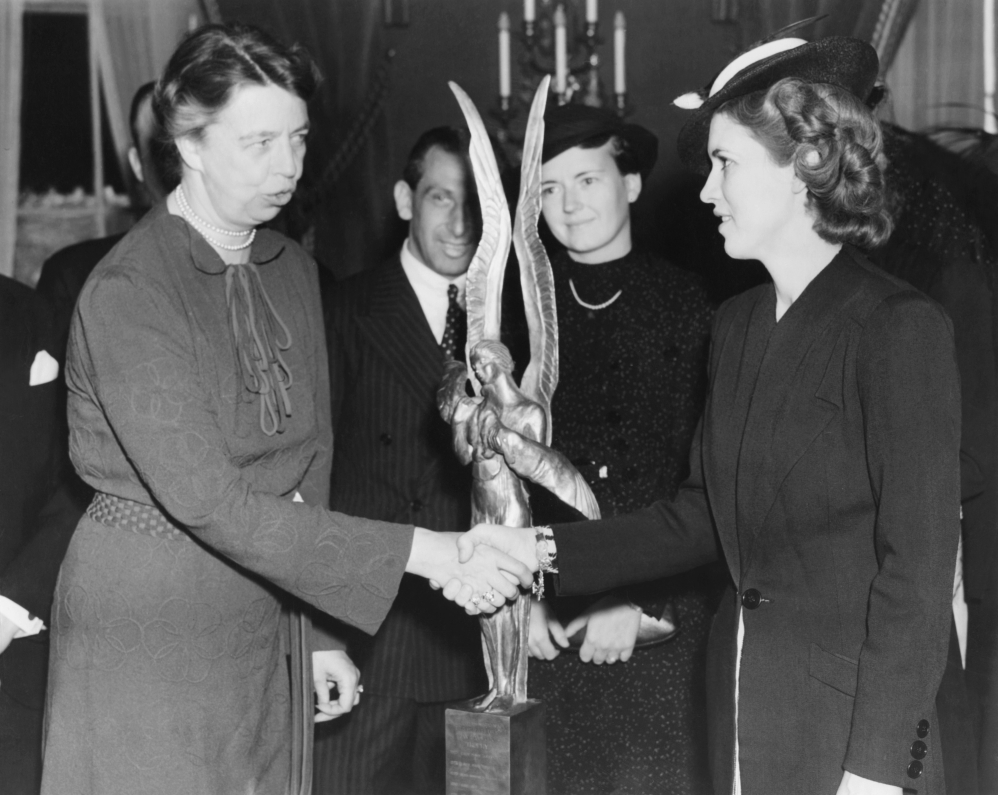
Mrs. Eleanor Roosevelt today presented the Harmon Aviatrix Trophy to Jacqueline Cochran for the second year in succession as “the world’s outstanding woman flyer.” In addition, Miss Cochran, who in private life is Mrs. Floyd Odlum, was awarded a medal stamped in memory of the late King Albert of Belgium—the first American to receive it. Ms. Cochran was awarded the trophy by Mrs. Roosevelt at an Advertising Club luncheon in New York City. It was the second time she had won the Harmon International Aviatrix Trophy. The 1939 trophy was in honor of Cochran’s winning the Bendix Trophy Race, 1 September 1938.
Issue #1 of “Mystery Men Comics” hit newsstands, featuring the first appearance of a new superhero, Blue Beetle.
Charlie Chaplin directs that receipts from his film “The Great Dictator” should aid refugees.
At Fenway, Pete Fox hits a first inning grand slam, his second homer of the year and his second slam in a week, as the Tigers top the Red Sox, 6-3. Tommy Bridges is the winner. The Bengals have now won 8 straight games. They’ll win tomorrow to move closer to 4th place.
Pittsburgh picks up Elbie Fletcher, who will be their regular first baseman for 5 seasons, from the Boston Bees for infielder Bill Schuster and cash. Fletcher will also lead the National League in OBA for 3 straight years, while Schuster will play just 2 games for Boston. The Pirates then send pitcher Jim Tobin to the Bees for pitcher John Lanning.
The King and Queen of the United Kingdom departed North America from Halifax, Nova Scotia as a crowd of 150,000 cheered a farewell. From the bridge of the Empress of Britain, King George VI and Queen Elizabeth waved farewell tonight to their Canadian subjects. They sailed for England and home from Halifax at 6:34 PM, Atlantic Standard Time, with the royal standard flying above the Union Jack astern and the red and gold flag of the Admiralty fluttering from the mizzen.
Before they left Nova Scotia, former Dominion of the British Crown, the King and Queen made farewell addresses at a luncheon given in their honor by the Lieutenant Governor and the Executive Council of Nova Scotia. Both expressed their gratification at the warmth of the reception accorded them by the people of North America. The King, who received a farewell message from President Roosevelt before he sailed, said that his visit to the United States was “all too brief.”
A showdown on the issue of the very existence of foreign settlements in China was forecast this morning by a Tokyo Government decision to stand behind the army’s blockade of the British and French Concessions in Tientsin. Said the Foreign Office spokesman: “The days of foreign settlements in China are numbered.”
Tensions increased in Tientsin as Japanese and British officials exchanged demands as Japan their blockade of Tientsin’s British and French concessions. The British insisted that the Japanese sees halting and searching British subjects and chips. Japan reiterated that there “strong attitude will be continued until British authorities completely changed their pro-Chiang Kai-Shek attitude. The two nations had patrols along opposite sides of sandbag barricades at the British concession’s borders. At one point British with machine guns and Japanese with tanks were separated by only a few feet.
For a time yesterday the tension in Tientsin was explosive. Troops of Britain and Japan faced each other across a barricade at a main entrance to the British Concession, but at length marched away. Afterward representatives of the two countries exchanged demands. Britain insisted that the halting and searching of her subjects and ships must stop and Japan called on the British to revise completely their “pro-Chiang Kai-shek” attitude.
Prime Minister Chamberlain summarized the situation for the House of Commons, but gave no indication as to Britain’s course. Officials continued to study the possibility of economic retaliation, but were aware that such a procedure would be a double-edged sword and that to be effective it would require American cooperation.
The U.S. State Department expressed concern to Japan over her blockade at Tientsin, China. The American Charge D’Affairs in Tokyo, Eugene H. Doorman, told the Japanese foreign office that the U.S. had interests in Tientsin and was concerned over the possible threat to them arising from the blockade. The blockade was a result of a dispute over the refusal of British authorities to hand over to the Japanese four alleged Chinese terrorists.
Government legal experts in Washington, D.C. expressed the opinion that Japanese blockade was without any basis in international law. U.S. Secretary of State Cordell Hull said there were exchanges of information between Washington, London, Tokyo, and Paris, but there was no plan for the United States to participate in joint action with Britain and France. Secretary Hull said in Washington that he had not yet gone into the question of joining in economic reprisals. The United States is more interested in trying to effect a local adjustment at Tientsin. It became known that this country was exchanging views with Britain, France and Japan and there seemed to be some hope that the United States could help in mediating the dispute.
The French submarine Phénix sank in Cam Ranh Bay off French Indochina with the loss of all 71 crew. The submarine was located the following day, but was too deep for divers to reach her, and after several days of attempts to drag her into shallower water, the salvage effort was abandoned. The impossibility of refloating Phénix meant that investigators never conclusively determined the cause of her loss. The French Navy submarine force noted that Redoutable-class submarines had poor habitability in tropical climates, and rumors circulated that Phénix′s engine room crew had bragged of shunting the closing indicators of her diesel engine panels without the knowledge of her officers to improve ventilation and fight the stifling heat inside the submarine, causing the panels to remain open during the dive and resulting in catastrophic flooding.
Another possibility considered was flooding resulting from one or more of her deck hatches accidentally being left open when she submerged. However, the investigation concluded on 19 July 1939 with the determination that the most probable cause of her loss was an explosion that occurred when Phénix′s batteries released hydrogen gas due to Phénix′s poor material condition, and that the explosion had killed or incapacitated the officers and men in her control room, rendering them incapable of carrying out the maneuvers necessary to save Phénix. The French government did not issue an official press release announcing the finding.
Dow Jones Industrial Average: 134.41 (-3.09).
Born:
Ward Connerly, American political activist (affirmative action), in Leesville, Louisiana.
Ty Cline, MLB outfielder, pinch hitter, and first baseman (Cleveland Indians, Milwaukee/Atlanta Braves, Chicago Cubs, San Francisco Giants, Montreal Expos, Cincinnati Reds), in Hampton, South Carolina.
Henry Clement, NFL tight end (Pittsburgh Steelers), in New York, New York.
Brian Jacques, writer, in Liverpool, United Kingdom (d. 2011).
Naval Construction:
The Kriegsmarine (German Navy) Type 37 torpedo boat T13, first of her class of 9, is launched by F. Schichau, Elbing, East Prussia (werk 1401).
The Kriegsmarine (German Navy) Type IIC U-boat U-61 is launched by Deutsche Werke AG, Kiel (werk 260).



 History Diaries