At a meeting of the National Security Council, McGeorge Bundy, the President’s national security advisor, informs Rusk, McNamara and the others present that President Johnson has decided to postpone submitting a resolution to Congress asking for authority to wage war, the resolution that William Bundy has been preparing. Johnson and his aides deny that this decision was based on politics.
Vietnamese Air Force bombers save a district capital, Lấp Vò, in Đồng Tháp Province, from capture by Việt Cộng. The all‐night bombing and strafing attack by Vietnamese Air Force fighter‐bombers saved the district capital 80 miles southwest of Saigon from capture by the Communists, United States military sources said today. A large, well‐armed force of guerrillas attacked the town shortly before midnight Saturday and threatened to overrun the defense post, a spokesman said. A distress call brought a United States Air Force C‐123 Provider transport, which dropped parachute flares to light the way for the fighter‐bombers. Other transports came in later and, dropped more flares.
The spokesman said the guerrillas withdrew at dawn, carrying at least three bodies. Government losses were reported at one killed. The town is in the Communist‐dominated Mekong Delta region. The Communist attack apparently was part of a stepped-up offensive. During the past week the Việt Cộng increased smaller operations from 151 the previous week to 217. The Government lost 121 men killed, compared with 56 the week before. Communist casualties were 160 killed and 25 captured.
Former President Dwight D. Eisenhower called today for an “intensive propaganda campaign” to provide a setting in which the people of South Vietnam will understand that this country is helping them to fight for freedom. He told 1,000 partisans at a Republican “party to people” forum on foreign policy that, without such a program, “the war in Vietnam is never going to end.” The only alternative to such an indoctrination program, backed by a military plan, General Eisenhower maintained, would be for the United States to “turn around and walk away” from Vietnam. That, he declared, will mean “a tremendous loss of prestige — the loss of the whole subcontinent of Southeast Asia.” General Eisenhower’s remarks, made in response to questions from the audience in the Crystal Ballroom of the Benjamin Franklin Hotel, were viewed as setting the tone for the Republican election campaign attack on the foreign policy of the Johnson Administration.
In stressing the need for clear “unity of view between the South Vietnamese people and the United States,” General Eisenhower said: “We must inform these peo‐ple of what is happening and how important it is to them to get on our side. Then they will want to choose victory.” During the forum, last of a series of six sponsored by the Republican National Committee, General Eisenhower blamed “lack of experienced personnel” for what he called the steady disintegration of United States alliances around the world. In deploring what he said was the conduct of American foreign policy through “public speeches,” he said that “trying to impress our theories” on other peoples has at times bred “resentment rather than cooperation.”
Premier Souvanna Phouma’s office announced today that the government had agreed to allow Pathet Lao officials and troops to leave the administrative capital of Vientiane as they had requested. The action came as government troops were reported to be regrouping around Muong Soui in an attempt to save that stronghold on the main Communist supply route from North Vietnam.
Communist China asserted today that United States air operations in Laos were inviting retaliatory action. Warning that “peace in Indochina and Southeast Asia is hanging by a thread,” Peking pressed its demand for the prompt reconvening of the 1962 Geneva conference on Laos. Jenmin Jih Pao, official organ of the Chinese Communist party, said in a lengthy editorial that the United States bore responsibility for the bombing Thursday of Peking’s mission at the headquarters of the Communist‐led Pathet Lao at Khang Khay, in north‐central Laos. One Chinese was reported to have been killed and five staff members to have been injured.
Rejecting denials by the United States Embassy at Vientiane, Laos, that United States planes were involved in the attack Thursday, the editorial charged that the bombing had been planned by the Johnson Administration as a premeditated and deliberate provocation against Communist China.
According to information received in Hong Kong, the raid was carried out by T‐28 trainer aircraft converted to fighter‐bombers that were supplied to the right‐wing Laotian Air Force by the United States. Strikes by the Laotian Air Force and reconnaissance flights by United States Navy planes began last month after Pathet Lao troops had attacked neutralist forces on the Plaine des Jarres. Reliable sources in Washington reported last weekend that United States Air Force jets bombed Communist gun positions in Laos last Tuesday after two Navy planes had been downed. But there were no reports that United States planes were involved in the raid Thursday.
Mrs. Ngô Đình Nhu complained to Secretary of State Dean Rusk in a letter today that “childish tricks” by United States officials were holding up her visa request for a visit to the United States. Mrs. Nhu, sister‐in‐law of the late President Ngô Đình Diệm of South Vietnam, charged “rudeness and bad faith” in another letter, this one to Charles E. Bohlen, United States Ambassador here. In the letter to Mr. Rusk, Mrs. Nhu said she applied to the United States Embassy two weeks ago for a visa. She was in the United States last year when her husband and brother‐in‐law were assassinated and their government overthrown. She came to Paris to live with her children.
Polish leader Wladyslaw Gomulka condemned the Chinese Communist leadership today in sharp terms. The First Secretary of the Polish United Workers (Communist) party, who was addressing the opening session of the party’s fourth congress, called the Peking leaders “shortsighted and dangerous.” In a speech lasting six and a half hours he said that the Chinese, in their pursuit of “great‐power ambitions,” had indulged in policies “that have nothing to do with Marxism-Leninism or proletarian internationalism.”
Mr. Gomulka then urged preparation of a world conference “of all parties to participate” in seeking to re‐establish Communist unity. The split is over methods of achieving world Communism, with Peking advocating revolutionary tactics and Moscow favoring the coexistence approach. The Polish leader said the calling of a world conference, first proposed by the Soviet Union early in the spring, should not depend “solely on the arbitrary will” of the Chinese, who have said it would take four or five years to prepare the meeting.
“The refusal of a single party or of several parties cannot be considered an insurmountable obstacle to the convening of such a conference,” he said. At this point there was a strong sentence in Mr. Gomulka’s printed text, but he deleted it when he spoke today. The sentence said: “Parties that do not take part in a conference thus prepared will prove that they have placed themselves outside the international movement.” This appeared to mean not only the Chinese and their allies but also such fence‐sitters as the Rumanian Workers party and the Yugoslav League of Communists.
President Johnson announced tonight that Premier George Papandreou of Greece would, confer with him here on the Cyprus crisis immediately after a similar meeting with Premier İsmet İnönü of Turkey. Mr. İnönü will meet with President Johnson next Monday. According to tonight’s announcement, Mr. Papandreou will be in Washington June 24 and 25. The Presidential invitations to the two Premiers were issued last week. This coincided with hastily arranged visits to the Greek and Turkish capitals by Under Secretary of State George W. Ball. The Ball mission reflected the concern here over the situation on the Mediterranean island, where fighting has raged between the majority Greek Cypriots and the Turkish Cypriots. Clashes broke out in December after the government proposed constitutional changes, which the Turkish Cypriots viewed as a repression of their rights. The United States regards the Cyprus crisis as extremely explosive. It is assumed that Mr. Johnson hopes to put forth conciliatory proposals to Greece and Turkey, even if they are not fully pleasing to the Greek and Turkish ethnic communities on Cyprus.
Hundreds of young Greek Cypriots began reporting in Larnaca and at the neighboring port town of Limassol today for six months of emergency service in the national guard. The young men, between the ages of 19 and 21, were called, up last week under the recent conscription act passed by the House of Legislature. Cypriot officers declined to say how many would be called up in the Larnaca and Limassol districts. Independent estimates, however, placed the total in the 19 to 21 age groups at about 2,000.
The Group of 77 (G77) was formed by developing nations who were members of the United Nations, with the signing of the “Joint Declaration of the Seventy-Seven Countries” at the United Nations Conference on Trade and Development. The founders were almost all of the African, South American and Central American nations, almost all of the Middle Eastern nations (except for Israel), and nearly all of the East Asian nations (except for the People’s Republic of China and Australia).
The last French troops leave Algeria. For the first time since 1830, the French Tricolor did not fly over the port of Algiers today. The last French troops here‐2,000 of them — quietly boarded transports and headed home across the Mediterranean. Few Algerians seemed to notice. Two years after independence, the French military presence, which dominated this city’s life during the bitter 1954‐62 war for independence, had ceased to matter. Apparently fearful of incidents, Paris decreed that the waterfront embarkation ceremonies on the Quai Gabés be brief and closed to the press and the public. Shortly after 8 PM, a 300‐man rear guard in combat dress marched across the quai behind a band. It consisted of troops of the First Spahi Regiment (originally formed from Algerian levies after the French landing here in 1830) and the Ninth Naval Infantry Battalion — trophy‐laden units of France’s old Colonial Army.
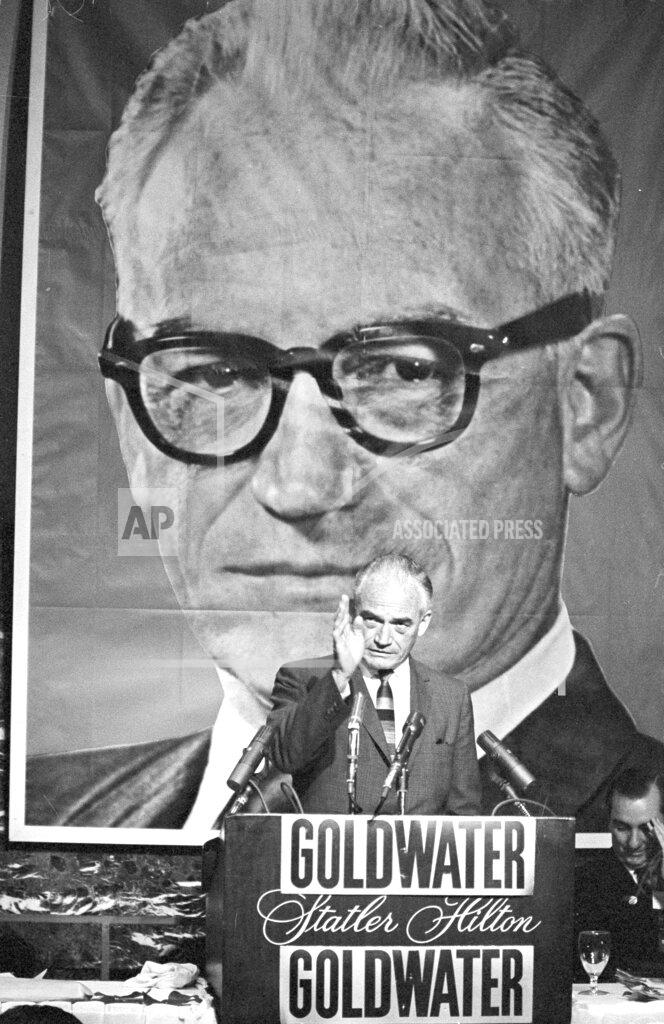
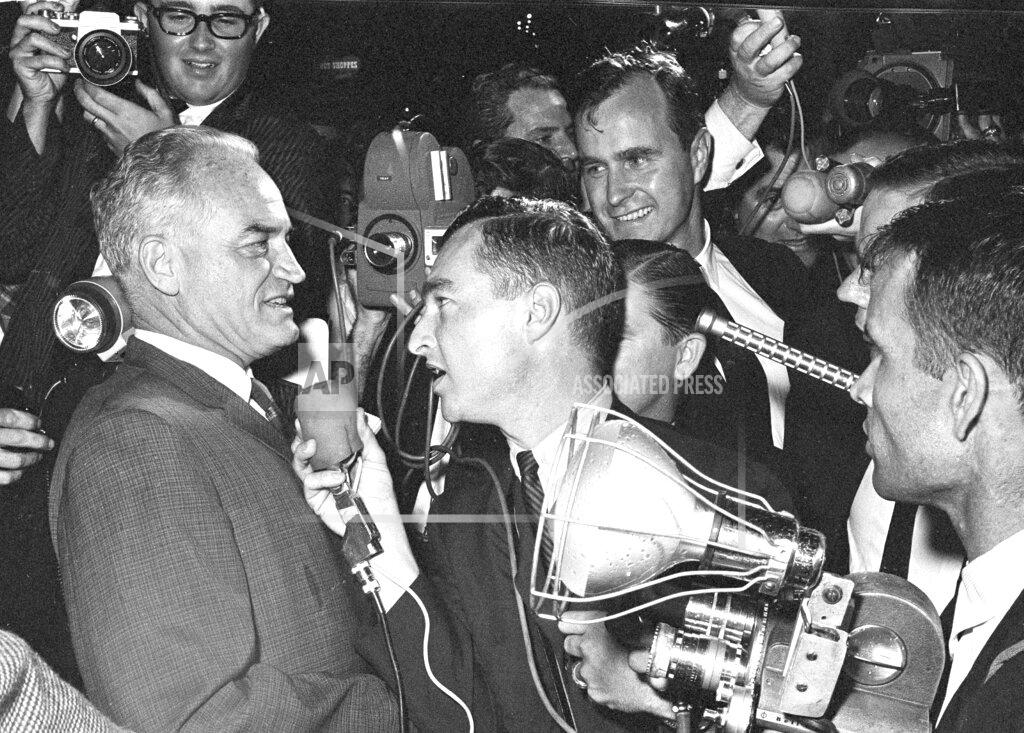
Senator Barry Goldwater and four of his staunchest supporters joined with the Southern bloc in the Senate today in a futile attempt to kill the public accommodations section of the civil rights bill. The vote by which the Senate repulsed the effort to strike out what Blacks regard as the vital core of the measure was 63 to 23. Seventeen Southerners, five Republicans and one Northern Democrat voted for the amendment. The other Republicans were Norris Cotton of New Hampshire, who was Mr. Goldwater’s campaign manager in that state’s Presidential primary last March; Wallace F. Bennett of Utah, Edwin L. Mechem of New Mexico and Milward L. Simpson of Wyoming. The Northern Democrat voting for the amendment was its sponsor, Robert C. Byrd of West Virginia. The public accommodations section, called Title II, bans discrimination or segregation in hotels, motels, restaurants, theaters and sports arenas.
Mr. Goldwater’s vote for the motion to eliminate the title was expected. He has always taken the position that he deplores discrimination in public accommodations but opposes any attempt to outlaw it as an invasion of private‐property rights. He has felt the same way about Title VII, which bans discrimination by employers and unions, and he voted to kill that title the day before closure was invoked, last Wednesday. The proposal was defeated. However, in another area, dealing with the protection of the Black’s right to vote — guaranteed by the 15th Amendment to the Constitution — Mr. Goldwater voted today against two Southern proposals.
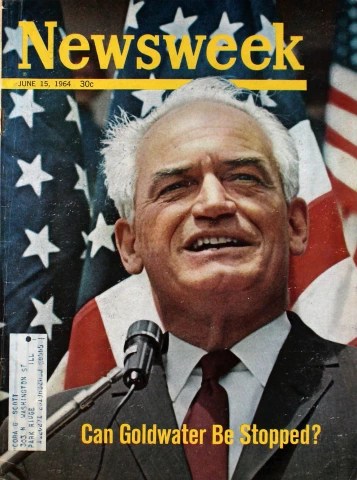
Governor Rockefeller, the first candidate to enter the Republican Presidential race, withdrew yesterday in favor of Governor William W. Scranton of Pennsylvania. In a brief statement released at his New York office, Mr. Rockefeller urged moderates in the party to unite behind Governor Scranton as “a candidate in the mainstream of American political thought and action.” This was the closest the statement came to mentioning Senator Barry Goldwater of Arizona, the leading candidate for the nomination. After he lost the California primary on June 2, Mr. Rockefeller remarked that if Senator Goldwater was in the mainstream “we’ve got a meandering stream.”
The Governor’s campaign aides estimated that he would be able to deliver 85 to 88 votes from the 92‐member New York delegation to Governor Scranton at the Republican Convention in San Francisco next month. These delegates are not legally bound to the Governor, but since they are from his home state, he is confident of his political control. In addition, Governor Rockefeller will attempt to give Governor Scranton the 18 delegates he won in Oregon in his only victory in a contested primary. These delegates will be legally free after he releases them and for that reason the Governor’s statement stopped short of a release. There are 20 to 25 more delegates pledged to Governor Rockefeller. It is considered likely that they will follow his lead into the Scranton camp.
In its decision in Reynolds v. Sims, the U.S. Supreme Court ruled, 8 to 1, that the legislative systems of six American states (New York, Maryland, Alabama, Colorado, Virginia and Delaware) were unconstitutional because the apportionment of their districts did not reflect an apportionment of a roughly equal number of people, thus violating the 14th Amendment guarantee of equal protection under the law. The new standards announced by the Court were such that nearly all 50 states would have to reform the apportionment systems of their state senatorial districts to reflect an equal distribution of the population, something not required of the United States Senate.
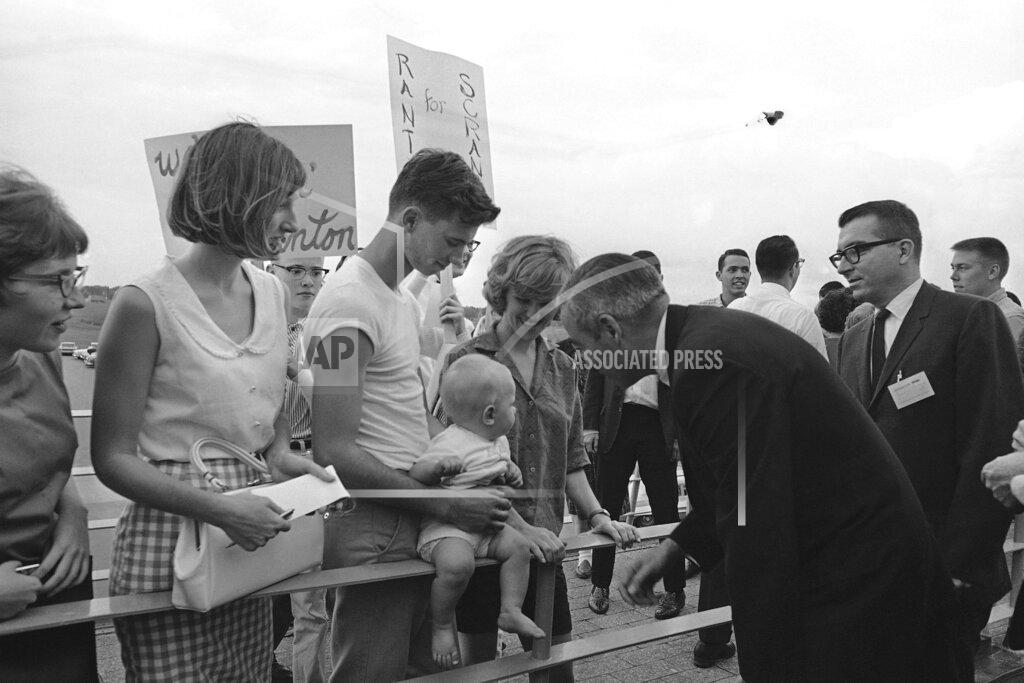
Governor William W. Scranton of Pennsylvania opened a fighting campaign for convention delegates in the Midwest tonight, swinging to the right at Senator Barry Goldwater of Arizona and to the left at President Johnson. With one hand he struck at “dime‐store feudalism” and “extreme reactionaries.” With the other he aimed blows at an Administration that he said had “put together a short‐order foreign policy, serving up each day’s hash from the leavings of yesterday’s mistakes.” The Governor received two rousing receptions, although Goldwater enthusiasts infiltrated both and interrupted speeches with yells for the Senator. A two‐floor auditorium that seats more than 4,000 was nearly filled. The crowd responded to the Governor’s speech with deafening approval time after time. Goldwater fans chose the quiet moments of the speech to yell, “We want Barry.”
To win the Republican Presidential nomination, Governor William W. Scranton of Pennsylvania will have to obtain many of the first ballot votes now pledged to, but not legally committed to, Senator Barry Goldwater of Arizona. He was faced with this task yesterday as he carried his quest for Republican National Convention votes into Iowa. He will be seeking delegates later in the week in Kansas, Minnesota, Missouri, Colorado and Massachusetts. The latest Associated Press survey credits Senator Goldwater with 618 first ballot votes of the 1,238 delegates already chosen for the convention. A total of 655 are needed for the nomination. However, he has only 118 legally bound to him. These are the 86 he won in the California primary and 32 in the Indiana primary.
Richard M. Nixon warned Republicans today that they faced disaster in November if they failed to back the civil rights bill. The former Vice President said that Republican opposition to the bill “may represent temporary gains,” particularly in the South. But he said “it would be disastrous to the party in the long run.” Asked at a news conference here whether Senator Barry Goldwater could be nominated at the Republican National Convention next month even if he voted against the bill, Mr. Nixon replied: “Senator Goldwater can take a view different from the majority of Republicans and still he nominated.” He said that Mr. Goldwater would have to follow his “conscience.”
Henry Cabot Lodge firmly denied today a Washington report that he had resigned as United States Ambassador to South Vietnam for health reasons. The report, he said, is “totally false.” Mr. Lodge underwent a thorough medical checkup only a few days ago, sources said, and was reported to be in good health. At 61, he continues to go for energetic swims nearly every day during his lunch hour. The question plaguing Ambassador Lodge today is whether he should resign for other reasons — political reasons. It is a question that remains unanswered.
As a liberal Republican and a possible though undeclared contender for the Republican Presidential nomination, Mr. Lodge has watched with extreme concern the gains made by Senator Barry Goldwater of Arizona, who is believed to have nearly enough votes for nomination. Senator Goldwater heads the right wing of the Republican party, which Mr. Lodge fought against — losing his Senate seat in the process — in 1952, when he managed the successful campaign to win the nomination for General of the Army Dwight D. Eisenhower. As a man to stop Mr. Goldwater, however, Ambassador Lodge realizes he is nothing like the favorite for the nomination that he was after defeating both Senator Goldwater and Governor Rockefeller in the New Hampshire primary March 10.
Jack L. Ruby’s new chief counsel said today he would ask a judge to call off a hearing scheduled for Friday to determine whether the condemned slayer needed a sanity trial “although we strongly believe that he is insane.” Clayton Fowler of Dallas, the, fifth man to head the defense for Ruby since he shot and killed Lee H. Oswald, accused assassin of President Kennedy, on November 24, said he believed Ruby’s death sentence should be appealed to its end through the courts before seeking a legal decision on his sanity. He said he had conferred with the other defense lawyers and “we have decided a sanity hearing should not be held at this stage in the case.”
Applause broke out in New York State Supreme Court yesterday after a jury had voted to send Winston Moseley to the electric chair for the murder of Catherine Genovese in Kew Gardens. The sudden hand-clapping and a few cheers, all from women, in the Queens County Criminal Courthouse, caused Justice J. Irwin Shapiro to pound his desk angrily for order. After the courtroom had quieted, however, Justice Shapiro told the jurors: “I don’t believe in capital punishment, but I must say I feel this may be improper when I see this monster. I wouldn’t hesitate to pull the switch on him myself.” Moseley himself showed no emotion. He stood before the bench, a small, slender, impassive figure in a red‐striped shirt and black trousers.
The U.S. Air Force launched a Minuteman missile from an underground silo at Vandenberg Air Force Base in California today. It was the 49th launching of a Minuteman. The missile was successfully fired into an area 5,000 miles out in the Pacific.
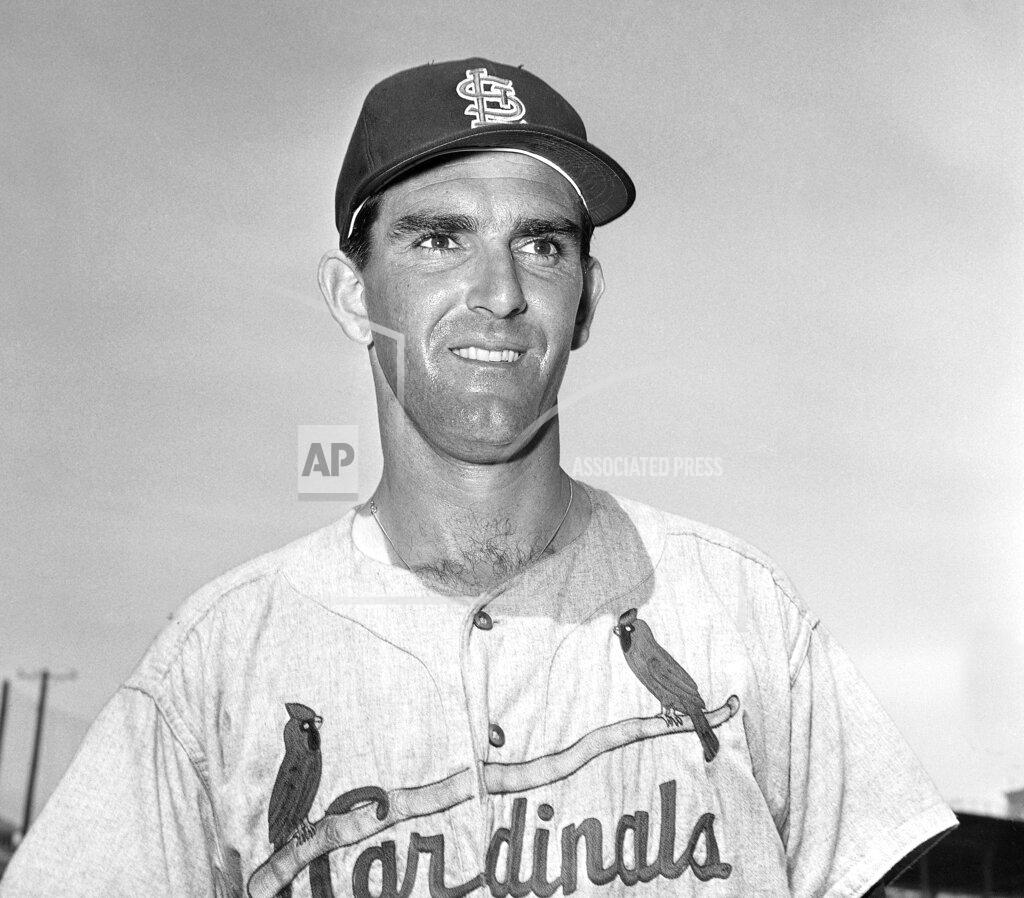
In one of the infamous trades of all time, St. Louis acquires outfielder Lou Brock, with pitchers Jack Spring and Paul Toth, from the Cubs for pitchers Bobby Shantz and former 20-game winner Ernie Broglio and outfielder Doug Clemens. Broglio, 28, has a 3–5 record, while Brock, a part-time outfielder with Chicago, is hitting .251. Brock will blossom in St. Louis hitting .348 while swiping 33 bases. Broglio’s arm will lock up in August and he will have off-season surgery, but his career is essentially finished. In 2011, Broglio will contend that the Cards knew he had elbow problems requiring regular cortisone shots. He says that an indication was the three wild pitches he threw in a game on May 19th against the Cubs. He believes the Cards knew they were trading “damaged goods” to the Cubs.
The White Sox send first baseman Joe Cunningham and a player to be named later to Washington for first baseman Bill Skowron and pitcher Carl Bouldin. The player named later is pitcher Frank Kreutzer, who is shipped on July 28.
Cleveland sends pitcher Jim Grant to Minnesota for pitcher Lee Stange and third baseman-outfielder George Banks.
Don Rudolph, with last-minute help from Ron Kline, pitched the Washington Senators to a 3‐2 victory over the Los Angeles Angels tonight for his first triumph since his recall from the minors. Rudolph limited the Angels to six hits and gave way to Kline in the ninth after Joe Adcock had hit a home run with two out.
Jim Ray Hart, a rookie, lashed a run‐scoring single to center field in the ninth inning to give San Francisco a 6–5 victory over Cincinnati today. The Giants now are only eight percentage points behind Philadelphia, the National League leaders. The Giants had gone ahead, 5–3, with three runs in the eighth, but the Reds rushed back for two in the ninth.
The Houston Colts scored four runs in the sixth inning and added four in the seventh tonight to defeat the St. Louis Cardinals, 9–3.
Dow Jones Industrial Average: 813.56 (+4.17).
Born:
Courteney Cox, American actress (“Friends”), in Birmingham, Alabama.
Dick Chapura, NFL defensive tackle (Chicago Bears, Phoenix Cardinals, Philadelphia Eagles), in Sarasota, Florida.
Mark Wheeler, NFL tight end (Detroit Lions), in Indianapolis, Indiana.
Dave Cullity, NFL tackle (San Francisco 49ers), in La Mirada, California.
Michael Laudrup, Danish footballer and manager, in Frederiksberg, Denmark.
 History Diaries