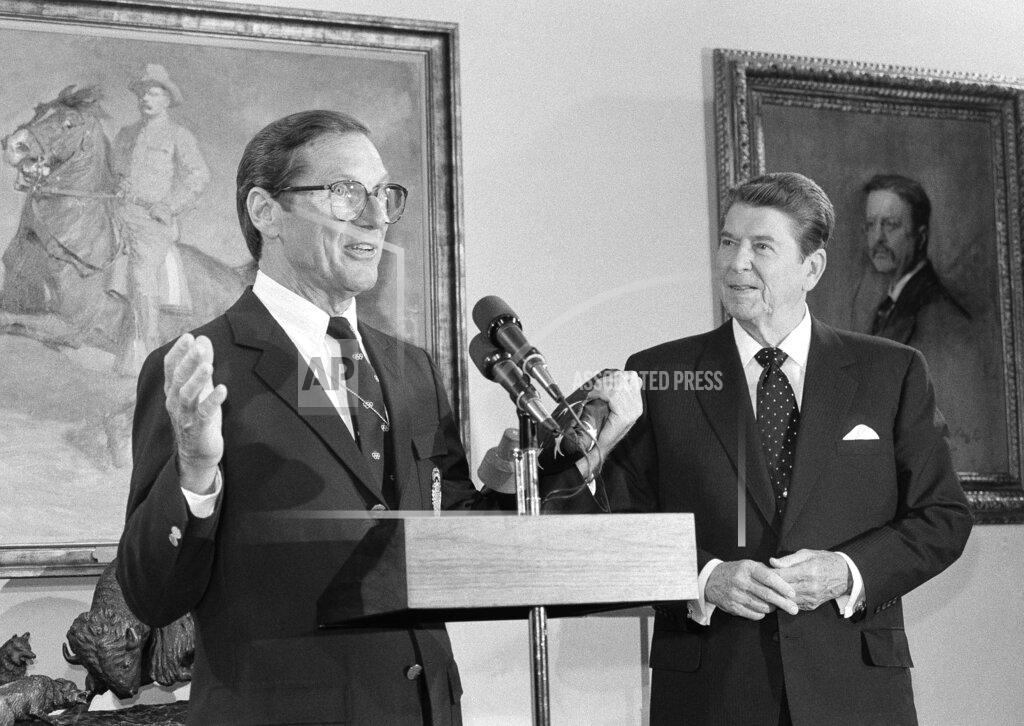
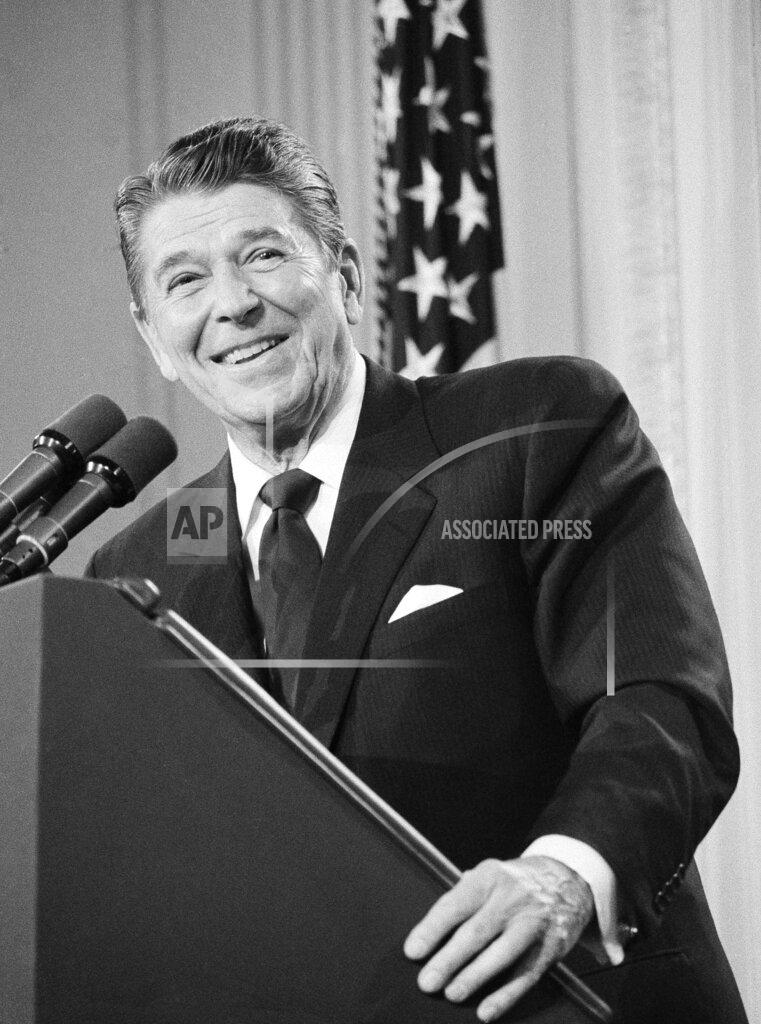
President Reagan is willing to meet “any time” with Konstantin U. Chernenko, the Soviet leader, to discuss a broad range of issues to improve mutual understanding, Mr. Reagan said at a news conference. He said, however, that Moscow had rebuffed him by insisting on “a very carefully prepared agenda.” Speaking at a televised news conference, Mr. Reagan appeared to relax the conditions that he and other Administration officials had earlier placed on having a summit meeting with the Soviet leadership. Asked repeatedly about the possibility of such a conference, Mr. Reagan said his interest in talking with the Russians was “legitimate” and was not politically motivated. “The door is open and every once in a while, we’re standing in the doorway seeing if anyone’s coming up the steps,” he said.
Previously, Mr. Reagan had attached two conditions to having a meeting with the Soviet leadership: first, that there be a specific agenda, and second, that there be reasonable chances an agreement would emerge from such a meeting. Not only did the President refrain from repeating these conditions tonight; he seemed to go out of his way to say there did not have to be “a preconstructed meeting” with “a list of points” agreed upon in advance. “You can have an agenda in which it is the general area of the things that you think could lead to better understanding,” he said. “And that’s good enough for me.” He went on to say: “Right now, we’re getting a response from them that they want a carefully prepared agenda.” But he added: “Now if they agree with me that there are things we can talk about that might clear the air and create a better understanding between us, that’s fine.”
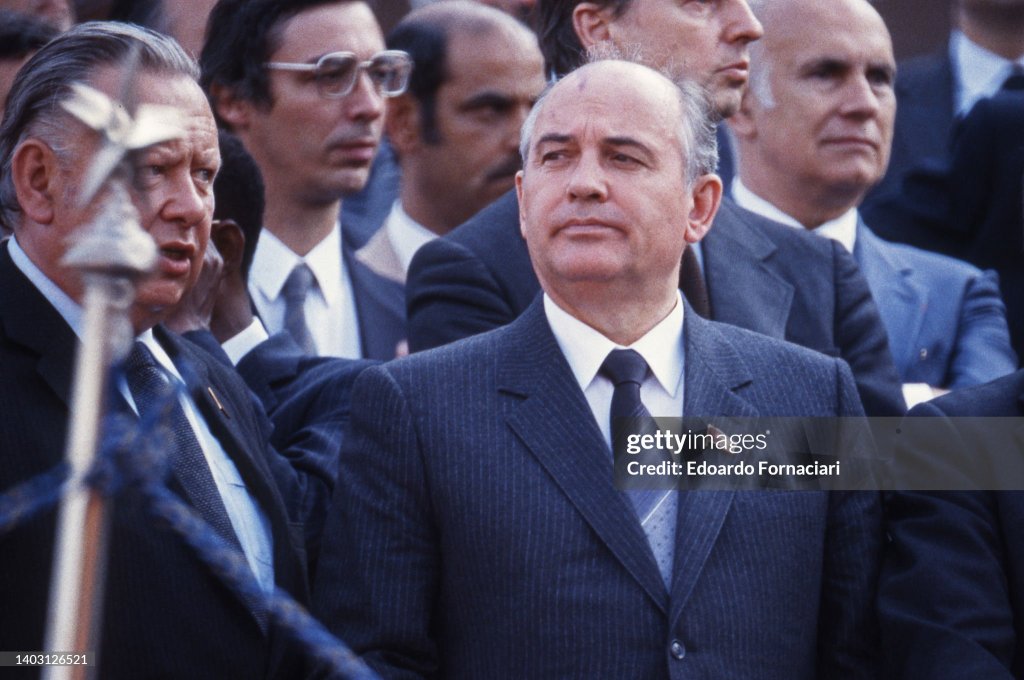
Moscow favors the idea of a summit conference with Washington, but the timing would depend on the preparation of issues to be discussed, according to the Kremlin’s spokesman, Leonid M. Zamyatin. Echoing American insistence that any meeting of the two countries’ leaders should be well prepared, Mr. Zamyatin said such a meeting would require “proper preparation and issues that require the participation of the general secretary.” Konstantin U. Chernenko, the Soviet leader, is general secretary of the Communist Party. Mr. Zamyatin’s comments, couched in general and noncommittal terms, were the first reference to a summit meeting by a senior Soviet official since Mr. Chernenko became the Soviet leader. Moscow has been unresponsive to most calls for Soviet-American contacts.
On Wednesday, Mr. Chernenko said in an interview with the Communist Party newspaper Pravda that the recent call made by leaders of the seven major industrial democracies for dialogue with the East was not “backed up by anything tangible,” and was a screen to cover the deployment of American missiles in Europe. Other Soviet statements have dismissed American overtures as election-year politics. ‘Nothing of Substance’ Mr. Zamyatin, asked why Moscow has not responded to the call Mr. Reagan made in Dublin for East-West discussions on a declaration against the use of force, said: “There was no response because there was nothing in what Reagan said that was worthy of consideration. There was nothing of substance to respond to.”
Britain’s House of Commons voted to liberalize divorce laws, allowing couples to dissolve their marriages after one year instead of three and restricting the power of courts to award alimony to wives. The legislation was approved on a 119–16 vote. It is scheduled to become law this autumn. Leo Abse of the Labor Party, an opponent of the measure, said the bill will “incite people to jump out of bed with one marriage and jump into bed with another.” The bill, introduced by Prime Minister Margaret Thatcher’s Conservative Government, is expected to take effect next fall despite bitter attacks on it by church leaders.
Britain’s centrist Social Democratic-Liberal Party alliance emerged an upset winner in a special parliamentary election in Portsmouth, England. Social Democrat Michael Hancock beat Patrick Rock, a Conservative businessman, by 1,341 votes in a district that last year gave the Tory candidate a 12,335-vote victory. The election was necessary because of the death last month of Portsmouth’s previous Tory legislator, Ralph Pink, who had held the district for 18 years.
After a tour of eight European countries in a month, the stepdaughter of Soviet dissident Andrei D. Sakharov called on the West to suspend the Helsinki accords on human rights to pressure the Soviet Union into easing the plight of the dissident and his wife. In addition, Tanya Yankelevich said, French President Francois Mitterrand can help the Sakharovs by using his influence during his official visit to the Soviet Union next week. Sakharov, who is the best-known dissident in the Soviet Union, and his ailing wife, Yelena Bonner, are in internal exile in Gorky.
The Pope urged honesty in banks in Switzerland at a mass in the Swiss village of Flueli. “Tiny Switzerland has today become a world power in business and finance,” the Pope said. “As a democratically constituted society, you must watch vigilantly over all that goes on in this powerful world of money. The world of finance, too, is a world of human beings, our world, subject to the consciences of all of us; ethical principles apply to it, too.’
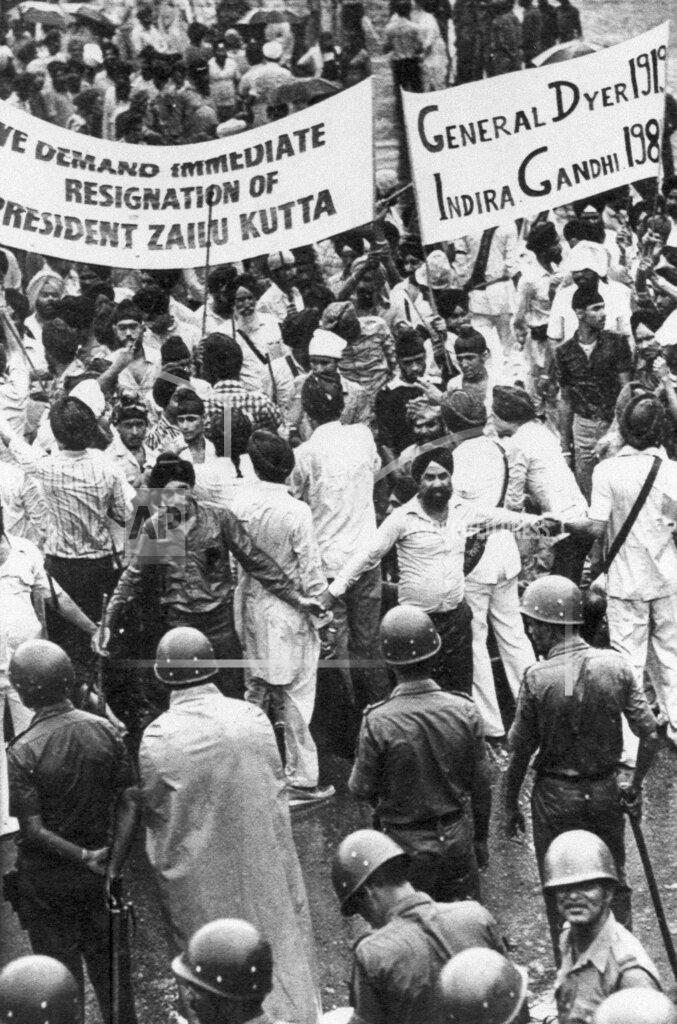
At least 86 Sikhs suspected of being terrorists were arrested in Punjab today, Indian officials said, but no army desertions or violence were reported in the state and some transportation service was restored. Those arrested included 75 armed Sikhs who were seized by troops as they approached a bridge near Amritsar, the site of the Golden Temple, the shrine the army stormed on June 6, a government spokesman told reporters in Chandigarh, the state capital. As security forces continued their search for suspected terrorists Wednesday night, a former brigadier of the Indian Army, Maninder Singh, was seized in Amritsar. He is believed to have helped train the extremists who terrorized Punjab for nearly two years in their drive for greater autonomy. The militants are said to have used the Golden Temple, the Sikhs’ holiest shrine, as an armory.
Major damage at the key Sikh shrine was observed by the first foreign reporters permitted to enter the Golden Temple complex at Amritsar since Indian troops captured it from Sikh militants June 6. However, the central structure appeared intact, with hardly a scratch.
The U.S.-China nuclear sales agreement that was a high point of President Reagan’s trip to Peking in April has hit a roadblock that may prevent approval this year, the Washington Post reported, quoting U.S. officials. The Administration seeks further assurances from Peking of its non-proliferation policies before sending the pact to Congress. The Chinese have refused, saying Washington is trying to reopen a deal that both sides approved in Peking, with Reagan himself present. The Administration reportedly seeks additional assurances from Peking in view of intelligence suggesting that China helped Pakistan develop nuclear weapons.
American delegates walked out of a U.S.-Taiwan trade conference in Taipei to protest continued local press reports describing them as high-ranking Washington officials, U.S. sources said. The United States has official diplomatic relations with China and regards its ties with the Nationalist Chinese government of Taiwan as non-governmental. One of the sources said the distinction was repeatedly stressed to the Taiwanese. The American delegates walked out of the meeting after the first day of talks, the sources said.
A Japanese researcher says he has discovered documentary evidence that Japanese troops used poison gas in China between 1938 and 1942. A 70-page document, compiled by the Japanese army at the end of 1942 and apparently found by U.S. forces at the end of the war, lists 56 cases of poison gas operations against Chinese troops, said Kentaro Awaya, a history professor. Awaya said he found the declassified documents last year at the National Archives in Washington. Awaya said he could not determine how many troops died or how much gas was used.
A Yokohama court convicted an American college lecturer today of defying Japanese alien registration laws by refusing to be fingerprinted, in the first such test of the practice. Kathleen Morikawa, a 34-year-old native of Pittsburgh who has lived in Japan for 11 years, was fined about $43 by Judge Yoshikatsu Uehara, half the penalty demanded by the prosecutor in Yokohama. Mrs. Morikawa, whose husband, Jun, is a Japanese college professor, refused to be fingerprinted September 9, 1982, because, she said recently, “I got a bit tired of it, it’s discriminatory, and I wasn’t willing to accept it.” Under Japanese law, all non-Japanese citizens staying in the country more than 90 days must apply for an alien registration card, a process that requires the imprint of the left index fingerprint. The fingerprint must be given every time the card, valid for five years, is renewed.
United States and Philippine military officials announced today that they had concluded a new defense plan for the Philippines in an annual meeting of the mutual defense board. The chief of United States Pacific Command, Admiral William Crowe, and the Philippine Chief of Staff, General Fabian Ver, issued a brief announcement that, in case of external attack, the Philippines could be defended under a new plan to be jointly executed with American forces operating from their bases in the country. In an interview later, the Philippine Deputy Foreign Minister, Pacifico Castro, said the new defense plan was an updated version of earlier plans and was in line with a 1979 agreement worked out between Secretary of State Cyrus R. Vance and Carlos P. Romulo, the Minister of Foreign Affairs of the Philippines.
The Government of New Zealand has lost its one-vote working majority in Parliament and has called general elections for July 14, Prime Minister Robert Muldoon, said today. An independent legislator, Marilyn Waring of Waipo, withdrew her promise of support for government measures, leaving the government with 46 votes in the 92-member House of Representatives. Mr. Muldoon announced the elections after a special National Party caucus. “Caucus has supported my recommendation that I tell the Governor General that we do not have a majority, and we must thus have a general election,” he said at a news conference. Mr. Muldoon, who heads the National Party, has been in office since November 1975. A general election was already scheduled for November.
Guerrilla forces of the Angolan rebel movement UNITA captured 11 Americans, Portuguese and Colombians during attacks on government troops in the southern African nation, a rebel spokesman announced. He did not identify the captives, presumed to be agricultural advisers, or say how many of the 11 are Americans. The National Union for the Total Independence of Angola also claimed to have killed 210 Angolan soldiers and 30 Cuban troops in battles in four provinces.
President Reagan is willing to debate Walter F. Mondale if he wins the Democratic Presidential nomination, Mr. Reagan said at his 25th televised news conference. “President Carter said that I would hide?” the President said, smiling like a tennis player putting away a slam shot. Then, drawing on a punch line that he used in his 1980 race for the White House, he added, “There he goes again.” On the CBS Morning News Wednesday, Mr. Carter said he expected Mr. Reagan to “hide behind all kinds of excuses to avoid debating” Mr. Mondale. President Reagan’s punch line, first used in rebutting President Carter in the 1980 campaign debate, drew a round of laughter at Mr. Reagan’s 25th televised White House news conference. And in so saying, President Reagan ended any doubts about his willingness to debate the Democratic nominee.
President Reagan presents a White House flag to the U.S. Olympic team for the opening day parade.
President Reagan participates in a Cabinet Council on Natural Resources and the Environment to discuss rights of offshore drilling.
A drive against the MX missile led by senior Democratic Senators was rebuffed in the Republican-controlled body in a cliff-hanging vote that required a rare ballot by Vice President Bush. In a series of afternoon speeches on the Senate floor, the Democrats began their strategy for attempting to limit funds for the nuclear missile in the military authorization bill for the fiscal year 1985. They started with an amendment that would have eliminated the missile and were prepared to offer progressively less stringent measures in the hopes of gaining Republican support for at least some reduction in funds for the MX. In a series of afternoon speeches on the Senate floor, the Democrats began their strategy for attempting to limit funds for the nuclear missile in the military authorization bill for the fiscal year 1985. They started with an amendment that would have eliminated the missile and were prepared to offer progressively less stringent measures in the hopes of gaining Republican support for at least some reduction in funds for the MX.
An amendment offered by Patrick L. Leahy, Democrat of Vermont, that would have deleted all funds for the MX from the bill was rejected. But it prepared ground for a measure from Daniel Patrick Moynihan, Democrat of New York, that would have eliminated only expenditures for actual deployment of the missiles. With Mr. Moynihan’s approval, Senator Lawton Chiles, Democrat of Florida, offered a modification to the New York Senator’s measure in an attempt to gather votes against the MX from Southern Democrats. The Moynihan-Chiles measure would have preserved work already authorized on the MX by Congress by providing $1.7 billion for continued development and testing of 21 MX missiles already purchased.
A motion to kill the Moynihan-Chiles measure, offered by Senator John Tower, Republican of Texas, chairman of the Senate Armed Services committee, brought a 48-to-48 tie vote that was broken by Vice President Bush. The tie-breaking vote by Vice President Bush was believed to be only the third time his presence was necessary in the Senate to obtain an objective sought by the Reagan Administration. His two previous tie-breaking votes were for production of new nerve gas weapons.
Temporary foreign farm workers would be admitted to the United States under legislation approved by the House in a 228-to-172 vote. The measure would admit several hundred thousand aliens to harvest perishable fruit and vegetables. The proposal was offered by Representatives Leon E. Panetta, a California Democrat, and Sid Morrison, a Washington State Republican. It was strongly supported by farmers, food processors and agricultural officials of some states. Approval of the amendment complicates efforts to pass a comprehensive immigration bill to outlaw employment of illegal aliens. With the Panetta amendment, the bill will probably be unacceptable to many people who might otherwise vote for it. Organized labor and some of its allies in Congress support the basic bill, but strongly oppose the Panetta amendment, saying it would create a big new “guest worker” program.
The Southern Baptist convention decides against allowing women clergy members. The resolution argues that women are subservient because of their responsibility for bringing sin into the world. But the resolution is not binding on local congregations, which have the power to ordain, and it does not affect the status of those Baptist women already ordained. About 250 women are ordained deacons and ministers among the 40,000 pastors in the denomination, but only a handful serve local congregations as pastors.
A Chicago judge was convicted of accepting thousands of dollars in bribes to fix cases in the nation’s largest court system. A federal jury of six men and six women deliberated nearly two days before returning the verdict against Judge John M. Murphy, 68. He is the first judge to be convicted in the Operation Greylord investigation of corruption in the Cook County courts. Murphy was the first judge and second defendant to be tried as a result of the probe. Seventeen persons, including four current or former judges, attorneys, police officers and court personnel, have been indicted.
Samuel Brown, the last defendant in the 1981 Brink’s holdup, was convicted of murder and robbery in the bungled $1.6-million heist in New York state that was organized by a coalition of radical groups. Brown, 43, was found guilty of three counts of murder and four counts of robbery in the October 20, 1981, armored-car robbery and subsequent shoot-out that left a Brink’s guard and two Nyack, New York, police officers dead. He faces a maximum 75-years-to-life prison term when he is sentenced June 26.
The demand for emergency shelter by destitute Americans seems to be mounting and an increasing number of homeless include the mentally ill, women, and children, a U.S. Conference of Mayors study found. An accompanying report shows that requests for housing assistance also appear to be on the rise but that resources to help those in need are inadequate. Last month, the Reagan Administration ignited debate when it issued a report that estimated the nation’s homeless population at between 250,000 and 350,000. Critics noted that other studies have placed the figure at about 2 million.
A woman who won a United States Supreme Court ruling that law firms must follow Federal antidiscrimination laws when choosing partners settled her lawsuit today against her former law firm. The settlement of the four-year-old dispute between Elizabeth A. Hishon and the law firm of King & Spalding came less than a month after the Supreme Court ruling. Although the terms of the agreement were withheld, her attorney, Emmet Bondurant, said it was “an obvious conclusion” that his client received a financial settlement. Damages of more than $100,000 had been sought when the suit was filed in 1979, alleging the firm failed to offer Mrs. Hishon a partnership because she was a woman. The firm denied the accusation and chose to challenge the suit.
Survivors of the World War II Bataan Death March, describing their “living hell” during captivity, asked Congress for the right to sue Japanese companies that profited from their slave labor. They urged members of a House Judiciary subcommittee to back a bill that would allow them to take their cases to the U.S. Claims Court. The former defenders of Corregidor and Bataan in the Philippines told of the savage beatings, near starvation, hard labor and lack of rest they endured after being forced to work in Japanese factories as replacements for men sent to fight the Allies. A 1951 treaty between the Allies and Japan bars suits by war prisoners against the signers’ governments.
A man convicted of trying to extort $1 million from the makers of Tylenol after seven persons were killed by cyanide-tainted capsules of the painkiller was sentenced in a Chicago federal court to 10 years in prison. James W. Lewis, 37, had faced a maximum 20-year prison term and $10,000 fine. Lewis was not charged in the 1982 killings in the Chicago area, in which cyanide was inserted into bottles of Tylenol capsules and planted on store shelves. The poisonings have never been solved.
A New Jersey man who conspired with a former Central Intelligence Agency agent to sell arms to terrorist groups has pleaded guilty to gun-running charges, prosecutors said yesterday. The defendant, George Gregary Korkala, faces up to 20 years in prison under a plea-bargaining agreement approved last week by a judge in State Supreme Court in Manhattan. In 1981, Mr. Korkala and his partner, Frank Terpil, a former CIA agent, were convicted in absentia of selling 10,000 submachine guns to detectives posing as terrorists. Mr. Korkala, who fled the country shortly before the trial, was captured in Spain in 1982 and extradited on a promise of a new trial.
Two Burlington Northern coal trains slammed head-on in a fiery crash that derailed 50 cars and left a pile of smoldering metal 40 feet high. One crewman was killed and two others were missing and feared dead. The remaining five crewmen escaped serious injury. The collision occurred between the Minnesota towns of Motley and Pillager.
A record $6.75 million has been paid by two insurance companies to the Teamsters’ Central States Pension Fund and its health and welfare funds to settle claims against seven current trustees, Labor Secretary Raymond J. Donovan announced. Donovan said the amount is the largest collected under the Employee Retirement Income Security Act. The payments bring to $11.1 million the total paid to the funds to settle claims brought by the government. Three weeks ago, the union’s Central Conference paid $4.35 million to the Central States Pension Fund to resolve the conference’s illegal sale of a jet to the fund.
Barriers to copper imports were urged in a unanimous vote by the International Trade Commission, which warned that imports were injuring American copper producers. Protection for the domestic companies, which operate in the West, could raise the price of copper and copper-made products.
Efforts to ease animals’ suffering have been organized since the 18th century. The older animal welfare groups have tended to work for legislative protections. But, since the late 1970’s, new organizations have become more vocal and some have grown militant, taking the law into their own hands.
Dow Jones Industrial Average: 1097.61 (-12.92).
Born:
Jesús Guzmán, Venezuelan MLB first baseman, pinch hitter, and outfielder (San Francisco Giants, San Diego Padres), in Cumana, Venezuela.
Ryan Jones, Canadian NHL right wing (Nashville Predators, Edmonton Oilers), in Chatham, Ontario, Canada.
Jamar Williams, NFL linebacker (Chicago Bears, Carolina Panthers), in Houston, Texas.
Lorenzo Booker, NFL football player, 2007-2012 (Miami Dolphins, Philadelphia Eagles, Minnesota Vikings), in Oxnard, California.
Siobhán Donaghy, British pop singer-songwriter (Sugababes, 1998–2001 & 2011–present), in London, England, United Kingdom.
Becca Stevens, American jazz singer, songwriter, and guitarist, in Winston-Salem, North Carolina.







 History Diaries