The Inter-governmental Committee of Refugees announced an international agreement to keep the 907 Jewish refugees aboard the St. Louis from having to return to Germany. Belgium agreed to grant temporary refuge to 250, the Netherlands 194, France about 200 and Britain the remainder. Britain, France, Belgium and the Netherlands (Holland) agree to take in the 907 Jews aboard the MS St. Louis. Those who find shelter on the Continent will come under German control in the summer of 1940 and 256 will later be murdered in the concentration camps.
The United Kingdom dispatched a relatively low-level diplomat, William Strang, to engage in talks with Soviet Foreign Minister Vyacheslav Molotov instead of sending Lord Halifax. Molotov took this as a sign that Britain was not seriously interested in forming friendly relations with the Soviet Union. The Soviets are insisting on “guarantees” for the Baltics which in essence are a recognition of a Soviet sphere of influence.
Heinrich Himmler, chief of German police, arrived in Prague. It was believed that his visit indicated that great importance that was being attached to a prompt clearing up of incidents in which two policemen, a Czech and a German, were killed. Heinrich Himmler, chief of all German police, including the Gestapo, the secret police, arrived here today, and Czech political quarters believed his visit indicated that great importance was attached to a prompt clearing up of incidents in which two policemen, a Czech and a German, had been killed. An official announcement said Herr Himmler was in Prague “on a short official visit.” He called upon the Reich Protector in Bohemia-Moravia, Baron Constantin von Neurath, who last week ordered drastic police measures in Kladno when a German policeman was found slain.
Dr. Franz Guertner, German Minister of Justice, also was in Prague and visited Baron von Neurath. Official quarters in Berlin, however, emphasized that the Minister of Justice was here to attend “German Culture Week.” The official announcement of Herr Himmler’s arrival said that he had inspected a number of offices of the German Elite Guard and of the police.
He arrived as the protectorate government canceled, at the last minute, funeral services for Johann Mueller, Czech policeman, who was killed Friday in a quarrel with German officers. It was feared that disorders would result when 20,000 persons, stirred by a crown of thorns sent by the Czech National Unity party, gathered for the services. Thousands began to gather at Nachod for the funeral early in the day despite advice of the party that attendance be limited. The Polish military attaché in Prague and other official foreign observers who had gone to Nachod reported that no disturbances took place and that the crowd scattered without clashes when the service was postponed.
The organization of a so-called Czech Legion in Poland — an adventuresome body of men now said to number 18,000 — is firing the imagination of many Czechs who are “passively” opposing German domination in the protectorate. Hundreds of young men have been disappearing from Prague, Bruenn and other Czech cities, and their friends say they have gone to join the Legion being recruited by General Lev Prchala, who commanded the Czecho-Slovak troops who resisted Hungarian occupation of Carpatho-Ukraine in March.
Meanwhile, it was reported that in new disorders two German soldiers had killed a Czech woman.
Czechs irritate Nazi officials by using radios to aid passive resistance.
The Reich will draft all girls under age 25 for farm labor.
The Rev. Martin Niemöller’s Dahlem community has unanimously protested the impending action of the Supreme Council of the Evangelical Church temporarily depriving the pastor of his office by placing him on the “waiting list.” Before a gathering of 2,000 members of the Dahlem community — which is made up for a large part of former officers of the Imperial Army — Pastor Friedrich Müller, chairman of the Provisional Directorate of the Confessional Church, read a strongly worded protest letter directed to Dr. Friedrich Werner, head of the Supreme Evangelical Council.
“You, Mr. President,” the letter says, “have attempted, through arbitrary measures that disregard all legal principles of the church, to invest in yourself a number of powers and rights that are in themselves devoid of all legality. You are attempting now to further burden our sorely tried Pastor Niemöller with worry for the welfare of his wife and seven children. This is not a Christian action and in so doing you are only forcing the Confessional Church into a new defensive position. The Dahlem community successfully defended itself against attempts by Reichsbishop Ludwig Muller to force on them a new minister in place of Pastor Niemöller. The Dahlem community is determined to defend itself again. We consider Pastor Niemöller, though he may be imprisoned, as our rightfully chosen minister and we hold thereto in all faith. I feel obliged to bring these facts to your notice in the name of the Council of Brothers of the Dahlem Community and in my own name as chairman of this Council.”
Ledwedge Vincent Lawlor, middle-aged Australian steelworker, was held for trial without bail today on the accusation that he twice fired shots near residences of the British royal family. The eccentric Lawlor said at a magistrate’s hearing that he just, “wanted to see dukes and kings,” that he had no intention “of causing any harm” and that he was just an aimless sightseer bicycling near the royal residences, carrying a sawed-off rifle because he was afraid it would be stolen if he left it at home. Lawlor was accused of firing a shot through the window of the Princess Royal, sister of King George and wife of the Earl of Harewood, on June 4, and of firing his rifle one day later near the Duchess of Kent, the King’s sister-in-law, as she was leaving her Belgrave Square home.
While Colonel Angel Manzaneque, chief auditor of the army of occupation in Madrid, has gone to Burgos to report to Generalissimo Francisco Franco’s general headquarters on the work of five military courts functioning under his direction, 247 more arrests have been made, including twenty-six women, in the last three days in the cities and provinces of Madrid, Toledo, Ciudad Real, Albacete and Valencia. A majority of those arrested are accused either of direct intervention or complicity in political murders, which were frequently accompanied by robbery. The death sentence is asked by the prosecution in all cases where the accused are charged with direct intervention in killings, and a daily average of about twenty supreme penalties has been imposed recently by the five courts in session here.
No executions are carried out, however, until after each case calling for the death penalty has been reviewed by General Headquarters in Burgos and approved by the generalissimo. So far considerably fewer than 100 of those condemned to death by the Madrid auditoria have been executed, and it is understood that the Burgos officials wish to confer extensively with Colonel Manzaneque about the death sentences in the territory under his jurisdiction before approving more executions. An editorial published in the official bulletin of the Madrid Press Association directs attention to a full-page death notice appearing in the newspaper ABC that advises friends of twenty-four members of two intermarried families who were assassinated in the early days of the war that memorial services have just been held for them.
Five hundred Jewish refugees from former Austria and Czecho-Slovakia were stranded in Rumania today after having tried in vain for a month to charter ships to continue their travels eastward. Police said the refugees’ plight was desperate. They reached Constanta, on the Black Sea, secreted in Danube River boats. Unable to bargain successfully for passage to Palestine and points east, they were expelled from Constanta three days ago and took shelter in Balcik, fifty-five miles southwest of Constanta on the Black Sea and near the Rumanian-Bulgarian frontier.
Five Arab villagers were slain early today in Baled Es-Sheikh, near Haifa. An armed gang, dressed in European clothes, dragged the five men from their homes and shot them. A sixth villager was reported to have been abducted. Arabs asserted that the killers, dressed in European clothes, were Jews, according to The Associated Press. Early this morning Tel Aviv was shaken by seven simultaneous bomb explosions which destroyed six public telephone booths in various parts of the city and set fire to the railway station. A bomb explosion on the Jaffa-Tel Aviv border severely injured a British constable.
Inter-Jewish party strife between the Revisionists and Laborites resulted early today in an attack on Revisionist headquarters in Tel Aviv. Seventy persons carrying clubs studded with nails beat young Revisionists, injuring one severely, five slightly. Office papers were destroyed and a Zionist flag was scorched. The raiders escaped.
The military commander of the southern district ordered a curfew in Tel Aviv for three nights, beginning tonight, from 10:30 PM until 4 AM “to facilitate means of preventing sabotage.” Hebrew newspapers today strongly condemned wrecking activities such as the destruction of telephone booths. One said such acts undermined Jewish life and asked: “Can wreckers build a home?” While the Jews are still deliberating on what policy to adopt regarding the White Paper the British authorities are forging restrictions based on the White Paper. The Palestine Land Department was said to have been ordered to send to London a report on the plan for division of the country into seventeen areas for applying the new land policy.
A notable sign of the political change in Palestine was a visit to Tel Aviv today by the High Commissioner, Sir Harold Alfred MacMichael. Sir Harold, who always came freely to this all-Jewish city, where he often stayed with Lady MacMichael, today arrived accompanied by three armored cars and a truck filled with soldiers besides the usual police guard. He spent an hour at tea with Mayor Rokach. The visit attracted a crowd near the mayor’s residence. When a man tried to hand a letter to the High Commissioner it was minutely examined by the guard before it was passed on.
Today in Washington, President Roosevelt discussed with Secretary Wallace and Senators Bankhead and Russell the question of taxes to provide funds for financing unbudgeted items of nearly $400,000,000 in the Agriculture Department Appropriation Bill, conferred with Assistant Secretary Edison and Admiral Leahy, and announced at his press conference that he would go to Hyde Park on June 23.
The Senate confirmed the nomination of Admiral Leahy to be Governor General of Puerto Rico and of Herbert E. Gaston to be assistant secretary of the Treasury, passed the bill permitting interstate shipment of fight films, approved the conference report on the War Department Civil Functions Appropriation Bill, completed action on the $21,850,000 Legislative Appropriation Bill and adjourned at 2:55 PM until noon on Thursday.
The House adopted amendments restricting the operations of the Tennessee Valley Authority, received the War Department recommendation for construction of a seaplane base at Pearl Harbor, and adjourned at 6:26 PM until noon tomorrow. The Foreign Affairs Committee approved the Bloom Neutrality Bill. The Labor Committee heard William Green urge adoption of amendments to the National Labor Relations Act.
Legislation to put the Neutrality Law in accord with the wishes of the Administration was recommended to the House of Representatives today by its Foreign Affairs Committee. The decision to report the resolution, introduced by Representative Bloom of New York, acting chairman, was taken by a vote of twelve Democrats against eight Republicans, with three Democrats absent and two Republicans present and not voting.
The recommendations differ from the existing statute principally in that they make no provision for an embargo on exports of arms, ammunition and implements of war, do not mention nations engaged in civil strife, and give the President broader discretion. Almost from the beginning of its consideration of neutrality legislation, the committee has divided along strictly party lines. Two attempts to insert an automatic arms embargo were repulsed by solid Democratic votes, at the urging of Secretary Hull. The abstention of the two Republicans today, Representatives Barton of New York and Stearns of New Hampshire, was the first important break in the Republican ranks.
Some House leaders feel that there will be as many, if not more, Democrats opposed to the Bloom resolution as there will be Republicans, although they are confident of passage of the measure in the House without a major amendment. Mr. Bloom said that the three absent Democrats, Representatives McReynolds of Tennessee, chairman, Shanley of Connecticut and Pfeifer of New York, would have cast ballots for the resolution and made the favorable vote almost two to one, which he thought was something of a foretaste of the proportion in which the House would divide.
Mr. Bloom said that he and his Democratic colleagues would start at once the work of drafting a formal majority report, and that he would go before the Rules Committee at the end of this week to seek special procedure to bring his resolution to the floor of the House. He indicated that he would seek an “open rule” permitting the offering of unlimited amendments and about eight hours of general debate. He thought the resolution would reach the floor about June 26.
At its final session today, the committee rejected an amendment by Representative Eaton of New Jersey to include an embargo on articles destined for Japan for use in the manufacture of war weapons, and a proposal by Representative Corbett of Pennsylvania to set up a neutrality commission to deal with the discretionary matters which the resolution would leave to the President’s judgment.
Revival of reports that President Roosevelt might insist upon new taxes at this session as the price. for approving the unbudgeted farm aid of about $400,000,000 recently voted by the Senate, added today to the nerve strain of Congressional leaders who are trying hard to end the session by July 15. Assertions that the President either would veto the Agricultural Department Appropriation Bill because of the increases, or insist upon taxes to meet at least part of the outlay, went the rounds of the cloakrooms after a White House conference held by the Chief Executive with Senators Bankhead and Russell and Secretary Wallace.
The reports took on added significance when Mr. Roosevelt himself, at his press conference, disclosed that his discussion with the Cabinet officer and Senators was concerned with the question of levies to meet at least the $220,000,000 voted by the Senate for farm parity payments and the additional $113,000,000 put into the Agriculture Supply Bill to enable the department to deal more broadly with the problem of surpluses.
The President’s known antipathy to approving the farm aid increases without new revenue to cover them has held the bill in a state of relative inaction since passed by the Senate on May 12. It was finally sent to conference between the House and Senate on May 29, but no report has been forthcoming from the conference committee. The Senators who discussed the problem with the President appeared confident that the farm bill increases would be enacted, but they declined to say whether, in their view, he would approve them. They confirmed reports that he privately demanded new taxes to meet the added expenditure, but they were not certain as to whether he would make his demands publicly to Congress.
Meanwhile, speculation centered on what sort of new taxes the President might propose. For light on this, reference was made to a conference which the President held some weeks ago with House leaders on farm legislation. Informed by these men that, in their belief, Congress could not be induced to re-enact the agricultural processing taxes which the Supreme Court struck down in its original Agricultural Adjustment Act decision, the President reached for a pencil and pad and dashed off a program of his own.
It included the broadening of the income tax base to add from 2,000,000 to 6,000,000 new taxpayers to the direct Federal tax rolls, and a substantial increase on incomes between $10,000 and $50,000 a year. He proposed that exemptions on married persons be lowered to $1,800, and on single persons to $750 or less. The President made the point that every person with an income of any size should pay a federal income tax and that, in the interest of simplification of collection, those in the lowest brackets might be assessed on a flat levy basis of say, $5, $7.50, and $10 a year.
The House put upon the Tennessee Valley Authority tonight drastic restrictions that would confine it to a specified area, take it out of competition with private power interests outside that area and submit its fiscal policies to the scrutiny of the General Accounting Office. The House rejected Senator George W. Norris’s bill granting the TVA authority to issue $100,000,000 in bonds and placing no restrictions upon the TVA. It adopted the House Military Affairs Committee bill, which limited the bond issuing authority to $61,500,000. The vote was 191 to 167, the Republicans voting almost solidly for the House version as sponsored by the TVA’s arch-foe, Representative Andrew J. May of Kentucky.
A denial that the Workers Alliance had sought to dictate labor relations decisions of the Works Progress Administration was made before the House Appropriations subcommittee today by Colonel F. C. Harrington, WPA Administrator. He added that he thought it not unusual that a high proportion of the alliance membership should be made up of Communists.
Ten peace officers and three spectators were injured seriously and scores of others received bruises today in rioting in the CIO strike at the Allis-Chalmers Manufacturing Company’s plant in suburban West Allis, Wisconsin, outside Milwaukee.
Mass fist fights broke out at the Flint, Michigan auto plants where the United Auto Workers Union employees are currently striking. Two are seriously hurt as CIO men go through AFL picket lines.
Charges and counter-charges at a magistrate’s hearing late today assured a grand jury inquiry into the branding of a Baltimore-area Jewish junior high school student which was followed by the suspension of eighteen of his fellow students. Morton Rosen, 19, a seaman, arrested for assault as an outgrowth of two disturbances at the Gwynn’s Falls junior high school, was held for the grand jury under $100 bond after Ellis Levin, his counsel, demanded a jury trial. No testimony was taken at the hearing before Magistrate George P. Welzant, though nearly a score of students, summoned as witnesses, crowded before the bench surrounding 14-year-old Melvin Bridge, a Jewish youth, who accused forty schoolmates of carving the letter “H” on his neck during a schoolyard fracas Friday.
A judge reveals that several witnesses and defendants in a New York garment racket case have been murdered. Many others have disappeared.
The U.S. Navy aircraft carrier USS Saratoga (CV-3) and the tanker USS Kanawha (AO-1) completed a 2-day underway refueling test off the coast of southern California, thereby demonstrating the feasibility of refueling carriers at sea, a technique which was to prove vitally important to operations in areas where bases were not available.
Actress Maureen O’Hara (19) secretly marries film producer George H. Brown in Harrow, England, before leaving for Hollywood (annulled 1941)
The United States agreed today to provide substantial credits for Paraguay through the Export-Import Bank to support the currency and assist in the building of public works, principally roads. The move is in line with credit arrangements previously made with Brazil, Haiti and Nicaragua, and in prospect with Chile and other Latin-American governments as one means of implementing the Good Neighbor policy. It is part of a drive to stimulate industry and trade in the Western Hemisphere, and to combat attempts of Germany and Italy to penetrate South America, economically.
The British envoy in China, Ambassador Sir Archibald Clark Kerr, receives a death threat. Troops guard him in Shanghai.
The Chinese War Minister Ho Yingchin says Japan has lost 864,500 men to war.
Tientsin incident: Japan began a blockade of the British concession at Tientsin because British officials refused to hand over the four killers of an important Chinese collaborator. In violation of international conventions, the Japanese imposed a blockade on the Chinese port of Tianjin (Tientsin), a British treaty port. The Japanese action also blockaded French interests as well. The Japanese government imposed the blockade after British authorities refused to turn over four Chinese citizens, accused of terrorism against the Japanese. The Japanese demanded that the British end all support for the Chinese nationalists and cooperate with the Japanese government in establishing a “New Order” in the Far East, but the British refused to relent. The Japanese were fighting the Chinese across a broad front, and the Chinese resolve remained strong. The Russians provided military supplies to Chiang Kai-shek, while the American and British governments provided the Nationalists with loans. In response, the Japanese applied pressure on the foreign powers in China, demanding greater influence in the Shanghai international concession, and challenging foreign rights in China.
All attention in Tokyo is concentrated on the British-Japanese trial of strength, which opened in Tientsin today. Habituated by two years of reports of victories, the public has no doubt of the outcome. The “economic blockade” of the British and French concessions went into effect at 6 AM today and all business firms inside the areas were barred from communicating with the outside city, according to The Associated Press. The reports said the Japanese and British authorities were uncertain whether the blockade applied to food. Americans and other foreigners were declared to be leaving the concessions.
Press discussions have been focused on only one aspect of the affair. The British contention that the evidence produced against the four Chinese suspects demanded by Japan is not sufficient is ignored. The British Concession’s long-standing rule that political refugees are protected and that criminals are handed over on the production of evidence has not been mentioned in the press. The blockade is being called in Japanese dispatches “an interrogation.”
The Foreign Office confirms that the Japanese authorities in Tientsin have rejected a British proposal for a settlement. The Tokyo Government was not consulted. The Foreign Office assumes that the ground for rejection was the proposed inclusion of a neutral chairman, which opposed Japan’s fixed policy of barring all third-party intervention in disputes with other countries regarding China.
Referring to new evidence that the British were reported to have discovered, the spokesman said it was no longer a question of delivering those Chinese. Japan demands guarantees that the British concession authorities in the future will “cooperate” with Japan. Describing the international settlements in China as “cancerous growths,” the newspaper Hochi expresses the prevalent sentiment and also indicates that a surgical remedy is desired. “Those concessions,” it says, “point like daggers at Japan’s holy enterprise of building up a new order in East Asia.”
Dow Jones Industrial Average: 138.20 (-0.93).
Born:
Siegfried Fischbacher, German American entertainer and magician (Siegfried and Roy), in Rosenheim, Germany (d. 2021).
Tom Cheek, sportscaster (Voice of the Toronto Blue Jays), in Pensacola, Florida (d. 2005).
Died:
Karl Gall, 35, Austrian motorcycle racer (from racing crash injuries sustained on June 2).
Naval Construction:
The Вое́нно-морско́й флот СССР (ВМФ) (Soviet Navy) “M” (Malyutka)-class (3rd group, Type XII) submarine M-59 is launched by Krasnoye Sormovo (Gorkiy, U.S.S.R) / Yard 112.
The Royal Navy BPB 60 foot-type motor anti-submarine boat HMS MA/SB 3 is commissioned.
The Royal Navy Dragonfly class river gunboat HMS Grasshopper (T 85) is commissioned. Her first commanding officer is Lieutenant Commander Edward Neville, RN.


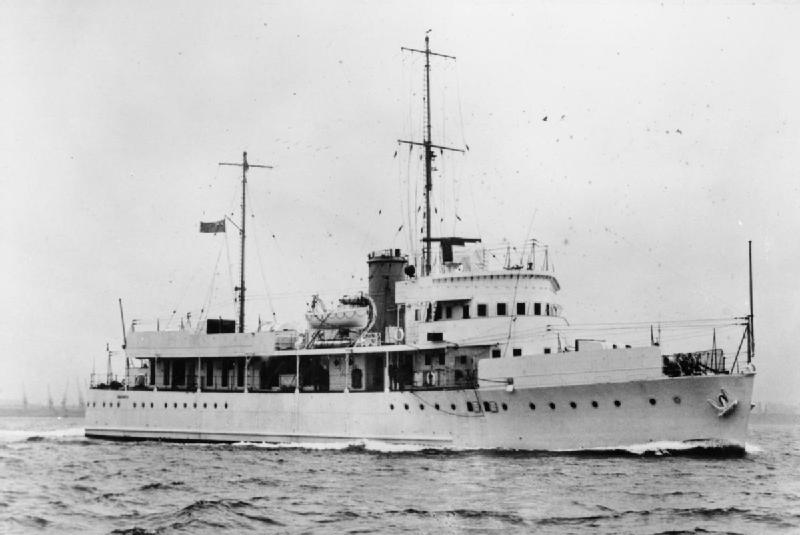
Lost 14 February 1942.
After completion was sent to the China station where she was deployed on the Yangtse River to relieve the Insect-class gunboat HMS Gnat. She remained there until the declaration of war by the Empire of Japan in December 1941. She was subsequently transferred to Singapore Naval Base and participated in the Malayan Campaign in early 1942. Near the end of the Battle of Singapore, she evacuated the base on 11 February together with her sister ship HMS Dragonfly. Three days later she was attacked and sunk by Japanese aircraft off the island of Sebayer (Rusuk Buaja). Most of the ship’s survivors, including the ship’s dog, Judy, were later captured on Sumatra by Japanese troops while trying to reach Padang.
Two of the crew elected not to travel with the others to Sumatra. They were Petty Officer George White and Able Seaman “Tancy” Lee, who were joined by one of the evacuees from the Royal Naval Reserve and two British Army soldiers who were already on Singkep. To prevent trouble with the incoming Japanese forces, they were transferred to the smaller Selayar Island. They were subsequently offered a boat by the island’s Dutch administrator, and a map of the Indian Ocean torn from a child’s atlas. They decided that they would aim to sail to Madras, India, as there were concerns that the Japanese were working their way through the islands. Their departure timetable was brought forward after the island was visited by a boat containing a Japanese officer and five soldiers. They were told by the Japanese to remain on the island and await collection. That evening they prepared the boat and put supplies on board. They departed on 11 April, only travelling by night until they were clear of the islands. During the day, they landed on nearby islands and hid. After four days, the engine broke and could not be turned off. As they travelled through the islands, they passed two Japanese transport ships and were buzzed by a Japanese bomber. Once out of sight of the islands, they navigated using the position of the stars during the night and the sun during the day. After seventeen days of travelling, they landed in India, a distance of 2,680 miles (4,310 km), only 23 miles (37 km) away from their intended destination.
 History Diaries