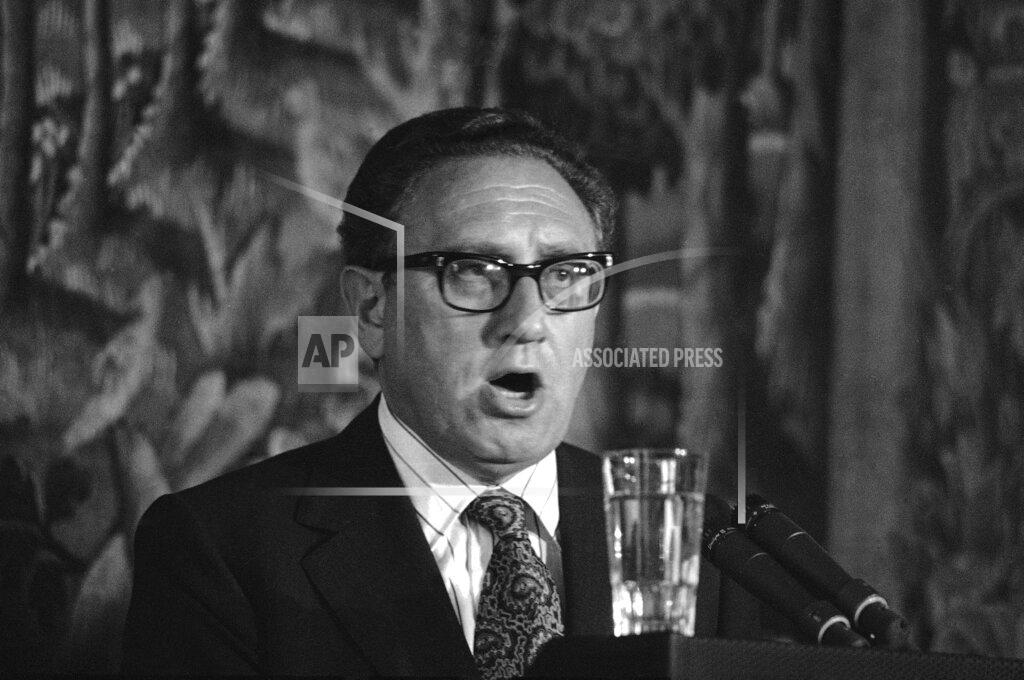
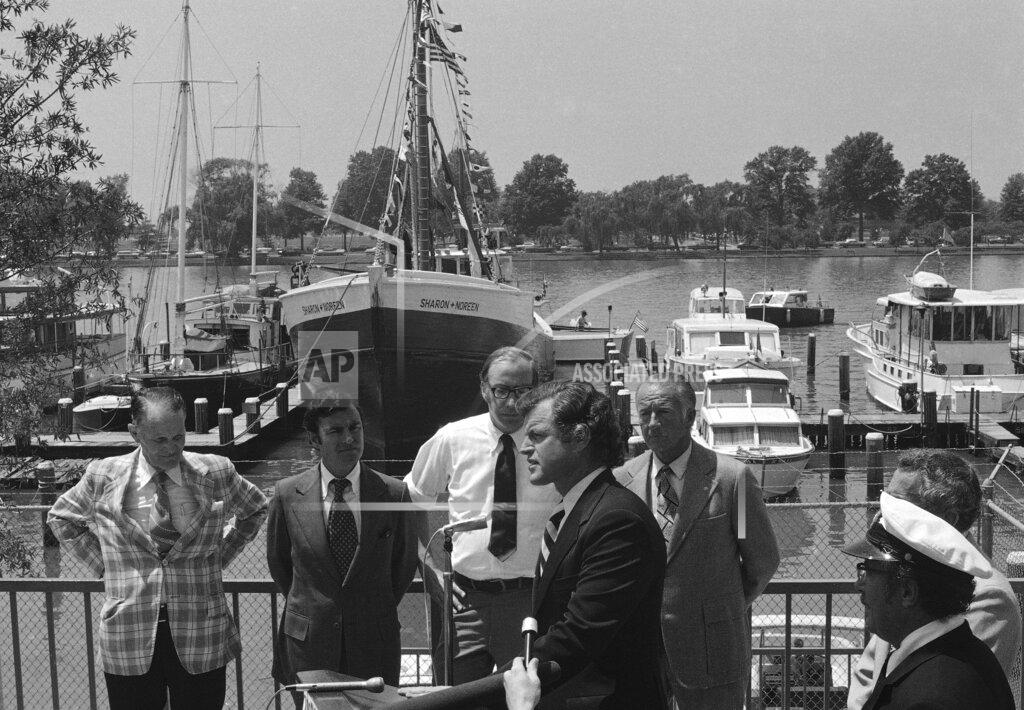
The Senate approved a $21.9 billion military procurement bill that provides $1.3 billion less than the amount requested by the administration for the new fiscal year. The bill will be reviewed in a conference with the House. The Senate, voting 46 to 45, defeated an amendment proposed by Senator Edward Kennedy that would have lowered the ceiling on military aid to South Vietnam to $750 million.
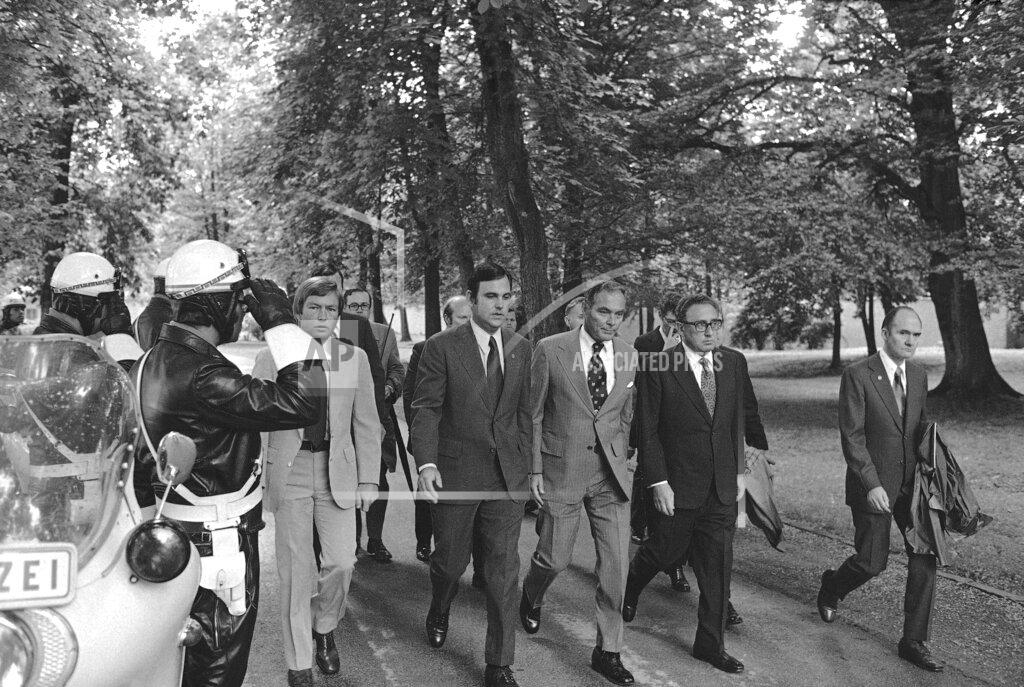
President Nixon, on his way to Cairo, conferred with Austria’s Chancellor, Dr. Bruno Kreisky, in Salzburg as part of his preparations for the beginning of his Middle East tour today. Dr. Kreisky recently led a Socialist International fact-finding mission on a tour of Middle East capitals. Secretary of State Kissinger and Austria’s Foreign Minister, Rudolf Kirchschlager, also participated in the meeting, held in the Klesheim Castle on the outskirts of Salzburg, where the President is making a 36‐hour stopover on his way from Washington to Cairo. The White House press secretary, Ronald L. Ziegler, said East‐West relations and European matters were also discussed. Dr. Kreisky made an official visit to the Soviet Union last month, and Mr. Nixon is due to go there in two weeks.
The Presidential party is to leave Salzburg by air tomorrow morning for Cairo. Mr. Nixon plans to deliver his arrival statement at Qubba Palace, where he is to stay in the Egyptian capital. His first meeting with President Anwar, el‐Sadat of Egypt is scheduled for tomorrow afternoon, to be followed by state dinner given by Mr. Sadat. Mr. Ziegler said that the White House party would travel by train from Cairo to Alexandria and spend a day and night in the seaport city before returning to Cairo for the final meetings between the two presidents. He said Mr. Nixon would give a dinner in Mr. Sadat’s honor in Alexandria Thursday. After the talks end on Friday, the Presidential party flies to Saudi Arabia for two days, followed by visits to Syria, Israel and Jordan.
Asked about plans for Mr. Nixon’s trip to Moscow, Mr. Ziegler hinted that he might stop on the way in Western Europe. But such a stopover, he said, “will be dependent upon the outcome” of a meeting of foreign ministers of Atlantic alliance countries starting in Ottawa next Tuesday. This was taken to mean that a decision to stop in Western Europe would probably depend on whether a long‐discussed new declaration of principles for the North Atlantic Treaty Organization is initialed by the foreign ministers in Ottawa. It has been suggested that Mr. Nixon would want to visit Brussels to sign the declaration.
A member of the Soviet leadership asserted today that President Nixon’s forthcoming visit to the Soviet Union emphasized that Moscow and Washington had put summit meetings on a regular basis. The election speech by Andrei P. Kirilenko, a Politburo member who is regarded as Leonid I. Brezhnev’s closest deputy in the party hierarchy, sought to paint a picture of stability in Soviet‐American relations. Mr. Kirilenko’s remarks contrasted with comments by Foreign Minister Andrei A. Gromyko in an election speech yesterday. Mr. Gromyko cautioned that it was impossible to be certain about the turn toward stronger Soviet‐American relations and he warned of possible “zigzags” in American policy.
Portugal’s President Antonio de Spinola announced that his government would grant independence to Portugal’s African colonies in Angola, Mozambique and Portuguese Guinea (later Guinea-Bissau), on the condition that ceasefires could be agreed upon in the ongoing colonial wars, and if democratic voting would be guaranteed on the form of post-colonial government.
Italian President Giovanni Leone began consultations to find someone willing to form a new government following the resignation of Premier Mariano Rumor. Hopes for a quick formation of a new government dimmed when the Socialist Party said it was unlikely to return to a coalition with Rumor’s Christian Democrats. The stock market, reflecting the deteriorating economic conditions that led to Rumor’s resignation, dropped 3% to a 1974 low.
The French cabinet minister who was fired in a nuclear policy dispute accused the French military of using intimidation to force President Valery Giscard d’Estaing into authorizing new nuclear tests. Jean-Jacques Servan-Schreiber was fired by Giscard d’Estaing for open opposition to the nuclear tests. Meanwhile in the South Pacific, French ships and planes fanned out around the test area at Mururoa atoll in preparation for this year’s series of tests. Officials in Paris said the first blast may come as early as this week.
Bomb blasts wrecked a Belfast primary school and a customs post in County Armagh in a new outbreak of violence in Northern Ireland. The school, in a mixed Protestant and Catholic area, was unoccupied and no injuries were reported there or at the customs post at Tullydonnell, 35 miles southwest of Belfast.
Three bomb explosions followed by fires destroyed a block of eight huts at a British Army camp near York used for training soldiers for duty in Northern Ireland. There were no casualties.
President Anwar el‐Sadat has promised Palestinian leaders that he will seek concessions from King Hussein of Jordan to make it possible for the Palestinians to take part in the Middle East peace talks in Geneva. The Egyptian President went out of his way to state his commitment to the Palestinians yesterday, two days before the arrival of President Nixon, with whom he is certain to discuss the issue.
In a meeting with the members of the newly elected executive committee of the Palestine Liberation Organization, Mr. Sadat said that he would meet with President Hafez al-Assad of Syria in the near future and then seek a four‐sided meeting that would include King Hussein; Yasser Arafat, the chairman of the Palestine Liberation Organization, and Mr. Assad and himself. “To sum up, we — Egypt and Syria — will try to coordinate with Jordan but we are committed to you,” Mr. Sadat told the Palestinian leaders according to the newspaper Al Ahram. All Cairo newspapers had front‐page pictures of Mr. Sadat with Mr. Arafat and some of the other Palestine Liberation Organization figures.
Rebels of Ethiopia’s Eritrean Liberation Front plan to try three of the five North Americans seized 10 weeks ago when their helicopter was forced to land in rebel area during a storm. Sources in Addis Ababa said the trio will be tried on charges of exploiting the natural resources of Eritrea province in northern Ethiopia. The men facing trial — all employees of the U.S. oil company Tennaco, are Clifford James of Toronto, William Casce of Texas, and J. W. Rogers of New York. The two other hostages — Don Wederfort of Alberta and Matte Tavela from California — are apparently exempt because they do not work for the oil company.
Dr. Christoph Staewen, a West German physician who was taken hostage by Chadian rebels on April 21, 1974, was released, unharmed, after payment of a ransom of 2,500,000 Deutschmarks by the West German government.
China has begun negotiations to establish diplomatic relations with the Philippines, Thailand, Singapore and Indonesia, a Japanese dispatch from Peking reported. The four countries are members of the five-nation Association of Southeast Asian Nations. The fifth member, Malaysia, has already set up formal ties with China. The negotiations were reported by the correspondent of Asahi Shimbum, a Japanese newspaper.
A suspect has been arrested in the assassination of Malaysian Police Chief Abdul Rahman Hashim. Acting Chief Haniff Omar reported that police have recovered two shirts that fit descriptions of those worn by the two gunmen who shot Hashim to death in a downtown Kuala Lumpur street. The shirts were found in a car borrowed from a city resident on the morning of the killing. The man who borrowed it has been arrested.
Police reported they have no clues in the second major kidnapping in Mexico’s Pacific coast state of Guerrero within two weeks. Two witnesses reported that five masked men armed with submachine guns intercepted Jorge Munoz Pineda, 20, son of a millionaire Taxco silver dealer, in his car on a highway near Taxco. Guerrillas, led by Lucio Cabanas, are accused of the kidnapping May 30 of Sen. Ruben Figueroa, prospective candidate for state governor.
Peru’s space agency, CONIDA (Comisión Nacional de Investigación y Desarrollo Aeroespacial), which now operates and gathers data from its PeruSat-1 Earth observation satellite, was created in Lima by Decree Law 20643, issued by Peru’s President, General Juan Velasco Alvarado.
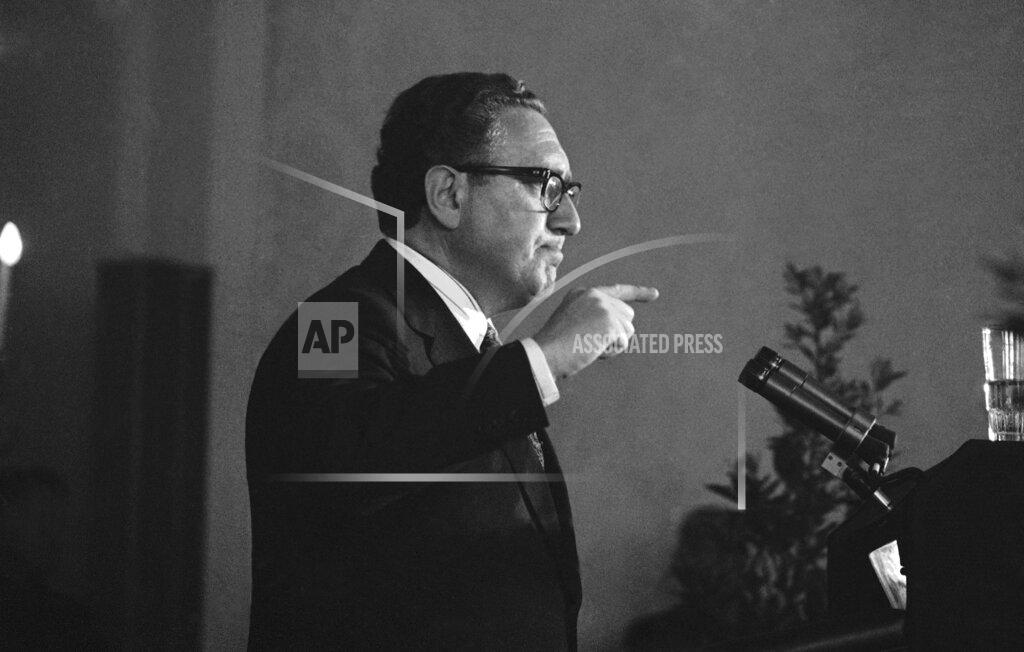
Secretary of State Kissinger, traveling to the Middle East with President Nixon, declared in an emotional statement at a news conference in Salzburg that he would resign unless he was cleared of allegations that he participated in “illegal or shady activity” in government wiretapping of individuals. Mr. Kissinger’s statement appeared to threaten what is widely believed to be one of the purposes of the President’s journey — to divert public attention from the administration’s scandals.
A summary of an inquiry made last year by the Federal Bureau of Investigation concluded that some of the “original requests” for wiretaps on 17 government officials and newsmen came from Mr. Kissinger or General Alexander Haig, who, at the time the taps were first ordered in 1969, was Mr. Kissinger’s deputy.
A number of Democrats and Republicans on the Senate Foreign Relations Committee and elsewhere in Congress expressed support for Mr. Kissinger and urged him not to resign. The committee unanimously agreed to accept his request for a review of information about the wiretaps initially given to the committee at his confirmation hearings last September while he was Secretary of State-designate.
A separate, and delayed, trial for John Ehrlichman in the “plumbers” case was ordered by Federal District Judge Gerhard Gesell, who cited President Nixon’s refusal to provide White House documents. The judge’s order was regarded as a significant victory by Mr. Ehrlichman and his lawyers, but lawyers for the special Watergate prosecution were reportedly bitter and angry.
President Nixon’s lawyers said that he had asked the Supreme Court to decide the legal question of whether a grand jury had the right “under the Constitution,” to “charge an incumbent President as an unindicted co-conspirator in a criminal proceeding.” Mr. Nixon, the lawyers said, will argue that the evidence the Watergate grand jury acted on was “totally insufficient.”
The House voted, 211 to 204, to kill a highly controversial land-use bill that would have given federal aid to states seeking to control runaway real estate development. The bill’s opponents said that it would undermine states’ rights, threaten personal property rights and “bring big government into everyone’s backyard.” The bill’s supporters said it had been smeared by a “campaign of distortion.”
The House passed and sent to the Senate compromise legislation that would slow clean-air efforts in an attempt to conserve scarce fuels. The bill would authorize temporary suspensions in emission requirements in order to allow power plants to switch from low-sulfur oil and natural gas to more abundant supplies of dirtier-burning coal. Such plants would have until 1979 to bring emissions back into compliance. The measure also would grant car makers a one or two-year delay in meeting auto exhaust deadlines. The compromise bill is expected to encounter little opposition in the Senate or the White House.
A lawyer who has called for President Nixon’s impeachment and the chairman of the Washington Metropolitan Council of Governments easily won Democratic congressional primaries in two of Virginia’s District of Columbia suburbs. Herbert Harris, a liberal Fairfax County supervisor, won in the 8th District and Joseph Fisher, an Arlington County supervisor, won in the 10th. All will face Republican opponents. In Maine, Mike Gartley, 29, a former Vietnam prisoner of war, and incumbent Peter N. Kyros won the Democratic Party congressional nominations. Republican candidates were unopposed. George Mitchell won the Democratic gubernatorial nomination. The close GOP race was still undecided.
Bill Clinton, a 27-year-old law professor at the University of Arkansas, won his first election, the Democratic Party runoff for the nomination for U.S. Representative of the Arkansas Third District, defeating state senator Gene Rainwater. in Clinton and Rainwater had been the top two finishers in a May 28 election. The future U.S. President would lose in November to the incumbent, Congressman John Paul Hammerschmidt.
Ted Bundy victim Georgann Hawkins disappears from the University of Washington, Seattle, Washington. Georgann, age 18, was an American college student from Tacoma, Washington, who disappeared from an alley behind her sorority house at the University of Washington in Seattle. Serial killer Ted Bundy confessed to Hawkins’s abduction and murder shortly before his 1989 execution. Bundy claimed that partial skeletal remains belonging to Hawkins were recovered from one of his many crime scenes on September 6, 1974. According to Bundy, the sections of Hawkins’s body he had not buried were recovered in Issaquah alongside the bodies of two other victims he had murdered on July 14. Bundy’s statement regarding the identity of the partial skeletal remains being those of Georgann Hawkins has never been confirmed. Although Hawkins is presumed dead, she is still officially listed as a missing person and no public records indicate that she has been declared legally dead in absentia.
In an effort to avoid the electric chair, Ted Bundy confessed in 1989 to the details of Hawkins abduction and murder to detective Robert Keppel. Bundy stated that he approached Hawkins in the alley limping along on crutches and dropping his briefcase as a ruse. He asked Hawkins for assistance with carrying his briefcase to his car, which was located in a parking lot that was 160 yards north of the alley. Thinking that Bundy was really injured, Hawkins agreed to help him. As she bent over to put Bundy’s briefcase into his car, he grabbed a crowbar that he had hidden beforehand, knocked Hawkins out with a single blow to the head, pushed her into his car, and sped off. Bundy claimed that while driving, Hawkins regained consciousness and started to incoherently talk about her Spanish test, believing he had taken her to tutor her for her exam. In response, he again knocked Hawkins unconscious with his crowbar. Once at the secluded location, allegedly located near Lake Sammamish, Bundy took an unconscious Hawkins out of his car and strangled her to death with an old piece of rope.
William Cann, Chief of Police for Union City, California, was fatally wounded by a sniper while speaking at a community meeting. He never regained consciousness after being struck in the neck by two .30 caliber bullets and died on August 29.
About 110,000 garment workers will go back to work across the nation today after ratification of a contract ending an 11-day strike against manufacturers of men’s and boys’ clothing. An official of the International Amalgamated Clothing Workers Union claimed 95% approval. The pact provides for a wage increase of $1 an hour over the next three years, plus cost of living provisions. Workers currently make an average of $3.50 an hour.
The Environmental Protection Agency disclosed that vinyl chloride gas, a chemical suspected of causing cancer, was detected in the air of neighborhoods surrounding seven plants that manufacture it. EPA Administrator Russell E. Train met in Washington with executives of the 29 makers of vinyl chloride and polyvinyl chloride resin and urged them to reduce emissions as much as possible. Train said there was no evidence that the gas posed an imminent hazard but, he said, prudence dictates that steps should be taken promptly to reduce the emissions.
A coroner’s jury in Daytona Beach, Florida, has cleared two Indiana University coeds who accidentally strangled an ex-convict with a scarf after he raped them in a wooded area. The jury ruled that the women, who may not be identified under Florida law, were justified in killing Lee Arthur Godwin, 26, of Vero Beach. The girls said Godwin had threatened to kill them with an ice pick. When he attacked, one of them wrapped a bandanna around his neck and both of them tightened it until Godwin lost consciousness. Then they ran to a farmhouse for help, not realizing that their assailant was dead.
New York’s Mel Stottlemyre makes his 272nd consecutive start, with no relief appearances, to set an American League record but he loses to California, 5–4. In the 4th inning, Stottlemyre feels a pop in his right shoulder after throwing a curve ball to Frank Robinson. It is a tear in his rotator cuff: he’ll throw just 2 more innings, his career over at 32. Dick Lange is the winning pitcher. Bill Sudakis accounts for the Yankee runs with a grand slam.
At Houston, Cesar Cedeno hits a grand slam as the Astros score 10 runs in the 7th to beat the Phillies, 10–1.
At Parc Jarry, the Expos score 7 in the 7th, then score 8 in the 8th to swamp the Reds, 16–6. Willie Davis has a grand slam in the 7th and a 3-run homer in the 8th.
Dow Jones Industrial Average: 852.08 (-7.59, -0.88%).
Born:
Emilee Klein, American golfer (3 x LPGA Tour titles; Solheim Cup 2002) and coach (University of Central Florida, San Diego State University, University of Tulsa), in Santa Monica, California.
Died:
Eurico Gaspar Dutra, 91, President of Brazil from 1946 to 1951
Julius Evola, 76, Italian philosopher.
Percy Correll, 82, British Antarctic explorer on Douglas Mawson’s expedition from 1911 to 1914



 History Diaries