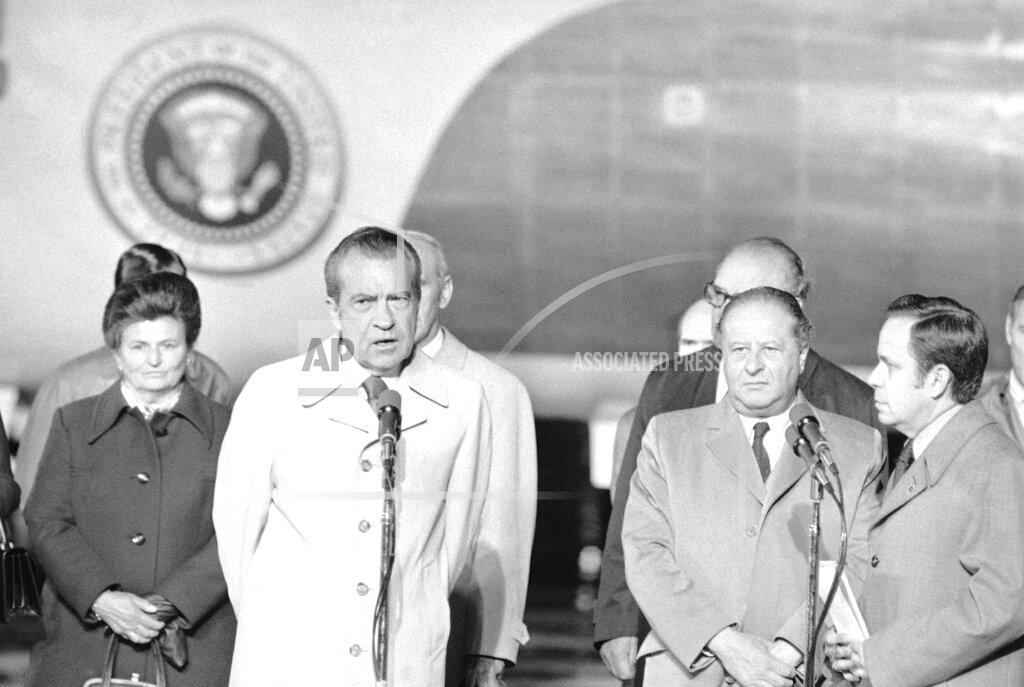
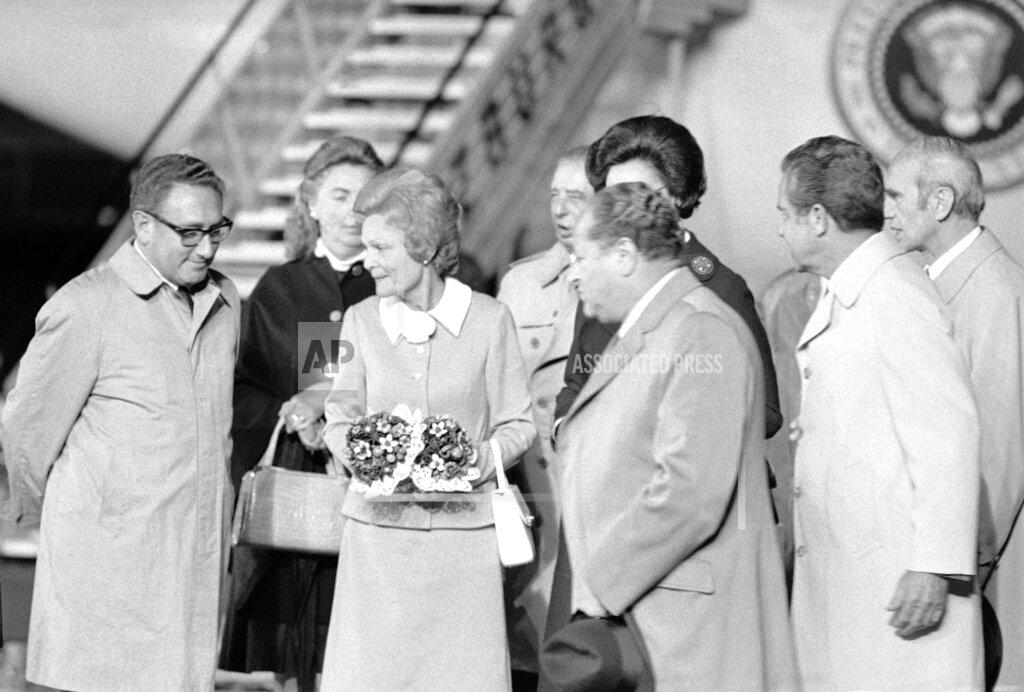
President Nixon arrived in Salzburg, Austria, tonight on his way to the Middle East, declaring that he is on a mission for peace not only for those nations directly involved but for the entire world. U.S. President Richard Nixon began a five-nation tour of Austria and the Middle East, as the presidential airplane, Air Force One, landed in Salzburg, along with his wife, Pat Nixon, and U.S. Secretary of State Henry Kissinger. Nixon was greeted on landing by Austria’s Chancellor Bruno Kreisky and Foreign Minister Rudolf Kirchschlaeger, and then traveled by motorcade to his lodgings at the Schloss Klessheim palace.
The President, accompanied by Mrs. Nixon, Secretary of State, Kissinger and aides, was smiling as he stepped into the rain from his plane to be welcomed by Chancellor Bruno Kreisky and the Foreign Minister, Rudolf Kirchschläger. He wore a tan raincoat but no hat. Mrs. Nixon emerged from the plane in a blue suit and white shoes, but no coat. In the rain, the American party then moved to a set of microphones on the landing strip of the Salzburg Airport. After welcoming remarks by Dr. Kreisky, Mr. Nixon spoke briefly of his purpose in making the trip: “Every nation in the world has a stake in maintaining peace in the Middle East and we trust that this journey, as that of two years ago, will contribute to peace not only in that area but throughout the world.”
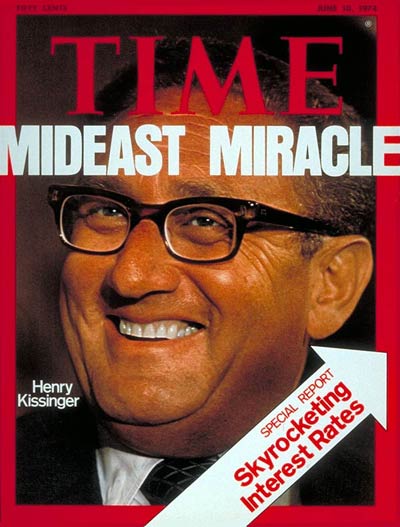
The official purpose of the trip to Egypt, Saudi Arabia, Syria, Israel and Jordan is, as the President said in Washington, to build on the negotiations conducted by Mr. Kissinger and “explore ways in which those nations in the area may have better relations.” While American officials have acknowledged the diplomatic and physical dangers involved in the journey, the President and his party seemed elated to be back at foreign diplomacy and away from Washington, where impeachment proceedings are under way in the House of Representatives.
Foreign Minister. Andrei A. Gromyko, charging that Israel had not yet proven her peaceful intentions in the Middle East, warned today against accepting “half-measures” of disengagement “favored by Israel and her backers.” His comments, in an election speech in the Byelorussian capital of Minsk, were the most wary from a Soviet leader since the signing of the Syrian‐Israeli disengagement agreement. In keeping with Soviet statements lately, Mr. Gromyko, who is a member of the ruling Politburo, said disengagement must be seen as a first step toward a final settlement insuring full Israeli withdrawal from all Arab lands occupied in 1967. Although he did not mention President Nixon’s trip to the Arab world, Mr. Gromyko seemed to be trying indirectly to undercut the triumphant mood of American diplomacy after Secretary of State Kissinger’s mission.
The U.S. Senate, putting Congress squarely on record in favor of one of the most basic and controversial changes in strategic defense doctrine in the last 20 years, endorsed the government’s potentially far-reaching decision to develop more powerful and accurate intercontinental missiles capable of attacking Soviet missiles in their underground silos.
The Senate refused to block a $77 million research program to increase the accuracy and nuclear power of U.S. strategic missiles. In a major victory for the Pentagon, it rejected by a vote of 48 to 37 an amendment to the military procurement bill by Senators Thomas J. McIntyre (D-New Hampshire) and Edward W. Brooke (R-Massachusetts), who argued that the program might provoke the Russians to escalate the arms race. The research program is aimed at enabling U.S. missiles to hit hardened Soviet missile sites. The vote was taken after an unusual secret session.
Vice President Ford said he is in favor of a mutual reduction of military forces but warned that a cutback in U.S. strength alone would undermine disarmament talks with Russia. Speaking at a dinner gathering of the United Nations Association of the United States in New York, Ford praised the Senate for defeating proposals to reduce American ground troops and airmen overseas. “For the United States to withdraw into a shell of isolationism… would be tragic for America and would dash every hope for peace in the world,” he said.
The Soviet ambassador to East Germany, Michail T. Yefremov, warned the West against “misusing” the routes to Berlin to smuggle refugees out of Communist East Germany. Yefremov, saying Russia seeks no confrontation in Berlin, gave the warning in an interview in Neues Deutschland, the East German Communist Party newspaper. It was timed to the second anniversary of the signing of the Big 4 agreement designed to lessen Berlin tension.
Final official returns in the West German elections in Lower Saxony gave the Christian Democrats 77 seats to the Social Democrats’ 67. But the Socialists retained control of the government because their coalition partners, the Free Democrats, won 11 seats, for a total of one more than their opponents.
In Bonn, Common Market foreign ministers decided to propose, despite American objections, a broad program of economic, technical and cultural cooperation with 20 Arab countries. The nine Common Market foreign ministers decided today, despite American objections, to make an offer of broad economic, technical and cultural cooperation to 20 Arab countries. The ministers also reached a “gentleman’s agreement” on consultations between Europe and the United States. One diplomat said that this would be tested tomorrow when the West German Foreign Minister briefs Mr. Kissinger on the move concerning the Arabs. The European plan was agreed upon March 4 at a similar meeting of foreign ministers in Brussels, but was held up after it was denounced by Secretary of State Kissinger, who was coming back from a negotiating mission in the Middle East at the time. He said that the United States had not been properly consulted.
Premier Mariano Rumor of Italy and his cabinet resigned because they could not agree on what measures to take to cope with a threat of national insolvency. Leading bankers at a meeting in Basel, Switzerland, said that they were prepared to arrange for extensive credits for Italy only shortly before the resignation of the government was announced.
The Soviet Union apparently has given Syria its first squadron of advanced MIG-23 jet fighters, according to U.S. intelligence reports. Sources in Washington said 16 crated MIG-23 “Floggers” were sent to Syria recently aboard Russian merchant ships. The swing-wing jet, whose top speed is nearly 2,000 m.p.h., is rated significantly better than the older MIG-21, which until now has been the best Russian fighter exported.
The Arabian American Oil Company, a partnership of American oil companies, and the Saudi Arabian government, announced an agreement under which the Saudis will assume majority ownership with 60 percent of the company’s concession rights and assets, retroactive to the start of the year. There had been indications recently that the Saudi Arabian government had been dissatisfied with only a 25 percent interest in the company.
Sudan prosecutors wound up their case at the trial of eight Black September guerrillas charged with the murder of U.S. Ambassador Cleo A. Noel, his deputy, George C. Moore, and Belgian Attache Guy Eid during a 60-hour siege of the Saudi Arabian Embassy in Khartoum in March, 1973. A spokesman said the court would announce Saturday when it intended to pass judgment on the eight Palestinians who have pleaded innocent to all charges.
The United Nations Security Council approved its Resolution 351, recommending that the UN General Assembly admit Bangladesh as a member. Previous Security Council resolutions in 1972 and 1973 had been vetoed by the People’s Republic of China in support of Pakistan, which had made peace with Bangladesh by 1974. Bangladesh was added to the General Assembly on September 17.
Tropical storm Dinah, packing winds of 60 m.p.h., swirled across tobacco farmlands in the northern Philippines, causing destruction and major flooding. There were no immediate reports of deaths or injuries. Dinah, the first storm to hit the Philippines this year, spared the populous metropolitan Manila area but interrupted rail and land traffic in southern Luzon.
Apparently moving toward a constitutional confrontation with Congress, President Nixon said in a letter to the chairman of the House Judiciary Committee that he must “draw a line” and refuse to provide the committee with additional Watergate evidence. The letter drew quick criticism from committee members and other members of Congress. The probability that the committee will vote to present a bill of impeachment to the House appears greater.
In another letter relating to Watergate, made public shortly after Mr. Nixon departed for the Middle East, the President’s lawyer, James St. Clair, told federal Judge Gerhard Gesell that only the President had the right to determine which White House documents could be made available in the defense of John Ehrlichman in the “plumbers” case. However, the letter did offer some compromises in an apparent attempt to end an impasse.
The Supreme Court ruled that cities may levy a high tax on private downtown parking lots and garages in an effort to reduce traffic congestion and divert commuters to public transportation. The decision specifically involved Pittsburgh, but it was expected to encourage other large cities to discourage automobile traffic in crowded areas by raising parking fees through the imposition of higher taxes on gross receipts of parking garage and lot fees.
The food industry dominates and partly finances the process by which government nutrition standards are set, Sen. William Proxmire (D-Wisconsin) said. The accusation was promptly denied by the National Academy of Sciences, whose Food and Nutrition Board was Proxmire’s main target. In a Senate speech, Proxmire said the board’s “recommended daily allowance” for vitamins and minerals was a “capricious, unscientific and illogical standard.” Dr. Philip Handler, NAS president, said Proxmire’s allegations were “extraordinarily irresponsible.”
The Agriculture Department said today that a low‐cost menu for a four‐member family, including two school children, cost $43.40 a week in April, down 0.7 per cent from $43.70 in March. But it was up 18 per cent, or $6.70 a week, from the figure for April, 1973. Officials said it was the first decline in the family food indicator since last October. More affluent families, as the monthly series has shown in the past, enjoyed a slightly better break relatively with their food budgets.
Dennis Banks announced his resignation as executive director of the American Indian Movement before a general session of the International Treaty Convention in Mobridge, South Dakota. Banks, 42, is on trial in St. Paul, Minnesota, with fellow AIM member Russell Means in connection with last year’s 71-day takeover of Wounded Knee, South Dakota. He said the trial had limited the time he has to devote to AIM business and also that he wanted to work with experimental and educational projects for Indians. The convention was called to discuss the more than 300 treaties Indians have signed with the U.S. government.
All five patients, one a convicted murderer, were back in custody after escaping from the Chattahoochee, Florida, state Mental Hospital Sunday with two hostages. One of the escapees, Jack Shaw, was shot in the buttocks by searchers after he threatened to shoot himself rather than be recaptured, said a hospital spokesman. Both hostages, an attendant and a security guard, were released unharmed. One of the five, Bernard Baker, had been transferred to the institution from Death Row at the state penitentiary. The others were committed after being found innocent of criminal charges by reason of insanity.
The police kept a woman under observation for her safety tonight after she had been named by the remnants of the self‐styled Symbionese Liberation Army as a collaborator who gave away the location of the hideout where six members of the terrorist group died. The woman, Mrs. Mary Carr, mother of the woman who rented a house to Donald D. DeFreeze and other members of the terrorist group, denied that she had informed the authorities.
In a related development today, radio station KHJ received a hand‐printed letter saying that “Tania is dead.” Tania is the name adopted by Patricia Hearst, who was kidnapped by the S.L.A. last February and later said she had joined the terrorist group. A Federal Bureau of Investigation spokesman in Washington said tonight of the letter, “We have no reason at this time to believe it is authentic.” The letter gave no details on where or how “Tania” was said to have died, but it said “documentation and photography” would be sent separately. No other material has been received at KHJ.
With the afternoon temperature at 95 degrees, today was the hottest day of the year in New York City and the city’s hottest June 10 since weather records were first kept. The heat buckled roadways and strained the city’s reserves of electrical power and good humor. Consolidated Edison cut voltage by 5 percent, and its No. 2 nuclear power plant at Indian Point failed, depriving the city and Westchester County of slightly more than 10 percent of their share of power. East Coast temperatures soared into the 90s, resulting in 5% cutbacks in electric power voltage from New York to Virginia. The New Jersey-Pennsylvania-Maryland power grid cut its power 5% to its 21 million customers and Consolidated Edison, which serves New York City and Westchester County, cut its power by 5% as the temperature rose to 94 and humidity remained high. The demand for power climbs during hot weather as people use more air conditioning and fans and stay inside and watch television. At these times, the companies cut voltage to avoid a blowout in the generating system.
The National Labor Relations Board said it would consider charges of discrimination as grounds for denying certification to unions in collective bargaining elections. The decision came in a case involving Bekins Moving & Storage Co. of Florida and Teamsters Local 390 of Miami. The company claimed that the union should have been disqualified on the ground that the local “engaged in invidious discrimination on the basis of sex and also against Spanish-speaking and Spanish-surnamed individuals.” Without ruling on the Bekins complaint, the five-member board established the new precertification objections procedure in a majority opinion.
“Feel Like Makin’ Love” single released by Roberta Flack (Billboard Song of the Year 1974).
Billy Martin returned to Detroit for the first time since he was fired as the Tigers’ manager last August 3. Now managing Texas, he was cheered as he took the line‐up card to the plate. Then he went back to the dugout and laughed all the way as the Rangers pounded Detroit pitching for 17 hits, on the way to a 6–3 victory. Jim Spencer and Duke Sims batted in two runs apiece.
During a 12–0 win over the Astros, Phillies’ third baseman Mike Schmidt hits a ball off the public address speaker hanging from the Astrodome roof, 117 feet up and 300 feet from the plate. Schmidt must settle for a titanic single. Jim Lonborg is the winner.
Montreal’s pitcher, Steve Renko, tripled home one run and scored another in a 3–1 win over the Cincinnati Reds called after eight innings because of rain. Ken Singleton of the Expos made a game-saving catch in the top of the eighth, leaping above the right‐field fence to rob Joe Morgan of a home run with a man on base.
Dow Jones Industrial Average: 859.67 (+5.95, +0.70%).
Born:
Dustin Lance Black, American filmmaker (“Milk”) and LGBT activist, in Sacramento County, California.
Died:
Prince Henry, Duke of Gloucester, 74, Governor-General of Australia from 1945 to 1947, and, as the son of King George V of the United Kingdom, the only member of the British royal family to hold the post.



 History Diaries