In reply to a formal question submitted by President Johnson ‘Would the rest of Southeast Asia necessarily fall if Laos and South Vietnam came under North Vietnamese control?’ the CIA submits a memo that effectively challenges the ‘domino theory’ that lies behind the Johnson administration’s policies. The CIA concludes that Cambodia is probably the only nation in the area that would immediately fall: ‘Furthermore, a continuation of the spread of Communism in the area would not be inexorable, and any spread which did occur would take time — time in which the total situation might change in any number of ways unfavorable to the Communist cause.’ Although the CIA analysis did not deny that the loss of South Vietnam and Laos ‘would be profoundly damaging to the U.S. position in the Far East,’ it concluded that the United States, with its Pacific bases and its allies such as the Philippines and Japan, would have enough power to deter China and North Vietnam from any further aggression or expansion. Having solicited this analysis, President Johnson appears to ignore it.
Members of the Australian Army, serving as advisors, came under attack by guerrillas. Official sources disclosed today that Australian training teams in South Vietnam, had already exchanged fire with Communist guerrillas. The disclosure followed a report from Canberra yesterday that Defense Minister Shane Paltridge planned to send the Australian advisers into combat areas for the first time. There are about 30 Australians in South Vietnam now to train the Vietnamese. They bear arms, accompany trainees on anti-guerrilla patrols and have orders to fire when fired upon.
United States Navy jets have attacked a Communist gun position in north‐central Laos in retaliation for ground fire that downed two American jets over the weekend, reliable sources said today. The Peking radio, in a Chinese‐language broadcast, asserted that six American jet fighters had dropped 12 bombs and fired two rockets at Phongsavang, a town held by the Communist‐led Pathet Lao, and had flown over Khang Khay, the Pathet Lao headquarters. Both are on the eastern edge of the Plaine des Jarres. The broadcast also said that Pathet Lao batteries had hit and damaged two of the jets.
In Vientiane Premier Souvanna Phouma said United States “reconnaissance flights will end June 10, 1964,” according to Reuters. The Premier was also reported to have said that he had not agreed to United States fighter escorts for the unarmed reconnaissance planes. United States officials said the sending of escorts had had the approval of the Laotian Government.
The Washington sources said the attack, which was made at dawn, was a result of high‐level discussions in the Administration yesterday. The President and his principal advisers were reported to have decided to destroy one Communist gun emplacement to underline the United States’ determination to stand firm in Laos. The decision was also interpreted as an effort to recoup prestige in the wake of the downing of the jets. No details of the raid were disclosed. The State and Defense Departments clamped a tight of secrecy on the activities of the Navy reconnaissance and fighter planes operating over central Laos. Officials refused to comment on reports that an attack had been carried out. An unofficial source said, however, that the version of the attack given by Peking in a broadcast today was “probably substantially correct.”
Communist China warned today that the situation in Laos had become “most dangerous.” Peking also ruled out by implication a Polish proposal for a six‐nation preliminary consultation on the strife in the Southeast Asian kingdom. The proposal, made by Warsaw in diplomatic notes on May 27, had been accepted by the Soviet Union and approved in principle by Britain.
The two nations were co-chairmen of the 14-nation Geneva conference, which agreed in July, 1962, to create a neutral and unified Laos. The Polish proposal would have excluded both Communist China and the United States from the talks, which were to examine the possibilities of reconvening the Geneva conference. The Chinese Communist rejection also reflected the ideological divergencies between Moscow and Peking, which has advocated more militant tactics in Laos by the Communist‐led Pathet Lao.
At a banquet tonight in honor of the President of Yemen, Premier Chou En‐lai described the situation in Laos as “very grave indeed.” He asserted that Thailand had concentrated a great number of troops on the Laotian frontier and that United States planes had reconnoitered and bombed positions on the Plaine des Jarres. The Peking statement declared that the deteriorating situation in Laos could be dealt with only by plenary meeting of the 14 nations that signed the Geneva accords, and insisted that consultations by any part of the signatories was “impermissible.” Communist China was one of the 14 nations. Charging that United States policies were threatening to wreck the Geneva accords, Peking asserted that Laos had been pushed “to the brink of a total split and general civil war.”
The Cypriot Government decided today to ask for an urgent session of the United Nations Security Council to denounce what it called “Turkish threats of military intervention in Cyprus.” The decision was made at an extraordinary meeting of the Cabinet, presided over by Archbishop Makarios, the President of Cyprus. Foreign Minister Spyros Kyprianou was instructed to ask for the session “with a view to denouncing the Turkish Government’s threats of military intervention in Cyprus, as well as other Turkish activities contrary to the Security Council resolution on Cyprus, which have worsened the situation in the island.” The “other activities” were specified in a statement by the archbishop.
Turkey, he said, “has repeatedly violated the airspace of Cyprus and dropped arms for the Turkish Cypriot terrorists.” That nation, he went on, “is repeatedly violating the territorial waters of Cyprus by sending irregulars from Turkey for the purpose of supporting the Turkish Cypriote insurrection and achieving the partition of Cyprus by means of arms.” In a move apparently related to the intervention fear, Polycarpos Georghiades, Minister of the Interior, announced the first call‐up of Greek Cypriots under the new military conscription law. All men born in 1943 and living in the Limassol and Larnaca areas on the southern coast were ordered to report next Monday for six months of emergency service. The number affected was not disclosed.
A United Nations spokesman here said that “despite frequent reports and rumors, the United Nations has observed no instances of illegal airdrops of arms or the arrival of illegal arms by any other means.” He also said no landings of irregulars had been observed. However, it was said in informed quarters that the 7,000‐man United Nations force was not able to supervise thoroughly arms entries into the island without abandoning all its other peacekeeping tasks. In fact, it is well known that arms smuggling has been going on virtually from the start of the strife between the Greek and Turkish Cypriots last December. Fighting broke out after Archbishop Makarios had acted to amend the Constitution and deprive the Turkish Cypriot minority of its veto over legislation.
The 17-nation disarmament conference resumed today after a five‐week recess in an atmosphere of hope that limited agreements might be reached to lessen the danger of nuclear war. The relaxed atmosphere, in a forum where the United States and the Soviet Union used to attack each other regularly, was evident in the speeches of William C. Foster, chief of the United States delegation, and Valerian A. Zorin, a Soviet Deputy Foreign Minister. It used to be that when Mr. Zorin loomed on the disarmament scene, the West prepared itself for a storm of abuse. Today he was what one Western delegate described as “calculatingly moderate” and more eager, it seemed, to slap down Chinese Communist ideology about the inevitability of war than to claw at the United States.
Mr. Foster gave the conference a message from President Johnson describing the treaty on a partial nuclear test ban, the direct communications link between the White House and the Kremlin and other measures as small steps down the “long and difficult road” to disarmament. “We must not hesitate now that the journey has been begun,” the President said “We must redouble our efforts until it is completed.” He mentioned the two fields in which the United States hoped something could be achieved: a halt in the production of fissionable material for nuclear weapons and the “mutual destruction” of obsolete United States and Soviet bombers, the so‐called “bomber bonfire.” Mr. Foster indicated American awareness of Soviet sensitivity on the inspection needed to verify such collateral disarmament measures. The United States, he said, “has attempted to design its collateral measures to reduce the scope of inspection while providing the necessary assurance of compliance.”
Lal Bahadur Shastri was sworn in as Prime Minister of India, becoming “the second man to rule modern India” since its independence from the United Kingdom. He would serve for a year and a half before his sudden death on January 11, 1966, during a summit in the Soviet Union. In his inaugural broadcast to the nation, “There comes a time in the life of every nation when it stands at the crossroads of history and must choose which way to go. But for us there need be no difficulty or hesitation, no looking to right or left. Our way was straight and clear — the building up of a socialist democracy at home with freedom and prosperity for all, and the maintenance of world peace and friendship with all nations.”
President Tito returned today from a four‐hour meeting with Premier Khrushchev in Leningrad, apparently still opposed to the Soviet leader’s plan for a world conference of Communist parties. President Tito asserted that he and Premier Khrushchev had found an identity of views, but he avoided mentioning the question of a conference.
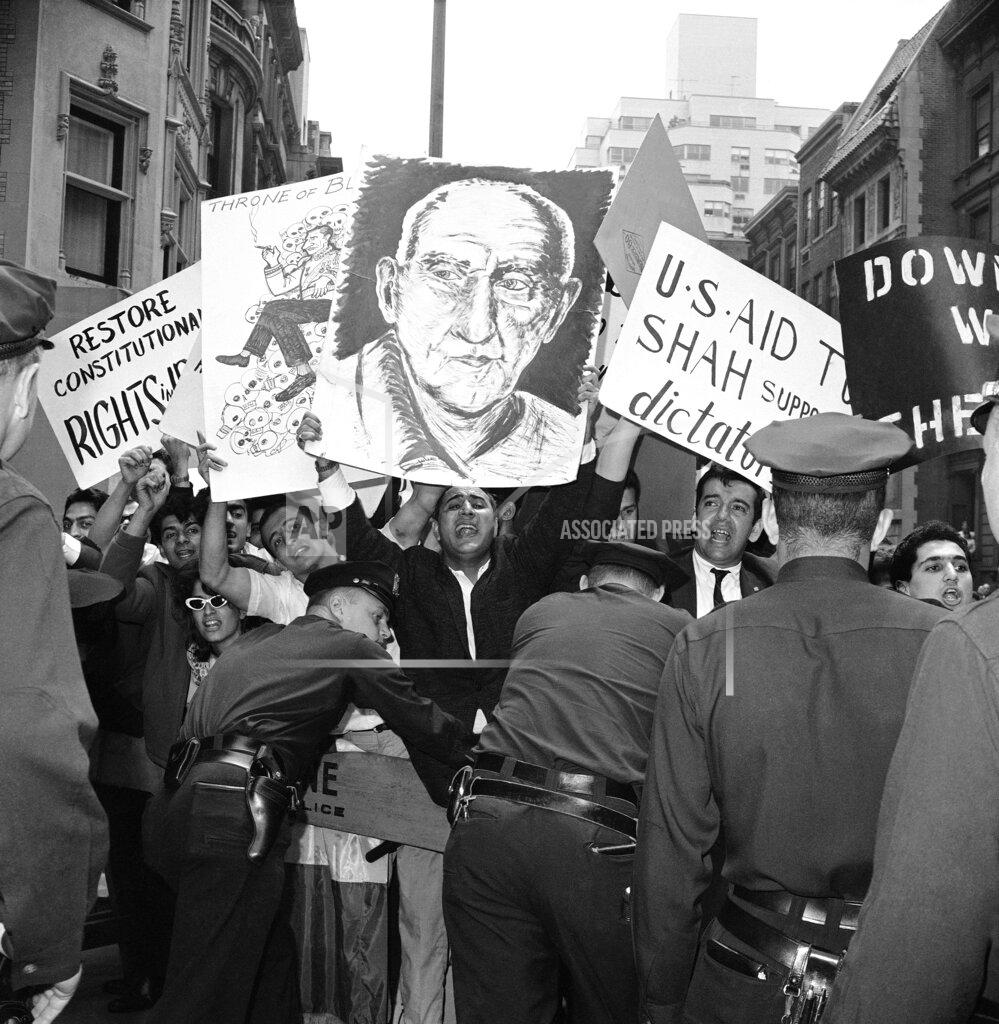
Mohammed Reza Pahlavi, the Shah of Iran, announced yesterday that Iran was prepared to designate a contingent for use in a United Nations peacekeeping force “in any part of the world.” He endorsed offers by the Scandinavian countries and Canada to provide specially trained contingents for such use and said that the Secretary General, U Thant, could count on Iran’s “full cooperation.”
In a warm‐up for the cloture (closure) vote tomorrow, the U.S. Senate decisively defeated today efforts by conservative Republicans and Southern Democrats first to kill and then to cripple the fair employment practices section of the civil rights bill. By a vote of 64 to 33, the Senate rejected a proposal by Sam J. Ervin Jr., Democrat of North Carolina, to strike from the bill the title banning discrimination by employers and unions. Today was the 74th legislative day that the bill has been on the Senate floor. Forty‐four Democrats and 20 Republicans voted against the proposal; 21 Democrats and 12 Republicans supported it.
The Senate then turned back, 63 to 34, an amendment by Norris Cotton, Republican of New Hampshire, to make the employment section applicable only to companies with 100 or more employees. The bill, as it now stands, would instead progressively extend the coverage over five years to all companies with 25 and more employes. Forty‐one Democrats and 22 Republicans lined up against this amendment, which would have exempted all but 2 percent of the nation’s companies from the bill’s coverage. Twenty‐three Democrats and 11 Republicans voted for it.
Before winning victories on these two amendments, the leaders were narrowly defeated on an amendment proposed by Thruston B. Morton, Republican of Kentucky. This would guarantee a jury trial in all cases of criminal contempt arising from the bill’s antidiscrimination bans in public accommodations, publicly owned facilities, schools, federally assisted programs and employment. The Morton amendment, however, would leave unaltered the provision in the Voting Rights Act of 1957. This makes a jury trial in a criminal contempt case discretionary with the judge but gives the defendant the right to a retrial with jury if he receives a sentence of more than 45 days or a fine of more than $300.
All in all, Mike Mansfield, the Democratic leader, and Everett McKinley Dirksen, the Republican leader, thought their three victories augured well for their attempt tomorrow to shut off the Southern filibuster. It was understood that Senator Richard B. Russell of Georgia, leader of the Southerners, thought he could muster no more than 30 votes against closure. This appeared to concede the Southern defeat.
“Bloody Tuesday” in Tuscaloosa, when a group of peaceful black marchers, were beaten, arrested and tear gassed by law enforcement officers. The marchers were walking from the First African Baptist Church to the Tuscaloosa County Courthouse to protest against whites-only drinking fountains. The police fired volleys of tear gas shells and bursts from high pressure water hoses into a church today where about 500 Black demonstrators had taken refuge. The Blacks hurled rocks, bottles and furniture at officers. Thirty‐three persons, including one white policeman, were injured during the outburst, which came when officers turned back an attempt to march into the downtown area of this university town, about 50 miles southwest of Birmingham. None of the injured was seriously hurt.
The police jailed 94 of the demonstrators, including the Rev. T. Y. Rogers, who led the march. Mr. Rogers’s wife said the marchers had proceeded only 100 yards from the First African Baptist Church when the police halted them. Authorities said they reminded Mr. Rogers of a ban concerning such demonstrations. When he failed to heed the reminder, they said, they ushered him into a patrol car and started pushing back the rest of the crowd.
The Blacks retreated slowly, hurling taunts at officers, and finally took refuge in the church, a red brick building about three blocks from the business district. Mrs. Rogers said the police surrounded the building and when the demonstrators attempted to get out “they filled the church full of tear gas.” “All bedlam broke loose. You can imagine what would happen if you explode tear gas in the midst of approximately 800 persons,” Mrs. Rogers said.
A band of angry whites broke through police lines tonight and attacked nearly 300 racial demonstrators marching on downtown St. Augustine, Florida in the start of a massive integration drive. An undetermined number of the integrationists, including several whites, were beaten. The march came only hours after a federal judge had issued a ruling in Jacksonville enjoining St. Augustine officials from enforcing their ban on night racial demonstrations.
After the ruling was handed down, the Rev. Dr. Martin Luther King Jr., the integration leader, immediately announced he would return to the city tomorrow to lead a new desegregation drive. But local integrationists did not wait for him. The marchers, most of them Blacks, walked silently toward the Slave Market in this old city and had gone about five blocks when television cameramen flooded the scene with lights. About 15 enraged whites stormed through a line set up by a dozen helmeted policemen with four leashed dogs. They pounced on a cameraman and the demonstrators. The camera man had his movie camera slammed in his face.
Most of the Blacks turned and began trying to march quietly back to the church where they had assembled. The whites made hit‐and-run attacks oil the line of Blacks for several blocks, until the marchers re‐entered the Black section. One Black, his face smeared with blood, held a handkerchief, to his lips and mumbled, “I’ve got the faith to go back there again, and you should, too. One of the white demonstrators beaten was identified as the Rev. William England, chaplain of Boston University. The Rev. Andrew Young, who led the march, promised the Blacks when they returned to the church that they would march again tomorrow.
Candidates backed by a group opposing compulsory integration survived every race today in the nonpartisan primary election of the racially troubled town of Cambridge, Maryland. The first two in each contest‐qualified for the general election on July 14. About 50 percent of the 5,312 registered voters turned out for the balloting as National Guardsmen patrolled the streets on their year‐long peacekeeping mission. There was no disorder. In the primary for Mayor, Osvrey Pritchett, a plumbing and heating contractor, outdrew three other candidates. This gave the anti‐integration group, the Dorchester Business and Citizens Association, the leading contender in the general election. The association successfully campaigned against adoption of a public‐accommodation amendment to the town charter in a referendum last October 1. Mr. Pritchett received 1,380 votes. Next, with 1,170, was S. Charles Walls, a Baltimore manufacturer’s salesman regarded as a moderate on the racial issue.
Democratic Governors killed today a Republican attempt to put the National Governors’ Conference on record for passage of the civil rights bill. But shortly after the action, many of the 50 governors assembled here signed bipartisan statements of principle urging Congress to pass the civil rights measure. The governors spent only four minutes in rejecting, 18 to 25, a Republican move officially supporting the rights measure. Governor Marx O. Hatfield of Oregon, keynote speaker at the Republican National Convention next month, offered a motion signed by all Republican governors to suspend the rules to permit the adoption of the civil rights resolution. Democrats, outnumbering Republicans more than 2 to 1, rejected Mr. Hatfield’s motion. Three Democratic governors, William A, Egan of Alaska, Richard J. Hughes of New Jersey and Jack M. Campbell of New Mexico, jumped party lines to vote with the Republicans to take up the question.
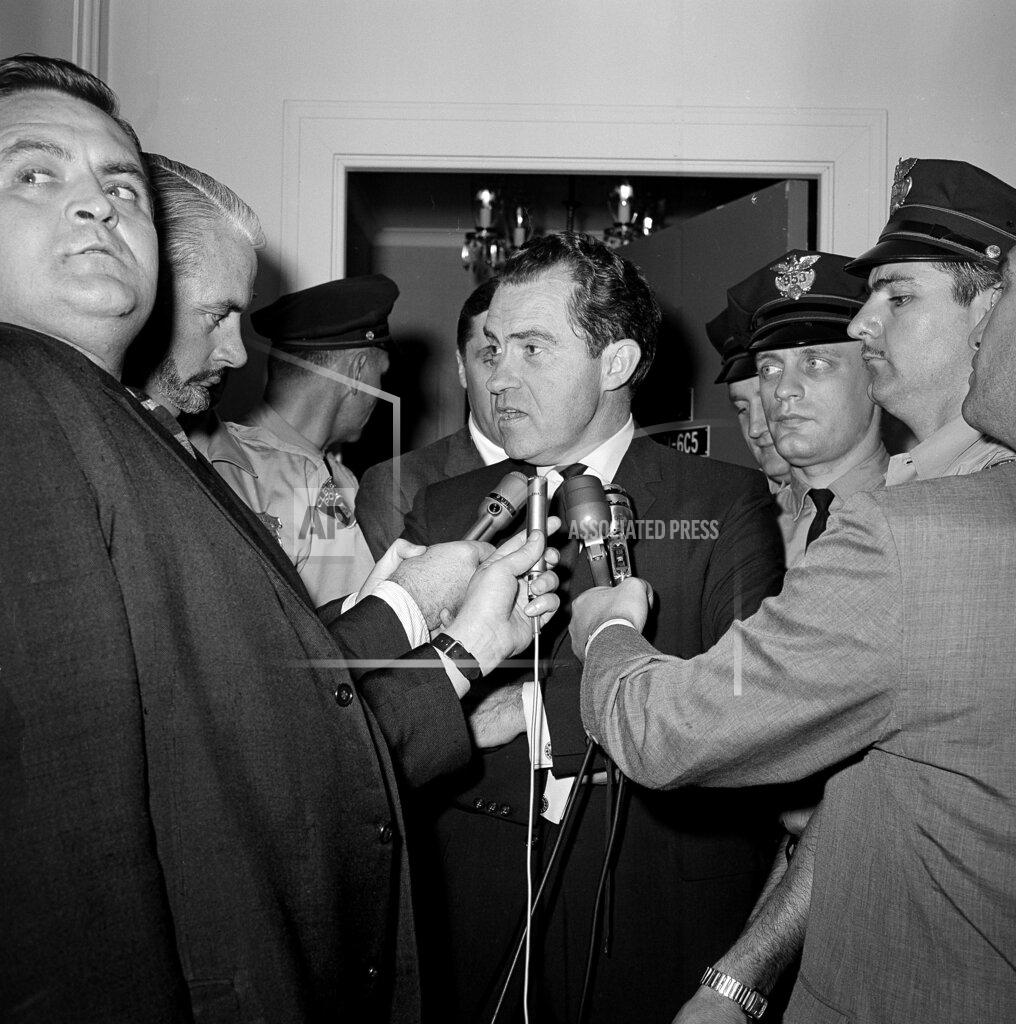
The hopes of Republican moderates to nominate a Presidential candidate other than Senator Barry Goldwater flickered faintly today at the National Governors’ Conference. This time the focus was on Governor George Romney of Michigan, who contends that the Arizona Senator’s nomination would be “suicidal” for the Republican party. This morning Governor Romney was urged by former Vice President Richard M. Nixon and at least two fellow governors to become a candidate and lead the disorganized and confused moderate forces. The Michigan Governor pondered the suggestion and discussed it with one of the nation’s most astute party organization figures. Then, late this afternoon, he reiterated his oft‐repeated statement of non‐candidacy but pointedly did not rule out a draft.
A federal court jury in Kansas City, Kansas, found army deserter George John Gessner guilty of passing United States secrets to the Soviet Union and sentenced him to life imprisonment. Private Gessner had fled from Fort Bliss in Texas on December 6, 1960 and, two days later, went to the Soviet embassy in Mexico City. He would admit that a month later, in January 1961, he had sold operational and design details of the Mark 7 nuclear bomb, the 280 mm atomic cannon and the 8-inch atomic mortar, in return for a payment of $200. However, his conviction would be reversed on findings that his confession had been made under duress and, on March 8, 1966, the U.S. Department of Justice would drop the charges because “the government had no case against Gessner without a confession.”
The U.S. Air Force test launched today a Minuteman intercontinental ballistic missile aimed at a point more than 5,000 miles down the Pacific missile range. The missile was on course for its target, the Air Force said.
Lord Beaverbrook, press baron and champion of the British Empire, died today at his Cherkley Court estate in Surrey. He was 85 years old. His son, Max Aitken, who now becomes the second Baron Beaverbrook, said: “He died this afternoon and he died peacefully. There’s not much else I can say about it except it’s a hell of a loss to the British Empire and a hell of a loss to Britain. He was a great journalist.”
Jim King hit his fourth homer in two nights as the Washington Senators took both games of a double‐header from the Kansas City Athletics, 8–4 and 5–1, tonight.
The Detroit Tigers scored eight runs in the seventh inning and crushed the Minnesota Twins, 16–1, while Denny McLain, a rookie, scattered seven hits to gain the victory tonight. Don Demeter paced the Tigers’ attack with a pair of home runs and had five runs batted in. He and Al Kaline had three hits each.
Charley James cracked a run‐scoring single off Juan Marichal in the ninth inning tonight and gave the St. Louis Cardinals and Ray Sadecki a 1–0 victory over the San Francisco Giants.
Dow Jones Industrial Average: 805.54 (+5.23).
Born:
Wayman Tisdale, NBA power forward (Indiana Pacers, Sacramento Kings, Phoenix Suns), in Fort Worth, Texas (died of cancer, 2009).
Don McSween, NHL defenseman (Buffalo Sabres, Mighty Ducks of Anaheim), in Detroit, Michigan.
Elena Andrianovna Nikolaeva-Tereshkova, the first child to be born to two space travelers, in Moscow, Russian SFSR, Soviet Union. Her mother, Valentina Tereshkova, was in orbit space almost a year earlier on Vostok 6, and her father, Andriyan Nikolayev had been on Vostok 3 in August 1962.
Gloria Reuben, Canadian actress (Jeanie Boulet-“E.R.”), in Toronto, Ontario, Canada.
Hiroko Yakushimaru, Japanese actress (“Sailor Suit and Machine Gun”), and singer, in Shibuya, Tokyo, Japan
Died:
Lord Beaverbrook [[William Maxwell] Max Aitken], 85, Canadian-born newspaper publisher and politician.

 History Diaries