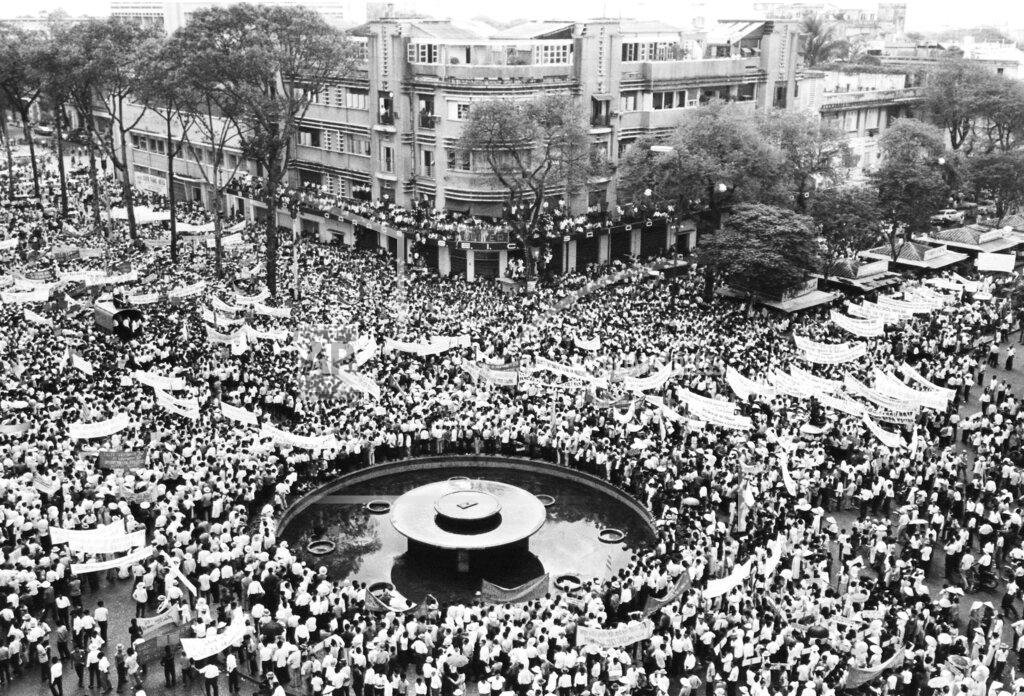
Some 35,000 Roman Catholic Vietnamese demonstrate in Saigon against what they allege is government favoritism toward Buddhists. Vietnamese of the Roman Catholic faith massed in a central square of Saigon today to demonstrate their resentment and solidarity in the face of what they believe to be favoritism toward Buddhists by the Government of Premier Nguyễn Khánh.
A splinter group of demonstrators, disowned by the organizers of the rally, waved banners denouncing United States Ambassador Henry Cabot Lodge for alleged interference in South Vietnam’s internal affairs. When one sign saying “Go Home, Cab. Lodge” appeared at the edge of the crowd, the chairman of the meeting asked that the banner be removed. A small scuffle broke out and one of the men carrying the sign was beaten before he surrendered it. Many Catholics have accused Ambassador Lodge of having been partial toward Buddhists during last year’s revolt against the regime of President Ngô Đình Diệm. Leaflets passed out today said this attitude still persisted, long after Mr. Diệm’s downfall and death last November. The late President was Catholic.
Demonstrations were planned for successive Sundays last month but were postponed on the orders of the Most Rev. Nguyễn Văn Bình, Archbishop of Saigon, who was reported to have feared violent clashes with Buddhists, then celebrating the anniversary of Buddha’s birth. Today’s meeting went off smoothly in the park in front of the Saigon Town Hall after a parade through the streets. The speakers were laymen and few priests in robes were evident. In recent weeks charges of oppression of Catholics by Buddhist officials; particularly in South Vietnam’s central provinces, have been increasing. The declaration did not specifically denounce Buddhist leaders but said “an extremist minority has brought about oppressions of our Catholics in an unjust and ruthless way.” The statement said that some Catholics had been victimized while engaged in the fight against Communism and that Premier Khánh’s Government had failed to intervene.
U.S. officials report that the Việt Cộng are blockading a 600-square-mile area south of Cà Mau to starve the residents and deprive South Vietnam of charcoal supplies. Hardest hit are the 4,000 persons living in Năm Căn, capital of Năm Căn Province, and the nearby village of Xóm mới. They face desperate shortages of food and water, the Americans reported. Năm Căn Province produces almost all of the charcoal for the cook stoves of South Vietnam. American sources in this provincial capital 150 miles southwest of Saigon said the guerrillas began to seal off the area more than two months ago, halting all food and water supplies for its 20,000 inhabitants. The district produces virtually no foodstuffs and drinking water must be brought in aboard river barges.
President Chung Hee Park’s Government pushed ahead today with measures intended to alleviate the Widespread popular discontent that produced bloody student rioting last Week. President Park continued his series of urgent meetings with top advisers. He conferred today with his cabinet, General Min Ki Shik, who is administering martial law in Seoul, and Kim Hyung Min, chief of his central intelligence agency. The President ordered the martial law command to investigate charges of corruption particularly in connection with the so‐called three‐powder scandals and illegal land sales. The three powders are sugar, flour and cement. For months there have been charges that illegal profits were being made with government connivance in these industries. No court action has been taken.
Starting tonight the earlier curfew imposed last Wednesday was moved back to 11 PM. A midnight to 4 AM curfew has been in effect nationwide since the Korean war, but the starting hour was advanced to 9 PM during last week’s crisis. The curfew has severely affected eating and entertainment places, as well as shops. President Park ordered the maintenance of strict discipline by the three divisions of troops moved into Seoul to deal with the student riots. The order followed protests over the invasion of the offices of the opposition newspaper Chonga Ilbo by a group of paratroopers who assaulted members of the staff.
Seoul remained orderly and there were no reports of new violence in the provincial cities. A troop convoy moved through the center of the capital this afternoon, with soldiers crowded into trucks, and two men with fixed bayonets alert at the front of each. Large troop formations gathered last night after the curfew hour near the broad avenue leading to the capitol, apparently for drill and exercise. Many military vehicles sped through the streets. Troops are encamped in parks and historic palaces and on college campuses.
Rhee Hyo Sang, Speaker of the National Assembly and a leader of the ruling Democratic Republican party, saw ex‐President Posun Yun, Opposition leader, to discuss united action in the crisis. Mr. Yun said the Opposition could not cooperate unless martial law were lifted immediately and arrested per‐sons, particularly newsmen and educators, released. The executive committee of the ruling party decided to nominate Chung Ku Yung, former party president, as successor to Kim Chong Pil, who resigned Friday as its chairman. Mr. Kim, General Park’s right‐hand man, was forced out during the governmental crisis under pressure from rivals.
Turkish Premier İsmet İnönü said here today that he had not rejected an invitation from President Johnson to visit Washington to discuss the Cyprus question. He told newsmen that useful results could be obtained from such discussions, and Foreign Minister Feridun C. Erkin said round‐the-clock negotiations between United States and Turkish officials were taking place “to prepare the ground for talks.” “At present, we have said neither yes nor no. The ground must be prepared first,” Mr. Erkin said.
Mr. İnönü declined to reply to questions on Cyprus, saying: “If we keep our mouths closed for a few days and do not speak out of turn, the Cyprus question will become clearer by, itself.” Mr. Erkin said the United States and Turkey were discussing ways to prevent President Makarios from violating the Cyprus constitution. He said that while the Soviet Union was not selling arms to Cyprus, Czechoslovakia and the United Arab Republic were. “We are trying to prevent arms from entering Cyprus,” he said.
U Thant, Secretary General of the United Nations, praised Prime Minister Nehru’s “moral virtue and sharpness of intellect” at a memorial service for the Indian leader held in New York today. “Sri Nehru was not only a great man; he was a good man, beloved by people all over the world,” Mr. Thant said. The service at The Community Church of New York, 40 East 35th Street, was attended by 1,100 persons, more than half of whom were Indian. Mr. Thant called Mr. Nehru, who died May 27, “one of the most perceptive analysts of the trends of human history, one of the great torchbearers of new concepts and new philosophies.”
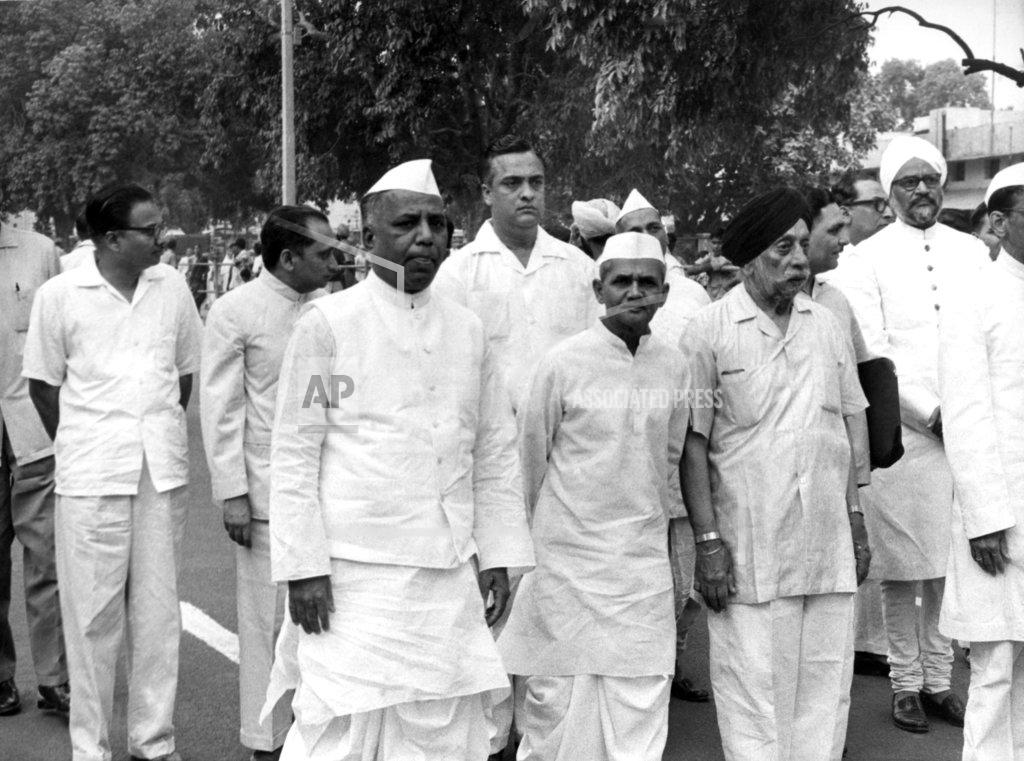
Mrs. Indira Gandhi, daughter of Prime Minister Nehru, will succeed him as India’s Foreign Minister, according to well‐informed sources. They predicted that her appointment would be made known Tuesday, when the Cabinet of Prime Minister‐designate Lal Bahadur Shastri is to be announced.
It was also predicted that Mrs. Gandhi would not be sworn in with the rest of the ministers Tuesday. She is expected to wait some weeks before assuming the post her father held as an adjunct of his office throughout his 17-year leader‐ship of the Government until his death May 27. Mrs. Gandhi is the widow of Feroze Gandhi, a lawyer and politician who was not related to Mohandas K. Gandhi. Mr. Shastri postponed his departure for Allahabad to continue the task of picking his Cabinet. He is scheduled to fly to Mr. Nehru’s birthplace at 3 AM tomorrow for the immersion of Mr. Nehru’s ashes at the confluence of the Ganges and Jumna Rivers.
Informed speculation on the new Cabinet indicated that it would include 18 or possibly 19 ministries, instead of the 14 in the Nehru Government. It was regarded as virtually certain that S. K. Patil, conservative former Minister of Food and Agriculture who was removed from the Cabinet by Mr. Nehru in a reshuffle last August, would return, possibly as Minister of Railways. Three major portfolios, Home Affairs, Finance and Defense, were expected to remain in the hands of the incumbents, Guizarilal Nanda, T. T. Krishnamachari and Y. B. Chavan, respectively. There was uncertainty about two other men, rivals of Mr. Shastri in the maneuvering last week for the Prime Ministership. They are Morarji R. Desai and Jagjivan Ram. They were also among the ministers squeezed out in the August reshuffle.
The showdown stage in the three‐month Senate battle over the civil rights bill will be reached this week. On Tuesday, the Senate will vote on three amendments favored by a group of conservative Republicans, and possibly on other amendments that would greatly limit the reach of the bill. On Wednesday, the Senate will vote on a motion to cut short the Southern filibuster. Senator Mike Mansfield of Montana, the Democratic leader, will file the closure petition tomorrow.
Therefore, the week may determine not only the scope of the bill but also whether there will be a bill at all. Before the bill can be voted on, Mr. Mans‑field and Everett McKinley Dirksen of Illinois, the Republican leader, must be able to terminate debate. This requires two‐thirds of the Senators present and voting — 67 if all 100 Senators are present. If the closure motion fails Wednesday, the leaders plan a second attempt within a few days. If that should fail, the bill would almost certainly be dead for this Congress.
Yesterday the Senate gave unanimous consent to a request of a group of conservative Republicans led by Bourke B. Hickenlooper of Iowa for a vote on three amendments before the vote on closure. The leaders acceded to this request in the hope of winning the needed votes for closure. Some of the Republicans had either stated, or broadly hinted, that they could not be counted on to vote for closure unless their amendments were voted on first. They did not say, however, that their votes for closure would be conditional on Senate acceptance of their proposed changes in the bill. Many in the Hickenlooper group are supporters of Senator Barry Goldwater for the Republican nomination for President. Mr. Goldwater has opposed closure and he has indicated he will oppose it on the civil rights bill.
Today, Senator Jacob K. Javits, Republican of New York, urged Mr. Goldwater to vote for, closure and thus “put himself in the mainstream of Republican thinking on civil rights.” However, bipartisan leaders of the bill do not expect to win over Mr. Goldwater to closure simply by permitting votes on the amendments favored by his followers. On the other hand, it is not expected that all in the Hickenlooper group will follow Mr. Goldwater’s example if he should oppose closure.
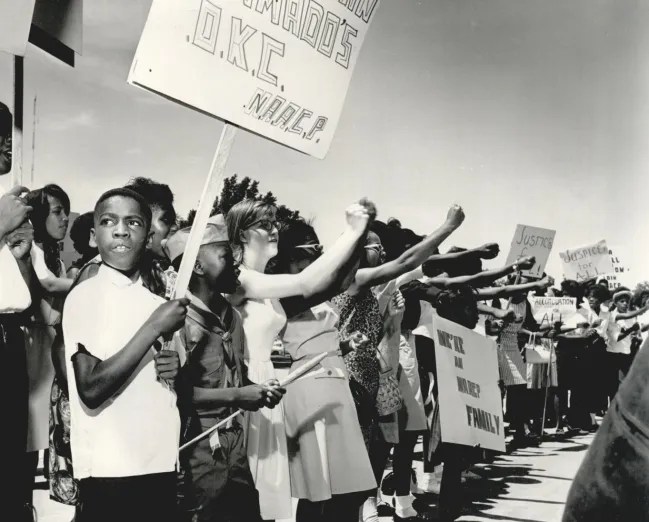
Senator Hubert H. Humphrey asserted today in the commencement address at the University of Massachusetts that the civil rights bill had not been watered down to obtain a vote on closure. The Minnesota Democrat expressed confidence that proposed amendments would be defeated and that closure immediately, and the bill in the near future, would be passed. “Only then will the real civil rights program get under way,” Mr. Humphrey said. “The bill provides the framework of the law. It is the signal to go ahead, but implementation will be up to community leaders. I urge them to settle down now to plan for the future of America, to put greater emphasis on education, to plan for true equal rights for all citizens.”
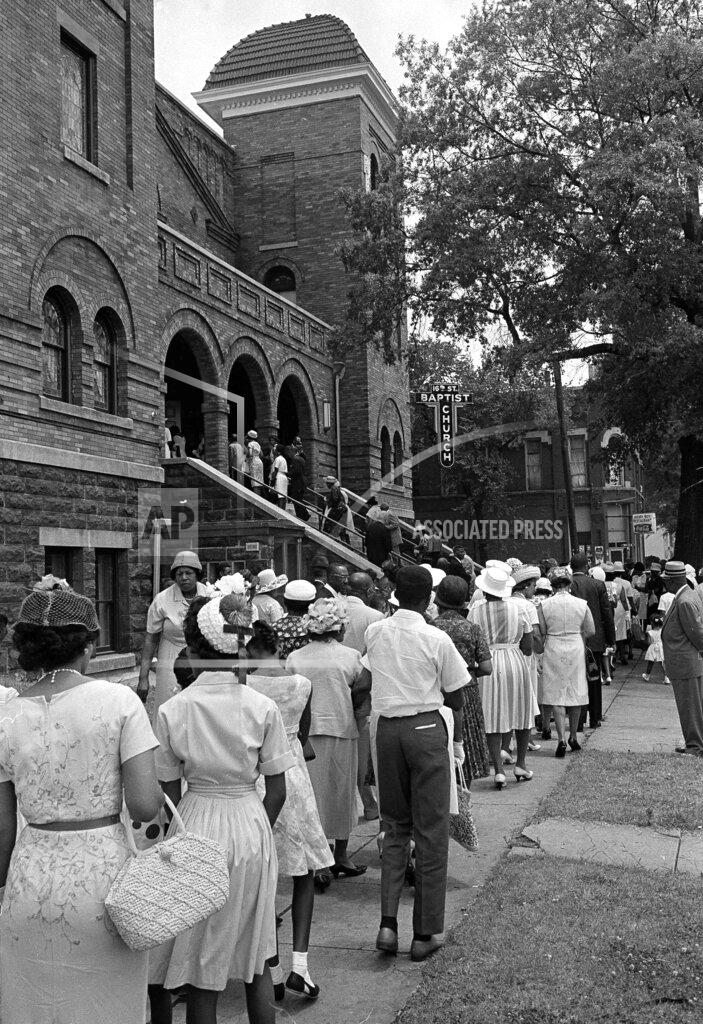
Teams of volunteer lawyers and law students completed two days of intensive instruction yesterday in the legal and practical aspects of attaining civil rights. The instruction was designed to prepare the students for a summer campaign in five Southern states to help local lawyers protect the rights of Blacks. About 150 lawyers and 100 law students from various parts of the United States will work in Mississippi, Alabama, Louisiana, Georgia and Florida. They will lay the foundations for appeals to the Supreme Court from rulings by state and local courts in derogation of Black voting rights and in support of other forms of racial discrimination. The first contingent of lawyers and students is scheduled to arrive in Jackson, Mississippi, on June 20.
The briefing sessions, held at the Columbia Law School yesterday and Saturday under the auspices of the Lawyers Constitutional Defense Committee, Inc., stressed to the lawyer volunteers that “you just can’t win civil rights cases in the local and state courts in, the South; your important job will be to help local counsel build a solid foundation for an eventual and successful appeal to the United States Supreme Court.” The two‐day briefing dealt in detail with the civil and criminal law and procedures applicable to civil rights activities in the areas where the teams of lawyers and students will operate.
Attorney General Robert F. Kennedy coined a label today or the current college generation: “The concerned generation.” Speaking at the Marquette University commencement, where he received an honorary degree, Mr. Kennedy observed that labeling college generations was always risky. “To call earlier college eras simply the Silly or Silent Generations was to exaggerate,” he said. “But I think it fair to describe yours as a generation of unusually genuine and intense concern with social justice and intellectual freedom.”
There was a slight note of admonition in Mr. Kennedy’s address. He noted that political and social “involvement” brought thousands of students into community problems, remedial reading projects and civil rights. He added: “Peace marchers or college civil rights demonstrators may not always express their concerns in the wisest or most effective manner, but it is clear that those concerns are deeply felt.” Mr. Kennedy said there was need to exhort today’s gradates to become concerned, but said the question was whether they would go on and participate whole‐heartedly in politics, government and community affairs. He strongly urged that they do so. He suggested that the axiom, “Youth will be served,” was being changed to “Youth will serve.”
Governor George C. Wallace of Alabama, a national crusader against civil rights, announced today that he would be a candidate for President this autumn in every state where his name could be legally placed on the ballot. He estimated that this might mean 30 states. The Governor, who amassed a large vote in the Democratic Presidential primaries in Wisconsin, Indiana and Maryland, said at the National Governors’ Conference that he would run as an “Alabama Democrat.”
Mr. Wallace contended that he would win enough Southern and border states to achieve approximately 70 Electoral College votes. This, the Alabamian explained at a news conference, should be sufficient to realize his objective: to prevent the election of either President Johnson or the Republican nominee and leave the choice to the House of Representatives. Under the Constitution, when no candidate has a clear majority of the nation’s 538 Electoral College votes, the House of Representatives elects the President, with each state casting one vote.
While the 16 Republican Governors at the annual gathering were obviously divided over their party’s course in the coming Presidential showdown, Governor Wallace was the only Democrat to sound a discordant political note within his party so far.
A majority of the Republican Governors accepted today the probable nomination of Senator Barry Goldwater for President on the first ballot. The moderates among the Governors, quarreling bitterly among themselves, determined to wring from the conservative Arizonan a commitment to a platform they can accept in the fall campaign. They immediately ran into difficulty in this plan to meet with him and get his views during the National Governors’ Conference in Cleveland. Senator Goldwater’s associates said his schedule permitted him to attend the Governors’ dinner tomorrow night and nothing else.
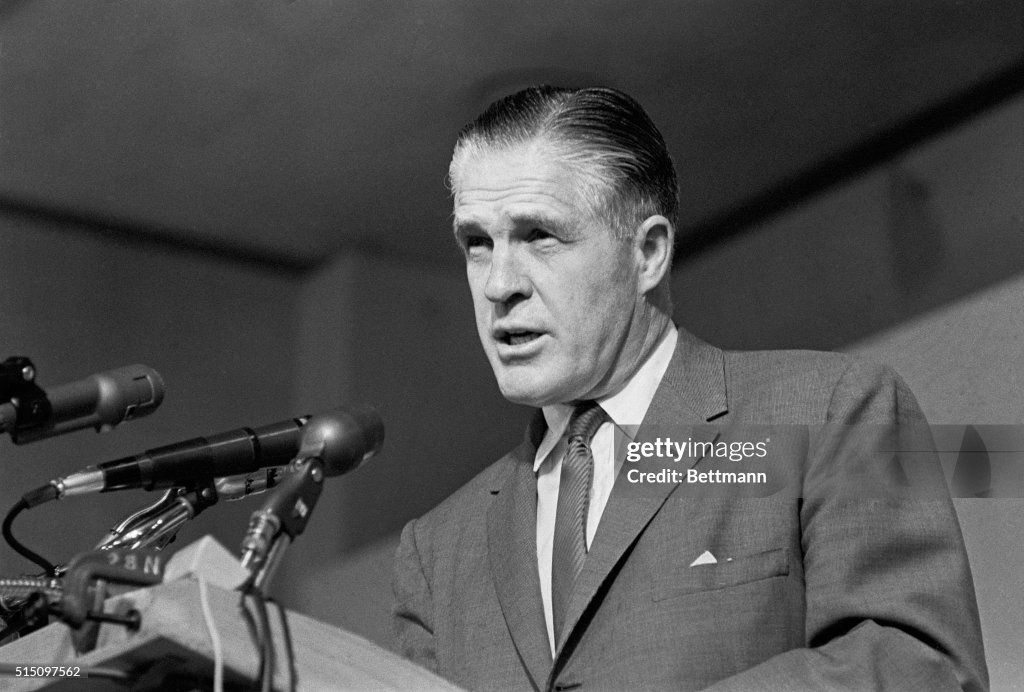
Governor George Romney of Michigan became the new avowed leader of the “stop‐Goldwater” forces as he uttered a warning of “suicidal destruction of the Republican party” if the Republican National Convention decisions now in prospect are allowed to materialize. The new boomlet to nominate Governor William W. Scranton of Pennsylvania at the convention, started by a meeting of Mr. Scranton and former President Dwight D. Eisenhower, at Gettysburg yesterday, subsided today. Governor Scranton’s refusal in two press conferences to speak out for the moderate point of view evoked from Governor Rockefeller of New York expressions that were widely interpreted as contempt.
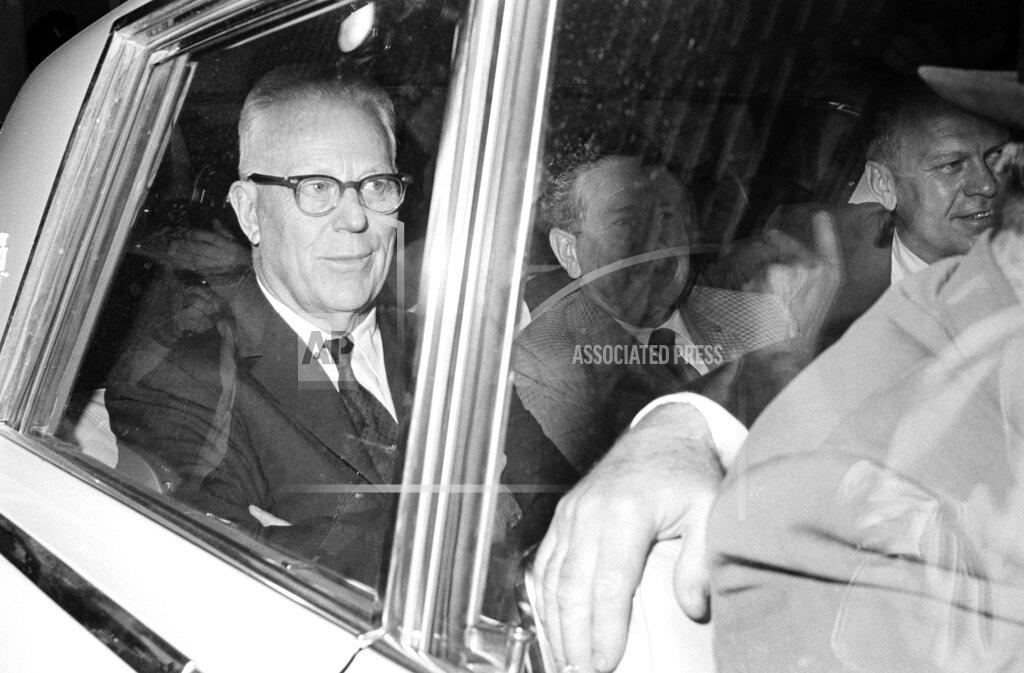
Jack Ruby, who had killed accused presidential assassin Lee Harvey Oswald, testified before the Warren Commission. Since Ruby had been imprisoned since November 24, the questioning took place at the interrogation room of the Dallas County Jail, with Chief Justice Earl Warren and U.S. Congressman Gerald R. Ford from the Commission, and began at 11:45 in the morning and lasted for three hours. “I would like to be able to get a lie detector test or truth serum of what motivated me to do what I did at that particular time,” Ruby began, “and it seems as you get further into something, even though you know what you did, it operates against you somehow, brainwashes you, that you are weak in what you want to tell the truth and what you want to say which is the truth.”
Gale winds swept the Carolinas’ coast Sunday as a storm dumped up to eight inches of rain, in some areas. Unofficial observers measured 8.1 inches of rain at Conway, South Carolina, in a 24-hour period. Low‐lying areas were flooded and most of the vehicular traffic to Conway and. the Myrtle Beach resort area was cut off. Gale warnings were in effect for a stretch between Nags Head, North Carolina, and Myrtle Beach, South Carolina.
The Taça das Nações football tournament, held in Brazil to celebrate the fiftieth anniversary of the founding of the Brazilian Football Confederation, was won by Argentina.
Deron Johnson again leads the Reds to a win over the Cards as he collects a homer, double and 3 singles. Johnny Edwards hits a grand slam as the Reds win, 11–6.
Bill Mazeroski’s three‐run homer inside the park and Vernon Law’s pitching led Pittsburgh to a 6–1 triumph over Houston in the second game of a doubleheader today. The Colts won the opener, 6–3, with five runs in the ninth inning. Bob Veale, the Pirate pitcher, fanned 12 batters, tying a Pittsburgh record for a nine‐inning game.
Born:
Judie Aronson, American actress (“Weird Science”), in Los Angeles, California.
Andris Vecumnieks, Latvian contemporary classical composer (Concertino Art-I-Shock), conductor, teacher, and musicologist, in Riga, Latvian SSR, Soviet Union.
Died:
Violet Attlee, Countess Attlee, 68, wife of former British PM Clement Attlee, from a cerebral hemorrhage.
Charlie Llewellyn, 87, the first non-white South African Test cricketer (1896 to 1912).
 History Diaries