British Prime Minister Neville Chamberlain today moved to forestall Parliamentary and public demands by announcing that a full public inquiry would be held into the disaster in which ninety-nine men died inside the submarine Thetis last week. The inquiry, which will not be held until the submarine has been salvaged — or at least until all hope of salvage has been given up — will supplement a private court of inquiry which the Admiralty will hold and which, according to custom, will be in camera. However, the decision to hold a public inquiry similar to that held when the dirigible R-101 was lost in 1930 means that a special tribunal under the chairmanship of an eminent lawyer will be set up, with the highest legal powers.
In addition to calling witnesses, who will be examined in public unless their evidence is of a secret nature from a military standpoint, the tribunal will have the Admiralty report before it. The demands for an open investigation have been intensified by the secrecy with which the Admiralty has surrounded the entire affair, but tonight there was a disposition to suspend further criticism until the inquiry had had its chance.
An attempt was made on the life of Marina, Duchess of Kent. As her car was pulling away from her home in Belgrave Square to see Wuthering Heights at the cinema, a man fired a sawn-off shotgun at it, but missed. The man was soon arrested and the Duchess was not aware of the attack until she returned.
The defense of Russia’s northwestern frontiers appeared tonight to be the only important point of disagreement still preventing the conclusion of a full-fledged defensive alliance between Britain, France and the Soviet Union. This morning Foreign Office experts examined and dissected Russia’s latest note replying to their proposals last week; Viscount Halifax, the Foreign Secretary, promptly took the experts’ conclusions across Downing Street for submission to Prime Minister Neville Chamberlain, and in the evening the Foreign Affairs subcommittee of the Cabinet met to consider Britain’s next move.
The difference of opinion between London and Moscow is clean cut although small in scale. The Russians have refused a promise of help to Poland, Rumania, Greece, Turkey or Belgium in case of aggression until Britain and France also have promised specifically to help Russia’s three northwestern neighbors, Latvia, Estonia and Finland. The British, on the other hand, find it hard to extend specific guarantees to States that have declared that they do not want anything of the sort.
The Reich predicts a British-Soviet pact. Berlin hesitates on the agreement until the terms are known.
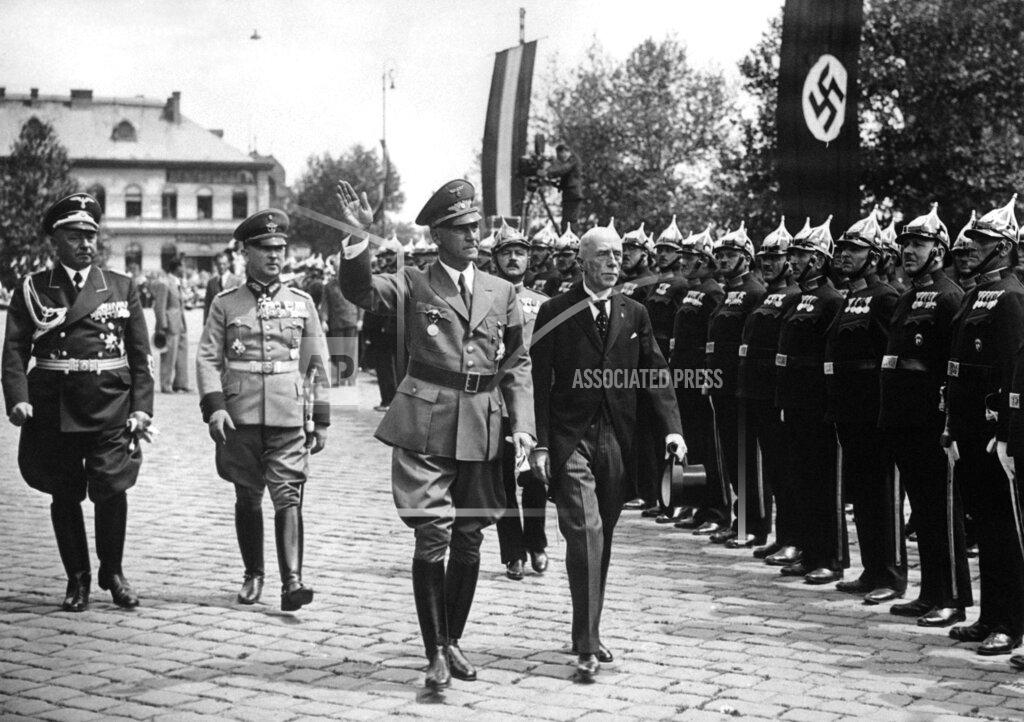
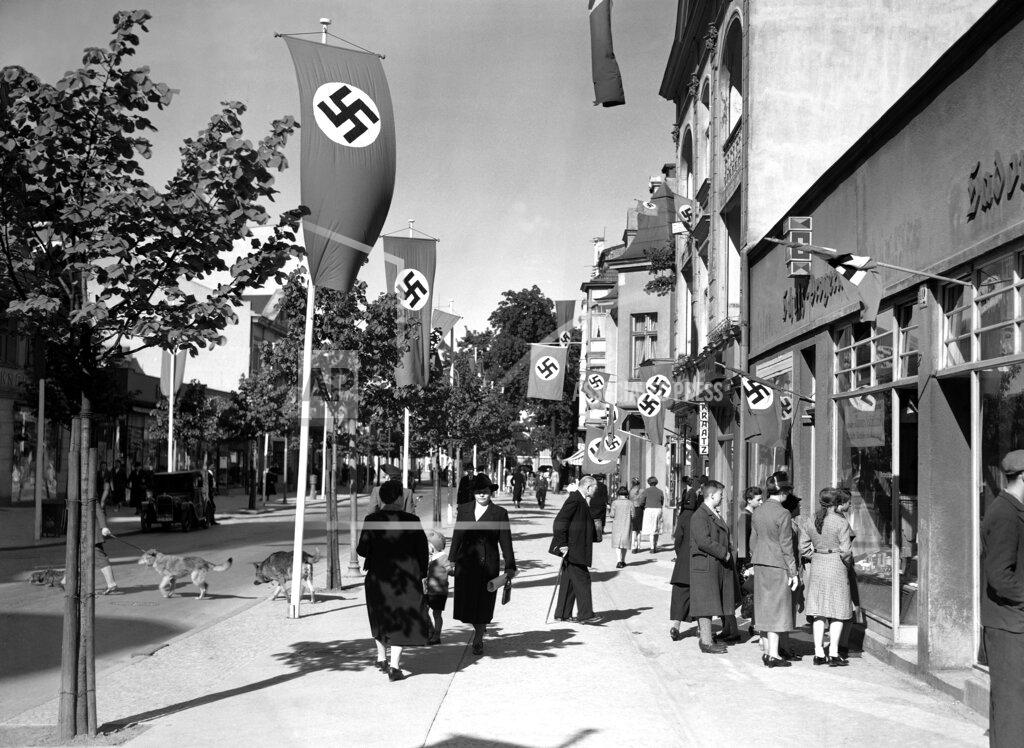
Prince Paul, Regent of Yugoslavia, and Princess Olga left Berlin tonight. The farewell accorded by thousands of Berliners was every whit as hearty as the welcome they received on their arrival five days ago. Chancellor Adolf Hitler accompanied his royal visitors from Bellevue Palace to Lehrter Station, where leading personalities of state, party and armed forces lined up to bid them Godspeed. Prince Paul took leave of Herr Hitler with a hearty handshake and a beaming smile.
The Prince and Princess were to travel by a special train to Dresden, where they will spend today prior to a two-day private visit with Air Marshal Hermann Goering at his hunting lodge at Schorfheide. Prince Paul spent his last afternoon in Berlin in conference with Chancellor Hitler. This final talk lasted nearly five hours.
The favorable reception given to his recent diplomatic soundings with several European governments has encouraged Pope Pius to continue his efforts for peace, it was learned in authoritative Vatican circles today. With this aim in view Pope Pius received yesterday the British Minister, Francis D’Arcy Godolphin Osborne, with whom he conversed for an hour. Nothing was divulged concerning the outcome of the meeting, which was made public only today. Vatican prelates, however, said that the Holy See’s object is now to obtain more specific assurances from all interested governments and ultimately a joint invitation from them to undertake an inquiry to ascertain whether there is basis for a general agreement among the major powers.
Informed prelates said that the Pope so far had limited himself to counseling moderation to the blocs of hostile powers in order to prevent the political quarrels dividing Europe from degenerating into armed conflict. As a result of that step, he received assurances that none of the governments concerned is fostering a policy that would ultimately lead to war.
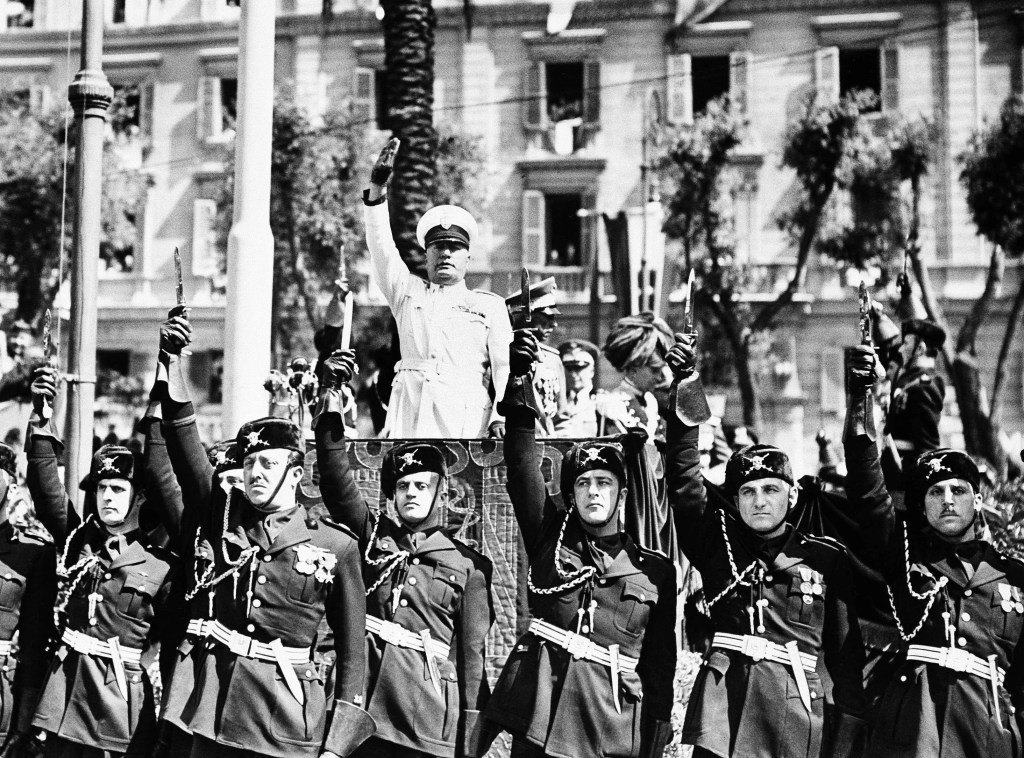
While Naples, with its buildings beflagged and its streets astir with troops and Blackshirts, was preparing tonight to welcome back in triumph 20,000 soldiers who had sailed from there to Spain, Premier” Benito Mussolini greeted them from Rome as conquerors of “the democracies and Bolshevism.” Twice in his brief message Signor Mussolini emphasized victory against France, Great Britain, and the United States.
Minister of the Interior Ramon Serrano Suñer and a Spanish military and naval mission arrived today at Naples, along with General Gastone Gambara, Italian commander in Spain, on the cruiser Duca d’Aosta and the troopship Sardegna. Air-raid sirens and whistles on every boat in the harbor sounded as they entered. Two cruisers boomed a twenty-gun salute. Count Galeazzo Ciano, Italian Foreign Minister, came from Rome to represent the government. At 7 o’clock, in front of the Hotel Excelsior, Blackshirts and workers who had been waiting for hours cheered and applauded.
Their shouts were for Count Ciano and Premier Mussolini, but Señor Serrano Suñer was duly and vigorously applauded when he appeared on a balcony outside his room. But today was just a mild prologue for tomorrow’s great show, when all the soldiers will parade before King Victor Emmanuel in the Piazza del Plebiscito. Transports will arrive tonight, and by 6:30 tomorrow morning the troops will have assembled on the huge dock, ready to begin the triumphal parade that has always been the due of soldiers returning home after a victory.
Differences with Russia over her insistence on an Anglo-Soviet guarantee to Finland and remilitarization of the Aland Islands are now agitating Finnish public opinion. The suggested guarantee has been rejected by the Finns in view of past Russo-Finnish relations and in fear of the possible presence of Russian troops in Finland. It is understood the Finnish and Swedish Cabinets are trying to find a joint formula to overcome Russian suspicions about refortification of the Aland Islands. Finnish talks with Russia may be hindered by the departure from Helsingfors of Soviet Minister Dereviansky, the date of whose return is not known.
Juho Niukkanen, Finnish Minister of Defense, who arrived in Stockholm today, said Finland was prepared to refortify the Aland Islands according to her original plan. In a statement to the press, he said Finland aimed at close cooperation with Sweden in the field of defense. “Together Sweden and Finland form an element of strength sufficient to be heeded even by great powers during a great general European conflict,” he said. “Therefore, we think there is a real case for comparatively far-reaching collaboration between the two countries in the field of defense measures.”
Today in Washington, President Roosevelt conferred with legislative leaders, sent to the Senate the nomination of Claude G. Bowers to be Ambassador to Chile and other nominations and vetoed the bill to prevent exportation of tobacco seeds.
The Senate completed Congressional action on the Strategic War Materials Bill and recessed at 1:56 PM until noon tomorrow. The Education and Labor Committee heard William Green and others on the La Follette bill to curb labor espionage, and a subcommittee received proposals from the American Iron and Steel Institute for amendment of the National Labor Relations Act.
The House refused to permit Wages and Hours Act amendments to be taken up under suspension of the rules, passed calendar bills and adjourned at 5:42 PM until noon tomorrow. The Foreign Affairs Committee began consideration of the Bloom neutrality bill and the Ways and Means Committee concluded corporate tax revision hearings.
Congress sent to the President today a bill which authorizes the expenditure of $100,500,000 in the next four years to finance acquisition of “essential war materials” which may be stored for use either in military or industrial fields should any future war contingency shut off normal supplies. This legislation was completed when the Senate agreed to a sum of $100,000,000, inserted in the bill by the House after the Senate had passed a bill authorizing the expenditure of $40,000,000.
The money would be used to finance both imports and domestic production of strategic materials, with the Secretaries of War and Navy authorized to expend $100,000,000 in purchases, and the Secretary of Interior: $500,000 for development and exploration of new domestic sources or the encouragement of development of substitutes. The money is to be expended between June 30, 1939, and June 30, 1943. The bill leaves to those three Secretaries the question of determining what materials are “strategic” and “the quality and quantities of same to be purchased,” but directs the Secretaries of State, Treasury and Commerce to cooperate in carrying out these studies.
The Procurement Division of the Treasury is designated as the purchasing agent in the program, and is directed and authorized, in the case of perishable materials, to provide for proper “rotation” of reserves so that deterioration will not spoil their value. The bill does not designate any materials, but presumably a large part of the money would be spent on rubber and tin, which are not produced in this country. Likewise, the United States is dependent largely on foreign sources for manganese, a necessary component of steel, due to the low grade of American ore deposits.
The Roosevelt Administration won its first skirmish, although a minor one, in the struggle over revising the Neutrality Act when the House Foreign Affairs Committee declined today to limit the discretion of the President in finding that a state of war existed abroad. An amendment which would have tended to limit his choice in the matter was defeated by what Representative Bloom of New York, acting chairman, described as “a pretty fair majority.” It was the first vote of any sort in either branch of Congress at this session which could be taken as in any way indicative of the prevailing sentiment on the controversial issue of overhauling the existing statute.
The question came on a motion to add a proviso that Congress by concurrent resolution could declare that a state of war existed. The first section of the Bloom resolution reads as follows, as amended thus far by the committee: “Whenever the President shall find that there exists a state of war between foreign States and that it is necessary to promote the security or to preserve the peace of the United States or to protect the lives of citizens of the United States, the President shall issue a proclamation naming the States involved; and he shall, from time to time, by proclamation, name other States as and when they may become involved in the war.”
The U.S. Supreme Court decided Coleman v. Miller and Hague v. Committee for Industrial Organization.
In Coleman v. Miller, the Child Labor Amendment had passed both houses of Congress in 1924. Under Article V of the Constitution, three-fourths of state legislatures must ratify an amendment passed by Congress before it becomes part of the Constitution. After both houses of the Kansas legislature had rejected the proposed amendment in 1925, the Kansas house passed a resolution of ratification in 1937. The Kansas senate then equally divided (20-20) on the resolution, and the Lieutenant Governor, over the objections of those who opposed the amendment, broke the tie in favor of ratification. Kansas legislators challenged the action in state court and it ultimately made its way to the Supreme Court.
In an opinion by Chief Justice Hughes, the Court held that the Kansas legislators had standing to sue, but found that two of the plaintiffs’ claims raised political questions that could only be resolved by Congress. With respect to the whether the Kansas legislature’s previous rejection of the Child Labor Amendment precluded its subsequent ratification, the Court stated that this “should be regarded as a political question pertaining to the political departments, with the ultimate authority in the Congress in the exercise of its control over the promulgation of the amendment.” In his concurrence, Justice Black (joined by Justices Frankfurter, Roberts, and Douglas) suggested that the Court had not gone far enough in denying judicial power to resolve Article V controversies. Black believed that all Article V questions should be considered political and not judiciable. Justices Butler and McReynolds dissented. They argued that the Child Labor Amendment proposal had expired.
In Hague v. Committee for Industrial Organization, the Committee for Industrial Organization (CIO) had gathered in New Jersey in 1937 to initiate a recruitment drive. Police shut down the meeting based on a city ordinance that forbade labor meetings in public. Arguing that the ordinance violated the First Amendment protection of freedom of assembly, the CIO filed suit against several city officials. A District Court and the United States Court of Appeals for the Third Circuit agreed and invalidated the ordinance.
In a plurality opinion authored by Justice Owen J. Roberts, the Court concluded that the actions taken by police violated the First Amendment, as applied to the states by the Fourteenth Amendment. The public long has used streets and parks to assemble and transmit ideas and speech on issues of public concern. Thus, the ordinances were void. Justices Stone, Reed, and Hughes concurred. Justices McReynolds and Butler dissented.
Almost unanimous opposition by House Republicans blocked passage today of an Administration proposal to create a government library at Hyde Park, New York, to house President Roosevelt’s papers. After asserting that such material should be preserved in Washington, if anywhere, along with other government records, they prevented the measure from receiving the necessary two-thirds vote required for approval under the procedure that House leaders adopted.
The roll-call vote was 229 to 139, with 139 Republicans voting against the bill and eight approving it. The measure would authorize the government to take title to twelve acres of the Roosevelt estate at Hyde Park. A private corporation would erect a building on it. Upon completion the United States Archivist would be authorized to accept formally Mr. Roosevelt’s papers.
Exiles’ woes move the American Writers Congress. The audience stands with bowed heads as the names of 45 writers killed in fascist countries are read.
The Philadelphia A’s sign Duke University All-American running back Eric Tipton.
Two thousand, eight hundred feet below the earth’s surface today, King George VI in overalls and Queen Elizabeth with a safety helmet on her head and a flashlight in her hand, saw miners hacking and drilling out the ore from the bedrock of Canada. By royal command the monotonous routine of royal receptions with their formal speeches, presentations and processions, was varied here to permit the King and Queen to visit the Frood Mine of the International Nickel Company of Canada. It is one of the largest workings in the Sudbury District, which produces 90 percent of the world’s nickel.
The Cuban president now claims he will allow the MS St. Louis refugees to enter Cuba if they pay a $500 bond each. The Cuban Government is willing to consider a plan to permit the Jewish refugees aboard the Hamburg-American liner St. Louis to debark in Cuba and remain in a provisional concentration camp situated in a suitable place, such as the Isle of Pines, until they can be re-embarked for some other destination, President Federico Laredo Brú told the press this afternoon. However, he gives them just 24 hours to comply, and the ship is now off Florida.
It is absolutely necessary, however, the Chief Executive asserted, that guarantees be given to the government that such refugees will not become public charges and that their food and lodging while in Cuba as well as their re-embarkation will be paid for. This offer terminates at noon tomorrow. The Cuban President said that no one could deny that the Cuban people had been extremely hospitable in receiving exiles, despite the fact that this meant a great sacrifice to Cuban commerce and labor. But this attitude, he said, had been “converted into a source of abuse to such an extreme that the greater part of this involuntary immigration has flowed to the port of Havana, giving rise to irregularities which are now being investigated.”
Steamship companies were advised, early in May, the Chief Executive asserted, that Cuba would not permit immigrants to debark without a previous authorization from the Secretaries of State and Labor. This communication, he said, was addressed directly to the companies, and no company could seek protection under the previous authorization issued by the Director of Immigration, because they were all expressly informed that such permits were no longer valid. The President expressed deep sympathy for the plight of these refugees, but said that he was forced to take measures that barred their landing.
Japanese bombers attacked Chungking (Chongqing), China for three hours during the day; 4,400 people died of asphyxiation in a collapsed air raid tunnel during this bombing.
The Japanese are continuing to advance toward the Yellow River in Western Shansi Province. According to Chinese dispatches today, one Japanese detachment was fifteen miles from the river crossing at Chikou, another eight miles from Chuntu, a crossing south of Chikou. Chinese were reported attacking the Japanese flanks. In Central Hupeh Province the Chinese were counter-attacking the Japanese at Chienkiang.
Terrified thousands abandoned their homes at Swatow early today and fled toward the interior as word spread that Japanese forces had made a long-expected landing near the harbor entrance. Military authorities said a Japanese landing had been repulsed, but Japanese warships were concentrated off the coast. Japanese planes were reported in continuous flight over Swatow. Seventy-five per cent of the population — normally 178,600 — was said to have departed with all portable belongings.
Following the refusal of Japanese military authorities to permit any foreigners other than Britons to leave Hankow for Shanghai aboard two British merchantmen returning from Hankow, a Japanese spokesman here today announced that the authorities were permitting eighteen third party nationals, none Britons, to leave Hankow aboard two Japanese military transports. The eighteen include five Americans, besides French, Germans, Italians and Russians. Japanese authorities handed to United States officials here yesterday representations enumerating seven alleged instances in which flags on American property had been used for Chinese military purposes. The note declared Japanese air forces were constantly attempting to avoid any damage to foreign property, but there had been cases where accidents had happened.
Dow Jones Industrial Average: 137.06 (-0.06).
Born:
Joe Clark, 16th Prime Minister of Canada (1979-80), in High River, Alberta, Canada.
Margaret Drabble, British author (“Needle’s Eye”), in Sheffield, England, United Kingdom.
Ron Baensch, racing cyclist, in Melbourne, Australia (d. 2017).
Jack Turner, NBA shooting guard (Chicago Packers), in Newport, Kentucky (d. 2013).
Naval Construction:
The Royal Navy river gunboat HMS Dragonfly (T 11), lead ship of her class of 4, is commissioned. Her first commanding officer is Commander Harold Thomas Armstrong, RN.
The Вое́нно-морско́й флот СССР (ВМФ) (Soviet Navy) “L” (Leninec)-class (3rd group, Type XIII) submarine L-17 is commissioned.

 History Diaries