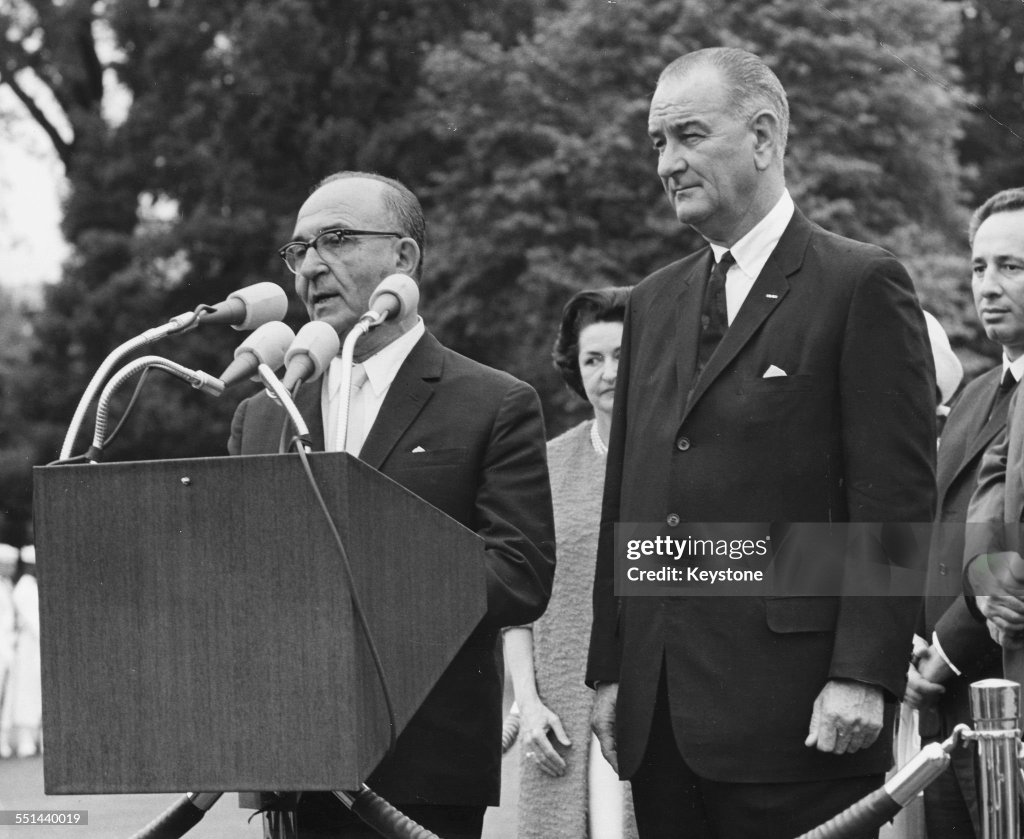
U.S. President Johnson sent a secret letter to Turkish Prime Minister İnönü, warning him to call off plans to invade Cyprus. Noting that Turkey’s action would begin a war with Greece “Adhesion to NATO, in its very essence,” said the letter, “means that NATO countries will not wage war with each other. Germany and France have buried centuries of animosity and hostility in becoming NATO allies; nothing less can be expected from Greece and Turkey.” Adding that a Turkish intervention “could lead to a direct involvement by the Soviet Union”, Johnson told İnönü, “I hope you will understand that your NATO allies have not had a chance to consider whether they have an obligation to protect Turkey against the Soviet Union if Turkey takes a step which results in Soviet intervention without the full consent and understanding of its NATO Allies.” İnönü would tell his cabinet, “Our friends and our enemies have joined hands against us,” and the invasion was called off. A ranking Turkish Government informant said later that Turkey had given up the idea of a landing on Cyprus “for the time being,” the agency said.
The announcement came amid reports from the Middle East that Turkey had massed a force 120 miles from Cyprus for a possible invasion to protect the Turkish Cypriote community on the island from the Greek Cypriote majority. Violence between the two communities broke out in December over the Greek Cypriotes’ efforts to alter the Constitution to strengthen their governmental authority. Officials here declined to confirm reports that a Turkish invasion fleet had been formed. But they noted that the Turkish Government some time ago announced plans for large amphibious maneuvers and that troops and vessels gathered near the port of Iskenderun. This is the nearest large port to Cyprus on the Turkish coast. The Turkish military activity and a military alert that it touched off in Greece and Cyprus prompted the United States to move quickly during the last 24 hours to try to avoid a collision between Turkey and Greece over the Cyprus question.
Government troops scored two major successes against the Communists and captured a Việt Cộng ammunition dump in a three‐day sweep near the Cambodian border, a United States military spokesman reported today. Three American army officers were wounded when one of them stepped on a mine 25 miles southwest of Saigon and an armed United States army helicopter was shot down by guerrillas yesterday. None of the four crew members was hurt. The army identified First Lieutenant Ralph G. Redmond of Topeka, Kansas, as the American killed most recently in South Vietnam. Lieutenant Redmond died of injuries suffered when a mine exploded while he was on duty as an adviser. He was the 141st American killed in direct combat.
The first Government victory over the Việt Cộng came in the jungle‐covered central highlands 320 miles north of Saigon, where government troops killed 15 guerrillas and suffered only two wounded. They also captured five submachine guns and three automatic rifles. The other clash occurred 50 miles west of Quảng Ngãi in the same region, where the South Vietnamese army recently completed a 5,000-man sweep against guerrillas in the rebel Đỗ Xá sector. A scorched earth campaign there destroyed rebel crops and supplies.
The Defense Ministry said South Vietnamese special forces killed 17 guerrillas near the Cambodian border in a three‐day sweep that ended Tuesday. More important, the special forces captured a rebel explosives dump that contained at least one 500-pound United States air force bomb.
The Communists scored a major success when two Vietnamese militiamen betrayed their outpost to the Việt Cộng Wednesday night. A United States spokesman said the turncoats opened the gates of a 26-man self‐defense post at night and let the Việt Cộng pour in. The guerrillas captured 21 submachine guns, 18 carbines and a 60-mm mortar.
The United States has been quietly building up the number of American civilians working in rural areas of South Vietnam to bolster the Government’s program to win the political support of Vietnamese peasants. In the last five months the number of American civilians living in the countryside and working as personal advisers to Vietnam’s 43 provincial chiefs has roughly doubled. Officials here hope to nearly double it again in the next two or three months. Compared with the 16,000 American servicemen in South Vietnam, the number of civilian advisers is small — numbering only in the hundreds. But such top officials as Ambassador Henry Cabot Lodge and Secretary of Defense Robert S. McNamara are understood to consider the civilian advisory effort in the countryside as vitally important.
Outside support of Communist guerrillas in South Vietnam is a form of “systematic aggression quite as real as that launched in Korea” in 1950, a leading United States policy strategist said today. Walt W. Rostov, the State Department’s policy planning chairman, made the statement in an address at the commencement ceremonies of Haverford College. Mr. Rostov said it would be hard to move toward a world of disarmament “until this form of aggression is recognized and sterilized by the international community.” He noted that the Communist Việt Cộng in South Vietnam consisted of about 25,000 highly organized guerrillas but “their leaders are systematically trained, infiltrated and guided from outside the borders of South Vietnam in violation of solemn international agreements.”
Henry Cabot Lodge, the U.S. Ambassador to South Vietnam, sent a cable to President Johnson recommending that the United States not send more ground troops into South Vietnam to fight the Việt Cộng. Such a step, he cautioned, would be a “venture of unlimited possibilities which could put us onto a slope along which we slide into a bottomless pit.”
The United States and France agreed today on their objectives in South Vietnam, but they disagreed basically on the means of reaching those goals, American sources disclosed. This was the upshot of a one-hour conversation at Élysée Palace between President de Gaulle and Under Secretary of State George W. Ball. The meeting was described by the Americans as “extremely friendly and forthcoming.” Mr. Ball explained United States policies and the French leader followed with a complete exposition of his government’s attitude. The underlying cause of the difference between the two Governments, qualified sources said, is that the United States believes the Chinese Communist regime is in an expansionist period that involves continued support of North Vietnam, which directs the Communist insurgents in South Vietnam. The French on the other hand believe Peking is in a period of consolidation.
President de Gaulle has called for the neutralization of the countries that formerly constituted French Indochina, a policy that would entail the participation of Communist China. The French position was outlined both in Mr. Ball’s talk with General de Gaulle and in a 70‐minute conversation the American had this morning with Maurice Couve de Murville, French Foreign Minister. Both French officials went out of their way to stress their government’s opposition to the advance of Communism in Southeast Asia, but they made it clear that they did not think the United States was attacking the problem in the right way. The French Government, official sources said, remains opposed to any expansion of the war in South Vietnam by land or air attack on North Vietnam.
Nevertheless, Mr. Ball found areas of substantial agreement in his talk with General de Gaulle. The two countries’ differences, it was emphasized, are over methods and over whether policies instituted by President Johnson’s Administration can succeed. The French view is that they are more likely to fail. Mr. Ball, who arrived today, carried a letter of greeting to President de Gaulle from President Johnson. The letter was friendly but did not contain any substantive message. General de Gaulle, the Americans said, showed every evidence of wishing to be in closest touch with Mr. Johnson. But there were no signs that enlargement of the conversations would shake the General’s conviction that negotiation for early neutrality was the only way out in South Vietnam.
Communist‐led Pathet Lao troops attacked a neutralist hill position northwest of the Plaine des Jarres today, breaking a five‐day lull in the civil war. A Laotian Army spokesman said the neutralist troops had repulsed the leftists in a seven‐hour fight, killing 10 of the attackers. The casualty toll of the neutralists was not disclosed. The attack was at Phoukoutt, which was recaptured last week by the neutralists after Pathet Lao troops seized it in an offensive sweep last month. Vientiane sources said the neutralists had radioed for air support from United States‐supplied T-28 fighter‐bombers based here, but bad weather kept the planes from going into action.
Monsoon clouds evidently helped the Pathet Lao troops in another area also. Laotian Army sources said a United States reconnaissance jet had detected a convoy of about 60 trucks headed for the Plaine des Jarres, apparently from Communist North Vietnam. The clouds closed in and screened the convoy before T-28’s, ordered to bomb the convoy, could reach the area. North Vietnam has been assisting the Pathet Lao forces in their hostilities against the two other factions in Laos — the rightists and neutralists.
The cancellation of a proposed flight to Khang Khay, the Pathet Lao headquarters, for discussion of the crisis illustrates the handicaps under which the International Control Commission operates in Laos. The commission, made up or representatives of India, Canada and Poland, is charged with supervising Geneva conference agreements for the neutrality and independence of Laos. Sources here said that the Pathet Lao refused to give clearance for the commission’s helicopters to fly to Khang Khay. The commission members never have been permitted to inspect Pathet Lao field positions, though they can look over neutralist and rightist territory at will. General Kouprasith Abhay, one of the leaders of the April 19 rightist coup in Laos, said the Communists must be dislodged by force from the Plaine des Jarres if they refused to withdraw peacefully.
President Chung Hee Park accepted today the resignation of his right‐hand man, Kim Chong Pil, as chairman of the ruling Democratic Republican party. The resignation was a move to try to end the outbreak of anti‐Government demonstrations. General Park asked for Colonel Kim’s resignation last week, but when it was submitted earlier this week, General Park turned it down under pressure from the colonel’s supporters. In another action, General Park ordered all colleges and universities in South Korea closed for the rest of the school year, which ends July 4. The order was issued as new anti‐Government demonstrations broke out in at least 12 provincial cities.
Students began demonstrations last March against plans by the Park Government to seek normal relations with Japan, Korea’s former colonial ruler and long‐time enemy. The demonstrations became a protest against the Park Government itself, which the students accused of misrule. Colonel Kim, 38 years old, was a leader in negotiations to restore normal relations with Japan. He was also a key figure in the military coup d’état in 1961 that brought General Park to power. In Pusan, the country’s second largest city, 1,500 rock‐throwing students from two universities raided a police station after having overwhelmed 500 policemen. Two companies of army troops were ordered there to suppress the riot. Several persons on both sides were reported to have been wounded hi clashes, and the soldiers arrested more than 30 students.
Brazil, the Ivory Coast and Morocco, all neutrals, were chosen today as the members of the Security Council committee that will investigate the Cambodian-Vietnamese frontier situation. The Council unanimously adopted a resolution on the issue yesterday. A United Nations spokesman said that the date on which the 45‐day mission would start had not been decided and that the names of the representatives were not available.
Canada’s Prime Minister Lester Pearson introduced a resolution in the Canadian House of Commons for a new flag of Canada. Attached to the bill was a picture of his suggestion, “a design with blue borders, a white middle and three maple leaves as on the Canadian coat-of-arms”.
The United States and the Soviet Union announced that they would work together for the first time on a joint project in outer space in the form of a weather satellite network, along with an exchange of data on space biology and medicine.
A group of conservative Republican Senators asked today for a 24‐hour postponement of the vote to shut off the Southern filibuster against the civil rights bill. The Democratic leaders conditionally agreed. The purpose of the request, which was made by Senator Bourke B. Hickenlooper of Iowa, was to obtain time to vote on three amendments before the imposition of closure. The Hickenlooper group feels there would be a better chance of getting these amendments passed if they were voted on before the closure test rather than after closure had been obtained. The support of several in the Hickenlooper group for closure is regarded as doubtful. The Democratic leaders agreed to the request because they discovered today that some Republican members they had counted on for closure were now leaning toward rejection.
The carrying out of the agreement, however, depends upon the unanimous consent of all members on the floor tomorrow morning immediately after, the session begins. A single objection could block it. In that event Senator Mike Mansfield of Montana would revert to his original plan for a closure test next Tuesday. Mr. Hickenlooper asked for the unanimous consent today, but Senator Richard B. Russell of Georgia, leader of the Southern Democrats, asked that the request be put over until tomorrow. Mr. Russell wanted time to weigh his strategy.
It was a day of huddles and scurrying to and fro, as confusing as any day since debate began March 9. Last Monday Mr. Mansfield, after consultation with Everett McKinley Dirksen, the Republican leader, announced he would file a closure petition on Saturday. Under the rules, the Senate would have voted on the motion to close debate two calendar days later — on next Tuesday, because Sunday does not count. This morning there was a conference of several Republicans who have been meeting regularly with Mr. Hickenlooper over the past several days. They are all classed as conservatives. Many are supporters of Senator Barry Goldwater of Arizona for the Republican Presidential nomination. Some of them, at least, have resented the way Mr. Dirksen has worked closely with the Democratic leaders and Attorney General Robert F. Kennedy to produce a substitute for the House bill.
The national unemployment rate dropped last month to the lowest point in more than four years. The May rate was 5.1 percent, the Labor Department announced today. This is the lowest since February, 1960, when the rate was 4.9 percent. In a statement commenting on the figures, President Johnson said: “This is further heartening evidence that the tax cut is working as expected and that its economic stimulus is being translated into new jobs.” The issue of the tax cut was raised earlier at a news conference on the monthly report of the Bureau of Labor Statistics. Harold Goldstein, assistant commissioner of the bureau for employment statistics, was asked if he attributed the improvement in the job situation to the tax cut. “You can’t sort out the effect of the tax cut from the other things that have been going on in the economy,” Mr. Goldstein replied.
Senator Barry Goldwater’s managers predicted today they would pick up at least 44 new Republican National Convention votes at state conventions this weekend. They have hopes of getting Colorado’s 16 votes as well, for a total of 60 new votes. Meantime, the Associated Press delegate poll reported that 32 previously uncommitted delegates had shifted to Mr. Goldwater, giving him a new total of 470 delegates in the AP poll. This was, for the first time, more than Goldwater headquarters itself would claim. The Goldwater camp maintains that 455 already elected delegates are “publicly committed” to the conservative Arizona Senator. A total of 655 is necessary to nominate at the convention, which opens July 13 at San Francisco.
The AP also reported that Pennsylvania Governor William W. Scranton had picked up eight delegates, scattered in Rhode Island, Kentucky and New Jersey, in recent days, giving him a total of 79. Warren J. Sinsheimer of New York, organizer a draft‐Scranton committee, also said that five Iowa delegates and two Minnesota delegates had sent messages promising to vote for Mr. Scranton, who may be-come the focus of stop‐Goldwater hopes. Republican state conventions will be held this weekend in Alabama, Colorado, Hawaii and Washington. Sources at Goldwater headquarters said they expected to get all of Alabama’s 20 votes and Washington’s 24.
If they can head off a move in Colorado to name Senator Gordon Allott as a favorite son, they hope to get all or most of that state’s 16 delegates. Hawaii has already selected its delegates, of which Mr. Goldwater claims four, and its convention is not vital. Mr. Goldwater’s advisers could sense a flurry of possibly dangerous underground activity by Republican leaders opposed to or fearful of his nomination. They said they were aware that leaders in some large industrial states were calling each other, possibly to rally a coalition behind Mr. Scranton.
Senator Barry Goldwater’s antagonists refused steadfastly today to concede that his nomination was inevitable. Even as they agonized over the lack of an avowed alternative, they worked unceasingly to keep alive a flickering hope that Governor William W. Scranton and his distinguished constituent, former President Dwight D. Eisenhower, would abandon their above‐the-battle positions. Neither Pennsylvanian appeared to be doing or saying anything to encourage this hope.
On the contrary, it was understood that General Eisenhower had decided to accept the hospitality of George M. Humphrey when he goes to Cleveland next week to attend a Governors’ conference. General Eisenhower has often been the guest of his first Secretary of the Treasury at Mr. Humphrey’s Thomasville, Georgia, plantation. His stopping at the Humphrey home in Cleveland would carry no political import at any other time, but Mr. Humphrey happens to be co‐chairman of the Goldwater fundraising campaign in the Great Lakes region. The fact that General Eisenhower accepted Mr. Humphrey’s invitation weeks ago will not comfort the Eastern politicians who have been try ing every channel they know to press their point that the moderate leadership of the Republican party will be lost unless the General takes command before the convention opens next month.
Dr. Ralph J. Bunche, Under Secretary of the United Nations, accused Senator Barry Goldwater today of “talking utter humbug” about civil rights legislation. Dr. Bunche, a Black, made the accusation in a speech three days after the Arizona Senator won the California Republican Presidential primary. Dr. Bunche was the speaker at commencement exercises of the University of Maine for 900 graduates in the Bangor Municipal Auditorium. He received an honorary doctorate in humane letters. Dr. Bunche said there was “no question of personal likes or dislikes” in the civil rights struggle, because “the American Black is seeking only rights and not affection.”
“The Black,” he continued, “is fully aware that the pending civil rights bill, as imperative as its passage is, or any other law, is not likely to change the established attitudes on race or color of very many individuals.” But, since the Black struggle is for rights and is conducted largely in the courts, what gets onto the law books is of tremendous importance.” “Besides this,” Dr. Bunche declared, “individual attitudes on questions of race and religion do change, of course; prejudices can be discarded. “The acid test comes when the individual, who may think right, comes face to face with the problem; when the problem becomes your neighbor, rubs up against you, touches your children.”
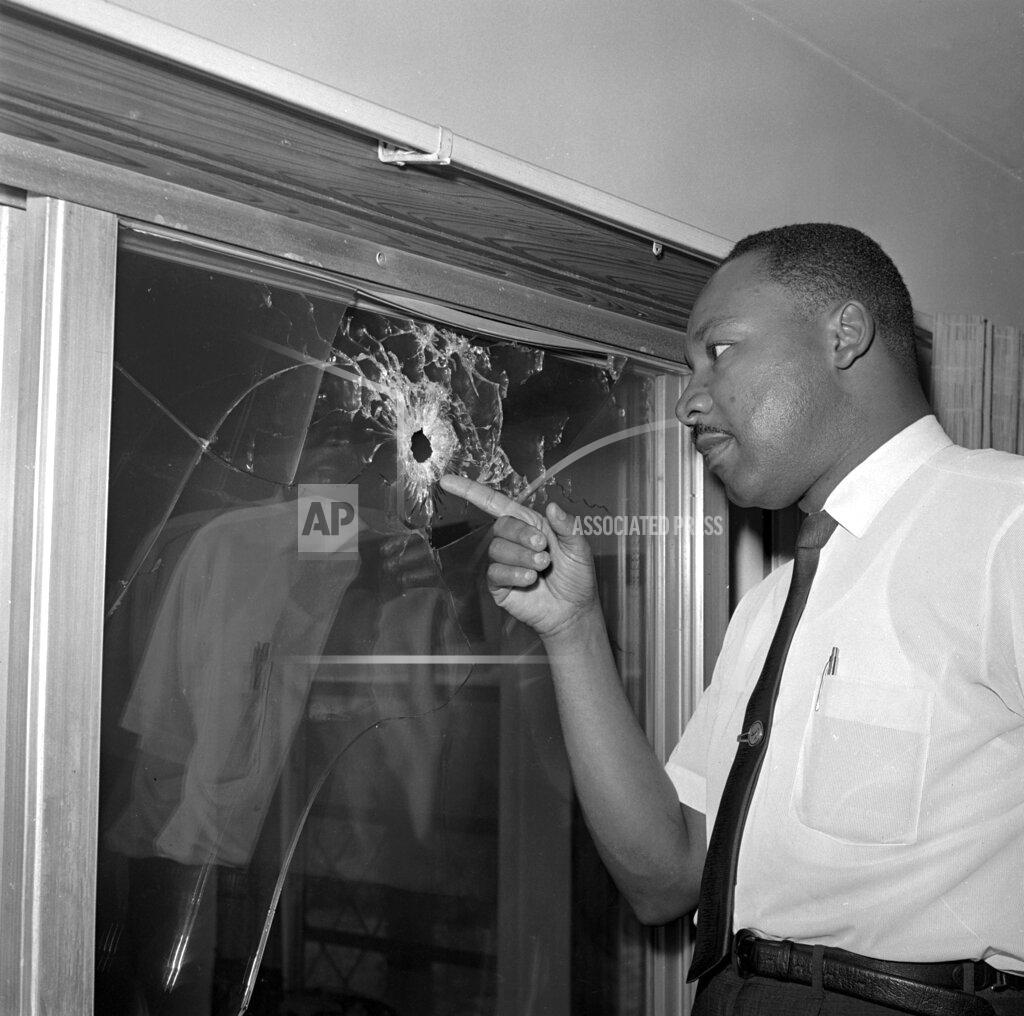
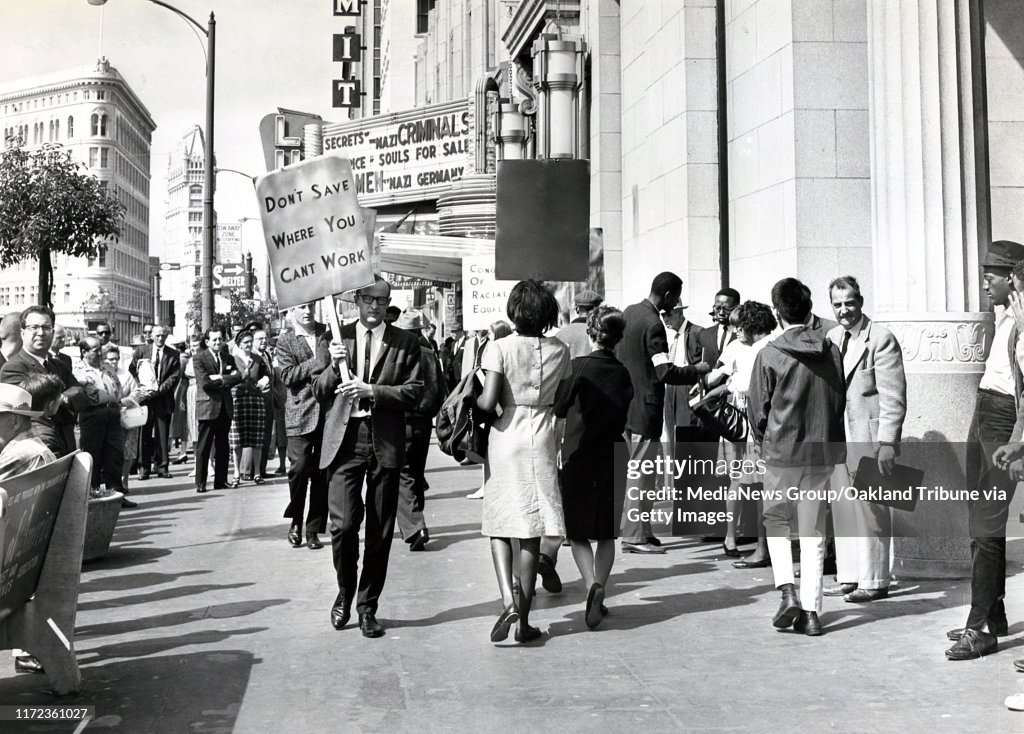
The Rev. Dr. Martin Luther King Jr. said today that St. Augustine was the most lawless community he had encountered. He made the statement at a news conference after a brief renewal of violence and threats in the nation’s oldest city. A retired Black railroad worker told the police that shots had been fired into his car as he drove to his home after attending a civil rights rally at which Dr. King spoke.
Dr. King said his own life had been threatened here and that he had appealed to the federal government to protect racial demonstrators. At the same time, Dr. King told white leaders that they could prevent a resumption of widespread demonstrations next week by making a “good faith” move toward ending discrimination. There was no indication that the whites would make such a move. Embittered by months of racial activity, they contend that Dr. King and other leaders of the Southern Christian Leadership Conference are here only to cause trouble and to stop the city’s 400th anniversary celebration next year. Dr. King has picked St. Augustine as the focal point of the summer campaign, contending that the city refuses to end bigotry and hate 400 years after its founding.
The deep-ocean research submersible DSV Alvin was commissioned by the United States Navy.
Davie Jones & King Bees release debut single “I Can’t Help Thinking About Me”; group disbands but Davie Jones goes on to success as David Bowie.
The Rolling Stones’ first U.S. concert tour (with Bobby Goldsboro & Bobby Vee) debuts in San Bernadino, California.
At Crosley field, the Reds plate 4 runs in the 9th inning to edge the Cards, 5–4. Deron Johnson drives home the tying and winning run with a single.
Dick Stuart hits his second grand slam in 10 days and the Red Sox score 9 in the 2nd as they pummel the Athletics, 14–7.
Dow Jones Industrial Average: 806.03 (+3.55).
Born:
Rick Riordan, American author (“Percy Jackson & the Olympians”), in San Antonio, Texas.
Karl Sanders, American heavy metal guitarist and singer (Nile), in Greenville, South Carolina.
Magz [Maggie Dunne], English musician (Fuzzbox), in Solihull, England, United Kingdom.
Mike Wise, NFL defensive end (Los Angeles Raiders, Cleveland Browns), in Greenbrae, California (d. 1992, suicide).
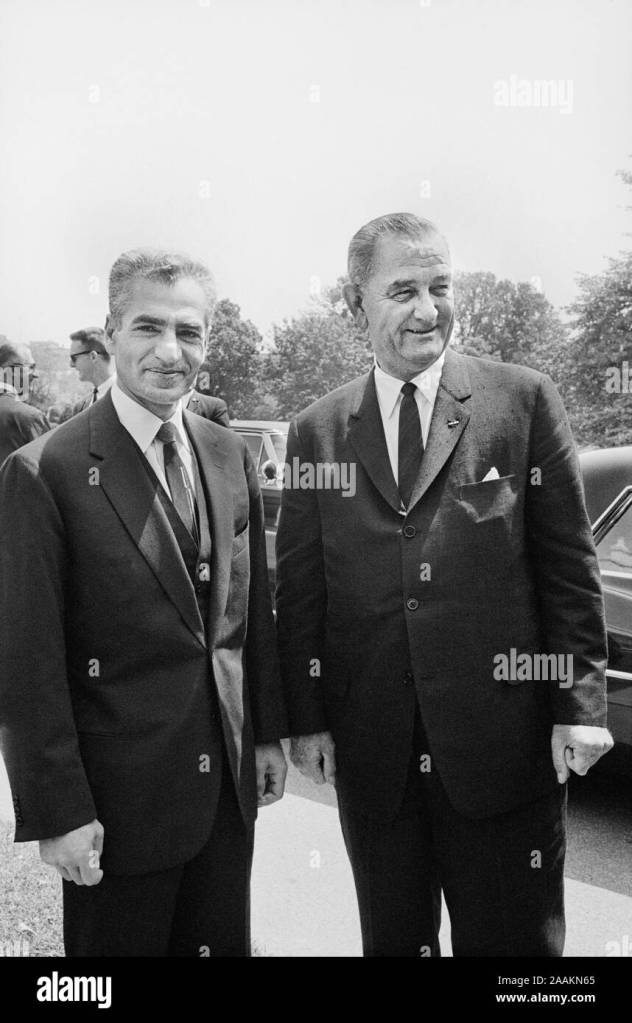
Mohammad Reza Pahlavi, Shah of Iran with U.S. President Lyndon Johnson, Washington, D.C., June 5, 1964. (Photo by Marion S. Trikosko/Glasshouse Images/Alamy Stock Photo)


 History Diaries