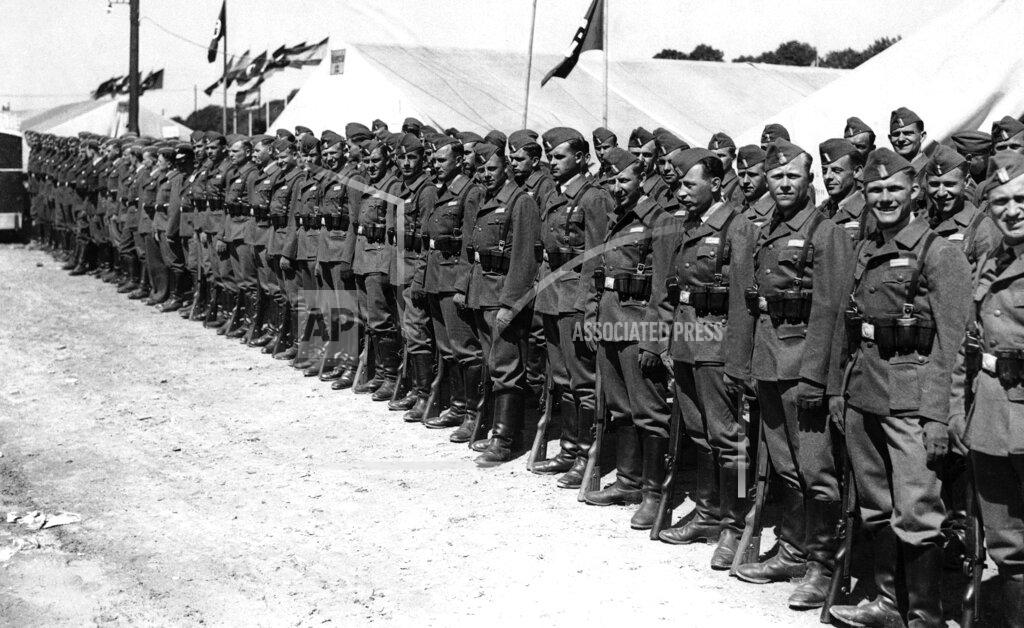
The Nazi-dominated Danzig Senate today began an official boycott of Polish officials, singling out three high civil servants with whom Danzigers were instructed to avoid official or social relations. All three were considered by the Senate as “implicated” in the killing May 21 of Gustav Grübner, Nazi, on whose grave in Marienburg, East Prussia, lies a wreath from Chancellor Hitler.
Arthur Greiser, president of the Senate, in a note to the Polish Government today announced the boycott and demanded that the number of Polish customs inspectors be reduced in Danzig. The action was aimed principally at Tadeuz Perkowsky, assistant Polish commissioner in Danzig, whose chauffeur shot Gruebner in Kalthof after the Poles had driven there to investigate an alleged attack on a Polish customs building. The Warsaw government has refused to withdraw M. Perkowsky from Danzig.
The other two officials boycotted were the chief customs inspector and the chief representative of Polish railways, both of whom have daily business to transact with Free City authorities. The boycott complicates relations with Poland, as M. Perkowsky is Poland’s chief diplomatic representative in the Free City when Commissioner Marion Chodacki is absent.
It became known that the German Propaganda Minister, Dr. Joseph Goebbels, would address a group of artists in Danzig on June 18 in his capacity as president of the German Culture Chamber.
Polish newspapers today reported friction between Poles and Germans in Polish Silesia had been carried even into church services. Press reports asserted a German Roman Catholic priest had slapped two Poles at Lipiny when members of a Polish patriotic organization began singing a religious-patriotic hymn at the conclusion of a German church service.
It was reported that Polish and German Catholics were crowding into the same church services instead of attending separately as has been the custom. During Polish services the Germans sing loud in German and during the German services the Poles intervene lustily with their own songs.
Jews are leaving Austria at the rate of about 200 a day, and if that rate should continue the remaining 200,000 would be gone within three years. In the fourteen months since Chancellor Adolf Hitler annexed Austria to Germany some 100,000 Jews have left. Some hundreds, it is generally admitted, have smuggled themselves into other countries, notably into Greece and Palestine, and many have gone to Shanghai simply because they could gain admittance there. A man who is released from a concentration camp and told he must emigrate within a fixed period or else be reimprisoned is not very particular where he goes, or by what methods he gains ingress into another country.
A State that seeks to rid itself of Jews is likewise not greatly interested in what happens to them after they cross its frontiers. Thus for the 200,000 Jews who remain as an alien and outcast mass in Vienna, where they are being driven from many apartments and forced to live outside the city or in overcrowded rooms within it, any exit is welcome, and many living on the verge of starvation have felt they could not wait for the official doors of foreign countries to open if meanwhile even a chance appeared of getting abroad in less formal ways.
Some of the Jews still living in Vienna are able, with the permission of the State, to draw limited sums from their bank accounts, pending virtual confiscation of this and other property upon emigration. Others have no resources and rely upon charity. For these the Jewish organization, the Gemeinde, does what it can, supplying food and sometimes lodging until the route abroad opens, and then supplying funds for emigration.
The resources of the. Gemeinde are derived chiefly from contributions of well-to-do Jews, who are obliged to pay upon departure a part of their cash funds (up to 25 per cent) to the Gemeinde. It is officially said that certain payments are made also by the State to facilitate emigration. The fourteen soup kitchens maintained by the Gemeinde are said to feed more than 30,000 persons daily. They get only the midday meal, plus two eggs and a portion of bread each to take home. Beyond this they have nothing to eat, save in many cases in which non-Jews surreptitiously help them.
German veterans plan to stage a huge parade in Berlin tomorrow.
The Italian government provided the Albanians with a new constitution, which established a Superior Fascist Corporative Council. The king, however, retained extensive control over the council.
A treaty was signed in Rome giving Italy the right to manage Albania’s foreign affairs and represent Albania abroad.
The British remain hopeful of reaching agreement on a defense pact with the Soviet Union. The French, however, are increasingly pessimistic. The Soviets appear to be insisting on any mutual assistance pact providing assurances of western support, if the Soviets should decide to enter the Baltic states to “protect Soviet borders.”
Beaten by swift tides, the lack of proper salvage equipment and what many persons believe was uncertainty of action, the British Admiralty last night gave up hope of rescuing any of the ninety-nine men now known to be entombed in the sunken HMS Thetis in Liverpool Bay. After publication of the official list Vickers-Armstrongs found another of their employees was aboard the Thetis, bringing the total of deaths to ninety-nine. She thus dived with 103 men aboard. The normal full complement was fifty-three. Apart from the additional air these extra men consumed, some naval writers hold, there were far too many aboard.
It is thought death finally overtook the men, piled on one another against the bulkheads of the tilted submarine, shortly after 2 AM yesterday when the last faint tapping was heard by divers, who were struggling in the slack tide to fix airlines to the central chambers. Slow suffocation, intensified by chlorine gas which, according to one of the four survivors who escaped through the Davis hatch, was beginning to catch at their throats early Friday morning, must have been their end.
A possible explanation of why more men did not escape through the Davis hatch was advanced by Lieutenant Kenneth Edwards, naval writer, who points out that every time the escape hatch was used two tons of water entered the submarine. “With the Thetis tilted over thirty degrees, it might have been impossible to confine that water to the bilges,” he says, “and a situation might have arisen in which the ingress of any more water would have flooded the electric batteries. This must be avoided at all costs, for if sea water reaches electric batteries, it produces chlorine gas.”
In the Thetis the batteries were under the floorboards of one of the central compartments and it is possible that the four tons of sea water that cascaded down the interior after the escape hatch had been twice opened reached the batteries and the rest of the crew were gassed.
Britain’s first conscripts under the Military Training Act were enrolled.
A contract for 310 Spitfires is signed. The price of the airframe, without engine, guns and equipment, is set at 4,500 pounds. It will finally increase to 6,033 pounds for the first 310 aircraft.
British Winston Churchill writes in Collier’s magazine: “Unless some change of heart or change of regime takes place in Germany, she will deem it in her interest to make war, and this is more likely to happen in the present year than later on.”
The question of the Aland archipelago’s refortification, which the League of Nations Council, because of Russian opposition, left unsolved last week, has now assumed an increasingly gloomier aspect after the recent declaration of the Russian Premier that the Soviet has important interests to protect in connection with the islands.
It is felt in Finland that the Soviet Union is using the Aland problem as a lever to push other strategic projects in the Baltic, including a demand to guarantee Finland’s “neutrality” in a prospective war. Finland’s Diet will probably pass the Aland measures in the next few days but in view of the diplomatic implications it is possible that they will be left unsanctioned by the President. Finnish public opinion seems to be averse to starting renewed negotiations with Russia with a view to appeasing the latter’s suspicions that Finland intends playing Aland into Germany’s hands, because it is held here that Finland’s neutrality is already clearly manifested.
There are insistent rumors that Russia might change her attitude on the Aland question if Finland were willing to make territorial counter-concessions, but it is reported that Finland will absolutely refuse such a compromise.
The name of Vice President Garner will be placed before the Democratic Convention in 1940 as a candidate. for President, regardless of any other name or names that may be offered. If he is the choice of the convention, he will accept the nomination. These assertions were made today by persons competent, if not authorized, to speak for the forces backing the candidacy of the veteran Texas leader. They came as the answer from that source to the third-term agitation for President Roosevelt, being offered at the time when the agitation had begun to get under the skins of some of the old-line Democratic Senators and Representatives.
For the last week or ten days the third-term discussion has really been growing troublesome to many of the old liners. Most of them had sought to ignore it, but with the announcement of tentative plans for a transcontinental tour by the President there began to take on in their minds the appearance of a definite possibility that Mr. Roosevelt might run for a third term.
As a result, there has been much private discussion among some of the veteran Democrats, particularly from Southern border States, of what they should or could do in such an event. The possibility of a “rump” convention, should the regular convention nominate Mr. Roosevelt again, has been mentioned among them, and so has the strategy of out-and-out pre-convention fights in the primaries of next Spring and Summer.
A lack of enthusiasm for Mr. Roosevelt and his policies, although that is definitely involved, is not the only factor considered in these cloakroom and private office discussions. Old-line Democratic Senators and Representatives feel that if Mr. Roosevelt is renominated the overpowering issue in the campaign will be the third term and that they and their party will have to stand or fall on their ability to break a tradition which most of them really wish to preserve. Whether Mr. Garner would be available to lead a convention rebellion in case Mr. Roosevelt sought to defy the third term taboo is a question which his backers would not answer today with anything like the definiteness with which they announced that his name would be offered the 1940 delegates. The Garner people are proceeding on the assumption that the President will not even allow his name to be presented. But should that happen, they see no reason why the convention delegates should not have a choice between a man who was elected President twice and the man who has been elected Vice President twice.
President Roosevelt has been told by some of his closest Congressional friends that unless Congress gets a chance to vote on Wagner Labor Act amendments this session, House investigation of the National Labor Relations Board is inevitable. This became known today as influential House members started a quiet campaign to obtain support for an investigation resolution. which Representative Cox, Democrat, of Georgia, has introduced. Mr. Cox said he would ask the Rules Committee to approve his resolution unless the Labor Committee reports amendments “in time for action this session.”
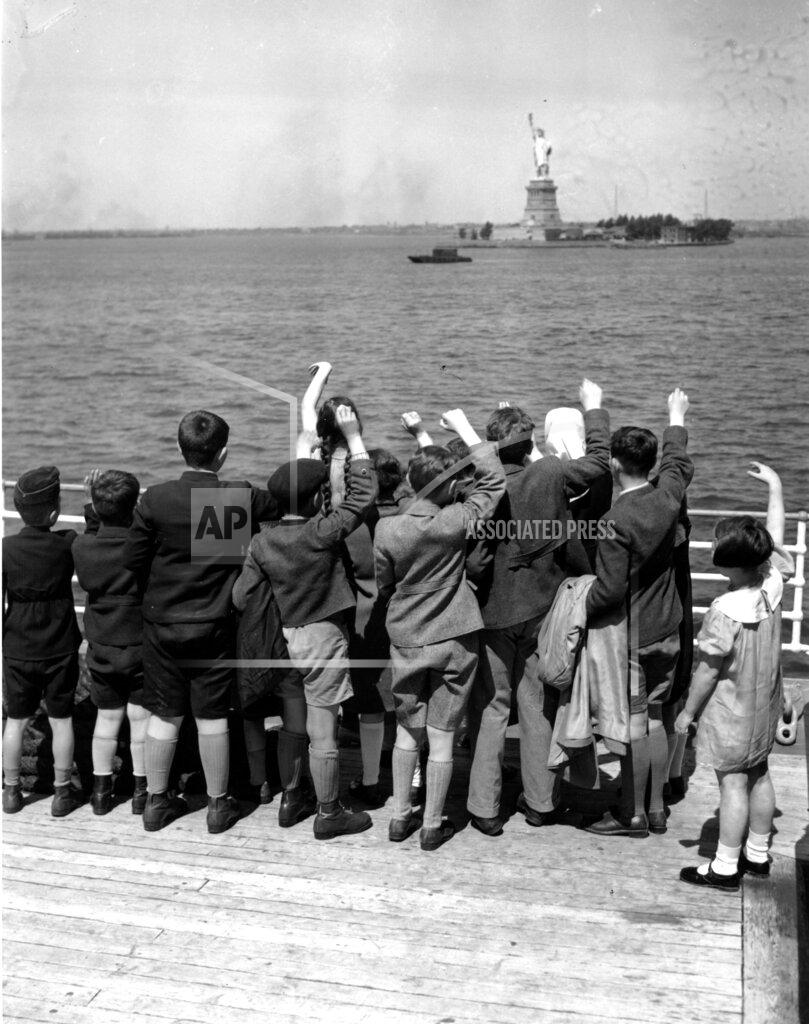
Fifty Jewish child refugees, half of them boys and half girls, aged 5 to 14, arrive in New York harbor from Vienna on the liner President Harding.
Charles Evans Hughes, the Chief Justice of the United States, is suffering from a duodenal ulcer and will be confined to his home for some time, it was announced today at the office of Charles E. Cropley, clerk of the Supreme Court. There is no reason to “doubt his full recovery,” said a statement by Nelson A. Potter, the assistant clerk in charge of press relations, but, it added, the Chief Justice, who is 77 years old, “must have complete rest for the time being.”
Unemployment benefit payments totaled $542,289,167 on May 1, with a total of more than $33,450,000 in benefits paid in April, and first claims received from 1,007,880 unemployed insured workers, the Social Security Board said today. Payments began in January, 1938, in twenty-two States, and in April of this year were being paid in forty-seven States, the District of Columbia, Alaska and Hawaii. In July, when Illinois and Montana begin their benefit-paying programs, job insurance will be in full operation in every State.
The U.S. Army is investigating whether there are grounds for the court-martial of Major General George Van Horn Moseley.
“Beer Barrel Polka” by Will Glahe hits #1 on the pop singles chart.
Joe Sprinz fractures his upper jaw in twelve places and has five teeth knocked out attempting to catch a ball dropped 800 feet from a Goodyear blimp. ‘Mule,’ a catcher with the PCL’s San Francisco Seals, had been participating in Baseball Day at the Golden Gate Exposition on Treasure Island in San Francisco Bay when the ball hit his upraised glove and was driven into his face, resulting in a two-month stay in the hospital.
Tony Lazzeri’s seventh-inning home run provided the margin of victory as the New York Giants downed the Cardinals, 6–5, at the Polo Grounds.
The Yankees, playing in Cleveland, subdued the Indians, 3–2.
At Ebbets Field the Chicago Cubs scored six runs in the eighth to beat the Brooklyn Dodgers, 10–5.
The Cincinnati Reds, leaders in the National League, were topped by the Boston Bees, 4–3.
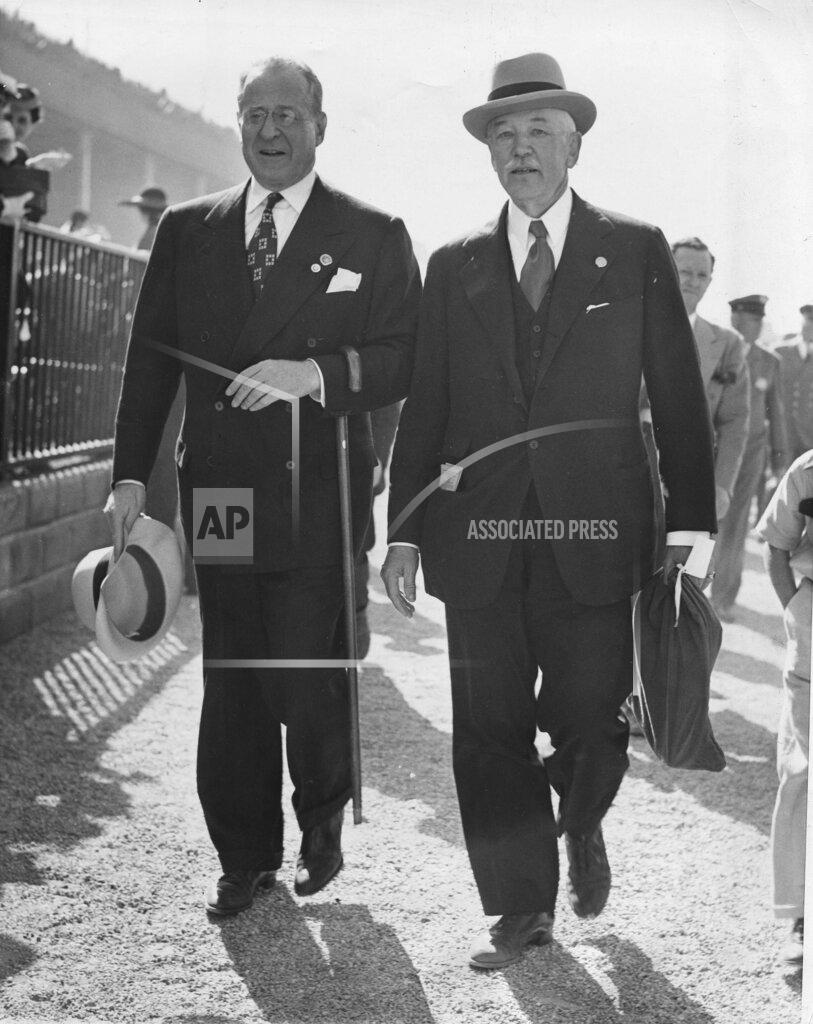
71st Belmont Stakes: James Stout riding Johnstown wins in 2:29.6. William Woodward’s Johnstown, 1 to 8 in the betting, led all the way to win by five lengths in the seventy-first running of the Belmont Stakes. Johnstown thus added $37,020 to his earnings and became the leading money winner of the year with a 1939 total of $124,645. A. C. Bostwick’s Belay, paying 7 to 1 to place, finished second to Johnstown, with the Wheatley Stable’s Gilded Knight third.
Argentina, Paraguay, and Mexico shut their borders to 304 German Jewish refugees.
Germany has reportedly acquired one of the most important air bases in South America in exchange for rearming Bolivia. This air base is situated at Trinidad, on the Mamore River, one of the headwaters of the Amazon. The German-owned Bolivian Airways has had a small landing field at Trinidad for several years, but the Germans are now constructing a huge modern air base, apparently with the object of accommodating transatlantic planes.
News of the construction of this new air base in the very heart of the South American continent happens to coincide with news from Europe that the Germans are using pressure against General Francisco Franco to acquire an air base on the Spanish island of Annobon, off the west coast of Africa. The acquisition of Annobon would give the Germans an important base within a short flight of the South American coast.
The Bolivian concession to the Germans at Trinidad has been surrounded by unusual secrecy. Private reports from Bolivia state that it has been given in exchange for arms, munitions, motorized army equipment and military planes. The Bolivian General Staff has launched a two-year rearmament plan designed to restore the army to an efficient war footing. The General Staff plans are based on the theory that Bolivia may have to fight another war in defense of her petroleum fields.
The Japanese Army is blocking efforts of neutrals to leave the Japanese-occupied city of Hankow for Shanghai aboard two British Yangtze River steamers. The army was adamant, despite special permission granted by Japanese Navy officials to the neutrals to leave aboard the steamers which brought supplies here for units of the British Yangtze patrol. The army’s stand was alleged to have been in retaliation for the recent action of two American gunboats which took a group of neutrals, including Soviet Embassy officials, to Shanghai.
A large number of neutrals have been endeavoring to leave Hankow, but the Japanese have objected, although Japanese cargo ships have been running regularly between here and Shanghai carrying Japanese. Those seeking to leave include the United States vice consul and citizens of France, Germany, Russia and Italy. The army’s action further embittered already strained relations between the military and the neutrals. The order to halt the departures came as the British steamers were taking on baggage which the Japanese forced them to return to the shore.
Dow Jones Industrial Average: 137.12 (+0.38).
Born:
Ian Hunter [Patterson], British rock singer (Mott the Hoople – “All the Young Dudes”; “Roll Away the Stone”; solo – “Just Another Night”), in Oswestry, England, United Kingdom.
David Stock, American composer (Rosewood Reflections), and conductor (Pittsburgh New Music Ensemble, 1976-99), in Pittsburgh, Pennsylvania (d. 2015).
Doug Hart, NFL cornerback and safety (NFL Champions, 1965-1967; Super Bowl Champions, Super Bowl I, 1966, Super Bowl II, 1967; Green Bay Packers), in Fort Worth, Texas (d. 2020).
Steve Dalkowski, American minor league baseball pitcher (108 mph fastball) and inspiration for “Bull Durham” film, in New Britain, Connecticut (d. 2020).




 History Diaries