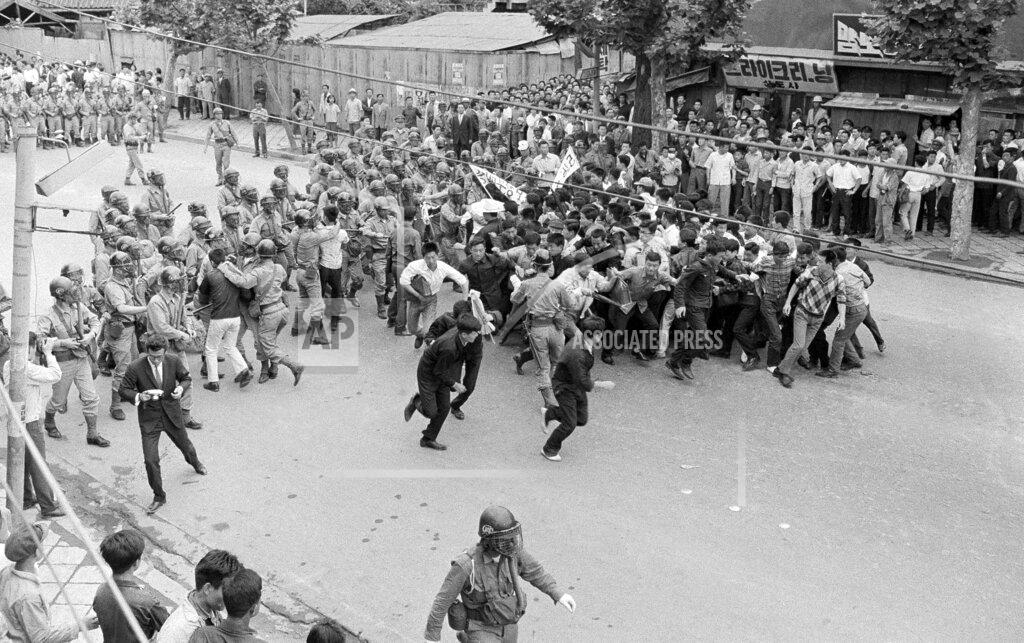
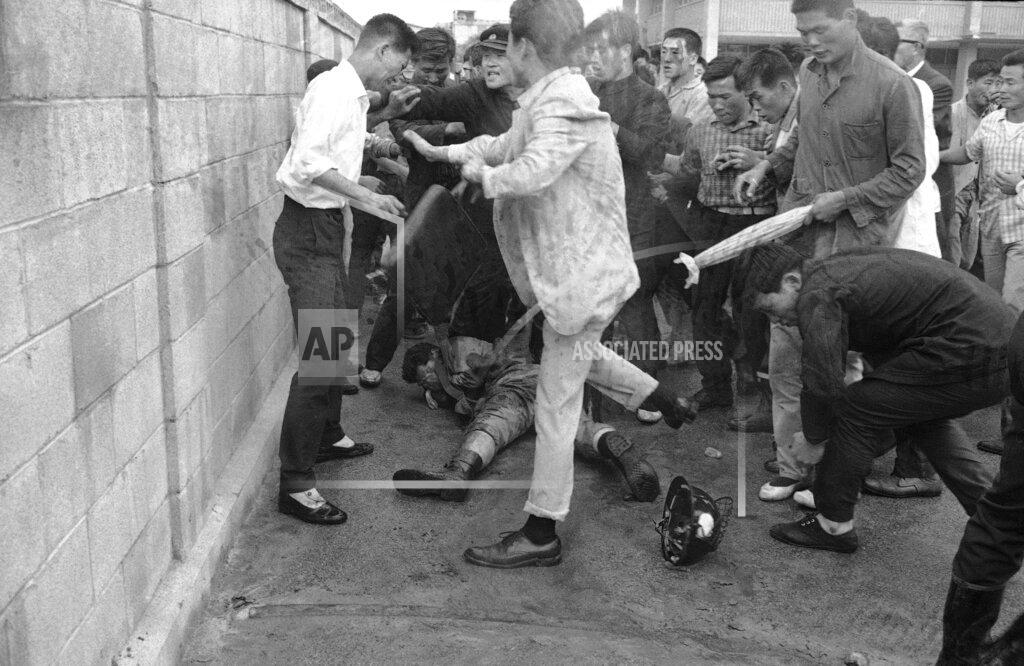
South Korean President Park Chung Hee declared martial law in Seoul, after 10,000 student demonstrators overpowered police. Park proclaimed martial law in the Seoul area tonight as mob rule threatened his government. He acted after more than 10,000 student demonstrators overpowered the police in violent clashes around the presidential mansion and other Government buildings. About two battalions of army troops were called out to take over the security assignment.
Police control broke down when barbed‐wire barricades and tear‐gas bombs failed to stop the marching students, who stormed into the Capitol compound. There they seized a dozen army trucks, which they drove through the streets as they chanted anti‐Government slogans. Crowds cheered the students and thousands followed them through the streets despite a drizzling rain.
Student demonstrations started in March as a protest against Government attempts to normalize relations with Japan, the former colonial ruler of Korea. The protests have recently been aimed at a broader target and the students have accused the Park Government of misrule. The authorities announced that 409 policemen had been injured, most of them by stones, in the clash here with the students. President Park declared martial law after he had conferred with Samuel D. Berger, the United States Ambassador, and General Hamilton H. Howze, commander of the United Nations forces in Korea. The two men flew to the presidential mansion by helicopter as the students demonstrated outside.
Rusk, McNamara and the other officials return to Washington and report to President Johnson. William Bundy prepares the briefing paper for Secretary Rusk and advises more time to ‘refine our plans and estimates,’ as well as an ‘urgent’ public relations campaign to ‘get at the basic doubts’ about U.S. interests in Vietnam.
President Johnson met this evening with his principal diplomatic, military and intelligence advisers to receive their recommendations on how best to stem Communist pressures in Southeast Asia. A number of high‐ranking officials returned after two days in Honolulu, where, on Mr. Johnson’s orders, they had reviewed the shaky situation in Southeast Asia. Secretary of State Dean Rusk, Defense Secretary Robert S. McNamara; the Chairman of the Joint Chiefs of Staff, General Maxwell D. Taylor, and the Director of Central Intelligence, John A. McCone, were among the officials who reported to the President. Others attending the conference were Under Secretary of State George W. Ball, who leaves tomorrow for discussions on Southeast Asia in London and Paris; the Assistant Secretary of State for Far Eastern Affairs, William P. Bundy, and McGeorge Bundy, special assistant to the President on international security affairs.
Việt Cộng guerrillas entered the strategic hamlet of Khánh Hội-Đông Hưng, 85 miles southwest of Saigon, and, meeting no opposition, kidnapped 47 men. The action took place in daylight at the hamlet, only five miles east of the Vietnamese Army’s IV Corps headquarters in Cần Thơ. The corps controls about 25 percent of the Vietnamese Army. The report referred to the incident as an “abduction.” But sources said the fact that no shots had been fired made it likely that it was a successful recruiting drive by the Communist guerrillas.
The South Vietnamese Defense Ministry reported that Civil Guards, recruited from their home areas, killed 20 guerrillas early yesterday in a clash about 280 miles northeast of Saigon. The guards reported no casualties.
On the long‐debated possibility of extending the Vietnamese war to North Vietnam, Mr. McNamara said on arrival at Andrews Air Force Base that “no plans have been recommended to the President for approval, and none has been approved.” Mr. Johnson said yesterday that he knew of no such plans.
United States studies have found North Vietnam capable economically of sustaining its present support of the pro‐Communist Pathet Lao in Laos and the Communist Việt Cộng in South Vietnam. Analysts say North Vietnam’s economy, with the current level of assistance extended by Communist China and the Soviet Union, could afford to provide military cadres and supplies to leftist forces in neighboring countries indefinitely. The viability of North Vietnam has been scrutinized by United States experts because that Communist state has become the principal center for revolutionary activities throughout the Indochinese region.
There were indications at the Administration’s conference on Southeast Asia in Hawaii this week that relations between the United States and France had deteriorated much more than their governments were willing to acknowledge. France, as such, was not discussed at great length during the two‐day meeting in Hawaii. But the United States diplomats assembled here from posts in South Vietnam, Laos and Thailand shared the estimate of their colleagues from Washington that the French were working to thwart and perhaps even to sabotage United States policies in Southeast Asia. Still more indicative of the subsurface tension was a widespread feeling among the Americans that spite — a wish to see the United States fail in a region where France could not succeed — was one of the motives leading Paris into conflict with Washington.
Senator Wayne Morse, Democrat of Oregon, described the Saigon regime of Premier Nguyễn Khánh as a “tottering instrument” incapable of resistance. He said that “for President Johnson to create the impression that the United States intends to determine the future for millions of people 7,000 miles away is not even a thinly disguised kind of imperialism.”
The Soviet Union attacked an African compromise proposal today under which the Security Council would establish a committee of three members to investigate violations of Cambodian territory. It was generally predicted, however, that the Soviet delegate would not veto the resolution in view of the fact that it has been accepted by Cambodia. Nikolai T. Fedorenko, the Soviet delegate, held to the Soviet position that the three‐member International Control Commission, established under the Geneva agreements of 1954, which ended the Indochina war, should assume the responsibility of investigating the border complaints.
Kenya and the United Kingdom signed the Defence Agreement of 1964. The Royal Air Force would be able to fly over Kenya, the Royal Navy to put into port at Mombasa, and British forces to train in Kenya twice a year. In return, all British troops in Kenya would be withdrawn by December 12, the British Army would commit to training the Kenya Rifles as a national army, the Royal Air Force would train the newly established Kenya Air Force, and a small Kenya Navy would be established at the end of the year.
Spear‐waving rebels massed on the doorstep to Bukavu today. At the same time the Congolese Army rushed reinforcements into this beleaguered capital of Kivu Province. Air reconnaissance showed more than 300 rebels concentrated on the road at Kamaniola, a village about 25 miles south of the city. This is the largest group of rebels sighted since the Kivu rebellion began more than six weeks ago. Rumors spread today that the rebels were planning to attack Bukavu tonight both from Kamaniola and from the hills west of the city, where Kabare tribesmen are believed to have joined the rebellion.
Premier Levi Eshkol said last night that the Israeli Government did not believe Arab hostility to his nation’s Jordan River water project would cause armed conflict. “It is our assessment,” he said, “that there will be no violence on this question and we hope that the Arabs will desist from their attitude of barren hostility.”
A British destroyer and landing party captured five antiCastro Cuban exiles and three other persons as they loaded up at a clandestine ammunition dump at Anguilla Key for a raid on Cuba, authorities reported today. More than 1,000 rounds of ammunition were reported to have been confiscated.
U.S. President Johnson gave an awesome accounting today of United States military strength, saying it now exceeds the combined might of all the nations in world history. He said this country was stronger than “any adversary or combination of adversaries,” and went on: “Against such force the combined destructive power of every battle ever fought by man is like a firecracker thrown against the sun.” But he emphasized that this “staggering” strength was not to destroy, but to save, not to put an end to civilization, but to “put an end to conflict.” In an inventory of the nation’s arms and manpower, the President listed 1,000 fully armed strategic missiles ready for retaliation, more than 1,000 strategic bombers, an increase of 45 per cent in combat‐ready divisions and 75 per cent in airlift capacity, and a 60 per cent increase in the number of nuclear warheads in Europe.
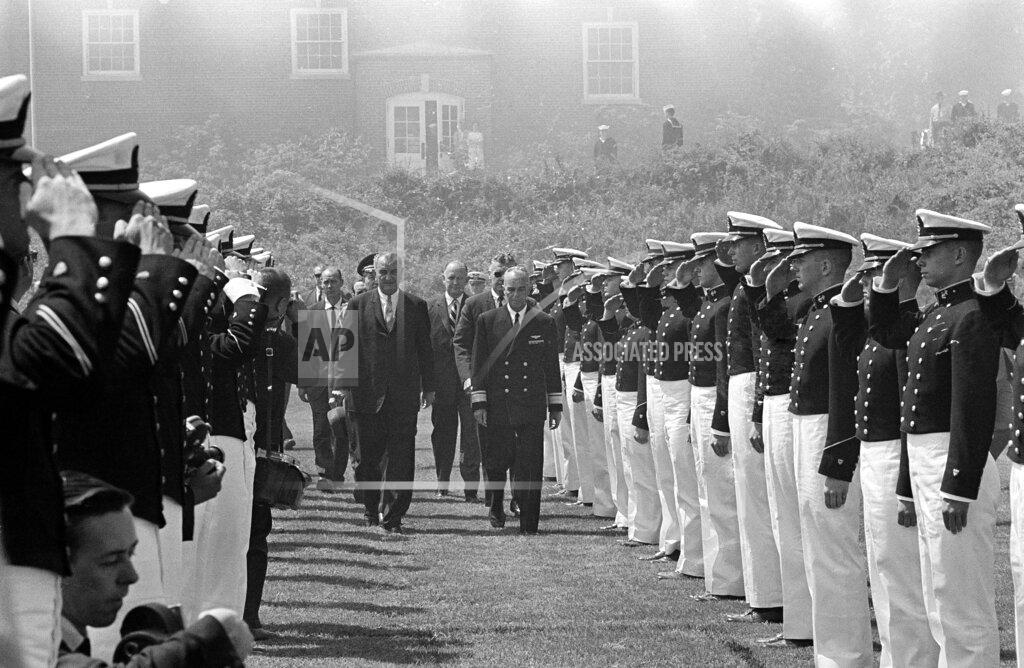
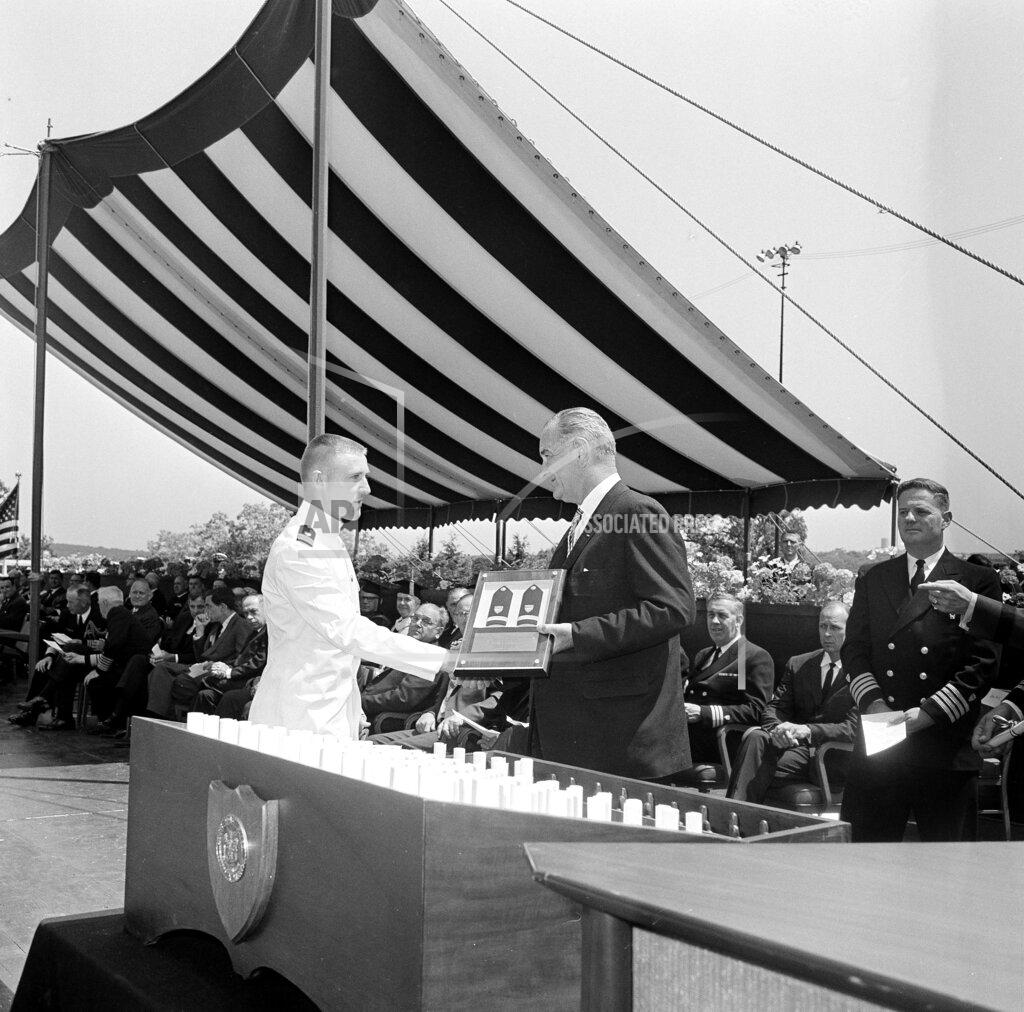
The nation’s adversaries, convinced that direct attack would be useless, are resorting to terror, subversion and guerrilla warfare, the President said. He pledged that American might would be increased still further to impress upon the enemy that such tactics would fail. “We, as well as our adversaries,” Mr. Johnson said, “must stand in awe before the power our craft has created and our wisdom must labor to control.” President Johnson discussed the nation’s military posture at the 78th commencement of the United States Coast Guard Academy here. Mr. Johnson, who handed commissions to 109 members of the graduating class at open‐air exercises, spoke in grim, almost somber tones, as he ticked off five “areas of increasing strength” in the American military establishment.
These included ability to deter atomic destruction, to fight “less than all‐out war,” to combat subversion, to develop new weapons for “deterrence and defense” and to increase the capabilities of the American fighting man. He reported that the United States now had 1,000 fully armed strategic missiles ready for retaliation. “The Soviet Union has far fewer,” he said, “and none ready to be launched beneath the seas. We have more than 1,000 strategic bombers, many of which are equipped with air‐to‐surface and decoy missiles to help them reach almost any target.” He said it was estimated that the Soviet Union would have difficulty sending less than one‐third of this total over targets in the United States.
He also gave these statistics:
The number of combat-ready divisions has been raised by 45 percent in the last three years and can be moved swiftly around the world by an airlift capacity that has increased by 75 percent. The number of tactical nuclear warheads in Europe has been increased by 60 percent.
Since January, 1961, special forces to combat internal subversion have been increased eight times. The Army now has six special action forces on call throughout the world.
The new Nike‐X, when fully developed, will give this country the option to “deploy, if national security requires it, the best anti‐ballistic missile available to any nation.”
Fifty‐two percent of the nation’s enlisted men under 25 years old are high school graduates as compared with 39 percent in the country as a whole. Sixty‐five percent of the commissioned officers hold college degrees.
Civil rights forces in the Senate engaged in an “anti-filibuster filibuster” today in a move to head off any votes on amendments until the issue of closure is decided next week. The floor was held throughout the day by strong advocates of the civil rights bill who, on this 69th day of almost continual debate on the controversial rights measure, emulated their Southern colleagues in minutely defining their position.
Yesterday the majority leader, Mike Mansfield, Democrat of Montana, turned down an offer by Southern opponents of the bill to permit voting to begin on individual amendments. His strategy was to preserve undiminished what he believes to be the growing frustration among Senators over the prolonged stalemate that has persisted since March 9. Mr. Mansfield repeated today his intention to forestall votes on the host of amendments that Southern opponents have advanced until the closure vote he has promised is held next Tuesday. “We’ve got a lot of talking to do,” he told reporters with a wry smile, adopting an argument frequently employed by members of the Southern bloc.
The effort by the bipartisan leadership to line up the 66 votes necessary to invoke Senate Rule XXII, and thereby shut off debate, continued today with growing signs that the quest would be successful. The minority leader, Everett McKinley Dirksen of Illinois told reporters this morning that he felt a growing confidence that the minimum of 25 Republican votes, to match 41 from the Democratic side of the aisle, would be available when the showdown came. He indicated, in fact, that there might be one or two to spare. A two‐thirds vote is necessary to invoke closure. That would mean 67 votes if all 100 Senators were recorded. However, Senator Clair Engle, Democrat of California, who has had brain surgery, is not expected to be present for the closure vote. That would reduce the necessary number to 66. Senator Hubert H. Humphrey, Democrat of Minnesota, floor leader of the civil rights forces, said yesterday that “more than 40 Democrats” were ready to vote for closure.
One of the more prominent Republican holdouts, Senator Bourke B. Hickenlooper of Iowa, today indicated a possible softening of his attitude toward voting for closure. He said he would favor closure if it promised to lead to enactment of a “satisfactory” rights bill, or if it were the only way to end pointless paralysis of the Senate’s business. He added, however, that he would not favor closure if it would lead to enactment of a bill he regarded as unsatisfactory. And the present bill needs more “sanitizing amendments,” he said, before he would find it acceptable. He did not give details.
Senator Barry Goldwater’s victory in the California Republican Presidential primary yesterday has put him tantalizingly close to the GOP nomination. The California race was a close one, with the outcome uncertain until late this morning. Senator Goldwater held a lead of about 59,000 votes out of more than 2 million. In the final unofficial returns, with all of the state’s 32,861 precincts reported, Senator Goldwater had 1,089,133 votes to 1,030,180 for Governor Rockefeller. Different tabulations throughout the early part of the day showed varying results, with the Governor sometimes leading and with the Senator ahead at other times.
Mr. Goldwater did best in Los Angeles County. His margins in Southern California were enough to put him finally ahead of the New Yorker, who ran well in the north and in the farm areas. The Senator may virtually wrap up the nomination at Republican state conventions this weekend in Alabama, Colorado, Hawaii and Washington. Mr. Goldwater’s campaign headquarters maintained today that the 86 national convention delegates won in California brought to 454 the number of delegates “publicly committed” to the Arizona Senator. This was close to an Associated Press poll of elected delegates that gave him 438. For nomination, 655 votes are needed.
To date, 1,053 delegates have been selected, leaving a total of 255 to be selected at state conventions between now and June 20, when Montana holds the last Republican state convention of the year. If Mr. Goldwater could win 201 of the 255 delegates left to be selected, he would have an automatic first‐ballot victory at the convention, which opens July 13 at San Francisco. It may be doubtful that he can do so well in the coming state conventions.
Governor Rockefeller said yesterday that present indications were that Senator Barry Goldwater would be nominated for President on the first or second ballot at the Republican National Convention. “But there’s a long time between now and the convention in San Francisco and it’s hard to tell what is going to happen,” he added. The convention opens July 13. Mr. Rockefeller said he intended to stay in the fight for the nomination “to the end,” but his main stress was on the need to formulate a “forward-looking” platform and on his intention to fight for this platform. He said he thought every Republican would support Mr. Goldwater if he ran on this type of platform but he declared that the Arizona Republican would have to decide “where he stands.”
Senate and House conferees agreed today on a $1,336,687,143 supplemental appropriations bill to tide over a number of agencies and departments until the end of the fiscal year June 30. The figure was $12,950,000 below the amount approved by the Senate last week, but $71,773,454 higher than in the House version. Both houses may act tomorrow on the compromise. The compromise includes $20 million to revive the lagging Federal manpower training program. Approval of new training projects has been cut to a third the former rate since the first of the year because of a lack of funds.
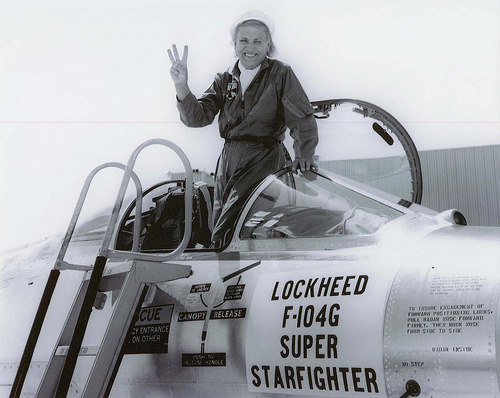
At Edwards Air Force Base in the high desert of southern California, Jackie Cochran set a third Fédération Aéronautique Internationale (FAI) speed record with the Lockheed F-104G Starfighter, 62-12222. She flew over a 500 kilometer (310.686 miles) closed course, without payload, averaging 1,814.37 kilometers per hour (1,127.397 miles per hour). She broke her own record, set over the same course in 1953 with an Orenda-powered Canadair Sabre Mk.3. Cochran set three speed records with this F-104 in May and June 1964.
Ringo Starr collapses from tonsillitis and pharyngitis, just before the Beatles embark on a World Tour.
In Los Angeles, the Angels sweep two from the Red Sox, winning 2–0 and 9–8. The Sox outhit the Haloes 10–4 in game 1 but Fred Newman shuts out Boston. Bob Lee gets a save, then another in game 2 as the win goes to Don Lee. The Angels plate 2 in the 8th to overcome a grand slam by Tony Conigliaro.
The Washington Senators combined home runs by Fred Valentine and Dick Phillips with two unearned runs to hand the Detroit Tigers their fifth straight defeat, 6–2, tonight.
Ray Sadecki held red-hot Billy Williams hitless in four times at bat today to break his eightgame hitting streak and, helped by Ken Boyer’s three‐run homer, pitched the St. Louis Cardinals to a 7–5 triumph over the Chicago Cubs. Williams, who entered the game with a streak of eight hits against left‐handed pitching, fouled out, grounded out, flied out to center field, and struck out. His National League leading batting average dropped 10 points to .412.
Dow Jones Industrial Average: 811.79 (-1.99).
Born:
James Purefoy, English actor (“Rome”), in Taunton, England, United Kingdom.
Kerry King, American heavy metal guitarist and songwriter (Slayer), in Los Angeles, California.
Dorothee “Doro” Pesch, German heavy metal singer and songwriter (Warlock), known as the ‘Metal Queen’, in Düsseldorf, West Germany.
Nelson Liriano, Dominican MLB second baseman, pinch hitter, and shortstop (Toronto Blue Jays, Minnesota Twins, Kansas City Royals, Colorado Rockies, Pittsburgh Pirates, Los Angeles Dodgers), in Puerto Plata, Dominican Republic.
Eugene Seale, NFL linebacker (Houston Oilers), in Jasper, Texas.
Eric Hodges, NFL wide receiver (Kansas City Chiefs), in Philadelphia, Pennsylvania.
Died:
Frans Eemil Sillanpää, 75, Finnish writer and 1939 Nobel Prize in Literature laureate.
Gustavo C. Garcia, 48, Mexican-American civil rights attorney.
 History Diaries