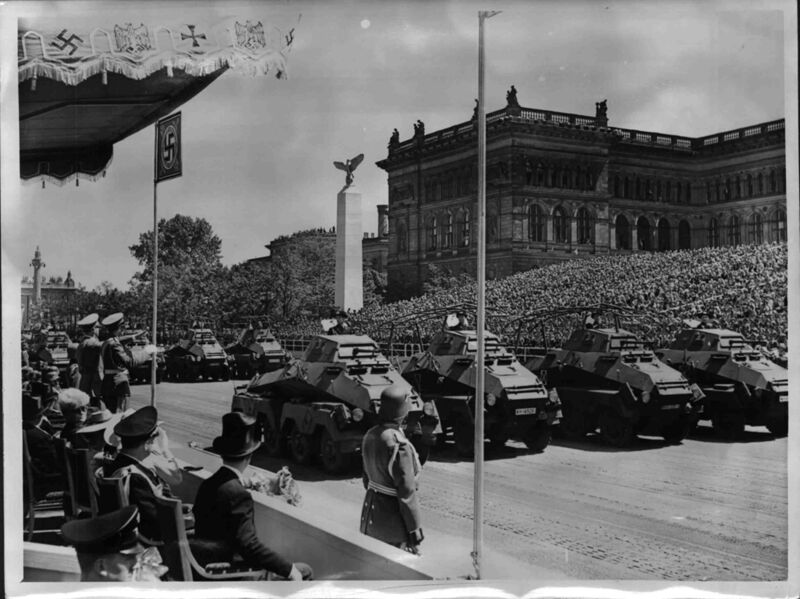
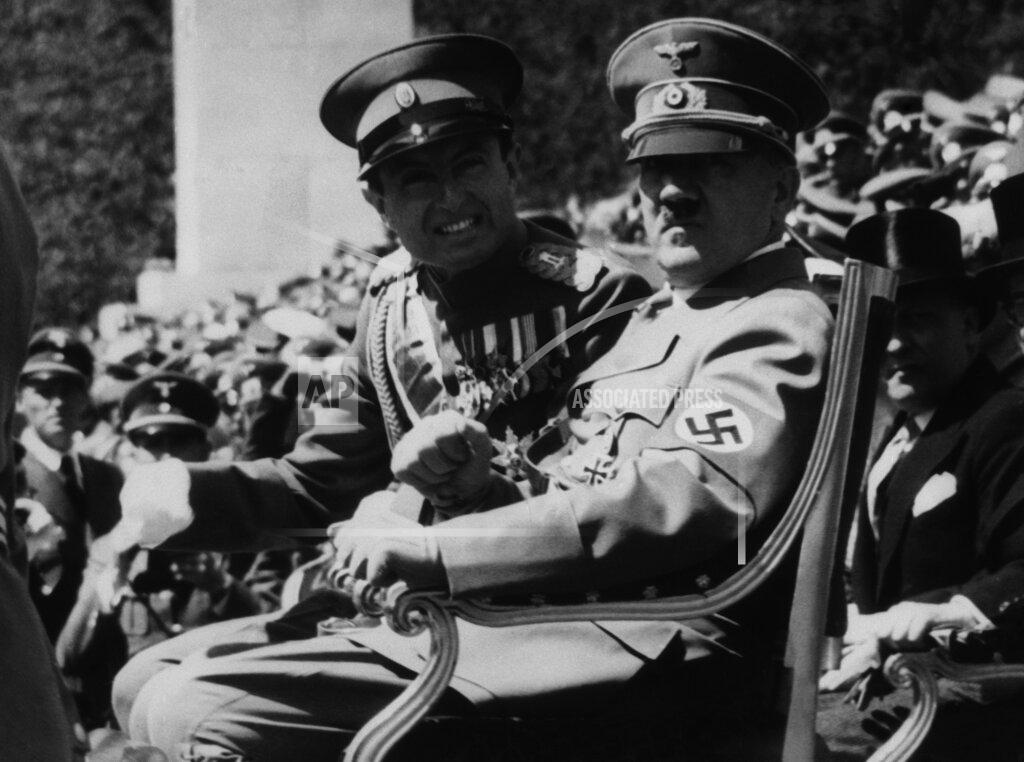
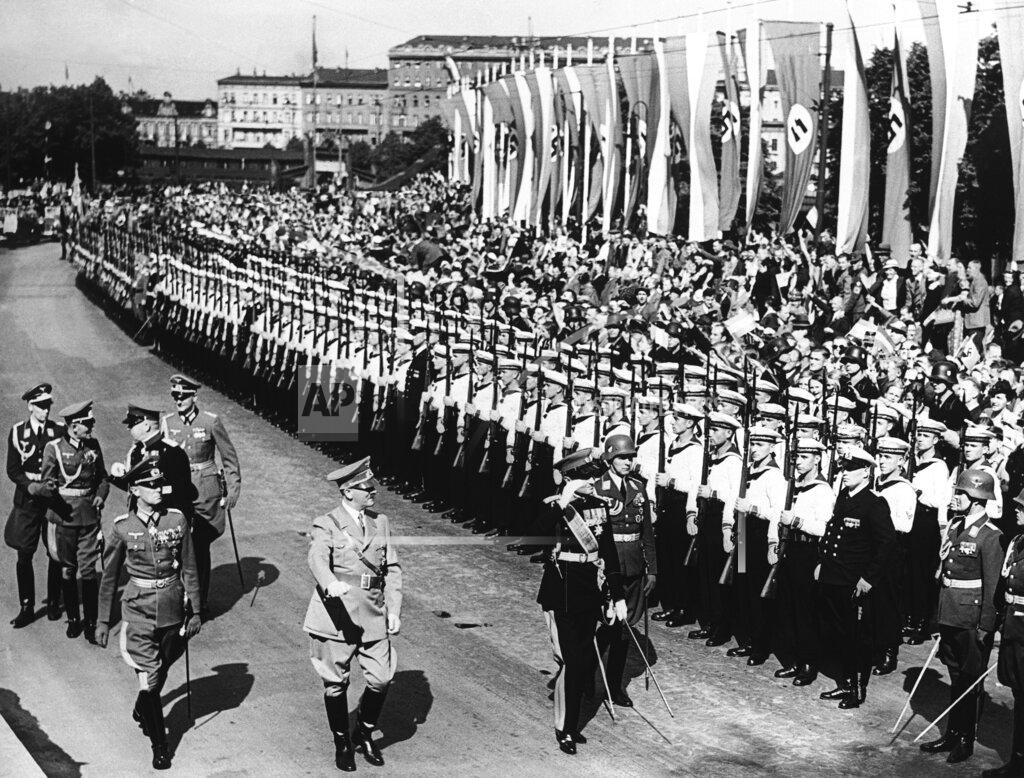
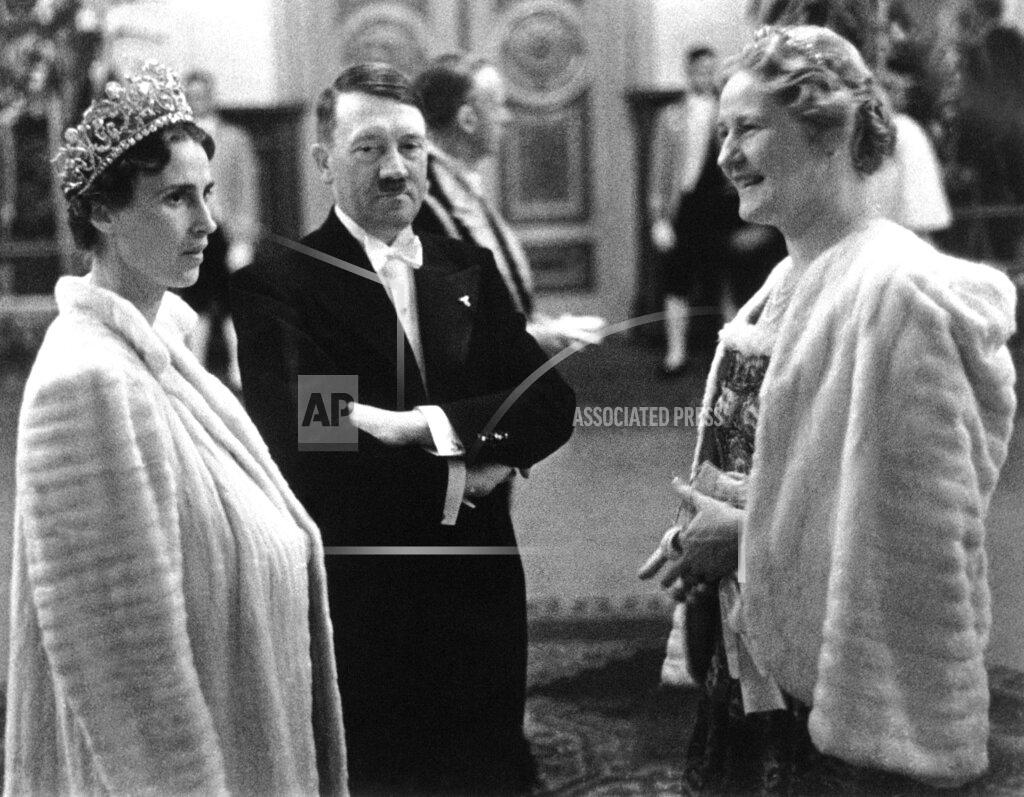
Hitler displays his army for the Prince Paul, Regent of Yugoslavia. Chancellor Adolf Hitler today staged another impressive demonstration of Greater Germany’s military might when some 25,000 troops of all arms, showing all the death-dealing equipment of modern warfare, paraded for almost three hours before him and his Yugoslav guests, Regent Prince Paul and Princess Olga along the festively decorated Via Triumphalis. Although not as big as Herr Hitler’s own birthday parade, which comprised 40,000 troops and lasted for four hours, it was nevertheless larger than the parade staged in honor of Admiral Nicholas Horthy, Regent of Hungary, last year. And though it appeared to be somewhat hastily organized from various unrelated units around Berlin, not in training camps at the moment, it was perhaps all the more effective because this circumstance detracted nothing from its grim efficiency.
This brilliant military spectacle, which for a half day converted the center of Berlin into a military camp and drew forth resounding cheers from approximately half a million spectators, who lined the parade streets without being, this time, marched to their allotted places, was obviously designed both to impress the visitors and to honor them as only ruling sovereigns of big powers are usually honored. And the Germans are confident that it achieved this purpose.
For now that Herr Hitler, by his toast of last night, has guaranteed the common border as having been “fixed forever,” just as Premier Benito Mussolini guaranteed the Yugoslav-Albanian border before this, German quarters are more than ever convinced that the present visit will be quickly succeeded by concrete agreements for the promotion of the “even closer ties” between Yugoslavia and the Axis powers that were envisaged in the toasts of both rulers last night. As interpreted in German quarters this phrase means not merely closer economic ties but the Yugoslav adherence to the Anti-Comintern pact, after the Anglo-Russian negotiations are completed one way, or another.
Such a development, the Germans insist, would not conflict with the Yugoslav “liberty and independence” emphasized by Prince Paul, and the Yugoslav spokesmen accompanying him do not, at this moment, quarrel with their hosts. Some of these spokesmen are not particularly happy about the present situation and emphasize that the sympathies of large sections of the Yugoslav population are with France and Britain.
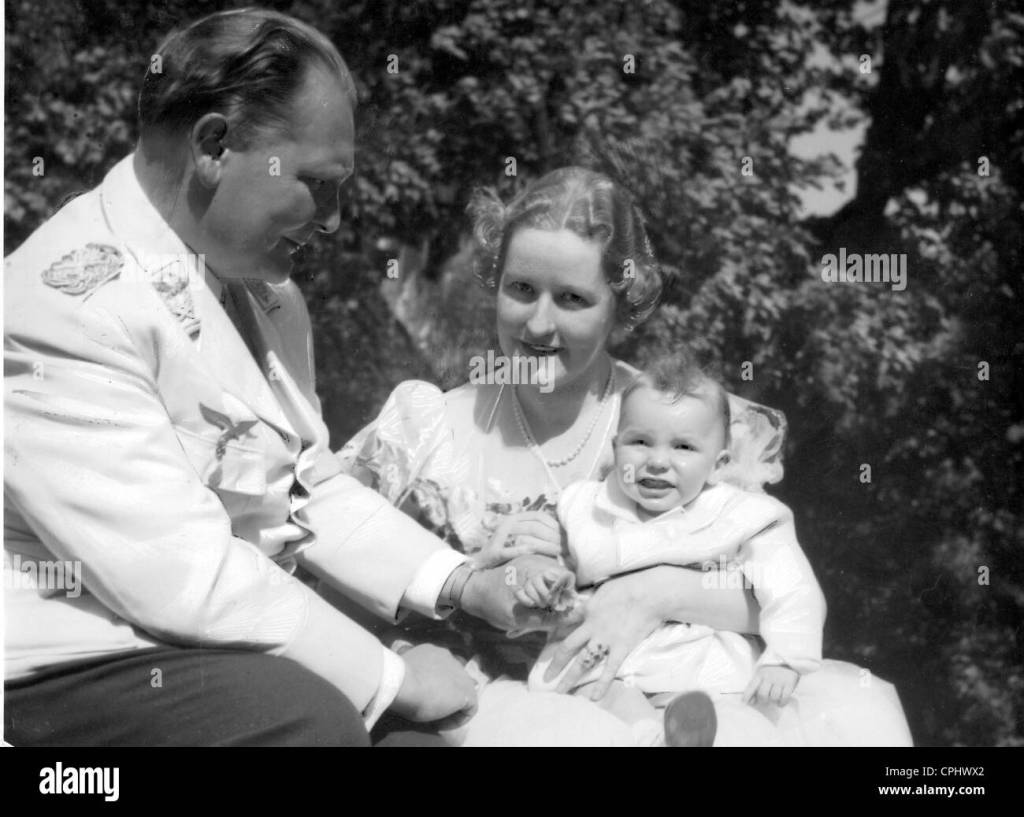
But the Germans express themselves as highly gratified with the almost unexpectedly hearty response of Prince Paul himself. He is already called “Prince Charming” by his German hosts, who expect that his prolonged stay — which includes a three-day private visit with Field Marshal Hermann Göring — will finally cement this phase of international friendship. And this, it is pointed out, will help the German and Italian allies to secure their Eastern front, which is the main point of their program for this year.
The parade was, in almost every respect, a smaller replica of Herr Hitler’s birthday parade. Herr Hitler and his royal guests sat on gilded throne-like chairs on a red plush-covered dais under a gray canopy adorned with eagles and swastikas, while behind them sat or stood a galaxy of generals in brilliant uniforms.
According to The Yorkshire Post, Chancellor Adolf Hitler has retired more than thirty officers who held leading appointments in the German forces owing to their opposition to a policy that might involve Germany in a war on two fronts. This “purge,” following that of February, 1938, prior to Herr Hitler’s invasion of Austria, now involves, The Yorkshire Post says, Major General Fritz Loeb, who is largely responsible for the military organization of industry under the Four Year Plan; General Edwin von Stuelpnagel, one of the highest officers in the German Air Force; General Quade, Commandant of the Air Force College; General Curt Liebmann, Commandant of the War Academy, and General Hermann Geyer, Commander in Chief of the Fifth Army Corps. “If last year’s precedent is any guide,” The Yorkshire Post says, “there seems to have been a sharp tussle between political and military leaders of the Reich, ending once again in victory for the former.”
The Czecho-Slovakians fear new German aggression — perhaps even outright annexation.
With at least eighty-six air-starved men still entombed in the sunken British submarine HMS Thetis, the stern of that vessel slipped from the grasp of rescuing ships in Liverpool Bay this afternoon and from then on hope rapidly diminished of saving any more than the four men who this morning floated to the surface from the submerged escape hatch of the ship.
Rome leaves war materials in Spain against a former agreement. Britain ignores Italy’s broken promise.
The Soviet reply to the Anglo-French proposals for a three-power pact against aggression was given to the British and French Ambassadors here this afternoon by Premier Vyacheslav M. Molotov at the Kremlin. Sir William Seeds, the British Ambassador, and Paul Emile Naggiar, the French envoy, conferred there for an hour on Mr. Molotov’s invitation. The answer is understood to have been “No,” though the door is still wide open for further negotiations. The prospects are still considered good for an eventual signing of the pact. No official statement was obtainable in any quarter. Newspaper correspondents, seeking to learn the nature of the reply were told, “Read Molotov’s speech.”
The nub of Mr. Molotov’s speech, as far as it concerns the pact, was his statement that it must be an effective mutual assistance pact of an exclusively defensive character; it must guarantee the States of Central and Eastern Europe, including all countries bordering on Soviet Russia’s western frontier, and there must be concrete agreement by Britain, France, and Russia regarding the assistance to be given each other and to the guaranteed States in the event of attack by aggressors.
The Foreign Affairs Committee of Sweden’s Parliament was informed today by the government that the bill for cooperation with Finland in fortifying the Aland Islands would be withdrawn tomorrow. Parliament will adjourn about June 10, but it may be summoned for an extraordinary session if action on the Aland question is required. After Premier Vyacheslav Molotov of Russia protested Wednesday against the Swedish-Finnish plan, many former adherents in Parliament became hesitant and urged further negotiations.
It is understood the Foreign Affairs Committee also was notified of the government’s intention to withdraw the bill for ratification of the naval agreement with Britain. Withdrawal means shelving, because the government maintains that Germany’s denunciation of the Anglo-German naval agreement has changed the situation. The British agreements with Sweden and other Northern countries were in the nature of supplements to the agreement with Germany.
Twelve die as terror in Palestine rages. British soldiers and Jewish policemen were shot to death in an ambush in the Sharon Valley. Four bombs exploded in Jaffa, killing five Arabs.
In Washington today, President Roosevelt canceled all engagements and remained on the second floor of the White House on the advice of his physician, and his temperature returned to normal.
With the Senate in recess its Banking and Currency subcommittee approved a bill extending the Stabilization Fund and dollar devaluation powers until 1941 and heard Administration advocates of Federally insured loans to small business. The Education and Labor subcommittee heard witnesses in support of the La Follette bill to curb anti-labor practices.
The House completed Congressional action on a bill creating the post of Under-Secretary of Commerce, received a measure to lower rates on power generated at Boulder Dam, while the Ways and Means Committee heard witnesses on revenue legislation and the Military Affairs Committee heard opposition to a bill permitting TVA to issue bonds for purchase of certain equipment. The House adjourned at 1:45 PM until noon tomorrow.
Apparently unmoved by appeals of business and industrial leaders who told him at a White House conference last night that the National Labor Relations Act was retarding business recovery, President Roosevelt has no intention of sponsoring any revision of the statute in the immediate future, it was indicated today.
This impression, which was brought away from the after-dinner meeting with the Chief Executive by eight business leaders last night, was confirmed today by Secretary Hopkins, who told a special press conference that “there was no indication at the meeting that he (the President) was in favor of any amendment to the act — he did not so indicate.” Although many specific recommendations for amendment of the labor statute were suggested by the group last night, according to Mr. Hopkins, he said that it did not follow that either he or the President would necessarily pursue the recommendations of the Advisory Council. The success of the council did not require that “the government should meet business halfway,” he added.
The complete views of the Council on the Labor Relations Act which, were given to the President informally, were embodied today in a three-page memorandum left with Secretary Hopkins. Although it had been the intention of the group to present a formal draft of its views to Mr. Roosevelt it had not been completed when they left for the White House dinner party. As one of their number reported today, it was because the group found the President indisposed and unable to attend the dinner party arranged for them that the business leaders did not present their views on the Wagner act more vigorously than they did. Some of them came away with the feeling that the meeting had been more on the social side than they would have had it, despite the frank discussion that took place.
The U.S. Navy places orders for two 45,000-ton battleships and 22 other vessels expected to cost $350,000,000. Assistant Secretary Charles Edison indicated that a major purpose of the action was to speed restoration of the 5 to 3 ratio of superiority over Japan in tonnage. Edison tells reporters “To the best of our information, the margin is now only about five to four. Japan and Great Britain were building during the years when we were idle.” The orders are placed despite the fact that the funds will not become available until July 1. Involved contract procedures normally followed will be shortened by receiving bids in advance, which Edison estimates would reduce completion time by six months.
Less than two weeks after a bill appropriating funds for an enlarged fleet was signed by President Roosevelt, the navy awarded contracts today for 159,800 tons of fighting ships, costing about $350,000,000. Plans had been made and bids invited while the bill was pending, and construction can start immediately on the twenty-four ships, twelve by private companies and twelve in navy yards. Comprising two battleships, four light cruisers, eight destroyers, seven submarines, one aircraft carrier and two seaplane tenders, they will bring the total combatant tonnage of the navy, in commission and under construction, to 1,784,690. In addition, the navy awarded contracts aggregating $5,430,576 for propelling machinery for submarines.
The 45,000-ton battleships, the largest and most powerful ever designed, will cost $80,000,000 to $85,000,000 each and will be armed with 16-inch guns, according to Charles Edison, Acting Secretary. In the main batteries these guns will number nine, three to a turret. Each battleship is expected to require 2,000 officers and men, and will have a top speed of more than twenty-eight knots, or better than five knots above that of the fifteen capital ships now in the line.
Six of the seven submarines in important respects will be like the Squalus, which sank last week off Portsmouth, New Hampshire, indicating that the navy still has faith in this type. Three submarines of 1,475 tons each were awarded to private shipyards, while three others of that size and one of 700 tons were allocated to navy yards. Two 800-ton submarines of a new type, authorized in the 1939 Naval Bill, will be contracted for at a later date, probably within a month. The four cruisers, assigned to private yards, are of a new type. Each will displace 6,000 tons and in speed will be among the fastest cruisers ever built.
The new battleships, now known as Nos. 61 and 62, will be built at the New York and Philadelphia Navy Yards, where materials are being assembled.
Danes exhibit a 3,000-year-old trumpet at the World Fair that was used to call to war or rites in the Bronze Age.
The Yankees coach says Lou Gehrig is going to the Mayo Clinic as a “sick man,” but Gehrig calls that a rumor.
The Reds score 4 in the 13th inning — 3 on a homer by Ernie Lombardi — and outlast the Braves, 4–0.
90,000 people turn out to greet the King and Queen in Edmonton, Alberta.
The Cuban government orders the MS St. Louis to leave Havana harbor. The MS St. Louis left Havana this morning. The liner St. Louis, carrying 907 Jewish refugees from Germany whom the Cuban Government refused to permit to land, left Havana Harbor at 11:30 this morning in compliance with a decree signed by President Federico Laredo Bru. The St. Louis cleared for Hamburg, Germany, according to the Cuban customs authorities. Her distraught passengers hope she will remain somewhere in the waters of the Western Hemisphere while friends, relatives and Jewish relief associations negotiate for their admittance to some other country.
Luis Clasing, agent in Havana for the Hamburg-American Line, refused to discuss the possibilities of a later agreement with the Cuban immigration authorities. He said the ship had left for Hamburg. “Of course, it might go elsewhere first,” he added. “However, we have nothing definite on this.”
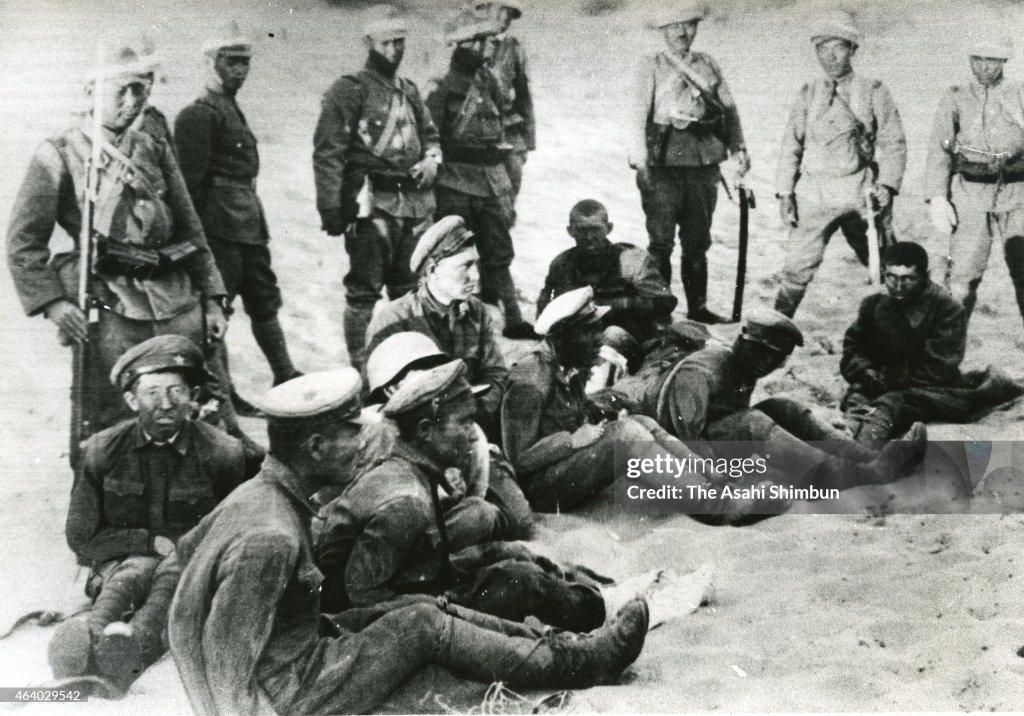
The Japanese lost in recent fighting on the Outer Mongolian border eleven officers and 114 men killed, it was announced today. The Mongolian dead, including an undeclared number of Russian soldiers, were reported by Japanese headquarters at Hsinking, Manchukuo, to total 300. The Mongolians were said to have lost fifty-nine planes, all Soviet-made, and to have abandoned fifteen tanks and other weapons in Manchukuoan territory.
In a surprise attack Wednesday Japanese troops were said to have driven the Mongolian forces from Manchukuoan territory. After a night march over sand hills the Japanese charged the Mongolian camp. The Japanese pursued till 4 AM.
The charge of Soviet Premier Vyacheslav Molotov that Japanese forces provoked border clashes was denied by official circles in Hsinking. They say Mongol frontier raids are instigated by the Soviets to promote Soviet popularity with the Mongols. The Japanese said the great loss of Mongol planes resulted because Mongol fliers were not properly trained.
A second Briton has vanished in China. The officer was sent to find a colonel held by the Japanese, and failed to report to duty. Two British officials left Peiping today to hunt for two colleagues, who are believed to be prisoners of the Japanese Army. British authorities say Lieutenant Colonel C. R. Spear, military attaché, has been under arrest at Kalgan, 100 miles northwest of Peiping, since May 26. They believe that Lieutenant John Cooper, who left Peiping Sunday to find Colonel Spear, also is being held. The Japanese disclaim knowledge of their whereabouts. Those starting out today were Brigade Major Delamain of the British forces at Tientsin and L. H. Lamb, acting counselor to the British Embassy in Peiping.
Constituting an admission that Japanese forces had crossed the Han River, eighty miles west of Hankow, after months of fighting, Chinese reports say the Japanese are advancing from Tsienkiang southward. The Japanese are separated from the river by about sixty miles of marshy, lake-studded terrain.
The captain of the British steamship Haitan brought to Hong Kong today a cargo consigned to Foochow because attempts to land it were frustrated. by Japanese naval units. Japanese small craft machine-gunned Chinese-owned lighters that attempted to reach the Haitan. The British destroyer HMS Diamond placed armed sailors on the Haitan, but after these were withdrawn attacks on the lighters were renewed. The Haitan gave up efforts to land her cargo after four days. Japanese also prevented the landing of cargo at Chuanchow, ninety miles south of Foochow.
The United States Embassy today protested to Japanese authorities against the bombing of the American Methodist Episcopal Mission at Futien, near Foochow, May 25 and 26. The mission’s residence and dormitory, quarantine station and girls’ high school were wrecked.
The Chinese representative to the League of Nations says Japan plans to sell $300 million in Chinese dollars in opium annually.
Dow Jones Industrial Average: 136.74 (+0.54).
Born:
Charles Miller, American rock-funk flutist, saxophonist, and singer (War – “Why Can’t We Be Friends?”; “Low Rider”), in Olathe, Kansas (d. 1980).
Janie Bradford, American songwriter for Motown (“Money (That’s What I Want)”), in Charleston, Missouri.
Horace Clarke, Virgin Islander MLB second baseman and shortstop (New York Yankees, San Diego Padres), in Frederiksted, U. S. Virgin Islands (d. 2020).
Jean-Pierre Gaillard, French journalist, in Paris, France.
Naval Construction:
The Royal Navy Net-class boom defense vessel HMS Dragonet (Z 82) is launched by the Blyth Shipbuilding & Drydock Co. Ltd. (Blyth, U.K.).
 History Diaries