The United States and the Soviet Union signed a bilateral treaty for the first time in 30 years, allowing for the two superpowers to establish consulates in each other’s cities. In addition, it was agreed that if an American citizen was arrested in the USSR, an American consular official would be notified promptly and be given access, and that the same right would apply for a Soviet citizen and a Soviet consular official within the U.S. The pact was signed at the Spiridonovka Palace in Moscow by Soviet Foreign Minister Andrei Gromyko and U.S. Ambassador to the Soviet Union Foy D. Kohler.
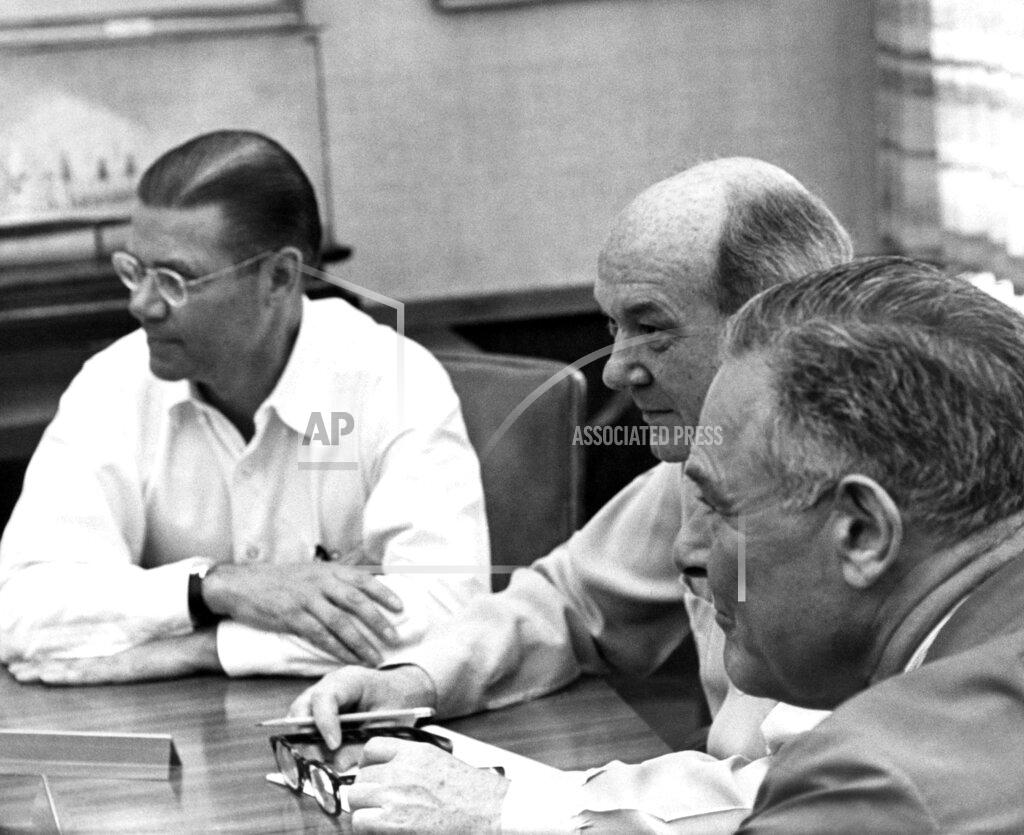
All the top U.S. officials concerned with the war gather for two days of meetings in Honolulu: Rusk, McNamara, Lodge, Westmoreland, Taylor, William Bundy, McCone and others. Much of the discussion focuses on the projected air war against North Vietnam, including a list of 94 targets. There is also discussion of the plan for a joint Congressional resolution. High Administration officials began a two‐day strategy conference on Southeast Asia today with a somewhat diminished sense of urgency about the situation in Laos.
A lull in the military sparring among the rival Laotian factions, at least for the moment, has tended to reduce the officials’ interest in hasty countermeasures, none of which had been contemplated with much enthusiasm. The officials hope now to stretch over a longer period of time a program of less dramatic political and military moves designed to combat doubts about Washington’s commitment to the region — and especially to South Vietnam. Concurrently they hope to prepare themselves and President Johnson for a faster reaction to any further deterioration of non-Communist positions there. “Uphill” is the word most often used now to describe the United States battle in Southeast Asia. The momentary calm in Laos has not diminished the difficulty of the problem, officials assert, but it has begun to refocus attention on more basic tasks.
Reliable sources said tonight that the French Government would participate in talks in Vientiane on the Laotian crisis provided they were not regarded as a substitute for an international conference of all interested powers. The talks are scheduled for tomorrow. President de Gaulle’s regime has been represented as having rejected a proposal for discussions at the ambassadorial level in the administrative capital of Laos.
The sources denied this. France, they asserted, is prepared to take part in the discussions, as long as it is understood by all concerned that the talks are not considered as an alternative to full consultations called for under Article 4 of the treaty of 1962 guaranteeing unity and independence of Laos. The treaty was signed after a conference at Geneva. Britain, co‐chairman with the Soviet Union of the Geneva conference, issued invitations for the Vientiane talks.
The French have been informed that only the United States, Canadian, Thai and South Vietnamese Ambassadors will participate in the consultations. The Government’s view is that, although the talks among this minority of interested powers may be useful, no real progress can be made toward a final solution until representatives of the other neutral and Communist powers participate. The Soviet Union, Communist China, North Vietnam, India, Cambodia and Poland will be absent from the discussions, the sources noted. Without their participation, the French find it difficult to envisage even a frank discussion of the problem with all points of view represented.
Prince Norodom Sihanouk, the Cambodian chief of state, left tonight for a six‐week visit to France. Prince Sihanouk will spend most of the month in a private clinic in the South of France before going to Paris June 24 to meet President de Gaulle.
A United States Army captain was killed and another was seriously injured today when their jeep collided with a bus on a highway 25 miles southeast of Saigon, military sources reported. Two Vietnamese in the jeep were also injured.
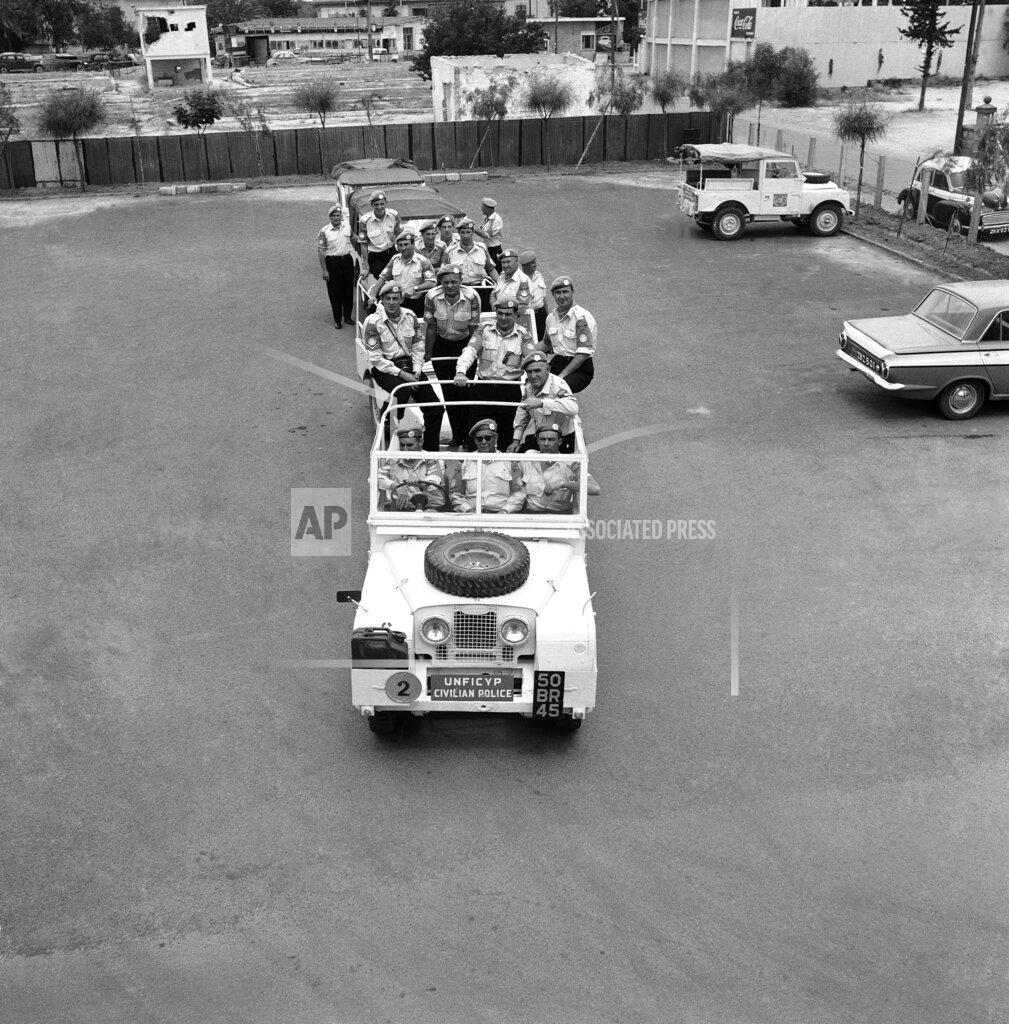
The parliament of Cyprus, the majority of whom were Greek Cypriot legislators, voted to pass a law over Turkish protests, allowing the government to establish the Cypriot National Guard and giving it authority to draft Greek Cypriot and Turkish Cypriot citizens. Vice President Fazil Kutchuk, a Turkish Cypriot, vetoed all three of the bills, which observers said would bring new warfare on the island. Greek Cypriots said they would ignore the veto and go ahead with their plans. The Parliament is under the control of the Greek community. The conscription bill provides for the draft of 25,000 men into the island’s National Guard. It was criticized by Britain and Turkey and the Greek Government was reported against it. The two other measures also were criticized.
Dr. Kutchuk’s action and the Greek Cypriot response were similar to the constitutional dispute last year that precipitated the fighting between the bitterly divided Greek and Turkish communities late in December. Dr. Kutchuk acted under the Constitution, which gives the Vice President the right of veto in defense, finance and foreign affairs. Western diplomats said his action was “completely legal” within the Constitution. The parliamentary action was carried out by the 25 Greek Cypriot members. The Turkish Cypriots are boycotting Parliament. The veto was mailed to the Greek Cypriot President, Archbishop Makarios.
President Johnson warmly welcomed Premier Levi Eshkol of Israel to the United States today, declaring it was “not only possible but imperative” for Israel and her Arab neighbors to resolve their disputes peacefully. The President told the Israeli leader the United States had been proud to help in Israel’s development and was prepared to continue technical aid to Israel. Mr. Eshkol, who arrived by helicopter from Philadelphia, is paying the first official visit by an Israeli Premier to the United States. He was accorded full military honors and a 19‐gun salute in a colorful ceremony on the south lawn of the White House. Mr. Johnson and Acting Secretary of State George W. Ball, toasting Mr. Eshkol at a State Department luncheon, dwelt on the fact that the Israeli Premier’s visit was the first of its kind since Israel was founded in 1948. This was interpreted as a demonstration of United States support for Israel in the face of continuing Arab pressure.
The Algerian Government heavily reinforced guards at key public buildings today following an attempt on the life of President Ahmed Ben Bella last night. The 47‐year‐old leader, who is regarded by most foreign observers as the key to Algeria’s political stability, was unhurt. Two guards were wounded, according to French sources, when a bomb exploded amid gunfire in front of the Villa Joly, the President’s home here. Official spokesmen refused to give details. The attack was believed to be the work of the clandestine Socialist Forces Front, whose hit‐and‐run attacks had hitherto been limited to the eastern Kabylia Mountain region. The front is headed by Hocine Ait‐Asmed, a former Deputy, who last fall briefly led the Berber minority in the Kabylia in open defiance of the Ben Bella regime.
The people of Aberdeen, Scotland, most of them scrubbed and on a restricted diet, battened down their city today and waited hopefully for an end of their typhoid epidemic. The number or confirmed cases in three hospitals in the city jumped during the day from 160 to 224. Seventeen others were in the hospital with suspected cases. Dr. Ian MacQueen, the city’s medical officer, said all the patients had been afflicted from a single can of corned beef, the slicer that had cut the meat, or the persons who had handled it. The 30,000 schoolchildren in Aberdeen were kept at home as all the public and private schools were closed. So far only one patient has died in Aberdeen, an elderly woman who was also suffering from two other serious ailments.
A total of 16 East Germans, including a border guard, and a Czechoslovak border guard with weapons and in full uniform crossed the borders into West Germany over the weekend, authorities said here today.
The Congo has appealed for United Nations troops to help put down a spreading rebellion in central Kivu Province. Nigerian soldiers here are standing by to be flown to Bukavu on the Rwanda border as soon as a decision is reached at United Nations Headquarters in New York. The request was made yesterday by Premier Cyrille Adoula when news reached here that Congolese troops were fleeing Bukavu. Late last week, two companies of elite paracommandos were ambushed by bands of rebel youth at Lubarika, 20 miles south of Bukavu. About 60 soldiers, including several officers, were reported yesterday to have been massacred and the expedition’s commander, Major Vangu, is missing.
The first Yaoundé Convention, signed on July 20, 1963, by 18 African nations (Burundi, Cameroon, the Central African Republic, Chad, the Republic of the Congo (Brazzaville), the Republic of the Congo (Leopoldville), Dahomey, Gabon, the Ivory Coast, the Malagasy Republic, Mali, Mauritania, Niger, Rwanda, Senegal, Somalia, Togo, and Upper Volta), went into effect for a five-year period to govern economic relations between the French-speaking nations that had been colonies of either France or Belgium; Somalia had been a UN Trust Territory composed of former British and Italian colonies. After the expiration on May 31, 1969, a new convention would be signed at Yaoundé on July 29 of that year.
The Kenya Air Force was established under the command of Captain Ian Sargenson Stockwell, formerly of Britain’s Royal Air Force. The RAF base located east of Nairobi at Eastleigh was renamed KAF Eastleigh, and is now Moi Air Base.
A Canadian Act of Parliament, that had been proposed by Jean Chrétien of Quebec, changed the name of Trans-Canada Air Lines to “Air Canada”, effective from January 1, 1965. The new name needed no translation in either the English or French language.
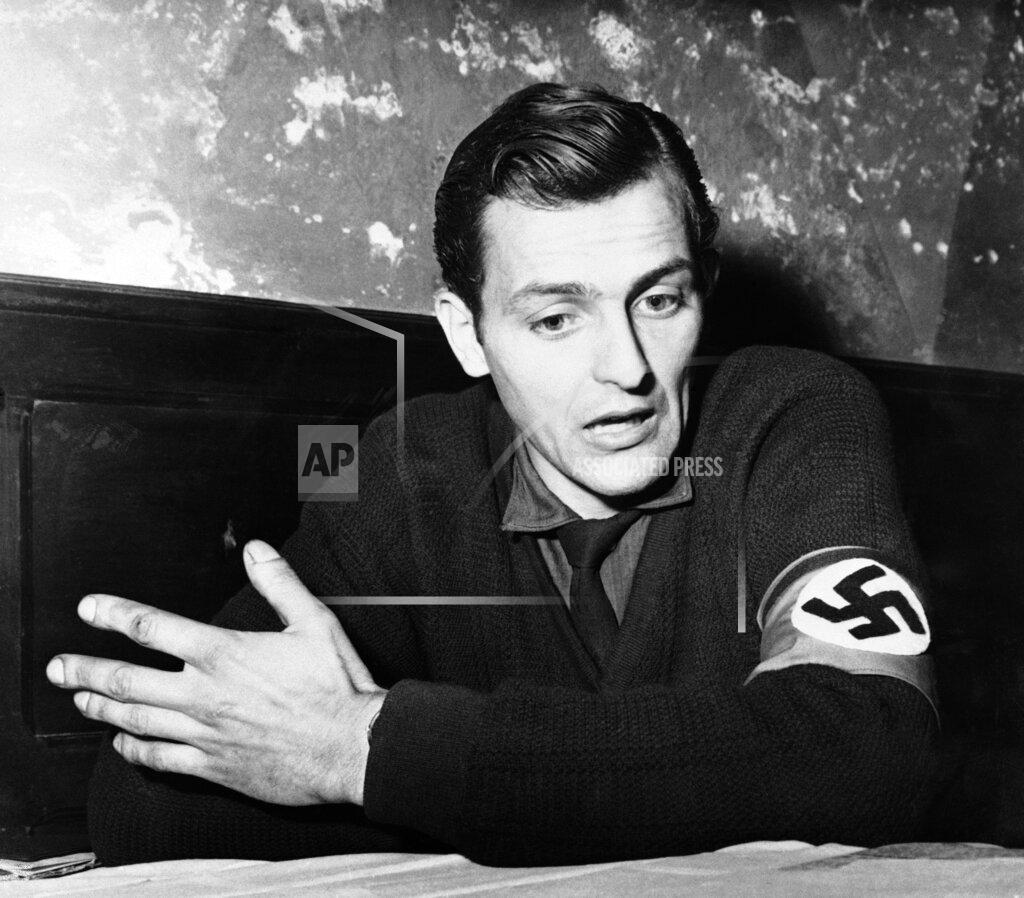
A son of Adolf Eichmann appeared in olive shirt, boots and swastika armband today and said he was active in a worldwide Nazi movement. Horst Eichmann, 24 years old, called a news conference two years and a day after his father, a former Gestapo colonel, was hanged by Israel for his role in the Nazi extermination of six million Jews. “My father fought for all those who are suffering under the international Jewish‐Zionist threat,” he said at a bar near the house where he and three brothers lived with his father until Israelis captured him in April 1960.
Barring an unforeseen development, the Senate will vote Tuesday, June 9, on the question of shutting off the filibuster against the civil rights bill. At the beginning of today’s session, Mike Mansfield of Montana, the Democratic leader, said he planned to file a closure petition this Saturday. Under the rules, a closure vote must take place one hour after the Senate convenes on the second calendar day following the filing of a petition signed by at least 16 Senators. Since Sunday does not count as a calendar day, the vote will come on Tuesday. Earlier Mr. Mansfield told reporters he planned to file the petition on Monday, June 8, and have the vote on Wednesday. However, he moved the schedule up after he conferring briefly on the floor with Everett McKinley Dirksen of Illinois, the Republican leader. The majority leader announced his plans as the Senate began the 13th week and 67th day of debate.
Mr. Mansfield told the Senate that the time had come for a decision one way or the other. “Seventy days is a long time to spend on this bill,” he said, “and I would hope that regardless of the outcome, the Senate would give its membership a right to speak on this.” Two‐thirds of the members present and voting are required to shut off debate — 67 if all 100 members are on the floor. Mr. Mansfield told reporters later that he was not certain that he had the votes in sight now for closure. “I just hope at the moment,” he said. Later in the week, he added, he and Mr. Dirksen will take a nose count. Even if the count shows them short of the necessary number, he said, the petition will be filed anyway.
“We have got to face up to it,” Mr. Mansfield declared. He added that if the first attempt at closure failed, he would try a second petition later. Mr. Dirksen, more optimistic, thought he could get the votes of at least 25 of the 33 Republicans, and possibly more. The leaders have always figured that they would need 24 or 25 Republican votes. Mr. Dirksen’s estimate is usually accurate. Between now and the closure vote, Mr. Dirksen and Hubert H. Humphrey, the Democratic floor manager of the bill, will explain at some length the substitute bill introduced by the minority leader last week.
Senator Barry Goldwater returned to California today and said that he had “never been so confident of victory” as he was in tomorrow’s California Republican Presidential primary. Mr. Goldwater was met at the airport by several hundred wildly noisy partisans and a platoon of wiggling, squealing Goldwater girls in cowboy hats. The Goldwater camp was heartened by two factors. One was the tortuously qualified language of the pollsters as they made their final predictions. The other was Dwight D. Eisenhower’s remark in New York that he had not meant to read Mr. Goldwater out of the party with his recent statement on Republican principles. Mr. Goldwater said that “it was just General Eisenhower staying in character” — or being neutral.
The conservative Senator surprised reporters by indicating he might support the civil rights bill as modified by the so‐called Dirksen amendments. However, he later altered his remarks to indicate that more modifications would have to be made on the bill before he could support it. Mr. Goldwater has opposed the public‐accommodations clause and the fair‐employment clause as “unconstitutional.” Today he said he wanted to support the bill if it were softened enough. He added that since he had voted for previous civil rights legislation, “It wouldn’t be out of character.”
California Republicans will record their feelings tomorrow about two candidates for the party’s Presidential nomination — Governor Rockefeller of New York and Senator Barry Goldwater of Arizona. Possibly 2 million of the state’s 2,895,000 registered Republicans will vote in the major remaining Presidential preference primary election. Many will presumably vote for one of the two in hope of aiding a noncontender such as Ambassador Henry Cabot Lodge, former Vice President Richard M. Nixon and Gov. William W. Scranton of Pennsylvania. Mr. Rockefeller and Mr. Goldwater are the only candidates on the ballot. No write‐ins are allowed. At stake are California’s 86 delegates’ votes at the Republican National Convention, which opens at the Cow Palace here on July 13. To nominate, 655 votes are needed.
Former President Eisenhower denied Monday that he had read Senator Goldwater out of the party in a campaign statement published last week. He called the inference a “complete misinterpretation.”
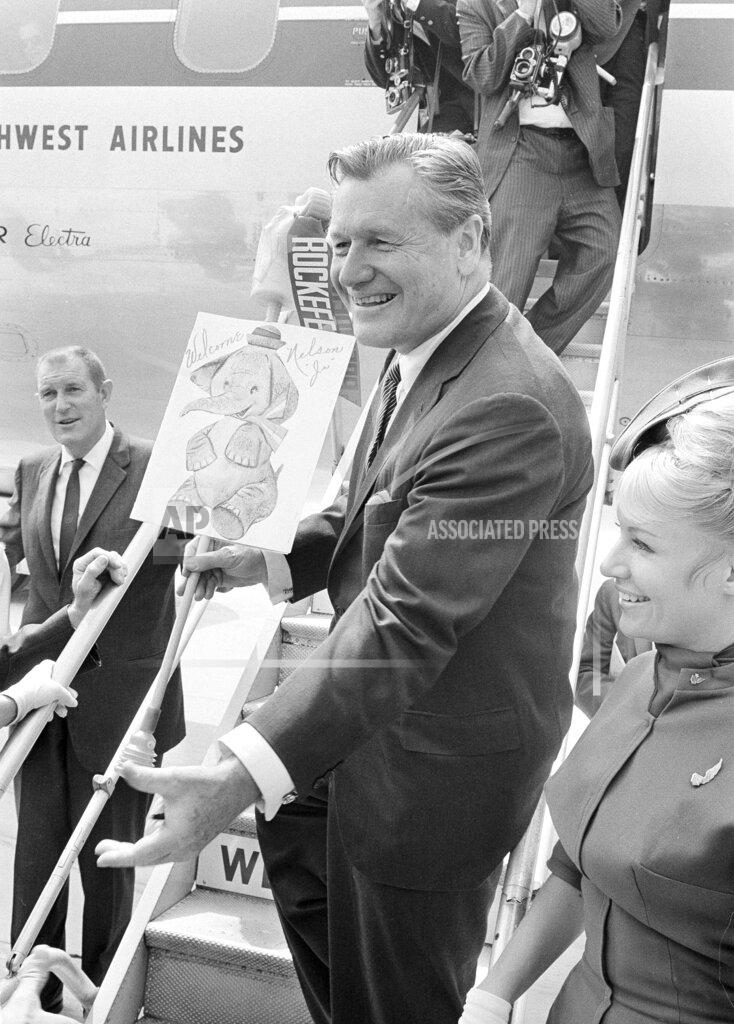
Governor Rockefeller faced down one of the more unruly crowds of his political career tonight in an improbable scene in the Los Angeles airport. It was at the end of his California primary campaign. He was met by about 700 persons. Half of these seemed to be supporters of Senator Barry Goldwater who had stayed behind for a rally at the airport after the Senator’s arrival earlier from Washington. The police had asked for reinforcements before the Governor’s chartered plane arrived at the end of a 1,250‐mile trip that took him to 11 California cities today. The Governor was interrupted frequently by Goldwater hecklers who carried signs and portraits of the Senator.
The U.S. Supreme Court cleared the way today for the National Association for the Advancement of Colored People to resume operating in Alabama. The association has been barred from Alabama since 1956 by a series of state court orders. It has gone to the Supreme Court four times for relief. Today the Court, showing signs of impatience, held definitely that Alabama had advanced no constitutional reason for excluding the NAACP. The Court warned that it would take further action if the Alabama courts did not comply promptly.
Justice John Marshall Harlan wrote the opinion for a unanimous Court. He also spoke for the Court the first time it dealt with this case, in June, 1958. One curiosity of the slow-moving case has been that the Alabama Supreme Court would never decide on the merits whether the NAACP. was entitled to operate in Alabama. Instead, it threw the case out on the ground of asserted procedural errors. Justice Harlan said today that the state court had applied rules of procedure with “pointless severity.” This was a strong comment from a Justice who is ordinarily mild in phrase and particularly sensitive to the powers of state courts.
An attempt to continue required prayers and Bible‐reading in Florida public schools was abruptly rejected today by the Supreme Court. By a vote of 8 to 1, without hearing argument, the Justices reversed a Florida Supreme Court decision approving the devotional exercises. The brief order cited the decisions of last June 17 in cases from Pennsylvania and Maryland. The Court held in the earlier cases that reading the Lord’s Prayer or verses from the Bible as opening school exercises was an unconstitutional establishment of religion. The only dissenter last year, Justice Potter Stewart, said today that he would have put the Florida case down for full argument on the merits. The majority’s order was unsigned.
The Florida case was brought by a number of parents in Miami, who attacked not only Bible‐reading but also the showing of religious films, religious programs at Christmas and Hanukkah, baccalaureate services, a religious census of pupils and asking teachers whether they believe in God. The state courts enjoined the presentation of religious films and Christmas and Hanukkah programs. They upheld the prayer and Bible‐reading. They declined to pass on the other issues because the plaintiffs’ rights were not really involved. Florida accepted the injunction against the religious films and holiday programs, and those practices are no longer at issue.
The Supreme Court limited today the power of states, to tax and restrict the liquor business. The Court held, 6 to 2, that alcoholic beverages imported from abroad may not be taxed by any state so long as they remain in their original shipping packages. The big import — and the chief gainer from this decision — is Scotch whisky. By the same vote, the Court said no state may prohibit the sale of untaxed liquor to airline passengers leaving on overseas flights. It rejected regulatory claims by the New York State Liquor Authority over sales at Kennedy International Airport. Justice Potter Stewart wrote both majority opinions. He was joined by Chief Justice Earl Warren and Justices William O. Douglas, Tom C. Clark, John Marshall Harlan and Byron R. White.
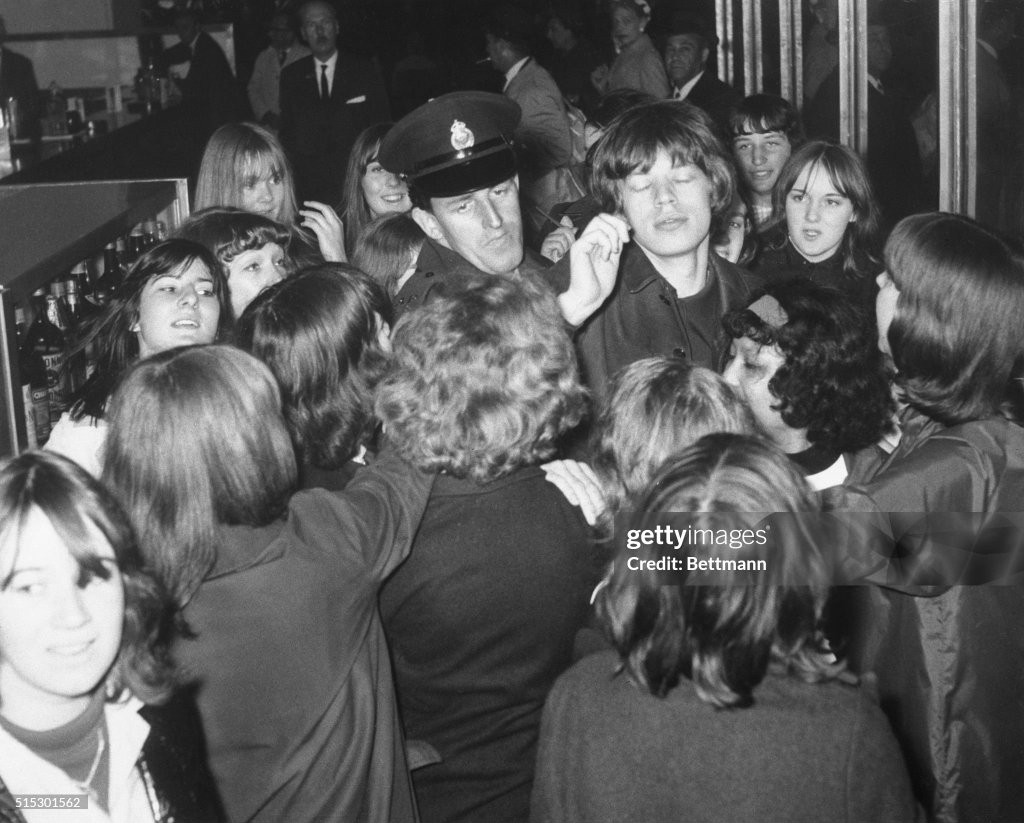
The Rolling Stones arrive in New York’s Kennedy International Airport for their first U.S. tour; they are greeted by about 500 fans. The young men with shoulder‐length haircuts, were greeted at Kennedy International Airport by about 500 teen‐age girls. About 50 Port Authority and New York policemen were on hand to maintain order. Most of the teenagers had been informed by the arrival of the singers by announcements made over the radio by disk jockeys.
Dick Stuart’s two‐run homer in the eighth inning, his seventh home run in nine days, lifted the Boston Red Sox to a 4–3 victory tonight over the Los Angeles Angels, who dropped their fifth straight game. With two out in the eighth Felix Mantilla beat out an infield grounder for a single and Stuart then lashed his home run off Barry Latman into the centerfield stands at the 400‐foot mark.
Jack Kralick shut out the Chicago White Sox on four hits tonight as the Cleveland Indians defeated the American League leaders, 3–0. Kralick, a lefthander who leads the Indians with five victories against one loss, was in control most of the way. He struck out six and walked two, although he hit one batter.
Dow Jones Industrial Average: 818.56 (-2.00).
Born:
Bobby Howard, NFL running back (Tampa Bay Buccaneers), in Pittsburgh, Pennsylvania.
Bob Bleier, NFL quarterback (New England Patriots), in Rochester, New York.
Died:
Rutkowski Bronislaw, 66, Belarusian organist, pedagogue, and composer.
 History Diaries