Vyacheslav Molotov gave his first speech as the Soviet foreign minister before the Supreme Council of the Soviet Union. He called for the Soviet Union to guarantee the borders of neighboring countries in Eastern Europe as means to contain German aggression, but at the same time, friendly relations should be maintained with Germany and Italy as commercial agreements with them were still of interest to the Soviet Union. Molotov announced that the Soviet Union had rejected the British-French proposal for an alliance to counter the Axis Powers. Molotov did not rule out further negotiations but the implications of his speech left little room for optimism when he insisted that Finland, Estonia, and Latvia be given specific guarantees against aggression. The rejection surprised British and French officials.
Now the diplomatic difficulty in such a proposition is that the Baltic States do not wish to be guaranteed-their own desire is to maintain neutrality and avoid offending either group of powers lest in the next war they play the role of Belgium in the last. They, above all, do not want Soviet troops on their soil, partly because of fear that the Red Army might sow dangerous ideas among their people and partly because they belonged to Russia before the revolution, disliked Russia then and have no more affection now for Red Russia. But Russia is insisting that something be done about this question of what to do if Soviet neighbors cannot defend themselves. Leaving such a question open, said Mr. Molotov this evening, might make any pact signed ineffectual — the word Mr. Molotov used literally means fictitious.
“The Soviet Union cannot undertake any obligations toward countries that insist on neutrality which they cannot defend,” he said. Premier Molotov charged that democratic countries had abandoned collective security and were still pursuing their appeasement policy while concealing the facts from their citizens. The Premier said the Soviet Union could not have sympathy either with aggressors or with the hiding of facts and thus emboldening Chancellor Adolf Hitler to abrogate the Reich naval pact with Britain and the Reich non-aggression pact with Poland and to annex Czecho-Slovakia. “Are there any signs that the democratic powers wish to make real efforts to check aggression?” Mr. Molotov asked. “Will this lead to aggression in other regions? We stand for peace, but we must be careful.
Still more delay over the Anglo-Russian pact appeared inevitable tonight in view of the doubts voiced today by Vyacheslav Molotov, Soviet Premier and Foreign Commissar. Whether the delay will be long or short will depend largely upon the speed with which the Chamberlain government satisfies the Russian objections. The difficulties do not look serious tonight in London or Paris; the British, in any case, are bound to give the Russians all possible satisfaction in order to get the one agreement above all others that will complete the anti-aggression front against Germany.
Without the Russian pact, the British feel, their existing pledges to Poland and Rumania would be hazardous, in the extreme; without it the important Anglo-Turkish pact and the Anglo-Greek agreement might fall to the ground. But with the Russian agreement safely completed, the British believe, they would have a good chance of preventing war by making it clear to Germany that “crime does not pay” in international affairs.
Germany signed a non-aggression pact with Denmark. Foreign Minister Joachim von Ribbentrop and the Danish Minister, Herluf Zehle, affixed their signatures at the Foreign Office here. The text of the treaty, which includes two articles and a protocol, will be published after its ratification by the Danish Parliament.
The pact is regarded here as “another proof of Germany’s policy of peaceful relations with neighbor states.” It was also guardedly hinted that publication of the treaty might reveal “ample provisions for friendly adjustment of any territorial issues between Germany and Denmark.” This would refer to territory in the northern part of Schleswig-Holstein returned to Denmark under the Treaty of Versailles. Germany, however, has never made an issue. of these regions and more than once has expressed herself as satisfied with the treatment of German minorities there.
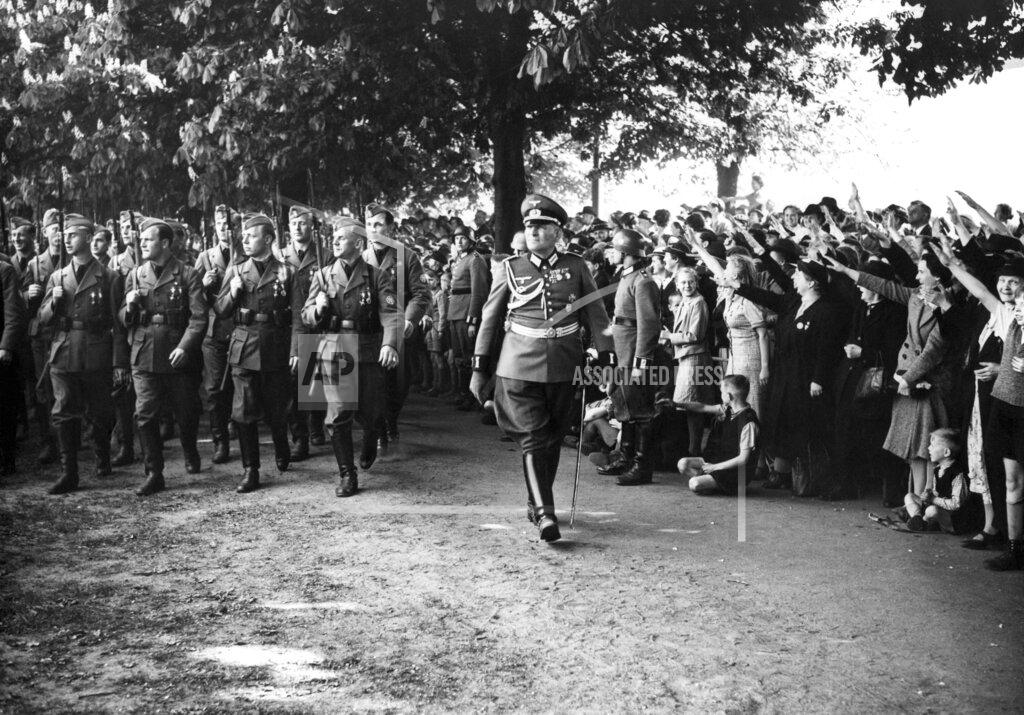
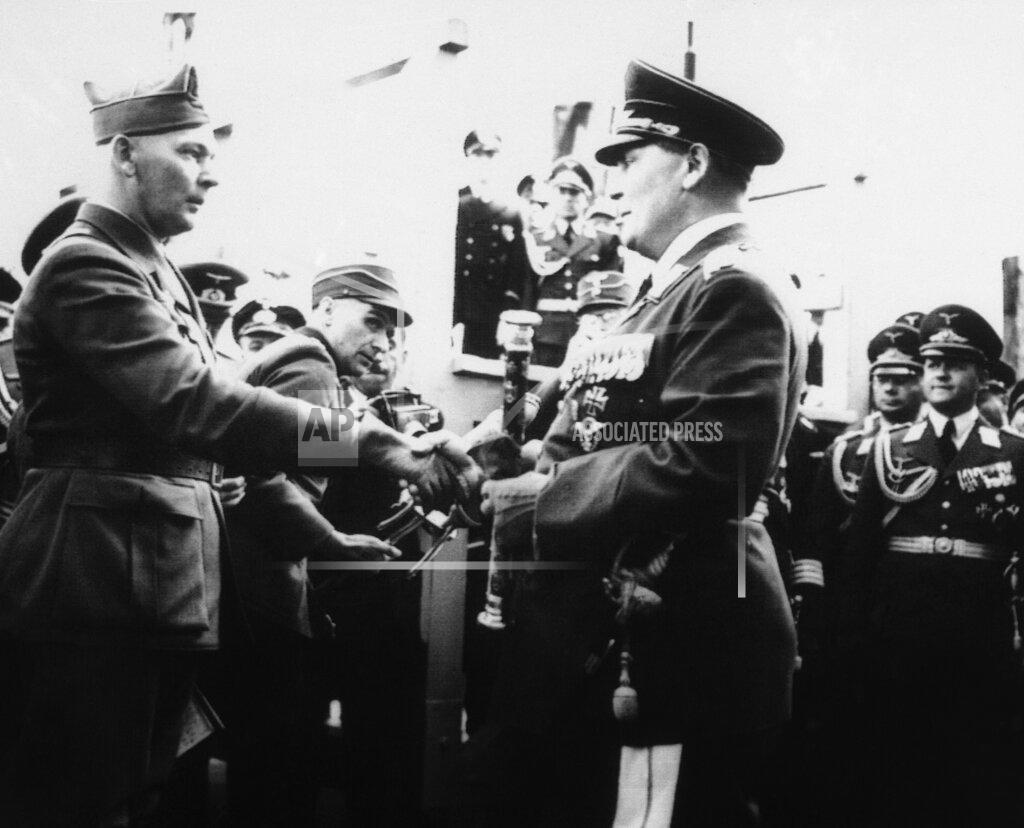
Celebrations were held in Hamburg for 5,000 German fighters returning from the Spanish Civil War. Hermann Göring ceremonially distributed medals to the veterans, including 36 gold crosses for extraordinary valor. Greeted by blasts from the sirens of all ships in Hamburg Harbor, a salute of thirteen guns and the cheers of many thousands, the German Condor Legion, returning from the Spanish civil war, arrived in Hamburg this noon. The troops were officially welcomed by Air Marshal Hermann Göring, accompanied by Colonel General Wilhelm Keitel, head of the supreme command of the armed forces; Grand Admiral Erich Raeder, chief of staff of the navy, and other representatives of the armed forces, State and party, Marshal Göring first boarded the yacht Hamburg and reviewed the line of five troopships of the “Strength Through Joy” organization carrying the legion. Then he reviewed a parade of the legion in Karl Muck Square.
Five thousand men clad in their Spanish uniforms participated in the parade, cheered and showered with flowers by the populace. Following the parade Marshal Göring spoke, celebrating the Legionnaires’ deeds on most Spanish battlefields. He hailed them as “aggrandizers of German Glory.” “You have shown,” he exclaimed, “that Germany can depend on her air fleet, army and navy, come what may. You have shown that we do not shrink from war when it is forced on us, and you have also shown that the German army is invincible.”
Germany participated in the Spanish war, Marshal Göring said, first because Generalissimo Francisco Franco asked Chancellor Adolf Hitler for aid against “Bolshevist anarchy” and secondly because “our young air fleet burned to show what it could do, burned to show that the Richthofen spirit was still alive in it.” The first German aid, he revealed, was rendered to General Franco by Lufthansa, which sent planes to transport his Moorish troops to the Spanish mainland. The Essener National Zeitung, Marshal Göring’s paper, further reveals today that these troop transports began as early as July 20, 1936.
A party of some fifty Czech school children who with their teachers last Monday traveled to Zlin, demonstrated against Germany with shouts of “Heil Stalin” in the train that brought them back to Moravia across part of the territory ceded to Germany at Munich. At the next station the train was met by the Gestapo [secret police], who removed the car from the train. The children are now confined in it and despite protests to the Protector’s office in Prague they are now passing their third night in the train.
Two bombs were found in Prague this morning three hours before they were timed to explode. One of them was in the building housing the police station in the Jewish district, the other in a house opposite.
Dr. Ivan Sekanina, noted Prague attorney who since his arrest in the law courts here March 16 has been transferred to Berlin by the Gestapo, is to be charged before the People’s Court with having organized from Czecho-Slovakia a terroristic movement against the Reich.
Hungary cautions German meddlers, warning the “irresponsible elements” of the Reich against interference in domestic Hungarian affairs. Through the Foreign Minister, Count Stephen Csáky, who was addressing his constituents at Sopron, the government warned that “the sincere friendship of the many millions of Hungarians toward the Reich is also of political and economic value” to Germany. Count Csáky hastened to assert his belief that these “irresponsible elements” in Germany had nothing to do with Chancellor Adolf Hitler’s Government.
“I know that irresponsible elements, people who think they obtain merit in higher German places by trying to make things difficult for us, sometimes tactlessly interfere with our internal life,” he declared. “Such people will in the future find themselves facing the strength of the Hungarian State, but they will also obtain their punishment in the German Reich as well because the German Government, whenever we have well-founded complaints regarding tactless and irresponsible influences on us, has given us satisfaction and has chastened such excesses.”
Hundreds of commercial licenses held by Jews are cancelled after the Hungarian Ministry of Commerce applies strict numerus clausus to Jewish businesses.
Eamon de Valera’s Irish government passes an anti-terror bill aimed at the IRA.
The Palestinian police seize Jews, en masse, and start a drive to round up suspects in terrorism. The British intend to detain over 200 right-wing Jews of the Revisionist faction to end the Jewish violence in response to the release of the British White Paper.
President Roosevelt returned from Hyde Park today, conferred with legislative leaders, discussed with Senator Hatch the legislative status of the bill to prevent pernicious political activities, accepted the resignation of Samuel H. Ordway Jr. as a member of the Civil Service Commission, received from the Interstate Oil Compact Commission a request for the extension of the existing oil compact and, with Mrs. Roosevelt, was host tonight at the annual White House party for newspaper correspondents.
The Senate passed the Tydings bill amending sections of the Philippine Independence Act, recommitted the bill providing for construction of a third set of locks at the Panama Canal and recessed at 5:06 PM until noon tomorrow. The Education and Labor Committee resumed hearings on amendments to the National Labor Relations Act and the Foreign Relations Committee postponed until June 14 action on neutrality legislation.
The House considered the Townsend Old-Age Pensions Bill and adjourned at 6:18 PM until 11 AM tomorrow. The Labor Committee heard J. Warren Madden, chairman of the National Labor Relations Board. The Committee Investigating Un-American Activities questioned Major General George Van Horn Moseley.
President Roosevelt pushes revision of the Neutrality Act. He will not drop his drive to allow the adjournment of Congress. Informed by his Capitol leaders that Congress would be in session until after July 1 at least, President Roosevelt tentatively planned his Western tour today as a prelude to a determined drive for revision of the Neutrality Law. Mr. Roosevelt made it clear to members of the Congressional “big four,” Vice President Garner, Speaker Bankhead, Senator Barkley and Representative Rayburn, who conferred with him today, that by no means would he drop neutrality revision in any move to speed the adjournment of Congress.
His interest in the adjournment situation, which he called the leaders to discuss, was not so much in learning how soon Congress could get out of Washington, but in how long it was certain to be here. If it was to stay until the time he expected to return, he proposed to go on his trip and come back “with both sleeves up,” as one leader put it, and ready for whatever it might take to force amendment of the Neutrality Law. The President did not disclose to his Congressional conferees whether he intended placing any unusual emphasis on the international situation in the speeches he plans to make in his tour. He asked them to use the few weeks between now and his return in clearing the decks for action on the one thing he will insist upon before adjournment, namely, modification of the stringent embargo features of the Neutrality Act.
The Congressional spokesmen not only told the President that Congress would surely be here until he returned, but added their view that the session could be ended by July 15. This opinion, representing a consensus of those present, discounted the assertions made for a group in the Senate to the effect that they would make a last-ditch fight and even resort to filibuster to prevent any substantial change in the arms embargo law.
The principal subjects which Congress has yet to consider include taxes, amendments to the Social Security Act, a relief appropriation for the next fiscal year, and neutrality. Numerous other problems are likely to be considered, but none is on what may be termed the “must” list. Amendments to the National Labor Relations Act and the wages and hours law are now under consideration before committees of both houses but the leaders did not give so much weight to them in their discussion with the President.
Retired Major General George Van Horn Moseley proposes use of the U.S. Army to drive Communists out of the country. A Jewish-led “Red Revolution” is about to overwhelm the country, he says. Major General Moseley, retired, spent five turbulent hours before the Dies committee today, alternately insisting that a Jewish-led communist revolution was about to overwhelm the country and protesting that he harbored no anti-Semitic prejudices. With an oratorical flourish, he asserted that “the Jew is an internationalist first” and “a patriot at home second.”
Several organizations are known to be looking to General Moseley for leadership in the fight against the alleged “revolutionary activity.” In this connection, the witness told the committee today that it was unfortunate that Robert E. Edmondson, identified with a “patriotic organization,” recently published an article entitled “Hail Moseley.” He defended organizations of “the extreme right” as an “anti-toxin for the disease of communism,” but asserted it was unnecessary to place the government in the hands of any or all of them in order to put down the Communist revolt.
“It ought to be handled in five minutes from the White House,” he said, clapping a broad hand upon the witness table. His method, it developed, was that the President should use the army, under a law passed in 1929. That law, he said, made it the duty of the President to take such action if the lives and property of citizens were threatened.
For the German-American Bund he had nothing but praise. Its George Washington’s Birthday meeting in Madison Square Garden, he called “impressively patriotic,” adding that an American flag and a picture of Washington were prominently displayed on the stage. The Bund’s only purpose, he said, was to “see that the Communists don’t take over the country.”
The rest of his time was spent quarreling with the committee over whether he would be permitted to read a long statement to support his thesis about a revolt. The committee finally agreed that it might be presented tomorrow, after committee counsel had examined it with a view to determining the credibility of the sources of his information. The General’s entry into the committee room was impressive. He stepped through the door, with a military stride, accompanied by a retinue of attorneys, augmented by one member of the House, Representative Thorkelson of Montana, whom the current issue of Liberation, organ of William Dudley Pelley’s Silver Shirts, calls a “new statesman rearing high above this miasma of skullduggery.”
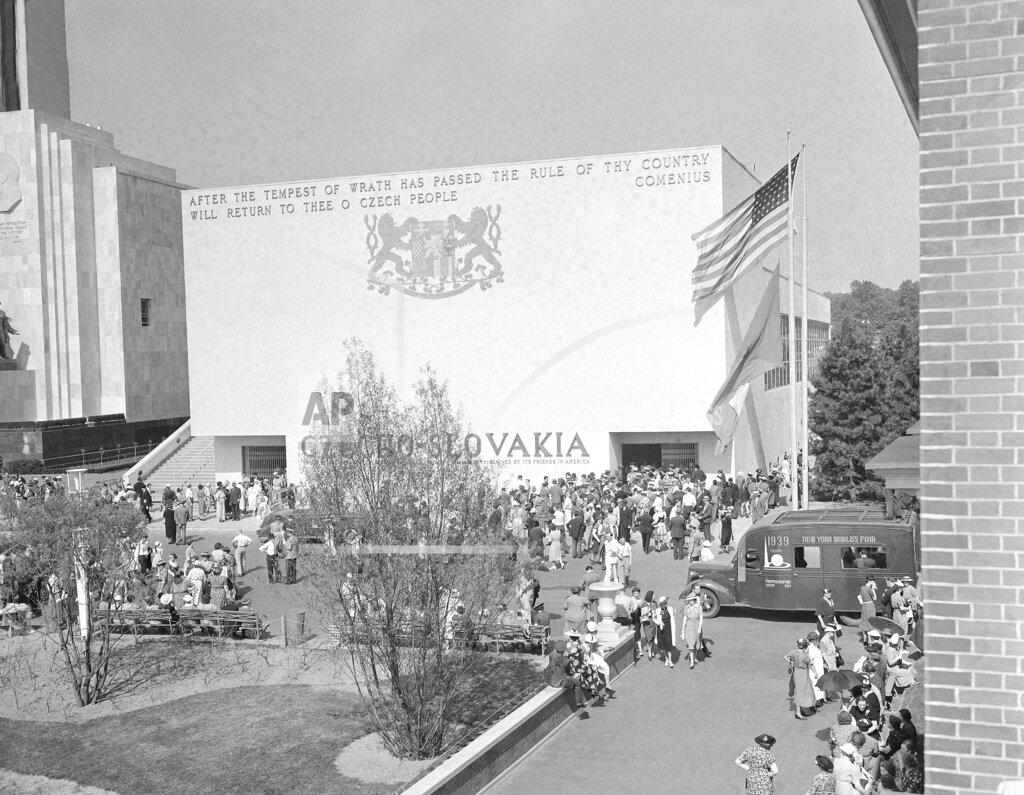
Dr. Edvard Beneš, the former president of Czechoslovakia praises the courage of Czechs at a World Fair speech. His pledge that “we will not die” is met with applause.
President Franklin Roosevelt tightens Pearl Harbor security, closing the waters except to those with special permits.
Forty school children were injured this afternoon, three critically and not expected to survive, by a terrific gas explosion that wrecked a temporary school house in suburban Barberton, outside Akron, Ohio. Four adults were also hurt. The adults and twenty-seven of the children were kept at the hospitals, at least for the night. Seventy-five of the 200 children in the building were thrown from their desks. Debris buried some of them as a wall was blown out. The second floor of the two-story structure collapsed and fell on those below. With the additional weight, parts of the first floor collapsed into the basement.
Witnesses said that some of the children, all between 6 and 11 years old, slid out of the shattered building on the sloping floor as if on a toboggan slide. Many had to be carried. Their screams could be heard above ambulance sirens and the cries of horror-stricken parents. Firemen and all available ambulances from Akron, four miles north of Barberton, sped to the town. The injured, including three teachers and the school janitor, were taken to the Barberton Citizens Hospital and the Barberton Clinic.
The Eastern railroads announced yesterday that they would make drastic reductions in round-trip, coach and Pullman rates, which will go into effect this month. Only once before since 1920 have the railroads in this region taken action of this kind. The decision reflects uncertainty concerning the benefits of a rise in fare made effective last July and is described as a move to restore passenger traffic to the rails. Round-trip tickets sold at the new rates will be good for sixty days. All the important Eastern lines, with the exception of the New York, New Haven & Hartford Railroad, will reduce coach rates on & round-trip basis from the present “straight” basis of 2.5 cents a mile to rates starting at 2¼ cents a mile and declining on a sliding scale to 1.7 cents a mile
Nearly 3,000 shore workers of the Eastern Steamship Lines will be laid off tonight in seven Atlantic ports from Yarmouth, Nova Scotia, to Richmond, Virginia, it was announced last night at the end of a day of futile negotiations between officials of the steamship company and striking members of the Seafarers International Union. The union struck last Friday night in a demand for higher pay and altered working conditions. Within twenty-four hours the company’s vessels were tied up at various Atlantic ports, at the beginning of a busy season. A spokesman for the company declared last night that the lay-off order, effective at the end of today’s work, was imperative for reasons of economy. The company’s business is at a standstill and no revenue is coming in, he declared.
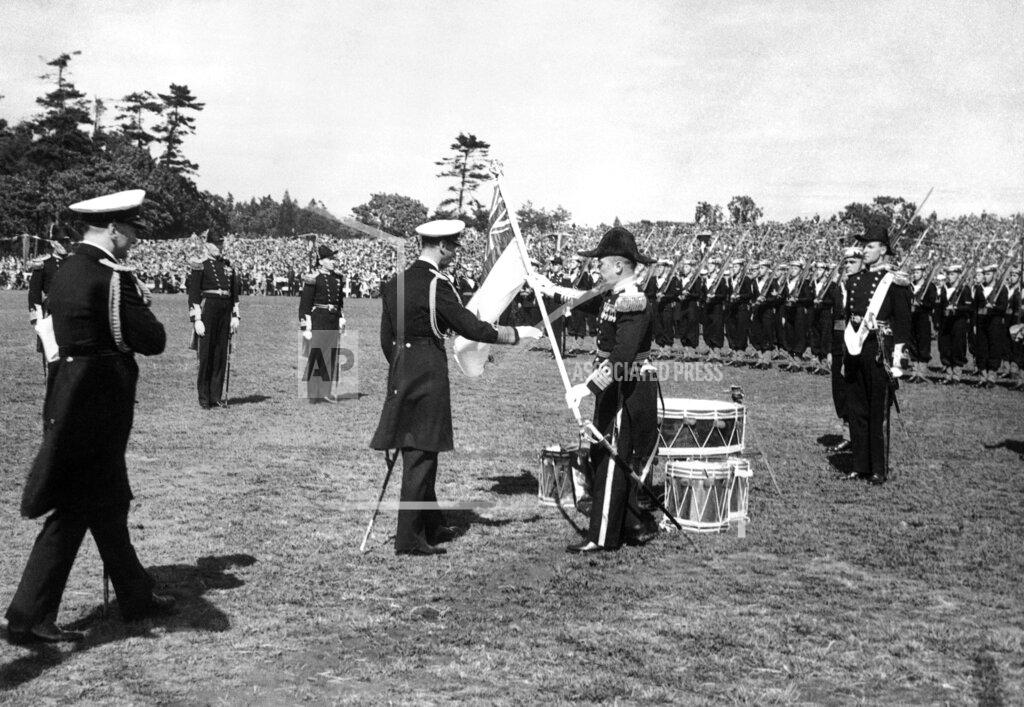
King George VI and Queen Elizabeth were speeding eastward tonight, having visited six of Canada’s nine Provinces. Today was spent in and around Vancouver, British Columbia. They will stop tomorrow for a day’s rest at Jasper National Park and then proceed to Washington, with seven straight nights of sleeping aboard the royal train ahead of them and only brief stops of a few hours at cities along the way to break the monotony.
Chinese officials advance two reasons for the Japanese reports of aerial and ground clashes on the border of Outer Mongolia and Manchukuo. They believe Incidents are greatly exaggerated by minor officers, perhaps at the instigation of leaders of the Japanese army in Manchukuo. The Chinese see a Japanese desire to warn Britain of the inferiority of the Soviet war machine at a critical stage of Anglo-Soviet negotiations as one of the reasons for the reported conflicts. Another reason is thought to stem from the dislike of the Japanese in Manchukuo to spare additional troops for the operations in China. Following serious Japanese reverses in Northern Hupeh the Chinese any reinforcements from Manchukuo are being sought by the Japanese commanders in China.
Officials here think the Japanese leaders of the Kwangtung Army in Manchukuo are reluctant further to reduce their strength. The Chinese assert that the border incidents, if they were not imagined, were magnified with the object of providing an excuse for a refusal to space troops for China. Moscow’s silence regarding the alleged fighting is believed to be designed to emphasize the emptiness of the Japanese versions of the border clashes.
Nomonhan (Khalkhin Gol), where forces of Outer Mongolia and Manchukuo are reported to have fought, is an oasis in the Gobi Desert, the rich pasturage of which is coveted by Mongol nomads. According to information obtained by Domei, the Japanese news agency, from military quarters in Tokyo, nomads from Outer Mongolia have been attempting to cross the border at this point in small numbers, but all were turned back. On May 11 a comparatively large force was said to have crossed the Halka River, which forms the boundary, and invaded the oasis. They were defeated, according to Domei, but the Outer Mongolian authorities massed large forces in the neighborhood and attacked.
The attackers were reported to have lost fifty-nine planes, several tanks and 110 killed. The Japanese claimed the loss of only one plane. Domei’s military informant compared the Soviet planes to sheep attacked by wolves. Military circles in Tokyo declare the fighting was instigated by Russians. They find it difficult to explain the Soviet’s motives and suggest it may be an attempt to check the peace movement that is alleged to be gaining strength in Chungking or to test Manchukuo defenses. The territory on both sides of this obscure frontier is inhabited by Mongols, who through no action of their own now find themselves divided under Russian and Japanese protection. Where they formerly moved their flocks and herds freely to new pastures, they now confront a rigid frontier. The Japanese believe the Outer Mongolian Government thought the weapons it acquired from the Soviet might be successful in opening the Nomonhan pastures to Mongol cattle and failed.
The Japanese news agency, Domei, reported in an undated dispatch today that 700 “Mongols” had been killed in a continuation of border fighting in Western Manchukuo. The “invading” forces, Domei said, retreated and carried 400 bodies with them but 300 bodies were left on the field. The news agency said Manchukuoan troops captured five Mongols and four Russians, twelve tanks and a number of heavy and light machine guns.
It was reported that Australia was expected to file a formal request for the opening of full diplomatic relations between Australia and the United States because of uncertainty in the Pacific. The Australians were wary of the ambitions of Japan and felt that Britain would mostly likely be tied up in a European conflict and be unable to be counted upon.
Dow Jones Industrial Average: 138.18 (+0.38).
Born:
Terry Waite, English Anglican Church envoy/Lebanese hostage, in Bollington, Cheshire, England, United Kingdom.
Charles Drain, American soul singer, in Eupora, Mississippi (d. 1995).
Naval Construction:
The Royal Navy Fiji-class (Crown Colony-class) light cruiser HMS Fiji (58), name ship of her class of 11, is launched by the John Brown Shipbuilding & Engineering Company Ltd. (Clydebank, Scotland).
The Japanese ocean liner Argentina Maru is completed for Osaka Shosen Kaisha. She will be purchased by the Nihon Kaigun (Imperial Japanese Navy) on 9 December 1942, converted into an escort carrier, and renamed HIJMS Kaiyō (海鷹, “Sea Hawk”).
 History Diaries