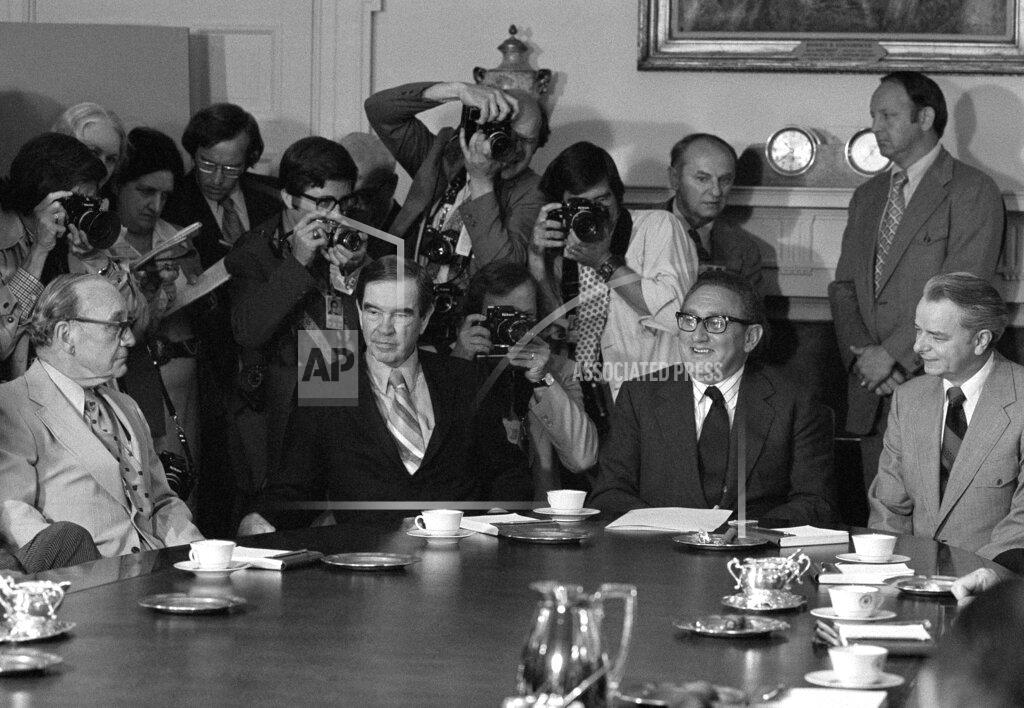
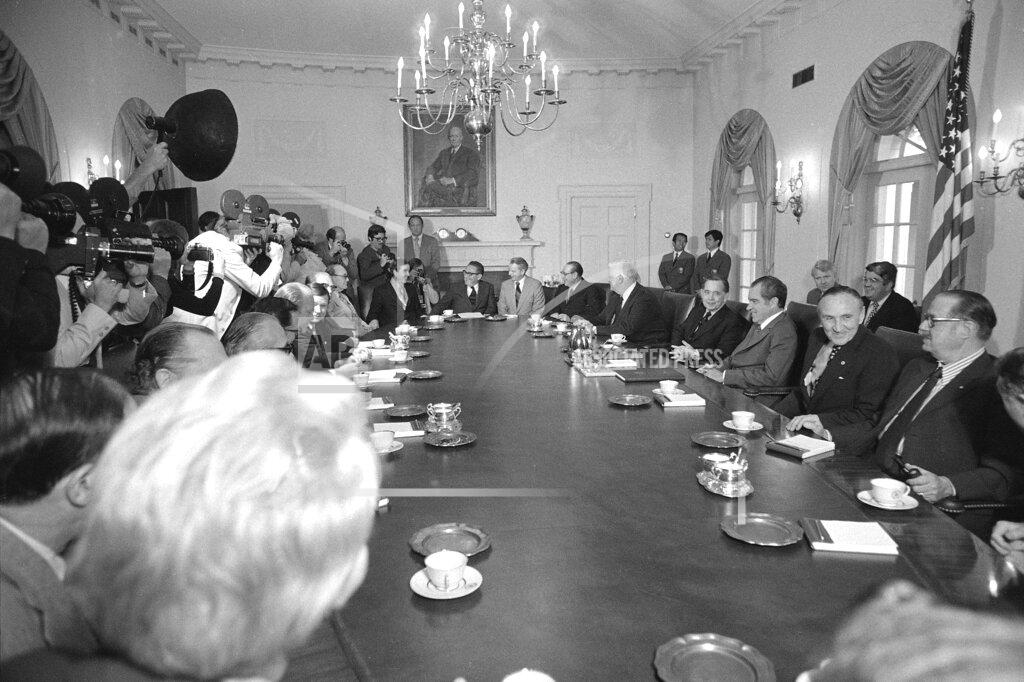
The Agreement on Disengagement between Israel and Syria, negotiated by U.S. Secretary of State Henry Kissinger, for the separation of the two nations’ military forces in the Golan Heights, was signed at the Palais des Nations (Palace of Nations) in Geneva, by Major General Herzl Shafir of Israel and Brigadier General Adnan Tayara of Syria. The firing of artillery on the Israel-Syria front ended at 1:15 PM Israeli time. With the signing of the agreement, the firing died away on the Israeli-Syrian front early this afternoon, but throughout the morning artillery shells had exploded over wide areas of the Golan Heights and the Damascus Plateau, the final crescendo of the strange war of attrition begun by Syria 11 weeks ago. The United Nations Security Council adopted Resolution 350, establishing the United Nations Disengagement Observer Force (UNDOF) to monitor the ceasefire.
A military working group headed by the United Nations, and composed of Syrians and Egyptians on one side and Israelis on the other, with American and Soviet observers, is to meet tomorrow to start drafting a more detailed map and specific disengagement procedures. Its work is to be finished in five days. The accords provide that actual withdrawals must be completed 21 days after that. This will result in withdrawal by Israeli forces from the entire salient captured in the October war and from a sliver of the Golan Heights area seized in the war of 1967. The exchange of wounded prisoners with the assistance of the International Committee of the Red Cross is to begin at noon tomorrow. The other prisoners are to be exchanged when the military group, which meets at 4 PM, completes its work.
Sources at the Middle East conference in Geneva said that President Hafez al-Assad of Syria gave secret assurances that Palestinian guerrillas would not be permitted to infiltrate across the Syrian border into Israel. Although the assurances were spoken, not written, they were accepted by Israel and were vital to the conclusion of the troop disengagement agreement. According to one source, Mr. Assad told Mr. Kissinger that he could not make an open commitment on the actions of the Palestinians. But he was said to have added that Syria was an organized country and would either make war or observe the cease‐fire. Other diplomatic sources reported that Mr. Assad had told the Palestinian guerrilla groups in Syria that they were to stop their attacks on Israel. The Israelis have no doubt that the Syrian Army is able to prevent such attacks if it chooses.
When Mr. Kissinger relayed Mr. Assad’s statement to the Israelis, the informants said, they agreed to abandon their demand for formal guarantees that Syria would halt further guerrilla attacks from bases on her territory. Also playing a part in the breakthrough to an agreement, it was said, was a United States pledge of political support to Israel if the Israelis respond to any future guerrilla attacks with reprisals. By this, the United States was understood to mean that it would use its veto if necessary to block any action by the United Nations Security Council to impose sanctions on Israel because of such a reprisal.
It was announced in Washington and Moscow that President Nixon and Leonid Brezhnev will meet in the Soviet Union for a week beginning June 27. It was also learned that Mr. Nixon was pressing ahead with arrangements for a trip to the Middle East beginning around June 9.
A booby trap believed placed by the Irish Republican Army’s Provisional Wing to kill British soldiers exploded at a house in Londonderry today, killing the owner and injuring his daughter‐in-law and another woman. The police had informed the man, 54‐year‐old Alfred Shotter, that they had received two anonymous telephone calls saying a bomb had been placed in a house he owned in the Waterside district of Londonderry. Army munitions experts did not investigate the report because they feared a bobby trap. But Mr. Shotter, accompanied by the two women, decided to go inside. When he turned at key in the front door, an explosion demolished the front of the building.
The Home Office of the United Kingdom announced that the British penal system abolished the traditional “bread and water” diet that had been used to punish infractions of prison discipline, replacing the penalty with loss of earnings or the forfeiture of reductions of sentences for good behavior.
The police today investigated right‐wing extremist groups throughout Italy in an attempt to identify persons responsible for the bomb attack in Brescia Tuesday in which six persons were killed. One youth was killed and two were arrested yesterday in a remote mountain area near Rieti, about 50 miles northwest of Rome, after an exchange of gunfire with policemen who were investigating reports of a paramilitary training camp. Two policemen were injured. The police said they had found 100 pounds of explosives and many weapons in a tent. The two arrested, Alessandro D’Intino, 21 years old, and Alessandro Danieletti, 19, were identified as members of the extreme right‐wing National Vanguard. The youth who was killed, Giancarlo Esposti, had a record of arrests in connection with transport of explosives and terrorist attacks.
West Germany’s policy of improving relations with the Communist states, shaken by the resignation of Chancellor Willy Brandt over an East German spy in his office, will continue to move forward cautiously under Chancellor Helmut Schmidt, his aides say. Mr. Schmidt has already been invited to visit Moscow this year in Mr. Brandt’s place, and he expects to make the trip after this summer, according to his advisers. Even relations with East Germany have begun to recover from the espionage affair. Bonn’s permanent representative — a quasi‐ambassador in East Berlin, Günter Gaus, expects to take up his post there before the end of June.
Soviet policemen have reportedly tightened controls and stepped up harassment around the American Embassy, intercepting and sometimes holding and interrogating Soviet citizens, Americans and even diplomats trying to enter the embassy. “There are virtually daily incidents, daily drag‐aways,” complained one American Embassy official. “This crude treatment is hardly in keeping with the spirit of détente. We consider these denials of access as violations of the Soviet‐American consular convention.” Today, gray‐uniformed militia guards stopped Arnold Ozolins, an American seaman who came here in 1962 and was forced to take out a Soviet passport as a condition of visiting his elderly mother in Riga.
The USSR performs a nuclear test at the Semipalatinsk Test Site in northeast Kazakhstan.
China has rejected as “blackmail” an assertion by the Soviet Union last week that it has the right to obstruct Chinese shipping on two rivers that figure in the bitter border dispute between the former allies. The rivers are the Amur and the Ussuri, known to the Chinese as the Heilung and the Wu‐su‐li. They flow together near the Soviet city of Khabarovsk. The essence of the dispute has been whether they from the border, as the Chinese maintain, or whether, as Moscow’s statement reasserted last week, they are “inland waterways” of the Soviet Union. The Chinese reaction to the Soviet assertion came in the form of a statement by a Foreign Ministry spokesman in Peking last night. It charged that the Soviet Union had been “obstructing by force” Chinese ships seeking to navigate the main channel of the rivers ever since 1966. Citing the “unequal” Treaty of Peking, signed by Czarist Russia and imperial China in 1860, the statement said that Chinese vessels had an “inalienable right” to use the rivers without Soviet approval.
Diplomatic analysts in Hong Kong speculated that the reasserted Moscow claim was caused not by any new developments in the dispute over the river but by an event that occurred more than 2,000 miles away in. Central Asia two months ago. That was the capture of an armed Soviet, helicopter inside Chinese territory in strategic Sinkiang Province. Moscow said the helicopter had been blown. off course on a rescue mission and demanded the return of the crew. Peking retorted that its mission had really been spying. China has yet to give any hint as to what she intends to do with the crewmen. In the view of the analysts, the Soviet purpose in raising the frontier dispute may have been to prod the Chinese on the helicopter crew by reminding them that there is always a risk of a frontier incident.
Thailand’s seven‐month-old civilian order has weathered one minor political crisis set off by the resignation of a Premier many Thais call “too democratic.” But the Premier, the gentle Sanya Dharmasakti, is now back in office, with a new Cabinet, as Thailand continues to advance into the uncertainties of democratic politics. The interim Government, which draws its authority from the King and last October’s student uprising against the military, seems to have just about shaken off the fear that the generals might be hatching another coup. Soldiers have dominated Thai politics for four decades, so the fear was — and is — understandable. But a different kind of uncertainty, remains: how to make a parliamentary system work.
More than 40 Marxist Argentine guerrillas briefly took control late last night of a small town about 650 miles northwest of Buenos Aires, according to police sources and news reports from the area. The move apparently was intended to demonstrate the ineffectiveness of a highly publicized counterinsurgency operation by army and police forces in the area. The guerrillas, who were said to have identified themselves as members of the People’s Revolutionary Army, entered the town of Acheral shortly before midnight. One group occupied the railway station and the police headquarters after disarming three officers. Another contingent, armed with bazookas and heavy caliber machine guns, set up a blockade at the entrance to the town. A third group patrolled the main avenue and took over several bars. No casualties or damages were reported, and the guerrillas left the town after an hour.
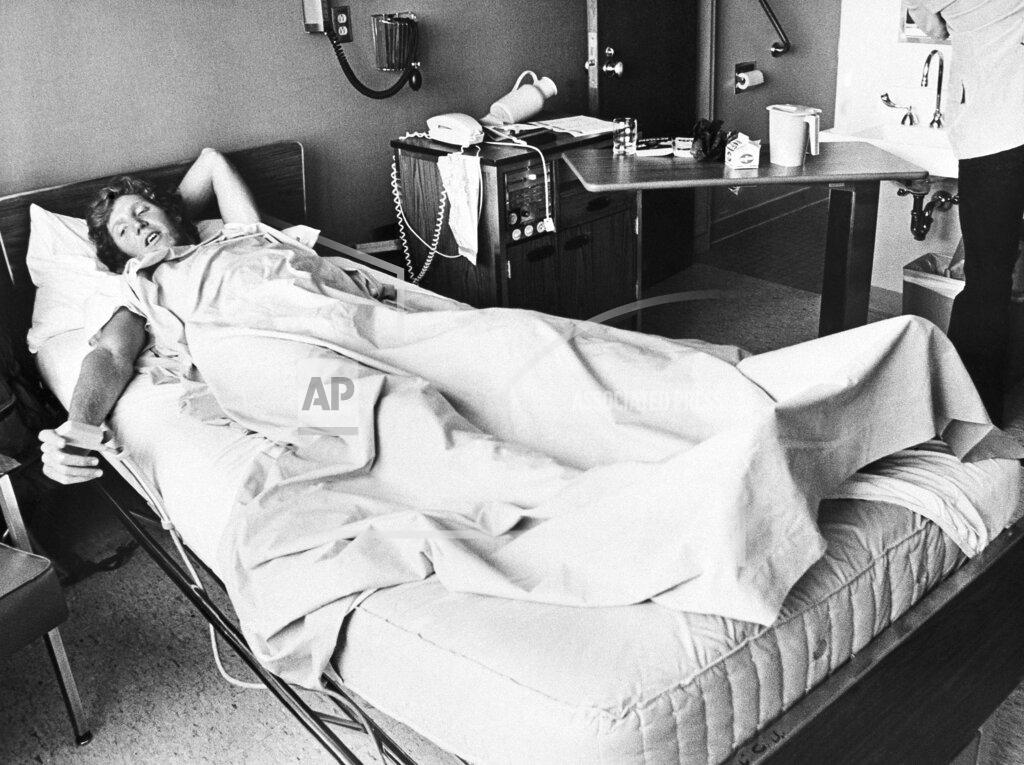
The Ethiopian guerrilla group that abducted an American missionary nurse from a village hospital in the northern province of Eritrea on Monday has demanded an undisclosed quantity of medical supplies in return for the safe release of the pregnant, 24‐year‐old New Jersey woman. The demand was contained in three notes delivered to the American consulate in the provincial capital of Asmara yesterday morning, according to the State Department, which said that the demands had been rejected by the missionary group that operates the American Evangelical Hospital in Ghinda. The nurse, Mrs. Deborah Dortzbach, was abducted from the hospital on Monday by four armed men who shot and killed a Dutch missionary nurse before taking Mrs. Dortzbach away in a helicopter.
Talks between Portugal and the independence movement in Guinea, the smallest of the three Portuguese African territories, were suspended today after encountering several obstacles. Mario Soares, Portugal’s Foreign Minister, and officials of the Guinea rebels said they would have to consult at home because of the “importance and complexity” of the issues. They insisted that progress had been made in a “frank and cordial atmosphere.” Other Portuguese sources said that the negotiations had run into some difficulty on several points, including the Cape Verde Islands, 300 miles off the coast of West Africa. The Guinea nationalists have argued that the islands should be included in a future independent Guinea.
Entering the Watergate case for the first time, the Supreme Court agreed to decide whether President Nixon can withhold evidence of possible crimes from the Watergate special prosecutor, Leon Jaworski. The Justices voted to let Mr. Jaworski bypass the United States Court of Appeals in an effort to settle the critical issue swiftly. Only yesterday, the White House urged the high court not to “rush to judgment” by accepting the case now. The Court laid down a timetable that could lead to a decision by mid‐July. The special prosecutor had argued that he needed the 64 tape recordings that the President had refused to surrender as evidence in the Watergate cover‐up trial, now scheduled to open in September.
In other matters related to Watergate, lawyers for the House Judiciary Committee are considering whether to subpoena four tape recordings of White House conversations that are in the custody of Federal District Judge John J. Sirica. Committee officials cautioned, however, that they had started only exploratory discussions about the highly unusual move and that it would be fraught with serious legal and constitutional complications. Judge Sirica turned down yesterday a request from Albert E. Jenner Jr., the committee’s chief Republican counsel, for access to the four recordings. The tapes are among a number that President Nixon has refused to provide in response to committee subpoenas. Judge Sirica said in a legal memorandum that he would not be “dragged into” the tapes dispute between the Judiciary Committee and the President and that he could not honor the committee request because he was merely a temporary custodian of the four recordings. But Mr. Jenner said in an interview this afternoon that he and John M. Doar, the special counsel on impeachment, had begun examining whether the committee had authority under the Constitution to demand that Judge Sirica comply with an impeachment subpoena.
And Mr. Jaworski urged Federal District Judge Gerhard A. Gesell not to force a showdown that could result in the dismissal of charges brought in the burglary at the office of Dr. Daniel Ellsberg’s former psychiatrist.
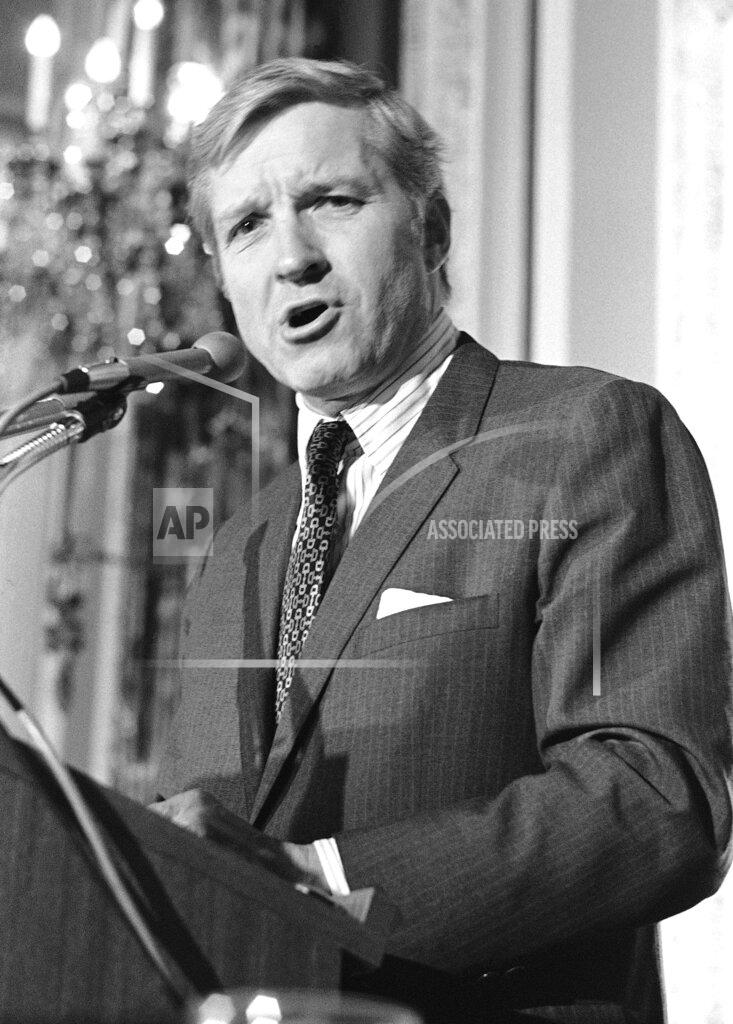
Senator Charles H. Percy, Republican of Illinois, said today he would vote to convict President Nixon in an impeachment trial if “he places himself clearly above the law and the Supreme Court… We cannot have a nation of constitutional law if anyone places himself above the Constitution,” Mr. Percy told a news conference before an address at the Harvard Business School. Mr. Percy made no specific reference to the President’s refusal to turn over documents and tapes of conversations related to the Watergate coverup that have been subpoenaed by the House Judiciary Committee. But he said, “I think the House power is absolute in the impeachment process,” and that “in a sense the President has said the Constitution applies to everyone but the President.”
The staff of the Senate Watergate committee believes that donations by dairy cooperatives to President Nixon’s 1972 re-election campaign were apparently linked directly to Mr. Nixon’s order to raise milk price supports in 1971. The staff found serious deficiencies in a recent White House paper that said the President had not been influenced by campaign pledges of up to $2 million when he ordered the price support increases.
The original Watergate grand jury, which will be two years old on June 5, was extended today for another six months by Chief Judge George L. Hart Jr., in Federal District Court here. The 23‐member panel, which indicted the original Watergate burglary team, sent evidence on the President to the House impeachment investigators and indicted seven men for covering up the burglary, still has “pending business,” the judge said. What that pending business might be is unclear. Presumably it would concern further indictments in the White House cover‐up of the burglary Democratic National Committee’s headquarters at the Watergate office building. The extension was made at the request of Leon Jaworski, the special Watergate prosecutor.
Prices of a host of consumer and industrial products have shot up since government controls lapsed a month ago, producing a widely anticipated inflationary surge, and buyers can expect to pay higher prices for hundreds of other items in the months immediately ahead despite a decline in farm prices.
In the third consecutive monthly decline this year, prices of raw farm products dropped 4 percent from April 15 to May 15, the Agriculture Department said. The price index declined 4 percent in the month ended March 15 and 6 percent in the month ended April 15. These decreases, particularly for livestock, resulted in some easing of retail food prices.
In one of the largest and boldest attempts to save a company, the Lockheed Aircraft Corporation and Textron, Inc., have agreed in principle on a financial plan that would revitalize the ailing aircraft company with at least $75 million in Textron funds. The agreement would also release the government from its guarantee of $200 million in loans to Lockheed, and could also give Textron part ownership in Lockheed.
Four new cases of angiosarcoma of the liver have just been uncovered. They raise for the first time the possibility in the minds of public health officials that this fatal cancer hazard that has been linked to vinyl chloride may extend to hundreds of thousands of workers and to members of the general public. Heretofore, the cancer risk associated with vinyl chloride, a basic chemical in the plastics industry, has been confined to the approximately 6,500 American workers who make vinyl chloride or convert the chemical to its polymer, polyvinyl chloride. Since January, when the hazard was first revealed, 19 cases of this invariably fatal cancer, which is extremely rare in the general population, have been uncovered among vinyl chloride workers here and abroad.
John Mayberry belted his 10th home run and Amos Otis singled home two runs to power Kansas City to a 4–2 victory over the Cleveland Indians, which gave the team a 17‐11 mark for May, a sharp reversal from their 8–11 mark in April.
Not long ago, the Houston Astros were going through a 10‐game losing streak. Now they are going through a five‐game winning streak, the fifth victim being the New York Mets last night. The Astros won, 7–1, in Shea Stadium before 20,736 fans who endured a drizzle from the second inning and the sight of the Mets losing their fourth straight game.
Gary Maddox hit two doubles, scored a run and drove in another for the San Francisco Giants who handed Philadelphia its fifth consecutive defeat, winning 6–2. Ron Bryant got the victory, his second in six decisions, with some good relief help from Randy Moffitt, who picked up his 12th save.
Johnny Bench’s bases‐loaded triple was the big blast in Cincinnati’s four‐run seventh inning, extending the Reds’ winning streak to seven games as they downed the Pirates, 7–5. The Pirates had taken a 5–3 lead into the seventh, largely on Bob Robertson’s two home runs, a two‐run blast in the three‐run second inning and a solo shot in the fifth.
Dow Jones Industrial Average: 802.17 (-1.41, -0.18%).
Born:
Steve Martin, NFL defensive tackle and nose tackle (Indianapolis Colts, Philadelphia Eagles, Kansas City Chiefs, New York Jets, New England Patriots, Houston Texans, Minnesota Vikings), in St. Paul, Minnesota.
Jim Carey, NHL goalie (Vezina Trophy in 1996; Washington Capitals, Boston Bruins, St. Louis Blues), in Dorchester, Massachusetts.
Doug Doull, Canadian NHL left wing (Boston Bruins, Washington Capitals), in Glace Bay, Nova Scotia, Canada.
Chad Campbell, American golfer (U.S. masters 2009 runner-up, 4 PGA Tour titles), in Andrews, Texas.
Zsolt Erdei, Hungarian professional and Olympic boxer, 1997 Olympic middleweight champion; in Budapest, Hungary.
Ara Celi [as Araceli Valdez], American film and television actress (Incan Mummy Girl- “Buffy the Vampire Slayer”); in El Paso, Texas.
Kenan Doğulu, Turkish pop musician known for “Çakkıdı”; in Istanbul, Turkey.
Adrian Tomine, American graphic novelist; in Sacramento, California.
Died:
Adelle Davis, 70, American writer and nutritionist described as “the most famous nutritionist in the early to mid-20th century”, of bone marrow cancer.
Ski Hi Lee (ring name of Robert E. Leedy), 53, Canadian professional wrestler who had acromegaly (at 6 feet 7 inches (2.01 m) the tallest man in the sport).
Harry Primrose, 6th Earl of Rosebery, 92, British liberal politician, elected to serve in the House of Commons 1906 to 1910, later elevated to the House of Lords in 1929.
Jim Prendergast, 60, British Communist and civil rights activist, died from injuries sustained when he fell down the stairs in front of his home.




 History Diaries