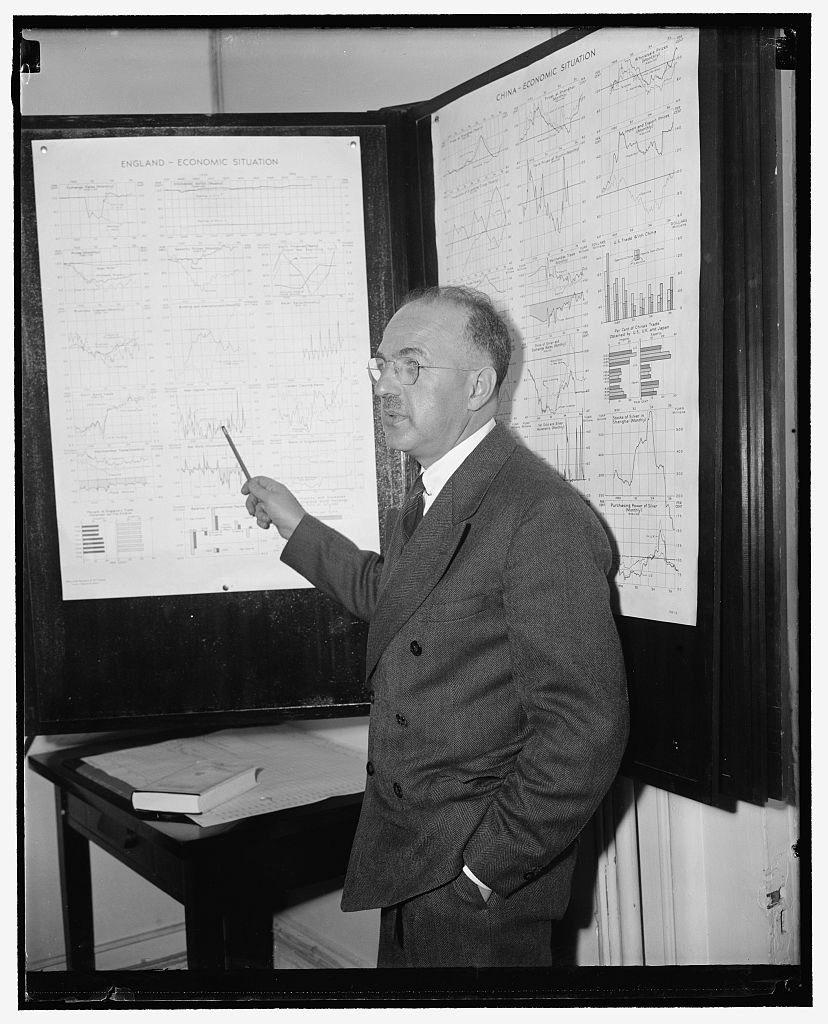
Vyacheslav Molotov, Premier and Foreign Commissar of the Soviet Union, announced today that he would speak Wednesday on foreign policies before the Supreme Soviet (Parliament). It was taken for granted that he would speak on Britain’s revised proposals for a British-French-Soviet pact. Mr. Molotov, who on May 3 succeeded Maxim Litvinov as head of the Foreign Commissariat, made his announcement when the Supreme Soviet rose at the end of tonight’s session to inquire if he would address the body on the international situation. “If the members of the Supreme Soviet wish to hear me on this subject I will speak to them May 31,” he replied.
The Soviet Union was silent today in regard to British-French proposals for a three-power mutual assistance agreement. No official or newspaper mentioned the negotiations, which culminated in the presentation by the British and French governments Saturday of notes containing the latest proposals. Some foreign observers interpreted the silence to mean that Moscow was in no hurry to announce its action.
The renewed outbreaks of fighting between Japanese and Soviet troops on the Siberian and Outer Mongolian frontiers made some observers even more skeptical than they were before about the possibility of an early reply to the proposals. Some also saw significance in a sentence of an editorial today in the newspaper Izvestia, as follows: “In the position adopted by the League Council in connection with the Aland Islands question may be found one more argument against a hasty and inconsiderate decision on important international problems.” Izvestia was expressing satisfaction over the failure of the League of Nations Council to take any action on the proposal of Finland and Sweden to fortify the Aland Islands in the Baltic.
The resolution of the League of Nations Council at Geneva to abstain from further action on the Finnish-Swedish project to remilitarize certain sections of the Aland archipelago, since all the signatory powers had given formal assent, is being hailed in Finland with universal satisfaction. Finnish military authorities will immediately proceed with the fortification plans. Public opinion is gratified that Russia’s determined attempt to wreck the plan miscarried in the face of a unanimous stand by the democratic powers and the Axia group. This stand is interpreted here to mean that both camps desire to maintain Finland’s and Sweden’s neutrality in case of a major war. It remains to be seen whether Russia contemplates a new move to offset the consequences of fortification of the Alands, which Moscow regards as in conflict with its strategic interests, but thus far no indication of Soviet action has been given.
Karl J. Burckhardt, League of Nations High Commissioner for Danzig, was visited today by Albert Foerster, Reich Nazi district leader for Danzig, who last week conferred with Chancellor Adolf Hitler at Berchtesgaden. Thus, the German Chancellor’s Deputy for Danzig had direct contact with the League of Nations Commissioner, who a day earlier in Warsaw had seen Colonel Josef Beck, Polish Foreign Minister, after having consulted at Geneva with Viscount Halifax, British Foreign Secretary, and Georges Bonnet, French Foreign Minister.
M. Burckhardt had already talked with Arthur Greiser, President of the Danzig Senate, and Marian Chodacki, Polish Commissioner General for Danzig. This resumption of relations between the League representative and both Danzig Government and Reich party officials after a lapse of several months is viewed here with special interest because of the unrelieved tension between Germany and Poland over Danzig.
It is M. Burckhardt’s mission in returning to Danzig to try to prevent further violence between Nazis and Poles on the Free City’s frontiers, as a preliminary to possible discussion of modifications of the statute governing Danzig. These efforts, if successful, might pave the way for broader negotiations though there would seem at present to be no visible basis of discussion between Germany and Poland on the fundamental question of Danzig’s future sovereignty.
It is suggested, for instance, that Danzig’s foreign relations might be removed from Poland’s hands, where the statute places them, and that alterations in customs administration might be conceded. This would mean probably the withdrawal of the Polish inspectors who check Danzig’s customs offices and whose presence on Danzig soil is resented. It was an attack on such an inspector that led to the shooting of a Danzig German eight days ago. These minor concessions might ease the local situation, but they would not touch the basis of the problem — the German demand for annexation of Danzig.
Germany bans the airing of religious programs on the radio. It is said to also be putting a ban on purchases of the Bible and other religious tracts.
Two days of parliamentary elections concluded in Hungary. The Party of Hungarian Life (previously the Party of National Unity) won another majority. The fascist Arrow Cross Party finished second.
President of the Hungarian Senate, Count Julius Karolyi, resigns in opposition to his country’s new anti-Jewish laws.
Neville Chamberlain ends his second year as premier. He marks the anniversary by fishing for trout.
Cadiz, Spain, is preparing a ceremonious farewell to Italian troops, now expected to leave early in June. Eight Italian transport ships, which were escorted into the harbor of Cadiz by two Spanish warships, will carry the troops back to Italy. Several Italian units are now in Cadiz. The last of many “farewell ceremonies” — for which triumphal arches are being hastily erected in Cadiz — will be attended by General Gonzalo Queipo de Llano, “the uncrowned king of Andalusia.”
It appears that the Italo-Spanish association has not been terminated. It is announced that four Spanish battalions will accompany the Littorio Division to Italy, where they will take part in a triumphal parade in Rome. This step suggests that rumors of the formation of a corps of Spanish “volunteers” for service in Libya may prove well-founded. The total number of departing troops is said to be about 20,000, including 12,000 in the Littorio Division. It would appear, therefore, that the number of Spaniards leaving totals 4,000 or 5,000.
A sign of a return to normal in Spain is a Ministry of Labor decision to establish headquarters in Madrid. Minister Pedro Gonzalez Bueno yesterday bade farewell to the Mayor of Santander, thanking him for the city’s hospitality. Antonio Pena, Minister for Public Works, intimated his ministry, too, would soon establish its headquarters in the capital.
A Burgos announcement today said Ramon Serrano Suner, Minister of Interior and Propaganda, would leave Cadiz June 1 for Italy to accompany the legionnaires as Generalissimo Francisco Franco’s representative.
Close Turkish relations with France and Soviet Russia, as well as Britain, were noted by President İsmet İnönü in an address to the Fifth Congress of the Republican People’s party today. Referring to French-Turkish negotiations for a mutual aid pact paralleling a British-Turkish arrangement already announced, President Inonu said: “An agreement in principle has been reached and after a solution of the Hatay problem no power will be able to compromise or destroy the accord between us. The Turkish and French nations are linked together by fate and possess the means to defend themselves.”
The Hatay Republic, formerly the Sanjak of Alexandretta in France’s mandate of Syria, is desired by Turkey. Referring to Russia, President Inonu said: “I can say frankly that our relations with Soviet Russia are warmer today than ever before and are based on mutual trust.” He said the present “menacing” international situation could not last much longer. “Either unconscious masses will assail each other or common sense will prevail and a humanitarian and peaceful life will be established,” he said, adding, however, that national defense measures were more imperative than ever.
Israeli Prime Minister Menachem Begin (25) weds Aliza Arnold.
In Washington, the Senate passed bill permitting railroads to arrange adjustment of debts where creditors are willing, heard Senators George and Smith criticize the Wages and Hours Law, passed and then voted to reconsider bill authorizing $277,000,000 to build a third set of locks at the Panama Canal, passed bill authorizing United States cooperation with Latin American republics in carrying out terms of treaties and resolutions agreed to at Buenos Aires and Lima Conferences, held memorial services for Senators Copeland and Lewis and adjourned at 3:59 PM until noon on Wednesday. The Education and Labor Committee resumed hearings on amendments to the National Labor Relations Act.
The House agreed to vote on the Townsend old age pension plan on Thursday, received the Bloom Neutrality Bill and adjourned at 1:10 PM until noon tomorrow. The Ways and Means Committee resumed hearings on tax legislation.
The president remains at Hyde Park and is extending his stay for one additional day.
A subcommittee voted 4 to 2 today to advise the Senate Judiciary Committee to reject the nomination by President Roosevelt of William S. Boyle for United States Attorney for Nevada. Senator McCarran, Nevada Democrat, declared the nomination “personally obnoxious.” Senator Pittman, subcommittee chairman and also a Nevada Democrat, said that he and Senator Norris voted to recommend Mr. Boyle’s approval, with Senators Burke, Van Nuys, Austin and McCarran against it. Senator Pittman observed that the four opposing the nomination had opposed President Roosevelt’s Supreme Court reorganization proposal two years ago, while he and Senator Norris had favored it. He added that he had not endorsed Mr. Boyle for the post, but advocated confirmation on the grounds that the nominee was well qualified.
Senator Vandenberg stepped today into the position of a receptive if not active candidate for the Republican nomination for the Presidency by a letter in which he recommended that the next Republican candidate stand for only a single term and, if possible, run on a platform looking toward a Republican coalition with conservative Democrats. The letter was a reply to a statement by the Michigan delegation in Congress endorsing the Senator as a Presidential possibility. One paragraph certainly marked him as a receptive if not a forthright seeker of the Presidency.
“Words fail to express my gratitude for this expression of confidence,” he wrote. “I shall hope to proceed with whatever responsibilities lie ahead in a manner that may justify these generous opinions. At the moment, these responsibilities require me to announce that I shall be a candidate to succeed myself in the United States Senate. If there are responsibilities of a broader nature, I shall meet them to the best of my ability.” It was obvious that those “responsibilities of a broader nature” could mean only the Presidency. On the other hand, Senator Vandenberg took the normal course of announcing his candidacy for reelection to the Senate next year in order to avoid a scramble among Republican aspirants for that post if he should fail the nomination at the National Convention.
U.S. Chief of Naval Operations Admiral William Leahy says the Navy is strong enough to bar any single enemy, and may be strong enough to beat any combination of foes.
Army officials are preparing the most intensive recruiting campaign since the World War, with a goal of nearly 115,000 recruits or re-enlistments in the next thirteen months. The drive is designed to meet replacement and expansion needs of the air corps and other branches of the service. Eighteen huge recruiting stations on wheels, new slogans, posters, motion pictures and the radio will be used. Major Harold N. Gilbert, recruiting officer in charge, said some “high-pressure salesmanship” might be used to assure that the air corps, particularly, gets properly qualified men for the expansion authorized by Congress. The navy needs men, but its recruiting job is much simpler. It will add 5,000 men in the next year, and there always are more applicants than vacancies. Of a prospective increase of 25,180 men in the army air corps, officials hope to sign up at least 17,000 young recruits with a high school education, or its equivalent, to train as aviation mechanics.
The U.S. Supreme Court decided Perkins v. Elg. The high court held in a 8–0 decision (Justice Douglas took no part in the consideration or decision of the case) that a child born in the United States to naturalized parents on U.S. soil is a natural born citizen and that the child’s natural born citizenship is not lost if the child is taken to and raised in the country of the parents’ origin, provided that upon attaining the age of majority, the child elects to retain U.S. citizenship “and to return to the United States to assume its duties.”
The dead of the armies that fought in the past for American ideals will be remembered throughout New York City today. Memorial Day, by the living, many of whom are war veterans. There will be parades — 75,000 persons are expected to march in the five boroughs — military salutes, cemetery exercises, speeches, ceremonies at patriotic shrines. Participating will be the armed forces of the nation and State, patriotic societies and veterans of the World, Spanish-American and Civil Wars. The Union veterans, members of the Grand Army of the Republic, will have the places of honor in the parades in which they march or ride, but so few of them remain that there will be none in some processions. In the G.A.R. parade up Riverside Drive this morning it is hoped that thirteen members of that group will be able to tramp their customary four blocks, from Eighty-sixth Street to Ninetieth. Two local G.A.R. men, Josiah C. Read and Edward M. Griffiths, died last week.
Because of the deaths of the two nonagenarians it had been expected that only twelve G.A.R. men would be available for the Manhattan parade. Yesterday, however, it was learned that another member of the organization, John W. Nichols of St. Louis, Missouri, here on a visit, would be in the parade. The parade will commence at 9 AM at Seventy-second Street and West End Avenue, go west to the Drive, up the Drive to Ninety-fifth Street and east to West End Avenue. The marchers will number 26,000.
Marian Anderson, African American contralto, sings at the World Fair. More than 200 are turned away at her sold-out performance.
The U.S. Navy heavy cruiser USS Astoria discontinued the search for the missing American travel writer and adventurer Richard Halliburton, missing at sea since being caught in a typhoon on March 23. He disappeared at sea while attempting to sail the Chinese junk Sea Dragon across the Pacific Ocean from Hong Kong to the Golden Gate International Exposition in San Francisco, California. Halliburton and his three shipmates were never found.
The Chicago Cubs get Claude Passeau from the Philadelphia Phillies for Kirby Higbe, Joe Marty, and Ray Harrell and $50,000.
Unconfirmed reports of fighting between the Soviets and the Japanese were circulating in Moscow. The Battle of Khalkhin Gol, known by the Japanese as the “Nomonhan Incident” had begun on May 11 with a Japanese attack on the Soviets along the Soviet-Manchukuoan border.
Japanese headquarters at Hsinking, Manchukuo, today reported the heaviest fighting yet recorded on the Manchukuo-Mongolia border. They said that in the neighborhood of Lake Bor yesterday, forty-two Outer Mongolian planes were shot down and that 150 Mongolians were killed in an attempted land attack. Undeterred by the punishment Inflicted on their air force during the past week’s sporadic fighting, says this report, the Mongols resumed the offensive at 9 AM yesterday, when five Soviet-made planes crossed the frontier near Lake Bor. Japanese planes immediately ascended and brought down all five, says Hsinking.
An hour later, the report continues, twenty more Mongolian planes crossed the border. The Japanese state that they destroyed four and that the remainder fled. At 11:40 AM, the Japanese report declares, 1,000 Mongolian troops supported by five tanks and seventy planes again advanced against the Japanese-Manchukuoan positions. Japanese land and air forces replied and within fifteen minutes, says the army report, thirty of the attacking planes were shot down. The Mongolian land forces were said to have been compelled to retreat, leaving 150 bodies.
The Japanese reports admit the loss of one plane but state that the crew escaped injury by parachute, whereas the ground forces lost six killed and twenty-three wounded. A severe purge now going on in Outer Mongolia is one of the causes of the present epidemic of frontier violations, according to Rear Admiral Tayui, Japanese attaché at Hsinking, who returned here yesterday. He alleges that the Soviet troops in Outer Mongolia are watching opportunities to quit and take advantage of these forays to escape into the Manchukuo wilderness.
The newspaper Asahi believes that the Soviet Union does not seek to bring on a general clash at present but is testing weak spots in Manchukuo’s defense. It is also, in Asahi’s view, a method of supporting the Chinese by switching Japanese attention to the north. Despite the reported size of yesterday’s battle, the Japanese press expresses confidence that the conflagration will not spread and treats the affair merely as another frontier squabble.
Manchukuo today demanded evacuation of Manchukuo territory allegedly occupied by invading forces of Soviet-supported Outer Mongolia in serious skirmishes in the region) of Lake Bor. The demand was registered in a diplomatic protest.
Dow Jones Industrial Average: 137.80 (+1.00).
Born:
Al Unser, auto racing driver (Indianapolis 500, 1970-1971, 1978, 1987), in Albuquerque, New Mexico (d. 2021).
Joe Novsek, AFL defensive end (Oakland Raiders), in Cardale, Pennsylvania (d. 2023).
Died:
Ursula Ledóchowska, 74, Polish-Austrian Catholic saint and foundress of the Ursulines of the Agonizing Heart of Jesus, of a carcinoma.


 History Diaries