Secretary of State Dean Rusk conferred here today with Aleksei N. Kosygin, a Soviet First Deputy Premier, on the eve of departing for high‐level American consultations in Hawaii on the crisis in Southeast Asia. The two leaders met for tea at the Soviet Embassy. Soviet representatives circulated news of the consultation, which they indicated took place at Mr. Rusk’s initiative. The United States Embassy confirmed the meeting only after it had taken place. The substance of the talk remained undisclosed. But the speculation was that Mr. Rusk had emphasized Washington’s view that Moscow should take action to check attacks in Laos by the pro‐Communist Pathet Lao on the neutralist Government of Premier Souvanna Phouma.
The view had been expressed earlier that Moscow no longer had “decisive influence” in Hanoi, capital of Communist North Vietnam, or with the Pathet Lao. One important question is why the Polish member of the three‐member International Control Commission in Laos has withdrawn, leaving only Indian and Canadian members of the commission to deal with the problem of Pathet Lao attacks. The commission was established by the 14-country Geneva. agreement of 1962 guaranteeing support of a neutralist Laotian Government. The United States and the Soviet Union were among the signatories, as was Communist China, which is now regarded as the dominant influence in the Pathet Lao.
Mr. Rusk and Defense Secretary Robert S. McNamara are scheduled to meet Monday and Tuesday in Honolulu for a conference with United States representatives in Southeast Asia. The situation in the region has been described by American officials as “very serious.” Mr. Rusk and Mr. Kosygin arrived in New Delhi yesterday for the funeral of Prime Minister Nehru. The Secretary of State will fly to Bangkok tomorrow and then to. Saigon, where he will spend the night. William P. Bundy, Assistant Secretary of State for Far Eastern Affairs, is due in New Delhi from London tomorrow. He will accompany his chief to Honolulu, as will Phillips Talbot, Assistant Secretary for Near Eastern and South Asian Affairs, who arrived here yesterday.
In Bangkok, Mr. Rusk’s plane will pick up Graham A. Martin, United States Ambassador to Thailand. Henry Cabot Lodge, Ambassador to South Vietnam, and Philip H. Chadbourn, deputy chief of the American diplomatic mission to Laos, will join the party in Saigon and go with it to Honolulu on Sunday. Mr. McNamara will fly there from Washington. The diplomats will return to their posts after the meeting and Mr. Rusk and Mr. McNamara will return to Washington with the Assistant Secretaries. The view expressed here is that the crucial issue is whether Peking and Hanoi can be persuaded “to leave their neighbors alone.” An essential question is the degree of Peking’s and Hanoi’s awareness that the United States “has determined not to withdraw from Southeast Asia without sure guarantees that the Chinese Communists will not move in.” Washington, it is said, “is not ruling out anything,” including use of combat troops, to defend the “freedom of Southeast Asia countries.”
Information that trendies and air‐raid shelters are being built in Hanoi has been interpreted as, an indication that the North Vietnamese are aware of the crisis caused by the pro‐Communist attacks on the Laotian Government. It is asserted that, though the Pathet Lao forces are armed chiefly with captured American and French weapons, they are receiving some supplies directly from North Vietnam and are also aided by “staff work and coordination” from Hanoi.
The Soviet Government was believed today to be embarrassed by the request for arms and ammunition it has received from the Laotian neutralist Premier, Prince Souvanna Phouma. The Premier, in a letter to Sergei A. Afanasyev, the Soviet Ambassador in Vientiane, published Wednesday, asked for planes as well as ammunition and spare parts for Russian‐made cannons and tanks the Laotian Government had received earlier. As far as is known, the Soviet Government has not replied. Soviet newspapers and the radio have not reported the request.
Diplomatic sources said it was highly improbable that the Russians would accede to the Laotian request, which has already been denounced by Communist China. If Moscow were to grant military assistance to Premier Souvanna Phouma at this point, it is believed here, it would almost certainly have to bury all hopes of ever again gaining a measure of influence over the Pathet Lao, the Leftist faction in Laos. Even now Soviet influence over the Pathet Lao is minimal.
Moscow, it is felt here, could not disassociate itself from the Pathet Lao even if it wanted to do so. A Pathet Lao victory with Chinese help and against Moscow’s opposition would make the Kremlin even more vulnerable to the charge that it had “betrayed” the national liberation movements in Asia. This charge is one of Peking’s principal themes in the Chinese‐Soviet conflict. On the other hand, observers here believe the Kremlin will find it difficult to give a plausible reason for turning down the neutralist Premier’s request. Moscow is still on record as favoring the coalition Government headed by the neutralists.
Premier Khrushchev has declared that the Soviet Union has photographed military bases and installations from space. He made this announcement in Moscow yesterday during, a long talk with former United States Senator William Benton. Mr. Benton’s impression was that, although Mr. Khrushchev did not specify “American bases,” that had been his meaning. Mr. Benton reported on this conversation when he arrived today in Paris, where he is the United States representative to the United Nations Educational, Scientific and Cultural Organization.
The former Senator quoted Khrushchev as having said: “If you wish, I can show you photos of military bases taken from outer space. I will show them to President Johnson if he wishes.” The United States declared Friday it would not discontinue aerial reconnaissance over Cuba, despite an appeal from Premier Khrushchev to stop the flights. Reconnaissance by space satellites would be no substitute for aircraft observations, United States officials said.
The Soviet leader suggested, Mr. Benton reported, that this sort of space photography had eliminated the necessity for United States reconnaissance flights over Cuba. The United States, the Premier implied, could maintain adequate aerial inspection of the Cuban military from space. The Premier’s comments, Western experts said indicated that he knew the United States, too, was using space satellites to photograph Soviet military installations, particularly missile bases. Mr. Khrushchev gave Mr. Benton the impression that he was extremely worried over the possibility that Cuban measures against United States aerial surveillance flights might provoke a serious international incident. “Neither President Johnson nor I want another crisis over Cuba,” Mr. Khrushchev told Mr. Benton. “This is the time for sober sense to reign.”
Security Council members worked all day today in a fruitless effort to find a resolution that might answer Cambodia’s charges against the United States and still have a chance of approval in the Council. Tentative plans had been made for a meeting this afternoon. Roger Seydoux of France, the Council’s President for May, had to drop the idea because of continued disagreement on details. The Council will meet again at 10:30 AM Tuesday. The basic draft under study was said to include a passage deploring frontier clashes between Cambodia and South Vietnam for which Cambodia blames the United States. It would call on the two sides to reach a peaceful agreement.
Feverish behind‐the-scenes canvassing was in progress today at top levels of India’s ruling Congress party to achieve agreement on a successor to Prime Minister Nehru, who died Wednesday. Kumaraswami Kamaraj Nadar, president of the party, was known to be seeking support for his candidate, Lai Bahadur Shastri, who was Minister Without Portfolio in Mr. Nehru’s Cabinet. The party chief is political leader of the big bloc of four southern Indian states — Madras, Kerala, Mysore and Andhra. Mr. Shastri, who assumed a large part of Mr. Nehru’s duties after the Prime Minister suffered a paralytic stroke in January, is the leading candidate for the post, according to political experts. He is a middle-of‐the-roader.
Mr. Shastri’s opponents, the left‐wingers in the Congress party, were reported to be maneuvering to delay as long as possible the choice of a new Prime Minister. Their goal was to keep the Acting Prime Minister, Gulzarilal Nanda, in office in the hope that the lineup of forces might eventually swing away from Mr. Shastri in favor of Mr. Nanda or some other candidate. Efforts to achieve unanimity have apparently been blocked by Morarji R. Desai, right‐wing former Finance Minister, who has indicated a determination to compete in the party election for the prime minister’s post. The split between the Kamaraj‐Shastri group and the Desai group is the first fissure in the Congress party solidarity now that cement of Mr. Nehru’s leadership is gone.
British Royal Air Force jet fighters made rocket and cannon attacks today on fortifications of dissident Radfan tribesmen in the Wadi Misrah and Dhubsan regions of the South Arabian Federation. British Middle East Command headquarters here said that patrolling continued and operations were still going on about 60 miles north of Aden, near the Yemeni border. There were no further casualties among British forces.
Salvador P. Lopez, special Philippine envoy, said tonight that a summit meeting on Malaysia would be held in Tokyo next month. Mr. Lopez also said that the Philippines, Indonesia and Malaysia would formally and separately ask Thailand to verify the withdrawal of Indonesian guerrillas from Malaysian territory on the island of Borneo. The Philippine envoy, who has been trying for nearly three weeks to arrange a conference of leaders of the three countries, conferred for 45 minutes with President Sukarno in the Presidential Palace.
Mississippi has assumed the air of a besieged fortress in the face of an impending civil rights campaign. There is anxiety among whites and Blacks that a summer‐long drive involving hundreds of student volunteers from outside the state may lead to serious violence. To meet this threat, state officials have won support among local authorities for a policy designed to prevent mob action. Law enforcement agencies have joined in a program of paramilitary preparations.
White residents are being urged to ignore civil rights demonstrations with the assurance that officials will deal firmly with any challenge to the state’s racial codes and customs. The Legislature has passed a series of bills aimed at defeating what many whites refer to as “the coming invasion.” Other measures are under consideration. Officials said that there was ground for hope that the summer would pass without widespread disorder. But they emphasized that much would depend upon the demonstrators’ tactics. Knowledgeable observers here have never considered mob violence the chief threat to the campaign and its participants. The threat arises, instead, from isolated acts of terrorism, intimidation and harassment.
The Ku Klux Klan has experienced a resurgence, and other vigilante groups have sprung up. Although its leaders deny it, many believe that the White Citizens Council has lost support because many whites consider it too tame. Officials of civil rights organizations contend that a reign of terror has been instituted against Blacks in the counties of Pike, Amite, Wilkinson, Adams, Franklin and Jefferson in the state’s southwestern corner.
Five Blacks have been reported slain in that area in the last six months. Others have been flogged. Still others have fled from their homes after receiving threats. Some homes have been fired into at night. A Black café and a barber shop have been bombed. Economic sanctions have been imposed against Blacks and a few whites. Crosses were burned in 64 of the state’s 82 counties the night of April 24.
The police in Canton, Mississippi arrested 55 demonstrators today during a voter registration march on the Madison County Courthouse. They were held on charges of parading without a permit and disobeying the police. Most were Blacks.
A bitter note was struck today by California supporters of Senator Barry Goldwater as his campaign in the state’s Republican Presidential primary drew near an end. Ronald Reagan, the youthful‐looking former Hollywood actor who has moved to the right wing of the political stage, today opened a rally for Mr. Goldwater with the words: “And good morning to all you irresponsible Republicans.” Mr. Reagan, a fixed smile never leaving his face, said there were two ways to introduce the Arizona Senator. One was as the true voice of Republicanism. Or, Mr. Reagan asked, “Should he be introduced as a Neanderthal man, a bigot, a warmonger, looking out at us from the 19th century?”
To some hearers it seemed doubtful that such questions — televised to a large audience — were very useful to Mr. Goldwater in his struggle with Governor Rockefeller of New York, even though they were intended as biting attacks on the opposition. One of the two men will pick up 86 national convention delegates in next Tuesdays winner take‐all primary. The other may have lost all hope for the Presidential nomination. Mr. Goldwater today appeared at a breakfast for some 700 campaign workers in Inglewood; at a similar luncheon meeting in Santa Monica, and at a “Republican Carnival” at the pool and tennis area of the Beverly Hills Hotel this evening.
Mr. Reagan, who opened the breakfast rally, also said that the liberal Republican enemies of Mr. Goldwater were conducting the “most vicious and venomous campaign against a candidate in our party we have ever seen.” Mr. Goldwater himself is a sunny man whose eyes twinkle rather than burn. He does not share his supporters’ strong emotions and passionate dislikes. This morning he sternly admonished the crowd when it began to boo The Los Angeles Times, a conservative newspaper that has, nonetheless, endorsed Mr. Rockefeller. He said that editors had a “perfect right” to back any man they chose.
Governor Rockefeller charged in San Francisco today that extremists among Senator Barry Goldwater’s supporters were responsible for forcing the Governor out of two speaking engagements, and also for more than 200 telephoned bomb threats against his Los Angeles offices. He made the statement in response to a question after his luncheon speech to the Commonwealth Club here. He was asked what he thought about the tactics of the Arizonan’s supporters in forcing the withdrawal of an invitation to the Governor to speak at Loyola University in Los Angeles.
“Well, they are reminiscent of what happened three days before when they forced the Elks to withdraw their invitation and I think, frankly, ladies and gentlemen, they go along with the same kind of tactics which have resulted in over 200 calls to our offices in the whole Los Angeles area saying that the offices were going to be bombed,” Mr. Rockefeller said. “I don’t think that has much place or much part in America as we know America, or in politics as I think we want politics conducted,” he declared. The speech at the Sheraton Palace Hotel was the New York Governors last formal speaking engagement before the California Presidential primary election next Tuesday. He left San Francisco to fly to New York for the weekend, but plans to return to California for an aerial tour of the state Monday.
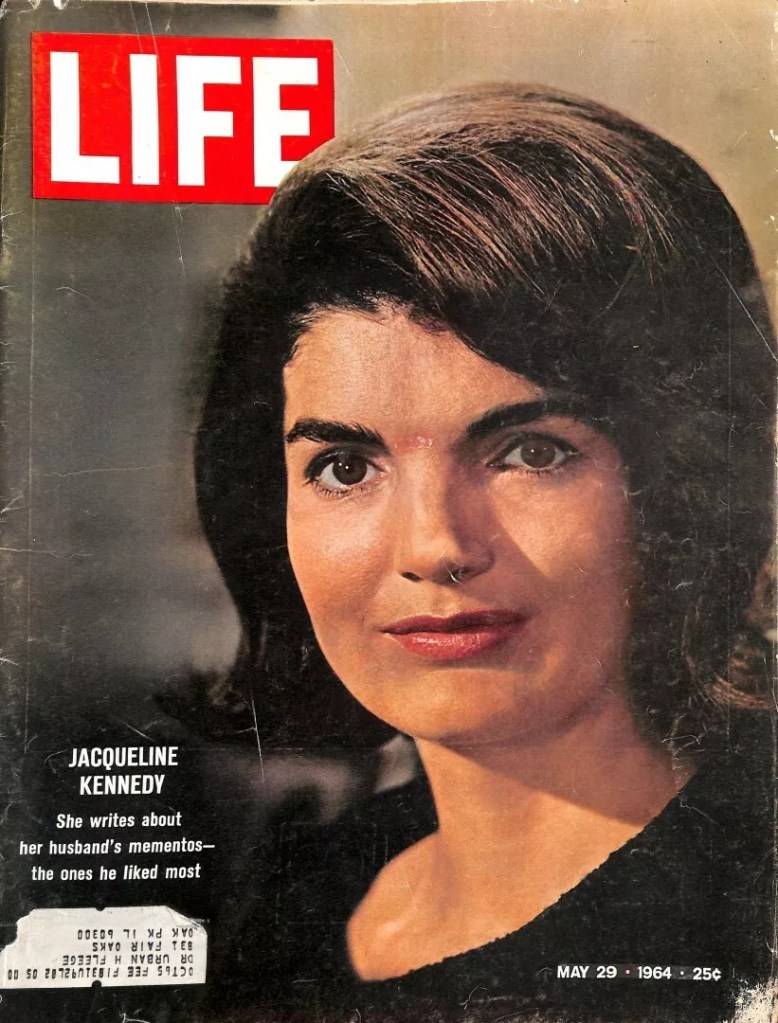
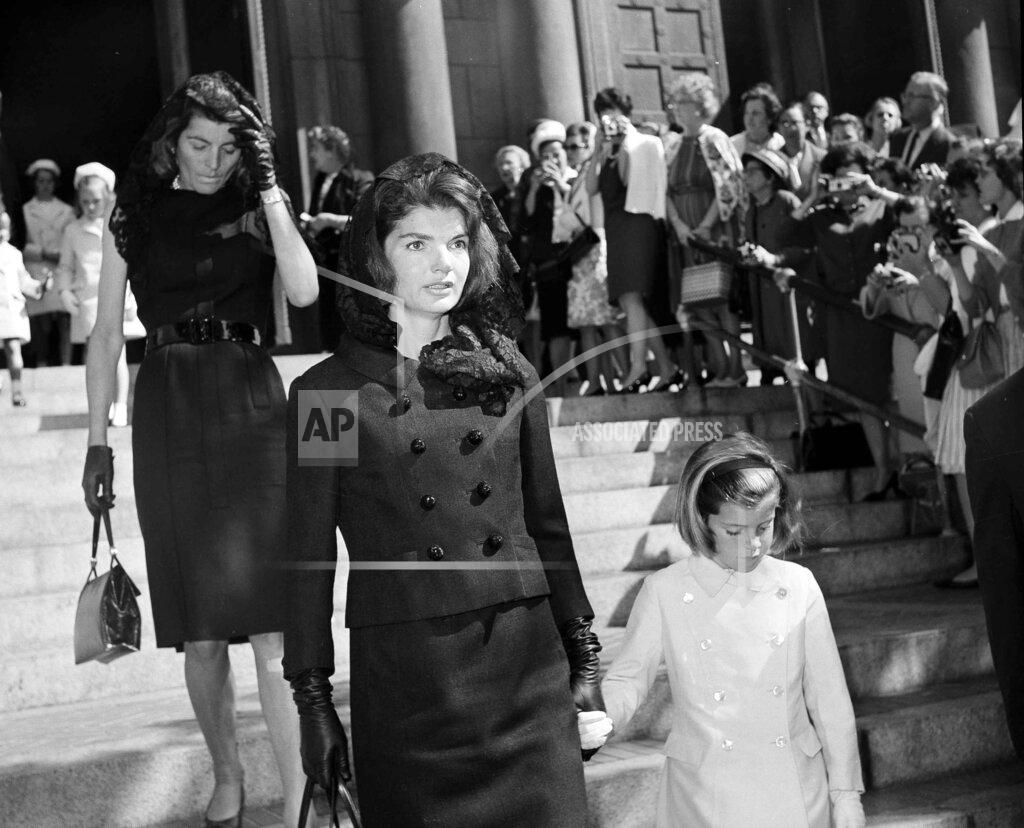
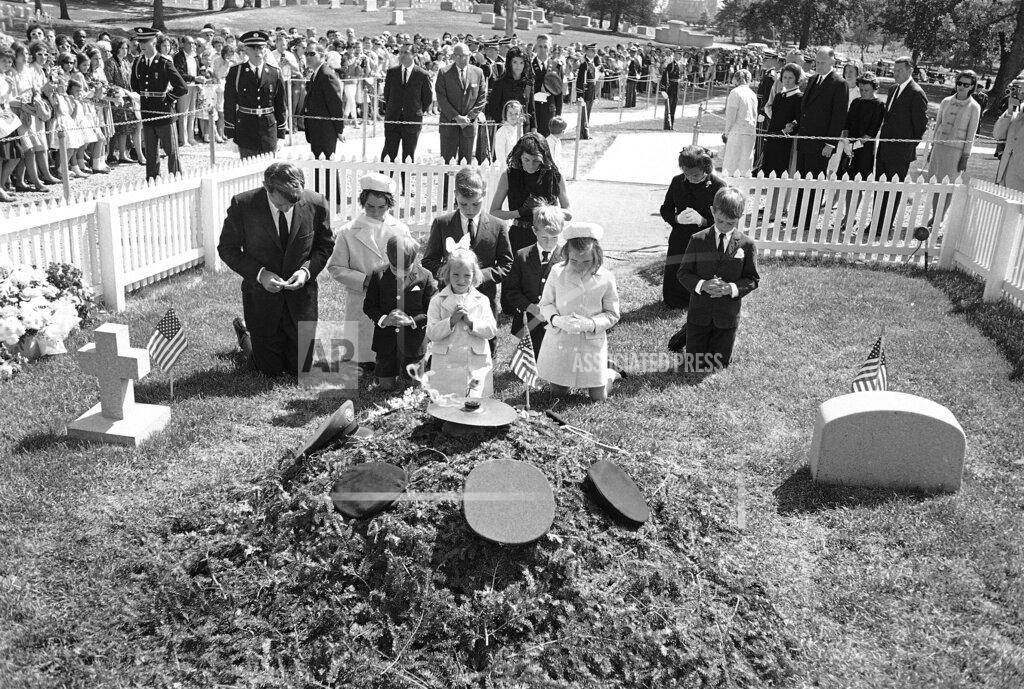
Mrs. John F. Kennedy today marked the 47th anniversary of her late husband’s birth. With members of her family and Washington officials, she attended a requiem mass at the Roman Catholic cathedral from which President Kennedy was buried six months ago. She climbed the green slope at Arlington National Cemetery hand in hand with her two children to place a sprig of lilies of the valley on Mr. Kennedy’s grave. Later in Hyannis Port, Massachusetts, with her brother‐in-law, Attorney General Robert F. Kennedy, the President’s widow joined in a memorial telecast that spanned the Atlantic by Telstar 2. It ended with Mr. Kennedy’s repeating the words of brother’s inaugural address:
“Now the trumpet summons us again — not as a call to bear arms, though arms we need — not as a call to battle, though embattled we are — but a call to bear the burden of a long twilight struggle, year in and year out, ‘rejoicing in hope, patient in tribulation’ — a struggle against the common enemies of man: tyranny, poverty, disease and war itself.” Participating in the live broadcast were President Kennedy’s youngest brother, Senator Edward M. Kennedy, and Irish Prime Minister Sean Lemass in Dublin; former British Prime Minister Harold Macmillan in London; and Mayor Willy Brandt in Berlin.
The most distinguished alumnus of Johnson City’s high school, a member of the class of ’24, came home tonight to deliver the 1964 commencement address. It was the third time Lyndon Baines Johnson had sent Johnson City, Texas graduates off into the world with words of advice. But it was the first time he had done so as President of the United States. His homecoming was considerably different from another that he recalled tonight — when he came back to Johnson City “with empty hands and empty pockets” after a brief fling at fame and fortune in California. That episode came only a few months, Mr. Johnson said, after he and five other classmates were graduated from Johnson City High in 1924. And it furnished him a theme for his address tonight to the 30 new graduates what now Lyndon B. Johnson High School. He came back in 1924, Mr. Johnson told an audience of more than 1,200, gathered in the school’s combination auditorium and gymnasium, “because I realized that, the place to begin was the place I had been all the time.”
The U.S. Air Force’s anti-satellite system was declared to be fully operational. The U.S. Army had inaugurated a different system on August 1, 1963.
The German football club SV Südwest Ludwigshafen was founded.
The Reds and Dodgers play 17 innings before the game is a called at 2–2. All 4 runs come in the 12th inning. National League rules state that no inning may start after 12:50 am.
In Detroit, Pete Ward’s 6th inning grand slam off Dave Wickersham provides all the Sox scoring as Chicago wins, 4–1. John Buzhardt is the victor.
Born:
Kenny Bynum, NFL running back and kick returner (San Diego Chargers), in Gainesville, Florida.

 History Diaries