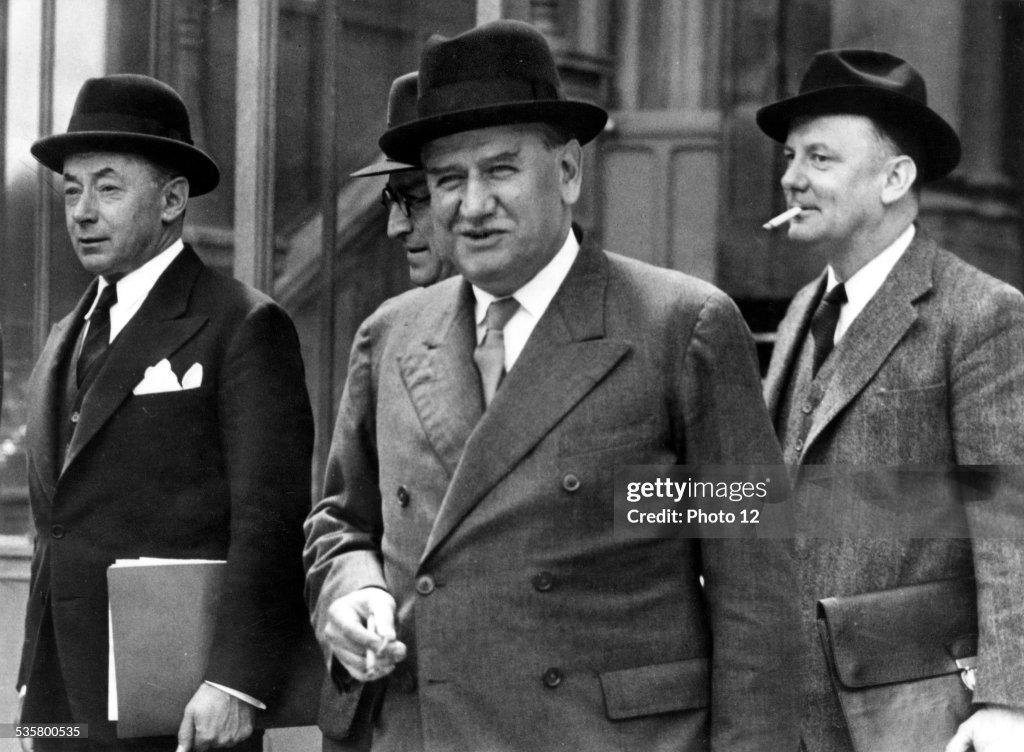
British Prime Minister Neville Chamberlain finally agreed to hold a talk with the Soviet Union. Later on the same day, British and French ambassadors in Moscow, Russia presented a draft agreement for Soviet Foreign Minister Vyacheslav Molotov to review, who received the wording coolly. The question of whether Russia will enter a pact with the Western democracies to check further aggressions by the Axis powers was put directly into the hands of Joseph Stalin this evening after a conference at the Kremlin. The conference was held in the rooms of the Council of People’s Commissars, of which Vyacheslav M. Molotov is chairman, instead of in the Commissariat for Foreign Affairs, where Premier Molotov, as Commissar for Foreign Affairs, heretofore had received Sir William Seeds, the British Ambassador. Sir William, accompanied by the French Chargé d’affaires, entered the Kremlin shortly after 4 PM and departed shortly after 5.
During this hour the conferees discussed in detail the latest British proposals designed to meet the Soviet Union’s demand that any agreement must be an ironclad mutual-assistance pact according the fullest rights of reciprocity to the Soviet. Little direct information was available tonight from any official source — Soviet, British or French — but it was authoritatively learned that Mr. Molotov at the end of the conference, which, it is understood, was quite friendly, said he would have to refer the matter to his government.
That would imply that the negotiations have gone about as far as they can go in the Commissariat for Foreign Affairs. Mr. Molotov’s phrase “refer to the government” means, in the last analysis, to Mr. Stalin. He has the controlling voice in every great Soviet undertaking by reason of his dominant position over the entire Soviet structure. Mr. Stalin is the leading figure on the Presidium of the Supreme Soviet. The Presidium, dominated by high party functionaries, exercises legal rule over the country and, when the Supreme Soviet is not in session, guides all its acts. Thus, by his control of both the Supreme Soviet and the party organization, Mr. Stalin is the final arbiter on foreign affairs as well as on every other Soviet issue. The fact that today’s three-power conference was held at the Kremlin is an indication of the seriousness with which the Soviet Union is viewing the present international situation.
Late tonight the Impression gained ground that the British and French negotiators had not been completely satisfied with the course of the conversation with Mr. Molotov. This possibly may be because they were disappointed that the Soviet leaders did not put their names on the dotted line at once, as many had hoped. This probably implies that the Kremlin is asking for further concessions and guarantees, because the Kremlin is jealous of the Soviet Union’s prestige. But nevertheless, the atmosphere is hopeful for the early signing of a binding pact against aggression.
Danzig Nazis open a new press attack. They claim Britain and France would not protect Poland from German attack.
What is heralded as the “greatest assemblage of women of all time,” will be witnessed here tomorrow when 70,000 feminine Lictor Youths and Fascisti will parade and perform gymnastics. About 15,000 of them will file before Premier Mussolini in the morning, and all will attend mass. In the afternoon they will go through their paces in the Mussolini Forum.
For three days various classes of girls and women have been gathering in Rome, many in the barracks built in the vast Circus Maximus. There will be women in uniform with rifles, others on horseback or on bicycles. Some of the thousands will carry fencing foils, some tennis racquets, bows and arrows, and soccer balls. It is all part of the celebration of the twentieth anniversary of fascism. Despite the rifles, all commentators make it clearly understood that a woman’s place is in the home.
Italian border guards posted at the Albanian frontier with Greece seize 675 ounces of King Zog’s gold being smuggled into Greece disguised as cheese.
Tomorrow and Monday, Hungary will go to the polls to elect 260 Deputies, and for the first time in nineteen years, the ballot will be secret. The attitude of the Hungarists, Nazi sympathizers, is causing some anxiety. They represent an unknown quantity and their propaganda has been most intensive. Competent observers even foresee the possibility that some governmental supporters will veer over to the Hungarist side at the first opportunity.
In view of the ever-increasing Hungarist activities the Premier, Count Pál Teleki, considered it necessary to make an appeal to the country on the eve of the polling. “This election,” he said, “casts increased responsibility on every honest man in Hungary. Deputies are elected for five years, but laws are made for several decades. At home the country needs security and order, while in its foreign policy it needs full liberty and independence. This can be achieved only if the nation does not swerve from a straight Hungarian path, refuses to adopt foreign models or directions from abroad.”
Although a government majority will certainly result from the elections, there is no doubt the Premier will have a difficult task when he faces the new Chamber. In recent years Nazi sympathies have, generally speaking, shifted from the Protestant East to the Catholic West. In the East the movement has regressed because in this thoroughly Magyar section the Hungarists were eyed suspiciously as a result of their German “taint.” In the West, on the contrary, the proximity of the Reich and the large proportion of German population won the Hungarists many adherents.
The Royal Air Force production program has made such progress during recent weeks that “in some responsible quarters it is estimated that the output of aircraft is now approaching 1,000 a month,” The Sunday Times aviation correspondent reported today. The writer, in a glowing account of the present British strength in the air, also asserted that the new British machines surpass all others in the “predominant factors in aerial warfare,” speed and concentration of gunfire. He declared that Britain’s supply of fast fighters is now “approaching the minimum limit for defense,” which would make it possible to concentrate on the development of bombers.
In letters to the chairman of the U.S. Senate and House of Representatives foreign relations committees U.S. Secretary of State Cordell Hull asked for a revision of the Neutrality Act to allow the sale of arms to belligerent states. He suggested enactment or reenactment of six provisions that “would make easier our twofold task of keeping this country at peace and avoiding imposition of unnecessary and abnormal burdens upon our systems.” The proposals were understood to have the approval of U.S. President Franklin D. Roosevelt. Discarding of the automatic arms embargo against all belligerents which is prescribed by the present Neutrality Act was described today by Secretary of State Hull as the sine qua non of any attempt to revise that legislation.
In the first authorized statement of Administration policy Mr. Hull sent identical letters to Senator Pittman of Nevada, chairman of the Foreign Relations Committee, and to Representative Bloom of New York, acting chairman of the Foreign Affairs Committee. The letters, the text of which was made public by the State Department, was the result of long-continued Congressional pressure to obtain from the Administration a concrete recommendation in regard to revision of the Neutrality Act.
President Roosevelt, in his annual message to Congress last January, described the law as one “which may operate unevenly and unfairly -may actually give aid to an aggressor and deny it to the victim.” In the intervening months, however, while hearings on various proposals went forward before the appropriate committees of the Senate and the House, the President, his Cabinet and other administrative officers were completely silent as to the means they favored for correcting the situation Mr. Roosevelt had indicated.
Secretary of the Treasury Morgenthau presented to Congress today a plan for immediate removal of tax “irritants,” with a provision for a long-range study of the revenue system, and suggested that the taxing and appropriating committees of both branches sit as one body to examine through one lens what the nation needs and what it can afford. Mr. Morgenthau, accompanied by Under-Secretary John W. Hanes and a battery of tax experts, was the first witness before the House Ways and Means Committee hearings, opened two days after Administration and Congressional leaders had agreed to put tax revision at the head of the remaining legislative program.
The statement containing the Treasury’s views had the approval of President Roosevelt, Mr. Morgenthau said in answer to a question from the minority side, and he nodded, with a smile, when it was observed that there was unanimity of opinion in the room over tax revision. Mr. Morgenthau carefully avoided the use of the word “recommend” in presenting his statement, but left the inference that the Treasury would be glad to work with Congress on the following program:
- Provision in income tax laws permitting business to carry over its net losses in one year to be deducted from business profits of future years.
- Legislation to make impossible the issuance in the future of tax-exempt securities.
- Repeal, or lapsing, of the undistributed profits tax, which was referred to as a business “irritant.”
- Repeal of the capital stock tax and the related excess profits tax, which he described as “very erratic in their operation.”
One category of tax problems, which raises the question of tax equity, was suggested as the subject of further study on the ground that hasty revision might mean the loss of revenue. An example, Mr. Morgenthau said, was the limitation now placed on the deduction of capital losses. Under the present law, an excess of corporate capital losses over capital gains can be deducted from ordinary income only to the extent of $2,000.
With the initialing of a new two-year agreement covering 100,000 anthracite miners, the United Mine Workers of America won the “union shop” yesterday in the hard coal fields of Northeastern Pennsylvania. John L Lewis, president of the miners, and Major W. W. Inglis, spokesman for the operators, hailed the contract as a “constructive” contribution to stabilization of the anthracite industry and as a guarantee of peaceful labor relations in the mine districts.
Through its victory on the union shop issue, the largest union in the Congress of Industrial Organizations safeguarded itself against incursions by its American Federation of Labor rival, the Progressive Mine Workers. The anthracite agreement represented another link in a chain of contracts under which 550,000 miners in the hard and soft coal fields of twenty-six States will have to join the United Mine Workers if they wish to work in the next two years.
The basic scale of wages and hours remains unchanged under the new hard coal pact, which became effective at midnight last night. Although formal signing of the contract was deferred until it is approved by referendum vote of the Pennsylvania miners, Mr. Lewis predicted that the assent would be “overwhelming.” The scale committee of the union and the full body of seventy-five operators ratified the agreement yesterday at a conference in the Engineering Societies Building in New York.
The contract specified that the establishment of a union shop and the granting of sole bargaining rights to Mr. Lewis’s organization were not to be construed as “intruding on the rights of management as heretofore practiced and understood.” The operators were unsuccessful in their attempt to have written into the anthracite agreement a penalty clause under which miners would be fined for strikes and owners for lockouts. A clause of this type has been included in the bituminous contract for twenty years.
Fiorello LaGuardia’s doctor warns the New York mayor that he must get more rest and slow his pace at the World Fair. LaGuardia berates political loafers and pledges a renewed effort to end useless jobs.
Members of the United Automobile Workers Union abandoned their efforts to picket Briggs Stadium, home of the Detroit Tigers, this afternoon after several skirmishes with a large detail of mounted policemen. Their leaders instructed the pickets, estimated by police to number about 3,000 men and women, to disperse and establish picket lines. at seven struck plants of the Briggs Manufacturing Company as the scheduled doubleheader between the Detroit Tigers and the St. Louis Browns began in the stadium. Sixteen persons, including a number of women, were taken into custody and many banners and placards were seized by police, who said that no one was injured seriously.
U.S. Women see a threat to their security as bills in 19 states would limit the types of jobs available to them.
Dr. Charles Mayo dies of pneumonia. He made the clinic in Minnesota world famous.
On the division flagship USS Arizona, Rear Admiral Russell Wilson relieves Rear Admiral Chester Nimitz as Commander, Battleship Division One (BATDIVONE).
The Reds set a club record by winning their 12th straight, a 3–2 decision over the Cards. Lee Grissom is the winning pitcher.
For the first time in his career, Detroit’s Charlie Gehringer hits for the cycle, in a 12–5 win against the Browns. Charlie does it in order, the first player to cycle that way.
Hank Greenberg of the Tigers hit a two-run home run off Browns pitcher George Gill in the bottom of the third inning. The game was rained out after 3½ innings with Detroit leading 4–3.
Free from crowds but not alone, even in the beautiful resort of Banff Springs, among the mountains, with its hotel towering like a Scottish baronial castle above the tumbling falls of Bow River, King George and Queen Elizabeth relaxed today as much as royalty on parade can ever relax. Accompanied by fifteen others including the Lords and Ladies in waiting, General Edouard Panet, Commissioner S. T. Wood of the Royal Canadian Mounted Police, Jim Brewster, a local concessionaire who has a monopoly on almost everything here, and several others, the King and Queen spent the morning motoring, sightseeing, walking and snapping pictures of the wildlife here.
The MS St. Louis reached Havana, but only 22 passengers were allowed to disembark. The diesel-powered motorship St. Louis sailed into Havana Bay with 937 Jewish passengers fleeing the Nazis. The Cuban government refuses to admit the Jewish refugees, and the ship will be turned away in June and forced to head for the Florida coast.
Chile’s Finance Minister Roberto Wachholtz warns U.S. oil companies that a government oil monopoly is planned by September 3.
Another difficult and even more dangerous Japanese-American dispute is certain to assume prominence at an early date when the Japanese authorities announce their new and carefully-considered policy concerning the presence and activities of American missionaries in all the areas in China under Japanese military occupation. This new official attitude, briefly summarized, will be: “If the missionaries cannot and I will not confine their activities solely to medical, educational and evangelical work, if they persist in encouraging anti-Japanism and covertly support non-cooperation movements among the Chinese, they had better pack up and go home or transfer their activities into territories still controlled by the Chungking regime.”
Japanese Army and diplomatic authorities make the grave charge that in many areas, particularly in the Yangtze Valley, American and British Protestant missionaries who have been permitted to return to mission stations are already making their missions and homes centers of anti-Japanese propaganda and keeping alive Chinese hatred for the Japanese invaders. In general, the Japanese authorities acknowledge that the medical missionaries are “minding their own business and not interfering in politics,” but they add the grave charge that “many educational and evangelical missionaries, instead of preaching the Christian doctrines of love and forbearance, are actually preaching a gospel of hate against Japan.”
The Japanese are counter-attacking at Suihsien, recently lost to the Chinese in the Japanese retreat from Northern Hupeh. Military reports! say that the counter-attack is intended to relieve pressure on Japanese troops in the Tahung Mountains, west of Suihsien. The Japanese forces at Tahung are declared to be in desperate straits with the Chinese closing in from the north, east, and west. Chinese describe the Suihsien assaults by the Japanese as “the last kick of a dying man,” and assert that recent Japanese reverses in Northern Hupeh have so weakened the invaders that a new offensive in the Wuhan cities area is impossible without large reinforcements and thoroughgoing reorganization.
Meanwhile Chungking is completing cleaning up following Thursday’s air raid casualties. These are generally estimated at about 1,000. Officials yesterday showed efficiency in the prompt tackling of post-raid difficulties.
Dow Jones Industrial Average: 136.80 (+0.71).
Born:
Donald “Don” Williams, American country singer (“I Believe in You”), in Floydada, Texas (d. 2017).
Frank Bidart, American poet and academic (Half-light Collected Poems – Pulitzer Prize for Poetry 2018), in Bakersfield, California.
Died:
Alfred A. Cunningham, 58, American aviator.
Joseph Roth, 44, Austrian-Jewish journalist and novelist.
Naval Construction:
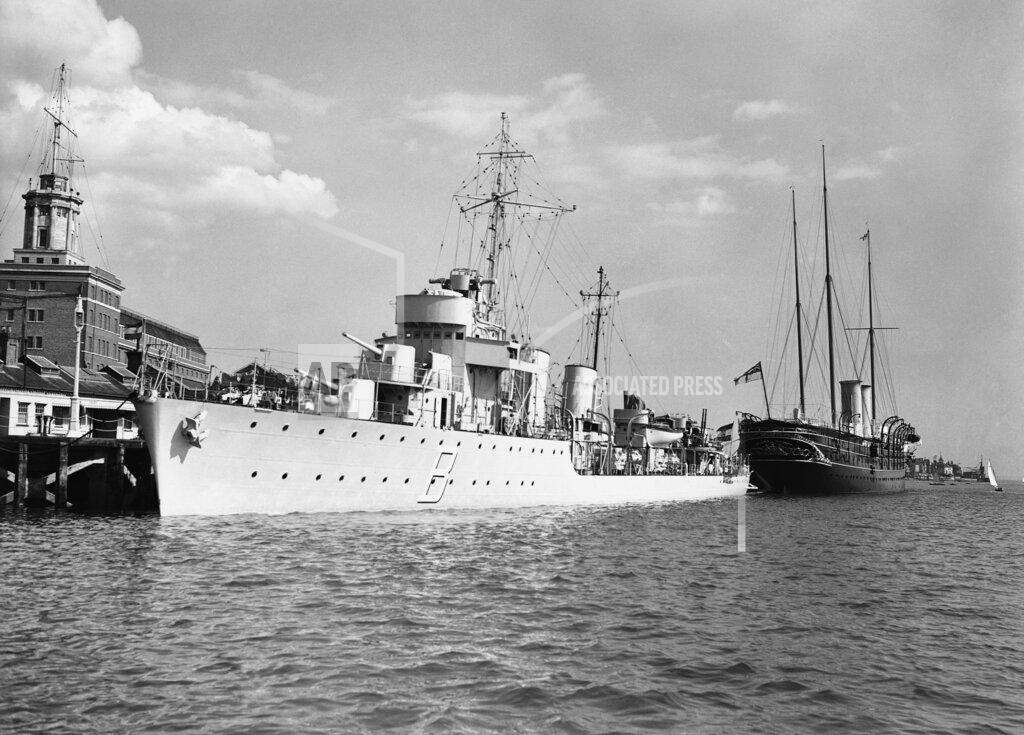
The U.S. Navy destroyer tender USS Dixie (AD-14), lead ship of her class of 5, is launched by the New York Shipbuilding Corp. (Camden, New Jersey, U.S.A.).



 History Diaries