Secretary of State Kissinger said that although he had further narrowed the differences between Syria and Israel in round-the-clock talks in Damascus, he had decided to return home on Wednesday even without a troop separation agreement. He insisted, while speaking to reporters who had accompanied him from Damascus to Tel Aviv, that it was premature to say that his mediation efforts had failed. “We will not know until tomorrow what the final outcome will be,” he said tonight. The Israeli cabinet will meet tomorrow morning to discuss possible new steps. The Secretary will hold discussions with Israeli leaders after the meeting.
The Soviet Union today mounted a diplomatic and propaganda offensive to bolster its influence among the Arab states. The Kremlin sent Foreign Minister Andrei A. Gromyko to Syria and Marshal Andrei A. Grechko, the defense minister, to Algeria. Three newspapers, taking a more positive tone toward Cairo, hailed Soviet‐Egyptian cooperation and friendship, asserting that relations would “not be shaken or undermined, by the intrigues of imperialist and reactionary forces.” Today’s moves follow improvement of Soviet relations with Libya during the talks in Moscow earlier this month with Premier Abdul Salem Jalloud. Reports from Cairo have said that the Soviet Union has resumed modest shipments of arms, mainly spare parts, in a gesture of conciliation that is interpreted as intended to cool off Egyptian eagerness to buy arms from other countries.
Cambodian troops, surrounded in the Longvek garrison, launched a three-pronged attack to dislodge rebels pressuring the camp’s southern defense. Fighters bombed insurgent positions there and south of a Phnom Penh suburb.
Meanwhile, South Vietnamese rangers met stiff resistance out of North Vietnamese bunkers in the second day of trying to retake An Điền, a village overrun by North Vietnamese and Việt Cộng troops north of Saigon. Government troops withdrew to Bến Cát.
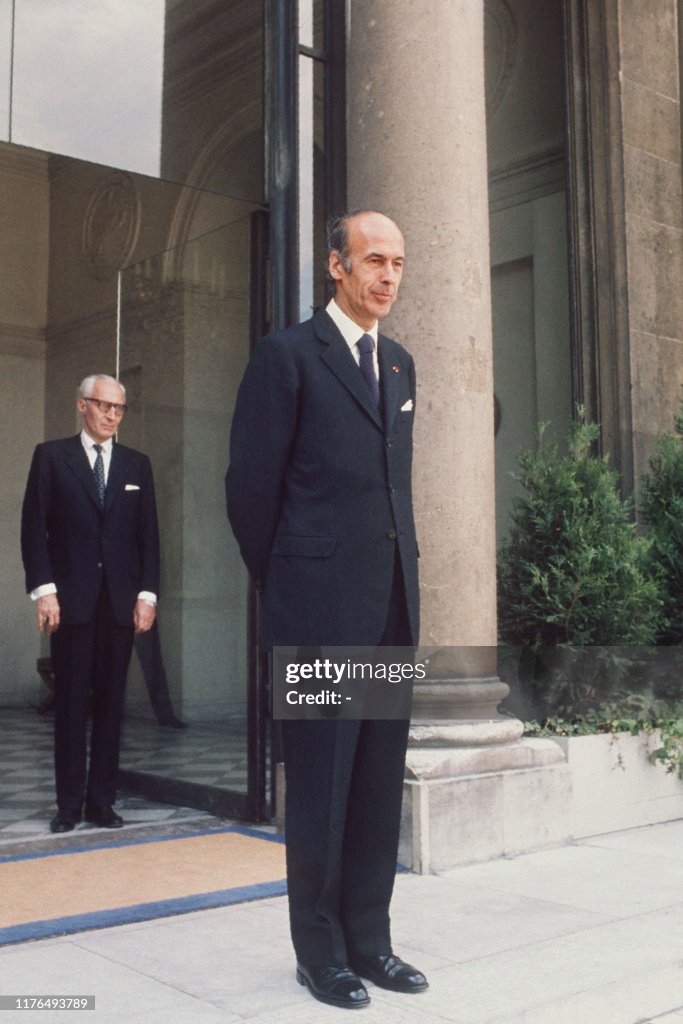
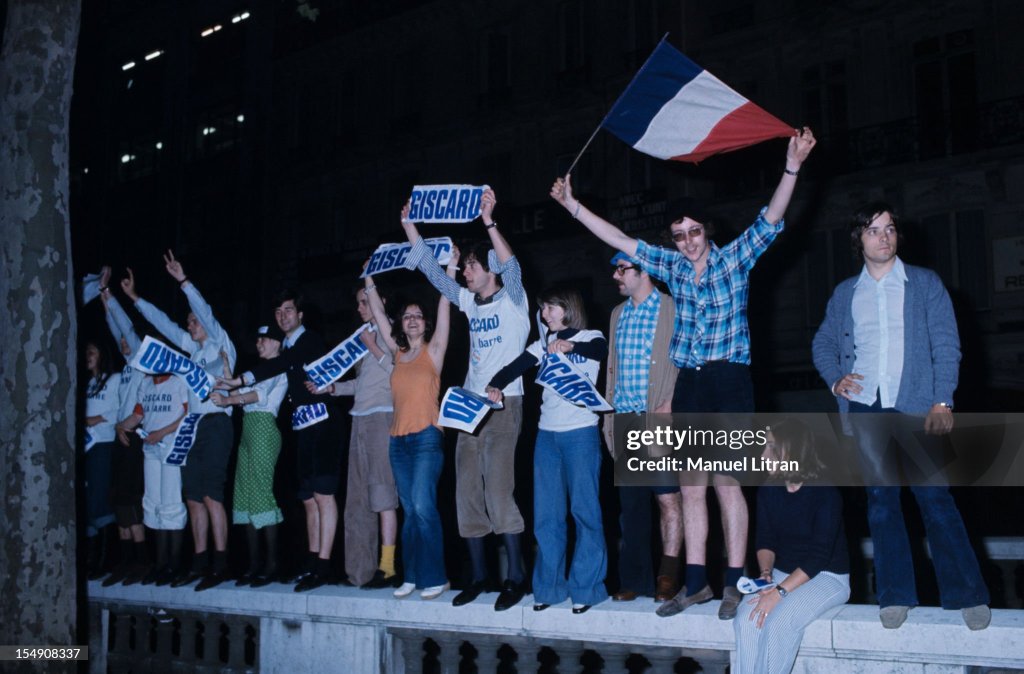
Valéry Giscard d’Estaing was inaugurated at the Élysée Palace in Paris as the third popularly-elected President of France, the 20th in her history and the youngest in this century. He is 48 years old. He promised in a short speech to heed “the immense wave of sound” demanding change. His four-minute inaugural address was one of the briefest in history, and had only 12 sentences. Five hours later, Giscard d’Estaing appointed Jacques Chirac, the Minister of the Interior, as Prime Minister.
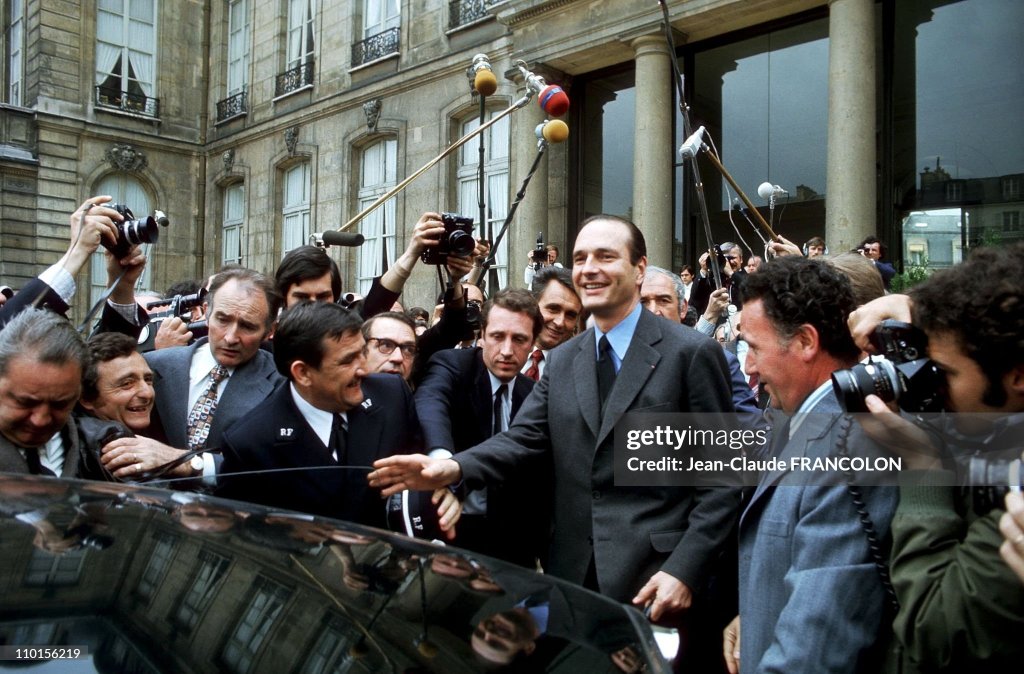
Jacques Chirac, a 41-year-old Gaullist, was named Premier of France by the new President, Valery Giscard d’Estaing. Mr. Chirac was known for his loyalty to the late president Georges Pompidou, whose Minister of the Interior he was, and who had brought him into politics. Mr. Chirac played a crucial role in President Giscard d’Estaing’s election victory by helping to outmaneuver Jacques Chaban-Delmas, the Gaullist candidate.
Strategic gasoline stations and oil depots in Northern Ireland were guarded by British soldiers to assure fuel for essential services as the general strike called by Protestant extremists threatened to bring a complete halt in food supplies, medical services and electric power. The takeover by the troops was ordered by Merlyn Rees, the British Secretary of State for Northern Ireland.
Barbara Forrest, 20, was raped and strangled in Pype Hayes Park, Erdington, Birmingham, England. Forrest’s co-worker Michael Ian Thornton was charged with her murder but would be acquitted due to lack of evidence. In a bizarre coincidence, the murder of Mary Ashford, which led to the Ashford v Thornton criminal case, also took place in Pype Hayes Park on May 27, 1817, 157 years to the day before Forrest’s murder. In each case, a suspect with the surname Thornton was acquitted of the crime.
Lisbon bus and streetcar operators, given a new minimum wage Saturday of $132 monthly, went out on strike demanding a minimum of $230, the same wage given to subway workers last week. Their strike is the latest in a series that have broken out since a military coup a month ago overthrew a half century of dictatorship. The junta and civilian government it set up have appealed to the people for discipline so Portugal can proceed with rebuilding the economy.
Luxembourg has elected a center-left government to replace 50 years of conservative rule, official election results showed. Liberal Party leader Gaston Thorn was expected to head a coalition government of Liberals and Socialists to be named this week. The ruling Christian Democrats were cut to 18 seats while the Socialists rose to 22 and the Liberals to 14 giving the new coalition 36 seats in the 59-seat Parliament. Education, abortion and divorce were primary issues in the election, with 18-year-olds voting for the first time.
Ten Jewish activists, detained over the weekend for demonstrating against Soviet refusal to let them emigrate to Israel, have been freed by Soviet police, Jewish sources reported in Moscow. No charges were reported against the 10 and no special warnings issued.
A Vatican court convicted four former Holy See telephone company employees of robbing Pope Paul VI’s private apartments in 1968 and 1969 while he was at his Castel Gandolfo summer residence. Sentences ranged from three years in jail to a $400 fine, but it is possible that the four will benefit from a papal amnesty.
The nationwide railway strike in India was abruptly ended by the Action Committee of the All India Railwaymen’s Federation (AIRF), 20 days after its start. Over three weeks, more than 30,000 union members had been arrested under India’s preventive detention law, including AIRF president George Fernandes. The Indian government began releasing prisoners the next day. India’s railway strike ended 20 days after it was started by the railwaymen’s union, whose members bitterly announced the strike’s end at a packed Socialist party headquarters in New Delhi. The union conceded that the government had crushed the strike through mass arrests of rail leaders. The collapse of the strike was regarded as a major triumph for Prime Minister Indira Gandhi.
India’s explosion of a plutonium device has rekindled fears about the spread of nuclear weapons and has prompted a high‐level interagency review of United States aid to India. Officials here are reasonably confident that the plutonium exploded by India on May 18 came from a natural‐uranium reactor of Canadian design, not from one of India’s enriched uranium reactors of United States design. Nevertheless, there are fears that the explosion may impel other countries to pursue a nuclear weapons ability and make their own tests, “If there isn’t some cost to India for doing this,” an official said in a reference to possible curtailment of United States aid, “other countries will go ahead.”
One of the more likely countries to seek such a path, it is believed in Washington, is Pakistan, whose relations with neighboring India remain troubled. Pakistan presumably would want to show New Delhi that she holds no advantage, even a psychological edge, by virtue of the May 18 test. Although Pakistan subscribes to international monitoring intended to prevent the spread of nuclear weapons, there is some belief that Pakistan might develop and test an explosive device anyway. Theodore B. Taylor, the physicist and former designer of nuclear weapons, said in an interview, “It’s about an even‐money bet.” Mr. Taylor thought that with “a major national effort” Pakistan could build within a year a plant to separate plutonium from the spent fuel rods of a natural‐uranium reactor.
In Brazil, 13 of the 14 people aboard a boat on the Parana River were killed when the watercraft capsized in the river, infested with piranhas. Thirteen of the 14 passengers on a boat died when it capsized in a Brazilian river infested with piranhas, also called cannibal fish. The survivor of the accident, in the Parana River near the town of Guaira, was in shock. “All I know is that I grabbed hold of an oar and swam ashore,” he said.
Light damage to buildings was reported near the epicenter of a strong earthquake that shook Guerrero state on Mexico’s Pacific Coast late Sunday night. The epicenter was about 60 miles north of Acapulco and the quake measured 6 on the Richter scale, the Tacubaya seismological station said. No damage was reported in Acapulco or Mexico City, where the quake also was felt.
The “Nixon round” of trade liberalization talks in Geneva may have to be shelved in favor of a smaller, less ambitious package deal, international trade officials said. The officials said hope is dwindling fast that President Nixon, preoccupied with Watergate and mid-term elections in November, can obtain approval from Congress in time for negotiations to start this year.
There have been strong indications recently that the long friendship between President Nixon and Vice President Ford — they have been personal and political friends for 25 years — has begun to fray. Neither will say publicly that there is a strain, but it is now a matter of public record that they are at odds over the refusal by the White House to give additional tape recordings and other material to the impeachment inquiry.
In a Memorial Day radio address, President Nixon coupled an appeal for a strong military force with praise for two Southern Democrats in Congress. It was the kind of speech that would appeal to the conservative bloc in Congress. He singled out for praise Representative Edward Hebert of Louisiana, the chairman of the House Armed Services Committee, and Senator John Stennis of Mississippi, chairman of the Senate Armed Services Committee.
President Nixon, Vice President Ford and Senate and House leaders have all agreed in recent weeks that Congress should enact a national health insurance program this year. Their rhetoric has matched the magnitude of the amounts of money that might be contained in such a measure, perhaps as much as $50 billion a year. But the two key congressional committees dealing with the issue of the health insurance plan have failed to keep up with the accelerated demands for action.
The Army apparently plans to continue testing deadly gases on beagle puppies at its Edgewood Arsenal Chemical Warfare Center in Maryland, Rep. Les Aspin (D-Wisconsin) said. The senator said the arsenal placed an ad for 450 puppies in the May 15 edition of the Commerce Business Daily. The Defense Department had no immediate comment. The Army conducted a variety of experiments with a new “binary” nerve gas and other chemicals last year, which brought more than 30,000 letters of protest. “Those 450 dead beagle puppies may not seem like much to the Army,” Aspin remarked, “but there are lots of people out there who care very much, and I am sure the Army will be hearing from them.”
President Nixon has closed the 90-year-old “usher’s book” that recorded the comings and goings of visitors to the White House family quarters and of the First Family itself. Tom Decair, an assistant White House press secretary, said the record was discontinued a few months ago. Mr. Nixon also ordered an end to the keeping of a visitors log book at his Key Biscayne compound when he spotted an aide recording his activities, sources said. The White House family log books were started by usher Ike Hoover in the 1880’s in the days of Grover Cleveland and traditionally are the property of the First Lady when she leaves.
Interior Secretary Rogers C. B. Morton says the White House seems better organized and more responsive since the Watergate affair forced the resignations of top presidential aides John D. Ehrlichman and H. R. Haldeman. Morton, in an interview, adds that his intuition tells him President Nixon is innocent of wrongdoing and will not be impeached. Until they resigned on April 30, 1973, Ehrlichman was chief of the President’s Domestic Council and Haldeman headed the White House staff. Morton said that Kenneth R. Cole Jr., Ehrlichman’s successor, was doing an excellent job and “I have no problem with the White House.”
Dallas police said Dan Burney, a senior vice president of the Ling-Temco-Vought Corp., one of the nation’s larger conglomerates, has been missing for six days and that a search had failed to turn up any reason for his disappearance. Burney was last seen Tuesday by a garage attendant as he drove away from the LTV Tower in downtown Dallas. His wife, Diane, had called him 45 minutes earlier at the office and he had told her he would head home in a few minutes. Burney, 47, had been working hard of late but sources said he had been under no apparent strain.
Robert G. Jensen, the FBI agent who directed the investigation into the murder of Dr. Martin Luther King, says the facts of the case do not lend themselves to “grandiose theories” of conspiracy. “It was a relatively simple thing,” Jensen said. “A man was killed. A man was caught.” Robert I. Livingston, attorney for James Earl Ray, said recently that he had been in periodic contact since March with a representative of the “men who actually carried out” Dr. King’s slaying. Ray, who pleaded guilty to the murder, is serving a 99-year prison sentence. Jensen, now head of security for an international motel firm, discounted Livingston’s remarks, saying there was no deep conspiracy involved.
Rapid advances in weapons technology, demonstrated in the 1973 Middle East war, are being incorporated into a major modernization program of the United States land forces. The new weaponry for ground forces, part of revolutionary advances in all weapons; already has raised questions about the future usefulness of arms hitherto considered essential. Will tomorrow’s infantryman, for example, armed with accurate and lethal antitank missiles and small antitank mines and bombs, make the tank obsolete and restore the infantry to its old role King of Battles?”
The tank, in cooperation with the fighter bomber, has dominated battlefields since the German campaign in Poland 35 years ago. But in the last 10 years there has been a steady development of antitank weapons, and the tank’s future is being studied in the Army with the same seriousness that the Navy’s planners give to the future of the aircraft carrier, whose effectiveness may also have been reduced by technological advance.
And besides the main battle tank, the whole family of tracked and wheeled armored fighting vehicles that for a generation have ranged battlefields with relative impunity — light tanks, armored cars, armored personnel carriers, self‐propelled guns — have become more vulnerable in direct ratio to increases in the range, and hitting of antitank missiles and guns.
Under a special reapportionment bill expected to be approved at a special session of the New York state legislature, the districts of Representative John Rooney, dean of the New York congressional delegation, and State Senator Carol Bellamy would be remapped. The new boundaries, confined to Brooklyn and Manhattan, were ordered by the Justice Department under the Voting Rights Act and are meant to increase black and Puerto Rican representation in Congress and in the legislature.
In Boulder, Colorado, the murder of six Hispanic-American residents began with the explosion of a bomb planted in the car of lawyer Reyes Martinez at Chautauqua Park. Martinez, his girlfriend Uma Jaakola and her friend Neva Romero were all killed in the blast. Two days later another car bomb exploded in the parking lot of a Burger King restaurant that had closed for the night, killing Florencio Granado, Heriberto Teran and Francisco Dougherty. Another person, Antonio Alcantar Jr., who was standing outside the car, survived but lost a leg. Nearly 50 years later, no suspect had been arrested for the killing of “Los Seis de Boulder” (Spanish for “The Boulder Six”).
Tornadoes formed over the North Carolina coast, toppling trees and power lines, damaging rooftops and overturning mobile homes. Minor injuries were reported. The tornadoes struck early in the morning, catching many residents asleep.
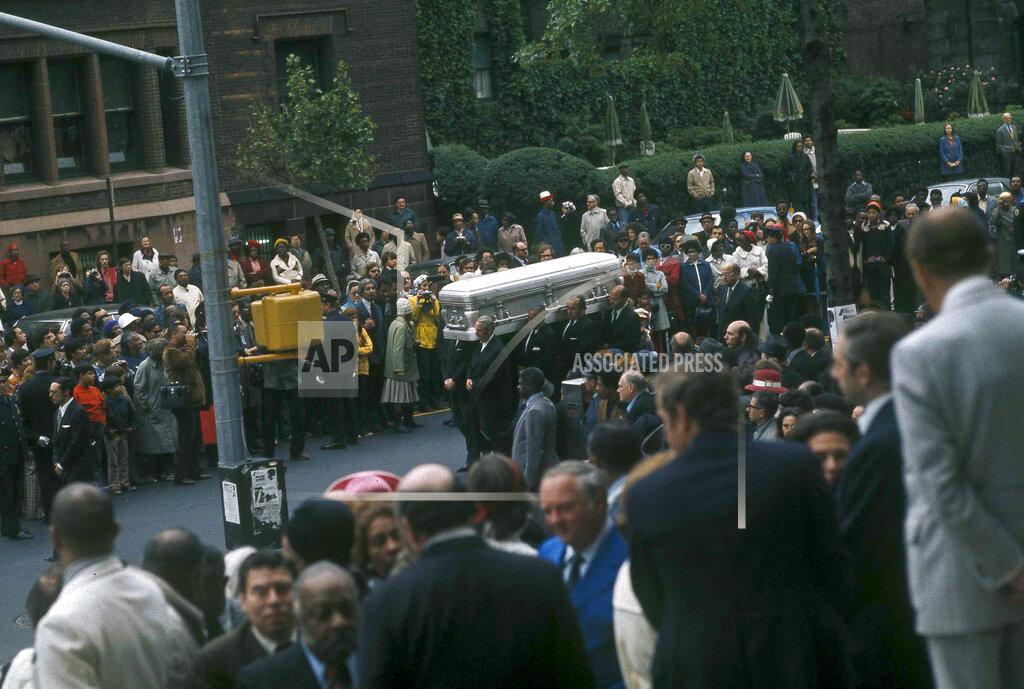
Funeral services for Duke Ellington attracted 12,500 people to New York City’s Cathedral of St. John the Divine, with the Suffragan Bishop of New York presiding. McHenry Boatwright, Ella Fitzgerald, Earl Hines, Ray Nance, Lou Rawls, Joe Williams, and Mary Lou Williams performed during the service. Present also were Pearl Bailey (representing President Nixon), Count Basie and Jack Dempsey. Every pew and even the aisles of the Episcopal Cathedral Church of St. John the Divine were filled by a crowd of 10,000 persons who came to attend the funeral service of Duke Ellington. And 2,500 others followed the service by loudspeakers on Amsterdam Avenue in front of the cathedral. The traditional Episcopal service was combined with musical selections played and sung by old friends of Mr. Ellington.
The Pirates Ken Brett no-hits the Padres until the 9th inning, settling for a 2-hit 6–0 shutout in the first game of the doubleheader. In the 2nd game, Brett’s 2-run pinch triple gives the Bucs an 8–7 win.
Born:
Marjorie Taylor Greene, American conservative politician, U.S. Representative for Georgia since 2021; in Milledgeville, Georgia.
Dr. Margaret “Mags” Portman, British physician and developer of preventative treatment for HIV using the technique of pre-exposure prophylaxis; in Leeds, England, United Kingdom (d. 2019 from mesothelioma)
Arbi Barayev, Chechen terrorist and leader of the Special Purpose Islamic Regiment; in Alkhan-Kala, Checheno-Ingush Autonomous Soviet Socialist Republic, Soviet Union (killed in gun battle, 2001)
Danny Wuerffel, College and NFL quarterback (College Football Hall of Fame, Heisman Trophy 1996, U of Florida; NFL: New Orleans Saints, Green Bay Packers, Chicago Bears, Washington Redskins), in Fort Walton Beach, Florida.
Dedric Willoughby, NBA point guard (Chicago Bulls), in New Orleans, Louisiana (d. 2023, from a heart attack during a pick-up game of basketball in Atlanta).
Sébastien Foucan, French founder of freerunning and developer of the sport of parkour; in Paris, France.
Gürkan Uygun, Turkish TV actor known for 10 seasons of Kurtlar Vadisi (“Valley of the Wolves”); in İzmit, Kocaeli Province, Turkey.
Died:
Kurt Wiese, 87, German-born American children’s book author and illustrator, known for the pictures in 300 books, including the Freddy the Pig series.




 History Diaries