Ribbentrop instructs Schulenburg to inform Molotov that Germany’s hostility to the Comintern will be abandoned if Hitler can be assured that the Soviets have, in fact, renounced their aggressive struggle against Germany as indicated by Stalin’s recent speech.
Anxious interest was aroused in Danzig today by a defiant article in the official Nazi newspaper, Vorposten, suggesting that the British and French guarantees to Poland would not be carried out if the Poles fought Germany; that Britain and France would not go to war to prevent Germany from obtaining Danzig and Pomorze, so-called Polish corridor: that Danzig “needs no Runciman” but looks to Chancellor Adolf Hitler and nobody else to “bring Danzig into the Reich without war.” The article was read in connection with the renewed local campaign against what the Vorposten calls “Polish madness.” The newspaper outcry over Sunday’s shooting of a local German leader after an anti-Polish demonstration was soft-pedaled for a day or so and then began anew. The incidents reported were trivial but much was made of Polish soldiers’ warning shots when a chauffeur approached the only bridge over the Vistula River and it was charged that Polish frontier officials were deliberately preventing Germans from crossing Pomorze.
Beneath the superficial calm of this quiet old city there is a certain nervousness as to what these outbursts in the official press may signify. Nazis here say everything is in Herr Hitler’s hands. Hence Danzigers scan the official and party press for hints of Berlin’s intentions. The Vorposten conspicuously published a report that Karl J. Burckhardt, League of Nations High Commissioner for Danzig, is returning with a kind of Runciman mission on behalf of Britain and France, who, the paper infers, are worried by Poland’s stiff attitude toward German claims and are seeking to avoid being dragged into war by Poland. Viscount Runciman was the mediator whom Britain sent to Czecho-Slovakia last Summer just before the Munich “settlement.”
But Berlin and Danzig do not believe the Western powers can “bring Poland to reason.” Meanwhile, the Nazi paper says, Germany wants no more Runciman missions and regards the League as merely an evil smell. The task of bringing Danzig into the Reich without war is too heavy for the slender shoulders of Geneva diplomats,” the paper continues. “This mission has been taken over by Berlin; and this is sufficient guarantee. For us it is more important than a British guarantee for the preservation of the present map.”
Privately one often hears the prediction that in some unexplained manner Germany will get Danzig — sometimes Pomorze is added — without war. But this conception has not previously been so confidently expressed in the official press. In Pomorze, just west of Danzig, are Polish troops numbering — according to some reports — several divisions. In the harbor of Gdynia are two Polish cruisers and three destroyers, and on the Polish shore facing Danzig harbor stand heavy guns. Seven roads lead from the Corridor to Danzig — where there are no natural barriers — while between Danzig and East Prussia runs the Vistula, flanked by swamps.
The Institute for Economic Inquiry declared its semi-annual report that Germany’s tremendous political and economic pace has placed a great strain on that nation’s machinery, but the Reich had become “beyond question” the leading industrial nation of Europe. The Institute for Economic Inquiry was an organization based in Chicago whose mission was to spread among adults a knowledge and understanding of the facts of economic life.
Franco has executed 688 since March 28. It was officially announced tonight that the Nationalists’ specially constituted councils of war and permanent military tribunals had sent 688 persons before firing squads since the fall of Madrid on March 28. The councils, formed by officers. of the Madrid army of occupation, condemned 1,000 persons to death, but the sentences of 312 of them were commuted to prison terms by Generalissimo Francisco Franco. Officials of the military tribunals said in disclosing the figures that daily trials contributing to “the total normalization of the life of the nation” were “indispensable for initiation of the second era of empire.”
Tribunals in Madrid have been trying daily 380 persons accused of assassinations, robberies, burning and sacking of churches, treason, imprisonment of Nationalist sympathizers and other activities during the time when the Republicans dominated the city. The number condemned includes those sentenced by councils of war operating in Toledo, Ciudad Real and Albacete in addition to Madrid. A round-up of suspected criminals in all newly incorporated zones is continuing under direction of military authorities.
The British and Portuguese governments reaffirmed their ancient alliance. This agreement secured Britain’s strategic sea lanes to Africa and the Mediterranean. The Portuguese also demonstrated their desire to work with both the Western and Fascist powers.
The Military Training Act received Royal Assent.
Bowing to a storm of criticism from all parts of the House of Commons, Sir John Simon, Chancellor of the Exchequer, today promised to see whether there was any way of preventing or delaying the physical transfer of £6,000,000 of Czech gold to the German Reichsbank by way of the Bank of England and the Bank for International Settlements. The World Bank requested the transfer as long ago as March 23, according to Sir John, and Montagu Norman, Governor of the Bank of England, agreed without telling the British Government about it. Nevertheless George Strauss, a Labor member, asserted that the gold involved was still physically in the vaults of the Bank of England and said there were ways of stopping or delaying the transfer if the government wished to use them.
Marshal Klementi E. Voroshilov, Soviet Commissar of War, has been asked to come to England to see the British army maneuvers this Summer. With the announcement of this invitation today it was learned the British Government had forwarded to Moscow its formal proposals for an Anglo-Russian agreement, the outlines of which had already been communicated to the Soviet Government by the British Ambassador, Sir William Seeds.
Marshal Voroshilov has not yet accepted the British Invitation. If he does, he will be the first Communist army chief to attend British maneuvers. These, incidentally, are expected by army officers to be on a larger scale than any since the World War. The fact that the British have made known that an invitation has been dispatched is bound to be interpreted here as another indication that Britain is ready and willing to start staff talks with the Russians. It is believed that the draft which went to Moscow today contained notification of a British agreement that staff talks should be initiated as soon as a final accord with Russia is reached. In Moscow, Molotov is said to have received the British proposals “cooly.”
From the outlines of the British proposals, which became clearer today, it would seem obvious that such a step is necessary. The British now have apparently acknowledged that the agreement should include not only mutual cooperation, should either France, Russia or Britain be attacked, but also immediate mutual cooperation, should any European — the word is important, since apparently the Far East is excluded — country guaranteed by any of the three be attacked.
This would mean that if Germany or Italy tried anything with Poland, Rumania, Greece, or Turkey, the two great European democracies would be joined by Russia in a war-that is, provided the country attacked resisted. Presumably all that Russia would have to do to bring the Baltic States into the same position would be to extend to them guarantees such as Britain has already extended to Poland and the Balkan countries. The agreement would apparently be entirely defensive and would be so described.
Although all official sources preserve strict silence on all matters relating to the Aland Islands, it is apparent that general anxiety is spreading in official circles in Stockholm and Helsingfors, Finland, that the question is about to be made a pawn in the game of the great powers. Until today no press comment had appeared, but today several Swedish and Finnish papers cautiously ventured to express a vague anxiety that Britain and France, in order to maintain good relations with Russia, would go back on their word and support the Soviet demand in Geneva for postponement of the discussions on fortification of the Aland Islands by Finland in agreement with Sweden.
Meanwhile, preparations for the fortifications are progressing. It is reported that steamers loaded with all kinds of material are leaving Finnish harbors daily and that surveyors for some time have been busy prospecting sites where fortifications can be erected.
A further private meeting of the League Council this morning failed to break the deadlock over the refortification of the Aland Islands and it now seems possible that the Council meeting may extend over the wee-end.
Izvestia, official mouthpiece of the Kremlin, said today that the Soviet Union had “a sacred historic right” to participate in deciding the future of the Aland Islands. It declared that Finland, which owns the islands, and Sweden, partner in the fortification plan, “realize full well the Soviet Union’s vital interest in the islands, which, if fortified, would dominate the entrance to the Gulf of Finland.”
“Yet Finland,” it continues, “has refused to give Moscow any information on the character or extent of the proposed fortifications, alleging that such information comes under the heading of military secrets.” Izvestia said Ivan Maisky, the Soviet representative in Geneva, had been instructed to insist on postponement of any further consideration of the question by the League of Nations Council.
In Washington, President Roosevelt challenged private utilities in a statement at his press conference to prove their willingness to cooperate with government by accepting the coordination plan of the New York Power Authority as he prepared to leave for a weekend at Hyde Park.
The Senate Appropriations Committee reported a $225,190,000 appropriation bill for rivers and harbors and flood control, cutting $50,000,000 from the House version of the bill. The Finance Committee reported favorably a bill to eliminate the $30,000,000,000 ceiling on the amount of government bonds which may be outstanding, the Military Affairs Committee tabled a bill to prevent entry of draft-dodgers into the country, and an education and labor subcommittee heard Dr. Morrie Fishbein oppose the Wagner bill for Federal aid to State health programs. The Senate recessed at 5:54 PM until noon tomorrow.
The House was in recess. Its Rules Committee gave the right-of-way to the Townsend Pension Bill.
President Roosevelt challenged the managers of electric utilities in New York and the nation today to prove their willingness to cooperate with the government by accepting the plan for coordinating public and private power production and distribution outlined in the annual report of the New York Power Authority to the Governor and Legislature. “The Power Authority’s report is obviously drafted to test the willingness of the private utilities to cooperate with government agencies in a program of expansion in order to make possible the widest possible use of electricity at the lowest possible cost,” Mr. Roosevelt said.
The statement, which ended with an expression of hope for early agreement between the United States and Canada on the proposed St. Lawrence Waterway Treaty, was read by the President at the opening of his press conference. The President left the White House shortly before 11 PM, motored to the Union Station and boarded his special train for a visit until Tuesday at his home in Hyde Park, New York. A guest on the trip. was Gerald Morgan, a Hyde Park neighbor. The President retired for the night without waiting for the train to pull out at midnight. He planned to devote most of the Hyde Park visit to rest.
Asked at his press conference whether the tax program would go beyond extension of nuisance levies and the corporate tax structure, he said he thought it better not to talk about the subject for fear of muddying the waters, adding that the publication of inaccurate stories concerning it had been the chief cause of the delay on the program. He declined to go beyond the text of his statement on the Power Authority report. Reminded of his warning to Canadians on his recent visit to the Dominion that private power interests would soon make a monopoly of the resources of the St. Lawrence Valley, and asked whether there had been any developments in that connection, he replied the question would have to be asked of Canada.
Representative Fish of New York, ranking Republican member of the House Foreign Affairs Committee, and Representative Tinkham of Massachusetts, another minority member, were not invited by Secretary Hull to attend a conference at his apartment today, but practically all other members of the committee were there and they discussed revision of the Neutrality Act for two hours. Both Mr. Fish and Mr. Tinkham have been such consistent critics of the Administration’s foreign policy that Mr. Hull apparently decided their presence would not make for a peaceful exchange of views. To avoid appearing formally before the committee Mr. Hull started his hotel conferences earlier in the week.
Rescue accomplished, with thirty-three of the crew of fifty-nine aboard the Squalus saved, the navy settled down today to the more tedious task of salvage of the $5,000,000 submarine. There was a slackening of the feverish tempo that had prevailed since Tuesday noon, when the sister ship Sculpin reported that one of the newest and finest of the navy’s submarines was lying on a bed of mud off the Isles of Shoals thirteen miles south-southeast of here with her after compartments flooded.
The crew on the Falcon, turning from rescue to salvage, was working steadily to take advantage of excellent diving weather which may break at any time, but the men were no longer under the pressure of having lives at stake. Even the salvage work was of a preliminary nature because no decision had been reached as to the method. The officers were awaiting a decision from Washington from the Bureau of Naval Operations. Commanders A. R. McCann and A. I. McKee, technical experts from the scene, were flown from the navy yard here to take part in the discussions at the capital.
There are two possible operations. Divers could seal the thirty-one-inch induction valve, the failure of which is believed to have caused the disaster, and all other openings in the hull and then air hoses on the Falcon could be used to blow out the water and permit the crippled ship to rise of her own buoyancy. It is a tricky and delicate operation to maintain a proper balance between positive and negative buoyancy so that the ship would not rise so fast as to be damaged. By the other operation, pontoons, huge floating tanks equipped with sets of valves, would be lowered in pairs alongside the stricken ship. They would be made fast and then the water would be expelled to provide the lift needed. This operation might take weeks. While this method is slower, the other is more risky. Rear Admiral C. W. Cole, commandant of the Portsmouth Navy Yard, returned to the rescue scene this morning, after a night ashore during which he got his first night’s sleep since the accident.
Although it was reported in Washington that the Bureau of Naval Operations had decided to leave the method of salvage to Admiral Cole, navy officials here declared that they had received no information, nor could they confirm a report that Admiral Cole had decided to use pontoons. At the scene of operations, it was also said that no decision had been made. Naval opinion here, however, inclined to favor the pontoon method.
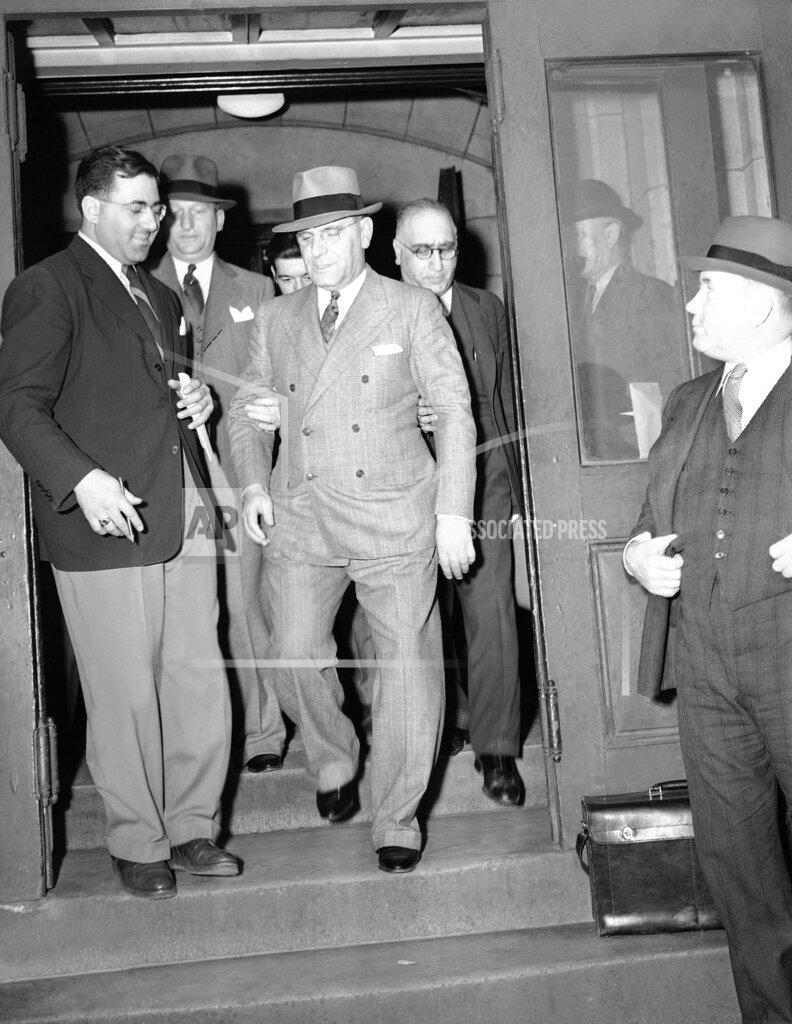
Fritz Kuhn, 43 years old, the president of the German-American Bund, was released in $5,000 bail from the Tombs at 5:30 o’clock last evening, almost twenty-four hours after his capture in an automobile near Krumsville, a Pennsylvania hamlet, on an indictment charging him with the theft of $14,548 of the bund’s funds. Kuhn spent six and one-half hours in a Tombs cell after he had pleaded not guilty before Judge Cornelius F. Collins in General Sessions. He would have been taken from his cell an hour earlier, however, had it not been for the fact that somebody, described briefly by Gustave Elmer, a national organizer of the bund, as a “kind friend,” had furnished the bail in banknotes, mostly of small denominations, which had to be counted by Warden William Adams in his office.
The money was brought to the prison by Elmer and Kuhn’s lawyer, Vohan H. Kalendatian. Finally, when Warden Adams ordered the doors on the main entrance of the Tombs facing Center Street opened, Kuhn and the other two men hurried to an automobile in which another man and a young woman, a brunette, both of whom refused to reveal their identity, sped off with the bund leader. Kuhn’s only statement before their departure was: “I shall prepare a statement about this whole affair later.”
Senator Vandenberg of Michigan will take a step next week that will make him at least an entry in the race. for the Republican Presidential nomination, it was learned definitely today, though not as an active aspirant at the outset. He is expected to “consent to be drafted” as the State’s favorite son in response to a resolution of Republican State officials and the Republican House delegation from Michigan. Following the presentation to him formally today of the resolution adopted by these two representative groups, Senator Vandenberg said he would reply early next week. He will say that he “will gladly accept the honor,” but has no intention of becoming an aggressive Presidential candidate, since he will seek renomination to the Senate next year.
The Eastern Steamship Lines and allied services announced last night cancellation of all its immediate sailings along the Atlantic Coast and to Bermuda, and officials indicated that the company would tie up its entire fleet of fourteen vessels today. The company moved in the face of a strike by the Seafarers International Union, an American Federation of Labor affiliate, the leadership of which it was said had been taken over in recent weeks by strong West Coast union men. Officials of the line said the strike had been called despite a three-to-one vote against it by the company’s unlicensed personnel. The company had been negotiating with the union for weeks and finally decided yesterday to cease operations because of demands the officials considered not only unfair but far beyond the ability of the company to meet under present conditions.
With their 11th straight win, a 7–5 victory over St. Louis, Cincinnati takes over first place and holds the lead for the rest of the season.
A tired King and Queen of England escaped from the crowds tonight for a brief respite of privacy and peace in Banff, Alberta, guarded by the snow-capped Rockies and the Royal Canadian Mounted Police. King George VI and Queen Elizabeth arrived here at 7:30 PM, Mountain time, after a hurly-burly Calgary reception where they stood among the Indians of five tribes and shook hands with about thirty chiefs in war paint and feathers.
Upon their arrival in Banff just as the sun sank behind the mountains, they did what was expected of them by riding in state through the village and then, the King in a business suit and the Queen in the dress she wore at Calgary, relaxed and began to enjoy life for the first time since they landed at Quebec. After shaking hands with a group of veterans of the great war, they retired to the vice-regal suite in the south wing on the sixth floor of the Banff Springs Hotel. A few minutes later they walked out arm in arm and unescorted, like a couple of honeymooning tourists, to gape in admiring awe at the beauty of the valley ringed with snow-crowned peaks.
For the first time they were completely free. There were no crowds. The Mounties, scattered through the pine trees around the hotel, saw to that. The arrival of the King and Queen at Banff after Calgary’s reception was like going into a church from a noisy street. At Calgary, the center of a sheep- and cattle-raising country, the royal visitors were escorted over eight miles of streets lined with 150,000 cheering subjects. They received a salute from English guns and Indian tom-toms.
For the first time on his visit to Canada the King rode in the royal procession at Calgary as a plain civilian. He was dressed in a blue lounge suit when he stepped off the royal train. The Queen was wearing a dress of beige crepe, a coat trimmed with blue fox and a beige straw hat with a crown of blue velvet. Warm, sunny weather was a welcome change after the last two rainy days in Winnipeg and Regina. The royal visitors spent only one hour and forty-five minutes in Calgary, which had turned itself inside out to greet them. Bunting flew from every building and stands had been erected to seat 40,000. More than twice that number were content to stand along the sidewalk and cheer as the royal procession passed.
More fighting is reported at both ends of the Manchukuoan frontier. Japanese reports blame aggression by Soviet forces and their protected allies, the Outer Mongolians. The affrays on the West seem to be a repetition of annual fights for grazing lands, which occur every Spring. Outer Mongolians allege that part of their former pasture has been included within Manchukuo. Before the boundaries were rigidly fixed, grazing ground could be allotted by tribal arrangement, but now the Japanese-Russian border runs down through what was once common territory, and crossing has become a serious offense.
On Wednesday 400 Outer Mongol horsemen, armed with two cannons, tried to enter Manchukuo at Barshagal, on the Khalka River, according to the Japanese reports. They were repulsed by Manchukuoan frontier guards after two hours of fighting, but returned at 2 AM yesterday, attempted a surprise attack and were again driven back, it was said.
On the extreme eastern boundary, where Manchukuo and Soviet territory meet near Lake Khanka, Japanese reports say Soviet guards opened fire from an observation post upon a Japanese-Manchukuoan border patrol. The latter returned the fire, killing two Russians, it was said. Japanese reports claimed the Russians numbered 700, with tanks. Since the snow has melted Soviet troops have several times violated the frontier, the Asahi correspondent at Hsinking writes, and Soviet gunboats on Lake Khanka are getting ready for active duty now that the lake is ice-free. Japanese-Manchukuoan forces are reported to be fully alert and ready to resist any attack.
The Japanese Ambassador, Shigenori Togo, has rejected a protest by Soviet Russia against a frontier incident on the Outer Mongolian border last week-end. Mr. Togo said the blame was not on the Japanese side, but that several Japanese-Manchukuoan had been killed. The Ambassador called upon Premier and Foreign Commissar Vyacheslav Molotov last night.
Japanese naval officials declared tonight that their minimum demands for withdrawing a landing party from Kulangsu, International Settlement of Amoy, was the addition of three Japanese to the Settlement’s Municipal Council. The Japanese said that they would station troops on Kulangsu, island in Amoy harbor, indefinitely if the United States, Britain and France did not accept their terms. In 1938 the Kulangsu Council included two British, two Japanese, one American and three Chinese members.
The Japanese demands were addressed to the United States, Britain and France because each of those nations landed forces of forty-two men-each precisely matching the Japanese landing party’s strength-on Kulangsu. The answer of foreign naval commanders and the Municipal Council was not disclosed, but they have refused so far to accede to demands that would give the Japanese control of the International Settlement. Sir Archibald Clark Kerr, British Ambassador to China, arrived at Kulangsu and conferred briefly with Vice Admiral Sir Percy Noble, British Commander in Chief in China, before both sailed for Shanghai aboard Sir Percy’s flagship, the cruiser Birmingham.
The United States gunboat Tulsa also arrived but it was not known whether the Tulsa was making a routine trip to Amoy or was reinforcing United States naval vessels already there, the cruiser Marblehead and the destroyer Bulmer. Japanese dispatches from Amoy, meanwhile, said that Japanese naval authorities had rejected an appeal of the Kulangsu municipal council for relaxation of a blockade of traffic between the island and the Chinese mainland. The council had declared that the question was “one of life or death” because Kulangsu was dependent for its food supply on junks plying those waters.
The Shanghai Mainichi, a Japanese newspaper, threatened that the Japanese “may be forced to resort to arms” to settle the Kulangsu question. Again singling Britain out as Japan’s principal enemy in the Amoy foreign zone, Mainichi said that British bluejackets must be withdrawn from Kulangsu or face strong action by Japanese “whose blood is aroused by two years’ fighting.”
Dow Jones Industrial Average: 136.09 (+0.56).
Born:
Brent Musburger, sportscaster (CBS Sports, “The NFL Today”; ESPN, ABC; VSiN; radio play-by-play Las Vegas Raiders), in Portland, Oregon.
Claude Gibson, AFL cornerback, safety, and punt returner (San Diego Chargers, Oakland Raiders), in Spruce Pine, North Carolina.
Died:
Charles Horace Mayo, 74, American surgeon and co-founder (Mayo Clinic).
Cornelis Jacobus Snijders, 86, Dutch military leader – Supreme Commander of Dutch Navy (1910-18).
Naval Construction:
The U.S. Navy Castor-class general stores issue ship USS Pollux (AKS-2) is laid down as SS Comet by the Federal Shipbuilding and Dry Dock Co. (Hoboken, New Jersey, U.S.A.).

 History Diaries