Premier Nguyễn Khánh of South Vietnam is reported to be strongly opposed at present to expanding the guerrilla war in his country to North Vietnam. Qualified sources said General Khánh had expressed his position recently to high United States military officials in South Vietnam and to Defense Secretary Robert S. McNamara, who r turned May 14 from an inspection trip to Vietnam. The sources said General Khánh insisted on ironclad guarantees of United States protection and support, including the use of American combat troops, if necessary, before he would consider having South Vietnamese or other forces carry the war to the north. The United States is not believed to be willing to give such firm guarantees now.
The premier is reported to be opposed to carrying the war to Communist North Vietnam because he feels the Saigon regime has its hands full fighting the war within its own borders. The Communist guerrillas are predominantly South Vietnamese, but they are supplied and in some instances led by North Vietnamese. Premier Khánh is pictured as believing it will take him at least another year to consolidate his position and develop sufficient support among the Vietnamese people for any action in the North to be feasible. In addition, United States military sources have reported that it is taking time rebuild the Vietnamese Special Forces, which in the past have been used for guerrilla harassment of North Vietnam.
The possibility of military operations against the North has been under review recently as Washington gropes for new means of combatting the pressures of Communist expansion, in the face of a deepening crisis in Southeast Asia. Only last Friday, Secretary of State Dean Rusk warned in a speech that the war in Vietnam might be expanded “if the communists persist in the course of aggression.” He did not elaborate. This warning was seen part of a campaign by the Johnson Administration, to use diplomatic pressures to weaken North Vietnam’s support for the Communist guerrilla war in the South.
Some critics of the Administration, including Senator Barry Goldwater, Republican of Arizona, have spoken of such measures as attacking against Communist supply routes running into South Vietnam. The purpose would be to warn Hanoi that the United States was prepared to support with force its declared intentions to win the war in South Vietnam. General Khánh’s position would seem to put limits on Washington’s options in the South Vietnamese war unless the Administration was prepared to undertake another Korea-style operation mounted by American combat units.
In another aspect of the problem, reliable sources said the United States was so anxious to avoid diplomatic troubles that American military advisers with South Vietnamese forces have been given orders not to stray into neighboring Cambodia, Laos, or North Vietnam. Vietnamese units accompanied by American advisers were recently reported to have stopped at the Laotian border in their search for the wreckage of a light aircraft that was carrying two United States officers. The plane was believed to have strayed over the ill‐defined border in mountain country north of Saigon. Appeals for ground search parties to venture into Laos were rejected and Saigon turned unsuccessfully to the Laotian Government for help.
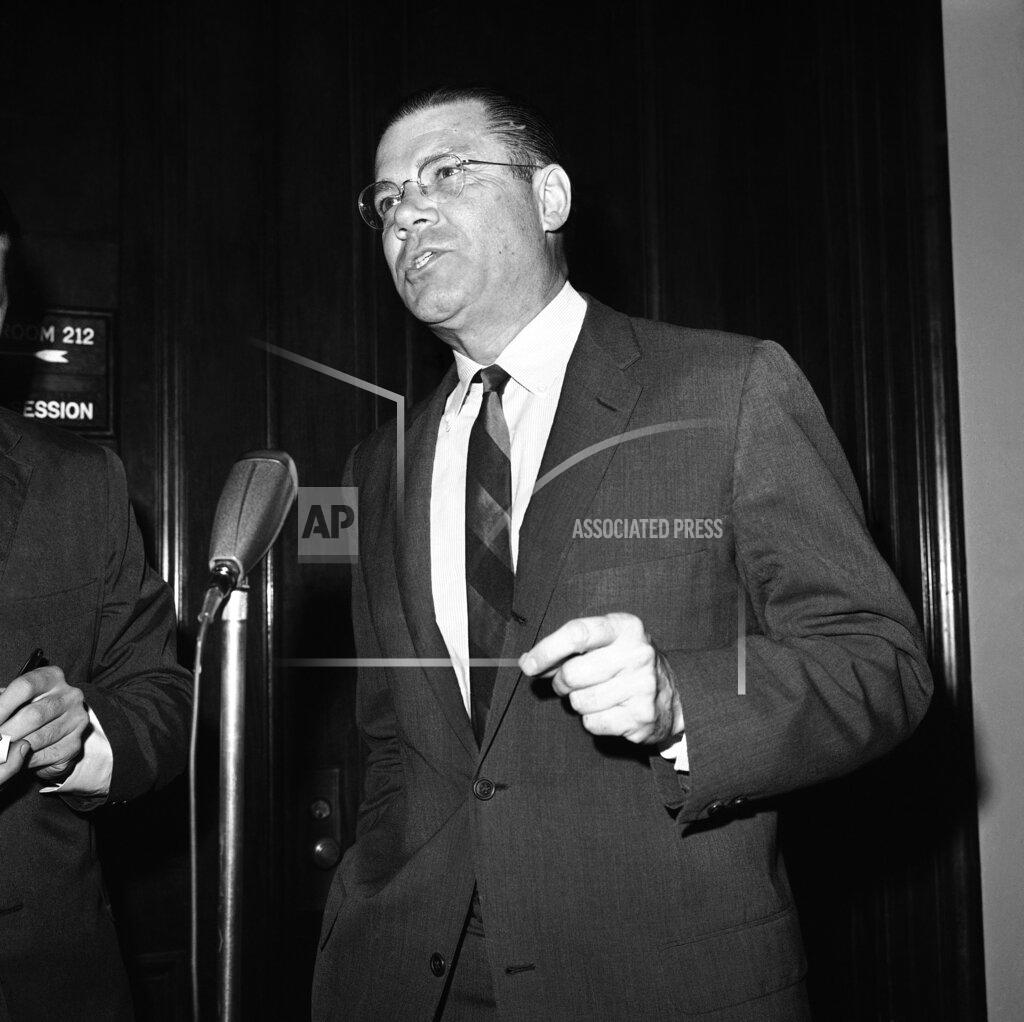
Meanwhile, Secretary McNamara and the Secretary of the Air Force, Eugene M. Zuckert, defended the equipment being sent to United States forces in Vietnam against charges of obsolescence. After he had testified before the Senate Armed Services Committee for nearly three hours, Mr. McNamara said the United States Advisory Command South Vietnam was “a blank check” on the Pentagon’s resources and had top priority on United States arms, manpower, and funds. Mr. Zuckert, expanding a position he had taken previously, asserted that the accident record of propeller‐driven B-26 and T-28 aircraft in South Vietnam was better than that of modern jet fighters in the United States.
Soviet Delegate Nikolai T. Fedorenko accused Senator Barry Goldwater of urging the United States to adopt a “cannibalistic policy” of atomic warfare in South Vietnam.
Anyone proposing to use atomic weapons for destructive purposes “is in my view out of his mind,” U Thant, Secretary General of the United Nations, said today. He was answering a question at a news conference about remarks Sunday night by Senator Barry Goldwater, a leading contender for the Republican Presidential nomination. Mr. Thant had just delivered an address calling upon Greek Cypriote and Turkish Cypriote leaders for moderation and peace. Without mentioning Mr. Goldwater by name, he gave four reasons why he was opposed to the use of atomic weapons anywhere and especially in Vietnam. On Sunday Senator Goldwater said low‐yield atomic weapons could be used to defoliate the forests along South Vietnam’s border to expose the jungle supply lines of the Communist guerrillas. He urged the use of non-atomic bombs to destroy bridges, roads, and railroads used for bringing supplies from Communist China and North Vietnam unless the Communists halted military shipments to the south.
“First of all,” Mr. Thant said, “there is the question of radioactivity, which is as deadly as the first physical impact of the bomb. This is recognized by all knowledgeable scientists.”
“Second,” he said, “the Việt Cộng or whoever may be the target of such projected attacks are not going from one place to another in set, well‐defined routes. They are not like ants. They may operate anywhere they like. So I do not see that any effective results will be achieved by such atomic blasts.”
“Third,” he added, “such action is sure to generate wide spread resentment and bitter criticism, particularly from quarters which so far have not been very vocal, have not been very outspoken regarding the situation in Southeast Asia.”
“Last, and this in my view is a very important element,” he continued, “there is, if I may say so, a racial factor in such a projected operation. In 1945 when atomic bombs were dropped over Hiroshima and Nagasaki in Japan there was a widespread feeling in many parts of Asia that these deadly atomic bombs were dropped upon Japanese cities because the Japanese were nonwhites; and it was also argued at that time that atomic bombs would never had been dropped over cities in Nazi Germany.”
Prince Sihanouk says he welcomes UN inquiry teams or UN troops to police the disputed border with South Vietnam. Cambodia has brought charges of aggression against both South Vietnam and the United States before the Security Council contending that border villages have been attacked. The South Vietnamese have charged that Cambodia is serving as a haven for communist Việt Cộng guerrillas.
Right‐wing military headquarters in Vientiane, Laos, accused the Chinese Communists today of committing atrocities against local officials in the Phongsaly region of northwestern Laos. A statement charged that the Chinese Communists had joined with the pro‐Communist Pathet Lao and North Vietnamese in torturing and killing village and district chiefs in retaliation for the capture on May 8 of two Chinese Communist soldiers by Meo tribesmen. The soldiers, identified by Laotian authorities as a captain and his noncommissioned orderly, were seized in the Muong Sing area of Phongsaly, where Chinese laborers under military guard are extending a road network. The Phongsaly region is controlled by General Khaouane Boupha, a self‐styled neutralist who is collaborating with the Pathet Lao. The two Chinese soldiers, last reported imprisoned by right‐wing forces at Paksane, 75 miles northeast of Vientiane, have been shown to Western observers.
The United States is considering an appeal to the United Nations as the next step in a broader American effort to reverse widespread Communist gains in Laos.
Desperate refugees are reported to be slaying their burdensome children in fleeing advancing Pathet Lao forces in Laos.
President Abdul Salam Arif of Iraq and President Gamal Abdel Nasser of Egypt signed an agreement creating the “Joint Presidential Council” as the first step in a unification of the two countries within the United Arab Republic. On October 16, the two would agree to create the “Unified Political Command” to merge the two nations over a period of two years, but by May 1965, the merger proposal would fall apart.
Mission 1005 of the Corona spy satellite series broke up during its uncontrolled re-entry into Earth’s atmosphere, and its capsule crashed on a farm near La Fría, Venezuela. Sent up by the United States on April 27, the fifth “Corona-J” satellite had been presumed lost in the Atlantic Ocean after five bright pieces were seen flying over Maracaibo, but the farm owner would stumble across it on July 7. On August 1, Leonardo Davilla, a Venezuelan photographer, would contact the U.S. Army attaché after the farmer had attempted to sell him the machinery. The Venezuelan Army would confiscate the object before the American attaché could arrive, and the capsule would not be returned United States until August 10.
Senate Democratic and Republican leaders prepared the way today for a drive toward closure of debate on the civil rights bill by introducing a number of amendments to the House‐passed measure. The long‐awaited amendments, the work of weeks of bipartisan consultations with the Justice Department, were introduced by their principal author, Senator Everett McKinley Dirksen of Illinois, the Republican leader. Senator Richard B. Russell, Democrat of Georgia, leader of the Southern opponents of the bill, characterized the rewritten version as “a punitive expedition against the South.” Joining Mr. Dirksen as cosponsor were Senator Mike Mansfield of Montana, the majority leader, and Senators Hubert H. Humphrey of Minnesota and Thomas H. Kuchel of California, the Democratic and Republican floor managers of the bill.
Mr. Dirksen said: “I doubt very much whether, in my legislative lifetime, there has been a measure that received so much meticulous attention.” By the process of give‐and‐take, he said, a bill has been produced that is regarded by its sponsors. as workable, equitable and calculated to attract the two‐thirds of the members needed to shut off debate. Mr. Dirksen noted that this was the 64th day of debate on the bill. “I think,” he said, “we have now reached the point where there must be action.” He also assured the Senate that all amendments to the House bill that had been read once and were on the table and all amendments offered before passage of a motion for closure would be called up.
Yesterday, Mr. Dirksen said he thought closure could not be obtained before the third week of June. Today, Mr. Mansfield and Mr. Humphrey were still hopeful that the Southern filibuster could be stopped before the middle of June. Mr. Mansfield paid tribute to Mr. Dirksen “for the leadership he has undertaken.” He then expressed the hope that not too long‐a time would elapse before an attempt at closure. After paying his respects to Mr. Dirksen’s “imagination,” Mr. Humphrey emphasized that “what we have sought to do in redesigning the civil rights bill is to make this bill not only workable and enforceable, but also acceptable not only to Congress but to the American people.”
In Cambridge, Maryland, Brigadier General George M. Gelston today ordered all racial demonstrations and mass meetings halted for 10 days. Integration leaders, he said, have “lost control” of their followers. “They are turning into unruly mobs,” he added. General Gelston, commander of National Guard troops assigned to keep order in this Eastern Shore community, said he hoped to gain time to set up “lines of communications” with Black leaders.
Maryland Governor J. Millard Tawes indicated he might ask for federal troops to be sent into Cambridge if the demonstrations continued. The Defense Department rejected a request for troops last summer, but Governor Tawes said that “now would be a good time to ask for them again.” General Gelston said mass meetings could resume after the 10-day period if leaders inform the National Guard where and when they would be held. He met separately today with a committee of Cambridge civic leaders and with members of the Cambridge Non‐Violent Action Committee. He said a meeting would be held tomorrow to discuss the possibility of expanding recreational facilities for Blacks. He said he had acted because “extremely dangerous and unruly activities” followed mass meetings and public rallies during the last two weeks.
General Gelston said the demonstrations were no longer concerned with civil rights. As an example, he cited last night’s violence in which one man was shot and three others injured. Last night the National Guard units used tear gas to break up a crowd of jeering, rock‐throwing Blacks. One guardsman, Specialist 4 Joseph Miller of Baltimore, suffered a minor gunshot wound. Officials said it was inflicted either by a 22-caliber rifle or a pellet gun. Specialist Miller is Black. Another soldier had his arm broken by a rock. A third soldier was burned when a tear gas grenade exploded in his hand. A fragment of the grenade also struck an officer, inflicting a minor cut.
The Administration’s $962.5 million anti-poverty program was approved today by the House Education and Labor Committee. The 19-to-12 vote was on straight party lines. The committee’s Republicans opposed the measure. The committee bill, basically the same as President Johnson’s proposal of March 16, will go to the House Rules Committee in about 10 days after a formal report is prepared. House Democratic leaders expect prompt clearance of the measure by the Rules Committee and hope to get House action completed by the end of June. The Senate has not begun to consider the bill.
Republicans, smarting because they feel that they were virtually cut out of discussions of the bill in the Education and Labor Committee, are planning to ask for a special order of business in the House next week to expose what they consider the measure’s weaknesses. They argue that it is an election‐year vote‐getting device that is, at best, unnecessary and, at worst, potentially harmful. They feel that the attack on poverty could be more effectively made by strengthening existing programs. The committee made several changes in the program originally submitted by the President, but left its essentials intact. A major change was designed to head off a developing church‐state issue over aid to schools. The committee eliminated, in the section dealing with local projects, Federal aid to both public and private schools for activities now included in their regular programs.
President Johnson’s request for a new foreign aid authorization of $3.5 billion was endorsed today by the House Foreign Affairs Committee. The total includes $125 million of economic and military aid to help win the war in South Vietnam. It was the first time in the 17-year history of foreign aid programs that the House group had decided to give a President all he had asked for. The decision will be made for‐mal by a vote of the committee tomorrow morning. The committee chairman, Representative Thomas E. Morgan, Democrat of Pennsylvania, said he expected no more than half a dozen of the 33 members to vote against reporting the measure for House action.
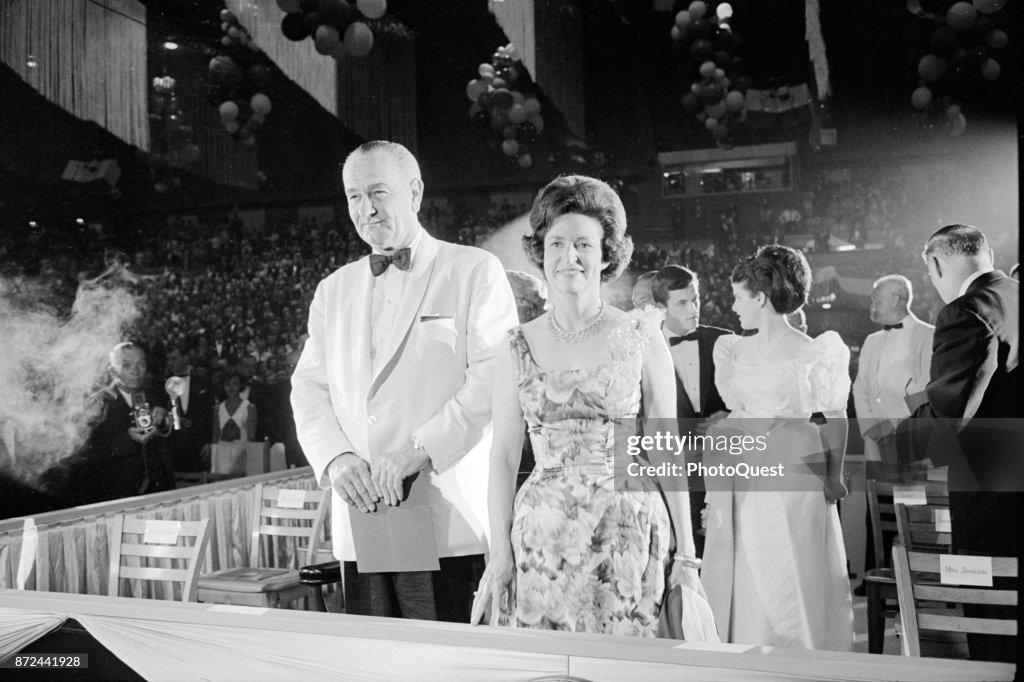
President Johnson, moving more confidently to the political offensive, pledged tonight that the Democratic party would seek “to meet the challenges and shoulder the burdens of a mushrooming America.” That could not be done, Mr. Johnson said, by “men whose acts are timid and whose aims are tiny.” Instead, the President said, his party would pledge strong action in‐civil rights, to eliminate poverty, illiteracy and unemployment, and to “pursue our national goals in a world at peace.” Mr. Johnson’s remarks were delivered late tonight to a $100‐a‐ticket “Salute to President Lyndon B. Johnson” at the National Guard Armory here. Earlier in the evening, Mr. Johnson attended an even more expensive affair — a $1,000-a‐plate dinner for more than 500 members of the District of Columbia “President’s Club.”
Florida Republicans defeated a slate of delegates pledged to Senator Barry Goldwater, electing instead an unpledged slate. But most of the unpledged group have expressed preference for Goldwater.
Senator John J. Williams (R-Delaware) called on the Senate to demand that Attorney General Robert F. Kennedy investigate alleged solicitation of federal employees for a Democratic fundraising dinner.
Five senators, three Republicans and two Democrats, urged that Congress prescribe strict rules of ethics by requiring that congressmen be required to disclose their sources of income.
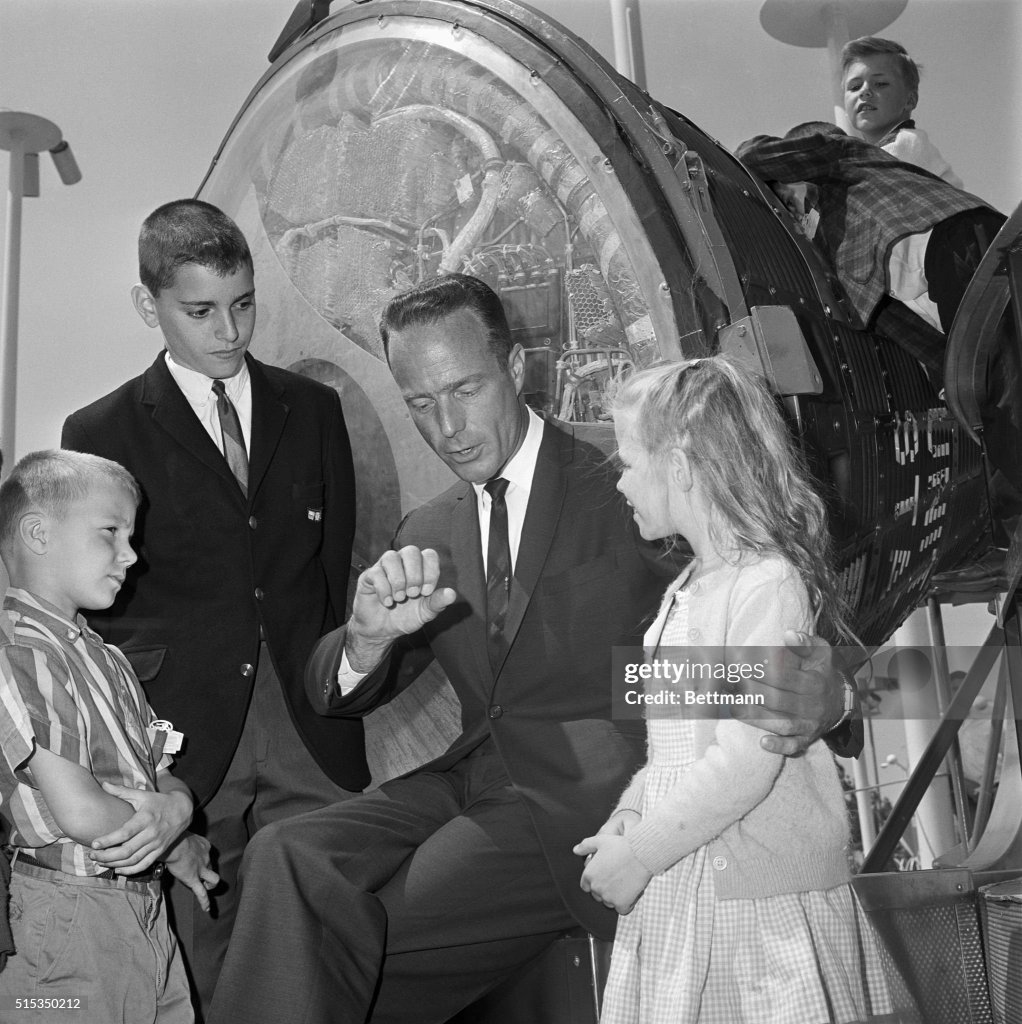
Lieutenant Commander M. Scott Carpenter revisited his Aurora 7 spacecraft yesterday, and at times the day was almost as hectic as the one two years ago when he landed the Mercury capsule in the ocean more than 200 miles off target and out of radio contact. Yesterday’s frenzy was provided by hundreds of shrieking children at the World’s Fair Space Park, where the capsule is part of a collection of space hardware. Through it all, the astronaut maintained the same calm he displayed on May 24, 1962, when he was retrieved from the water after completing three orbits of the earth.
After posing with children and the Aurora 7 for reporters, he had to pose for the children themselves, who also had cameras. “Over here, Shep,” said a boy who confused him with Commander Alan B. Shepard Jr., another astronaut. Most of the youngsters got the name right, however, especially after pressing every manner of scrap of paper (including a dollar bill) on him for his autograph. “That’s mine,” one girl said as she tugged over an autographed piece of paper with another girl, “it’s got my name on it.” “He’s adorable,” a teenage girl sighed. And so it went until Commander Carpenter had to be extricated from the youngsters by two men in Air Force uniforms.
Betty Comden & Adolph Green and Jule Styne’s musical “Fade Out-Fade In”, featuring Carol Burnett, Jack Cassidy (later replaced by Dick Shawn), and Tina Louise, opens at Mark Hellinger Theater NYC for 271 performances
Washington’s Jim King hits for the cycle against Boston pitcher Earl Wilson, but it is not enough as the Red Sox win, 3–2.
In Chicago, the Mets set 6 club records in overwhelming the Cubs, 19–1. Coming off 20 straight scoreless innings in Houston, the Mets jump on Bob Buhl, and 5 relief pitchers for 23 hits, including 17 singles. Dick Smith becomes the first Met to notch 5 hits in a game as every Met in the lineup has a hit and RBI. Jack Fisher is the easy winner.
Vernon Law and the Pirates subdue the Phillies, 13–4. Cookie Rojas has an inside-the-park home run for Philadelphia and Johnny Callison hits one outside. But Jim Pagliaroni has a grand slam for Pittsburgh.
The Cleveland Indians complain that Yankees pitcher Whitey Ford is defacing the ball with his wedding ring, which is wrapped in tape, and after he removes the ring, he exits with one out in the 9th and the game tied at 2–2. Pete Mikkelson is the victor when Bobby Richardson singles home the winner, 3–2. Richardson has a pair of triples and Roger Maris hits a home run.
Jim Kaat scored his fifth victory and drove in the winning run with a seventh‐inning single tonight as the Minnesota Twins defeated the Los Angeles Angels, 2–1. Don Mincher led off the seventh with a single, moved to third on a bunt and an infield out and scored when Kaat beat out a bouncer to second for a single.
Dow Jones Industrial Average: 818.92 (-1.33).
Born:
Lenny Kravitz, American singer and songwriter, four-time Grammy Award winner; in Manhattan, New York, New York.
Caitlín R. Kiernan, Irish-born American science fiction and fantasy author; in Dublin, Ireland.
Willie Fraser, MLB pitcher (California Angels, Toronto Blue Jays, St. Louis Cardinals, Florida Marlins, Montreal Expos), in New York, New York.
 History Diaries