The retreating neutralist garrison of Muong Kheung escaped encirclement by Pathet Lao forces today after losing the battalion that had screened its withdrawal from the major base north of the Plaine des Jarres. Military sources said a neutralist column of 1,000 men supported by light tanks had reached the village of Ba An, apparently en route to Moung Soui about 88 miles farther to the west. Muong Soui, which is astride important Route 7 leading to Luang Prabang, the royal capital, and Vientiane, the administrative capital, appeared to be the next objective of the Pathet Lao force.
The Eighth Infantry Battalion of the neutralists, with about 400 men, was encircled south of Muong Kheung after the base area was occupied yesterday by the Pathet Lao. The troops closing the trap had descended on Muong Kheung from the northeast and had pushed northeast from the Plaine des Jarres in an unsuccessful effort to cut off the bulk of the withdrawing garrison. Military sources said evacuation of Muong Kheung actually began Friday with a preliminary withdrawal of some tanks and removed families of soldiers by air. Hundreds of other dependents and refugees were accompanying the Muong Kheung garrison on its retreat. It is believed in Vientiane that the Pathet Lao decided to resume the offensive, after a pause of several days, for military and political reasons. The Pathet Lao leadership appeared determined to take possession of the entire zone held jointly by their troops and the neutralists prior to April, 1963, when a military clash disrupted an alliance between the two factions. The neutralists have since joined right‐wing forces.
All positions taken by the Pathet Lao in their attacks in the last two weeks were mixed neutralist‐Pathet Lao areas under the cease‐fire agreement of June, 1962. The Pathet Lao were also believed to be using military pressure, as they have done repeatedly in the past, to compel opposing factions and Western powers to negotiate on terms favorable to the pro‐Communists. At a news conference yesterday, Premier Souvanna Phouma said he was willing to take part in a new 14-nation conference on Laos only if there was a cease‐fire and the pro‐Communists withdraw from territory they have captured in the last 10 days.
The Soviet Government declared today that reconvening of the 14‐nation conference on Laos would serve the purpose of strengthening the coalition Government of Premier Souvanna Phouma. The Soviet Government proposed last Saturday that the conference reconvene in Geneva next month. Today’s Soviet statement was in the form of an article signed “Observer” in the Government newspaper Izvestia. This signature is frequently used for statements defining Soviet policy.
The article blamed the United States in the current crisis in Laos. It charged that American arms had been shipped to rightist forces, which attempted a coup last month. The article confirmed the belief of diplomatic observers in Moscow that the Soviet Union’s prime interest at this point is to restore the situation as it existed before the abortive coup, on April 19.
Lord Harlech, British Ambassador to the United States, said today that the military situation in Laos must be stabilized and the Communists required to honor their agreements before the British would consider negotiating on problems there. The Ambassador, the former Sir David Ormsby Gore, said the Communist powers were violating the 1962 Geneva that provided for the neutralization of Laos. Lord Harlech’s stand was expressed in response to questions, after a speech before 325 members of the Economic Club of Detroit.
Following his own suggestion of 1 March, William Bundy drafts a joint Congressional resolution that would give the President the authority to take whatever steps he deems necessary in Vietnam.
Admiral Harry D. Felt, commander of United States forces in the Pacific, has informed Congress that South Vietnam has developed a “junk fleet” to patrol its coastline and prevent Communist arms shipments. “This was a Vietnamese idea,” he told the House Foreign Affairs Committee in testimony given in closed session April 24 and made public today after security censorship. “Through military assistance we built hundreds of junks,” Admiral Felt added. “They have junk division all up and down the coast. Their little navy is patrolling.” He said the Vietnamese were good at patrolling the coast and were improving at patrolling canals and the rivers in the Mekong delta area. During the last year, he said, there has been a significant increase in the infiltration of arms into South Vietnam.
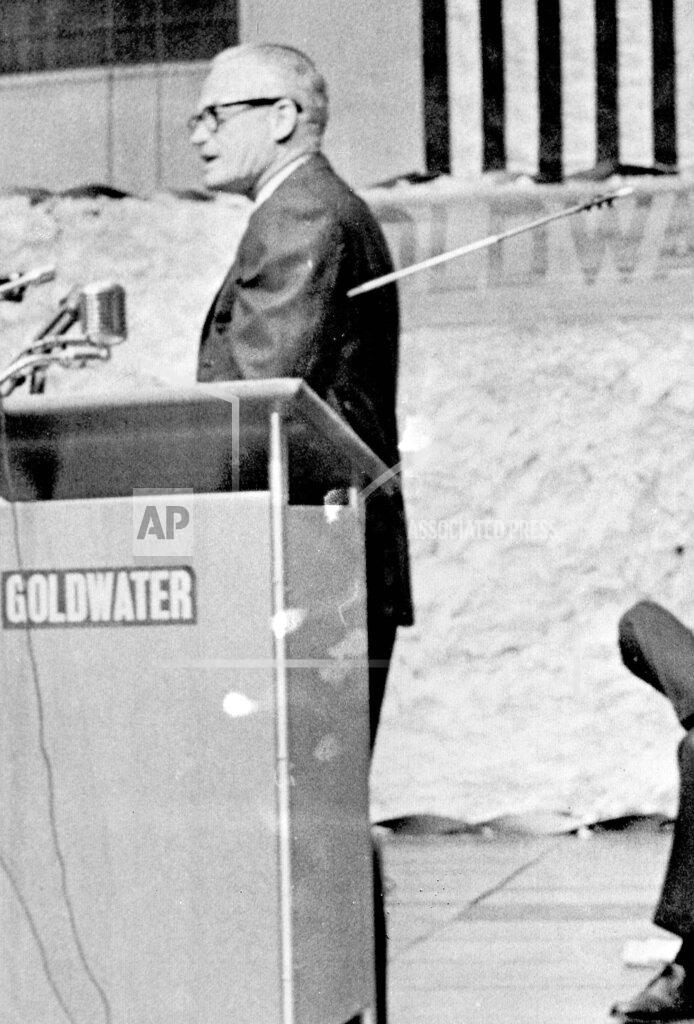
The utilization both of nuclear and conventional weapons to expose and interdict Communist supply lines to South Vietnam has long been under study in the Pentagon. Senator Barry Goldwater brought some of these discussions into the political forum over the weekend when he suggested — his spokesman said he merely “discussed” — the possible use of nuclear weapons to defoliate the trees over jungle, trails; and of conventional weapons, to destroy bridges, roads, and railroads in North Vietnam. The Arizona Republican said he “strongly advised” that the United States “interdict supply routes, wherever they may be.”
Such action has been advocated by some military men as part of contingency plans. The Navy and the Air Force proposed some time ago the utilization of United States planes to undertake, in conjunction with a naval blockade, token bombings with conventional weapons of thinly populated areas in North Vietnam. The bombings, it was maintained, would serve to demonstrate to Hanoi and to Peking the determination of Washington to carry the war to North Vietnam unless President Hồ Chí Minh of Communist North Vietnam halted his aid to the Communist Việt Cộng operating in the South. The initial targets suggested were power plants, some key bridges, and a few factories, selected to minimize loss of life. If the hint were not taken or the Communists stepped up their war effort, still unapproved contingency planning envisaged sea and air blockades of North Vietnam.
The supplying of the Việt Cộng guerrillas in the South from North Vietnam does not, however, depend to any large extent on formal communication routes. Many hard‐core Communists filter into the South with their weapons over the so‐called Hồ Chí Minh Trail. This consists of many alternative trails leading over the mountains and through the jungles, from North Vietnam and Laos into South Vietnam. Other infiltrators operate out of a secure “sanctuary” in Cambodia; a few come in by sea. Defoliation experiments have been carried out, usually along South Vietnam’s main communication routes, in attempts to eliminate the cover that the verdant forests and mangrove swamps provide for Communist ambushes. Chemical herbicides sprayed from aircraft have had localized and limited utility.
The suggestion that nuclear weapons might be used to block routes through mountains, rain forests, valleys, mangrove swamps or bamboo groves was discussed at length in 1960 in the spring issue of the Air University Quarterly Review. The magazine is described, as the professional journal of the Air Force, but neither its authors nor its articles reflect official opinion. In an article entitled “Nuclear Weapons and Limited War,” Gen. Frederic H. Smith Jr., now retired but then Commander in Chief, United States Air Forces in Europe, and later Vice Chief of the Air Staff, cited some of the terrain of Southeast Asia in discussing what nuclear weapons might do.
During a discussion of the Cambodian-South Vietnam issue in the UN Security Council, France splits from the United States and Great Britain’s position and urges the Council to pass a resolution ‘deploring’ South Vietnam’s violations of the border. She proposed that “those who bear responsibility” should pay reparations. Roger Seydoux, the French representative, mentioned only South Vietnam in his statement to the Council. Cambodia had accused both the United States and South Vietnam of “repeated acts of aggression,” and the suggested French resolution, presumably would apply to the United States as well.
The Soviet and the Czechoslovak delegates walked out during the address of a South Vietnamese representative and did not return until he and the Chinese Nationalist delegate had finished speaking. Mr. Seydoux further widened the split between, France and her allies by endorsing a Cambodian request that the Council ask the International Control Commission’s teams for Cambodia and Vietnam to check on any future violations of Cambodia’s frontier. The commission was established under the armistice agreement signed in Geneva in 1954, which ended the war in Indochina President de Gaulle has suggested that the Geneva conference be reconvened to examine the new situation.
Thirteen Arab envoys called on Secretary of State Dean Rusk today to express concern over the visit here next week of Premier Levi Eshkol, of Israel. The Ambassador of the United Arab Republic, Mostafa Kamel, said later that the diplomats had indicated their fear that the Israeli leader would seek to “destroy Arab-American relations in order to have liberty of aggression in the Middle East.” The meeting with Mr. Rusk was arranged by Dr. Kamel. According to officials here, the Secretary told the Arab envoys that the United States was aware of Middle East problems and that it would keep in mind the Arab concern when Mr. Eshkol arrived in Washington next Tuesday for two days of meetings with President Johnson. However, the officials emphasized that the Arab envoys had not delivered anything that could be construed as a “warning.” They said the United States would pursue its Middle East policies from the viewpoint of its national interest and its desire to see peace preserved in the region.
The officials said that the Arab diplomats essentially came to convey their hope that Mr. Johnson’s talks with Mr. Eshkol would not “upset” Washington’s relations with their governments. Those at the 22-minute conference with Mr. Rusk were the ambassadors of the United Arab Republic, the Sudan, Libya, Tunisia, Algeria, Morocco, Iraq, Jordan, Lebanon, and Kuwait, and the charges d’affaires of Yemen, Saudi Arabia, and Syria. It was believed in diplomatic quarters that Arab concern over Mr. Eshkol’s visit was based primarily on the fact that he would be the first Israeli Premier to be received officially in Washington and that his talks here might alter Washington’s reluctance to sell modern military equipment to Israel. David Ben‐Gurion visited Washington in 1961 when he was Premier, but his presence was considered “private,” even though he met with President Kennedy. At that time, too, Arab diplomats conveyed their unhappiness to the State Department.
By a 67-0 vote in the Haitian Congress, President of Haiti Francois “Papa Doc” Duvalier was declared to be “President-for-Life” (Président à vie) under Article 197 of a new constitution. The measure reportedly would be overwhelmingly approved in a referendum on June 22. Duvalier’s oppressive rule would continue for the rest of his life. Upon his death on April 21, 1971, his 19-year-old son, Jean-Claude Duvalier, would become President.
South Korean students at six of Seoul’s universities held rallies today in the second week of demonstrations against the Government of President Chung Hee Park. After the rally about 500 students of Seoul National University marched in the streets chanting such slogans as “we are starving,” “release arrested students,” and “guarantee campus freedom.” The police arrested 133 demonstrators. A resolution adopted at the Seoul rallies demanded that the Government publicly apologize for alleged misrule and punish a group of paratroopers for attempting last week to pressure a Seoul judge into issuing warrants against student demonstrators. It also called for confiscation of properties of big businessmen to “ease the lot of hungry people.” President Park warned today than “extraordinary situation might be created” unless the students and opposition restraint.”
The United States Supreme Court issued its 9–0 decision in Griffin v. County School Board of Prince Edward County, unanimously ordering Prince Edward County, Virginia to reopen its public schools, which had been closed for more than four years. The Court reversed a 1963 decision by Virginia’s highest court holding that the state was not required to operate schools in any of its counties. Justice Hugo Black wrote that the decision denied equal rights to the county’s schoolchildren, declaring that “Prince Edward children must go to a private school or none at all; all other Virginia children can go to public schools.” The county’s public schools had been closed since 1959 after the school board declined to follow a federal court order to file a plan for desegregation of schools, and no school taxes can be levied by the county during that time.
The white people of Prince Edward County, in rural Southside Virginia, were and are determined not to send their children to school with Blacks. Their lengthy and so far successful resistance to the integration decision of 1954 has been watched from elsewhere in the Deep South. Justice Black’s opinion had implications beyond the immediate question of school closing. He hinted that the pace of desegregation generally must pick up, that the court would now insist on more than the “deliberate speed” it called for in 1955. “The time for mere ‘deliberate speed’ has run out,” Justice Black said, “and that phrase can no longer justify denying these Prince Edward County schoolchildren their constitutional rights to an education equal to that afforded by the public schools in the other parts of Virginia.”
Robert L. Carter, general counsel of the N.A.A.C.P. issued the following statement yesterday on the Court’s ruling: “Now that the United States Supreme Court has outlawed Prince Edward County’s experiment in ignorance and brought to an end to one of the most shameful chapters in the history of the school desegregation crisis, we can confidently move forward to the general implementation of the historic 1954 anti-segregation ruling throughout the South. Today’s decision has broken the back of the south’s unlamented ‘massive resistance’ to school desegregation and marked the end of open defiance of the Supreme Court’s decree. And finally, 10 years after the ruling, schoolchildren in the county will begin reaping the benefits of the 1954 decision which ruled segregation in public education unconstitutional.”
Maryland National Guardsmen quelled a new racial demonstration in Cambridge tonight that left one guardsmen shot, two injured by an exploding tear gas grenade and one hurt by a thrown rock. The state police reported that several demonstrators also were injured. The violence erupted when guardsmen entered the Black section of Cambridge to disperse groups of integrationists as hundreds of whites gathered on the edge of the district. None of the wounded or injured was reported in serious condition.
The outbreak was the fourth in two weeks and was described as the most serious in nearly a year. Guardsmen have been stationed in this community on the Eastern Shore of Chesapeake Bay since last summer, when nearly a dozen persons were shot and several buildings were burned during racial protests. The guardsmen used tear gas tonight after they were met by a shower of rocks and bottles while trying to break up a Black demonstration. Earlier, the guardsmen had cleared a bordering street of whites by moving along it with fixed bayonets. Many of the whites heckled the guardsmen and shouted taunts at Blacks.
About 300 of the 400 National Guard troops stationed in Cambridge were on the streets then, attempting to prevent clashes between white and Black extremists. The guard enlisted men do not carry rifle ammunition, but their officers wear loaded sidearms. The outbreak, like earlier ones in Cambridge, lasted only a few minutes. It was preceded by two hours or more of marching, milling, and singing by the demonstrators. By midnight, Brigadier General George M. Geiston, commander of the guard units, said, “All seems to be quiet for now.” The whites had gathered as Blacks milled about in their section. At least twice Blacks marched up to intersections of Race Street, which has streets leading into the Black section, and confronted guardsmen at barricades.
It was at a similar confrontation two weeks ago tonight, shortly after Governor George C. Wallace of Alabama made a Presidential primary campaign speech here, that the first violence in nearly a year erupted in Cambridge. That episode was marked by the use of tear gas to disperse demonstrators trying to march into the white section. Thirteen of the demonstrators were arrested.
Former President Dwight D. Eisenhower believes the Vice President should be entrusted with the ultimate responsibility of determining when a President is incapable of performing his duties. He also feels that a President should have the authority to designate a Vice President, subject to Congressional confirmation, whenever that office falls vacant. General Eisenhower, who suffered three major illnesses during his two terms as President, spoke today at a luncheon meeting of the National Forum on Presidential Inability, and Vice‐Presidential Vacancy. The forum brought together approximately 200 leaders of industry education, labor and the legal profession for a one‐day session under the auspices of the American Bar Association. The Views expressed by General Eisenhower conform in general to those of the bar association and also of a Senate Judiciary subcommittee, which has been working in legislation concerned with Presidential inability.
Governor Rockefeller said today that he would have first‐ballot strength of 400 delegates if he won the California primary on June 2. He also welcomed former President Dwight D. Eisenhower’s statement of yesterday and identified himself with the views expressed in it. He was asked at a news conference at the El Cortez Hotel in San Diego how many delegates he would have if he won the primary. He said he would have “in the neighborhood of 400 hard, committed votes.” He refused to say where they would come from, or to discuss the figure further. If he won 86 votes here by defeating Senator Barry Goldwater of Arizona, his only opponent in the Republican primary, the Governor would have the votes of about 200 delegates. His claim would mean a potential doubling of his strength — if he wins in California — before the Republican National Convention opens in San Francisco on July 13.
But the major impact of the day on the Rockefeller campaign was General Eisenhower’s statement, in which the general called for a candidate identified with “forward‐looking Republicanism.” The Governor came to a news conference with a prepared statement that emphasized his agreement with the Eisenhower Administration’s leadership, and particularly with the 1956 and 1960 Republican platforms, which the former President praised. “It was my privilege to help in the drafting of the 1960 Republican platform at Chicago,” the Governor said. I have subscribed wholeheartedly to that platform. I have continually and consistently advocated policies in harmony with it. I agree with President Eisenhower that only through following the principles and extending the policies of the 1960 and 1956 platforms and building upon the record of achievement of the Eisenhower Administration can the Republican party provide a sound basis for its 1964 platform, the choice of its 1964 candidate and the Republican victory this November.”
Senator Barry Goldwater said today that former President Dwight D. Eisenhower’s statement on the desirable qualities of a Republican Presidential nominee was “most timely and most welcome.” The statement, however, has been widely interpreted as a rebuff to the Senator, and it appears to have shaken his campaign for the vital California Republican primary on June 2. General Eisenhower’s viewpoint, in stressing loyal support for the United Nations, proud adherence to the Republican platform of 1960 and vigorous action on civil rights, appeared to imply that Mr. Goldwater was the least suitable Republican candidate. This morning, in a speech at Redding, California, Mr. Goldwater indulged in a joke. He tucked an arrow under his armpit so that it seemed to be imbedded in his back. He told his audience of about 1,000 persons that it illustrated “some of the problems I’ve had in the last few days.”
At the 16th Primetime Emmy Awards ceremony, “The Dick Van Dyke Show” and “The Defenders” won the major awards for Program Achievement, while Jack Klugman and Shelley Winters won the main acting awards.
Frank Gilroy’s dramatic play “The Subject Was Roses”, starring Jack Albertson and Martin Sheen, opens at Royale Theatre, NYC; runs for 832 performances; wins Pulitzer Prize, and 2 Tony Awards.
Ground is broken for the new Busch Memorial Stadium in St. Louis. It opens in 1966, and is demolished in 2005.
Dow Jones Industrial Average: 820.25 (-0.62).
Born:
Ray Stevenson, Northern Irish film actor (“King Arthur”, “Rome”), in Lisburn, Northern Ireland, United Kingdom.
David Shaw, Canadian NHL defenseman, (Quebec Nordiques, New York Rangers, Edmonton Oilers, Minnesota North Stars, Boston Bruins, Tampa Bay Lightning), in St. Thomas, Ontario, Canada.
Jeff Hurd, NFL linebacker (Dallas Cowboys), in Monroe, Louisiana.

 History Diaries