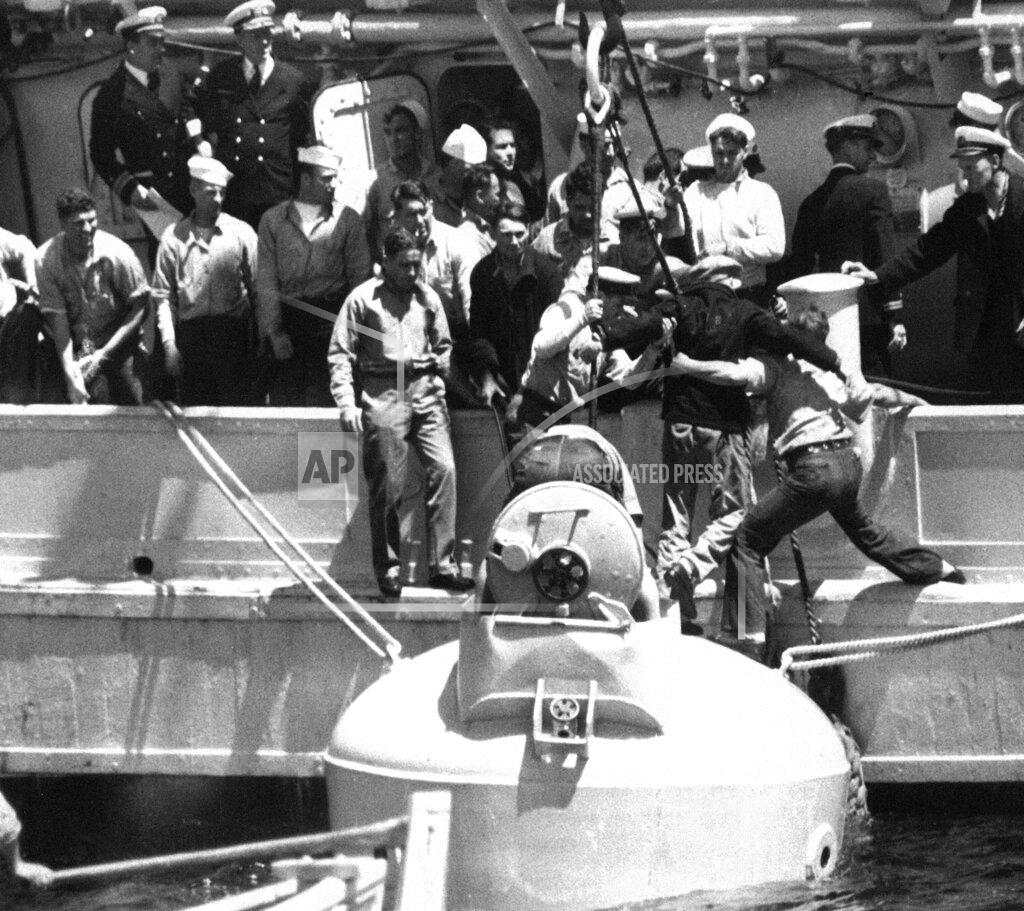
Survivors of the sunken submarine USS Squalus are helped from a rescue diving bell to the salvage ship USS Falcon (ASR-2) when they were brought to the surface off Portsmouth, New Hampshire, May 24, 1939. A fellow sailor has his arm around a survivor at left. On the bell, another rescuer bends over to extend a hand to man climbing out of the bell. (AP Photo)
In a year when so much bad happened, this was one of the best stories of all.
Eternal Father, strong to save,
Whose arm hath bound the restless wave,
Who bidd’st the mighty ocean deep,
Its own appointed limits keep.
Oh hear us when we cry to Thee,
For those in peril on the sea!
-The Navy Hymn
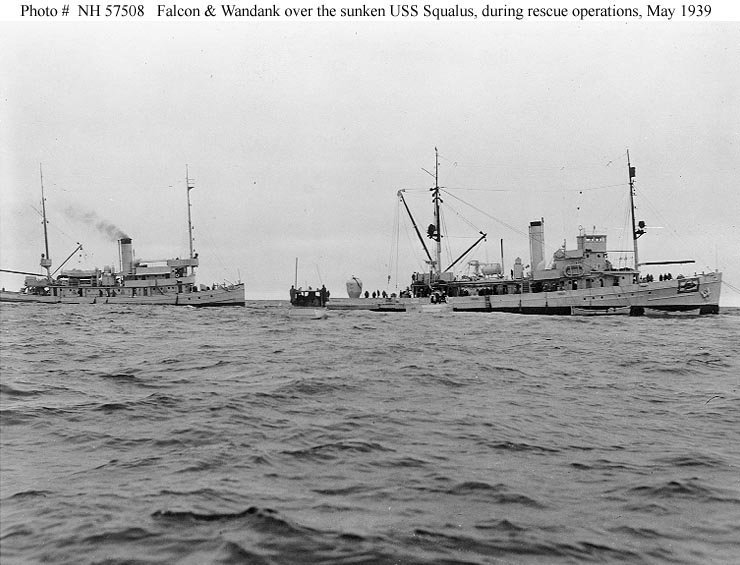
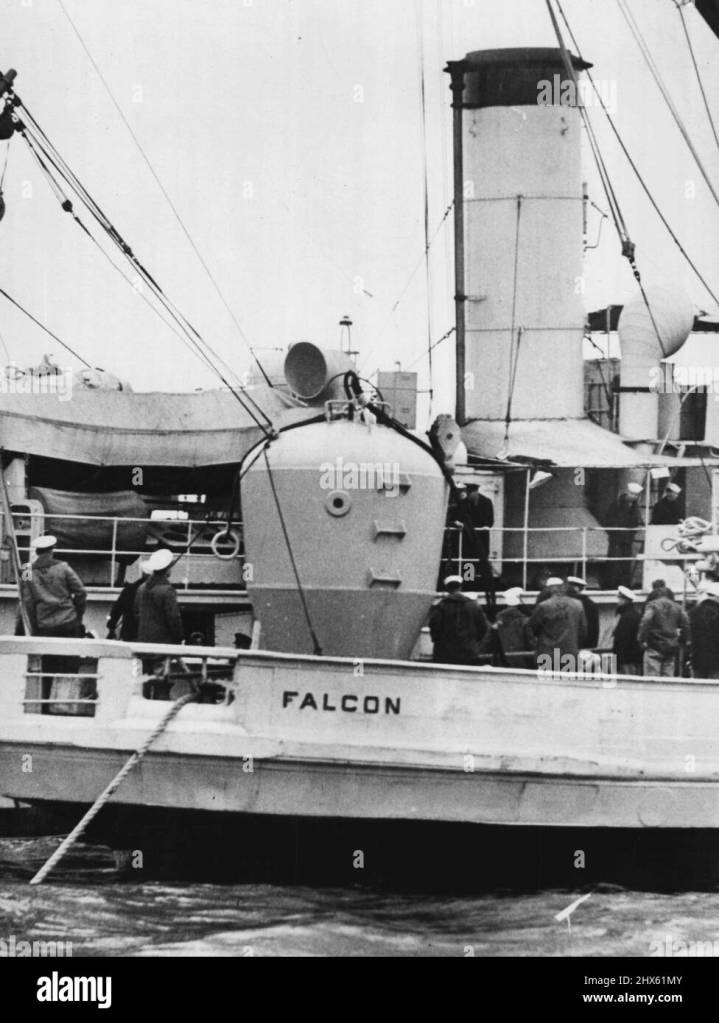
The submarine rescue ship USS Falcon (ASR-2) arrives at the scene of the sinking of the submarine USS Squalus. In a heroic and almost unbelievable, unprecedented feat, first use is made of a Submarine Rescue Chamber to save the survivors from the sunken boat. A diving bell designed by Charles “Swede” Momsen brings 33 survivors (26 had already perished) safely to the surface after the sub sank the previous day. This is the first successful undersea rescue operation to retrieve a sunken submarine crew. Four enlisted divers, Chief Machinist’s Mate William Badders, Chief Boatswain’s Mate Orson L. Crandall, Chief Metalsmith James H. McDonald and Chief Torpedoman John Mihalowski will receive the U.S. Congressional Medal of Honor for their actions in the rescue. The submarine will soon be raised and re-christened the USS Sailfish. She will make twelve war patrols during World War II. She will be credited by JANAC with sinking seven enemy vessels, totaling 45,029 tons. Sailfish will be awarded nine battle stars for service in the Pacific and the Presidential Unit Citation for outstanding performance on her 10th patrol.
From the U.S. Naval Institute:
Meanwhile, the submarine tender Falcon (ASR-2) sailed from New London, Connecticut, with the revolutionary McCann rescue chamber on board. The chamber had never before been used in a rescue attempt, only in training. Its inventors — Lieutenant Commander Charles Momsen and Commander Allan McCann — went aboard the Falcon to help. The nine-ton chamber looked like an inverted tumbler. Like a submarine, it submerged by means of compressed air, ballast tank, and a watertight hull. Using air-driven power and winches, it was supposed to lower itself to the disabled submarine’s deck. A rubber gasket would seal the chamber to a hatch on the submarine. Then, blowing water ballast from its lower chamber, the bell’s two operators would open their hatch and the submarine’s and take on the Squalus’s trapped crewmen. That, at any rate, was the idea. This day, the bell would be put to the test of whether it could save a submarine crew for the first time.
Several vessels arrived at the Squalus’s position during the overnight journey of the Falcon. Grappling hooks were dragged across the area, searching for the Squalus unsuccessfully. A heavier anchor taken from the Sculpin finally snagged the boat. Down below, the survivors banged out Morse code by wielding hammers against the hull. Among the messages was a casualty count, which was relayed to Portsmouth. There, a throng of reporters gathered with families and friends of the crew, while world attention riveted on the struggle to save the surviving men.
The Falcon arrived at 0430, mooring over the Squalus at 0800, 23 hours after the sinking. By that time, the survivors were suffering headaches and nausea from labored breathing as Naquin stretched the air supply. At intervals, he released stored oxygen to relieve the symptoms. Some men, soaked by seawater, shook with chills. The captain gave up his coat to one.
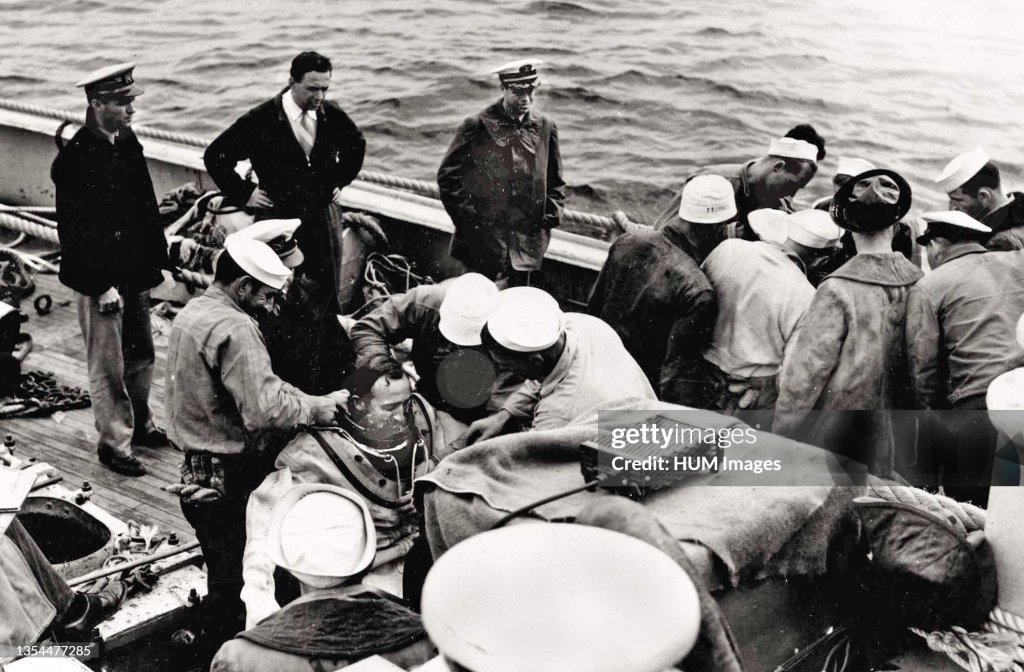
Within an hour, a hard-hat diver from the Falcon began his descent, carrying the downhaul cable from a winch inside the rescue bell. The extreme depth affected him. slowing his reflexes as he landed with a thud on the deck over the forward torpedo room. Persico was in the trunk under the forward escape hatch, separated from the diver by the bare thickness of the hull. “I could hear every word that he was communicating to the surface. I was so elated I wanted to holler up to him.” The diver eventually succeeded in connecting the cable to the hatch. Then the two operators carefully maneuvered the bell, reaching the Squalus after an hour-long descent. The bell settled gently around the hatch, which was pumped clear of water. Torpedoman First Class John Mihalowski cranked it open. Below, Persico was startled as water splashed down on him. Light from the bell momentarily blinded him.
Persico’s gaze fixed on Mihalowski’s shoes. “They were black, tom sneakers, which were wet. To me, they were the prettiest sight in the world.”
Coffee and blankets were passed to the ecstatic survivors. Naquin divided them into four groups for successive trips to the surface. The last carried ten men including Naquin, Bryson, Nate Pierce, and Persico. On the way up. the bell jammed on its downhaul cable, straining a similar cable which ran from a winch on the Falcon to an eyebolt in the top of the bell. Five of the cable’s seven strands separated. A diver returned to the Squalus and cut the downhaul cable so the bell could swing free. Dangling and spinning at 150 feet, it was lowered to the ocean floor as rescuers pondered what to do next. The operators decided to lighten the bell using compressed air while men on the Falcon pulled the bell up by hand so as not to snap the cable and lose the crew. Finally, after four perilous hours, the last survivors bobbed to the surface — 40 hours after the Squalus sank.
The Squalus survivors — the captain, three officers, one civilian, and 28 enlisted men — came ashore in two groups at Portsmouth. The wife of one survivor rushed up to him, tears streaming, and sobbed, “Oh, you poor kid.” Two other women broke through the crowd and kissed another survivor as tears poured down their cheeks. In silence, 150 others watched as the men stepped into ambulances. Two were on stretchers.
A week later, on Memorial Day at a hillside cemetery in nearby Kittery, Maine, the survivors joined the town’s veterans. Boy Scouts, and Girl Scouts for a requiem to those lost on the Squalus. A plaintive bugle played taps while out on the Atlantic the USS Brooklyn (CL-40) and a destroyer sent a 21-gun salute rumbling over the waters that covered the submarine.
The British Cabinet brought weeks of hesitation to an end today by agreeing to enter into a mutual-assistance accord with Russia and France against further aggression in Europe. On good authority it was reported that the Ministers had approved the broad principle of immediate concerted action in the event that any of the three powers were attacked on any European front. In other words, a German onslaught against any one of them would be regarded instantly as an attack upon all and would be met by the combined strength of the powers that formed the Triple Entente in 1914.
Moreover, the plan is said to provide for common action by Britain, France and Russia in the event of an attack upon Poland, Rumania or other smaller powers, although it does not cover the little Baltic republics of Latvia and Estonia. It will also be linked to the League of Nations Covenant by a formula still to be worked out by London, Paris and Moscow. It took only two hours of quiet discussion for the Cabinet to reach its momentous decision — a decision more tremendous in some of its implications than any of the other reversals of British foreign policy since the German Army marched into Prague in March.
The Cabinet seems to have given its full approval to a plan brought back by Viscount Halifax, the Foreign Secretary, from his consultations in Geneva. As far as could be discovered tonight the Ministers did not delete or modify any of Lord Halifax’s proposals, and instead of having to argue his case before a reluctant Cabinet he found he had to submit to nothing worse than earnest questioning by his colleagues. The new alliance is not yet signed and sealed and important details have still to be settled, as Prime Minister Neville Chamberlain told the House of Commons today. Nevertheless, the British Ministers seem to realize now that a pact with Russia is the coping-stone of a new defensive structure in Europe and that without it the whole “peace front” might crumble into ineffectiveness and decay.
[Ed: The Soviets will now string the British along but are investigating an alliance of convenience with the Third Reich.]
Should Great Britain and Russia sign a mutual assistance pact, the Anglo-Polish guarantee will have to be modified and written into a definite pact, it is held here. The London agreement, it is emphasized, was a stopgap arrangement and the rather unusual diplomatic document in the form of a statement that Prime Minister Neville Chamberlain read in the House of Commons was to be followed by a treaty. In such a treaty the new situation created by a London-Moscow pact would have to be taken into account, as well as Poland’s position. with regard to Britain and France in view of the Western powers’ new obligations in Eastern Europe. The Poles do not want automatically to become allies of Russia through their agreements with Britain and France.
On the whole, however, Poland’s attitude toward the “peace front” has not materially changed since Foreign Minister Josef Beck’s conversations with Vladimir Potemkin, Soviet Vice Commissar of Foreign Affairs. Warsaw has always believed that clear-cut bilateral international agreements were preferable to loose general security pacts. It is reported that Colonel Beck was pleased to find the Russian diplomat favorably disposed to this type of agreement, which he still thinks should be the basis of international relations.
Poland, of course, will not stand in the way of the conclusion of any Anglo-Russian or Franco-Russian alliance; a Polish-Russian agreement, however, is not to be expected in the near future. The Soviet takes into consideration Poland’s geographical situation and her relations with Germany and is not insisting on her participation in any future Anglo-Franco-Russian agreement.
The British Government is considering de facto recognition of the German annexation of Bohemia and Moravia and will announce its decision “very shortly,” Prime Minister Neville Chamberlain told the House of Commons today. Despite Labor protests, the Prime Minister refused to give an assurance that the Commons would have an opportunity to discuss the question before any final step was taken. If past precedents are any guide, de facto recognition would not imply in any way recognition of Germany as the legal and rightful holder of the former Czecho-Slovak Republic. The Czech Legation in London would remain fully accredited, just as that of Ethiopia was from the time that the British gave de facto recognition of the Italian conquest until they extended legal recognition last Fall.
The German Government, however, recently served notice that five foreign legations in Prague must be reduced to consulates, and the British had to comply to be able to maintain diplomatic representatives there. Presumably because reduction of the legation to a consulate itself means de facto recognition, Mr. Chamberlain contented himself today with a declaration that the British vice consul would be “temporarily in charge” of British interests in Prague after the departure of the chargé d’affaires tomorrow.
There was also a flood of questions in the Commons today about the talks that the British Government is holding with German delegates on the disposition of the millions of pounds here belonging to Czech institutions and individuals. These holdings were impounded immediately after the German invasion. Laborites feared that the Germans might end up getting hold of these funds, just as they have already obtained between £5,000,000 and £6,000,000 in Czech gold held in London to the credit of the Bank for International Settlements.
Mr. Chamberlain at first would say only that the purpose of the negotiations was to assure that British holders of Czech securities would receive due rates of interest, but he finally assured the House that “there is no intention of releasing the money to Germany.” The statement did not satisfy Brendan Bracken, a Conservative, who has led the fight for retention of all Czech assets in London, and the House cheered him when he asked if Mr. Chamberlain did not prefer to keep “real” assets instead of exchanging them for German promises.
Russia’s last-minute move at Geneva to postpone the League’s decision on the revision of the Aland treaty because of Finland’s alleged refusal to divulge the details of the fortifications, caused indignation in Finland. It is held, however, that Russia’s attempt will fail to influence the League Council. The Finnish Government in a firmly worded reply states that Soviet Russia has had ample time to study all the relevant information of the Finnish-Swedish Aland plan and claims that Finland cannot justifiably disclose important military secrets.
The German “volunteers” who fought for Generalissimo Francisco Franco have presented to the Spanish welfare organization 4,500 pieces of clothing, chiefly overcoats and suits. The clothing was handed over as the troops sailed from Vigo, Northwest Spain, today. The welfare organization sent a message of thanks to General von Richthofen, their Commander in Chief. Traveling in five transports, the troops are due at Hamburg next Wednesday and, it is understood, will take part in a parade in Berlin June 6 for which a considerable number of Spaniards are coming to the German capital.
Eight troop transports left Naples this morning for Cadiz to embark the remaining Italian legionnaires in Spain, who are said to number about 20,000. Another ship, the Duilio, sailed from Genoa for the same destination. It is hoped all can return to Naples June 2, when there will be a great welcoming ceremony.
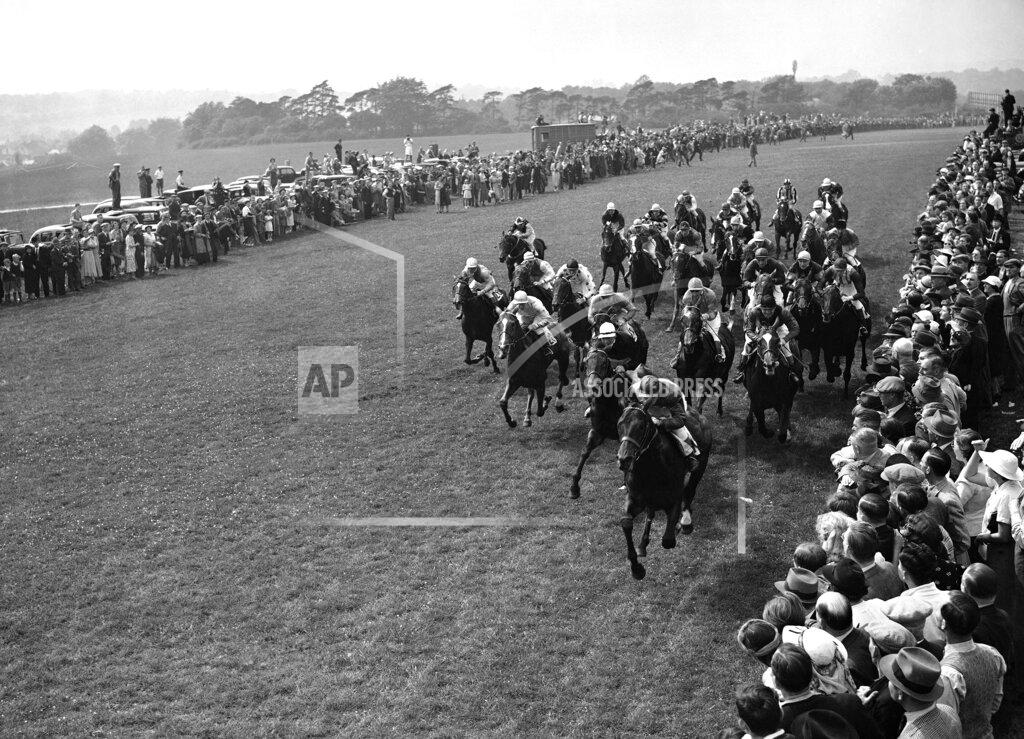
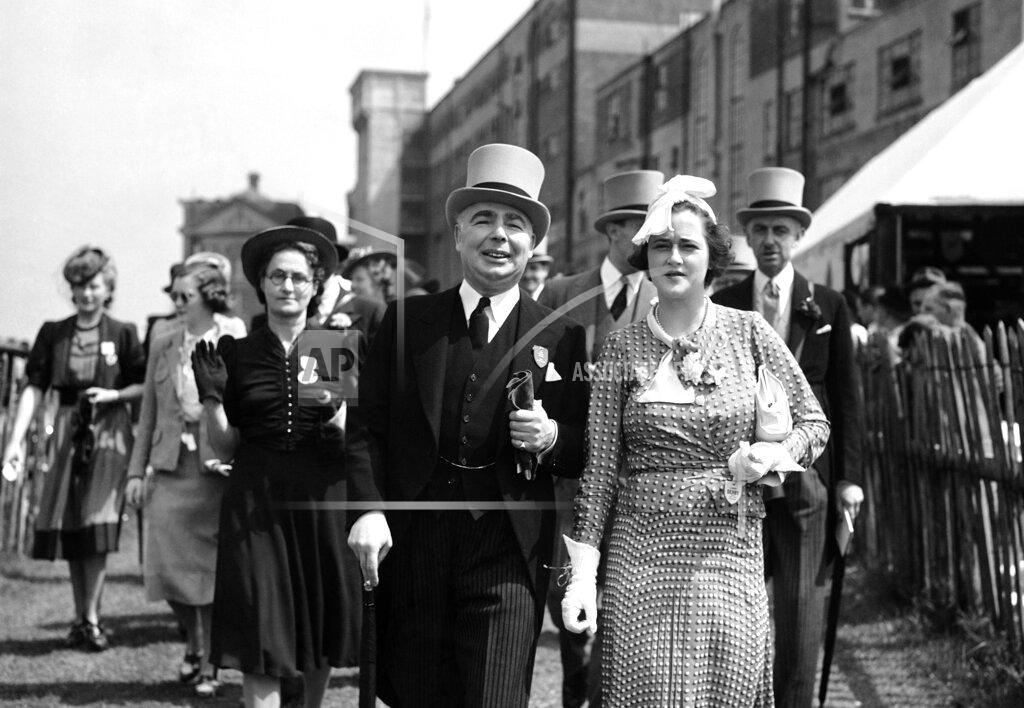
Blue Peter won The Derby. The race was televised live in six major London theaters.
The Albanian-Italian newspaper Fashizmi was founded.
Today in Washington, President Roosevelt sent to the Senate the nomination of David J. Lewis. to be a member of the National Mediation Board, discussed tax legislation in conferences with Senators Harrison and Byrnes and Representative Jere Cooper, vetoed the bill making it a federal offense to transport stolen cattle in interstate commerce and talked with William E. Sweet, former Governor of Colorado.
The Senate debated the Wheeler Omnibus Railroad Bill, confirmed the nomination of George Allen as a member of the Board” of Commissioners of the District of Columbia and recessed at 5:11 PM until noon tomorrow.
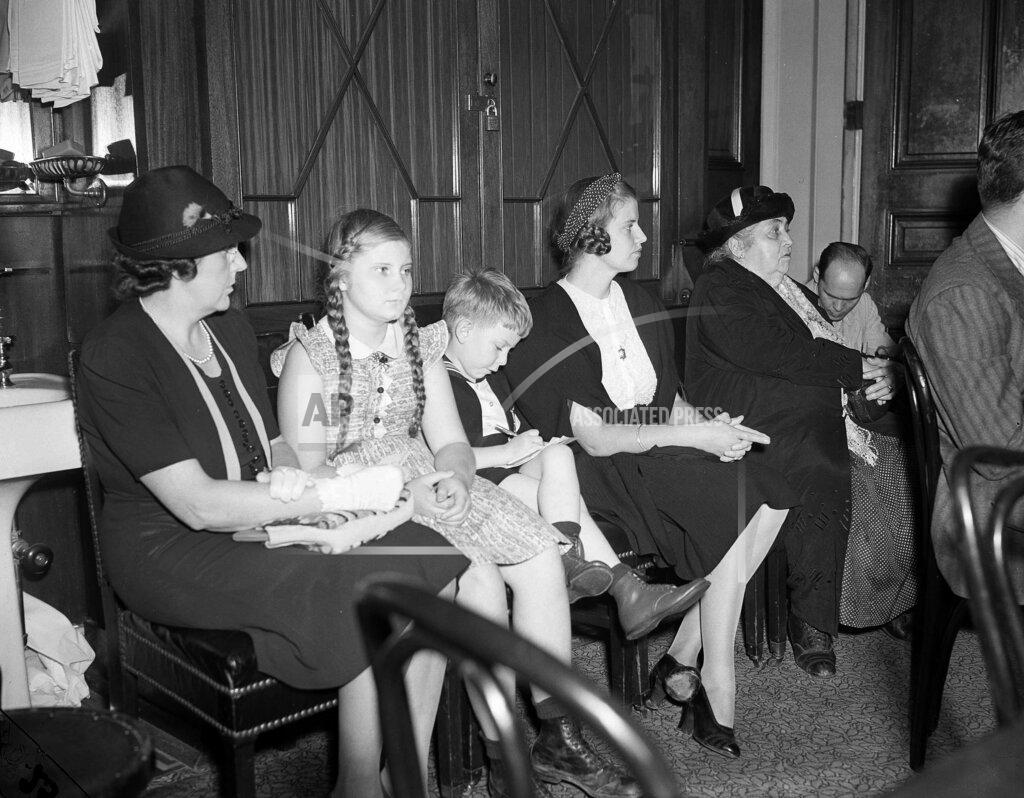
The House approved a Senate bill for strengthening the Coast Guard, heard eulogies of the late Representative Bert Lord of New York and adjourned at 3:59 PM in respect. The Ways and Means Committee voted to report without recommendations the Townsend Old-Age Pension Bill and the Immigration Committee resumed hearings on the bill to permit entrance of 20,000 German refugee children. The Dies Committee heard further testimony regarding a reputed movement to establish a fascist government in the United States.
Prospects for moderate corporate tax revision at this session of Congress, involving deletion of the remaining stump of the undistributed profits levy and collateral changes to protect the revenue, were heightened still further today with the quick development of a better feeling on the subject between President Roosevelt and revenue leaders at the Capitol. The easing of nerves over the tax question was the first product of a cooperative drive for adjournment of Congress by mid-July. It was signaled by a luncheon given by the President to Senator Harrison, chairman of the Senate Finance Committee, and Senator Byrnes of South Carolina.
The attitude exhibited both at the White House and at the Capitol was in marked contrast to what it was a week ago Monday, when Senator Harrison, critic of the undistributed corporate profits tax, told the President bluntly that he could expect business-encouraging changes in the revenue laws at this session, with or without White House aid. The White House luncheon was preceded by a conference between the President and Representative Cooper of Tennessee, chairman of the House Ways and Means subcommittee on taxation. It was followed in the afternoon by an exchange between Mr. Cooper and Representative Doughton, chairman of the Ways and Means Committee, and Secretary Morgenthau and Under-Secretary Hanes at the Treasury.
Arrangements were understood to have been made tentatively for Mr. Morgenthau’s and Mr. Hanes’s appearance next week before the Cooper subcommittee on the subject of corporation tax revision. Mr. Doughton said at the end of the day that the subcommittees would meet before the end of this week and would arrange to hear Mr. Morgenthau next week. He added that the full committee was “all set” to speed new tax legislation. He understood, furthermore, that the Senate Democratic leaders proposed to call a party caucus in an attempt to bind their followers to the revisions, if those adopted by the House were in competition with their own proposals.
George Daetherage, commander of the Knights of the White Camellia, informed the U.S. Senate Dies committee that a “world service” in Germany supplies material to interested organizations in the United States for anti-Jewish and anti-communist publications. The Knights of the White Camellia was a secret group, similar to and associated with the Ku Klux Klan, who were anti-Semitic and supported white supremacy.
Barred from Carnegie Hall and later from Mecca Temple, 700 persons met last night in the ballroom of the Great Northern Hotel, about two hundred feet from Carnegie Hall, and listened for three hours to speeches attacking communism, Mayor La Guardia, John L. Lewis, Lieutenant Governor Charles Poletti and others. Literature distributed throughout the meeting place and repeated references to “Christian America” by several speakers had a definite anti-Semitic tinge.
The meeting was sponsored by four self-styled patriotic organizations and their affiliates, including, American Patriots, Inc., American Federation Against Communism, The Christian Front and American Nationalist Party. An overflow meeting was held in Columbus Circle. A hundred policemen under the charge of Deputy Chief Inspector John J. DeMartino patrolled the meeting place and the streets outside to prevent disorder. State Senator John J. McNaboe, the principal speaker, addressed the meeting for forty-five minutes. He was interrupted a dozen times by cries from the floor to “throw the Jews out of Christian America.”
Grover Cleveland Bergdoll steamed toward his homeland today after nearly twenty years of self-imposed exile in Germany while government officials debated whether he should be permitted to re-enter this country. The discussion arose after Harry Weinberger, the draft dodger’s attorney, had informed the Senate Military Affairs Committee that Bergdoll was aboard the liner Bremen, due in New York tomorrow. He had departed unannounced from Germany after signifying a desire to serve a five-year sentence imposed after his conviction in 1920.
Major General Allen W. Gullion, the army’s Judge Advocate General, told the committee that the War Department was anxious to take Bergdoll into custody and send him to prison. Gerald D. Reilly, solicitor of the Labor Department, said that immigration authorities would oppose Bergdoll’s entry on the ground that he had forfeited his citizenship by his nearly twenty years of exile. The committee had under consideration a House-approved bill designed to close the doors of the United States to Bergdoll and any other draft evaders who might have fled this country to escape punishment.
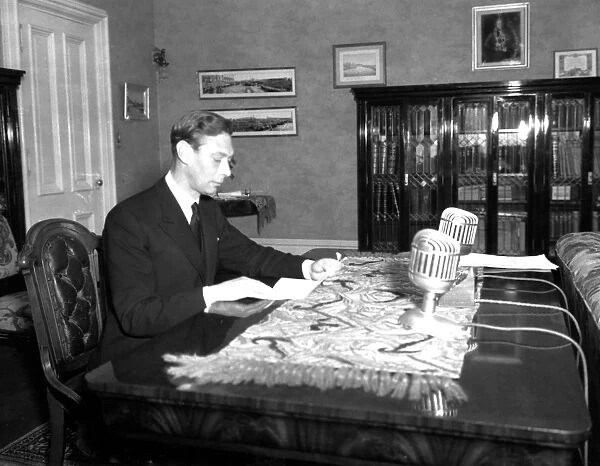
In Winnipeg, King George VI gave a radio address broadcast around the world extolling the century of peace between Canada and the United States. King George VI, in an Empire Day address broadcast to the polyglot peoples all over the world who come under his rule, expressed the wish that the Old World of Europe and Asia might learn a lesson from the New World of North America in the solution of racial aspirations and national differences. The King was at special pains to emphasize the friendship between the peoples of his empire and those of the United States, and he thanked God that no man in the future would ever again consider a resort to force to resolve differences which might arise between them.
Indeed, he declared, that faith “in reason and fair play” which he said Britons share with the people of the United States “is one of the chief ideals that guide the British Empire in all its ways today.” The royal train left here at 9:10 PM, Eastern Daylight time, carrying the King and Queen into Saskatchewan tomorrow.
The celebration of Empire Day, coinciding with the birthday anniversary of Queen Victoria, the Sovereign’s great-grandmother, was in some respects one of the most impressive occasions of the visit of the King and Queen to Canada, the first any rulers of England ever have made to a self-governing Dominion.
An air clash occurs on the Manchu border. The Japanese report dogfights started by Soviet Outer Mongolian forces
The Battle of Suixian–Zaoyang ended in Chinese victory. The Japanese launched a major two-pronged offensive that captured many cities and towns. However, their failure to defend against a series of coordinated Chinese counter-attacks forced them to completely withdraw, resulting in territorial control returning to the original status quo. During the month-long campaign, the Chinese incurred a total of 28,000 casualties, a significant portion of which was due to the Japanese Army’s continuous and extensive use of air attacks and chemical weapons. On the other hand, the Japanese suffered 21,000 casualties. Although Chinese casualties were still a third greater than that of the Japanese, it was clear that by now the casualty margin was getting smaller and smaller. Although the Japanese were initially successful in capturing many cities and towns, their inability to hold onto any of them resulted in their offensive operation ending in a complete failure. By the end of the battle, the Chinese Army had not only recaptured all positions, but also gained the ability to utilize mobilized warfare to launch counter-offensive into Japanese-held territory.
Counter-attacking Chinese troops are sweeping back Japanese forces in Northern Hupeh Province between the Han River and the Peiping-Hankow Railway. Driving on the highway from Tanoyang the Chinese yesterday reoccupied Suihsien, Chinese military dispatches said today, and the Japanese, unable to consolidate for a stand at Suihsien because of the speed of the Chinese advance, were reported falling back on Anlu, about forty miles to the southeast. Westward of Suihsien the Japanese were managing to retain their recently won positions in the Tahung Mountains in the face of vigorous Chinese assaults, while still farther to the west Japanese forces at Chunghsiang, threatened by Chinese attacks, were pulling in outposts and fortifying defenses in preparation for a prospective siege. The Japanese flank northeast of Suihsien was reported withdrawing toward Sinyang.
The Chinese have now pushed back the Japanese in Northern Hupeh at many points from positions they occupied a month ago, virtually nullifying the gains of the Japanese offensive early in May, made at an estimated cost of 10,000 to 20,000 casualties. The Japanese military announced at Shanghai on Tuesday that Japanese forces in the Hupeh area between the Han River and the Peiping-Hankow Railway had “withdrawn” fifty miles in a “completely successful” maneuver, and at that time the Chinese claimed they had routed the Japanese.
Chinese successes on other fronts also were reported today. Around Hangchow, about ninety miles southwest of Shanghai, the Chinese are reported to have occupied Zakow, three miles from Hangchow, and their attack was assisted by planes, Yuhang and Fuyang, near Hangchow, are under Chinese siege, while Chinese troops claim they have retaken Tsungteh, thirty miles northeast of Hangchow. A tentative Japanese push toward Changsha, Hunan Province, from Yochow is said to have been balked after a final brisk engagement at Tsaohsienling, in which the Chinese claimed they were successful. Northward of Tungshan and northeastward of Tsaohsienling the Chinese are said to have occupied Tafan.
Yesterday a Chinese military spokesman in Chungking reported that Chinese counter-attacks last week had erased most of the Japanese gains in Northern Hupeh Province of the preceding two weeks. He said then that the Chinese, after retaking Tanoyang, were pushing on to Suihsien, while the famed Japanese Nagoya Third Division had been driven back toward Tungpeh and Sinyang with heavy losses. Japanese formerly at Tsaoyang were said to have fallen back on the Tahung Mountains, southward of Tienchiacht, in a badly battered condition.
Press dispatches yesterday reported a renewal of Japanese offensive operations northward of Changsha along a thirty-mile front below Yochow. The Chinese were then said to be checking the attempts to advance. Three thousand Japanese reinforcements from Wuenang were said to have arrived at Yochow, and planes and gunboats on Tungting Lake were reported assisting the land forces.
Japan’s invasion of China is becoming increasingly marked by uncertainty and confusion, Chou En-lai, Communist Political Vice Minister under the Chinese Military Affairs Commission, declared in a speech to correspondents yesterday.
Dow Jones Industrial Average: 135.04 (+3.27).
Born:
Clint Miller, American rockabilly singer (“Bertha Lou”), and politician (Virginia House of Representatives, 1972-1996), in Ferguson, North Carolina.
Gert Schutte, Dutch politician (GPV), in Nieuwpoort, Netherlands.
Jim Duckworth, MLB pitcher (Washington Senators, Kansas City A’s), in National City, California.
Tom Goosby, NFL guard and linebacker (Cleveland Browns, Washington Redskins), in Alliance, Ohio (d. 2018).
Died:
Witmer Stone, 72, American ornithologist and botanist.
Naval Construction:
The Türk Donanması (Turkish Navy) “I”-class destroyers Muavenet and Gayret are laid down by Vickers Armstrong (Barrow-in-Furness, U.K.). These ships are acquired by the Royal Navy in 1941 and enter service as HMS Inconstant (H 49) and HMS Ithuriel (H 05).
The Türk Donanması (Turkish Navy) Oruc Reis-class (P 611-class) submarines Oruc Reis, Murat Reis, and Burac Reis are laid down by Vickers Armstrong (Barrow-in-Furness, U.K.). These ships are acquired by the Royal Navy in 1941 and enter service as HMS P-611, HMS P-612, and HMS P-614.
The Royal Navy Grampus-class submarine HMS Seal (37 M; later N 37) is commissioned. Her first commanding officer is Lieutenant Commander Rupert Philip Lonsdale, RN.
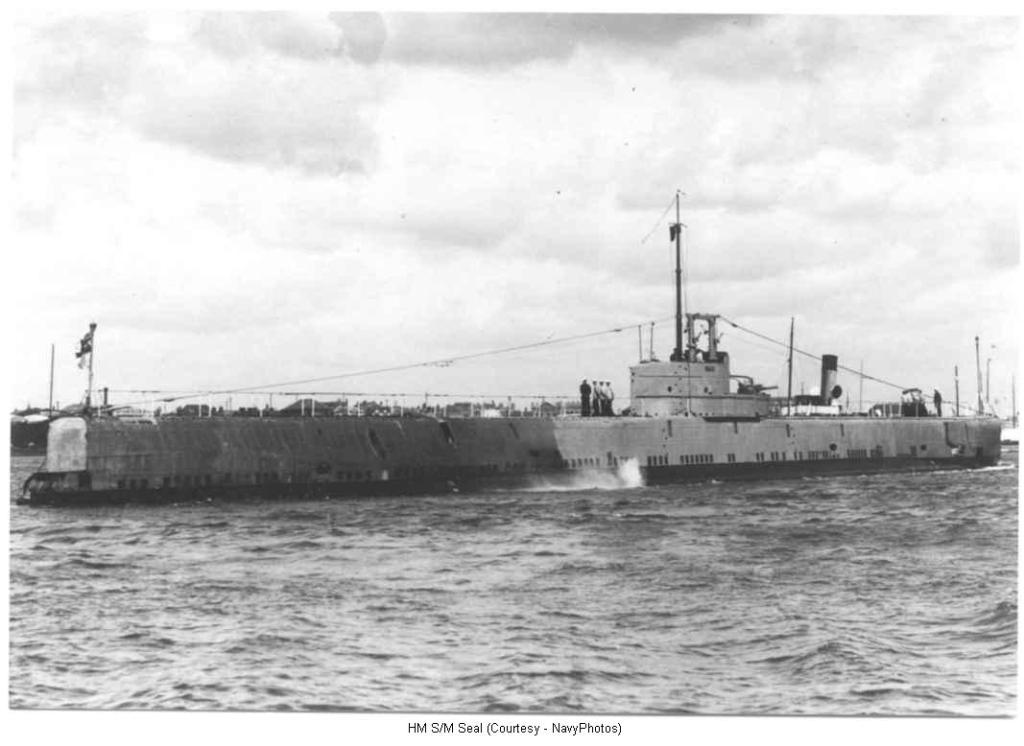
As HMS Seal was at Aden en route to join the 4th Submarine Squadron on the China Station at the declaration of war, and her first patrols were in the Mediterranean. After her return to England, she patrolled in the North Sea and served as escort to one Atlantic convoy. She was then transferred to the 6th Submarine Squadron (Commander S.J.S.Bethell).
After temporary repairs following a collision with a merchant ship, she was assigned to operation DF 7, the purpose of which was to interdict the German route to Norway by laying a mine barrage in the Kattegat.
HMS Seal was captured by the Germans on 5 May 1940 after being damaged by a mine the day before. HMS Seal successfully laid 50 mines on the 4th. Shortly after completing the lay she hit a mine herself and was badly damaged. She was put on the bottom until after dark when she surfaced and tried to make for Swedish waters but failed to do so due to the heavy damage.
She was attacked by German He-115 aircraft from Aalborg, Denmark and then by a German Ar-196 seaplane, which also attacked. Joined by a second Arado. Unable to dive, with her crew suffering from CO2 poisoning, Seal put up a fight but the Lewis gun jammed. The auxiliary submarine chaser UJ-128 arrived on the scene. The crew of Seal then surrendered, expecting the submarine to sink, but it stayed afloat. All crew taken prisoner except for one casualty. Seal was towed to Frederikshavn, and later to Kiel.
Rupert Lonsdale had the unhappy distinction of being the only British warship captain to have surrendered his ship to the enemy in the Second World War. After the War Lieutenant Commander Lonsdale was Court-Martialed for the loss of the Submarine but was acquitted with honour. He retired from the Royal Navy in 1947 and took Holy Orders. Lieutenant Butler was Court-Martialed for the loss of the Submarine as he was technically in charge of the Submarine after the Commanding officer was taken Prisoner but was acquitted with honour.
The former HMS Seal commissioned as the Kriegsmarine U-boat U-B, commanded by Fregkpt. Bruno Mahn, 52-year-old veteran of WWI (commander of SM UB-21). U-B was of limited value to the Kriegsmarine except for training and propaganda purposes. Analysis of her British torpedoes led to development of a superior pistol design (torpedo detonation device) to replace the existing highly unreliable type.
 History Diaries