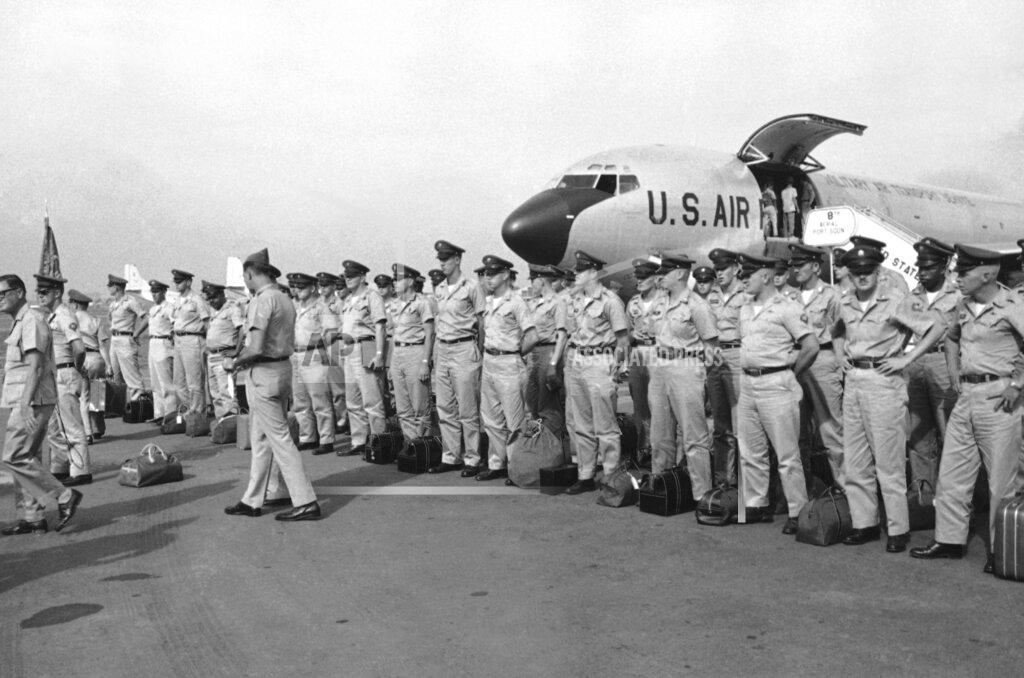
Assistant Secretary of State William Bundy directs the drawing-up of a 3-day scenario that, while publicly pretending that the United States and South Vietnam are trying to avoid widening the war, actually assumes that the United States will begin full-scale bombing of North Vietnam.
The South Vietnamese Government reported today new successes against the Communists southwest of Saigon and in the Đỗ Xá region of central Vietnam. Army forces there were chopping up Communist training camps and supply dumps. The government said its troops killed 21 guerrillas and captured 10 more and a supply of explosives in a two‐day sweep through the Cai Lậy district 50 miles southwest of Saigon. The announcement said the government had suffered no casualties.
A terrorist threw a grenade at a Saigon bar crowded with American servicemen early today, but it bounced off a protective wire screen behind a window and exploded harmlessly outside. About 10 Americans were in the “Rainbow Bar” at the time of the explosion. Most of them were still there half an hour later. American sources attributed the blast to Communists.
In Saigon, Foreign Minister Phan Huy Quát, leaving to attend the United Nations Security Council debate on Southeast Asia, ruled out today any neutralist settlement in South Vietnam. He said his government would soon organize full coordination of support being offered by non‐Communist countries for the war against the Communist Việt Cộng insurgents. Nationalist China and South Korea have already “spontaneously proposed their efficient assistance,” Mr. Quát said, and South Vietnam’s appeal has been “enthusiastically” received in Japan, Thailand, the Philippines, New Zealand and Australia. “The recent developments in Laos have proved to the world that the neutralist solution is an open door for the Communists,” the Foreign Minister said in a departure statement.
Ambassador to South Vietnam Henry Cabot Lodge lives and works behind barbed wire and travels to and from work surrounded by tight security. Though he dislikes the security measures, he has taken to carrying a gun on occasion. The streets through which the Ambassador sometimes drives or walks have been rocked with increasing frequency by terrorist bombs and grenades. So far, he has not been attacked. Mr. Lodge has carried a gun occasionally in the last few months, but only when rumors of violence reach what he considers dangerous proportions. The 61-year‐old Ambassador, mentioned as a possibility for the 1964 Republican Presidential nomination, believes that, fanatics are the main danger he faces in his daily rounds about Saigon. “You can’t protect yourself against fanatics,” an aide said. “If a man is fanatic enough to kill and be killed there’s precious little you can do about it.” Mr. Lodge himself rarely speaks on the record for publication.
A reliable Western source reported today the capture of two Chinese Communist soldiers by right‐wing Laotian forces amid renewed charges here of foreign Communist participation in the fighting in Laos. The two Chinese Communists, manacled and wearing blue work uniforms, were seen by a military observer in the area of Paksane, 75 miles northeast of Vientiane. One was said to have been identified by his papers as an officer and the other as a noncommissioned officer. The two were captured by Meo tribesmen guerrillas on May 8 in the Phongsaly region of northwestern Laos. The area is near the Chinese border and in the vicinity of a highway being constructed by Peking from Mengla, in Yunnan Province, to the town of Phongsaly.
It was the first time that the Laotian right‐wing forces had been able to produce prisoners to substantiate their assertions of North Vietnamese and Chinese Communist military presence in areas where the pro‐Communist Pathet Lao movement operates. General Kong Le, the neutralist military commander, said in a broadcast here that his soldiers had seen North Vietnamese soldiers participating in the battle this week that drove his forces from the Plaine des Jarres. Neutralist forces have counter‐attacked on the Plain des Jarres against Pathet Lao troops, United Press International reported.
Earlier, Prince Souvanna Phouma, the neutralist Premier, distributed to foreign missions photographs of documents said to have been taken from bodies of North Vietnamese killed in other fighting with Pathet Lao troops. The Premier has offered to display the originals to members of the International Control Commission. Independent Western observers here are convinced that the Pathet Lao forces operate with North Vietnamese cadres and that at times entire units are committed against the right‐wing and neutralist troops. However, they feel that the extent of North Vietnamese participation has often been exaggerated to “save face” when the neutralists or rightists have retreated under a Pathet Lao attack. The two Chinese Communists captured near Phongsaly are believed to have been assigned to operate with Chinese Communist construction gangs that built the Mengla‐Phongsaly highway and were extending the road network so that troops could be moved quickly toward the Burmese and Thai borders.
Prince Souvanna Phouma, in the period when, he was allied with the Pathet Lao movement prior to April, 1963, when fighting broke out between the neutralist and Pathet Lao troops, gave his consent to the construction of the all‐weather road to Phongsaly. The Premier later let it be known that he regretted the decision as the Chinese Communists sent troops as well as construction gangs into northwestern Laos. Chinese Communist troops have been observed periodically in the vicinity of the Mengla-Phongsaly road after it was completed in January, 1963. Supplies brought down the road are believed to have been passed to Pathet Lao units operating in the area. The Phongsaly region is controlled by General Khamouane Boupha, a self‐styled neutralist who has been working with the Pathet Lao movement.
The Soviet Government announced tonight that it had proposed to Britain the convening of a 14‐nation conference on Laos next month in Geneva. A statement by the Soviet, Foreign Ministry said the two countries, as co‐chairmen of the 1962 conference that guaranteed the independence and neutrality of the Indochinese kingdom, should issue a joint appeal for another meeting to discuss the present crisis. According to the statement, made public by Tass, the Soviet press agency, the Foreign Ministry said it acted after Prince Souvanna Phouma, the Laotian Premier, and the French Government had urged such a conference. The Soviet proposal was evidently handed to Sir Humphrey Trevelyan, the British Ambassador, by Sergei G. Lapin, a Deputy Foreign Minister, during one of several meetings they held here this week to agree on the next step to be taken in the Laotian situation. Washington opposes the idea of a full‐fledged conference on the grounds that its scope may be extended to cover the entire Indochinese Peninsula, including Cambodia and the two‐Vietnamese states.
The Soviet Union at the United Nations and elsewhere last week was clearly playing a complex and strange game in relation to the growing crisis in Southeast Asia precipitated by the latest developments in South Vietnam and Laos. On the one hand, the Soviet United Nations delegate, Nikolai T. Fedorenko, last week excoriated the United States role in South Vietnam, accused Washington of engaging in aggression against Cambodia, and generally used some of the roughest, cold war language heard in the Security Council in years. On the other hand, the Soviet Government has made plain its support for the restoration of the coalition government in Laos, supported the French call for an international conference on Laos, and been much less violent than might have been expected in its reaction to the American reconnaissance flights over the Pathet Lao forces in that country.
But at the same time Moscow has sought to emphasize that it now has no control over the Pathet Lao. It has done this by inducing Poland to withdraw from participation in the work of the International Control Commission for Laos. Any attempt to explain this diverse Moscow behavior must begin with two basic and interrelated facts with which the Kremlin must reckon in trying to influence events in Southeast Asia. The first is the Soviet Union’s geographic distance from this area and the absence of any Soviet military forces in or near the region. Several years ago, the Soviet Union was able to influence events in Laos directly because its planes supplied the Pathet Lao forces, but that is now impossible because of the bitter hostility now existing between the Soviet Union and Communist China. It is the Sino‐Soviet political war which is the second key feature Moscow must keep in mind in framing policy toward Southeast Asia today. Every move the Kremlin is now making in this area is considered with an eye on its possible impact on the rivalry with Peking.
As the North Yemen Civil War continued, Egyptian military intelligence “came within an ace of assassinating” Hassan ibn Yahya, the Crown Prince of the Royalists who were supported by Saudi Arabia in their fight against the Yemen Arab Republic that had overthrown the monarchy in 1962. A member of the Hashid tribe, hired by Egyptian agents, raided Prince Hassan’s headquarters in the mountains at Al-Gahrir, while Hassan’s low-paid bodyguards revolted because they were paid only half as much as the guards of other princes. Hassan “escaped with his life, but not before losing his hoard of gold.”
The Soviet Union will grant a $230 million loan toward Egypt’s second five‐year plan beginning in 1965, the authoritative newspaper Al Ahram said today. Al Ahram added the Soviet Union also decided to aid the United Arab Republic’s land reclamation program and would provide “required facilities” for restoring of 200,000 acres. Al Ahram said that Premier Khrushchev realized President Gamal Abdel Nasser’s keenness on land reclamation. Mr. Khrushchev has directed that the Soviet Union will furnish Cairo with means for the saving of 10,000 acres by the “most up‐to‐date scientific methods,” the paper said. Since 1956, the Soviet Union has provided a large part of the financing and engineering facilities for the new High Dam on the Nile at Aswan. That financing and other Soviet aid to the U.A.R. in its first Five‐Year Plan are estimated at the equivalent of about $400 million.
A Greek Government spokesman scoffed today at a Turkish territorial claim to some of the Dodecanese, a group of islands studding the South Aegean Sea close to Turkey’s Anatolian shores. “We have just heard of this Turkish claim 16 years after the islands were united with Greece,” this official said. “Clearly the Turks are inventing this to strengthen similar claims over Cyprus.” The Dodecanese Isles, inhabited by ethnic Greeks, with a community of Moslems not exceeding 10 per cent of the population, were seized by Italy from the Turks in 1912. They were ceded to Greece after World War II. The largest island in the group is Rhodes, a favorite international holiday resort. Though the island group’s name in Greek means “12 islands,” there are 14 main islands and about 40 islets and reefs. Turkey’s claim to some of the islands was disclosed by her Foreign Minister, Feridun Cemal Erkin, in an interview published in the pro‐Government Athens newspaper Eleftheria yesterday. Mr. Erkin appeared to imply that at least half of the Dodecanese — those closest to Turkey’s Asia Minor coast — should been turned over to Turkey to preserve Greek‐Turkish friendship.
Nearly four years after the discovery of a large underground oil reservoir in the Tyumen Oblast of the Soviet Union, the first cargo from the Shaim Oil Field was shipped on the Irtysh River to a refinery in Omsk.
Mrs. Madeline Dassault, 63, wife of French multimillionaire Marcel Dassault, was kidnapped while getting out of her car in front of her Paris home. Two gendarmes from Creil rescued Mrs. Dassault, unharmed, the next day at an abandoned farmhouse near the village of Villers-sous-Saint-Leu 27 miles (43 km) north of Paris, after being tipped off by neighbors who had become alarmed by lights inside the building. After overpowering her captor, Matheiu Costa, the police were surprised when the farm’s owners, brothers Gabriel and Gaston Darmont, drove up.
Pablo Picasso painted his fourth version of Head of a Bearded Man.
Talk of a possible compromise on health care for the aged has been revived in closed sessions of the House Ways and Means Committee. Members are not optimistic, however, over prospects of agreeing on a formula acceptable to the Johnson Administration. A majority of the 25-member committee is still opposed to financing health‐care benefits by higher Social Security taxes, according to reliable informants. This is a basic principle of the Administration’s program, and Administration spokesmen have repeatedly said that any compromise must include such financing.
The new compromise talk centers on a formula that the committee rejected in 1960. Under the proposal, persons over 65 would be given the choice of participating in either of two plans. One would provide an increase of about 5 per cent in cash retirement benefits under the existing Social Security program. The other would provide the same hospitalization, nursing care and clinical services, when needed, that are contemplated by the Administration’s healthcare bill. The total estimated cost of this option is about equal to the cost of the Administration bill and it would be financed by a like increase in Social Security taxes. The present tax rate of 7¼ per cent, shared equally by employers and employes, would be raised to 7¾ per cent, and probably would be applicable to the first $5,600 of a person’s annual pay. The tax applies to the first $4,800.
The Ways and Means Committee suspended deliberations on health care Thursday after hearing Administration officials explain the compromise plan. It will resume them sometime next month. Discussion of the proposal was encouraged by the committee chairman, Representative Wilbur D. Mills, Democrat of Arkansas. However, Mr. Mills is an apparently adamant opponent of Social Security financing of health benefits, and a committee majority has always supported him in the past.
A report being circulated privately within the Labor Department indicates how difficult and complicated it will be to give genuinely effective assistance to America’s poor. The report, prepared within the department for the information of policy‐makers and staff members in the manpower program, describes the problems encountered during last year’s successful retraining program for 100 unskilled, unemployed Black men at the Norfolk division of Virginia State College. The project was experimental, run by the college’s staff and financed largely by Federal funds provided under the Manpower Development and Training Act. Although the training phase, which lasted a year, is over, project staff personnel are still trying to place some of the men in jobs and are following the experience of all of them to find out the results.
A deliberate effort was made to seek out the hardest of the hard‐core unemployed — men who were for the most part uneducated and poverty‐stricken and who had irregular work histories. This is the sort of people who will have to be helped if the Administration’s projected “war” on poverty is to succeed. “The desperate plight of these Negroes, many of them illiterate and many drained of hope, is well known,” the report says. “The older males are steadily displaced from muscle jobs by automated and rationalized ways of doing work. They can find no new jobs. The young men find it increasingly harder to enter the labor market at all. They cannot get the crucial first job.”
A segregationist group that is seeking a referendum on Maryland’s new statewide public accommodations law was apparently a substantial beneficiary of Gov. George C. Wallace’s Presidential primary campaign in the state. Workers of the Maryland Petition Committee were at every public gathering the Alabama Governor held in Maryland during his 10‐day campaign to win “a significant protest vote” against the civil rights bill in the Presidential preference primary last Tuesday. The committee itself sponsored one such rally. Petitions that could force the state public accommodations law to a referendum in November were signed by thousands of ardent Wallace supporters at the Governor’s rallies, a development that vastly simplified the committee’s task of collecting 23,080 valid signatures. Thousands of names on a similar petition that the committee filed last year were invalidated by state officials for technical reasons and the petition movement failed. This year, however, the committee has made an effort to collect many signatures over the required number as insurance against technical challenges by election officials.
The National Association for the Advancement of Colored People and other civil rights groups are anticipating success for the petition movement. They are conducting a voter registration drive among Negroes and white church groups in hope of spurring support of the public accommodations measure when it comes to a vote in November. The Presidential preference race was won by Maryland’s favorite‐son candidate, Senator Daniel B. Brewster, with 53 percent of the Democratic vote. He is pledged to give President Johnson the state’s 48 votes at the Democratic National Convention. But Governor Wallace won 43 percent of the largest Democratic vote ever recorded in a Maryland primary.
Nelson Rockefeller campaign strategists now figure that if the New York Governor wins the California Presidential primary a week from Tuesday, he will have at least 250 delegate votes on the first ballot at the Republican National Convention in mid‐July. Furthermore, the Rockefeller high command now expresses confidence that its candidate will pick up enough “reserve” support to win the Presidential nomination after “favorite sons” have men given the complimentary votes of their respective states. Of the 1,308 delegate votes at the convention, which opens July 13 in San Francisco, 655 are needed for nomination. Aside from Senator Barry Goldwater of Arizona, who is Mr. Rockefeller’s sole competitor in the showdown California primary, the Governor’s campaign inner circle considers only former Vice President Richard M. Nixon as a serious rival for the party candidacy.
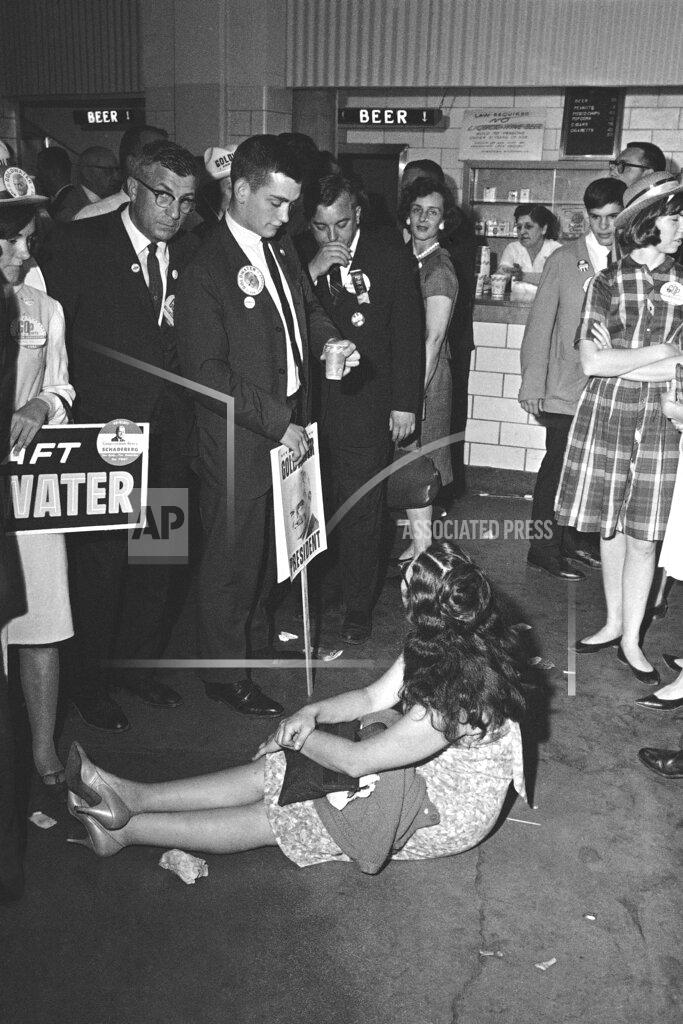
Senator Barry Goldwater returned to the scene of the California primary campaign today — but did no active campaigning. Mr. Goldwater flew here from Washington, held a news conference in the Cocoanut Grove nightclub of the Ambassador Hotel, and then flew to Phoenix, Arizona, to spend the night and most of tomorrow at his home. It was an almost lethargic contrast to the nonstop, handshaking effort of Governor Rockefeller, his opponent in the Republican Presidential primary June 2. Mr. Goldwater, who had been absent from California for four days, made no speeches or public appearances today. He will campaign vigorously in Redding, Sacramento and Oakland on Monday.
Despite the importance of the primary, Mr. Goldwater is avoiding day‐by‐day dawn‐to‐dark campaigning to avoid “overexposure” in the press, his aides said privately. Mr. Goldwater said, in his news conference, that there was “no question that Governor Rockefeller has improved his position” in the campaign. Although Mr. Goldwater said that he had enjoyed a lead here, he added of the Governor, “I would be rather foolish if I thought he hadn’t cut into it,” since Mr. Rockefeller’s victory in Oregon. Mr. Goldwater said the election here would be close.
Sometime in August, if current plans hold, the Air Force will test‐fire the first of its radically advanced Minutemen. Known as the Minuteman 2, the weapon is designed for twice the accuracy of existing Minutemen — equal to an eightfold increase in warhead power. The firings will he conducted from Cape Kennedy, Florida, down the Atlantic Missile Range. The Minuteman 2 will have far greater range than the existing weapon — about 9,000 miles compared with 6,300. This is sufficient to reach Communist Chinese targets from United States launching sites. The new missile will also have greater flexibility.
Dale Greig runs a female marathon world record (3:27:45).
At New York, At New York‚ the California Angels score 4 in the 1st‚ and the Yankees counter with 5 in the bottom of the inning off Bo Belinsky. That’s all the scoring for the pinstripers as the Angels win, 9–5. Bobby Knoop has a grand slam and 5 RBIs to pace the Angels. This is the 2nd game this season that the injury-plagued Yanks have started their regular outfield of Mantle, Maris and Tresh. Mantle will pull a muscle on the 26th, keeping him out of the lineup for 2 weeks, but today he has a homer and double off Haloes starter Bo Belinsky.
White Sox pitcher John Buzhardt has 3 RBIs, 2 in the 9-run 2nd inning, as the Sox roll up the Senators, 14-2. Pete Ward has a grand slam in the 2nd and collects 5 RBIs.
Born:
Kenny Gattison, NBA forward (Phoenix Suns, Charlotte Hornets, Vancouver Grizzlies), in Wilmington, North Carolina.
Lorenzo Freeman, NFL nose tackle (Pittsburgh Steelers, New York Giants), in Camden, New Jersey (d. 2016).
Gino Minutelli, MLB pitcher (Cincinnati Reds, San Francisco Giants), in Wilmington, Delaware.
Staci Greason, actress (Isabella Toscando-“Days of Our Lives”), born in Denver, Colorado.
Died:
Bob Alcorn, 66, former Dallas County, Texas deputy sheriff who had shot killers “Bonnie and Clyde” (Bonnie Parker and Clyde Barrow) in an ambush near Gibsland, Louisiana. Alcorn’s death from a heart attack came 30 years to the day after the May 23, 1934 gunfire that he and five other lawmen had carried out. The day before, he had spoken to a reporter about his recollections.




 History Diaries