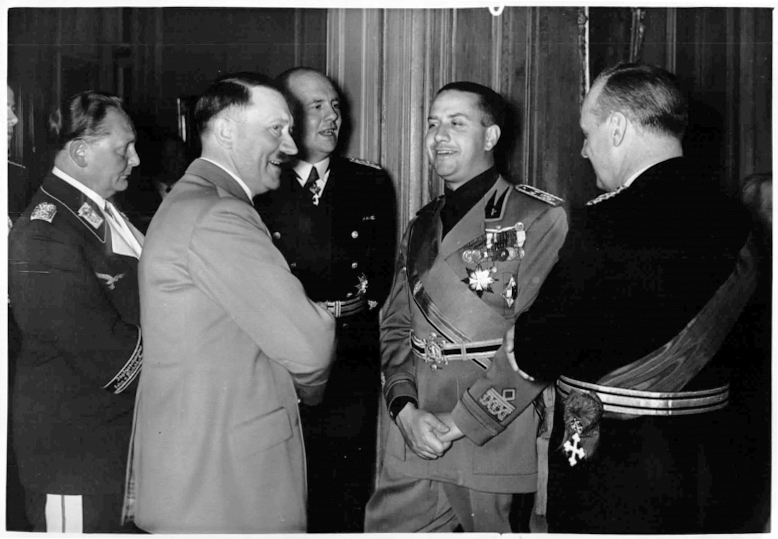
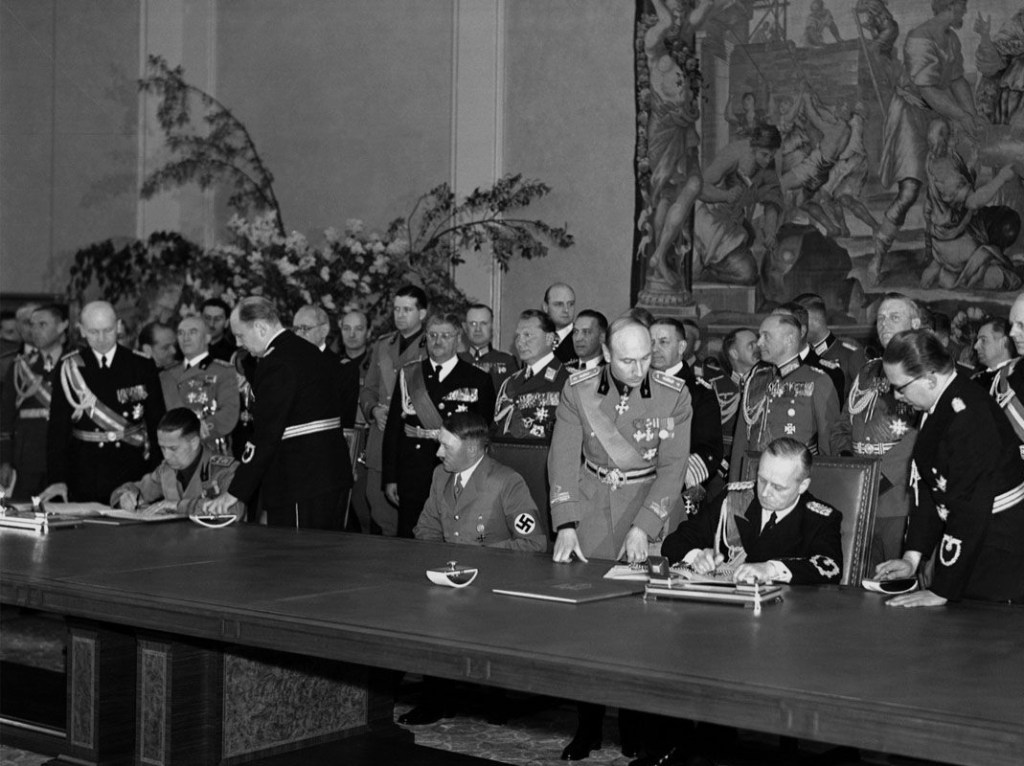
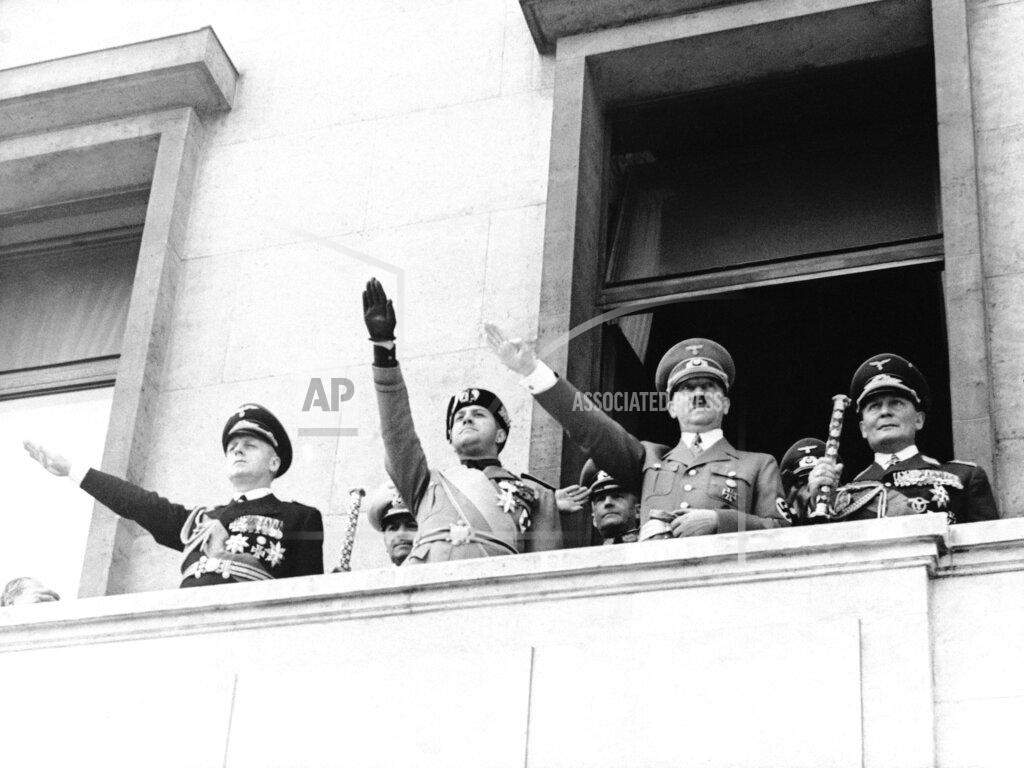
Germany and Italy signed a ten-year military and political alliance known as the Pact of Steel. Hitler and Mussolini sign the “Pact of Steel, (“Stahlpakt“)” proclaiming their full military alliance. The Italians have been told that war is still three to five years off. Foreign Minister Joachim von Ribbentrop declared that Germany and Italy had forged a bloc of 300 million people “ready to offer the hand of friendship to anyone, but determined to stash any enemy by their united power.” The pact was initially drafted as a tripartite military alliance between Japan, Italy and Germany. While Japan wanted the focus of the pact to be aimed at the Soviet Union, Italy and Germany wanted the focus of it to be aimed at the British Empire and France. Due to this disagreement, the pact was signed without Japan and as a result, it became an agreement which only existed between Fascist Italy and Nazi Germany, signed on 22 May 1939 by foreign ministers Galeazzo Ciano of Italy and Joachim von Ribbentrop of Germany.
The Rome-Berlin Axis was transformed yesterday into an unconditional and automatic military alliance with the ceremonious signing of a ten-year pact in Berlin. According to the accompanying speeches, there was thus created an invincible bloc of 300,000,000 people to obtain a “just peace.” In war, it was understood, Germany would have command on land and Italy on the seas. Interpreted from the Rome point of view, the pact means that the two partners are going to get their “living spaces” and Italy’s is asserted to be in Southeastern Europe, in the Mediterranean and in Africa, in which spheres Germany is not to interfere. Officially, the Pact of Steel obliged Germany and Italy to aid the other country militarily, economically or otherwise in the event of war, and to collaborate in wartime production. The Pact aimed to ensure that neither country was able to make peace without the agreement of the other. The agreement was based on the assumption that a war would not occur within three years. When Germany invaded Poland on 1 September 1939 and war broke out on 3 September, Italy was not yet prepared for conflict and had difficulty meeting its obligations. Consequently, Italy did not enter World War II until June 1940, with a delayed invasion of Southern France.
Article I
The Contracting Parties will remain in permanent contact with each other in order to come to an understanding of all common interests or the European situation as a whole.
Article II
In the event that the common interests of the Contracting Parties be jeopardized through international happenings of any kind, they will immediately enter into consultation regarding the necessary measures to preserve these interests. Should the security or other vital interests of one of the Contracting Parties be threatened from outside, the other Contracting Party will afford the threatened Party its full political and diplomatic support in order to remove this threat.
Article III
If it should happen, against the wishes and hopes of the Contracting Parties, that one of them becomes involved in military complications with another power or other Powers, the other Contracting Party will immediately step to its side as an ally and will support it with all its military might on land, at sea and in the air.
Article IV
In order to ensure, in any given case, the rapid implementation of the alliance obligations of Article III, the Governments of the two Contracting Parties will further intensify their cooperation in the military sphere and the sphere of war economy. Similarly the two Governments will keep each other regularly informed of other measures necessary for the practical implementation of this Pact. The two Governments will create standing commissions, under the direction of the Foreign Ministers, for the purposes indicated in Article I and II.
Article V
The Contracting Parties already at this point bind themselves, in the event of a jointly waged war, to conclude any armistice or peace only in full agreement with each other.
Article VI
The two Contracting Parties are aware of the importance of their joint relations to the Powers which are friendly to them. They are determined to maintain these relations in future and to promote the adequate development of the common interests which bind them to these Powers.
Article VII
This Pact comes into force immediately upon its signing. The two Contracting Parties are agreed upon fixing the first period of its validity at 10 years. In good time before the elapse of this period they will come to an agreement regarding the extension of the validity of the Pact.
In the Berlin discussions that coincided with the ceremony, it was assumed, there was discussion of a joint attitude toward the latest Danzig flare-up, but this incident was subordinated in the German press. Warsaw received assurances from the Danzig government regarding the safety of Polish customs officers and the Poles were inclined to consider the incident closed.
Britain’s Cabinet was summoned for an extra meeting today to dispose of domestic business and leave tomorrow’s session clear for the Anglo-Soviet problem. While there seemed to be a chance that a prompt decision on the proposed accord would be reached, the sense of urgency did not seem so strong as last week.
In Geneva, however, League circles had a definite impression that a British-Russian mutual aid pact would be forthcoming in the next week or so.
Italy’s first act today after signing the military alliance with Germany was to announce that all Italian legionaries would be withdrawn from Spain before the end of this month. The following brief communiqué was issued: “Complete repatriation of Italian legionaries from Spain will occur within the current month. Legionaries will be concentrated at Cadiz and will debark at Naples.” Asked whether Spain included the Balearic Islands and Spanish Morocco, officials here said there was no reason to doubt the withdrawal’s “completeness.” There are no authoritative figures on the number of Italian troops remaining in Spain because there has been a steady withdrawal of small groups in the past few months.
Madrid dispatches last Friday stated that the 10,000 Italians who participated in the victory parade were all that remained in Spain. It was said they would leave for home from Cadiz probably on May 28 and that the Germans would depart from Vigo the same day. The Associated Press reported yesterday, however, that Cadiz was preparing for the departure of about 20,000 Italians on June 5.
The British government’s plan for bringing peace to Palestine took a severe battering in the House of Commons today. In a debate that cut across party lines the government was accused of betraying both the Jews and the Arabs, but the Labor opposition put its emphasis chiefly on the contention that the government’s plan is a violation of the mandate from the League of Nations, under which Britain governs Palestine, as well as a violation of the Balfour Declaration and other British promises to the Jews.
“Delay will lead in Palestine to the supposition that our policy is once more to be uncertain and unsettled and that it is once more to be changed,” Colonial Secretary Malcolm MacDonald said at the close of a lengthy speech designed to stress the government’s intention to carry through this plan against all opposition, Conservative, Liberal, or Labor.
As an even stronger indication, the government made tomorrow’s vote on the Palestine White Paper subject to a three-line whip — the strongest order it can give its supporters to be in the “aye” lobby when the vote comes. The Cabinet let it be known that the vote on the Palestine policy was to be regarded as one of confidence, that is, an issue that could force the Cabinet’s resignation. As a result, most observers predicted tonight that the policy would be steam-rolled through tomorrow.
Nevertheless, there was general agreement in the lobbies tonight that the Jewish case had taken form as a result of today’s debate. Winston Churchill, who as Colonial Secretary played a large part in the development of Palestine policy and was, as he said in an interjection today, the inventor of the phrase, “economic absorptive capacity,” is expected to speak tomorrow. Despite the general belief that the policy would be adopted, it was not considered outside the bounds of possibility that opinion in the House might crystallize to a point where the government would recede from the policy as set forth in the White Paper. However, there was no indication tonight that the government would do so unless an extraordinary situation develops tomorrow.
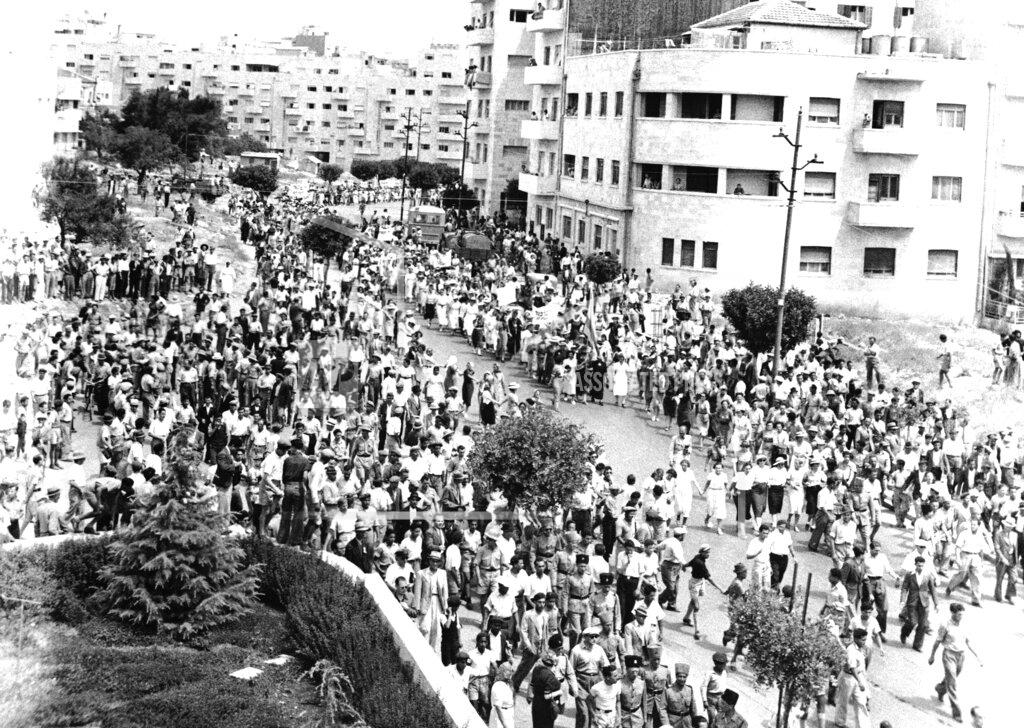
The Jews in Palestine continue to demonstrate in protest against the British policy set forth in the White Paper. This morning 2,000 Jewish women in Jerusalem marched through the heart of the city to the government offices, headed by wives of leading Jews, carrying banners reading, “We won’t give in.” A deputation handed to the chief secretary, W. D. Battershill, a document that said: “A cry from the broken hearts of thousands of Jewish mothers who showed marvelous restraint for three years of terror when so many of our young sons were killed who had turned the desert into a paradise. On behalf of the Jewish women of the world we pray that this terrible mistake may be rectified, preventing the greatest catastrophe to the Jewish people.”
Two armored cars and a large detachment of steel-helmeted police with batons watched the procession. Mr. Battershill promised to dispatch a memorandum to London and the demonstration dispersed peacefully. Jewish ex-servicemen in the British forces who assisted in the conquest of Palestine have called a meeting to approve the return to the British War Office of the medals and distinctions that they received for bravery. They will urge their comrades residing in America, England and elsewhere to act similarly.
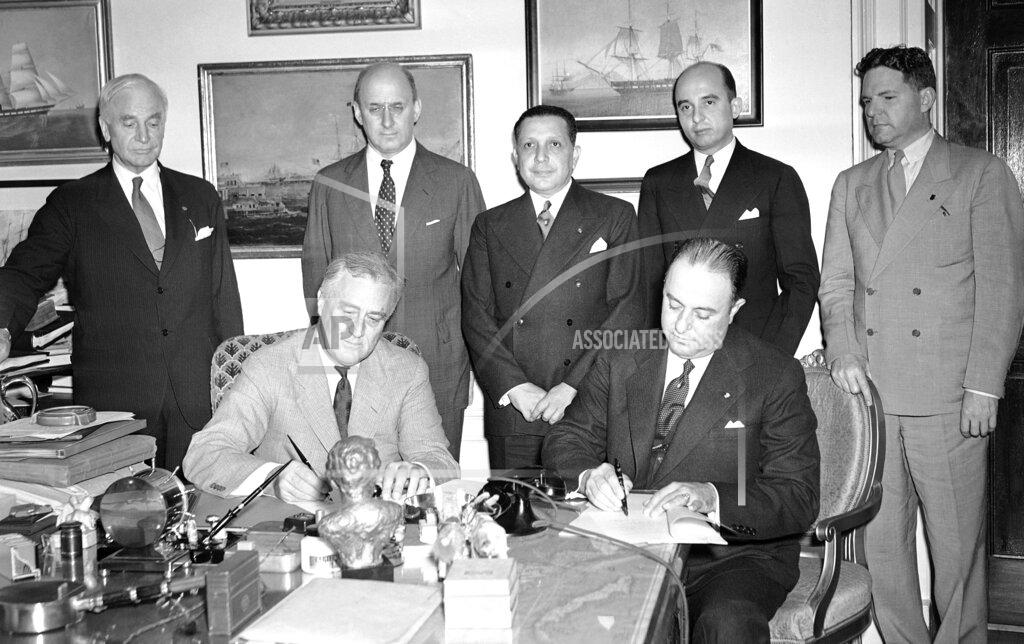
Today in Washington, President Roosevelt exchanged letters with President Somoza of Nicaragua, giving effect to a five-point program of financial, commercial and military assistance to that country, including $2,500,000 of credits through the Export-Import Bank; renominated George E. Allen to be commissioner of the District of Columbia, and addressed the National Retail Forum on the objectives of his administration.
The Senate approved the $30,747,780 Labor Department Appropriation Bill, considered the Wheeler omnibus transportation bill, adopted a resolution directing assemblage of Congress for reception of the King and Queen of England on June 9 and recessed at 4:29 PM.
The House passed two bills establishing minimum national allotments for wheat and cotton on a permanent basis, received a bill to liberalize credit to small business firms and adjourned at 3:35 PM, until noon tomorrow.
Before a friendly forum of the country’s leading retailers, President Roosevelt reiterated tonight his determination to press forward with the principles and objectives of the New Deal, and classified as “radicals” and “gamblers” those who are demanding that the government take its hands off the economic system.
The President made it clear that this meant a continuation of all of the major Administration policies, especially that of deficit spending. But he added the assurance that a continuation of deficits was not a permanent part of the Administration’s plans. Furthermore, he issued an invitation to the retailers, over whose counters, according to his calculation, more than 50 cents of every federally spent dollar passes, to cooperate with him in improving operating methods. His one condition was that they first approve the purposes that lie behind his policies.
The President’s speech, delivered at a dinner meeting tonight, marked the first day of a two-day meeting of the Retailers National Forum, under the auspices of the American Retail Federation. Because of his vigorous defense of his spending policies, many in Washington saw in the President’s remarks further evidence to sustain reports that another program of this kind is being considered seriously by the Administration.
The President’s address followed by several hours one delivered by Harry Hopkins, Secretary of Commerce, in which he, too, laid down the proposition that the New Deal’s philosophy of social and economic reform must be carried forward at all odds.
In between the two, however, Representative Joseph W. Martin Jr., Minority Leader of the House, had evoked several rounds of applause from the retailers with attacks upon the Administration’s spending-lending and labor policies. Another interim speaker, Dr. Beardsley Ruml, treasurer of R. H. Macy & Co., and member of the National Resources Committee, practically prophesied the coming of a permanent compensatory fiscal policy, deliberately operated in the interest of the private, competitive capitalistic system.
The U.S. Supreme Court decided Lane v. Wilson. This was a United States Supreme Court case that found a 12-day one-time voter registration window to be discriminatory for black citizens and repugnant to the Fifteenth Amendment. In 1915, the Supreme Court of the United States held in Guinn v. United States that a grandfather clause to Oklahoma’s literacy test for voting was unconstitutional, violating the Fifteenth Amendment. In response, the Oklahoma legislature passed a law giving citizens of the state a 12-day period, from April 30 to May 11, 1916, in which they were allowed to register to vote. Individuals who missed that registration period would be barred permanently from voting. But, a grandfather clause exempting citizens who had voted in 1914, that is, before Guinn, largely exempted white voters from the provisions of the narrow registration window. In practice the registration period worked against black citizens.
I. W. Lane, a black citizen of Oklahoma, was banned from voting under Oklahoma’s rules, and sued for $5,000 in damages. The district court found against him, and the Tenth Circuit Court of Appeals upheld the ruling of the district court. Lane appealed to the U.S. Supreme Court. Justice Frankfurter delivered the 6–2 ruling of the court, which held that Oklahoma’s registration window and grandfather clause violated the Fifteenth Amendment to the United States Constitution.
A strike of the United Automobile Workers affiliated with the Congress of Industrial Organizations left more than 24,000 men idle tonight, and a government conciliator was reported hastening here to offer his services toward a settlement. Nine hours after the strike closed seven plants of the Briggs Manufacturing Company and threatened operations in other factories, R. J. Thomas, president of the union, announced that James F. Dewey, Federal mediator, would come here tomorrow from Chester, Pennsylvania. The Briggs strike affected 15,000 employees directly. A few hours after the halt in production of the Briggs car bodies, 6,000 day-shift employees of the Plymouth division of Chrysler Corporation became idle. An additional 3,000 Plymouth workers were expected to be laid off.
Congressional plans for a special reception for King George VI and Queen Elizabeth took form today as the Senate adopted and sent to the House a joint resolution providing for the occasion in the rotunda of the Capitol. The resolution stipulated that each branch of Congress convene at 10:30 AM on June 9 and proceed from the respective chambers to the rotunda at 11 o’clock. A committee of three Senators and three Representatives will work out details. The Police Department of Washington was reported to be working out a program for an unprecedented massing of forces around the Capitol to isolate it and the grounds during the ceremonies.
Acclaimed enthusiastically by crowds estimated at 250,000 persons along the way, New York’s new Archbishop, the Most Rev. Francis Joseph Spellman, arrived in the city late this afternoon from New England, and shortly afterward took formal canonical possession of the Archdiocese of New York. Tomorrow morning, at St. Patrick’s Cathedral, where he celebrated his first mass in the United States nearly twenty-three years ago, he will be installed as the sixth Archbishop of New York and the immediate successor to the late Cardinal Hayes as spiritual head of 1,000,000 Catholics.
The amazing career of Kansas City’s Thomas J. Pendergast, one of the last of the powerful city bosses, came to an end in United States District Court today when he pleaded guilty to income tax evasion and was sentenced to serve one year and three months in a federal penitentiary and to pay a fine of $10,000. The man who rose from a boyhood of poverty to dominate for a quarter of a century the government of this Middle Western metropolis of 400,000, with a suburban population of nearly equal size, received the sentence stoically.
At Pittsburgh, the Giants whip the Pirates, 9–2. With the Giants up 6–0, New York’s Ken O’Dea is at bat against Mace Brown with a runner on third and 2 out in the 7th. In the middle of his wind-up to catcher Ray Berres, Brown sees that Berres’ mask isn’t right (the buckle on the mask came loose) and stops his delivery. Umpire Pinelli calls a balk scoring the seventh run. O’Dea then pops out to end the inning (as noted by Clem Conly).
The King and Queen of England met the Dionne quintuplets in Toronto, Ontario, Canada. Five little unofficial princesses, the Dionne quintuplets, curtsied today before their King and Queen. This was the big moment of Toronto’s welcome to King George VI and Queen Elizabeth, who stopped here) today in their royal progress across Canada. The little girls enjoyed their triumph before the proud eyes of Dr. Allan Roy Dafoe, the country doctor who kept them all alive in the trying hours of their birth nearly five years ago and who has guarded their health ever since.
The meeting of the King and Queen with their five most famous subjects in the New World all but blotted out the other events in the day’s crowded program: the great throaty welcome from the city’s throngs, the stuffy ceremonies in the City Hall and the legislative buildings and even the colorful show at Woodbine Park, where for the first time in history the King’s Plate was run under the eyes of the ruling sovereign. The presentation of the little girls to the King and Queen took place in the music room of the suite of offices in the Provincial Parliament, allotted to Lieutenant Governor Albert Mathews. The room has a big bay window, a grand piano, a large sofa and soft chairs. Except for the banked flowers it might have been the living room of a private home.
After their meeting with the King and Queen the five little girls, in ankle-length white organdie dresses and poke bonnets, walked through the Provincial legislative chamber filled with notables and heroes with as much assurance and aplomb as the Queen herself when she walked out on the arm of Prime Minister Mitchell Hepburn, behind the King.
Japanese forces were reported today to have withdrawn 50 miles in Central Hopeh Province during a week of major fighting north of Harkow. Japanese commanders said the withdrawal was in accordance with a “completely successful” maneuver that resulted in wiping out Chinese resistance in the zone and definitely eliminating a threatened counter-attack against Hankow. The Chinese declared, however, that the Japanese had been routed and that their troops were harassing the fleeing invaders.
A Japanese spokesman said 36,000 Chinese had been killed in three weeks of heavy fighting in which the defenders had been drawn into a trap between two Japanese forces. One of the Japanese forces was said to have operated along the east bank of the Han River and the other along the Peiping-Hankow Railway. In accordance with a preconceived plan, the Japanese reported, twenty-six Chinese divisions were caught between the opposing lines. Following this maneuver, the Japanese said, their forces withdrew preparatory to further operations.
The flagship of the Japanese Commander-in-Chief arrived in Amoy this afternoon and salutes were exchanged with foreign warships preparatory to negotiations among the four powers concerned. The Japanese say that the foreigners’ protest to Japan alleged that Japan had used terrorism as a pretext for landing marines and erecting gun batteries with which to bombard the mainland. Japan replied that there was no need for foreign landing parties, since Japan was only protecting her nationals.
The decision regarding the withdrawal of Japanese forces from Kulangsu at Amoy rests, according to the Foreign Office, entirely with the Japanese admiral there. The troops will not evacuate the settlement until peace and order are restored. Japan’s demands for the reform of the municipal council there have fallen into the background and the Japanese landing is now represented solely as a measure of antiterrorist activities. There is no doubt that the unexpectedly firm attitude of the British, American, and French governments impressed the Japanese government in Tokyo.
Dow Jones Industrial Average: 132.45 (+1.23).
Born:
Paul Winfield, actor (“Sounder”, “King”, “Star Trek II: The Wrath of Khan”, “The Terminator”), in Los Angeles, California (d. 2004).
Larry Siegfried, NBA point guard and shooting guard (NBA Champions-Celtics, 1964, 1965, 1966, 1968, 1969; Boston Celtics, San Diego-Houston Rockets, Atlanta Hawks), in Shelby, Ohio (d. 2010).
Don Webb, AFL and NFL cornerback and safety (AFL All-Star, 1969; Boston-New England Patriots), in Jefferson City, Missouri.
Wayne Hall, Canadian NHL left wing (New York Rangers), in Melita, Manitoba, Canada.
Ian Underwood, American musician (Frank Zappa), in New York, New York.
Died:
Ernst Toller, 45, German playwright (suicide).
Naval Construction:
The Kriegsmarine (German Navy) Type VIIB U-boats U-100 and U-102 are laid down by F. Krupp Germaniawerft AG, Kiel (werk 594 and 596).
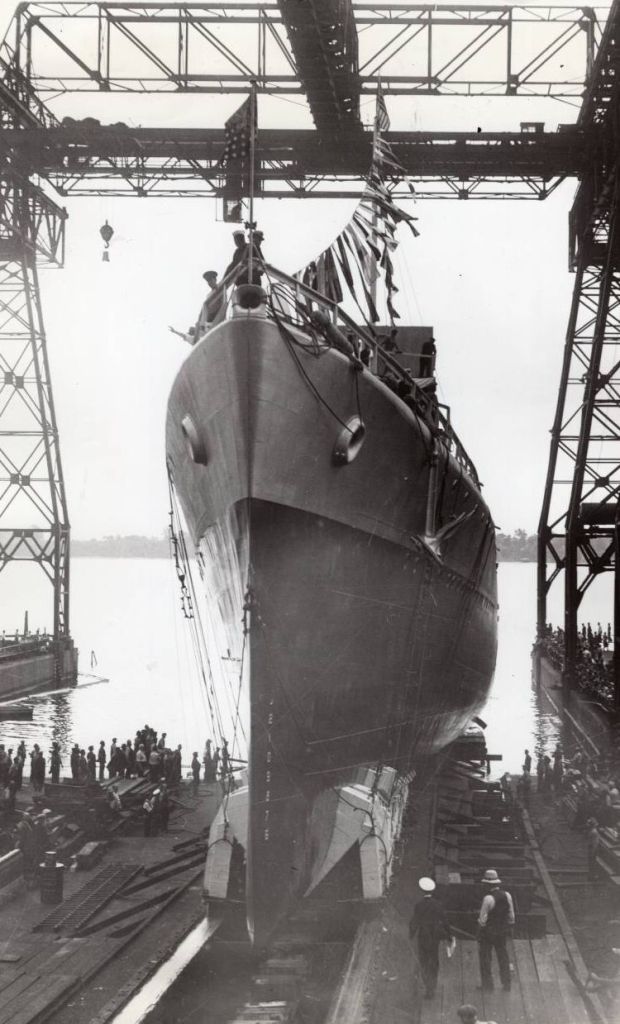
The U.S. Navy Sims-class destroyer USS Buck (DD-420) is launched by the Philadelphia Navy Yard (Philadelphia, Pennsylvania, U.S.A.).
 History Diaries