Secretary of State Dean Rusk raised the possibility tonight that the war in South Vietnam might be expanded “if the Communists persist in their course of aggression.” This was considered the most serious warning the United States has given during the deepening crisis in Southeast Asia touched off by leftist and Communist attacks in Laos. In a major speech before the American Law Institute in Washington, Secretary of State Rusk explicitly accuses North Vietnam of initiating and directing the aggression in South Vietnam. U.S. withdrawal, says Rusk, would mean not only grievous losses to the free world in Southeast and Southern Asia but a drastic loss of confidence in the will and capacity of the free world. “We have made it clear that we are not going to abandon people who are trying to preserve their independence and freedom,” Mr. Rusk said solemnly. “This is the signal which must be read with the greatest of care in other capitals, and especially in Hanoi and Peiping. He concluded: “There is a simple prescription for peace: leave your neighbors alone.”
The Soviet Union was reported today to have told France that it supported her proposal that a 14‐nation conference be convened on Laos. According to usual reliable sources, Moscow suggested that the meeting be held in the second half of June. A note to that effect was handed yesterday to Ambassador Philippe Baudet of France, the sources said. The French appeal was made Wednesday to Britain and the Soviet Union, the co‐chairmen of the 1962 Geneva conference that guaranteed Laotian neutrality and independence. The appeal was based on a clause in the 1962 declaration providing for consultations in the event of a threat to the Indochinese kingdom. There has been speculation that, if the conference were convened, France and other nations, such as the Soviet Union and Communist China would attempt to extend the discussions to other matters such as a possible neutralization of the entire Indochinese Peninsula.
It became clear today that the United States intends to play up the crisis in Laos and to avoid negotiations until it has satisfactory evidence that the Communist side will help restore and respect a neutral coalition there. Discerning who represents the Communist side in the conflict is one of Washington’s most difficult problems in gauging the adversary’s intentions. The belief here now is that the Soviet Union is no longer able to enforce its part in the two‐year‐old Laos arrangement. The refusal of Poland, presumably on Moscow’s instruction, to participate in the work of the International Control Commission for Laos has been underscored by signs that Poland may be withdrawing from the commission altogether. The vehemence of Soviet criticism of the United States at the United Nations this week is thought to be camouflage for the Russians’ inability to influence their erstwhile allies in Communist China, in North Vietnam and among the pro-Communist Pathet Lao forces in Laos.
Premier Souvanna Phouma announced today that “we are going to ask aid from France, the United States and Britain — both military and economic — for the defense of the country’s unity.” The Laotian leader, whose neutralist army has been swept from the Plaine des Jarres by the pro‐Communist Pathet Lao, said that “we are now in the process of establishing our needs.” Prince Souvanna Phouma spoke to newsmen after it became known that United States jets already were flying reconnaissance missions over territory held by the Pathet Lao, trying to pinpoint military concentrations and ascertain the intentions of the pro‐Communist commanders. Washington sources have said these unarmed craft started the flights yesterday at the prince’s request. He declined to comment on them.
All foreign military forces were supposed to withdraw from Laos under the 14‐nation Geneva agreements of 1962, which guaranteed the independence and neutrality of the Southeast Asian kingdom. But the accords permit the Government to bring in limited quantities of war materiel for defense. The United States withdrew its contingents which had trained and advised Government troops in the civil war of 1959 to 1961. But there never has been proof that foreign Communists — specifically combat and supply units of Communist North Vietnam — left the country.
American military might was being massed on Okinawa today prepared for possible action in the Laotian crisis. Air Force units have been on peak alert all week and C‐124 transports carrying troops and cargo took off from the Kadena Air Base last night for unidentified destinations. Official military sources refused to comment on the activity and referred all questions to Washington. But observers here could see increased movement of troops and equipment along the island’s highway network from the northern marine base to the military ports at Naha and White Beach.
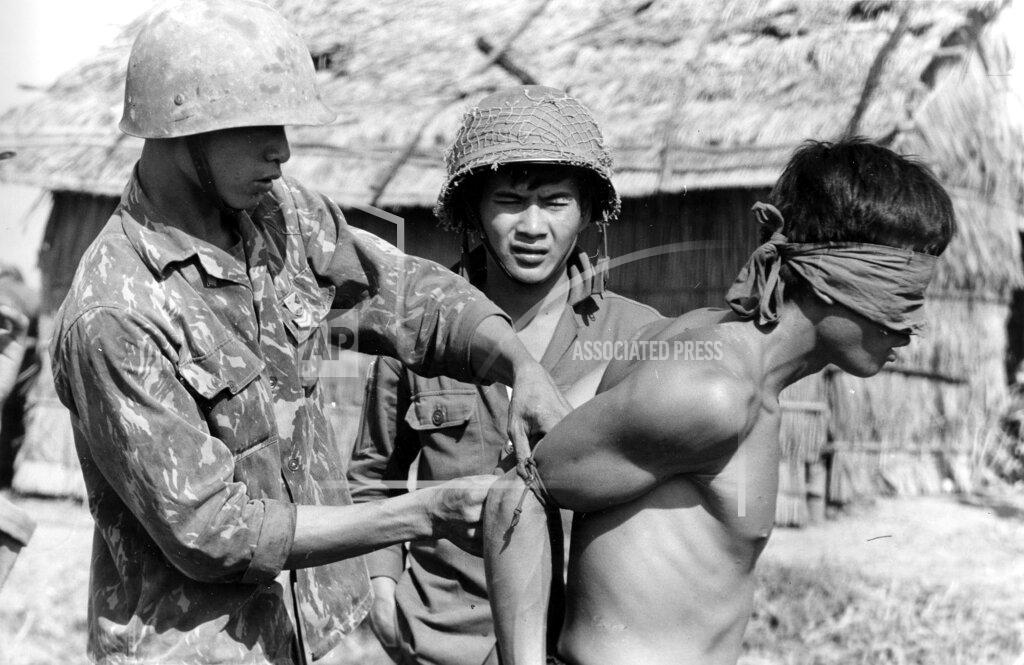
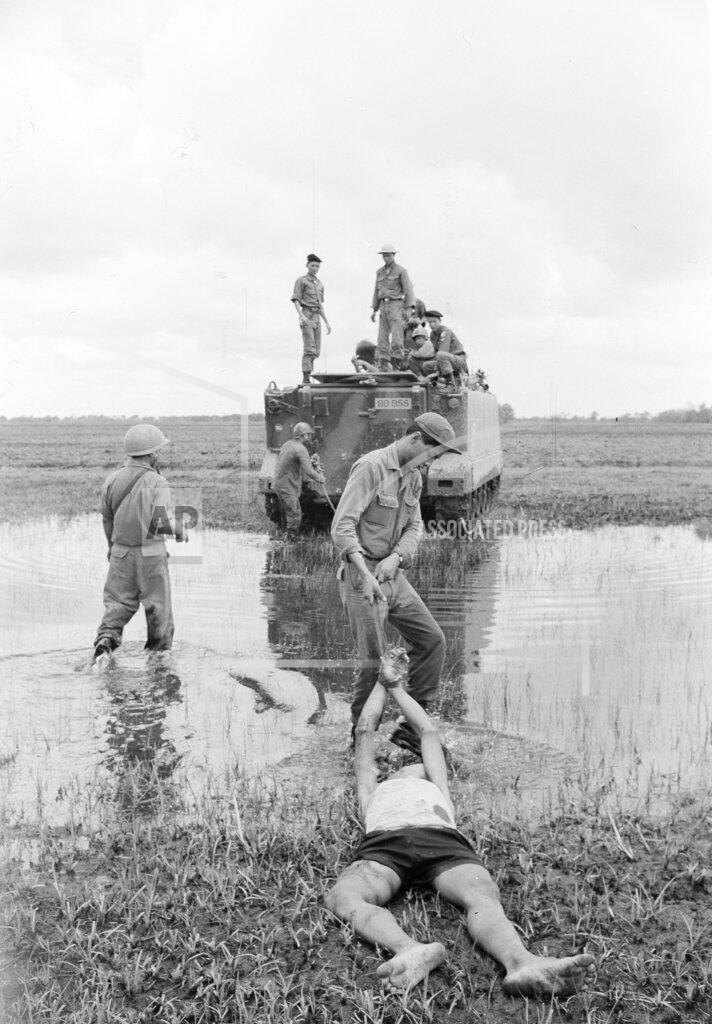
ARVN (South Vietnamese) forces wind up almost a month of campaigning in the Đỗ Xá region by overrunning the headquarters of General Đôn, a top Việt Cộng leader; he escapes, but South Vietnam claims this will set back the Việt Cộng’s efforts for many months.
Stung by charges that 100 planes destined for South Vietnam had been resurrected from a “boneyard,” the Pentagon said today it had spent $12.3 million to recondition the bombers, which were used in the Korean War. Most of the propeller‐driven Skyraider bombers came from mothball storage at an open-air depot near Phoenix, Arizona, the Pentagon said. It also said most of the planes had completed their normal service lives before going to the storage area, known as Litchfield Park. The Pentagon added, however, that the planes had been placed in “almost like‐new” condition at a cost of $123,000 each. Military officials expect them to perform well in the absence of Communist air opposition in South Vietnam.
Thailand mobilizes its border provinces against incursions by the Pathet Lao and agrees to the use of bases by U.S. Air Force for reconnaissance, search and rescue, and even attacks against the Pathet Lao. By the end of the year, some 75 U.S. aircraft will be based in Thailand to assist in operations against the Pathet Lao.
A state of emergency was proclaimed in the colony of British Guiana tonight as racial violence and terrorism rose to a new peak. The proclamation was made by the Governor, Sir Richard Luyt, in a nationwide broadcast. He said more British troops would be coming to help preserve law and order. All troops in the British garrison, which was reduced in January from two battalions to one, moved into positions tonight to prevent further disturbances. The heavily armed soldiers patrolled the capital of Georgetown and seven other trouble spots. The police used tear gas on several occasions today on mobs looting the municipal markets and small business premises owned by East Indians. Black mobs attacked East Indians who were boarding a boat to leave the city.
Other Indians were badly beaten in the streets and had to be sent to a hospital. A man was severely injured when the police fired on a crowd attempting to loot an Indian‐ owned jewelry store. Yesterday two policemen were shot and critically injured near Georgetown. Earlier in the week gangs armed with machetes raided trains and terrorized passengers. Four persons were seriously injured. All trains traveling on the west coast between dusk and dawn were withdrawn today. The violence engendered by the sugar workers’ strike has led to the reappearance of strife between Guianese of Indian and African origin.
Premier Khrushchev toured land‐reclamation projects in the desert near Alexandria today and both praised and criticized what he saw. First of all, the Soviet leader declared, new stone and concrete houses built for Bedouin families are “too costly.” “You are paying for these houses what you should be spending on reclaiming land,” he said. “That is more important.” Mr. Khrushchev began the tour in El Kahrir, the principal village of the 80,000‐acre Nasser Project, about 30 miles southwest of Alexandria. Mr. Khrushchev said new village housing in the Soviet Union followed a more economic pattern — multiple dwellings of three and four stories for collective farm families.
The Soviet Premier’s good humor was restored when the party passed a field of ripened wheat. Leaving the automobile, Mr. Khrushchev took a sickle from the hand of a peasant and went to work cutting the crop. He examined the wheat admiringly and carried a handful back to the car.
Two thousand Protestant and Roman Catholic clergymen and church officials in the United States joined Jewish leaders today in signing a protest against the treatment of Jews in the Soviet Union. The endorsers included three Cardinals of the Roman Catholic Church, the heads of several major Protestant denominations and seven Bishops of the Protestant Episcopal Church. The Catholic leaders were Francis Cardinal Spellman, Richard Cardinal Cushing of Boston and Joseph Cardinal Ritter of St. Louis. The communication will be given to the State Department and to the United States delegation to the United Nations for transmission to Moscow. There are estimated to be three million Jews in the Soviet Union. The representation, termed a “letter of conscience,” was drawn up by the Anti‐Defamation League of B’nai B’rith, the international Jewish service organization, and was announced at the league’s national executive committee meeting in Beverly Hills, California. The league charged that, in addition to systematic discouragement of Jewish religious traditions, the Soviet Union was engaging in a “campaign of vilification of the Jewish past and present in newspapers and other official publications.”
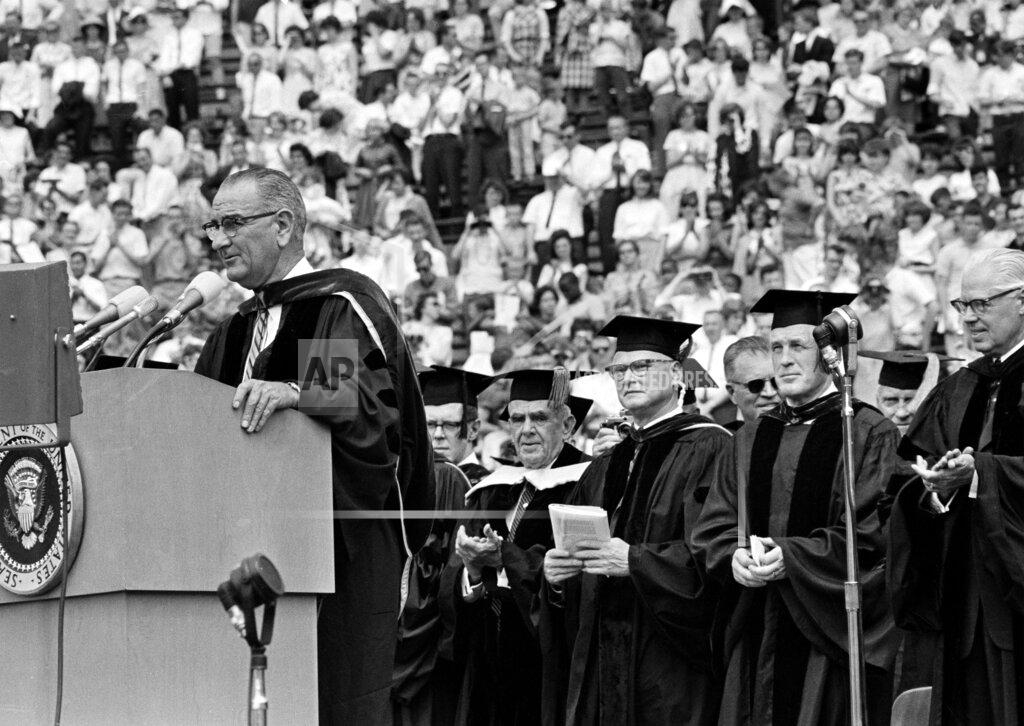
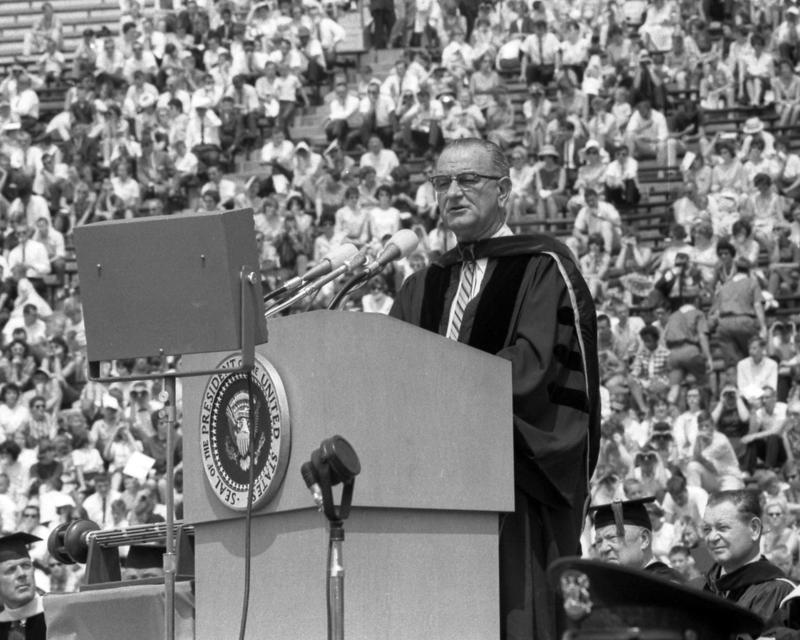
In his commencement speech to University of Michigan graduates as well as to his largest audience as President (90,000 people at Michigan Stadium at Ann Arbor, Michigan), U.S. President Johnson formally introduced his vision of “the Great Society”, a welfare state of federally-funded social programs to fight poverty and transform the nation. “For in your time,” he told graduates, “We have the opportunity to move not only toward the rich society and the powerful society, but upward to the Great Society,” which he said “rests on abundance and liberty for all… demands an end to poverty and racial injustice… a place where every child can find knowledge to enrich his mind and to enlarge his talents.” Johnson, who received an honorary law doctorate, used the term “Great Society” nine times in his 15-minute speech. Though his plan was elaborated at Michigan, President Johnson had first used the term 15 days earlier in a May 7 speech at Ohio University.
Senator Hubert H. Humphrey said today that he and the Republicans’ Senate leader, Everett McKinley Dirksen of Illinois, planned to introduce early next week their package of amendments to the civil rights bill. Senate Republicans held their third meeting on the proposals this morning but did not complete their discussions. Mr. Dirksen said a final meeting would be held next Monday morning. He was hopeful of concluding then the consideration of several minor changes in language proposed by his colleagues. When Mr. Dirksen went to the meeting today, he had with him three pages of changes suggested during the two earlier meetings. These had been gone over with Democratic staff members and representatives of the Justice Department. Mr. Dirksen indicated that most of them had been accepted. As an example of the changes made, Mr. Dirksen said it had been decided that any person who felt he had been defamed by a complainant in an executive hearing of the Civil Rights Commission could appear to make answer and have his reply made part of the record.
Senator Milton R. Young of North Dakota told reporters after the meeting that he thought the bipartisan leaders would be able to get the votes to shut off the Southern filibuster. Closure of debate requires two‐thirds of the members present and voting — 67 if all 100 members are recorded. Mr. Young, who has been regarded as one of six Republicans immovably opposed to closure, said that “maybe eventually” he would vote to cut off debate. “But not for some time yet,” he added. Mr. Young said that he and several other Republicans were concerned lest they could not get their own amendments considered after the Dirksen‐Humphrey proposals had been introduced and a petition for closure filed.
However, Senator Humphrey said today that he and Mr. Dirksen were making it “crystal clear” that before a closure petition were filed, members would have a chance to introduce amendments, to discuss them and call them up. Mr. Humphrey said that the petition for closure would be filed “in early June,” but he indicated that that phrase included the first 15 days of the month. Mr. Dirksen wants to have the Senate pass its bill and to get House concurrence with amendments and the President’s signature before the Republican National Convention starts on July 13. It is now agreed that this is going to be difficult to accomplish unless most of the amendment s except those in the Dirksen‐Humphrey package are killed one after another by nondebatable motions to table after closure is imposed. There will be no Senate session tomorrow. The leaders thought that a Saturday session was unnecessary because most of the details of the Dirksen ‐ Humphrey proposals had been ironed out and also because the members seemed to by getting weary of the debate.
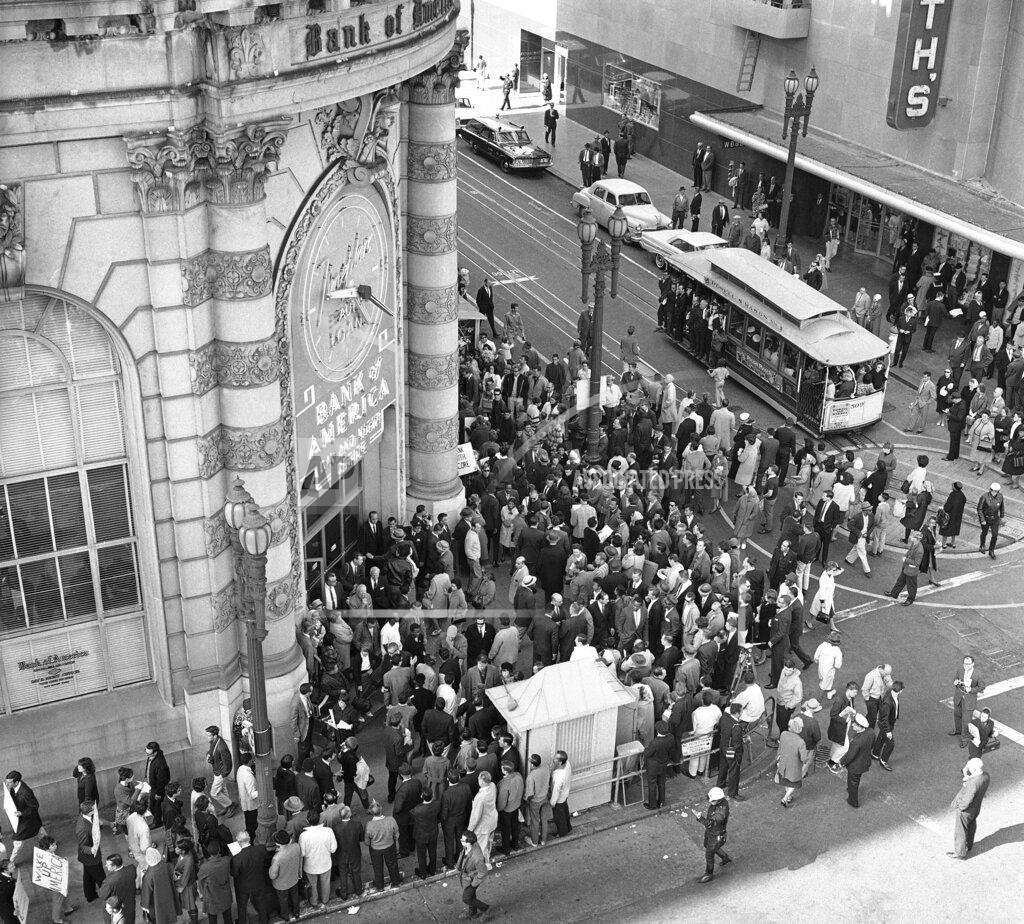
Civil rights groups began demonstrations today against the Bank of America throughout California. About 500 demonstrators marched in front of the San Francisco day‐and-night branch to protest alleged discriminatory hiring practices by the bank. Similar demonstrations were staged at two branches in Los Angeles, and at San Diego, Palm Springs, Sacramento, Oroville, Stockton, Richmond, Bakersfield, Sausalito, San Jose, Pomona and San Bernardino.
In San Francisco the police used megaphones to direct the heavy rush hour traffic in front of the bank, in the heart of the downtown district at Powell and Market Streets. In San Diego a group of 25 pickets walked outside the main downtown branch carrying signs which read: “There Are Other Banks,” “Don’t Save Where You Can’t Earn,” and “Why Give Your Dollars for Discrimination.” In Bakersfield, Police Chief Charles Dodge said the pickets were “just as nice as they can be.” Officials of the State Fair Employment Practices Commission met with leaders of the Congress of Racial Equality a few blocks from the San Francisco demonstrations. The bank has denied any discrimination.
Attorney General Robert F. Kennedy has told friends he will reach a decision on running for the Senate from New York State in a few weeks. Earlier Mr. Kennedy had been described as unlikely to make a decision until after the Democratic National Convention, which opens in Atlantic City on August 24. His associates now report, however, that the Attorney General feels it would be unfair to New York Democratic leaders and the other potential candidates to delay his decision beyond mid‐June or shortly thereafter. Many New York Democrats want to choose a candidate to oppose Senator Kenneth B. Keating as early as possible after the state’s June 2 primary. The state convention for nominating a Senate candidate cannot be held before August 31 under the law.
Mr. Kennedy reportedly believes it would be unwise for him personally and for the Democratic party in New York if he caused delay of a campaign, whoever the nominee might be, by failing to make an early, unequivocal declaration. The Attorney General’s plan to make an early announcement underscores the belief in the Capitol that he has largely written off the possibility of becoming the Democratic Vice-Presidential nominee. It also undercuts one of the strongest arguments raised against his Senate candidacy by his opponents: that New York could not be sure of Mr. Kennedy’s availability until so late in the political season that Senator Keating might by then nave gained an unbeatable campaign advantage.
A cliché has — not for the first time — become a major issue in a political campaign. Senator Barry Goldwater begins his final drive in the California Presidential primary campaign tomorrow armed with a variety of weapons designed to offset charges that he is “out of the mainstream” of Republican and American thought. The author of the charge is Governor Rockefeller of New York, who opposes the Arizona Senator in the California primary June 2. Hundreds of thousands of copies of a pamphlet entitled “Who Represents the G.O.P. Mainstream?” will be sent to Goldwater precinct workers next week for distribution to voters. The pamphlet contains quotations meant to show a close similarity of view between Mr. Goldwater and a wide range of prominent Republicans.
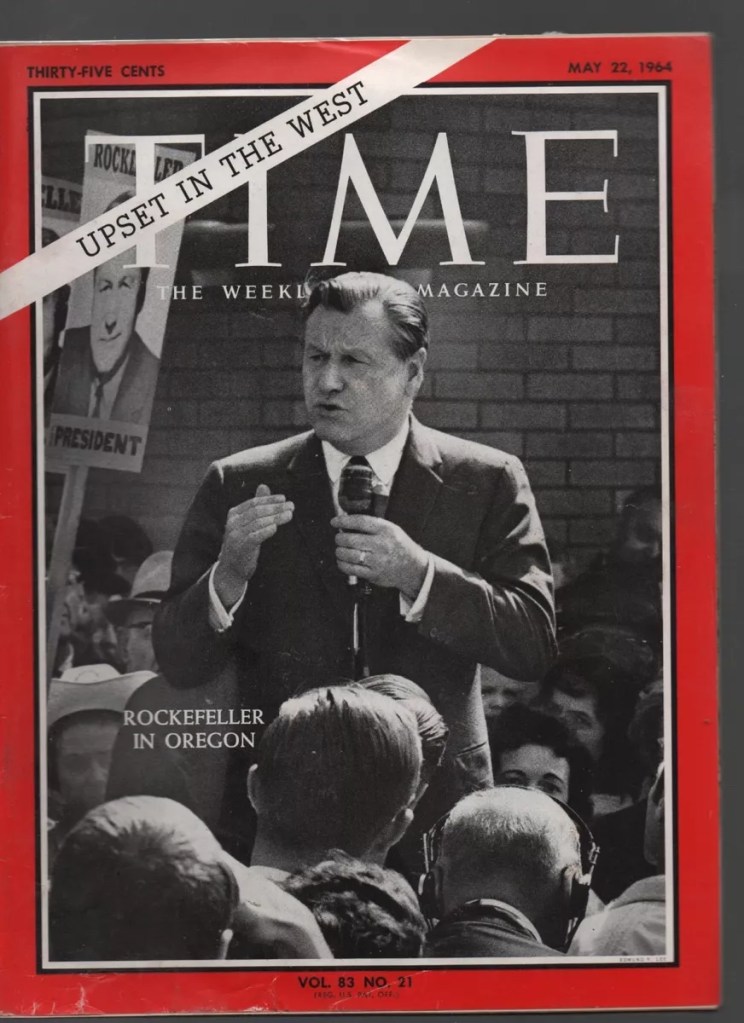
Governor Rockefeller said tonight that if Senator Barry Goldwater won the California primary there would not be sufficient moderate strength to stop him at the Republican National Convention. “I think he’ll get the nomination on the first ballot,” the Governor said of Senator Goldwater. He added that he had absolutely no intention of withdrawing from the race if he lost the primary here. He said that “I’ll fight right down to the ditch.” The Governor showed elation over the probable shape of the 1964 Republican platform. He was asked at a news conference to comment on the maneuvering for convention position between his and Senator Goldwater’s supporters.
One of Richard Nixon’s former political lieutenants called today for all Republicans who remembered the Eisenhower‐Nixon Administration fondly to vote for Senator Barry Goldwater. Patrick J. Hillings, a former Representative and an official in the 1960 Nixon campaign, is a member of the Goldwater delegation in the Presidential primary June 2. Mr. Hillings also sought the support of backers of Henry Cabot Lodge in the contest between the Arizonan and Governor Rockefeller. “Any Republican who shares my view that President Eisenhower, Vice President Nixon and Ambassador Lodge helped to provide our country with courageous and effective leadership at home and abroad should have no difficulty voting for Barry Goldwater,” he told a press conference.
The six‐month anniversary of President John F. Kennedy’s assassination passed like an ordinary Friday at his grave in Arlington National Cemetery today. As usual for a week day, the stream of visitors to his grave was estimated at 10,000 persons.
Indonesia defeated Denmark, 5 games to 4, to win the 1964 Thomas Cup badminton competition held in Tokyo. In the final match, the team of Tan King Gwan and A. P. Unang beat Erland Kops and Henning Borch, 15–6, to capture the Cup.
Baltimore edges the Twins 6–5, scoring 2 runs in the 9th for the victory. Twins’ reliever Jerry Arrigo allows a 2-out home run to Sam Bowens, his 2nd home run of the game, then throws three balls to John Orsino before being lifted for Bill Fischer. Fischer throws a strike to Orsino who then hits his next pitch for the winning home run. It is Fischer’s last Major League throw: on the 24th he is placed on the voluntarily retired list.
Dow Jones Industrial Average: 820.87 (+1.07).
Born:
Marcus DuPree, USFL and NFL running back (USFL: New Orleans-Portland Breakers; NFL: Los Angeles Rams), in Philadelphia, Mississippi.
Stuart Rindy, NFL tackle (Chicago Bears), in Milwaukee, Wisconsin.
Jim Playfair, Canadian NHL defenseman (Edmonton Oilers, Chicago Blackhawks), in Fort St. James, British Columbia, Canada.
Died:
deLesseps “Chep” Morrison, 52, former Mayor of New Orleans and former U.S. Ambassador to the Organization of American States, was killed along with six other people in the crash of a private Piper Aztec airplane on a business trip in Mexico. Morrison and his party departed Matamoros, Tamaulipas at 5:05 in the afternoon for what was to be a one-hour flight to Tampico, but crashed into the side of a mountain in the Sierra de Tamaulipas during a severe thunderstorm.
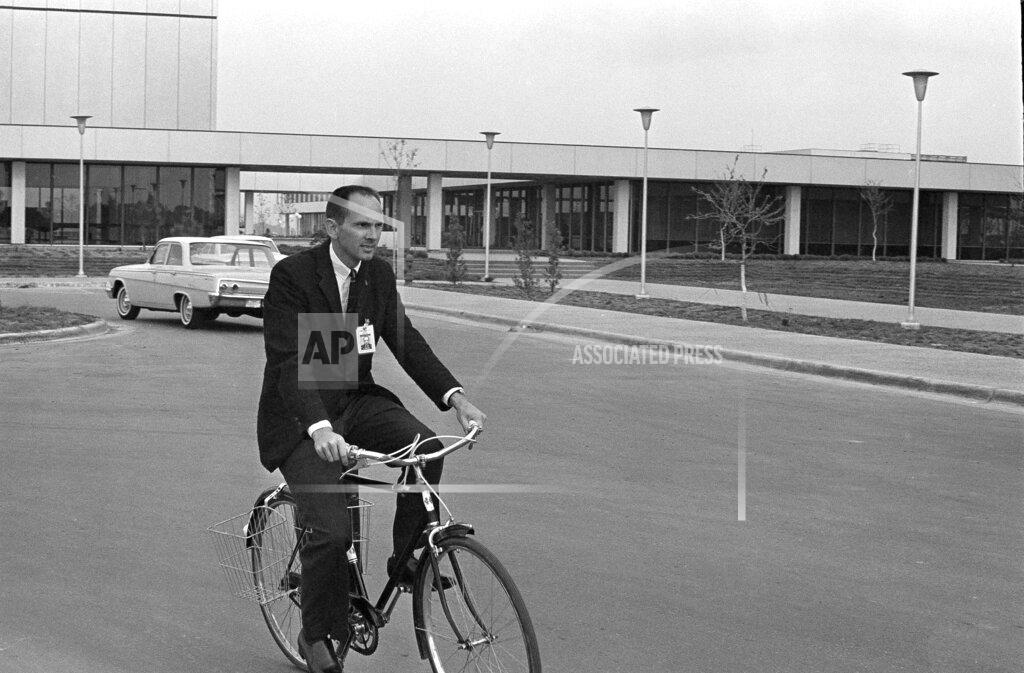
[Freeman never flew in space. He died of a bird strike on the morning of October 31, 1964. After a delay caused by fog, he piloted a T-38A Talon from St. Louis to Houston. Freeman was returning on Saturday from McDonnell training facilities in St. Louis and crashed during final approach to landing at Ellington Air Force Base in Houston. There were reports of geese due to the fog, one of which flew into the port-side air intake of his NASA-modified T-38 jet trainer, causing the engine to flame out. Flying shards of Plexiglas entered the jet engine during the crash. Freeman attempted to land on the runway, but realized he was too short and might hit military housing. He banked away from the runway and ejected. The jet had nosed down a considerable amount, and he ejected nearly horizontally. Freeman’s parachute did not deploy in time, and he died upon impact with the ground; his skull was fractured and he had severe chest injuries.]
 History Diaries