A Pole kills a German in the Danzig disorder. Both sides protest. A German butcher was shot dead in a small village within Danzig territory yesterday, and the Nazi Danzig government and the Polish Government immediately exchanged protests and demands. Both sides agreed the victim had been shot from a Polish automobile. But the Danzig version said he had been fired on after he had got out of a taxicab, while the Polish version said he had been shot when a Nazi crowd attacked the chauffeur of a Polish Commissioner who was on the spot to investigate a previous raid on a customs house.
The official Danzig and Polish versions agree that the victim, butcher named Gustav Gruebner, was shot from an official Polish automobile in which Tadeus Perkowsky, Warsaw’s Under-Commissioner in Danzig, had gone with two assistants and a chauffeur to Kalthof, a small village in Danzig territory on the border of East Prussia. The purpose of the midnight Journey was to investigate demonstrations against Polish customs officials in the village. As a result of the shooting, Arthur Greiser, President of the Danzig Senate, sent a sharp note to Marian Chodackl, the Polish Commissioner. It gave the Danzig government’s interpretation of the incident and demanded compensation for relatives of the deceased, an expression of regret by the Polish Government and the surrender of the man suspected of the shooting to the Danzig police.
A partially uniformed crowd, sympathetic to the Nazis, attacks three Polish custom inspectors at their posts in Danzig. As a sequel to the killing of a Danzig German by a Pole early today an angry mob this afternoon surrounded the building in Pieckel where Polish customs inspectors live. The inspectors called Danzig for help. They reported the mob was yelling that “the killing must be paid for in blood.” After two hours the mob broke up, however, and according to official reports from both Polish and Danzig sources no damage was done.
London heard of the incident with concern, but thought it might help speed up the negotiations with Moscow for an anti-aggression front. London-Paris-Moscow treaty talks continue, despite diplomatic difficulties. The negotiations were pursued in Geneva, where the League Council is to meet today, and, while no conclusions were reported, the opinion was that the British ultimately would make concessions to the Russian demands.
The French Foreign Minister Georges Bonnet says force cannot rule Europe and a spirit of domination is not tolerable. French Foreign Minister Bonnet expressed the hope that the negotiations would succeed. He said in a speech that France would not permit “the spirit of domination to reign over the world.” And United States Ambassador Bullitt praised the courage and unity of the French people as a factor for peace.
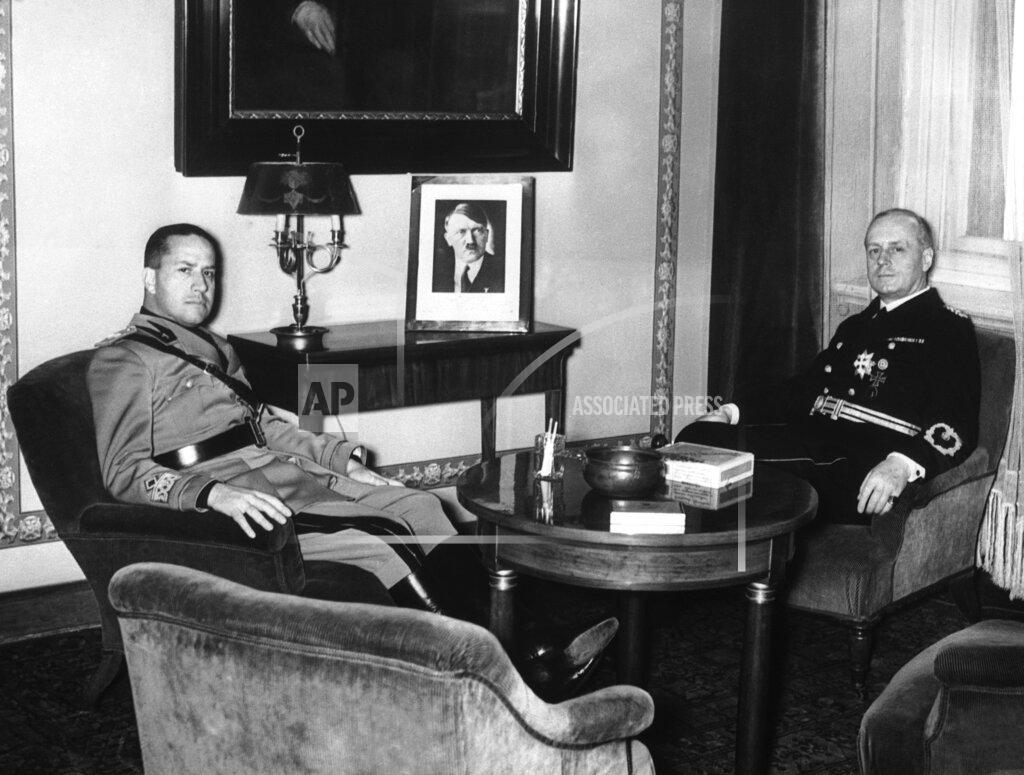
Meanwhile, in Berlin, the Italian Foreign Minister was greeted with thunderous cheers as he arrived to seal the German-Italian military alliance today. This pact, it is understood, provides for prompt, unquestioning mutual aid and runs for ten years.
Germany now focuses on eastern forts. The new defense system is called a warning to Poles who talk of an attack on the Reich.
German mothers, honored this Mothers’ Day by Nazi leaders as perpetuators and guardians of the German people, symbolically presented their children today to Chancellor Hitler. Speaking in the name of all mothers, Frau Gertrud Scholtz- Klink, leader of Nazi women and the mother of four children, said in a radio address: “We bring the fruits of our motherhood to the Führer and say to him: ‘It is the best that we have, therefore it belongs to you.’
Pride in motherhood was being stimulated by the distribution of medals authorized by Herr Hitler to “kindereiche” women (mothers rich in children). More than 1,000,000 mothers more than 60 years of age received the decorations-gold crosses for mothers of eight or more children, silver crosses for those with six or seven and bronze crosses for those who have “only” four or five. Women wearing the new medals began appearing on Berlin streets in the afternoon and received respectful Nazi salutes.
Interior Minister Wilhelm Frick, who represented the government in the Mothers’ Day observance, recalled that some years ago babies were “unfashionable” in Germany. “What a change since 1933!” Dr. Frick exclaimed. “Our Führer took an iron broom to sweep out those anti-social ideas. He taught us that the future does not depend on the material success of the individual, who passes away, but on a wealth of healthy children.”
Germany needs 3,000 to 4,000 additional engineers immediately to carry out building and technical projects, Dr. Fritz Todt, Reich Highways Commissioner, told a convention of engineers at Cologne today. Dr. Todt said the need was so acute that about 3,000 engineering students were being taken from colleges to assist in the Nazi building program.
Also in Germany, Paul Cohn, a Jewish schoolboy, receives permission to join a Kindertransport of Jewish refugee children bound for England to escape the Nazis. He will never see his parents again. Later in life he will become a professor of mathematics in England. Cohn was the only child of Jewish parents, James (or Jakob) Cohn, owner of an import business, and Julia (née Cohen), a schoolteacher. Both of his parents were born in Hamburg, as were three of his grandparents. His ancestors came from various parts of Germany. His father fought in the German army in World War I; he was wounded several times and awarded the Iron Cross. Following the rise of the Nazis in 1933, his father’s business was confiscated and his mother dismissed.
On the night of 9/10 November 1938 (Kristallnacht), his father was arrested and sent to Sachsenhausen concentration camp. He was released after four months but told to emigrate. Cohn went to Britain in May 1939 on the Kindertransport to work on a chicken farm, and never saw his parents again. He corresponded regularly with them until late 1941. At the end of the War, he learned that they were deported to Riga on 6 December 1941 and never returned. At the end of 1941, the farm closed. He trained as a precision engineer, acquired a work permit and worked in a factory for 4½ years. He passed the Cambridge Scholarship Examination, and won an exhibition to Trinity College, Cambridge. Cohn ultimately became the Astor Professor of Mathematics at University College London, 1986–1989, and author of many textbooks on algebra.
The League of Nations Council began its one hundred-fifth session in Geneva.
The New World and the Old were linked for the first time by regular air service across the North Atlantic today when the Yankee Clipper arrived in Lisbon, Portugal at 8:42 PM, British Summer time (3:42 PM Eastern Daylight Time), just over twenty-six-and-one-half hours after taking off from Port Washington, Long Island. Postal authorities waiting at the pier immediately took charge of the many letters addressed to persons here, including several thousand put on when the clipper called at the Azores early this morning. Captain Arthur E. LaPorte reported a pleasant trip, although the clipper, which was expected here around 6 o’clock, was delayed by a headwind in the final stages of the flight. The Horta-Lisbon stretch was covered in 6 hours 54 minutes. The ship’s actual time in the air for the whole ocean crossing was 20 hours 16 minutes. The clipper is going on tomorrow to Marseille and then to Southampton to deliver four dozen California marigolds, which will be presented to Queen Mary by Ambassador Joseph B. Kennedy.
Violence abates in Palestine as Jewish leaders insist on peaceful resistance. Plans include more demonstrations and a general strike in the Jewish quarter of Jerusalem.
Four members of the British Peel Commission recommend separate areas in Palestine for Arabs and for Jews. The Peel Commission recommended partition of the mandate two years ago. Note that the original mandate has already been partitioned once, in 1926, when the larger part was set aside for the kingdom of Jordan.
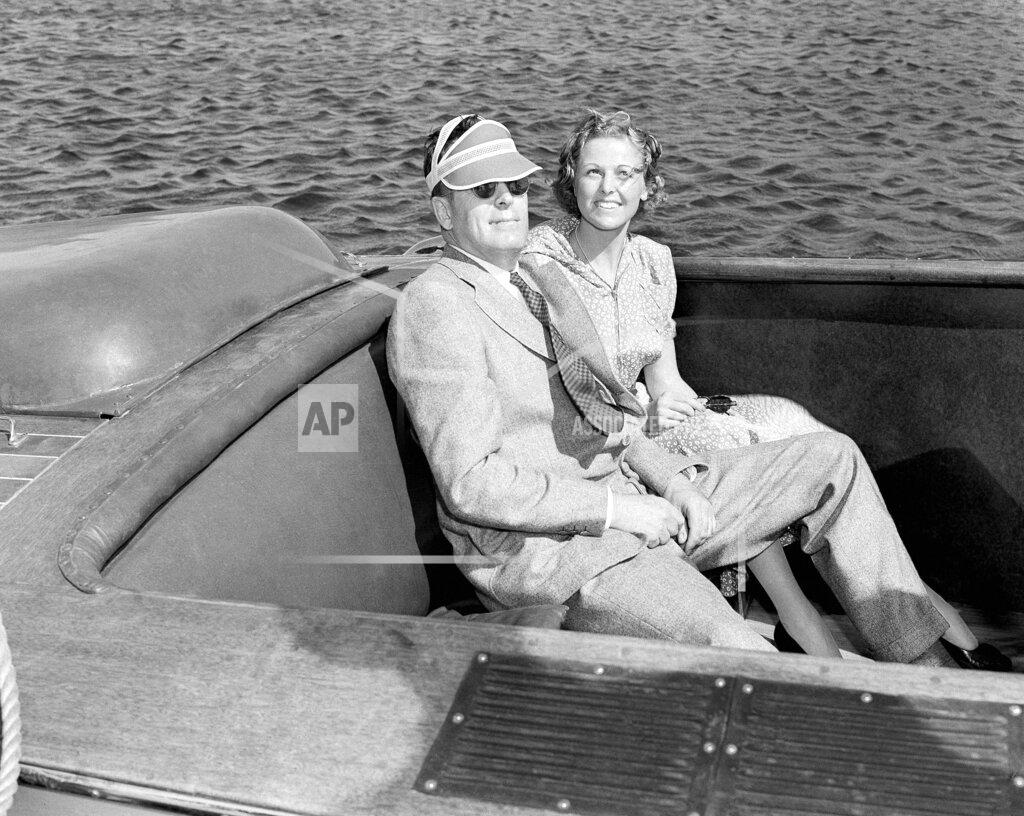
The possibility that President Roosevelt might be preparing to give his support to a drive for a new Federal lending-spending program to stimulate lagging industrial recovery was suggested today by the presence of Senator James F. Byrnes of South Carolina aboard the Presidential yacht on a week-end cruise. In some quarters it was surmised that the invitation to Senator Byrnes was to afford the President an opportunity to discuss with him the chances such a program would have of gaining Congressional approval. Another possibility was that the conversation aboard the Potomac dealt with plans for the new public works agency which is to be established under the President’s first reorganization order.
Senator Byrnes is one of the high command of the economy bloc on Capitol Hill. He is also the author of a plan for reorganization of the relief machinery which would place emphasis upon public works projects with local sponsorship predominating rather than the strictly Federal type of projects of the present Works Progress Administration program. Although originally a New Deal stalwart, Senator Byrnes has of late found himself advocating proposals which found little or no support in the White House or other influential New Deal circles. Because of his leadership in the movement for government economies, he is in position to gauge the strength of opposition to a renewal of “pump-priming” as a basic recovery policy.
Peaceful trade is still the ideal of most of the world and is the “dominant purpose of the foreign policy of the United States,” President Roosevelt declared today. A message by the President, containing this statement and given in connection with the opening of Foreign Trade Week, which starts tomorrow, was read over a nationwide hook-up of the Columbia Broadcasting System this evening by Secretary Hull. The President asserted that the celebrations in connection with National Trade Week were celebrations of peace, inasmuch as they promoted beneficial exchange of goods, traffic of merchant ships on many seas, and the friendly development of commerce. He stressed that foreign trade promoted economic well-being “and friendly relations with other countries.”
Expressing the hope that peaceful interchange should again become the “normal state of affairs,” the President remarked that, in carrying out a program to this effect, “we have a right to expect breadth of vision from all groups in our own country.” The President noted that “almost 60 percent” of United States foreign trade was now carried out with countries with which trade agreements had been concluded and asserted that this country must import as well as export in increasing foreign trade. He called for further extension of the reciprocal trade program and extended “cordial greetings” to all those engaged in foreign commerce.
Secretary Hull, in a speech delivered immediately after his reading of the President’s message, declared that the “span” of trade agreements signified that a large number of nations were now “actively cooperating with the United States in a policy of trade liberalization.” He also asserted that a larger volume of foreign trade was likely as a result of the scaling down of artificial trade barriers, and attacked the isolationist viewpoint with regard to foreign trade.
The Secretary of State asserted. that this country could live entirely by itself “if the need were dire enough,” but said that such a course would lead to a decline in the wellbeing and comfort of the American people, besides forcing the absorption into other activities of those whose livelihood now depended on foreign trade. He noted in this connection that industrial and farm workers both would suffer from an isolationist course. The full effects of our economic Isolation would have swift and disastrous results not only for ourselves but also for the rest of the world,” Mr. Hull said.
Private and not public spending is required to restore business and jobs, Senator Vandenberg of Michigan, mentioned as a Republican candidate. for the Presidency, declared today in a speech assailing the New Deal’s spending policies. Asserting that saving rather than spending was an essential to restoring confidence and “wholesome recovery,” he said that the United States was following a “poor house” route that led to “bankruptcy or to the equally suicidal jeopardy of an inflation.” While conceding that a balanced budget could not be achieved by anybody “this year or next,” he insisted that “a real will to thrift” was necessary.
A reply to his address, also over the Mutual Broadcasting System, in the Forum of the Air, was made by Senator Minton, Indiana Democrat, who, after analyzing the national debt, contended that the Roosevelt Administration actually had increased it by only $9,000,000,000 for relief and recovery. He held that Federal spending had been necessary to offset reduction of business income caused by a “mess” which he said the Democrats inherited from the Republicans.
The United States Department of Justice began its inquiry today to determine whether civil rights had been violated in Harlan County, Kentucky during the present coal-mining crisis. Twenty-five of the county’s forty-three soft-coal mines have been in operation for a week, guarded by the Kentucky National Guard. Some of the mines have been sniped at from the surrounding hills and National Guard machine-gunners have swept the mountains with bursts of fire. No one has been killed and only one man slightly wounded.
Some Washington elite feel slighted over not being invited to the royal garden fête and make their anguish known.
The Southern Baptist Church deplores President Roosevelt’s overtures to Pope Pius XII.
A U.S. judge bars fishing as a reason for divorce. Husbands are entitled to enjoy fishing, he says, and wives who object are unreasonable.
The U.S. Chamber of Commerce drafts a tax revision plan and asks Congress to avoid punitive and reform levies.
In Philadelphia, Frankie Hayes hits a grand slam in a six-run 7th as the A’s down the St. Louis Browns, 12-4.
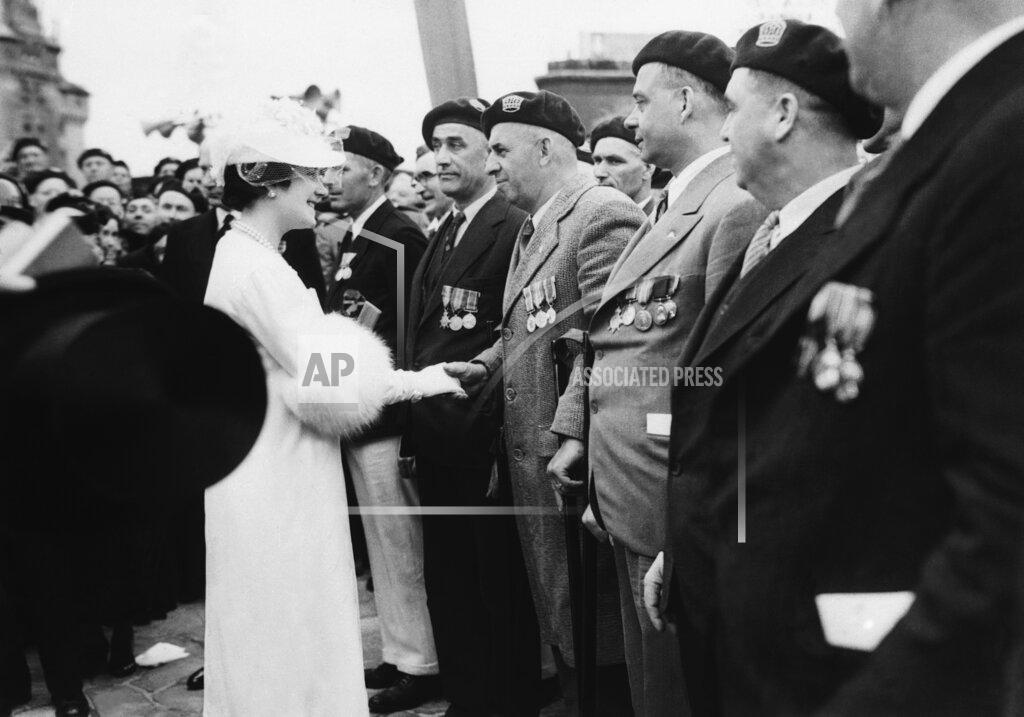
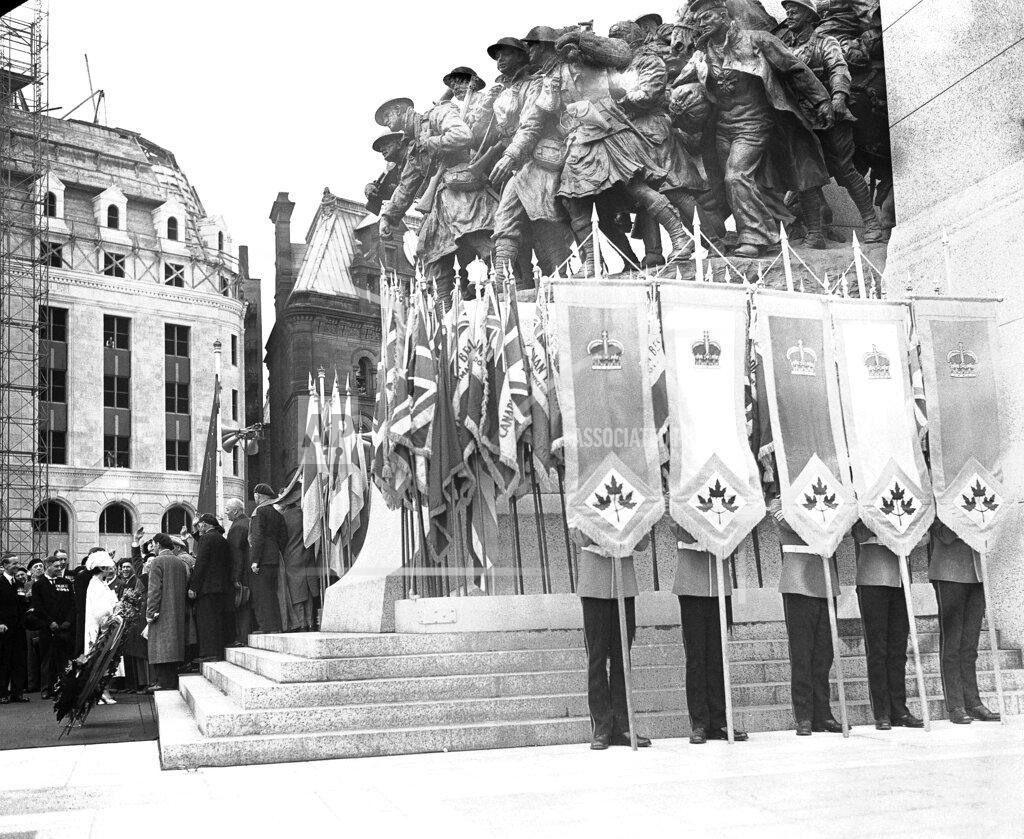
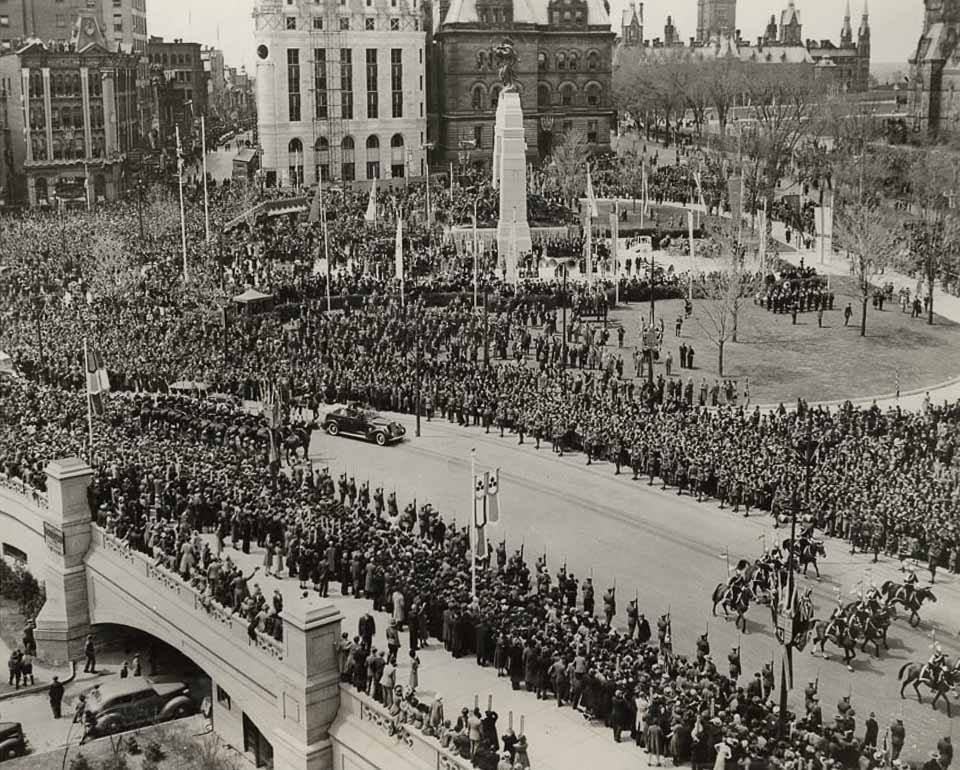
George VI dedicated Canada’s National War Memorial. King George VI left the people of Ottawa, capital of his vast dominion beyond the sea, today with the message that “without freedom, there can be no enduring peace, and without peace, no enduring freedom.” These were the words of the ruler of one of the greatest empires in history as he unveiled a monument to those who fell in the last war for democracy before a crowd of more than fifty thousand in Connaught Square.
Soon after the unveiling of the monument, depicting a heroic group of sailors and soldiers surging through an arch, the King and Queen boarded their royal train and started on the third leg of their 7,000-mile tour of Canada. Throughout the afternoon they rode over the flat green plains of Ontario with every cow pasture and plowed field lined with men, women and children waving Union Jacks behind the stone and rail fences along the right of way.
The King and Queen, on the longest rail jump of their present tour, were on their way to Toronto, where tomorrow they will see the Dionne quintuplets, one of their dominion’s natural wonders. Before leaving Ottawa, the Queen took time out to make her first telephone call to Buckingham Palace to talk to her own two children, the Princesses Elizabeth and Margaret Rose, who were left behind in England. The call went through at 10 AM local time, which was 3 PM in London, soon after the Princesses had finished luncheon.
The Dionne quintuplets leave their home for their first ever trip — going to meet the King and Queen of England in Toronto.
Generalissimo Chiang Kai-shek declared today that worldwide peace could be achieved “not on the basis of outworn and discredited pacifism, but by bold, positive resolution of the sane majority of world citizens to oppose the insane minority.” The Chinese leader, speaking before the annual meeting of the Chinese branch of the International Peace Campaign, said it “as necessary to oust and punish “irresponsible, perverted rulers leading their nationals on courses more injurious to world peace than the conduct of criminals toward society.” He expressed the belief that the Chinese-Japanese War would result in the establishment of a great example in curbing aggressors and the hope that “the Japanese collapse would not come too late to avert a vaster war involving the entire globe.”
Three hundred American and other foreign children of the Inland Mission School in Chefoo, China, felt the restrictive force today of the Japanese military administration. The Japanese decreed that all third power nationals over 6 years of age must obtain military passes to appear on Chefoo streets. In addition, all foreigners were ordered to file two photographs with the local military headquarters. All nationalities appealed to their respective consuls to have the orders rescinded.
Born:
David Groh, American TV and film actor (“Rhoda”, “Victory at Entebbe”), in Brooklyn, New York, New York.
Heinz Holliger, oboist, composer and conductor, in Langenthal, Switzerland.
Raúl Madero, Argentine soccer defender (5 caps; Estudiantes) and sports physician (Argentina national team), in Buenos Aires, Argentina (d. 2021)
 History Diaries