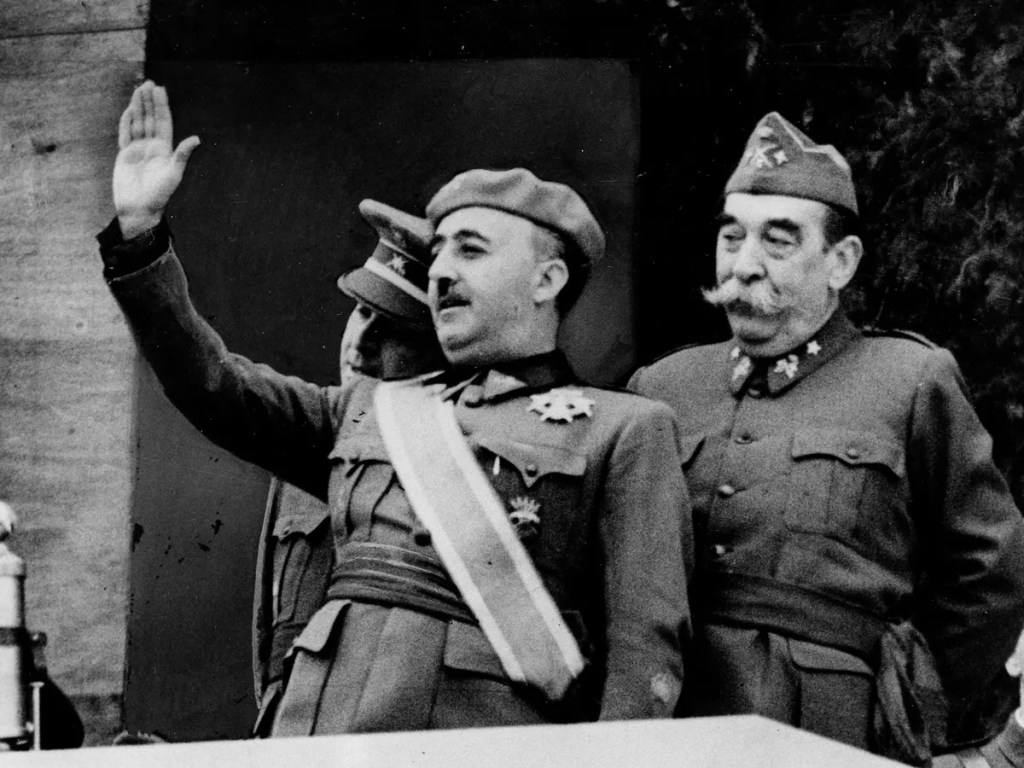
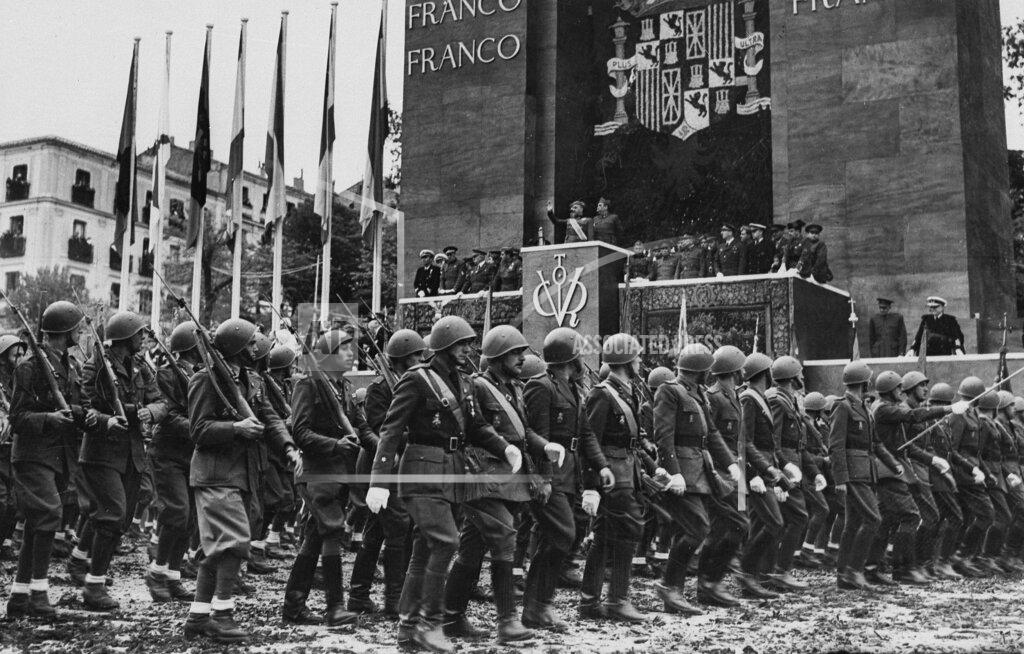
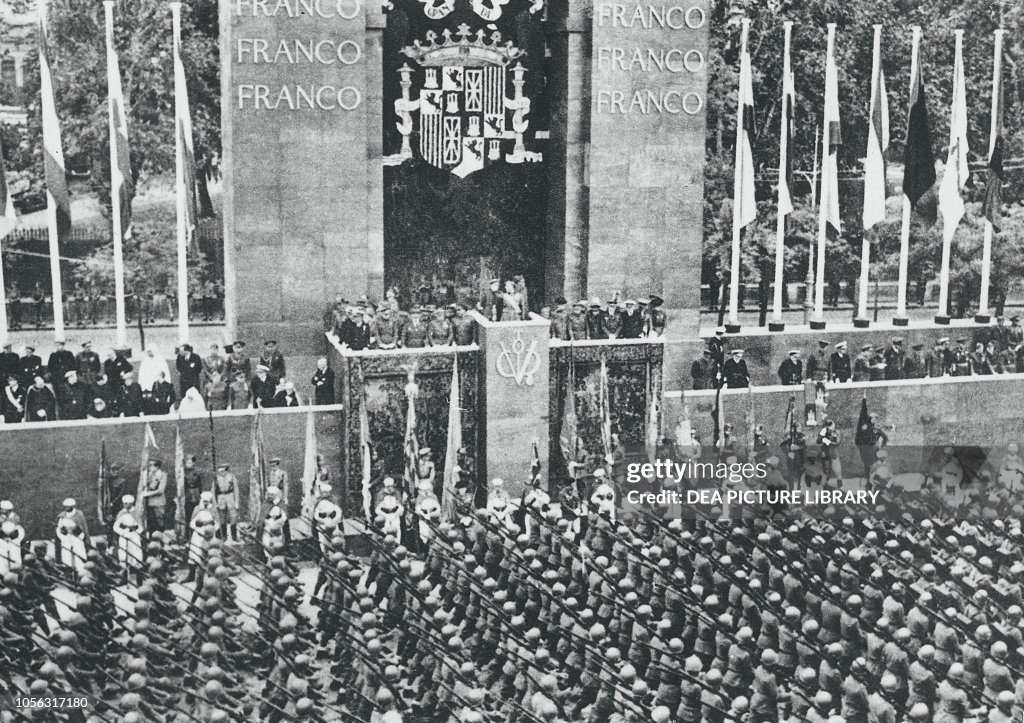
Spanish leader Generalissimo Francisco Franco watched a military parade (desfile de la Victoria de Madrid de 1939) intended as a farewell to the foreign soldiers who helped him win the Spanish Civil War. Italian, German, and Moorish troops joined some 127,000 Spanish soldiers pass Franco in his reviewing stand in Madrid. The foreign troops were expected to be departing Spain by June 5. The parade was commanded by General Andrés Saliquet, Commander of the Madrid Military Region, and was presided by the Franco.
More than 120,000 men and 1,000 vehicles took part in the parade, including small contingents of the German Condor Legion, the Italian Corpo Truppe Volontarie and the Portuguese Viriatos. The forces went along Paseo de la Castellana, the main Madrid avenue, in a North to South direction and in total spent around 4 hours in marching past the full path. Around 400,000 people attended the event. The environment was spectacularly fitted out with countless patriotic, triumphal and Franco’s Cult of personality slogans. It was the first of a yearly series, named Día de la Victoria (Victory Day), held on 1 April until 1976, the year after Francisco Franco’s death.
It rained, not continuously nor heavily, but enough to disconcert the foreign diplomats and to wilt the elegant headgear of their ladies when more troops than were in Spain’s army before the civil war passed in review before Generalissimo Francisco Franco today. Many resplendent uniforms and the gala decorations on an extravagant scale were dampened, but not the public’s enthusiasm. However, the great victory parade, which may have made it easier for the people here to comprehend General Franco’s military superiority over the Republicans, notwithstanding Madrid’s prolonged resistance to siege, has been held at last. It symbolized officially the civil war’s termination and the nation’s entry into a peaceful era of reconstruction.
A majority of the soldiers who marched today will be demobilized soon and allowed to return to their pre-war civilian occupations, although all will remain subject to peacetime mobilization for rebuilding the country, according to the terms of a new decree which says every Spanish male between the ages of 18 and 50 years will be obliged to lend his services to the State if he has the special training or ability needed for the tremendous rehabilitation task faced by the country. About 10,000 Italians and nearly 5,000 Germans who took part in the parade are expected to be back in their own countries before the end of this month. The Associated Press states that May 28 has been tentatively set for the departure of the Italians from Cadiz and the Germans from Vigo.
General Franco’s government may or may not be overhauled to enable it better to tackle peacetime problems, but it seems fairly certain that some of its departments, notably that of press censorship and propaganda, which has operated heretofore in strictest conformity with military requirements, will be reorganized now along more flexible lines.
British Prime Minister Neville Chamberlain and R. A. Butler, Undersecretary of Foreign Affairs, outlined Britain’s position in a foreign affairs debate in the House of Commons. The two said Britain was giving cautious consideration to the Soviet Union’s stand for a full military alliance and at the same time asked Germany to renounce aggressive aims in favor of a long-range policy for European peace. The Soviets withheld comment on Chamberlain’s pronouncements and were considered to be suspicious of Britain’s ultimate motives.
The British Ministers today worked out compromise proposals for ending the diplomatic deadlock with Russia after Prime Minister Neville Chamberlain had undergone a severe battering in the House of Commons for his failure to include an Anglo-Russian defense alliance.
Without Russia, David Lloyd George told the Prime Minister, in the first of the day’s broadsides, Britain could not possibly fulfill her pledges to Poland and other European countries. Winston Churchill told the House of Commons “without an Eastern Front, there can be no satisfactory defense in the West. And without Russia there can be no effective Eastern front. And if no Eastern front is set up,” he asked, “what is going to happen in the West?” Without Russia, said Anthony Eden, the “peace front” would not be strong enough to deter a would-be aggressor from plunging Europe into war.
Leaning on the gallery railing the Soviet Ambassador, Ivan Maisky, listened attentively to these speeches and he also heard the official leaders of the Opposition parties talk in the same strain with bitter reproaches for the “leaky diplomacy” that had failed until now to achieve a pact with Russia after two months of negotiation. At the same time, however, the government hinted that the British were ready to modify their attitude still further in an effort to reach an agreement. R. A. Butler, UnderSecretary for Foreign Affairs, paid unusual tribute to Mr. Maisky for his work in trying to reconcile the views of the two governments and said that the latest “suggestions and criticism” from Moscow were receiving serious consideration in Downing Street.
Because the Russians and British had not yet reached an agreement, Mr. Chamberlain had to make a more cautious statement than he had hoped to deliver. It had been hoped in Downing Street that the agreement with Moscow could have been completed before today’s debate began. But the deadlock continued and in the circumstances, Mr. Chamberlain could only assure the House that Britain valued Russian help against aggression.
The Trades Union Congress decided not to oppose the British government’s conscription plans. They still oppose conscription on principle, but reject the idea of a general strike or any such action which might imperil the defense of the Empire.
The King of England is hesitant about visiting the U.S. Congress. He wants the visit to stay personal, not political.
The New York Times reports:
“Submarine detection apparatus known only to the British which is said to have been perfected during the 1935 crisis in the Mediterranean, when the Admiralty was keeping track of the movements of Italian submarines, is to be the chief equipment of twenty "mystery" vessels ordered constructed with all possible speed. According to The Daily Express, these vessels of 900 tons each are "very fast and handy." With thirty-six destroyers also fitted with the secret detector gear now under construction, they are expected to render the fleet virtually impregnable against submarines.

“The device is said to have been evolved at the Anti-Submarine School at Portland, one of the most jealously guarded stations of the navy, where the services of a certain number of high officers have been retained for ten years, some being held long after the normal retirement age. Future convoys, says The Daily Express, are not expected to lose one ship in a hundred from the submarine menace. The new detectors are able to locate a submarine to within a few yards, and depth charges, of which modern destroyers carry forty to fifty, make destruction of submarines almost certain.”
[Ed: Sadly, ASDIC — or SONAR, as it will become known elsewhere — is not quite so effective as hoped. The destruction of submarines will be a long, grueling contest all in itself: The Battle of the Atlantic.]
Chancellor Hitler today completed his demonstrative six-day inspection of the “West Wall” — as the western fortifications are now universally called — in the literal translation of the Latin word “Limes” that Herr Hitler has applied to them — and is expected to return here tomorrow for Foreign Minister Galeazzo Ciano’s two-day state visit, which will be brought to a climax by the formal signing of the German-Italian military alliance Monday. This West Wall and the Italian alliance are presented to the German people, together with the size and excellence of the German and Italian Armies and friendship with Spain as the main factors guaranteeing Germany’s safety from attack in the west and with it, Germany’s freedom of action in the east.
German and Italian western fortifications, it is emphasized here, are the equivalent of no fewer than 100 divisions now released for action elsewhere. The significance of the German West Wall is further underlined by the proud, if vague, description of the mighty guns in the Black Forest which “are ready to crush every attack in the bud and tear to pieces with their gigantic shells every hostile line-up of troops not only close to the Rhine, but also far behind in the enemy’s deployment zone.”
This boast is further underlined by Herr Hitler himself today when on the completion of his tour at Efringen, Baden, he issued an order of the day addressed to “soldiers and workers of the west front” in which he said: “The inspection of the West Wall has convinced me of its invincibility. With me the entire German people thank all those who through their unconditional devotion created in a short time in steel and cement the foundation of Germany’s security.”
In view of all that it appears paradoxical that in an article featured on the front page of the Voelkischer Beobachter, Propaganda Minister Joseph Goebbels himself today gave the public signal for a switch in the propagandistic attacks tacitly carried out heretofore, namely a switch replacing Bolshevism with the Western democracies as Germany’s enemy No. 1. He scrupulously avoids every mention of Bolshevism, which was savagely denounced on previous occasions. and concentrates on “encirclers and war and panic mongers in London, Paris and Washington.”
Lieutenant General Robert H. Haining, commander of the British Forces in Palestine, invited the heads of the Jewish Agency for Palestine, the National Council of Palestine Jewry and the Jewish Communal Council to his headquarters here this morning and warned them that he intended to enforce order and would make no exceptions. General Haining added that, while he appreciated the three years of restraint on the part of Jews, he would suppress violence unflinchingly.
The first move in the Jewish noncooperation movement against the government in protest at the new British policy was a decision of the Landlords Association, composed of rural and urban property owners, to refuse to pay taxes, beginning today, until the White Paper had been repealed. Despite all stringent measures taken to prevent illegal immigration into Palestine, 300 Jews succeeded in landing clandestinely near Ashkelon, Southern Palestine, but were apprehended by British troops and taken to Tel Aviv for detention.
In contrast with yesterday’s turbulence in this Holy City, it was quiet today, although considerable tension still exists. As a result of the violence yesterday, when a mob of Jews attempted to raid the District Commissioner’s office, smashed the windows of an English shop and a German restaurant and engaged in fighting in which a British constable was killed and more than 100 Jews were wounded, the military today took far greater precautions to prevent further bloodshed.
All government offices were heavily guarded, various parts of the city were barricaded, and soldiers manned machine guns for action. The only incident today occurred when several Jewish youths penetrated a branch post office in the Jewish quarter of Mahne Yehuda here and broke window panes and furniture. Three British police sergeants and two constables, who yesterday annoyed the Tel Aviv public, it is charged, by wearing helmets marked with the swastika and by shouting “Heil Hitler,” were relieved of duty today pending disciplinary proceedings.
President Roosevelt told his press conference in Washington that he looks unfavorably on proposals to use part of the $2,000,000,000 stabilization fund for spending-lending programs.
The Senate passed a joint resolution making the first and second departmental reorganization plans effective July 1 and approved a bill authorizing $53,000,000 for the construction of navy yards. The Senate adjourned at 2:20 PM until noon Monday.
The House passed the State, Justice and Commerce Departmental Appropriations Bill and rejected attempts to curtail funds for reciprocal trade agreement negotiations; completed Congressional action on the $773,000,000 Naval Appropriations Bill, and received a favorable report from the Interstate Commerce Committee on amendments to the Railroad Unemployment Insurance Act. The House adjourned at 5:38 PM until Monday noon.
A bill authorizing the expenditure of about $50,000,000 on improvement of naval facilities was passed by the Senate today, less than twenty-four hours after that body had approved appropriations of more than $700,000,000 for use by the navy in the fiscal year beginning July 1. The authorization bill, already passed by the House, was increased considerably by the Senate, but a major increase which would have benefited New York City was eliminated at the last moment in favor of Boston.
Some Senators opposed the proposal to spend $3,500,000 in aiding private construction of a drydock in New York City sufficiently. large to service the 45,000-ton battleships proposed under the new naval building program, on the ground the government would spend a large sum of money for facilities which would not belong to it. Senator Walsh, chairman of the Naval Affairs Committee, then withdrew the amendment on the floor just prior to the vote, and in its stead inserted an amendment authorizing the expenditure of $2,545,000 to enlarge facilities at Boston. Other authorizations provide for enlarged facilities at more than a score of naval establishments. Another Senate amendment authorizes the expenditure of $6,000,000 to purchase and improve two graving docks in San Francisco Bay, to be operated as an annex to the Mare Island Navy Yard, as well as the spending of almost $2,000,000 in enlarging the Mare Island facilities. The House already has approved the latter provision.
In sum, the bill was designed to step up all navy facilities in keeping with the building program under which more than forty warships now are being constructed or are in the planning stage. This bill, like yesterday’s record appropriation bill, was passed with little debate, and no roll call was required on the vote.
Among bills on the calendar, the Senate passed one further carrying out President Roosevelt’s recommendation for creating an administrative officer for the Federal courts and transferring administration from the Department of Justice. A similar bill is pending in the House. The Senate authorized the President to cooperate with the government of Panama in building a highway from the Canal Zone to an army bombing range and training field at Rio Hato, Panama, a distance of seventy miles.
The rumors, charges and countercharges which its investigators have brought in of the existence of an alleged conspiracy to overthrow the Government of the United States by force next August have hastened the efforts of the House Committee on Un-American Activities, it was learned today. Originally it had been planned to renew active work only in July or August. In consequence of the testimony yesterday of Dudley P. Gilbert of New York and James Erwin Campbell of Owensboro, Kentucky, the committee subpoenaed John D. M. Hamilton, chairman of the Republican National Committee; Major General George Van Horn Moseley, retired; Felix McWhirter, Indianapolis banker, and George Deatherage of St. Albans, West Virginia, head of the Knights of the White Camellia.
These witnesses have been asked to appear on Monday. Mr. Hamilton has signified his willingness to testify. Mr. Deatherage, before he received the committee’s invitation, sent Mr. Dies the following telegram: “The revelations of your committee given to the press yesterday are simply wonderful and we marvel at the courage it took to follow orders in spite of the upheaval in Palestine. A committee has been appointed to plant a pansy dedicated to you, and all the boys send you a great big kiss.”
So far as can be gathered from the guarded statements of committee members and officials, the four men will be examined as to the credibility of other witnesses and sources of information. They are believed to have known some of the chief figures, including Mr. Gilbert and Mr. Campbell, who have been active in trying to unmask the supposed plot. At one time, General Moseley is said to have taken the matter seriously enough to consider discussing it with General Malin Craig, Chief of Staff, although it has not been definitely established whether he actually got to the point of taking the War Department into his confidence or only assembled what information he could get.
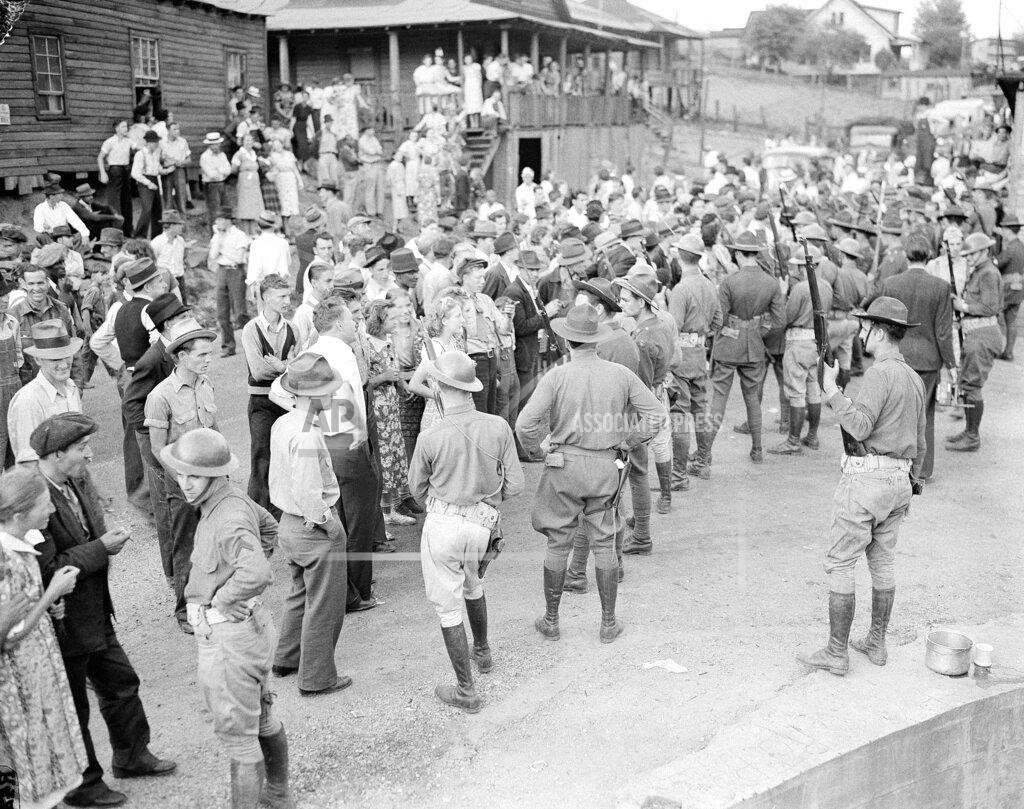
Large quantities of Federal surplus food, including a big shipment of grapefruit, a luxury in miners’ homes, are expected here in a few days, it was announced today. With peace negotiations between the representatives of the United Mine Workers of America and officials of the mining companies proceeding slowly, the intervention of the federal government on a large scale through its relief agencies indicated that, whatever may happen, the miners will not be starved back to work. Labor conciliators from the United States Department of Labor and the State are leading the peace efforts.
Twenty-five of the county’s forty-two coal mines have been operating since last Monday under the guns of the Kentucky National Guard and there has been much shooting, but, until today, no casualties. This afternoon a miner was shot in the thigh by the driver of a truck which had been conveying working miners to their homes from the mine of the R. C. Tway Coal Company here. The shooting occurred under the noses of the National Guard detail near the mine and the man who did the shooting escaped after a National Guardsman had clung to the running board of his car.
Exactly twelve years after Colonel Charles A. Lindbergh began his historic non-stop New York-to-Paris hop in a single-engine monoplane, Pan American Airways’ giant four-engine, 41½-ton Yankee Clipper will take off from Port Washington, Long Island, about 1 o’clock this afternoon on the first regularly scheduled airplane flight between this country and Europe. Only mail will be carried on the flight, but so great has been the rush to get first covers aboard that the line announced that 100,000 pieces of mail would be in the flying boat when it leaves the waters of Manhasset Bay. Announcement of the flight was made yesterday by C. V. Whitney, chief executive officer of the international airline, within an hour after the Civil Aeronautics Authority had given its approval to the line’s application for a certificate of convenience and necessity.
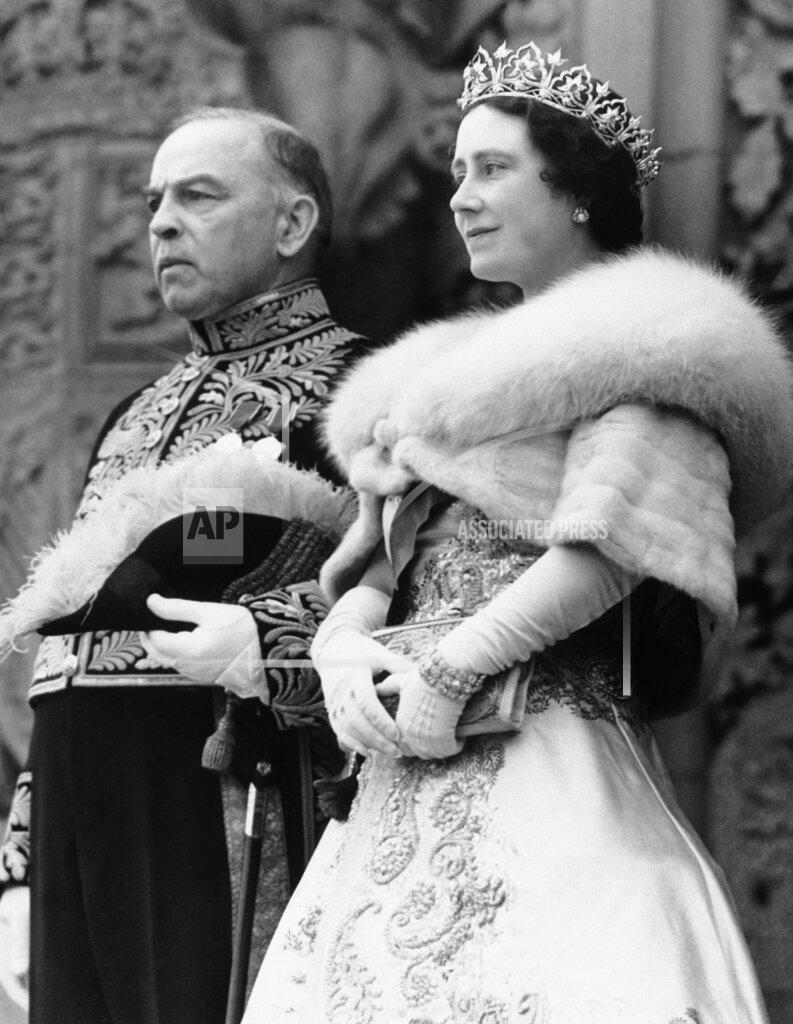
For the first time in history a British monarch sat in the Senate of Canada. George VI gave Royal Assent to several bills. It was as though some modern Merlin had waved a wand and whisked the very atmosphere of London, including its overcast skies and foggy weather, across the broad Atlantic when King George VI and Queen Elizabeth came here today to ride in state and sit in Parliament. From the Peace Tower of the Parliament Building the deepthroated bell, which is the counterpart of Big Ben, announced the arrival of the royal visitors at 11:15 AM (daylight time), almost drowning out the chimes of Westminster sounding the quarter-hour from a near-by church.
After their two days in the Province of Quebec, where they were serenaded and welcomed in French as well as English, it must have seemed something of a homecoming to the King and Queen. At the station they were welcomed to the Dominion capital by Lord Tweedsmuir, the Governor General, who is the King’s own representative in this autonomous land which is bound through the magic of the crown to the British Commonwealth of Nations. Lady Tweedsmuir joined in the welcome. Escorted by a troop of the Princess Louise Dragoons in brass helmets and scarlet tunics, the first ruling British sovereigns to visit the North American Continent climbed into an open, horse-drawn landau with outriders and footmen for the royal procession through the parked streets.
Before the ceremony of giving royal assent to bills passed at this session of Parliament-a ceremony which was the climax of a crowded day-Daniel C. Roper, former Secretary of Commerce, the new Minister to Canada, presented his credentials directly to the King at an unprecedented function in Rideau Hall, the home of the Governor General. Attired in white tie and tails, the only uniform the United States authorizes for its diplomatic representatives abroad, Mr. Roper told the King that it was his privilege to convey President Roosevelt’s “assurances of friendship and genuine good wishes for the continued happiness and well-being of the Canadian people.”
Bolivia denies ties to the fascist Axis nations.
Chinese troops captured Tsaoyang (Zaoyang), Hupeh (Hubei) Province, China.
Although the Chinese so far have checked the Japanese May offensive up the Han River Valley short of the important twin cities of Fancheng and Siangyang, the Japanese, nevertheless, have apparently pushed up and consolidated their Northern Hupeh flank more than fifty miles along the seventy-five-mile front between the Peiping-Hankow Railway and the Han River.
The Japanese now control Tsaoyang, Suihsien and the east-west line between Tsaoyang and Sinyang. West of Tsaoyang, the Japanese vanguard is evidently only ten or twenty miles east of Fancheng, since Chinese press dispatches speak of Japanese and Chinese troops facing each other across the Han River in this sector.
Reports say that severe fighting, rivaling that of the Taierchwang hostilities, is continuing on the northern flank and the western front along the Han River. Crack Chinese divisions are said to be striking back at the Japanese, inflicting thousands of casualties. East of the Peiping-Hankow Railway, mobile Chinese troops, after taking Macheng and Sungfow, are said to be harassing the Japanese just north of Hankow.
Dow Jones Industrial Average: 130.38 (+0.95).
Born:
Lieutenant Colonel Dick Scobee, American U.S. Air Force pilot and astronaut (STS-41-C, STS-51-L), in Cle Elum, Washington (d. 1986 in the STS-51-L Challenger accident).
James Fox, English actor (“The Servant”, “King Rat”, “Patriot Games”), in London, England, United Kingdom.
Nancy Kwan, Hong Kong-born American actress (“Flower Drum Song”, “World of Suzie Wong”), in British Hong Kong
Sonny Fortune, jazz saxophonist and flautist, in Philadelphia, Pennsylvania (d. 2018).
Livio Berruti, track and field athlete, in Turin, Italy.
Naval Construction:
The U.S. Navy Sims-class destroyer USS Anderson (DD-411) is commissioned. Her first commanding officer is Lieutenant Commander William Matthews Hobby, Jr., USN.
The U.S. Navy light cruiser USS St. Louis (CL-49), first of her class of 2 (modified Brooklyn-class), is commissioned. Her first commanding officer is Captain Charles Henry Morrison, USN.
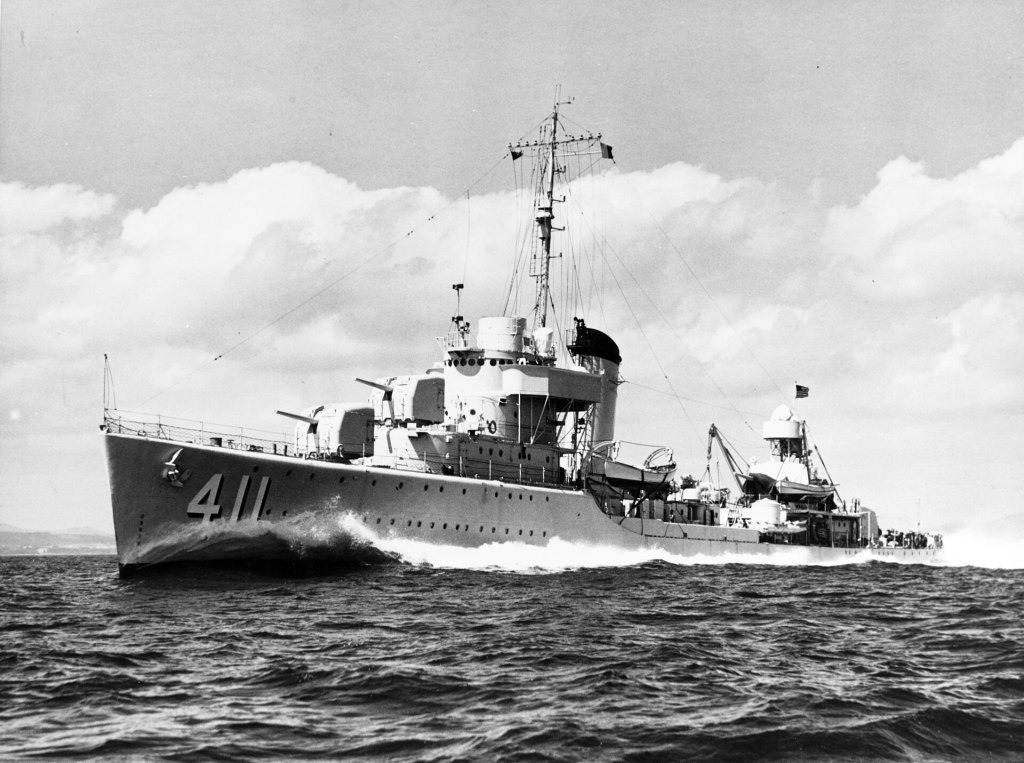
Anderson (DD-411) was awarded ten battle stars for her World War II service.
https://www.history.navy.mil/research/histories/ship-histories/danfs/a/anderson.html
On 1 July 1946, the bomb used in Test Able sank Anderson in Bikini lagoon. Her name was stricken from the Navy Register on 25 September 1946.
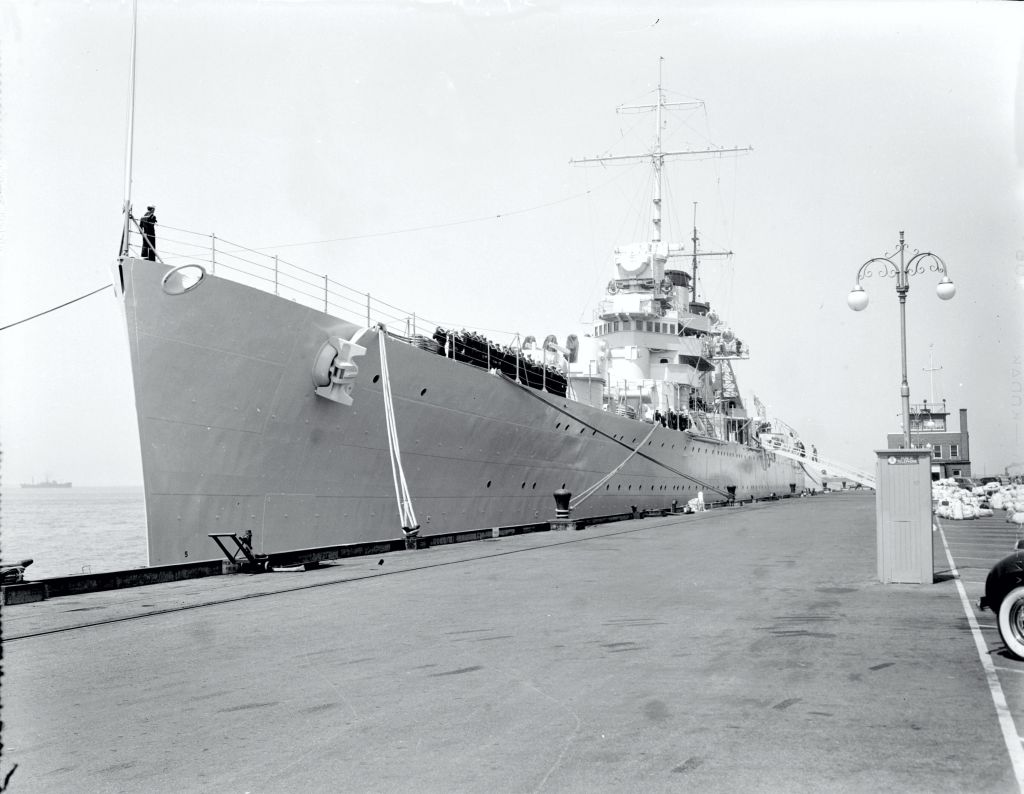
St. Louis (CL-49) earned eleven battle stars during World War II.
https://www.history.navy.mil/research/histories/ship-histories/danfs/s/st-louis-v.html
In the early 1950s, as the U.S. Navy sought to reduce the number of surplus vessels in its inventory, St. Louis was allocated to the Brazilian Navy. She was stricken from the U.S. Naval Vessel Register on 22 January 1951 and commissioned into Brazilian service on 29 January as Almirante Tamandaré. She served as the Fleet Flagship until 1976. She was deployed as part of the force in the Lobster War between Brazil and France. Tamandaré was stricken from the naval register in 1973 and was laid up until 1980, when she was sold to ship breakers based in Taiwan. While being towed there on 24 August, she foundered off South Africa.
 History Diaries