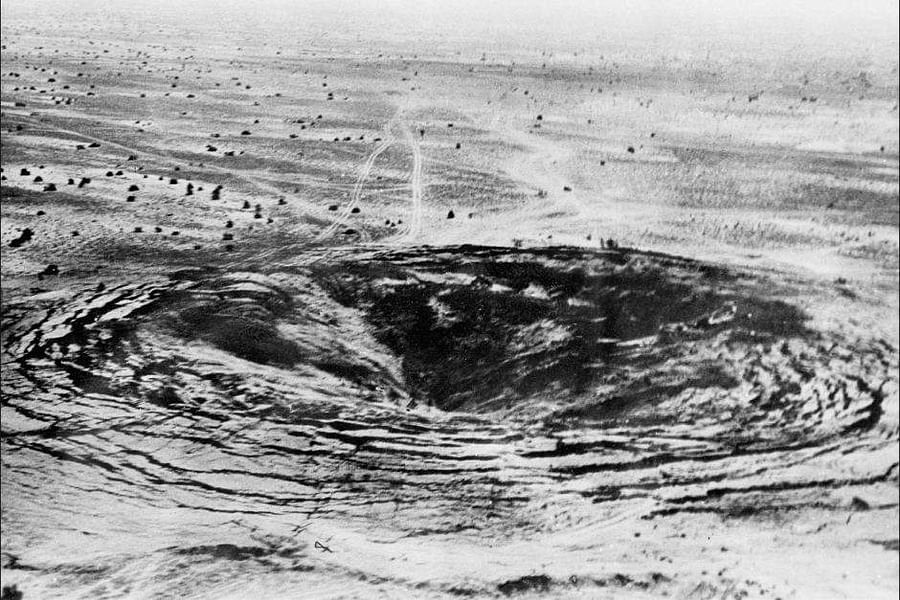
India became the sixth nuclear power, with the successful test of a low-yield weapon at the Pokhran Test Range in the state of Rajasthan. Taking place on Buddha Jayanti, celebrated as the birthday of Siddhartha Gautama Buddha, the test was code-named Project Smiling Buddha. India became the sixth nation to explode a nuclear device when she conducted a successful underground test that put her in the exclusive nuclear ranks with the United States, the Soviet Union, Britain, France and China. Few details were supplied by the government, but Dr. H.N. Setha, chairman of India’s Atomic Energy Commission, said the device had been in the range of 10 to 15 kilotons, or somewhat smaller than the low-yield bomb dropped by the United States on Nagasaki in 1945. The government announcement called it a “peaceful nuclear explosion experiment,” stressed peaceful uses of the nuclear program such as mining and earth moving, and said India had “no intention of producing nuclear weapons.”
A brief Government statement said that India’s Atomic Energy Commission had carried out “a peaceful ‘nuclear explosion experiment.” The underground blast took place “at a depth of more than 100 meters,” or about 330 feet, the statement said. In exploding the device, India was entirely within her rights in international law, Government officials maintained. India is a signatory of the Moscow test‐ban treaty of 1963, forbidding explosions on land, in the air, or underwater in the seas. In exploding the device beneath the ground, officials say, India adhered to the treaty. Although India is a party to the nuclear test‐ban treaty, she did not sign the 1968 treaty to bar the spread of nuclear weapons. She declined to subscribe to it on the ground that it divided the world into countries with nuclear weapons and those without such weapons and, India said, imposed obligations on nonnuclear states without imposing similar obligations on nuclear states.
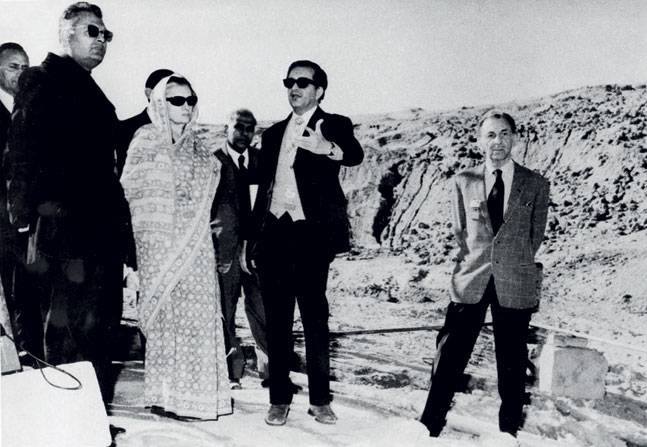
Indian Prime Minister Indira Gandhi, who appeared cheerful, chatted briefly with newsmen this afternoon at New Delhi’s Palam Airport where she had gone to receive the President of Senegal, Leopold Sedar Senghor. Asked if the explosion would, raise India’s prestige among developing nations, Mrs. Gandhi said: “I never bother about prestige. It is nothing to get excited about. We are firmly committed only to the peaceful uses of atomic energy.’’
In Geneva, sources at the disarmament conference viewed the Indian, explosion as a setback to efforts to restrict the spread of nuclear weapons. The Soviet press stressed that it had no military significance, while in Washington a State Department spokesman restated opposition to “nuclear proliferation.”
[Ed: The Indian bomb, of course, will prompt the development of the Pakistani bomb. Indira Gandhi may piously claim she does not want nukes, but that’s exactly what she made inevitable on this day.]
Secretary of State Kissinger scored an apparent breakthrough in his efforts to bring about an Israeli-Syrian troop separation agreement, and announced that he would extend his Middle East mission for several days to wrap up the negotiations. As his party returned to Israel from Syria, a senior American official summed up the optimism: “I think now we can get it.” Mr. Kissinger himself told newsmen at the Damascus airport that, after three and a half hours of talks with President Hafez al‐Assad of Syria, “significant progress has been made and the prospects for an agreement have been advanced.”
The main breakthrough was achieved on the sensitive question of the demarcation line between the Israelis and the Syrians on the Golan Heights. Though both had narrowed their differences to less than mile in some places, Until the last 24 hours they had been unable to make any, significant progress. But, on the basis of an American plan first raised in Damascus Thursday night and discussed in Israel yesterday, the senior American official said, “I think we now have a good chance of getting an agreement on the line.” Newsmen traveling with the Kissinger party had been told for 10 days that once agreement on the actual demarcation line was reached, other issues could be negotiated, in a short time. Mr. Kissinger has allowed himself, for the moment, up to four more days in the Middle East.
A day after terrorist bombs killed more than 25 people at the height of the Dublin evening rush hour, the Irish government decided to recall the 340 Irish troops stationed in the Sinai as part of the United Nations peace-keeping force, and to use them to intensify security along the border with Northern Ireland. In addition, officials pledged a series of tighter security measures, including new checkpoints at the border, and possibly on the outskirts of Dublin.
The bombs that rocked Dublin Friday afternoon have shattered, perhaps permanently, the mental barriers erected by the southern Irish to keep the problems of Ulster out of their minds. The blasts, widely believed to have been the work of Protestant extremists, may change this complex attitude of long-standing indifference.
The head of the Eastern Orthodox Church in Albania, Archbishop Damian, has died in prison at the age of 80, the Austrian Catholic news service Kathpress reported in Vienna. Kathpress said the archbishop, who had been in prison for six years, died last November but the news had just reached Orthodox communities abroad.
Mrs. Marija Sulskiene, an elderly, Brooklyn-born woman who has spent most of her life in Lithuania, was declared a U.S. citizen by the State Department, an important step in her battle to return to the United States from Soviet-controlled Lithuania. Rep. Robert P. Hanrahan (R-Illinois) said that Mrs. Sulskiene had received her U.S. passport in Moss cow. She is the mother of a Lithuanian seaman who four years ago fled a Soviet trawler off the Massachusetts coast only to be returned to the Russians by the U.S. Coast Guard.
Rixi Markus and Fritzi Gordon of Britain took first place in the pair match points, at the World Bridge championship with a score of 10,630 Olympiad in the Canary Islands. Robert Hamman and Bobbie Wolff of Dallas were confirmed as winners of the open pair championship with 4,062 match points. Two U.S. women, Dorothy Hayden and Imogen Hawes, were eased out of second place in the pair championship because the South African team was awarded 20 match points in a protest against another U.S. team. With the 20 additional points, the South African team ended up in second place.
China said that a struggle by the U.S. and Soviet navies to dominate the Mediterranean posed a direct threat to the independence and security of countries on its shores. The warning was given by Vice Premier Teng Hsiao-ping at a Peking banquet for the visiting Cyprus president, Archbishop Makarios. The New China News Agency said Makarios held talks with Premier Chou En-lai earlier in the day but that ill health prevented Chou from attending the banquet.
Thousands of Saigon troops moved into Bến Cát, 25 miles north of Saigon today after North Vietnamese forces advanced to within half a mile. The North Vietnamese rolled over three government outposts and seized a village, field officers said. Fierce fighting erupted in the region Thursday night, the field officers reported. In the last two days, the North Vietnamese troops poured hundreds of artillery, rocket and mortar shells into the area, including Bến Cát itself, the officers said. By this afternoon, about 20 civilian houses had been damaged by the shelling, which was still continuing, but at a lighter tempo. The field officers said the three outposts, spread from half a mile to four miles west and southwest of Bến Cát, were defended by about 300 militia troops and that half of them had reached government rear lines after their positions were overwhelmed by a North Vietnamese regiment estimated at up to 2,000 troops. The rest are either dead, wounded, missing or captured, the officers said.
Bến Cát is in the heart of the “Iron Triangle” along the Saigon River corridor leading from Cambodia to Saigon. It has long been used as an infiltration route for North Vietnamese troops and supplies. Field officers speculated that the North Vietnamese wanted to consolidate their positions and take Bến Cát to secure the infiltration route. Some of the 2,000 civilian residents of nearby An Điền were reported to have escaped and moved southward to Phú Cường, 10 miles away, along with other civilians from Bến Cát and surrounding villages. The fate of those still in the village in North Vietnamese hands was not immediately known. A South Vietnamese officer asserted that when one group of villagers from An Điền moved into an open field, the North Vietnamese and Việt Cộng opened fire on them with grenade launchers. By this afternoon, Bến Cát had been virtually deserted by its 4,500 population, with most of the homes shuttered tight.
The Defense Department has acknowledged to Congress that the Navy and Air Force participated in extensive rain-making operations in Southeast Asia in an attempt to slow the movement of troops and supplies through the Ho Chi Minh trail network from 1967 to 1972. Testimony just made public showed a considerable disagreement within the Pentagon about the military value of the top-secret effort, and it was also disclosed that former Defense Secretary Melvin Laird had apologized to Congress for his categorical denial that such rain-making efforts had been going on.
American combat aircraft will begin leaving Taiwan this summer or fall in another step designed to improve Washington‐Peking relations and remove the vestiges of the Vietnam war. When these aircraft are all withdrawn, perhaps next year, the United States will have no routine combat presence in or around Taiwan. Elements of the Seventh Fleet stopped patrolling the Taiwan Straits between the mainland and Taiwan on a regular basis in 1969. Secretary of State Kissinger is said to want to start and complete these aircraft withdrawals “sooner rather than later,” while the Chinese Nationalist Government on Taiwan is understood to be seeking delays.
The Shah of Iran, who predicts that “the great civilization” he fosters in Tehran will gradually make Iran a major world power, has begun to press his strategy for making his country an increasingly dominant force in the Middle East and southern Asia. Shah Mohammed Reza Pahlevi, with virtually authoritarian control of his own country’s political life, has been using standard diplomacy laced with promises of oil and other economic help in dealing with the visiting leaders of several less stable, poorer countries in the region.
In voting for the Australian House of Representatives and the Australian Senate, Gough Whitlam’s Labor government lost seats but maintained a slim majority in the 127-member House (66 to 61) over the Liberal/Country Coalition led by Billy Snedden. In the 60-seat Senate, the Labor Party and Snedden’s Coalition won 29 seats each, while Tom Drake-Brockman of the National Alliance and independent Senator Michael Townley winning the other seat.
The wife of missing U.S. diplomat John Patterson said she had received a letter from his kidnappers, but that it did not arrive until after the date it suggested for a meeting. Ann Patterson, 28, told newsmen at the U.S. Embassy in Mexico City that she went to the area suggested in the letter, took an ad in the newspaper explaining the delay, “and waited for six days to be contacted.” She said no contact was made, but that she was still prepared to pay the ransom for her husband, missing since March 22.
Portuguese military operations against guerrillas in Angola, largest and richest of Portugal’s three war-torn African colonies, have virtually halted in anticipation of an announcement soon on the start of cease-fire negotiations, a senior military source reported. Talks between Portugal and the Guinea-Bissau liberation movement are scheduled for May 25 in London. No word on Mozambique negotiations has been released.
Nigeria announces 55 percent government participation in all oil concessions. Nigeria, the world’s seventh largest oil producer, announced that it has assumed controlling interest in the local operations of two U.S. petroleum companies, Gulf Oil and Mobil. A government statement said agreement has been reached for it to assume 55% participation in the two operations, retroactive to April 1. The African nation formerly had no interest in the operations.
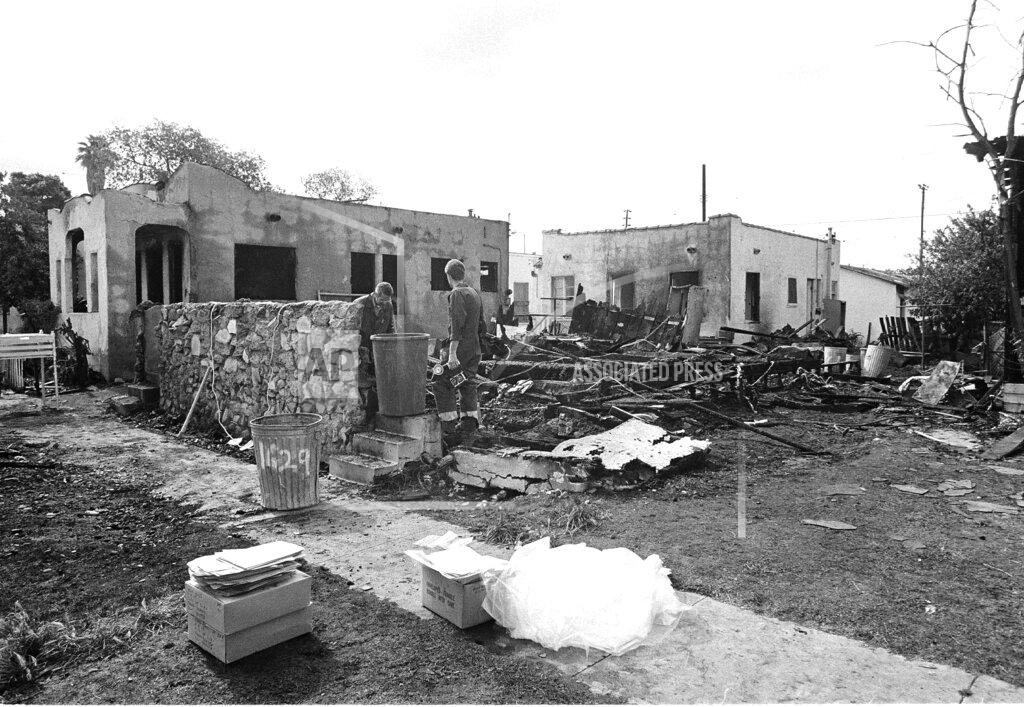
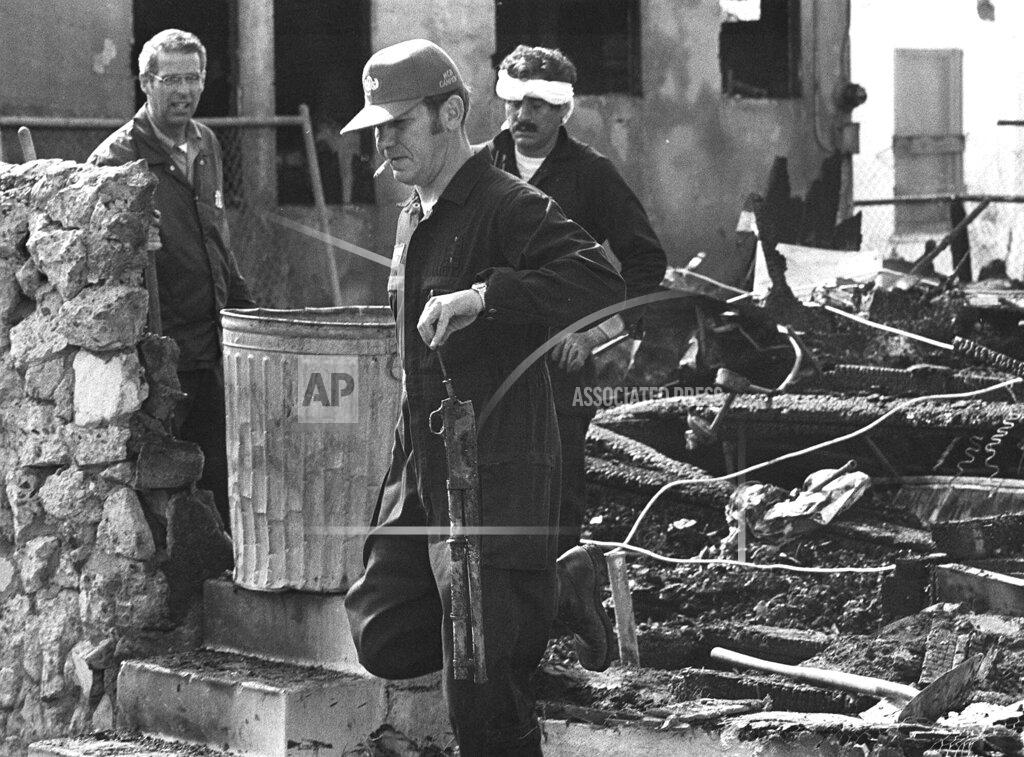
Patricia Hearst was not among the five persons killed during Friday evening’s gun battle with the police in Los Angeles, according to the county coroner. He identified the five victims as Donald DeFreeze, the black leader of the so-called Symbionese Liberation Army who styled himself General Field Marshal Cinque; Nancy Ling Perry and Patricia Soltysik, two of the S.L.A.’s white women leaders; and William Wolf, a white S.L.A. member. A fifth body, that of a young white woman, was later identified as Angela Atwood.
Reacting to complaints from the Northern Cheyenne Indians, the Interior Department has reportedly decided to cancel valuable strip-mine coal leases covering some 260,000 acres of the tribe’s vast Montana reservation. The reported move, which is seen as a blow to the Nixon administration’s plans for rapid coal development in the Plains States, followed tribal complaints that the Bureau of Indian Affairs had cheated the Indians in negotiating the leases — potentially worth billions of dollars — with four major energy corporations and two groups of land speculators in Montana.
“I am 21 years old, very conservative but very radical. I am supporting you and praying for you.” Those words from a letter to President Nixon from a college student (name deleted by the White House) typify the attitudes of a network of grassroots activists across the country who are working to prevent the resignation or impeachment of the President. The letter, expressing a plaintive hope that “silent voices” might somehow “start a chain reaction across the country,” echoed a common theme of the loosely organized movement: a sense of alienation and of outrage.
A Gallup Poll survey indicated that, although confidence in the nation’s leadership is at a low point, 68% of persons interviewed expressed a high degree of confidence. in the nation’s future. The opinions were recorded at a time when President Nixon’s approval rating in a recent survey was at 25% and only one-third of all voters approved of the way Congress was handling its job. The common theme among those expressing confidence was that difficult times brought people together or that the country had been revitalized by earlier periods of stress.
For the first time in 20 years, the Internal Revenue Service’s treatment of taxpayers is to be the subject of a major investigation and review by an independent Federal agency. The yearlong study which is expected to cost at least $100000, will examine the policies and practices of the I.R.S. in such areas as the summary seizure of the assets of delinquent taxpayers, the extent to which confidential taxpayer information is given to other agencies and the manner in which taxpayers are selected for auditing of their tax returns. The initiation of the study was announced this week by the Administrative Conference of the United States a little-known agency set up to identify the causes of inefficiency, delay and unfairness in the administrative proceedings of all Federal agencies and to recommend how these proceedings can be improved.
A dispute between House and Senate committees over how much educational benefits should be increased has raised the possibility of thousands of veterans temporarily losing the benefits. Jeopardized by the dispute are the educational benefits of some 285,000 veterans who served in the armed forces between 1955 and 1966 and who are now attending school under the G.I. Bill. Veterans of that era became eligible for the Veterans Administration benefits in 1966 for eight years, a period that expires May 31. Although both the House Veterans Affairs Committee and the Senate Veterans Affair Committee favor a two‐year extension of eligibility, their disagreement on the size of the educational benefits increase may prevent them from enacting the extension before Friday. If the deadline expires, committee staff members say that Congress will act to make the benefits retroactive, thus ensuring that the veterans now in school will, sooner or later, receive their checks.
Contract talks between New York City’s three major newspapers and their 2,100 union printers will move headquarters of the International to Colorado Springs, Colo., Monday, Typographical Union. The ITU has refused to sanction a strike or recognize as a lockout a dispute that has kept union printers from their jobs at the Daily News since May 7, when the paper switched to automated typesetting equipment. ITU offered its services, however, if a contract was not agreed on by this weekend. Union pacts expired more than 13 months ago. Renewal has been held up by disagreement on wages and automation.
Mandatory retirement can be harmful to a person’s health, the American Medical Assn. said in Chicago in announcing that it would join a lawsuit seeking to declare forced retirement unconstitutional. The suit involves Marton O. Weisbrod, 70, an attorney with the Chicago office of the Department of Housing and Urban Development. He has been told that under regulations he must retire despite the fact he is above average in competence and is capable of performing the duties of his job.
A 41-year-old Ford Motor Co. employee, in what may be the first age-discrimination lawsuit in the country, has charged in U.S. district court in Detroit that he was passed over for promotion because of age. The plaintiff, Edward B. O’Connell of Lincoln Park, Mich., started with Ford as a mailing clerk 24 years ago and advanced to a $15,467-a-year job as engineering change coordinator in Dearborn, a post he has held since 1958. His suit contends he has been denied requested promotions seven times in the last 17 years.
Americans gave a record-breaking $24.5 billion to philanthropic causes in 1973, an increase of $2 billion, or 8.9%. A declining — but still the largest — share went to religion — 41.1% of the total, down from 49.4% in 1964. Religious giving rose only 6.9% in 1973, while overall giving rose 8.9%. Of the total 1973 contributions, the bulk of it — $18.16 billion — came from individuals.
In fiction, May 18, 1974, is the “seventh day” in the bestselling 1962 novel Seven Days in May, about an attempted overthrow of the U.S. government. The day was modified to Sunday, May 19, for the 1964 film of the same name.
In the final weekend of matches in West Germany’s 1973–74 Bundesliga season, first-place Bayern Munich (20-9-4, 49 points) and second-place Borussia Mönchengladbach (20-6-7, 46 points) faced each other. Borussia, already eliminated from the race for first place, defeated Bayern Munich, 5 to 0.
99th Preakness: Little Current, ridden by jockey Miguel Rivera, won the 1974 Preakness Stakes in 1:54.6 at Pimlico Race Course in Baltimore. Little Current flashed along on the inside to score a sparkling victory in the 99th running of the Preakness Stakes at Pimlico today. The Kentucky‐bred colt, owned by John Galbreath’s Darby Dan Farm, responded to a brilliant ride by Miguel Rivera to score by seven lengths over the long shot, Neapolitan Way, and the favored Cannonade. Little Current was pretty much of a long shot himself, paying $28.20 for $2 to win here after covering the 13/16 miles in 1:54 3/5 on a good track. His time, under the same 126 pounds that was carried by each of the 13 participants, was the third fastest in the history of the Preakness. He won $156,500 of the $209,000 purse. The combination of Little Current and Neapolitan Way (B and K) returned $1,413.30 in $3 exacta betting.
Born:
Nelson Figueroa, MLB pitcher (Arizona Diamondbacks, Philadelphia Phillies, Milwaukee Brewers, Pittsburgh Pirates, New York Mets, Houston Astros), born in Brooklyn, New York, New York.
Félix Martínez, Dominican MLB shortstop and second baseman (Kansas City Royals, Tampa Bay Devil Rays), in Nagua, Dominican Republic.
Died:
Dan Topping, 61, American sports executive, former part owner and president of the New York Yankees, died of complications of emphysema.
Roald H. Fryxell, 40, American anthropologist, was killed in a car accident.
Martín Echegoyen, 83, former head of state of Uruguay as Chairman of the nine-member Consejo Nacional de Gobierno, 1959 to 1960
Tyree Glenn, 61. American jazz trombonist of the big band era.
Xenia Makletzova, 81, Russian ballet dancer.





 History Diaries