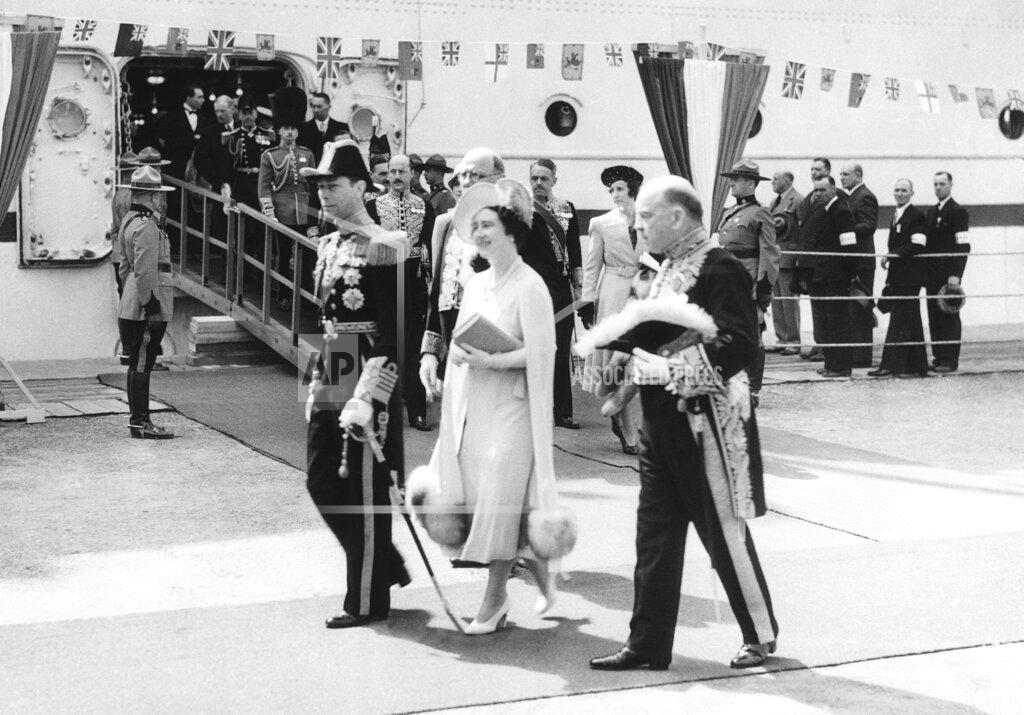
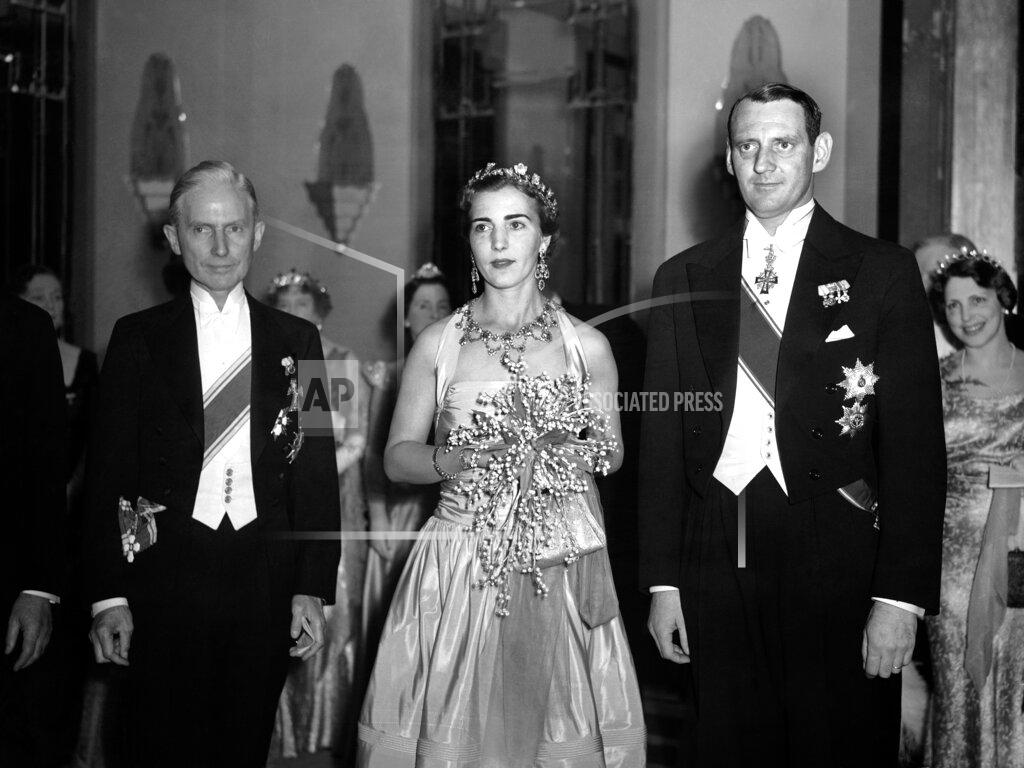
The royal tour of Canada began. King George VI and Queen Elizabeth arrived in Quebec City, Canada at the beginning of their North American tour. It was the first time a British monarch had visited Canada. King George VI and Queen Elizabeth of England arrived in Quebec City, Quebec aboard the Canadian Pacific liner Empress of Australia in a convoy with the cruisers HMS Glasgow (21) and HMS Southampton (83). The two cruisers carried a secret cargo: 3,550 gold bars from the Bank of England. The gold, worth about 30 million pounds at the time, would be stored with the Canadian government and used to pay for the looming world war. This was the first time a British monarch visited Canada and the Canadian welcome reinforced Anglo-Canadian ties.
Out of the Old World into the new there stepped today a King and Queen of Great Britain to receive the homage of their subjects in this oldest and largest Dominion of the British Crown. They were the first ruling sovereigns ever to set foot on Canadian soil and, for that matter, on that of any other self-governing Dominion of their realm.
For that reason and because the people of this bit of France in America were anxious to demonstrate their fealty in this time of crisis in world and empire affairs, the welcome that was accorded to King George VI and Queen Elizabeth when they landed here was a warm as well as an historical one. There was a touch of fantasy, of unreality about it all from the time the King sailed past this ancient, walled city on his modern “barge,” the Empress of Australia, until he and his Queen retired behind the grim walls of the Citadel, his slumbers guarded by the bayonets of the French-speaking Twenty-second Regiment in the scarlet tunics of the British Army.
Standing on the dock as the Empress of Australia came alongside with the “Sailor King,” in the full-dress uniform of an admiral, and feeling the eager curiosity and awed reverence with which his people awaited him, one had to pinch one’s self to remember that this was North America and that the year was 1939.
There, at the end of a roped-off area filled with Privy Councilors in scarlet and gold, with women eager to curtsy before their Queen and the Union Jack floating above all, was set apart a throne room. In that enclosure of silk, with its potted ferns and palms, the King and Queen held impromptu court and had presented to them the men and women who carry on for them in this Dominion beyond the sea. From that point the royal visitors went to the Provincial Parliament where they were welcomed to Quebec in French in a chamber filled with local officials, priests in Old World garb and sandaled monks.
The Anglo-Russian negotiations were at another critical stage tonight after Ivan M. Maisky, the Soviet Ambassador to London, had served notice that the new British concessions were inadequate and had reiterated that Russia would accept nothing less than a full military alliance with Britain and France. Mr. Maisky called on Sir Robert Vansittart, chief diplomatic adviser to the Government, this morning while the Cabinet was considering the new proposals worked out last night by its Foreign Affairs Committee. It is understood that he emphasized particularly the danger to Russia from German aggression in the Baltic countries as a reason for something more than an informal pledge.
The British were gloomy and resentful tonight, all the more so as the Cabinet gave general approval to the scheme drafted last night with some reluctance. Official quarters feel that the new plan marks a great advance toward meeting the Russian demands and that in fact it is so sweeping that it may strengthen the German charges of “encirclement.” Although the British are still unwilling to consent to a joint guarantee to specific countries, the new proposals call for a joint declaration by Britain, France and Russia that they would resist aggression, accompanied by a declaration by Russia pledging help to any of her western neighbors if they were attacked.
Furthermore, and most important of all, the British are proposing that if any of the three powers should become involved in war in carrying out its pledges the others would immediately provide help. The proposals also contain provisions for staff talks to work out joint strategy in the event of war. These proposals, the British contend, amount to all intents and purposes to an informal defensive alliance between Russia and the two Western democracies, and it is believed that Sir Robert told Mr. Maisky that in view of the reluctance of Russia’s neighbors — particularly Finland — to accept Soviet help, it was as far as the British felt they could go.
The British House of Commons turns down a bill that would give military conscripted men the right to vote at age 20. The first 40,000 are called up to start training on July 15.
A German census lists 330,539 Jews in Greater Germany; 138,819 males and 191,720 females. These figures include 94,530 Jews in what was formerly Austria and 2,363 in the Sudetenland.
The German government offered bilateral, non-aggression pacts with the Scandinavian and Baltic states. The Finnish, Norwegian, and Swedish governments rejected the proposal, basing their decisions on a policy of strict neutrality in any new European war. The Danish, Estonia, and Latvian governments accepted the German proposal. In response, the British government entered into negotiations with the Soviet government in an attempt to persuade the Soviets to enter into a anti-fascist front. The Soviets remained suspicious and insisted on complete reciprocity in military affairs and a guarantee on the independence of the Baltic States (the Baltic republics opposed these types of guarantees).
The Balkan Entente opened its economic conference in Bucharest today. Its importance is minor because trade among the Balkan States is small, Rumania being the principal exporter with her oil, for which her neighbors owe her fairly large sums, and because the political aspect of the entente overshadows all other considerations. The conference is discussing payment of commercial debts to Rumania and various matters relating to railroad and postal traffic.
Much more important are Foreign Minister Grigore Gafencu’s projected visits to Ankara and Athens, now expected to occur in June. The mere fact that he is not going to Belgrade and Sofia indicates the nature of his mission. Manifestly Rumania’s Foreign Minister will inquire in Ankara how far Turkey is prepared to resist Bulgarian claims for revision of peace treaties, which Sofia has been voicing recently rather vociferously, and how far it would be possible to form a new entente of Black Sea States, favored by both Turkey and Russia, if Bulgaria and Yugoslavia declined to adhere. In other words, is there to be a realignment of the Balkan States?
Meanwhile Germany is seizing every opportunity to impress Rumania with her all-embracing activity. The number of German missions sent here grows daily. Another arrived today, headed by a high official of the Reich Ministry of Communications, to study the creation of free zones in Rumanian, Danube ports. About twenty German engineers are at Cluj, in Transylvania, on an inspection tour of Rumanian industrial centers.
Albanian King Zog asks the League of Nations to restore the independence of his country.
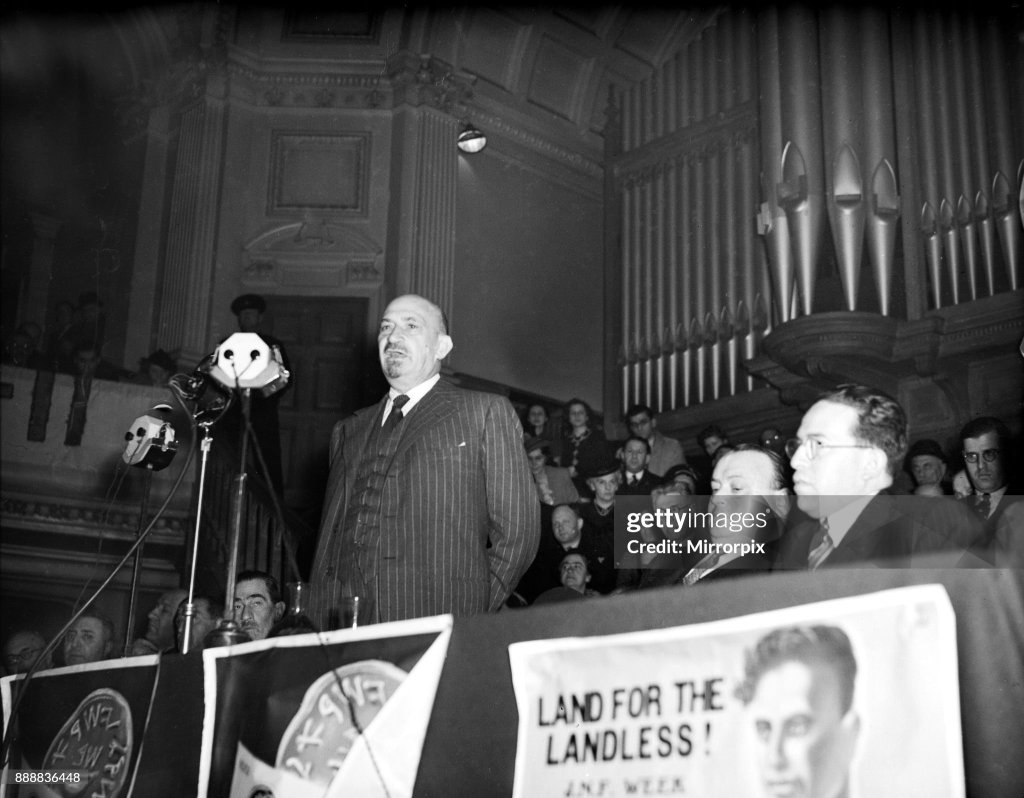
The British government published a new plan (“White Paper”) for the future of Palestine, after negotiations collapsed with Arab and Jewish leaders. The British plan called for an independent Palestinian state within ten years, which included a treaty relationship with Britain. Both Jews and Arabs would participate in a new government, which represented the interests of both peoples. During a transition period, Arabs and Jews would lead departments, with the support of British advisers, and participate in an advisory executive council based on population. After five years, a representative organization would draft a constitution, which would provide for a Jewish home and make arrangements for various communities.
The British ended the principle of absorptive capacity, which had served as the basis for Jewish immigration to Palestine, and Jewish immigration would end after five years, unless the Arabs agreed to its continuation. Under this scheme, the British would permit the immigration of 75,000 Jews into Palestine, which would result in one-third of the population being Jewish by 1944 and have Arabs outnumber them 2–1. The British announced they would regulate, and sometimes prohibit, the transfer of land. Both the Arabs and Jews strongly criticized the new proposal. Clashes between demonstrating Jews and British police in Tel Aviv and bomb explosions in Jerusalem signaled the first reactions to the new plan.
Twenty-five Jews, among a crowd demonstrating in Tel Aviv tonight against the new British policy on Palestine, were wounded by troops called by the police after the situation had gone out of their control. The demonstrators, composed of Revisionists, radical wing of the Zionists, first marched to the government offices, shouting, “Down with the government!” At the government offices they pulled down the Union Jack and replaced it with the Zionist emblem. Furniture, files and even cash were thrown out of the building into the street. Later fire started in the building, damaging it extensively. Finding the situation beyond their control, the police called British troops, who forcibly dispersed the demonstrators. A Jewish constable was seriously wounded. Mayor Israel Rokach of Tel Aviv and the head of the Jewish Civil Guard were beaten by the police while the latter were trying to disperse the crowd.
The Pro-Palestine Federation of America, an organization of Christians supporting the movement for a Jewish national home in Palestine, sent a telegram to President Roosevelt yesterday asking him to intervene against the application of the plan announced by the British Government for the establishment of an independent Palestine State. The telegram was signed by Charles Edward Russell, president of the federation; William Green, president of the AFL; Bishop Francis J. McConnell, and other members of the organization. The telegram accused Great Britain of preparing to violate its “plighted word to the Jewish people and to the nations of the world” and “repudiate its signed guarantee of the rehabilitation of Palestine as a Jewish national home.”
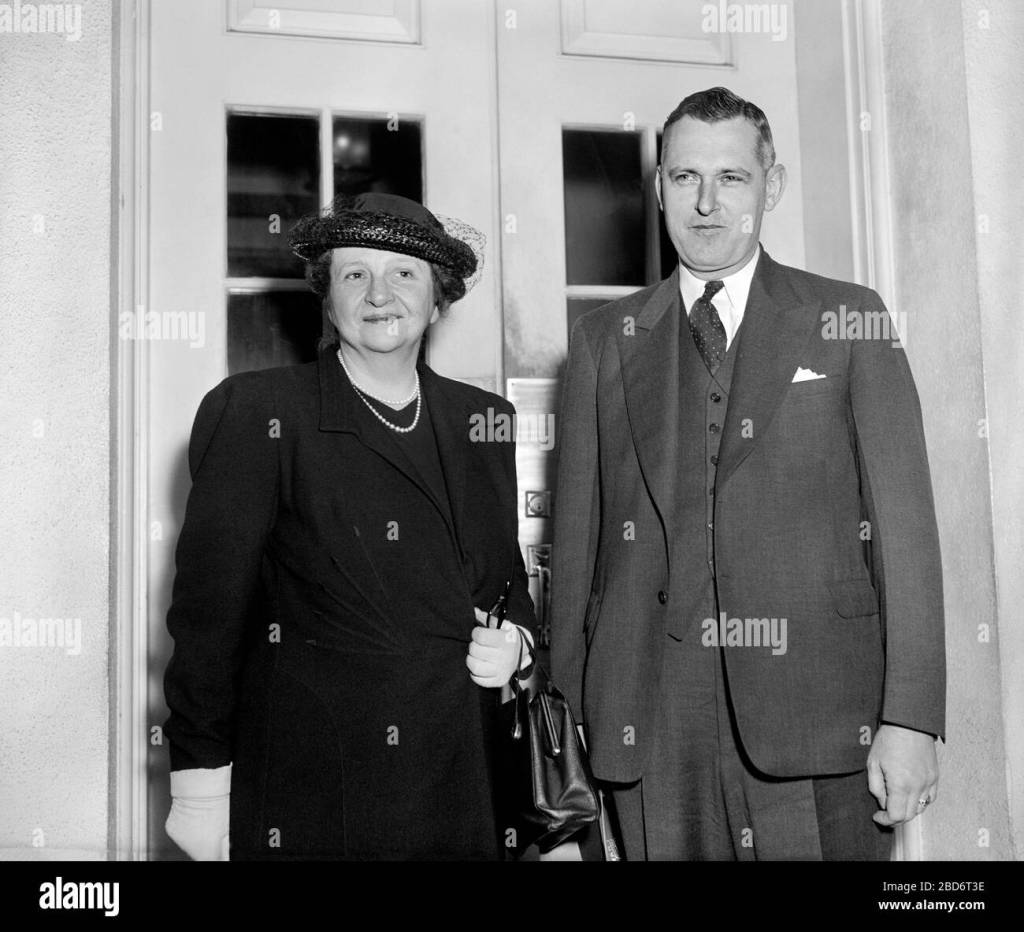
In Washington today, President Roosevelt conferred with Secretary Perkins on the Harlan County coal controversy, accepted the resignation of Brien McMahon as Assistant Attorney General and transacted other administrative business.
The Senate rejected the bill authorizing completion of the Florida ship canal, confirmed the nominations of Norman Armour to be Ambassador to Argentina, and General George C. Marshall to become U.S. Army Chief of Staff, received the minority report on the Lee bill to conscript wealth in wartime and recessed at 3:55 PM until noon tomorrow. The Temporary National Economic Committee heard Owen D. Young, Edward R. Stettinius Jr. and others on the flow of capital in industry. The Appropriations Committee approved a clause in the Navy Appropriation Bill prohibiting the purchase of Argentine canned beef and a Judiciary subcommittee heard Stuart Chase support the proposal for a constitutional war referendum amendment.
The House considered the omnibus Rivers and Harbors Bill, received a Presidential request for $225,000 supplemental appropriation for a Department of Commerce study of the problems of commerce and industry, and adjourned at 4:55 PM until noon tomorrow.
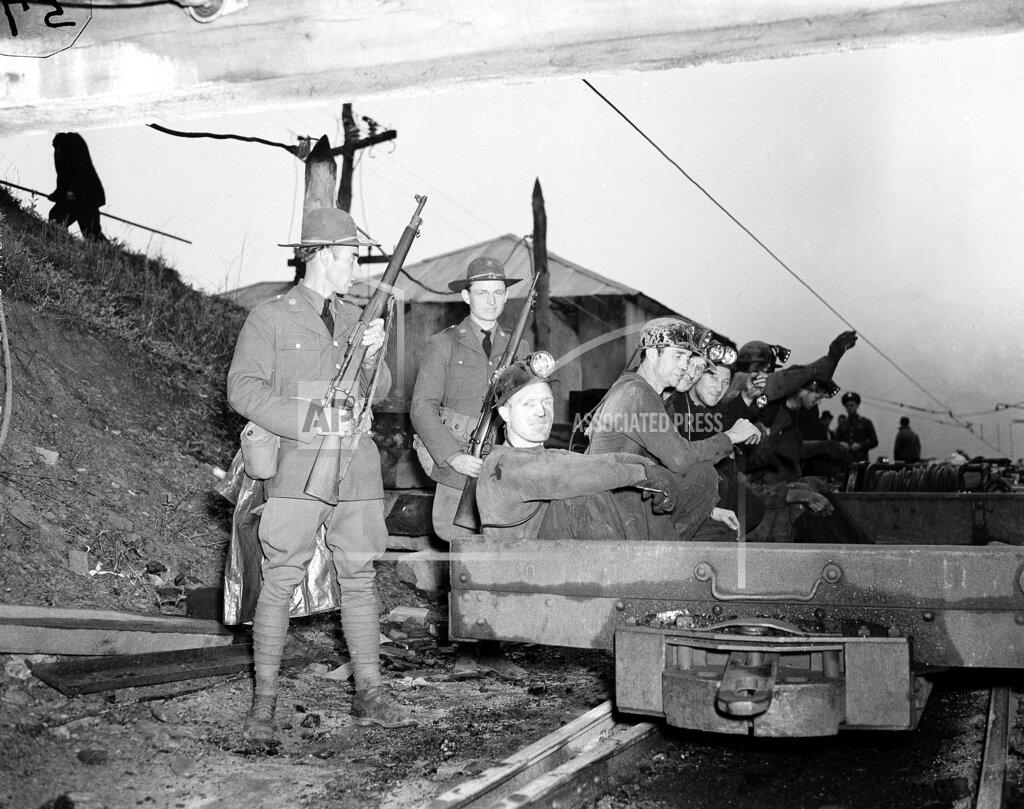
Filled with armed and temper-frayed National Guardsmen and miners, Harlan County, Kentucky stood alone today, the last Appalachian soft coal region that has not signed a contract with the Congress of Industrial Organizations. The Virginia Coal Operators Association signed with John L. Lewis’s union, the United Mine Workers, this afternoon but the Harlan operators were standing firm in their refusal. Between 300 and 400 National Guardsmen were being called up to reinforce the 800 already patrolling the roads and guarding the twenty-four of the county’s forty-two mines that were back in operation after the long stoppage.
Late this afternoon Brigadier General Ellerbe W. Carter, commanding the National Guard contingent on duty in the county, said: “The miners seem to be getting tougher instead of quieter.” Most observers here believe that one or two incidents of violence. might produce a serious fight.
The Senate defeated by 45 to 36 today a bill to authorize construction of the Florida Ship Canal. The vote was considered significant as a test of economy sentiment freed of the usual considerations in legislation involving group interests. Defeat of the measure served to stop consideration for the time being of a project, of unknown actual cost, but which has been estimated to involve potential expenditures of between $200,000,000 and $300,000,000.
The bill failed despite broad concessions by Senator Pepper of Florida, its chief sponsor. Defeat was made possible only by a sharp split among the Democrats, of whom a sizable group bolted the majority leadership of Senator Barkley, who made a last-minute appeal for the project principally as a defense measure and secondarily as an aid. to Atlantic-Gulf commerce. Those who voted against the bill likewise rejected an appeal filed by the executive council of the American Federation of Labor, which endorsed the project as an enterprise that would make jobs.
Politically the vote constituted a feather in the hat which Senator Vandenberg may cast into the Presidential ring next year. He led the opposition and made a formal speech contesting the value of the project. After extended debate yesterday by Senators Vandenberg and Pepper, most of today’s debate was taken up with a speech by Senator Andrews advocating the bill. He was questioned at length by Senator Tydings.
Members of the Senate understood from the time that the bill was placed on the calendar, without recommendation by the Committee on Commerce, that in essence the vote would be a test of Senate sentiment on spending versus economy rather than on the canal itself. For that reason, debate was confined to three short sessions of the Senate.
Secretary Hopkins has moved to enforce safety-at-sea laws in connection with the strike of the CIO National Maritime Union against major East Coast tanker operators, including the Standard Oil Company of New Jersey, a move that strikers feel will aid them in winning their fight. As a result of an investigation ordered by Mr. Hopkins of alleged violation of the safety-at-sea laws with respect to employment of qualified seamen, fines of $50,000 have been assessed in the last fortnight against five major tanker operators, Allan Jones, acting director of the Bureau of Marine Inspection and Navigation, revealed today. He made it known after over 500 striking seamen picketed the Department of Commerce for five or six hours. The pickets dispersed when they learned the steps they were advocating already had been taken.
In addition to the assessment of fines, George Fried, supervisory inspector in New York, has been ordered by the bureau to order the master of one tanker to appear and show cause why his master’s ticket should not be suspended or revoked for taking a ship to sea in violation of personnel safety laws. “We are going to make an example of that master,” Mr. Jones declared. “It will serve as an indication of the department’s attitude.”
A U.S. House of Representatives military appropriations subcommittee heard from Colonel Charles A. Lindbergh that the United States had been outstripped by Germany in military aviation but was in no danger of aerial attack from abroad. Committeemen quoted Lindbergh as saying that German attack planes and light bombers were better than those of the U.S. but were not long-range types and could not be compared to the Army’s “flying fortress” four-motored bombers.
The Ohio legislature kills a bill that would ban female bartenders.
U.S. doctors dispute WPA medical data. The number of people lacking a doctor is closer to 40,000; not 40 million, as reported.
The Glenn Miller Orchestra begins a three-month engagement at the Glen Island Casino in New Rochelle, New York.
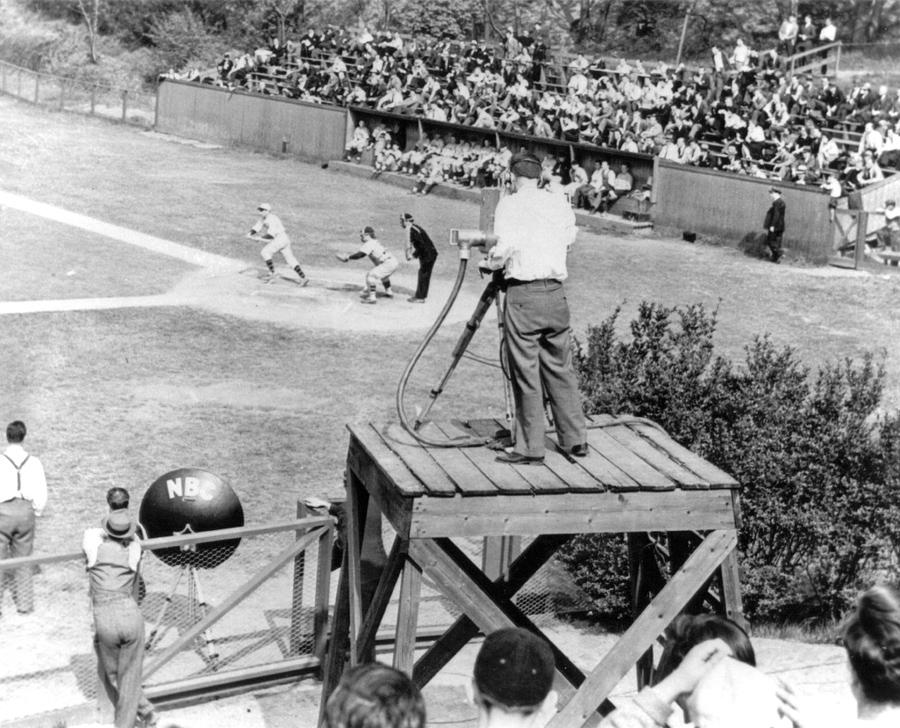
NBC televises the first baseball game, a college game between Columbia and Princeton. The first baseball game ever televised, Princeton against Columbia at Baker Field, Columbia’s home field, is seen by a handful of viewers via W2XBS in New York City. Bill Stern announces, as Princeton wins 2–1 in 10 innings. The 2nd game of the doubleheader is not televised. Reviewing the game the next day, The New York Times sniffs, “it is difficult to see how this sort of thing can catch the public fancy.”
Brooklyn and Chicago play a 19-inning 9–9 tie game at Wrigley Field.
Boston Bees pitcher Fred Frankhouse beans Harry Craft of the Reds and is accused of throwing spitballs. Boston wins 6–1.
In a Northern League game at Crookston, Joe Hatten of Crookston strikes out 21 Superior Blues batters to win, 5–0. Hatten’s Major League call up won’t come until 1946.
Bolivia is said to be falling under the influence of Germany and close to effectively adhering to the Axis.
The United States refused to grant Japan’s demand for increased Japanese representation and international settlement at Shanghai. American ambassador at Tokyo Joseph C. Grew delivered a memorandum to this effect at the Japanese Foreign Office at approximately the time American naval forces were landing and other international settlement – at Amoy. The Japanese challenge of the status of international settlements in China was met today by the landing of United States, British and French naval forces in the international area on the island of Kulangsu in the harbor of Amoy. The Japanese at Kulangsu later yielded to a demand of United States, British and French officials and withdrew all but a few members of their landing party there, it was reported from Shanghai early today.
Coincidentally Joseph C. Grew, United States Ambassador in Tokyo, by direction of the State Department delivered to the Foreign Office an aide-mémoire couched in strong terms. It rejected Japanese overtures in a memorandum on May 3 for elaborate revision of the status of the International Settlement in Shanghai. The Japanese move, in diplomatic opinion here, was a thinly veiled effort to take over the Shanghai settlement. The situation at Kulangsu was precipitated by the occupation of the settlement there by 150 Japanese troops last week in what was obviously an effort to reinforce the demands made through the aide-mémoire dealing with Shanghai.
The challenge was taken up under circumstances pointing to a test that will decide whether foreign rights will be abridged by Japan not only at Amoy but in the great International Settlement at Shanghai. The immediate naval move has been made at Kulangsu, where foreign interests are relatively slight; the same principles, however, are involved in the rich city of Shanghai. Britain and France are also expected to send strong notes of protest to Japan over her demands at Shanghai. Hence the combined diplomatic and naval moves have taken on the appearance of a joint front in circumstances where British, French and United States interests are parallel and in many cases identical.
The first television broadcast in Japan occurred.
Dow Jones Industrial Average: 129.09 (-0.77).
Born:
Dick Smith, MLB outfielder and first baseman (New York Mets, Los Angeles Dodgers), in Lebanon, Oregon (d. 2012).
Gary Paulsen, American author of young adult literature, in Minneapolis, Minnesota (d. 2021).
Naval Construction:
The Вое́нно-морско́й флот СССР (ВМФ) (Soviet Navy) Project 7-class (Gnevny-class) destroyer Boyky (Бойкий, “Active”) is commissioned.
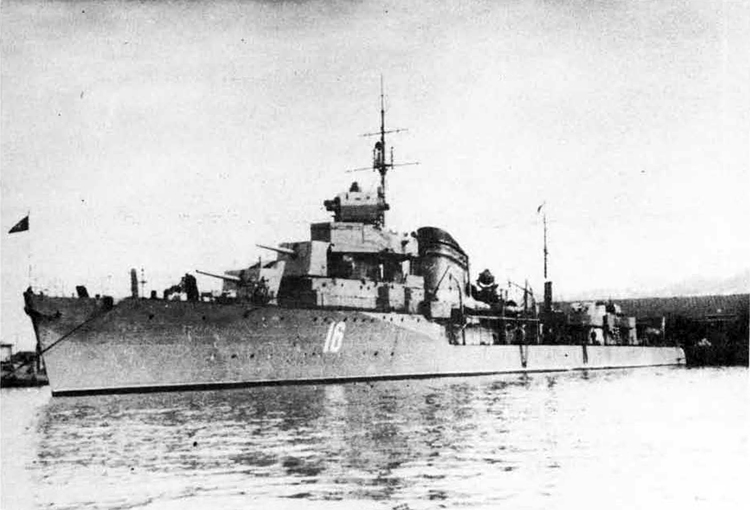
When the Germans invaded the Soviet Union on 22 June 1941, the ship was assigned to the 2nd Destroyer Division. On 23–24 June Boyky laid defensive mines off Sevastopol. On 9 July, the 2nd Destroyer Division, including the destroyer leader Kharkov, Boyky and her sister ships Bodry, Bezuprechny and Besposhchadny made an unsuccessful attempt to interdict Axis shipping near Fidonisi. On 14–17 August, Boyky escorted the incomplete ships being evacuated from the shipyards at Nikolayev. Together with the light cruisers Chervona Ukraina and Komintern and the destroyers Nezamozhnik and Shaumyan, Boyky and Besposhchadny bombarded Axis positions west of Odessa on 1–2 September. That month, Boyky began ferrying troops and supplies to encircled Odessa as well as providing naval gunfire support. On 7 September, Boyky and the destroyer Sposobny escorted the Commander of the Black Sea Fleet, Vice Admiral Filipp Oktyabrsky, aboard the destroyer leader Kharkov to Odessa. While they were present, all three ships bombarded Romanian troops. On 16–21 September the destroyer helped to escort transports ferrying the 157th Rifle Division to Odessa. She landed a company of naval infantry behind Romanian lines at Grigorievka on 21 September and provided fire support for them the following day.
Boyky helped to escort the ships evacuating the 157th Rifle Division from Odessa to Sevastopol on 3–6 October. She escorted the damaged submarine Shch-212 to Sevastopol on 27 October. The ship was assigned to the fire support group defending Sevastopol on 31 October and then helped to evacuate cut-off Soviet troops from pockets along the Black Sea coast to Sevastopol in early November. When not bombarding Axis positions, Boyky ferried reinforcements and supplies to Sevastopol. The ship was refitted in Poti, Georgia, from 17 November to 1 December. On 29–30 December, she escorted reinforcements during the Battle of the Kerch Peninsula. During 1941, Boyky fired a total of 1,227 main-gun shells, laid 106 mines and transported 4,883 troops.
Together with the destroyer Soobrazitelny, she escorted a pair of merchantmen to the Bosporus on 3–5 January 1942. The following night, the destroyer escorted the battleship Parizhskaya Kommuna as she bombarded targets near Stary Krym while contributing shells of her own. During the night of 6/7 January, Boyky landed 450 men west of Feodosia. While escorting the transport SS Serov from Novorossiysk to Poti, the ship collided with the merchantman and was forced to return to port. She was repaired at Tuapse from 16 January to 11 February, although she was further damaged by a storm on 22 January. Boyky resumed ferrying supplies to Sevastopol and often bombarded Axis troops in the Crimea. Partial records of her main-gun ammunition expenditures have survived: 134 rounds on 22 and 26 February and 118 rounds on 5, 14, 15 and 26 April. Her last supply mission to Sevastopol was on 23 May before the ship spent the next several months under repair.
Soobrazitelny and Boyky bombarded the port of Yalta with 97 shells on the night of 2/3 October. The destroyer helped to ferry troops to reinforce the defenders of Tuapse on 24–28 October. A month later, Besposhchadny and Boyky were tasked to attack Axis shipping off the Bulgarian coast and to bombard the port of Mangalia, Romania. They failed to locate any ships and mistook coastal rocks for a convoy in heavy fog on 1 December, firing 141 shells from their main guns and six torpedoes at them. On the night of 20/21 December Kharkov and Boyky bombarded Yalta with 168 shells; on their way home they encountered German motor torpedo boats, but neither side was damaged in a desultory action. In preparation for amphibious landings west of Novorossiysk on the night of 3/4 February 1943, Boyky, Besposhchadny and Soobrazitelny and the cruiser Voroshilov bombarded German positions during the night of 30/31 January; during the actual landings, Boyky bombarded Anapa as a diversion. The ship was awarded the Order of the Red Banner on 27 February. On the night of 30 April/1 May, Boyky and Besposhchadny shelled Axis positions on the Kerch Peninsula. Two weeks later, Kharkov and Boyky fired 235 shells between them from their 130 mm guns at Anapa harbor. Boyky, Besposhchadny and Sposobny made an unsuccessful attempt on 30 September to intercept German transports evacuating troops and equipment from the Kuban Bridgehead. The loss of Kharkov, Sponsoby and Besposhchadny to German dive bombers on 6 October prompted an infuriated Stalin to issue an order forbidding the use of ships destroyer-sized and larger without his express permission and Boyky saw no further action during the war.
The ship was modernized from 1948 to 27 December 1951; Boyky was stricken from the Navy List on 17 February 1956 and redesignated as test ship OS-18. She was sunk in shallow water on Tendra Spit on 9 February 1962.
 History Diaries