Communist guerrillas in Vietnam have carried out a series of daring hit‐and-run attacks. on five targets, near the Cambodian frontier in a show of tactical agility at the start of the rainy season, a military spokesman said tonight. Government forces had at least 36 fatalities and large losses of weapons. The attacks, which took place early yesterday, came only 48 hours after similar coordinated attacks in another section of the border area. There the guerrillas, Việt Cộng, inflicted even heavier casualties.
Together, the attacks seem to point to a rainy‐season offensive by the Việt Cộng, for which the South Vietnamese troops and their United States advisers have been bracing. The Việt Cộng struck about 2 AM yesterday, hitting four outposts and a hamlet about 60 miles west of Saigon near Mộc Hóa, a town in Kiến Tường Province. No losses were reported from two of the posts but in the three other settlements 17 men, including one civilian, were reported to have been killed, 23 wounded and at least 10 missing.
Later yesterday a government landing craft, believed to be part of a force reacting to the earlier attacks, hit a mine and sank in the river that drains the Plain of Reeds near the frontier. Nineteen soldiers were reported to have been killed in the craft, with 20 small weapons, three 30-caliber machine guns and one automatic weapon lost. In the hardest‐hit post, Bình Thạnh Thôn, three mortars, seven automatic weapons, 27 small weapons and two radios were lost. Government pursuit operations were begun yesterday, but by late today there had been no report of contact with the attackers.
Some military sources said the Việt Cộng had attacked from across the Cambodian border several miles away, but this was not officially confirmed. The South Vietnamese have accused Cambodian border authorities of permitting Việt Cộng units to move freely back and forth. The Cambodians have denied the charge. No Việt Cộng losses were reported and there were no reports of any American casualties in the raids. The Việt Cộng force was placed at the strength of one battalion. The attacks came in the week that seasonal rains started, turning rice paddies of the Mekong Delta into wide expanses of mud laced with flooded canals. In previous rainy seasons, lasting about four months, the Việt Cộng’s small, swift units have seized tactical advantages as government forces bogged down with their heavy equipment and vehicles.
U.S. Secretary of State Rusk visits Saigon primarily to get Ambassador Lodge’s support for the ‘retaliatory’ actions being effected or contemplated by the Johnson administration. Lodge counsels more reliance on the South Vietnamese forces and more attempts to apply the ‘carrot’ of inducements to North Vietnam before applying the ‘stick’ (of heavy bombing).
In Laos, General Kong Le, his neutralist forces crumbling in the face of a strong pro‐Communist offensive, was reported today to have fled from his headquarters on the strategic Plaine des Jarres. Members of the International Control Commission reported that General Kong Le had left his headquarters at Muong Phanh on the southern edge of the north‐central region of the plain. But they said they did not know where he had gone. They also reported that the neutralist forces on the plain appeared to be offering no resistance.
Commission members evacuated from Muong Phanh said all the Plaine des Jarres appeared to be in the hands of the pro‐Communist Pathet Lao, United Press International reported. In Washington, Secretary of State Dean Rusk met with foreign envoys, including the Soviet Ambassador, on the Laotian situation, urging efforts to preserve the Government of Premier Souvanna Phouma.
The International Control Commission—made up of India, Canada and Poland—has an observation post at Muong Phanh. Members of the commission and of the French military mission there were brought here today. The commission supervises accords reached in 1962 at a Geneva conference that established a neutral coalition Government consisting of neutralists, rightists and leftists.
The pro‐Communist offensive against Muong Phanh began yesterday. At that time six battalions of General Kong Le’s neutralist forces were reported to have rebelled and some were believed to have defected to the pro‐Communist forces. The dissidents were described as opposed to recent military and political changes in the government that followed the coup d’état by a right‐wing military junta April 19. General Kong Le’s forces are loyal to Prince Souvanna Phouma, the neutralist Premier, and are also aligned with the right wing.
The attack by the Pathet Lao was denounced by Prince Souvanna Phouma as a violation of the Geneva accords of 1962. He called on the Pathet Lao to cease the attacks “immediately.” He charged yesterday that North Vietnamese troops were helping the Pathet Lao, which the North Vietnamese denied.
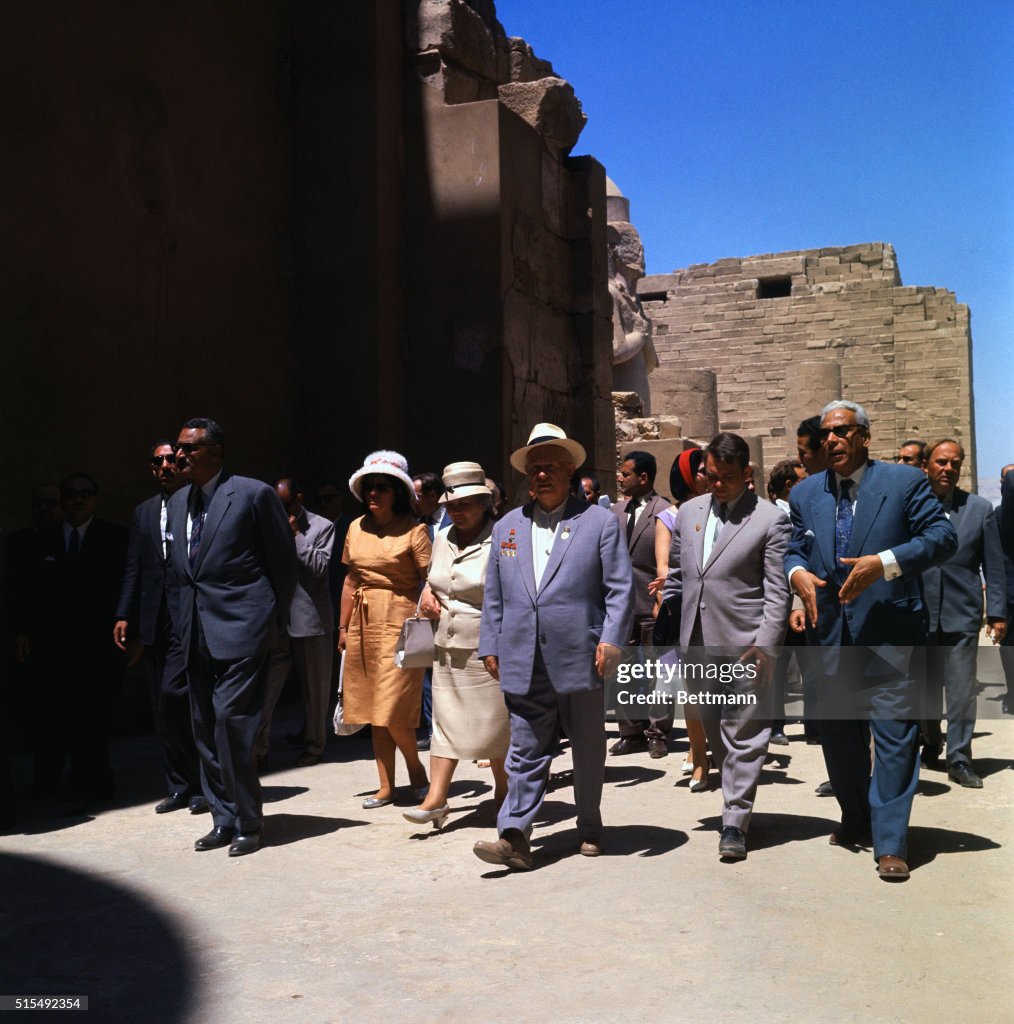
Soviet Premier Nikita Khrushchev visited the Karnak temples of the Pharaohs in the Luxor area today on his way back to Cairo from ceremonies at the site of the Aswan High Dam. The Soviet leader and his wife and other members of the visiting party returned to the capital to continue their tour in the United Arab Republic. The Premier appeared to be feeling the 100-degree heat. Newspapers here made it seem as if Mr. Khrushchev was supporting Arab unity in speeches he made yesterday in which he actually administered a caustic scolding.
In Aswan he said Arab leaders should be less concerned with nationalist unity and more eager to get “workers of the world” to unite. “I have heard your leaders urge Arabs to unite,” he told his audience. “In such a case what shall we Russians here do? Go home? Certainly, we are not Arabs.” The Premier was addressing a meeting of Egyptian and Soviet workers and engineers at the Aswan construction site. He appeared annoyed at earlier remarks by another guest, President Abdel Salam Arif of Iraq. The Iraqi leader called the Aswan High Dam “a symbol of Arab brotherhood and unity.”
Teams of highly-trained anti-Castro infiltrators and saboteurs were reliably reported today to be crossing the Caribbean, toward Cuba. They were said to be mostly former officers of the army of Premier Fidel Castro, who are now members of- the anti‐Castro “Revolutionary Junta,” led by Manuel Ray. Mr. Ray, a 39-year‐old engineer who served in 1959 as Public Works Minister in the Castro regime, pledged publicly last year that he would be in Cuba this year by May 20, the anniversary of Cuban independence, to carry out an underground struggle against the Castro Government.
Spokesmen for the Revolutionary Junta here contended that Mr. Ray would “definitely” be in Cuba before Wednesday to begin to carry out a program of subversion. The spokesmen said that the program had been planned for a year and that it involved building an underground that would seek members in the Castro regime and its armed forces. Mr. Ray’s whereabouts today were undisclosed, but he was understood to be somewhere in the Caribbean area, having left San Juan, Puerto Rico, in the last few days. Reliable sources said that some of the group’s agents might already have landed in Cuba.
The debate over a new Canadian flag in time for Canada’s 1967 centennial began at the 20th Royal Canadian Legion convention, in Winnipeg, when Prime Minister Lester Pearson told an unsympathetic audience that the time had come to replace the red ensign with a distinctive maple leaf flag. “I believe most sincerely,” Pearson told the veterans, “that it is time now for Canadians to unfurl a flag that is truly distinctive and truly national in character, as Canadian as the Maple Leaf that should be its dominant design; a flag which cannot be mistaken for the emblem of any other country; a flag of the future which honors also the past; Canada’s own and only Canada’s.” Pearson would introduce the resolution in the Canadian House of Commons on June 5.
The chances for passage of the civil rights bill will be put to a crucial test this week in the Senate. Republican and Democratic Senators will meet in separate sessions starting Tuesday to consider a large package of amendments to the House‐passed bill. At stake will be nothing less than the possibility of obtaining enough votes to close debate. It will take 67 votes for closure if all 100 Senators are present. As the bill stands, the leaders admit they cannot claim that many votes. Some have counted to within four or five of 67, but no higher.
The purpose of the amendments is to make the legislation more acceptable to Senators who are not committed civil rights supporters. The meetings this week should indicate how many find themselves persuaded by the changes. The main force behind the amendments is the Senate Republican leader, Everett McKinley Dirksen of Illinois. But both Attorney General Robert F. Kennedy and Senator Hubert H. Humphrey of Minnesota, the Democratic manager of the civil rights bill, have approved the changes. There is great interest in whether Senator Dirksen will be able to lead his own flock.1 Almost all the doubtful votes on closure are among the 33 Senate Republicans. Half a dozen will have to be won over if the bill is to pass.
Such Republicans as Bourke B. Hickenlooper of Iowa, Thruston B. Morton of Kentucky and Roman L. Hruska of Nebraska are in this group. One difficulty for them is their friendship for Senator Barry Goldwater of Arizona, who opposes the bill. A hopeful note for the bill’s supporters came today from Senator Milton R. Young, Republican of North Dakota, who had not been considered likely to vote for closure. In an interview he said: “I think there is a good chance that we can get the votes for closure, if we first agree on the package of amendments.”
Senator Dirksen expects that it will take more than one meeting to explain all the amendments. The meetings could continue through the week. The most important amendments in the package limit the right of Government agencies to sue in behalf of individuals denied jobs or access to public accommodations because of their race or color. Under the Dirksen version, the Attorney General could sue only if the discrimination were part of an intentional pattern.
New and complex pressures for social change beset the nation on the tenth anniversary of the Supreme Court decision against public school segregation. Widespread progress has been made. But there is no end in sight to the sweeping revolution in racial codes and customs generated by the nine Justices’ unanimous ruling in Oliver Brown et al v. Board of Education of Topeka. Further, the psychological effects of the ruling have been immense. Blacks frequently observe that, while the Emancipation Proclamation freed them physically, the Supreme Court decision freed them mentally. Ironically, perhaps the smallest quantitative change accomplished by the decision lies in the very practice at which it was aimed — public school segregation.
Still, observers generally agree that the forces unloosed by the Supreme Court are shaping an America that will differ sharply from the one that existed on May 17, 1954. Significant, if sometimes token, adjustments have been made in the South in public education, public accommodations, voter registration practices, employment and the administration of justice. Other adjustments are expected to follow enactment of the civil rights bill now before the Senate. Less tangible gains are evident on the individual level, particularly in the relations of the younger white and Black Southerners of the middle class.
Worshipers at New York’s St. Patrick’s Cathedral were urged yesterday “to participate actively in specific programs” designed to attain racial justice in their communities. Preaching, at the 10 AM solemn mass celebrating Pentecost Sunday, the Rev. Edward J. McCrorry of the cathedral staff said that “unfortunately too many men, including ourselves, are obsessed with the differences that exist among us.” Father McCrorry said: “We ask, how can I like him, his skin is black? how can I trust him, he’s a Jew? how can I respect him, he’s a Protestant? We ignore the fact that all children have a universal appeal, be they black or white, red or yellow; that all men in Naples or London, the Congo or India, laugh the same way and shed similar tears of sorrow.”
The Draft Lodge Committee of California is expected to support Governor Rockefeller’s slate of delegates in the state’s Republican primary June 2, and at the same time pledge a continuing campaign for the nomination of Ambassador Henry Cabot Lodge for President. Maxwell M. Rabb, national chairman of the Lodge campaign committee, said that the California decision was being left exclusively to Californians, but that “the one thing we can be sure about, whatever the results of our survey, there will be no deal.” The Lodge leaders in the state are trying to canvass more than 1,000 members of their volunteer organization and will meet within the next few days to decide their course.
The prospect that they will work for the Rockefeller slate while maintaining a Lodge organization derives from the pro‐Lodge enthusiasm that manifested itself, despite the setback in the Oregon primary Friday, at a meeting here yesterday. A second factor pointing toward that decision is the obvious anti‐Goldwater sentiment in the Lodge group. Mr. Rabb and other national Lodge workers, meantime, were making a telephone canvass of Republican leaders in other states where delegations are uncommitted or have not been chosen. A decision to support the Rockefeller slate in California would be made solely for the strategic purpose of trying to eliminate Senator Barry Goldwater of Arizona, now the leading contender for the nomination at the convention opening in San Francisco on July 13.
Liberal attempts to block his nomination “could be suicidal” for the Republican party, Senator Barry Goldwater said today. Meantime, the Arizonan attempted to refute one of the most common attacks against him — that he would recklessly risk war. In a speech to more than 1,000 wildly enthusiastic Republicans gathered at a high school here, the Senator said: “I pledge from the depths of my heart and conscience that as President of this nation I would consider it my foremost duty to keep the peace and to keep freedom at the same time.”
With little more than two weeks left before the crucial California Presidential primary on June 2, Mr. Goldwater intensified his pleas that his Republican opponents stop making him and his conservative philosophy the main issue of the campaign. No one in the Goldwater camp denies that Governor Rockefeller’s surprise victory in last Friday’s Oregon primary will improve the New Yorker’s prospects in the California primary.
“Operation Desert Strike”, the largest American military exercise since the end of World War II, began in an 18,000 square mile area of desert in the U.S. states of California, Nevada and Arizona, and involved 89,000 U.S. Army and U.S. Air Force personnel training for two weeks in mock combat. Coordinated by United States Strike Command, the “huge mock war between the mythical nations of Calonia and Nezona” employed tanks, artillery, jet fighters, paratroopers, and tens of thousands of men using blank-loaded weapons. Based on data from the exercise, the U.S. Army developed the Air Support Operations Center, which would soon be introduced into the Vietnam War. Despite the precautions, 34 American servicemen had been killed by the time that the exercise ended on May 30, mostly in traffic accidents involving military vehicles.
In New York City, 150 bicyclists rode together through the streets from Manhattan to the site of the World’s Fair in Flushing “in an attempt to make the city’s roads and bridges more bicycle-friendly.”
The first Tim Horton’s coffee and donut shop opens in Hamilton, Ontario by NHL player Tim Horton.
Mickey Mantle’s homer in the 1st starts the scoring and New York outslugs the A’s, 11–9, in the first of two. Mantle scores 3 times. Tom Tresh has a 3-run homer and Hector Lopez 3 RBIs. Dick Green hits two triples and has 3 RBIs for the A’s. In the nightcap, Whitey Ford scatters 4 hits and Joe Pepitone has 4 hits, including a pair of homers, and 4 RBIs. The sweep puts the Yanks in a tie for first place.
In game 2 at Fenway, Harmon Killebrew hits a grand slam and Earl Battey adds a 2-run pinch homer in the 9th as the Twins edge the Sox, 6–5. It is Killebrew’s 5th homer in 5 games. The Sox use a 6-run 7th in the opener to win, 6–2.
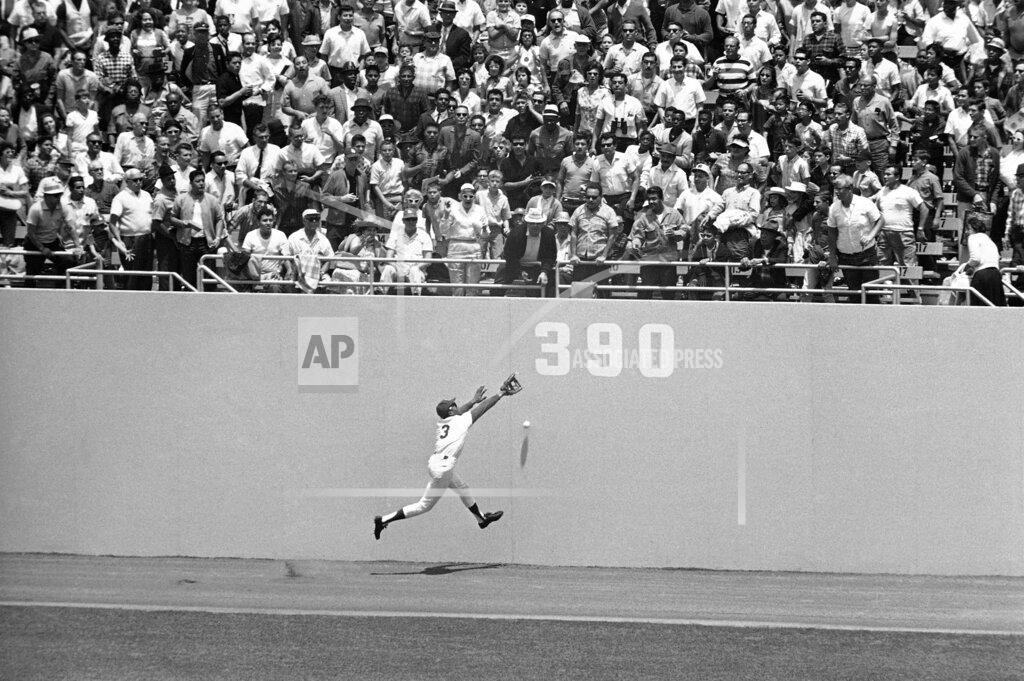
Roberto Clemente puts on quite a show but can’t prevent Pittsburgh’s 3–2 loss to Sandy Koufax and the Dodgers. Frank Finch of the Los Angeles Times reports: “Pittsburgh’s exciting right fielder, Roberto Clemente, waged a one-man war against Los Angeles with a spectacular display of throwing and batting. The fiery Puerto Rican smacked a triple, double and single to keep Koufax in hot water, but it was his arm that captured the fans’ fancy and left two baserunners for dead.
Dick Tracewski ended a promising scoring spree in the 2nd inning when Clemente’s strike to Ducky Schofield nailed him as he tried to scramble back to second base. When Ron Fairly’s triple eluded Clemente in the 7th, he retrieved the ball and threw it on the fly from the warning track to home plate. And then Roberto took John Roseboro’s game-winning sacrifice fly and pegged another shot to the plate that nearly nipped Fairly. The next batter, Willie Davis, challenged Clemente’s arm by trying to stretch a single. He was out at second by a couple of lengths. Not since their own Carl Furillo was in his prime have the Dodgers seen such a display of throwing as Clemente’s.”
Born:
Rob Nelson, MLB first baseman and pinch hitter (Oakland A’s, San Diego Padres), in Pasadena, California.
Dave Popson, NBA power forward (Los Angeles Clippers, Miami Heat, Boston Celtics, Milwaukee Bucks), in Kingston, Pennsylvania.
Menno Oosting, Dutch professional tennis player, in Son en Breugel, Netherlands (killed in auto accident, 1999).
Died:
Steve Owen, 66, NFL tackle (New York Giants) and coach (NFL Championship 1927, 1934, 1938; Giants) and Pro Football Hall of Fame inductee.
Otto V. Kuusinen, 82, Finnish politician (founder of the Finnish Communist Party).

 History Diaries