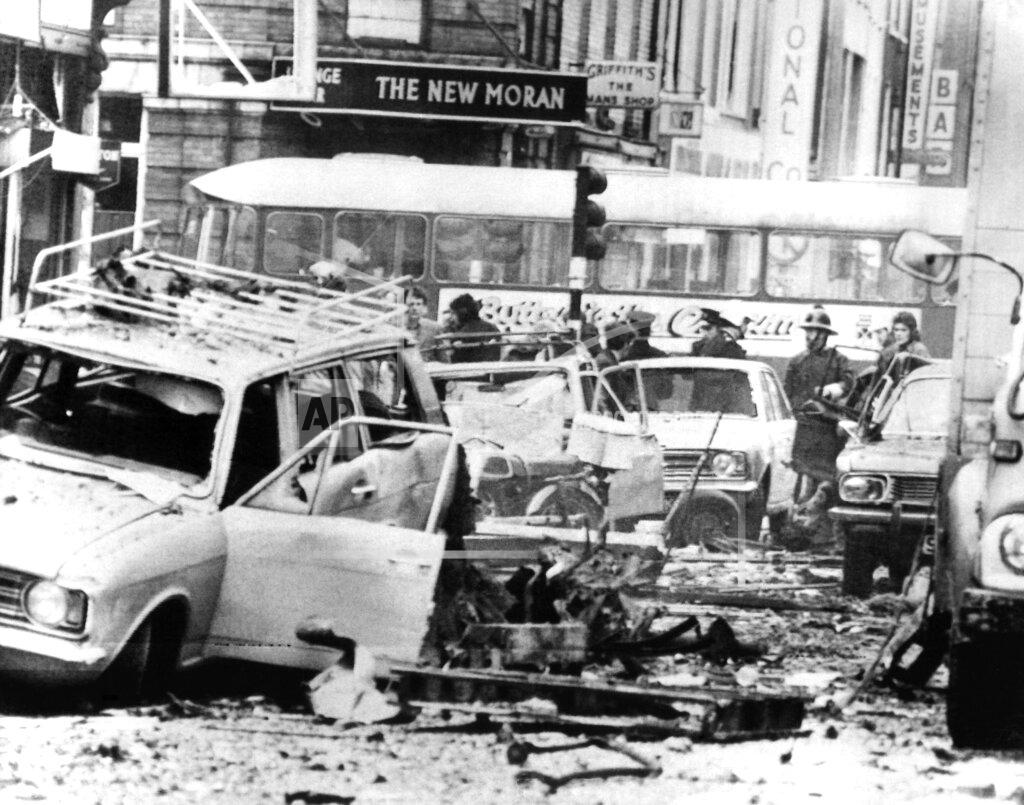
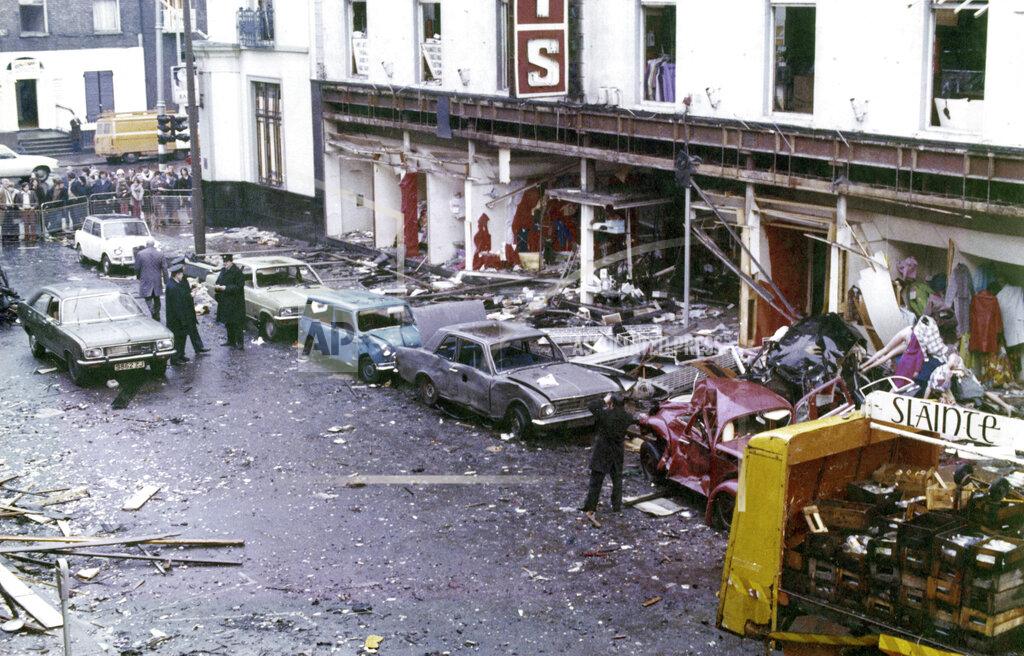
UVF terrorists killed 33 civilians and injured more than 300 in the Republic of Ireland in four simultaneous bomb explosions in County Dublin and County Monaghan. The event marked the highest number of casualties in any single event in The Troubles. Three bombs planted in automobiles exploded simultaneously during the height of the evening rush hour. The car blasts, which caused, more casualties than any other attack since the fighting over Northern Ireland began five years ago, were followed a short time later by a bombing in a small town 80 miles to the north, where five people were killed. Officials did not indicate which side was suspected, but there was a widespread belief in Dublin that extremist Protestants had set the bombs.
Tonight, the Irish Prime Minister, Liam Cosgrave, looking grim but collected, went on television to tell his people: “This will help to bring home to us here in this part of our island what the people in Northern Ireland have been suffering for five long years. Today’s evil deeds will Only serve to strengthen the resolve of those north and south who have been working for peace.”
Neither Mr. Cosgrave nor any other official has indicated which side is suspected of planting the bombs, but there is a widespread if unproven conviction in Dublin that it was the work of Protestant extremists. This was bolstered by reports that at least two of the cars used were stolen from Protestant areas of Belfast. A spokesman for the militant Provisional Irish Republican Army said that his organization had had nothing to do with the bombings and denounced them as “vile.” The bombs in Dublin went off just before 5:30 PM, when, crowds coming out of work were thickest on the sidewalks. The explosions were timed so closely that most witnesses thought there had been only one.
The bombings took place just as Protestant militants in Northern Ireland have embarked on what seems to be building up into a climactic struggle. They are aiming their action against the moderate Protestant‐Catholic coalition government and against plans by London and Dublin to set up a Council of All‐Ireland that will provide some link between the north and south. The fact that the bombs went off just as this was happening fortifies the belief here that Protestant extremists were responsible. Some spokesmen for paramilitary groups in the north have denied responsibility. But one of them, Sammy Smyth of the Ulster Defense Association, was quoted as saying he was “happy” about the explosion.
In a second day of reprisals for the attack on Ma’alot, Israeli planes bombed villages near the base of Mount Hermon in eastern Lebanon, but the day’s raids were reportedly lighter than the initial Israeli air attack, which was described as the heaviest ever against Lebanon. A spokesman in Damascus said that Syrian jets had challenged the Israeli planes over Lebanon, but Israeli spokesmen denied a Syrian report that an Israeli jet had been shot down by Syrian planes.
On the Syrian-Israeli front, the long-range exchange of firepower, now in its ninth week, ground on. Israel said that Syrians directed artillery, rocket and tank fire at the enclave of Syrian territory that Israel captured in the October war and on the southern part of the Golan Heights. Israel said it returned the fire, and that she had not taken any casualties.
In northern Israel, it was reported, a major security alert called yesterday to block further incursions by Palestinian guerrillas had eased somewhat and life was more normal. However, some municipalities, including the Tel Aviv suburbs of Ramat Gan and Herzliya, had decided to form armed civil defense units as a precaution against future attacks. The Israeli Army did not reveal the size of the unit that entered Lebanon last night, but from the official communiqué the raid did not appear to have been a major operation. “A search of the building prior to blowing it up confirmed that it had been used by terrorists,” the Israeli announcement said. It added that the force “returned safely to Israeli territory.”
Lebanon protested to the Security Council today over Israel’s air attack on her territory yesterday, calling it “murderous and barbaric rampage.” But after being pressed by the United States and other nations not to endanger current Middle East peace efforts by insisting on a debate, Lebanon did not call for a Council meeting. President Nixon and Secretary of State Kissinger both sent messages to Lebanon today expressing condolences for the losses inflicted by the Israeli air attacks, which were carried out in retaliation for the killing of Israeli students at Ma’alot. Lebanon’s letter to the Security Council said that more than 40 persons were killed and 180 wounded by the Israeli raids yesterday.
Delegates here said that a number of governments, among them Britain and France, had been active in dissuading the Lebanese, from demanding a Council meeting that could upset Secretary of State Kissinger’s efforts to obtain an Israeli‐Syrian disengagement accord. They were said to have impressed on Lebanon that she could not get a resolution condemning Israel that did not also mention the Ma’alot killings by Arab terrorists.
The Council last month condemned an Israeli attack on southern Lebanese border villages that was in retaliation for a terrorist assault on the village of Qiryat Shemona, where. 18 Israelis were killed. There was no specific mention of Qiryat Shemona in the resolution, and this caused the Israeli delegation to walk out in protest and denounce the Council action as a “travesty.”
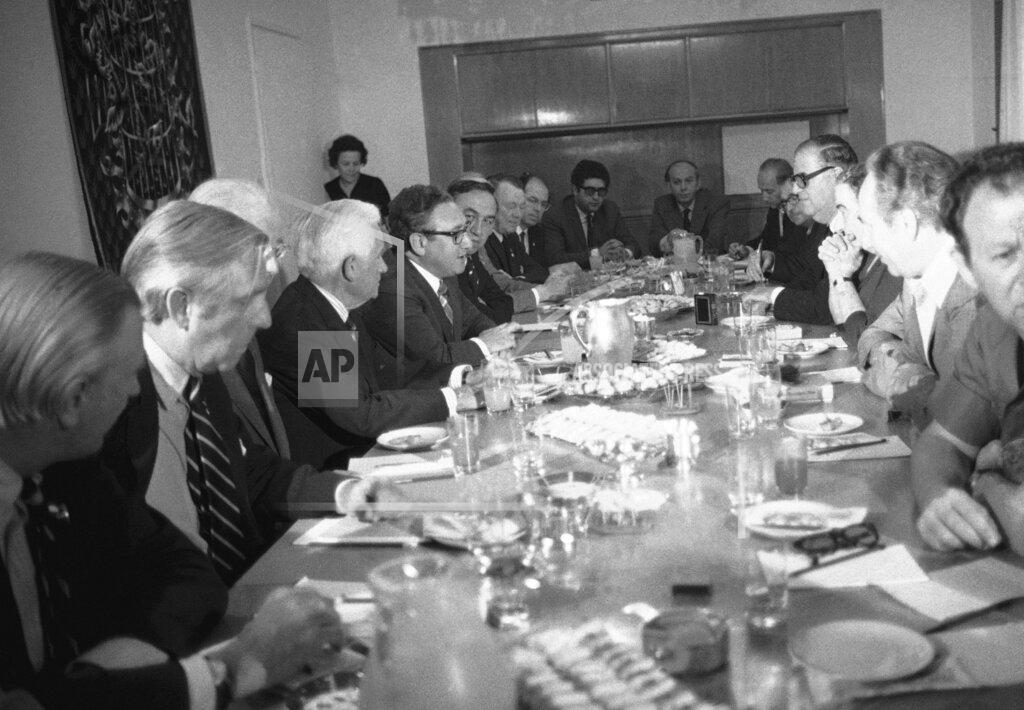
Frustrated by the inability of Israel and Syria to overcome the final obstacles to a troop separation agreement, Secretary of State Kissinger made his own proposals to Israel, in hopes of achieving an agreement before his planned return to Washington this weekend. American officials, who reported the two sides “excruciatingly near” agreement, said that Mr. Kissinger expected to know by tomorrow night whether his current mission to the Middle East could produce a concrete pact.
A high official in Syria’s Foreign Ministry declared today that Syria is willing to depend on U.S.-Soviet guarantees of eventual Israeli withdrawal from all occupied territory in the Golan Heights without that agreement being included in a pact separating the combatant forces. His statement was regarded as a breakthrough in efforts to reach a cease-fire agreement between the two Middle East neighbors. It came as U.S. Secretary of State Henry A. Kissinger prepared to return here from Jerusalem today at the crucial point of his diplomatic shuttle mission between Syria and Israel. The Syrian official told the Los Angeles Times that the assault on the Ma’alot school in Israel had delayed but not disrupted efforts to conclude a disengagement agreement.
Fighting advanced to within 25 miles of Saigon today when North Vietnamese and Việt Cộng forces took two more Government outposts, military sources said. The attacks followed the government’s loss of a remote frontier garrison near the Laotian border 300 miles north of the South Vietnamese capital. Fighting was reported from Quảng Trị Province in the north to the Mekong Delta in the south. The Saigon command reported 175 violations of the cease‐fire by the Communist side during the 24‐hour period ending at dawn, about double the average and the highest number reported in nearly a year.
The Senate Armed Services Committee has cut $1.3‐billion from the Defense Department’s weapons and research programs and voted for a $700 million reduction in the level of military aid to South Vietnam. Senator John C. Stennis. of Mississippi, the committee chairman, announced today that the committee had approved and annual military procurement bill authorizing $21.8‐billion in weapons production and research in the coming fiscal year The committee bill represented a 5.6 percent reduction from the $23.1 billion requested by the Administration. The committee also imposed a spending ceiling of $900‐million on military aid to South Vietnam in the fiscal year that begins July 1. The Administration, which has been thwarted in attempts to raise the $1.126 billion ceiling for the current fiscal year, had requested authority to provide South Vietnam with $1.6‐billion in military aid in the new fiscal year. The Administration was expected to view the cut in military aid to South Vietnam much more seriously than the reductions in the weapons programs.
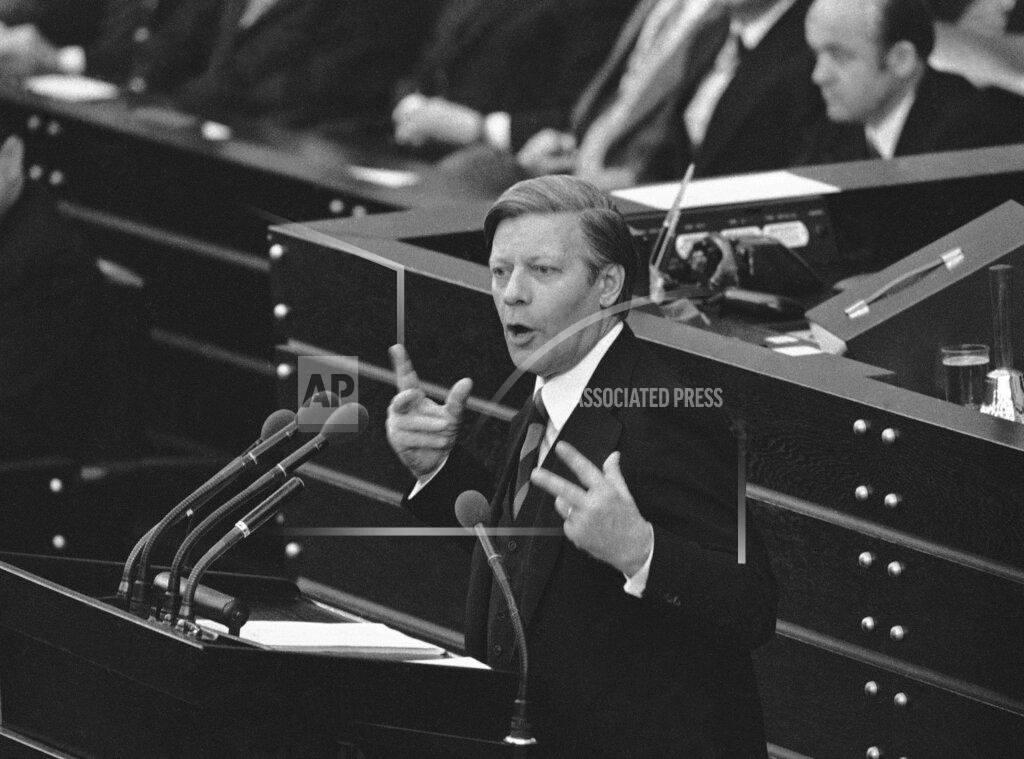
Chancellor Helmut Schmidt pledged today the continuity of West Germany’s foreign policy and stressed the need for partnership with the United States in achieving the political unity of Europe. “The security of Western Europe will, within the foreseeable future, remain dependent on the military and political presence of the United States in Europe,” Mr. Schmidt told the Bonn Parliament in a policy statement, presented the day after he was sworn in as the new West German Government Chancellor, replacing Willy Brandt, who resigned. “We subscribe to political unification of Europe in partnership with the United States,” he said. The middle‐of‐the‐road Social Democrat, who is continuing his predecessor’s Social‐Liberal coalition, devoted most of his 90‐minute address to the issue of maintaining financial stability at home, emphasizing his awareness of anxieties over inflation.
Portugal and the rebel movement in Portuguese Guinea have agreed to open cease‐fire talks in London at the end of next week. The agreement to hold the talks May 25 was reached in Dakar, Serzgal, by Mario Soares, the Foreign Minister of Portugal’s day‐old provisional Government, and Aristedes Pereira, leader of the African Party for the Liberation of Portuguese Guinea and the Cape Verde Islands. Dr. Soares had flown unexpectedly to Dakar last night in the personal jet plane of Senegal’s President, Leopold S. Senghor, who acted as a mediator between the two sides. The Foreign Minister returned tonight. A Government spokesman said tonight that the London talks “will be about a cease-fire, not about the independence” of Portuguese Guinea.
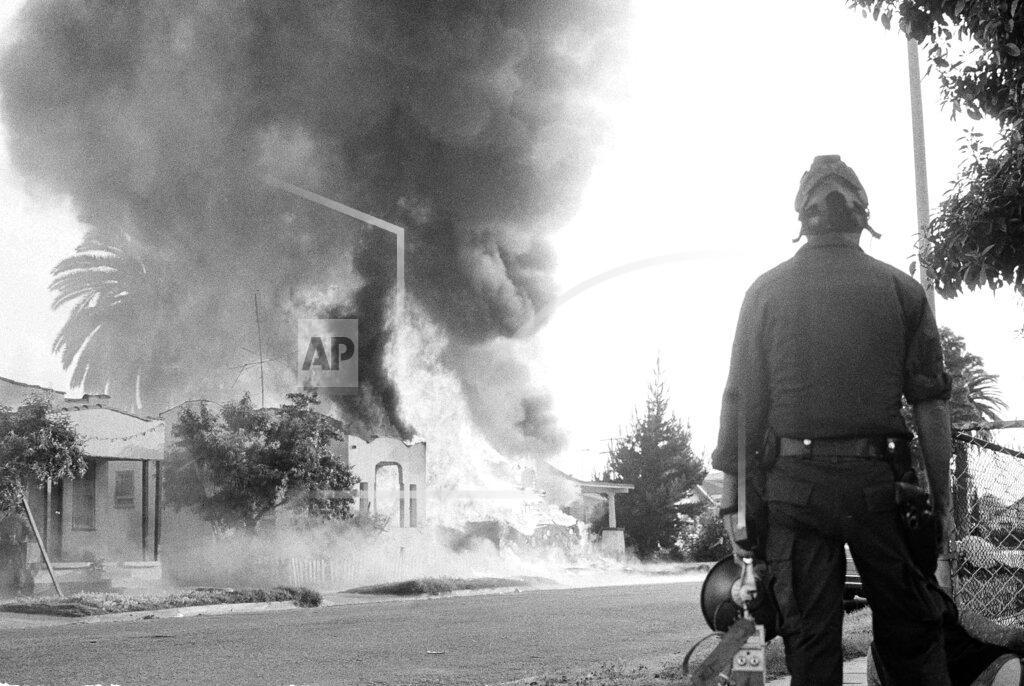
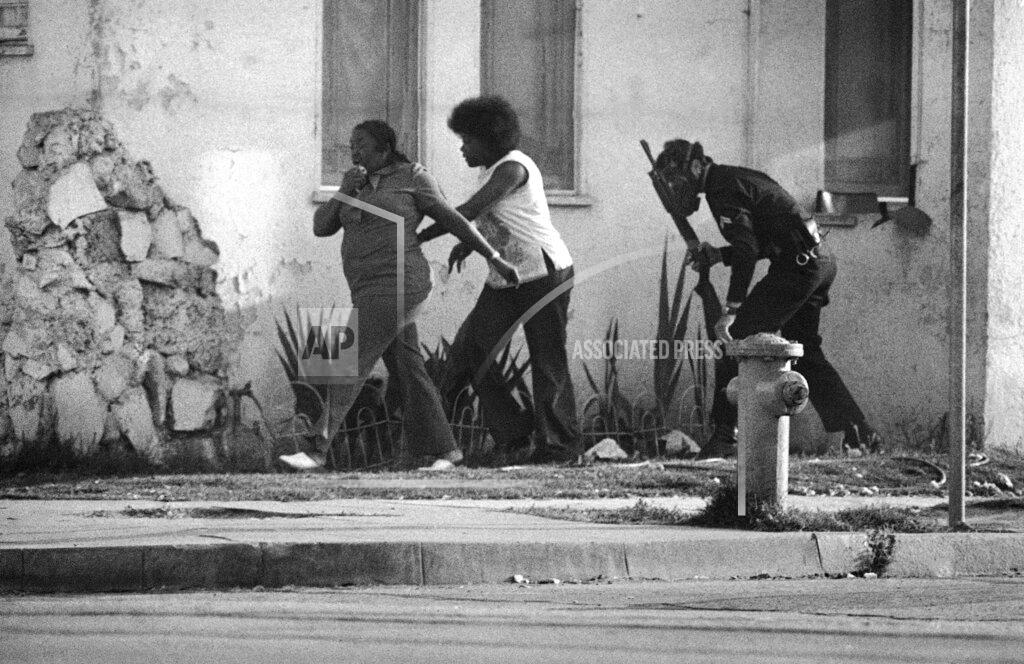
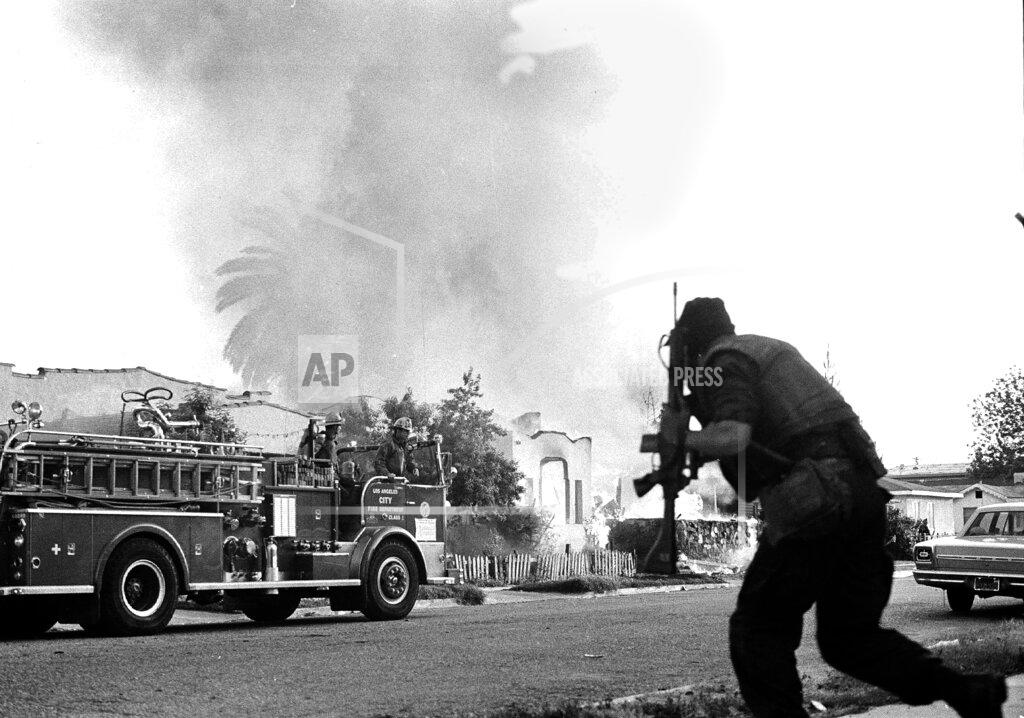
In Compton, California, a shootout between members of the Los Angeles Police Department and the Symbionese Liberation Army (SLA) terrorist group began at 5:50 p.m. local time at the terrorist group’s hideout at 1449 54th Street. The firing of tear gas canisters into the residence was followed by a fire that killed six of the SLA members, burning their bodies beyond recognition. The shootout and fire were broadcast on live television in Los Angeles, preempting national news programming. Six SLA members died during the incident. SLA leader Donald DeFreeze (aka Commander Cinque), 30, shot himself to death. Camilla Hall, 29, and SLA co-founder Nancy Ling Perry, 26, died after being shot by police. Patricia Soltysik, 24, Angela Atwood (aka General Gelina), 25, and Willie Wolfe (aka “Kahjoh”), 23, died of smoke inhalation or burns.
The suspected members of the Symbionese Liberation Army were killed by the Los Angeles police in an hour-long gun battle that ended when fire swept the suspected S.L.A. hideout. Some 9,000 rounds of ammunition were fired during the shootout. The victims were not positively identified at press time, and there were no indications that Patricia Hearst was with the group. According to unofficial reports, those inside the hideout included Donald DeFreeze, the S.L.A. leader who styled himself General Field Marshal Cinque, and Camilla Hall and two members of the group. The bodies were reportedly burned beyond recognition in the blaze in a black slum near Watts.
The shooting never ceased during the police assault. There was the pop-pop-pop of the lawmen’s semiautomatic weapons, interrupted at times by staccato bursts of machine gun fire. A police spokesman said it appeared the machine gun fire was coming from the SLA hideout as the lawmen were not using completely automatic weapons. This was borne out by a wavy line of bullet holes — obviously from a machine gun — in the wall of an apartment house across the street from the hideout. At 6:35 pm, officers began to make their way gingerly into the front of the burning building. A police sergeant came upon the bodies of two women. They had cartridge bandoliers strapped to their bodies. Their clothes were on fire. The flames were causing the ammunition in the bandoliers to fire.
Fire units had arrived on the scene as soon as the bungalow caught fire. But because of the shooting, firemen were not able to get their hoses trained on the burning bungalow and the two dwellings flanking it — an apartment house and a frame house — until 6:45 pm. That also was the time when the last shot of the battle was heard. It may have been a cartridge inside the bungalow exploded by the flames.
The transcript of President Nixon’s conversation with John Mitchell and H.R. Haldeman on June, 30, 1972, indicates that the three men related Mr. Mitchell’s resignation as the President’s campaign director to the Watergate burglary and not to the family responsibilities Mr. Mitchell gave as the reason for his departure in sworn testimony before the Senate Watergate committee. A portion of the June 30 tape, which was not included in the transcripts released by the White House, was heard by the House Judiciary Committee on Wednesday.
President Nixon asserted the doctrine of executive privilege again today in an effort to block a government subpoena for correspondence between himself or his White House aides and Maurice H. Stans, who was his chief fund raiser in the 1972 campaign. There were repeated indications, however, that United States District Judge George L. Hart Jr. might overrule the latest attempt to withhold evidence from the office of the special Watergate prosecutor, Leon Jaworski. Judge Hart said he would review the letters himself next week, and would then probably apply a recent decision by Judge John J. Sirica that overruled such claims of privilege.
A possible line of Presidential defense in the Watergate cover‐up will come under close study next week in hearings before the Senate Judiciary Committee. That line of defense is based on the quality of the Justice Department’s investigation of the early days of Watergate — the summer, fall and winter of 1972‐73. At issue is the conduct of Richard G. Kleindienst, Henry E. Petersen, Harold H. Titus Jr. and Earl J. Silbert — the men who headed that first investigation. The White House contends that they did their jobs well. All have stoutly defended their actions in Watergate, and some, particularly Mr. Silbert and Mr. Petersen, are widely admired in Washington. Howlever, their roles have come under question since the release of edited transcripts of Presidential and White House conversations. From the transcripts, it appears that members of the Justice Department worked closely with the White House throughout the early days of Watergate.
Vice President Ford, seeking to head off a possible confrontation over additional White House material sought in the Presidential impeachment inquiry, suggested today that everyone involved “ought to cool it for the time being.” The House Judiciary Committee, he said, should analyze what it already has before pressing its demand for addi. tional evidence that it has subpoenaed from the White House. The Vice President also echoed White House demands that the Judiciary Committee conduct open hearings in the impeachment inquiry so that Americans can be fully informed of the evidence presented and the President’s position.
J. Fred Buzhardt Jr., counsel to the President, said today that the White House was considering action to show that President Nixon made no disparaging remarks about Jews in recorded conversations submitted to the Federal Court in New York in the recent Mitchell‐Stans trial. “We have not dropped the subject,” Mr. Buzhardt said. “We will deal with this in due time.” He would not say what action was contemplated or whether Mr. Nixon planned to make public the recordings in question. Mr. Buzhardt, in response to questions in a news conference, addressed himself in general to a wide range of published and broadcast reports as well as rumors recently that President Nixon made disparaging remarks about Jews and other ethnic groups in some of the many ‘recorded conversations at issue in Watergate and related matters.
A Florida county judge dismissed a misdemeanor indictment against Senator Edward Gurney, who had been accused of violating a state election law by accepting campaign contributions without naming a campaign treasurer or setting up a campaign bank account. In dismissing the indictment, the judge called the law unconstitutional and criticized as improper and illegal the advice given the indicting grand jury by a Democratic state representative, who had asked for the investigation.
The performance of the economy was a bit worse than had been estimated earlier for the first quarter, according to the Commerce Department, which released figures indicating a larger than expected rate of inflation and a sharper decline in total output than had been predicted.
Representative Angelo Roncallo was acquitted of extortion charges by a federal jury in Westbury, Long Island, and promptly announced that he would ask the House of Representatives to investigate his indictment and would institute a suit against those responsible for it. Mr. Roncallo and a co-defendant were acquitted on all four counts of an indictment charging them with pressuring a businessman to make a $1,000 political donation.
Governor Wilson of New York, citing “sufficient benefit,” signed a bill requiring the death penalty for those convicted of murdering a policeman or prison worker and for any murder committed by a life-term prisoner. In announcing his signing of the limited death-penalty bill, Mr. Wilson said it appeared to be constitutional.
In Lafayette, Louisiana, 28-year-old Russell James Foote, the director of the local chapter of the American Red Cross, was found in his car with a gunshot wound to the head inflicted by someone standing outside the car. He died shortly afterwards at Lafayette General Hospital. The investigation by the Lafayette Parish Sheriff’s Office revealed embezzlement within the Red Cross office. As of 2018 Foote’s murder had not been solved.
The derailment of a Southern Railway train injured 133 people 15 miles (24 km) northwest of Tuscaloosa, Alabama.
The first Synchronous Meteorological Satellite, SMS-1, a weather satellite placed in geosynchronous orbit, was launched from Cape Canaveral, to be placed at a point 22,951 miles (36,936 km) above the Earth’s equator and the 100th meridian west.
Dmitri Shostakovich completes his 15th String quartet.
18th European Cup: Bayern Munich beats Atletico Madrid 4–0 at Brussels.
Ron Bryant allows 5 runs in the 1st inning without recording an out as his San Francisco Giants lose to the Padres, 7–3. Nate Colbert blast a grand slam for San Diego.
Dow Jones Industrial Average: 818.84 (-16.50, -1.98%).
Born:
Andrea Corr, Irish pop music singer and member of The Corrs; in Dundalk, County Louth, Ireland.
Wiki González, Venezuelan MLB catcher (San Diego Padres, Seattle Mariners, Washington Nationals), in Aragua, Venezuela.
Mike Prokopec, Canadian NHL right wing (Chicago Blackhawks), in Toronto, Ontario, Canada.
Tamara Rojo, Canadian-born Spanish ballet dancer, principal dancer in the English National Ballet; in Montreal, Quebec, Canada.
Died:
Charles Braswell, 49, American actor (“Only Game in Town”).
Durga Das, 73, Indian journalist, editor of the Hindustan Times and founder of the India News and Feature Alliance (INFA) news agency.
Maurice Lehmann, 79, French actor, director and producer, former general manager of the Paris Opera.
Fritz Roethlisberger, 75, American social scientist and business theorist.
 History Diaries