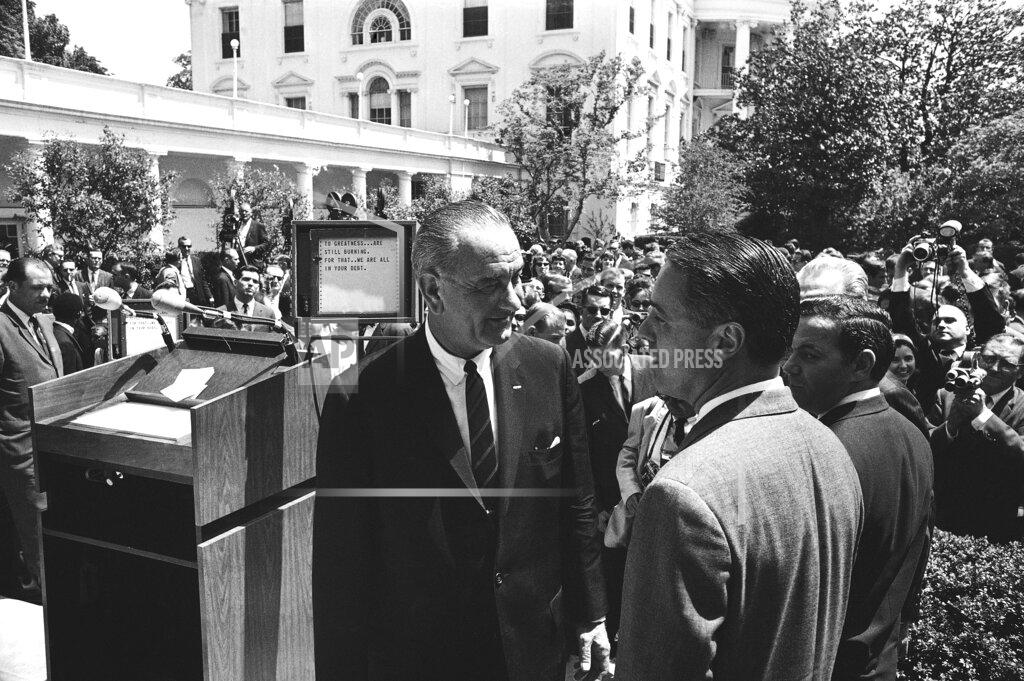
President Johnson conferred with his principal aides for the third day in a row today on plans to cope with increasingly effective Communist insurgency in South Vietnam. Although few new developments were announced, the meeting took place in an atmosphere of concern. This was due largely to gloomy assessments reported privately by Congressional participants in a National Security Council meeting yesterday. The Administration plans, which may require additional Congressional appropriations, call for increases in economic and military support of the Government of Premier Nguyễn Khánh. The exact amounts of money and of possible increases in training personnel have not been made known. According to one report, the President will send a special request to Congress Wednesday.
George E. Reedy, White House press secretary, said after today’s meeting that the President’s recommendations would be made known shortly. He warned against any “purely speculative” estimates of the amounts involved. United States military and economic support to South Vietnam has been estimated to be running at about $500 million a year. The United States has more than 15,500 men in South Vietnam, serving as trainers and advisers with combat forces.
Participants in this morning’s session with President Johnson were Secretary of State Dean Rusk, Secretary of Defense Robert S. McNamara, Secretary of the Air Force Eugene M. Zuckert and General Maxwell D. Taylor, Chairman of the Joint Chiefs of Staff. The presence of Secretary Zuckert underscored that part of the plans calling for increased bombing and strafing of Communist Việt Cộng positions in South Vietnam. Officials have made known that the South Vietnamese Air Force is to be bolstered with about 100 Douglas Skyraider fighter‐bombers and that its corps of 400 pilots is to be doubled. South Vietnamese pilots now fly T‐28 trainers that have been specially equipped for jungle fighting. A fleet of B‐26 fighter-bombers recently was withdrawn. All the planes are propeller types.
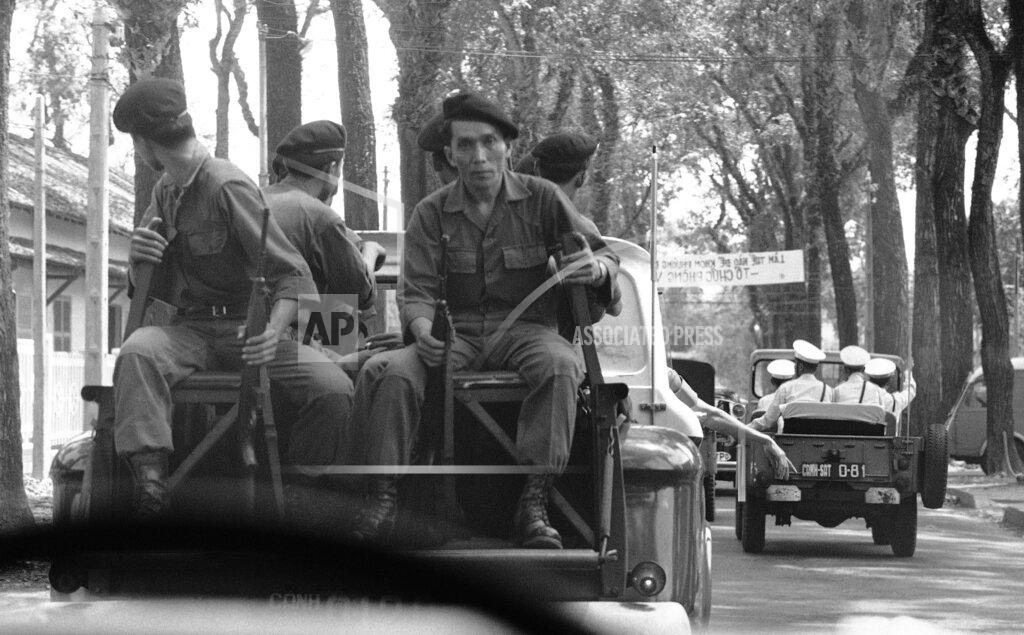
The accelerated effort to support the South Vietnamese Government followed a one‐and‐a-half‐day trip to Saigon by Secretary McNamara and General Taylor early this week. After they returned Thursday, Mr. McNamara said that Communist harassment had increased in recent weeks and that the government forces “must be increased in size very substantially and very soon.” Authoritative sources said that the plans for increased military and economic support now under discussion were largely the same as those advanced by General Khánh last March and approved by the United States. These include not only direct military assistance, including additional weapons and other equipment, but financial help to pay higher salaries for military personnel. An important part of the plan concerns accelerated efforts to train administrative personnel.
For the fourth time in seven months Secretary of Defense Robert S. McNamara went to South Vietnam last week — and this time he rode into Saigon wearing a bullet‐proof vest. The frequency of his missions, and the precautions for his safety, were testimony to the increasing gravity of the Vietnamese struggle. On his return to Washington Mr. McNamara set in motion planning for a deeper commitment of American men, money and moral support to the fight. He was still predicting victory, but he warned: “It is not going to come soon. This is not that kind of war. This is a war for the confidence of the people… and that kind of war is a long hard war.” The repercussions of the struggle were spreading. In Washington there were signs of increasing restiveness in Congress over the United States’ role. In Europe American spokesmen sought symbolic commitments of help from the North Atlantic Allies, with limited success so far.
Moreover, there was new cause for concern in South Vietnam’s northeastern neighbor, Laos, scene of a sharpening struggle among three factions. Last week leftist troops were on the march. Whether their purpose was an all‐out assault on Laos’ rightist and neutralist forces, or only to maneuver for position, was uncertain. The stake in all this is immense. The loss of South Vietnam and Laos — or either one — would deeply shake all Southeast Asia. The shock waves would be felt immediately in Cambodia, Thailand, Burma and Malaysia, and Chinese Communist influence over the whole region would be greatly enhanced. For the United States, therefore, the question is: How far are we prepared to go to prevent so great a Communist victory?
Governor Rockefeller accepts President Johnson’s offer to brief all Republican candidates for the presidency; afterwards, he will agree with a questioner that Americans are not getting the full story of the situation in Vietnam. Senator Goldwater openly charges that U.S. pilots have died because of obsolescent planes.
Today, the Communist Pathet Lao succeed in driving the neutralist forces led by Kong Le from the Plain of Jars, marking the end of any efforts at a coalition government and leaving Souvanna Phouma and his rightists in control. When word of this loss reaches Washington, President Johnson orders a troop alert in Okinawa and orders the Seventh Fleet in the South China Sea to prepare for possible military action. Officials begin drawing up a resolution that Johnson might present to Congress to get it to declare that the independence and integrity of Laos are vital to U.S. interests.
Prince Souvanna Phouma, the neutralist Premier, charged today that the pro‐Communists had opened a general offensive in Laos with the help of North Vietnamese soldiers. He said at a news conference that the Pathet Lao and North Vietnamese troops had begun a two‐pronged drive against both the northern and southern flanks of the neutralist forces in the strategic north‐central Plaine des Jarres region. The neutralists, commanded by General Kong Le, are loyal to Premier Souvanna Phouma and aligned with the right wing. The Premier’s announcement came a day after the pro‐Communists had captured the town of Tha Thom, situated on a vital route leading to the rightwing stronghold of Paksane, which is on the Mekong River border with Thailand.
The developments led a highly placed Western diplomatic source to say: “I have never seen things look quite so bad.” Reliable military sources said today General Kong Le has lost control of as many as six battalions of his neutralist troops in the Plaine des Jarres area 110 miles northeast of Vientiane. The sources said that it was not known whether the dissidents had teamed up with the Pathet Lao but that such a move could be expected. The dissidents were described as opposed to recent military and political changes in the Government that followed the coup d’état by a right‐wing military junta in Vientiane last April 19.
A U.S. Army Captains Ben W. Stutts and Charleton W. Voltz, whose OH-23 helicopter was shot down over North Korea May 17, 1963, when they strayed north of the Demilitarized Zone, were released after 365 days of imprisonment. In return for the release, the United Nations Command had agreed to sign a statement that the Stutts and Voltz had committed espionage. North Korea declined to return the helicopter.
Communist North Korea released today two United States helicopter pilots after the United Nations Command furnished a receipt acknowledging espionage by the fliers. The pilots had been held for a year after their craft strayed over Communist territory and was shot down. The two Americans — Captain Ben W. Stutts, 30 years old, of Florence, Alabama, and Captain Charleton W. Voltz, 26, of Frankfort, Michigan, were turned over to officials of the United Nations Command at the end of a meeting of the Joint Military Armistice Commission in Panmunjom. The receipt, prepared by the command at the behest of the Communists and signed by Major General Cecil E. Combs, acknowledged “the crime of espionage and intrusion by Captain Voltz and Captain Stutts, the two United States pilots who were captured by the self‐defense measures of the People’s Army while committing military espionage acts after illegally intruding into the air over the northern part of the Democratic People’s Republic of Korea.”
The United Nations Command had repeatedly demanded the men’s release. It had acknowledged that their helicopter strayed into Communist territory May 17, 1963, while checking markers along the boundary of the demilitarized zone, but had denied the spy charge and said the helicopters had no weapons or photographic equipment. The two men were handed over by the Communists just outside the north end of the conference room at 12:05 PM, five minutes after the scheduled time. They had been brought in two Soviet‐made jeeps and were wearing gray cotton tunic suits. They appeared well and healthy, and were immediately driven to Seoul in a United States Army sedan.
President Makarios, a Greek Cypriote himself, denounced tonight the abductions by Greek Cypriotes of Turkish Cypriotes who are then held as hostages. Archbishop Makarios’s broadcast statement followed strong United Nations protests against the Greek Cypriotes’ taking hostages in the Famagusta area. It also followed the release after a half‐hour’s detention earlier in the day of a Turkish Cypriote journalist in Nicosia. The journalist, Hushref Suleiman, was freed on the personal intervention of the United Nations peace force commander, Lieutenant General Prem Singh Gyani. It was the first public denunciation of the abductions by President Makarios. The Government said that two Greek Cypriotes, Joannis Dionyssious and Joannis Mitsingas, had been arrested and would be tried for the abduction of the Turkish Cypriote.
There was no word of any action to be taken against Greek Cypriotes who seized Turks hostage in the Famagusta area. Turkish Cypriote sources say 34 hostages were taken by Greek Cypriotes there. The abductions followed the killing of two Greek National Army officers and a Greek Cypriote youth leader in Famagusta’s Turkish quarter last Monday. The Makarios statement said: “I deeply regret the fact that there are certain Greek Cypriotes who by their activities cause serious damage to their country and prejudice its good name. I wish to state in a most emphatic manner that the practice of taking hostages is a revolting criminal action which I unreservedly condemn. To resort to such methods cannot be justified as retaliation to Turkish criminal actions against the Greeks.”
Sir James Black, a British physician synthesized propranolol, the first beta blocker drug, a class of medication used to manage cardiac arrhythmias, and to protect the heart muscle after a myocardial infarction against a recurrence. Black recognized that the blocking of Beta receptors, a form of adrenergic receptor proteins, could prevent the overstimulation of neurotransmitters within the heart tissue. For his discovery, Black would share the 1988 Nobel Prize in Physiology or Medicine.
Needing more foreign money, Communist China is gradually lifting the “bamboo curtain” to allow tourists and overseas Chinese to enter. Hotel accommodations are improving in quality, as are air connections, but irritated students and others who want to get out find that it’s a one-way street.
Because the Soviet Union supported a trade boycott of South Africa, the de Beers diamond cartel there announced that it would no longer sell Soviet gems on the world market.
The USSR performs a nuclear test at the Semipalatinsk Test Site in northeast Kazakhstan.
The civil rights bill has been debated in the Senate for fifty-seven days during a 10‐week period. The last five weeks —and this is a charitable judgment — have been pure, 100-proof Southern filibuster even though it has been filtered through the charcoal of germaneness. For nearly four weeks the Southerners have been “debating” the issue of jury trials in criminal contempt cases arising out of willful violations of the anti ‐ discrimination provisions in the bill. Two weeks ago, Majority Leader Mike Mansfield and Minority Leader Everett McKinley Dirksen believed they had an understanding with Senator Richard B. Russell of Georgia, leader of the Southern forces, to wind up voting on jury trial amendments last Wednesday. But Mr. Russell suddenly announced he would permit no votes until next week.
Mr. Russell knows his men cannot filibuster the bill to death, but he also knows it cannot be passed until Mr. Mansfield and Mr. Dirksen can assemble the votes to shut off the filibuster. It is conceivable that Black militancy and the “white backlash” reflected in the votes for Governor George C. Wallace of Alabama in Wisconsin, Indiana, and, expectedly, in Maryland next week could have enough cumulative impact to slow down the process of collecting the last few votes for closure and coincidentally start a movement for a real weakening of the bill. This possibility has dictated Mr. Russell’s strategy for the last several weeks. Everything hinges on Maryland. If Governor Wallace can get 30 to 40 percent of the vote, Mr. Russell hopes to be able to bring off two major victories.
First, he hopes that enough wavering votes will be obtained to pass the Southern amendment to guarantee a jury trial in all cases of criminal contempt arising under the bill. The Southerners are fighting firmly for this amendment because they know — but bitterly resent any Senator’s saying so — that the federal government will have great difficulty getting Southern juries to convict fellow townsmen and Southern officials for defying a court’s order in civil rights cases. Thus an unlimited right to jury trial could drastically impair the act’s effectiveness. Second, Mr. Russell hopes Mr. Wallace’s showing may strengthen the hand of those Republicans and two or three Democrats who are reluctant to vote for closure until the titles on fair employment practices and the cut‐off of Federal funds from discriminatively‐administered programs are either killed or made ineffectual.
Senator Richard B. Russell took the floor today to defend his reputation as a man of his word. As the Senate debated the rights bill for the 57th day, the Georgia Democrat denied that he had made any commitment or entered into any understanding for voting this week on pending jury‐trial amendments. Mike Mansfield of Montana, the Senate Democratic leader, agreed that there had been no commitments or understandings. Mr. Russell’s word, he said, “is as solid as gold.” Questioned later by reporters, Mr. Mansfield said it had been my assumption” that Mr. Russell, as leader of the bill’s Southern opponents, would permit the remaining jury‐trial amendments to come to a vote Wednesday or Thursday.
Senator Hubert H. Humphrey, Democrat of Minnesota, today called upon the governors of states having civil rights laws to speak out against Governor George C. Wallace of Alabama “who seeks to poison the political atmosphere.” The Democratic leader of the bipartisan forces in the Senate said that Mr. Wallace’s arguments against the rights bill were proving effective. Mr. Humphrey spoke before the annual convention of Americans for Democratic Action. He said he had instructed his staff and would urge other civil rights supporters to “demand equal time” on radio and television programs to counter the “misinformation that is spewed across the countryside” by Mr. Wallace’s frequent “interviews” on broadcast programs.
Civil rights organizations and the National Council of Churches hope to put 1,000 carefully selected and trained college students into Mississippi this summer to challenge the white power structure there. On the basis of applications and interviews, backers of the project are convinced that the student campaigners are seriously motivated, emotionally stable individuals, intent on participating in social change.
They cited as typical a history major in an Eastern university who described his commitment in the following terms: “Mississippi is the last stronghold of the old Confederacy and feelings are bitter, but those who are going there have made their decisions rationally. We know there is a chance of being hurt, of being jailed, or being killed, but we still believe in the cause so strongly that we must go.”
The participating civil rights groups are the Congress of Racial Equality, the Student Nonviolent Coordinating Committee, the National Association for the Advancement of Colored People and the Southern Christian Leadership Conference. They and the National Council of Churches have formed a group to direct the Mississippi operations from headquarters in Jackson. It is called the Council of Federated Organizations.
The New York City Commission on Human Rights withdrew from the plumbers’ dispute last night as three Puerto Ricans and a Negro hired at a Bronx project held firm on their refusal to take job‐qualification tests. The commission abruptly ended its mediation efforts after a meeting with three of the men involved in the controversy with Local 2 of the Plumbers Union. The commission had made a “final” attempt to conciliate the dispute yesterday following the collapse of a settlement announced Friday by Mayor Wagner. Under the Mayor’s plan, the union had agreed to give the tests and put the men to work tomorrow if they passed.
Twelve young men in New York City publicly burned their draft cards to protest against the Vietnam War, the first mass act of resistance in the history of this particular war. The demonstration, with about 50 people in Union Square, was organized by the War Resisters League chaired by David McReynolds.
Governor Rockefeller, buoyed by his impressive victory in the Oregon Presidential primary, declared yesterday that the “trend” in his favor should carry over into the California primary on June 2. While hesitating to predict outright that he would defeat Senator Barry Goldwater in California, the Governor confidently declared at a news conference that the brand of “progressive” Republicanism he represented would turn back the threat of extremists taking over the Republican party. The California primary, the last in which rank‐and‐file Republican sentiment can be gauged at the ballot box before the Republican National Convention in July, is generally regarded as the ultimate test for Mr. Goldwater.
If the Senator is the victor in California, virtually all significant political people, including Mr. Rockefeller, believe he will win the Republican nomination for President. On the other hand, if Mr. Rockefeller defeats the Arizona Senator on June 2, it is believed that Mr. Goldwater’s nomination prospects will fade. Then either Mr. Rockefeller or a compromise contender, like Richard M. Nixon or Gov. William W. Scranton of Pennsylvania, would be expected to emerge as the party’s standard bearer.
The Los Angeles Times, the largest newspaper in the West, endorsed Mr. Rockefeller in its Sunday edition today. The traditionally Republican paper said in part in an editorial: “The Times believes that the delegation pledged to Rockefeller represents the broader spectrum of Republican philosophy. We believe also the promise of its chief spokesman that this delegation, in the event that Rockefeller himself fails to win the nomination, then will give its support to a candidate whose broad‐gauged tenets most closely match its own.”
U.S. Defense Secretary Robert McNamara ordered the deactivation of the Titan I missiles, which had become obsolete because they had to be raised out of their silos and fueled before they could be launched. The first Titan I missile would be taken off alert on January 4.
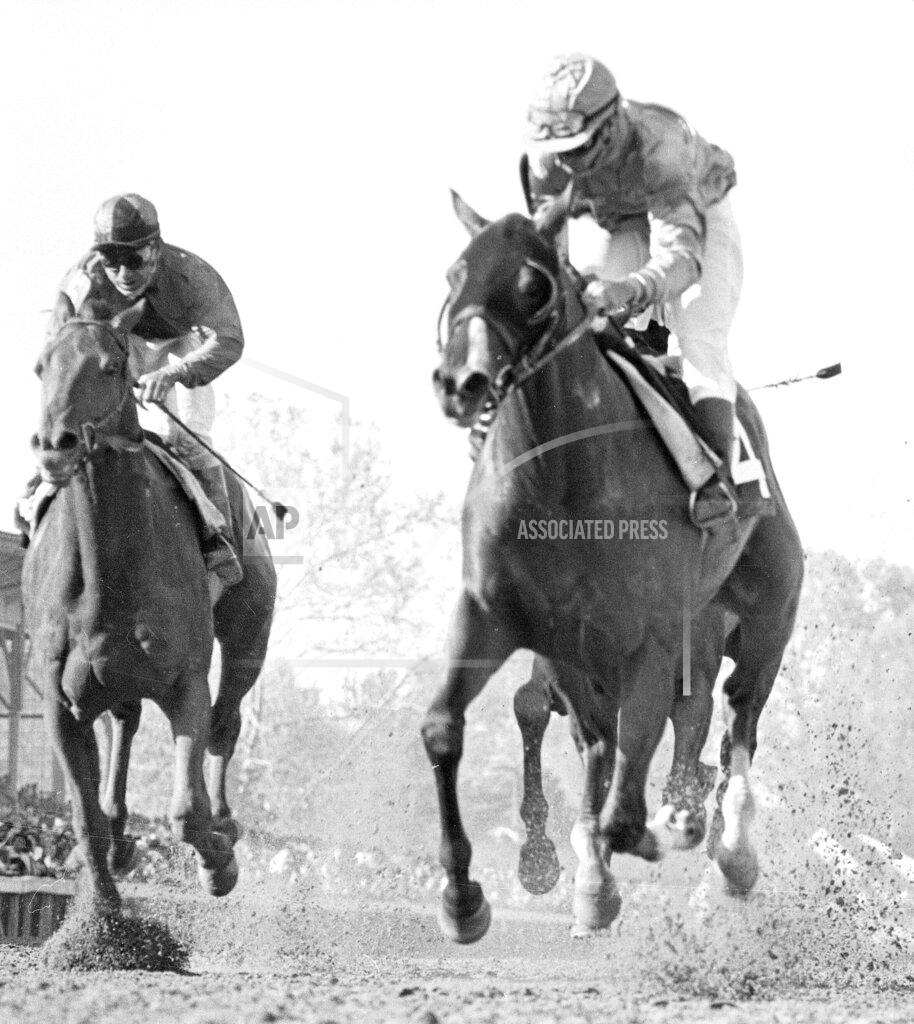
E. P. Taylor’s Northern Dancer, the Kentucky Derby winner two weeks ago, won the 88th running of the Preakness yesterday at the Pimlico race track, Baltimore. Bill Hartack again was aboard the Canadian-bred colt, who returned $6.20, $3.60 and $2.20 for $2 across the board. The time for the 13/16 miles was 1:56 4/5. The Scoundrel was second, two and one‐quarter lengths back, in the $176,700 stakes and the favored Hill Rise third. The third part of the Triple Crown for 3‐yearold horses will be the Belmont Stakes June 6.
At Yankee Stadium, Mickey Mantle hits his 13th homer of the year, off Joe Grzenda, and New York pounds the A’s, 10–6. Roger Maris hit two home runs and Mickey Mantle and Joe Pepitone one each
Jim Davenport’s two‐run homer in the 15th inning gave the San Francisco Giants a 6–4 victory over the New York Mets at San Francisco. Willie Mays had tied the game for the Giants with a ninth‐inning home run.
Born:
John Salley, NBA power forward and center (NBA Champions, Detroit, 1989, 1990; Chicago, 1996; Lakers-2000; Detroit Pistons, Miami Heat, Toronto Raptors, Chicago Bulls, Los Angeles Lakers), in Brooklyn, New York, New York.
Kevin Guidry, NFL defensive back (Denver Broncos, Phoenix Cardinals), in Lake Charles, Louisiana.
Boyd Tinsley, American violinist and mandolin player (Dave Matthews Band, 1992-2018; Crystal Garden, 2015-), in Charlottesville, Virginia

 History Diaries